

Benefits of Market Segmentation: 8 Reasons + Data (2026)
Most articles about the benefits of market segmentation recycle the same vague promises: "better targeting," "improved messaging," "increased loyalty." None of them give you a number. Here's the actual case for segmentation, backed by the data that makes CFOs pay attention.
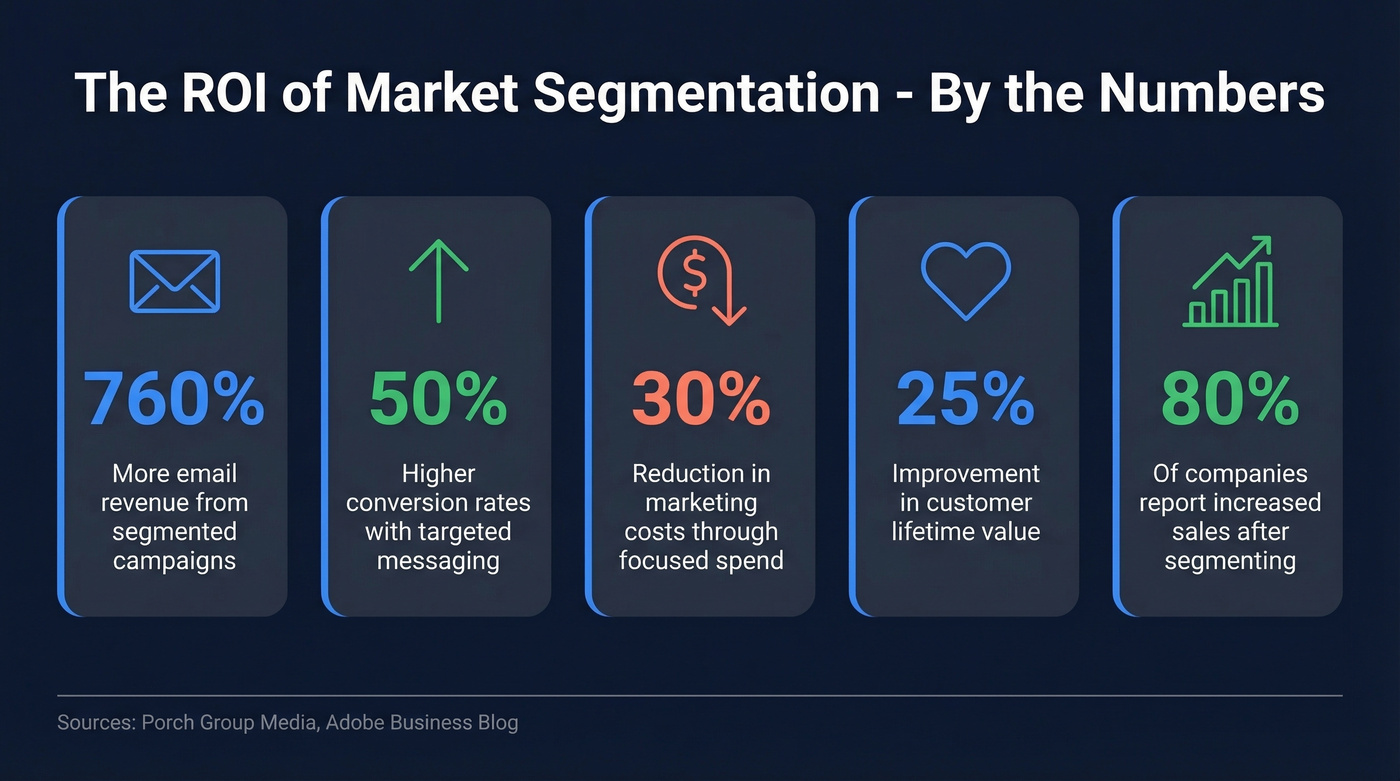
The core benefit in one sentence: segmentation stops you from spending money on people who were never going to buy. Everything else - sharper messaging, higher loyalty, smarter products - is downstream of that one insight. Segmented email campaigns drive up to 760% more revenue. Conversion rates climb by up to 50%. And 80% of companies using segmentation report increased sales. That's not a marginal improvement. That's a fundamentally different way to allocate budget.
What Market Segmentation Actually Is
Market segmentation divides a total addressable market into smaller groups that share meaningful characteristics - then lets you treat each group differently. Not complicated in theory. Brutal in execution.
The classic framework is STP: Segmentation, Targeting, Positioning. You segment the market, choose which segments to pursue, then position your product differently for each. It's been the backbone of marketing strategy for decades, and it still works when you don't overthink it.
Here's where most teams go wrong: they treat segmentation as a demographic exercise. Age, gender, income, zip code. Harvard Business Review made the contrarian case years ago that psychographic profiling often becomes a "wasteful diversion" from segmentation's real purpose - finding customers whose behavior can actually be changed, or whose needs aren't being met. Demographics describe who people are. They don't tell you what people will do. That distinction matters more than most segmentation guides admit.
Segmentation can also surface demand customers can't articulate. Malcolm Gladwell recounts Howard Moskowitz's work showing Americans preferred different pasta sauce types, including "extra chunky," alongside "plain" and "spicy" - a segment nobody was serving until someone bothered to look.
8 Advantages of Segmenting Your Market
Understanding why segmentation matters starts with the numbers. Here are eight concrete advantages, each backed by real data.
1. Sharper Messaging That Resonates
Generic messaging is a tax on your conversion rate. 71% of consumers expect personalized experiences, and 76% get frustrated when they don't get them. Segmentation gives you the context to write copy and build campaigns that speak to a specific problem - the difference between "grow your business" and "cut your SDR team's list-building time from 15 hours to 3."
2. Higher Conversion Rates
When you talk to the right people about the right problem, more of them convert. Segmentation increases conversion rates by up to 50%. That's the difference between a campaign that justifies its budget and one that gets killed at the quarterly review.
3. Dramatically Better Email ROI
Email is where segmentation's impact is most measurable. Segmented campaigns drive up to 760% more revenue than non-segmented blasts, and email overall generates $36 for every $1 spent. Welcome emails alone generate 320% more revenue per email than generic promotional sends. These aren't theoretical gains - they're what happens when you stop sending the same email to your entire list.
4. Lower Marketing Costs
Segmentation isn't just about making more money. It's about wasting less. Companies that segment effectively reduce marketing costs by up to 30%. When you know which segments convert and which don't, you stop pouring budget into audiences that were never going to produce pipeline. That 30% savings often funds the next campaign.
5. Stronger Loyalty and Higher CLV
Customers who feel understood stick around longer. Segmentation-driven personalization improves customer lifetime value by up to 25%. The mechanism is simple: when your onboarding, upsell sequences, and support reflect what a customer actually needs, retention goes up and churn goes down.
6. Smarter Product Development
Peloton is a masterclass here. They sell the Bike at $1,445 for the fitness-curious, the Bike+ at $2,495 for the committed enthusiast, and a $44/month app tier for people who aren't ready for hardware. Peloton reported $2.5B in FY2025 revenue. Segmentation told them which customers existed at each price point, and product development followed.
7. Competitive Differentiation
Look at the plant-based milk market. Total sales hit $2.8B in 2024 - down 5% year-over-year - but the segments tell a completely different story. Almond milk owns $1.5B, oat milk holds $700M, and soy milk sits at $212M. In a declining market, segment-specific positioning matters even more. A brand like Silk doesn't compete in "plant-based milk." It competes in specific segments with specific positioning, turning a crowded market into a series of winnable niches.
8. Increased Sales Across the Board
The aggregate data is hard to argue with. 80% of companies using segmentation report increased sales. Marketers who segment see a 20% increase in ROI. These aren't cherry-picked case studies - they're the baseline outcome when you stop treating your market as one homogeneous blob.
Types of Market Segmentation
The Standard Four
Demographic segmentation groups by age, income, education, job title - the basics. It's where most teams start and where too many teams stop.
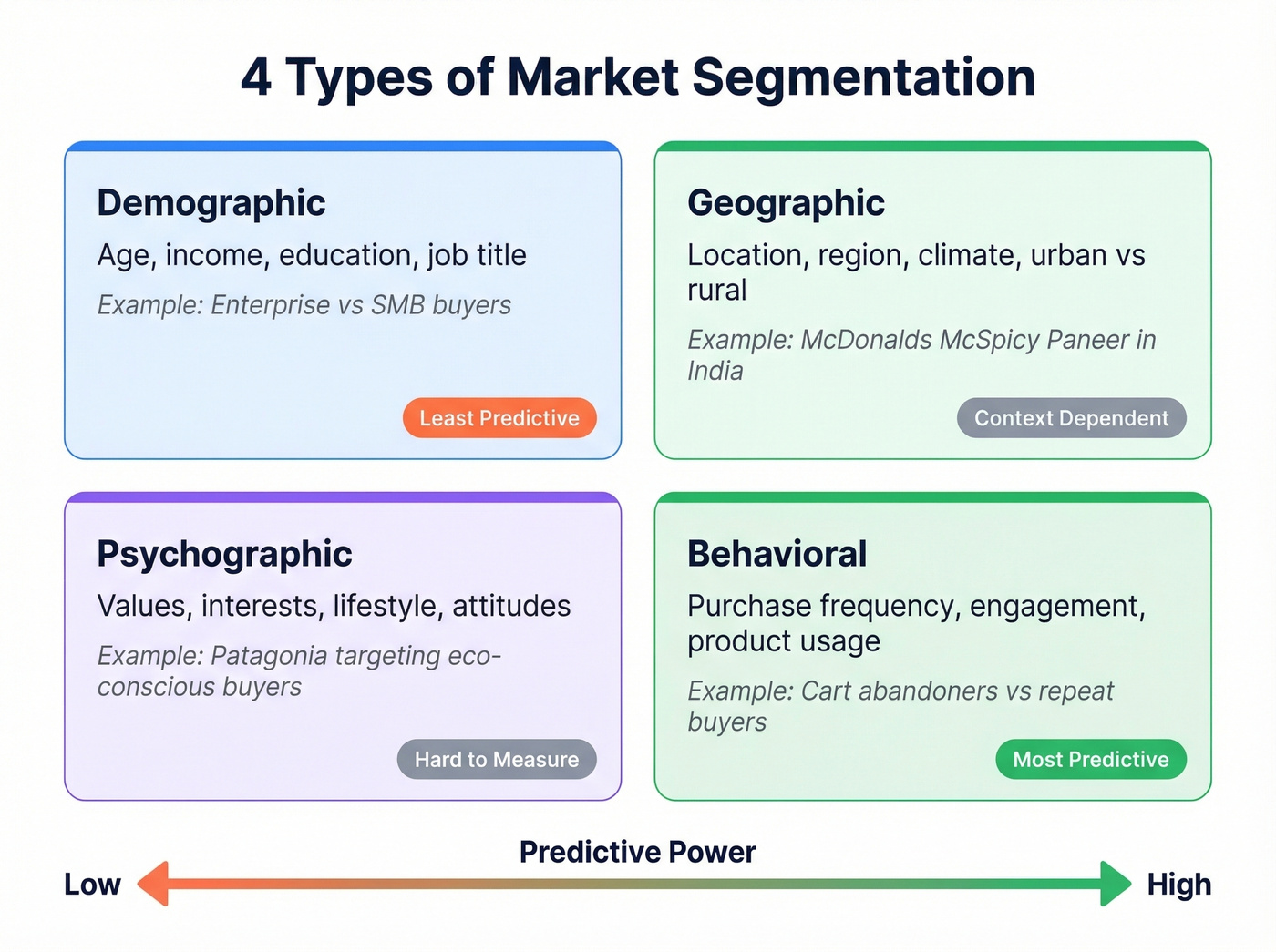
Geographic segmentation accounts for location-based differences. McDonald's localized menus are the textbook example: teriyaki burgers in Japan, McSpicy Paneer in India. Same brand, completely different product-market fit by region.
Psychographic segmentation digs into values, interests, and lifestyles. Patagonia doesn't sell to "outdoor enthusiasts" - it sells to environmentally conscious consumers who happen to need a jacket.
Behavioral segmentation groups by actions: purchase frequency, engagement patterns, product usage. It's the most predictive of the four because it's based on what people actually do, not what they say they are.
Beyond the Basics
The standard four get all the attention, but advanced types are where B2B teams get the sharpest results.
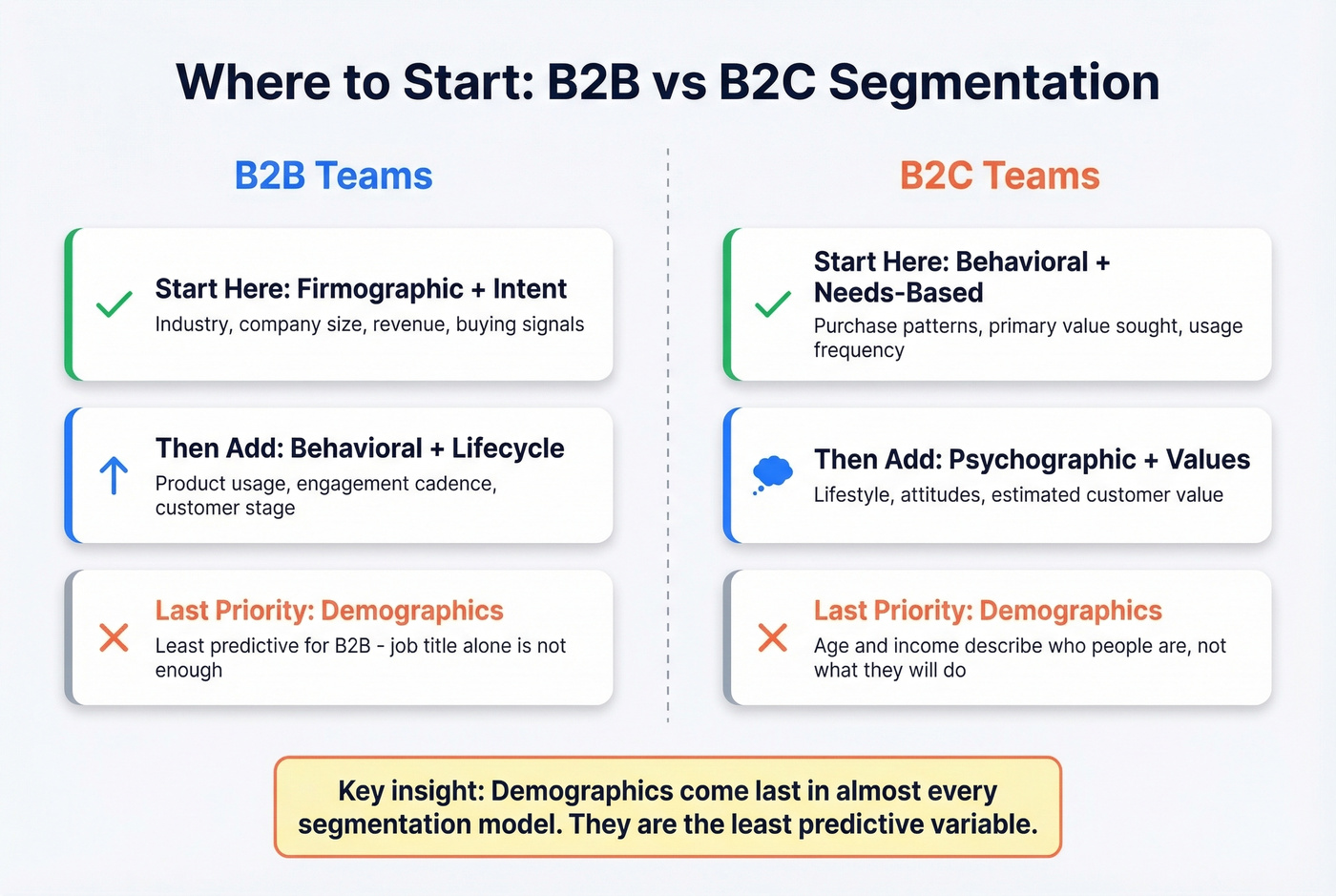
Firmographic segmentation is the B2B equivalent of demographics - industry, company size, revenue, headcount. It's table stakes for any account-based motion. Needs-based segmentation groups by the primary value customers seek, not who they are. Intent-based segmentation identifies not just who fits your ICP, but who's actively researching solutions right now.
Lifecycle segmentation treats a new subscriber differently from a repeat buyer differently from a loyal advocate. And values-based segmentation groups by estimated economic value to your business.
Here's our honest recommendation: if you're B2B, start with firmographic + intent. If you're B2C, start with behavioral + needs-based. Demographics come last. They're the least predictive variable in almost every segmentation model we've built.

Segmented campaigns drive 760% more email revenue - but only if your emails actually land. Prospeo's 98% email accuracy and 7-day data refresh mean your carefully built segments connect to real, verified contacts, not dead inboxes that tank your domain reputation.
Stop segmenting into the void. Start reaching the right people at $0.01 per email.
How to Activate Your Segmentation Strategy
Let's say your CMO just asked for a segmentation strategy and you need to justify the investment with real numbers. Here are five steps that actually work, validated against Bain's operational framework for segmentation.
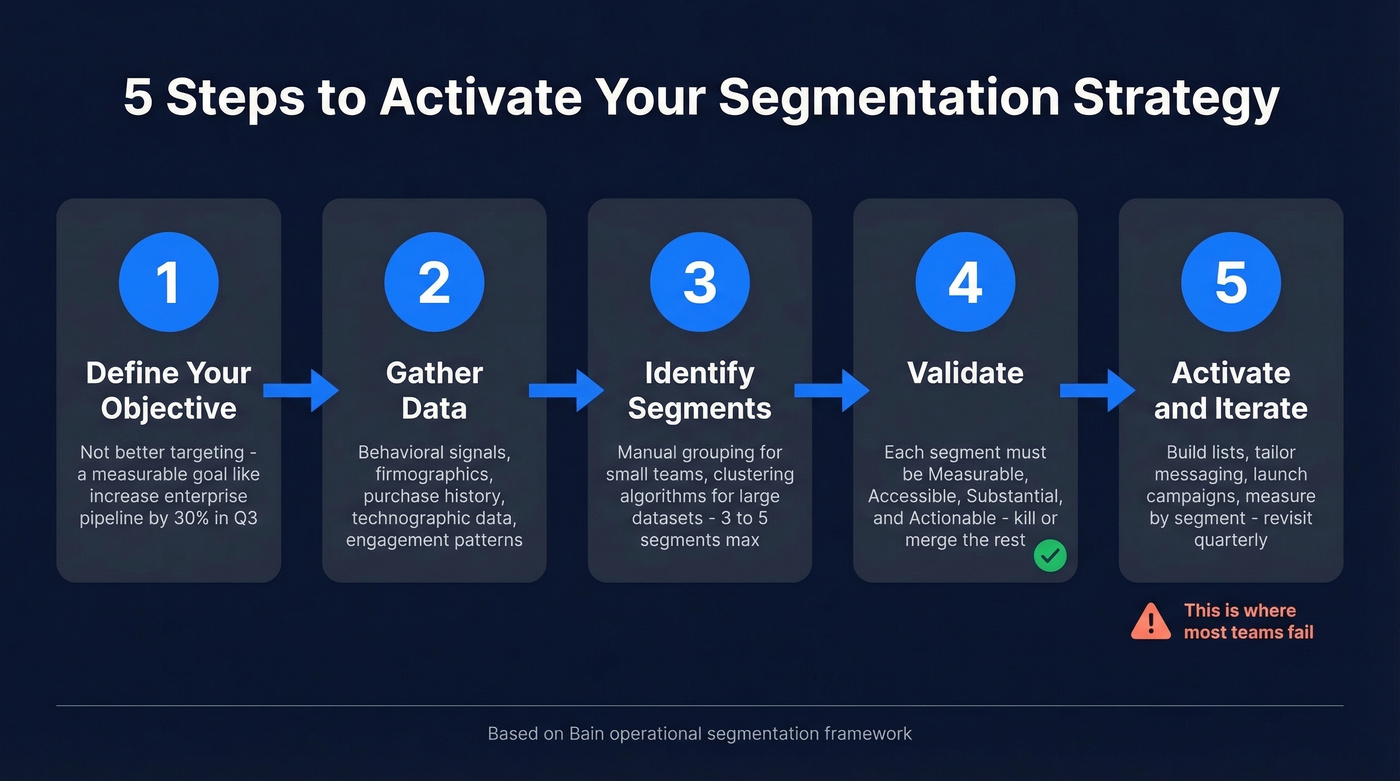
Step 1: Define your objective. "Better targeting" isn't an objective. "Increase enterprise pipeline by 30% in Q3 by focusing outbound on segments with the highest close rates" is an objective. Every segment you create should trace back to a measurable goal.
Step 2: Gather behavioral and firmographic data. Pull purchase history, engagement patterns, website behavior, technographic signals, and firmographic attributes. The richer your input data, the more meaningful your segments. Bain's approach emphasizes building segments that are both meaningful and measurable, then evaluating the profit potential of each.
Step 3: Identify segments using clustering or manual grouping. For smaller teams, manual grouping works fine - pick 3-5 segments based on clear behavioral or needs-based differences. For larger datasets, clustering algorithms surface patterns you'd miss. Either way, each segment should represent a group that responds differently to your product or messaging.
Step 4: Validate. Run segments through the checklist: Is each one measurable (can you size it)? Accessible (can you reach them)? Substantial (big enough to matter)? Actionable (can you build a distinct strategy for it)? If a segment fails any of these, merge it or kill it.
Step 5: Activate. This is where most segmentation projects die. In our experience, the teams that fail at segmentation don't fail at the analysis - they fail at activation. Build prospect lists for each segment, tailor messaging, launch campaigns, and measure results by segment, not in aggregate. Segmentation is iterative, not a one-time exercise. If you're not revisiting segments quarterly, you're flying on stale assumptions.
AI-Driven Segmentation
Static segments decay. If your segments haven't been updated in six months, they're already wrong.
Modern clustering algorithms find customers who "move together" across signals - browsing patterns, engagement cadence, usage behavior - and update segments dynamically as behavior shifts. Classification models add predictive scoring: churn risk, conversion likelihood, CLV prediction. Instead of asking "who are our best customers?" you're asking "who's about to become one - and who's about to leave?"
Real-time segmentation matters most for high-velocity triggers like cart abandonment, onboarding drop-off, and churn signals. The batch-refresh model where you re-segment every six months is a relic. Platforms like Braze are built for this kind of dynamic segmentation and activation across channels.
7 Segmentation Mistakes That Kill ROI
1. No clear objective. Segments without a business goal are spreadsheet decoration. Every segment needs a "so what" - a specific action it enables.
2. Over-segmentation. Start with 3-5 segments. Ask any B2B marketer on r/sales about segmentation and the first answer is always "start smaller than you think." We've seen teams build 20+ segments and then run the same campaign to all of them. That's not segmentation. That's a taxonomy project.
3. Demographics-only thinking. Behavioral and needs-based segmentation outperform demographic segmentation every time. Purchase frequency and engagement patterns tell you what someone will do next. Age and income don't.
4. Static, stale segments. You segmented six months ago, launched campaigns, and response rates have been declining ever since. Build dynamic segments that auto-update as customer behavior changes.
5. Ignoring lifecycle stages. A new subscriber isn't a repeat buyer isn't a loyal advocate. Each lifecycle stage demands different messaging, offers, and cadence.
6. Siloed segments across channels. One customer, one segment, everywhere. If your email team segments differently from your ad team, you're creating a disjointed experience that wastes budget on both sides.
7. No testing or iteration. Treat segments as hypotheses, not permanent categories. A/B test messaging within segments. Measure performance quarterly. Kill underperforming segments and split high-performing ones when the data supports it.
From Segments to Sales
Here's the thing nobody talks about: you build perfect segments, define your ICP for each, craft tailored messaging - and then try to reach those segments with a contact list that's 30% bounced emails and disconnected phone numbers. Bad data is where segmentation strategies go to die.

Segmentation tells you who to target. You still need verified, fresh contact data to actually reach them. Prospeo bridges that gap - 300M+ profiles with 30+ search filters including buyer intent signals across 15,000 topics let you turn segment definitions into contactable prospect lists immediately, with a 98% email accuracy rate and 7-day data refresh cycle.
If your deal sizes sit below five figures, you probably don't need a $30K/year data platform. You need accurate emails, intent signals, and the discipline to activate your segments weekly. Skip the enterprise tooling if you're an SMB - overinvesting in platforms and underinvesting in execution is the most expensive mistake in B2B marketing.
You just read that 80% of companies using segmentation report increased sales. The gap between segmenting and selling is contact data. Prospeo gives you 30+ filters - buyer intent, technographics, headcount growth, funding - so every segment maps directly to verified decision-makers.
Turn your market segments into pipeline with 300M+ verified profiles.
FAQ
What's the biggest benefit of market segmentation?
It stops you from wasting budget on people who were never going to buy. When you know which segments convert, every downstream decision - messaging, channel selection, product development, pricing - gets sharper. 80% of companies using segmentation report increased sales.
How many segments should a company start with?
Three to five. Each one needs its own strategy, messaging, and dedicated resources, so over-segmentation kills execution speed. If you can't build a distinct campaign for a segment, it shouldn't exist separately. Split high-performing segments later as your data and capacity grow.
What's the difference between market segmentation and customer segmentation?
Market segmentation divides an entire market, including people who aren't your customers yet. Customer segmentation divides your existing base. Both use similar methods - behavioral, demographic, needs-based - but the scope differs. Market segmentation informs go-to-market strategy; customer segmentation informs retention and expansion plays.
What tools help with B2B market segmentation?
For AI-driven clustering and dynamic segment updates, platforms like Braze handle the modeling layer. For turning segments into verified prospect lists with accurate emails and direct dials, Prospeo offers 300M+ profiles with intent data across 15,000 topics and a 7-day refresh cycle.
Why is segmentation useful for budget planning?
Segmentation gives you a clear picture of where dollars generate returns and where they don't. Instead of allocating spend across an undifferentiated audience, you size each segment's revenue potential, assign budget proportionally, and measure performance at the segment level. Teams using this approach routinely cut wasted spend by up to 30%.