

The 9 Best ABM Platforms for 2026 (And What They Actually Cost)
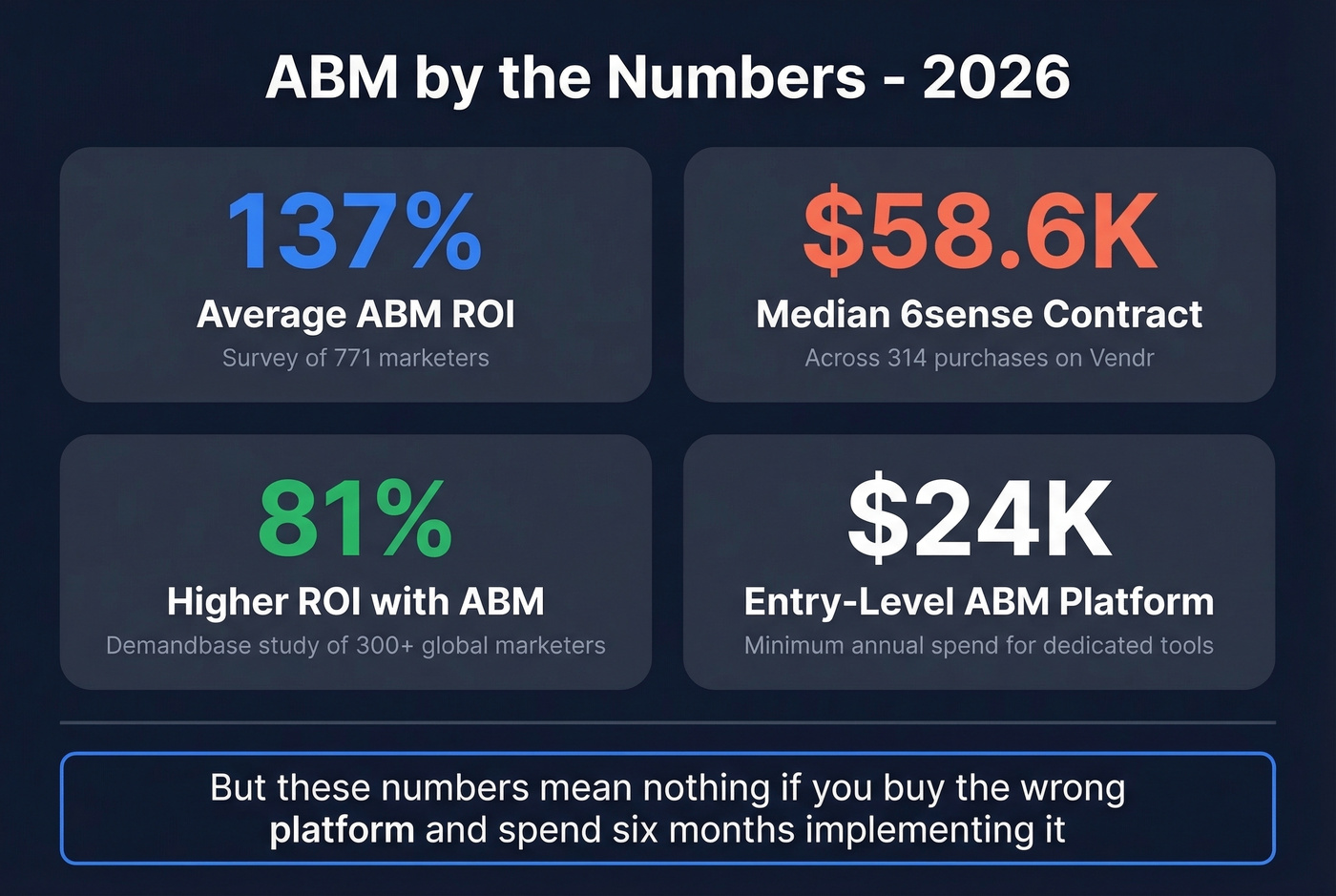
Your CMO just came back from a conference convinced ABM is the answer. Now you're staring at vendor quotes ranging from $24K to $300K and wondering which platform is actually worth the money. A survey of 771 marketers pegged average ABM ROI at 137% - but that number means nothing if you buy the wrong platform and spend six months implementing it.
Here's what's actually worth your money.
Our Picks (TL;DR)
| Platform | Best For | Starting Price |
|---|---|---|
| Demandbase One | Enterprise all-in-one ABM | ~$24K/yr |
| 6sense | Predictive intent scoring | Free (50 credits/mo) |
| HubSpot Marketing Hub | Mid-market HubSpot users | $890/mo |
| RollWorks | Account-based ads on a budget | ~$12K/yr |
| Influ2 | Contact-level ad targeting | ~$30K/yr est. |
We've deliberately included platforms across the full budget spectrum. The enterprise orchestration tools get the most attention, but most teams don't need a six-figure ABM suite. They need accurate data, intent signals, and a way to put ads in front of target accounts.
Here's the thing: the biggest ABM waste isn't picking the wrong platform. It's buying a $60K orchestration suite when your contact data has a 30% bounce rate. Fix the data first, then decide how much orchestration you actually need.
Do You Actually Need an ABM Platform?
A practitioner on r/b2bmarketing recently called enterprise ABM suites "incredibly expensive and not useful" for niche B2B markets. Their actual need? Prove ad spend is reaching the right organizations and share reached-account lists with sales. No orchestration engine required.
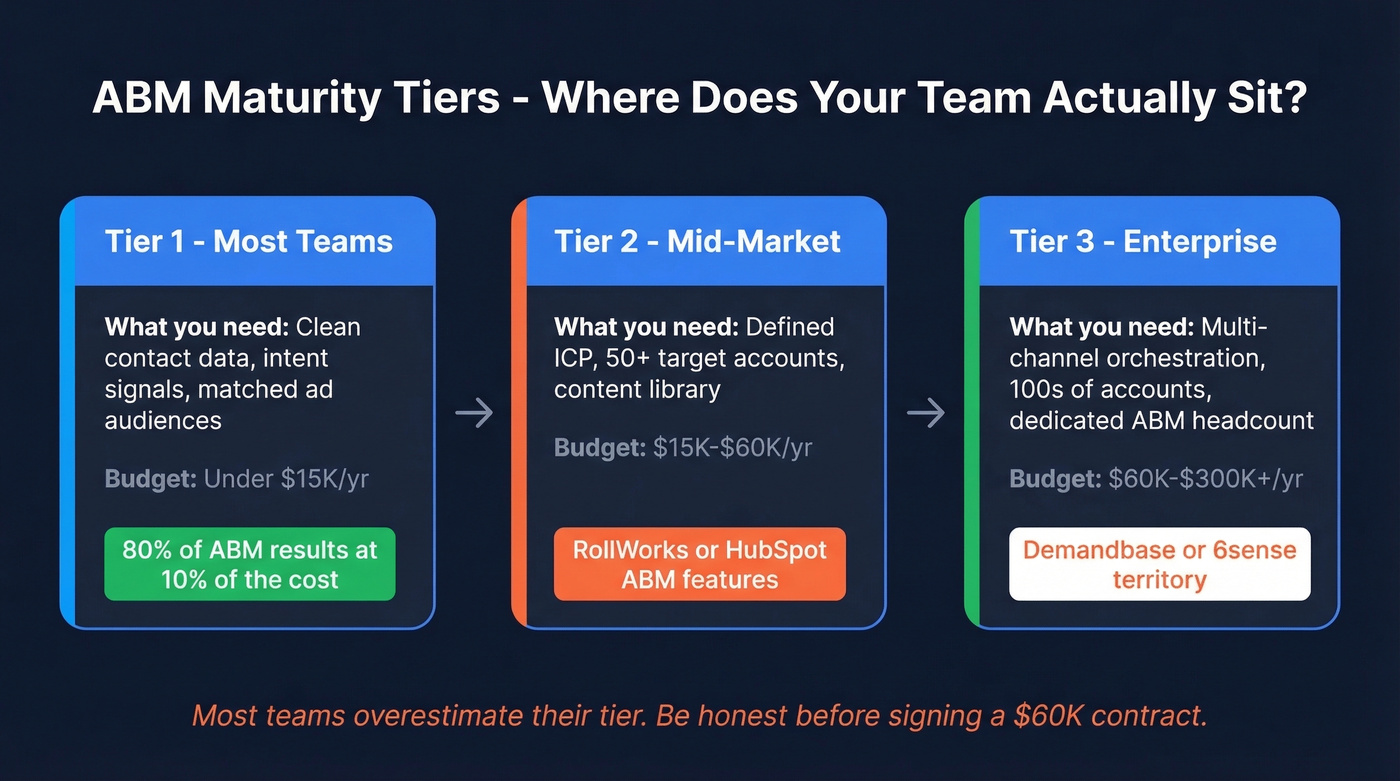
Enterprise ABM is really an ecosystem play - sales intelligence, intent data, advertising, gifting, call tracking - and no single platform does everything well. Think about your maturity in three tiers before committing.
Tier 1 - most teams. You need clean contact data, intent signals, and matched audiences on ad platforms. A B2B data platform with intent coverage plus your existing ad channels gets you 80% of ABM results at 10% of the cost.
Tier 2 - mid-market. You've got a defined ICP, 50+ target accounts, and a content library. A mid-range tool like RollWorks or HubSpot's ABM features makes sense here.
Tier 3 - enterprise. You're running multi-channel orchestration across hundreds of accounts with dedicated ABM headcount. That's when Demandbase or 6sense earns its price tag.
Most teams overestimate their tier. Be honest about where you are before signing a $60K contract.
How ABM Platforms Price
ABM pricing is deliberately opaque - it's the #1 complaint in most Demandbase review roundups. Here's how the four models break down:
- Account-based pricing: You pay per target account plus a base platform fee. Costs scale directly with your addressable market list size.
- User-based pricing: Per-seat pricing, sometimes with unlimited accounts. Common in mid-market tools.
- Feature-tiered: Basic/Pro/Enterprise gates with escalating limits on accounts, channels, and analytics depth.
- Hybrid: The enterprise default. Base platform fee + account tiers + seat costs + module add-ons. This is how 6sense and Demandbase price.
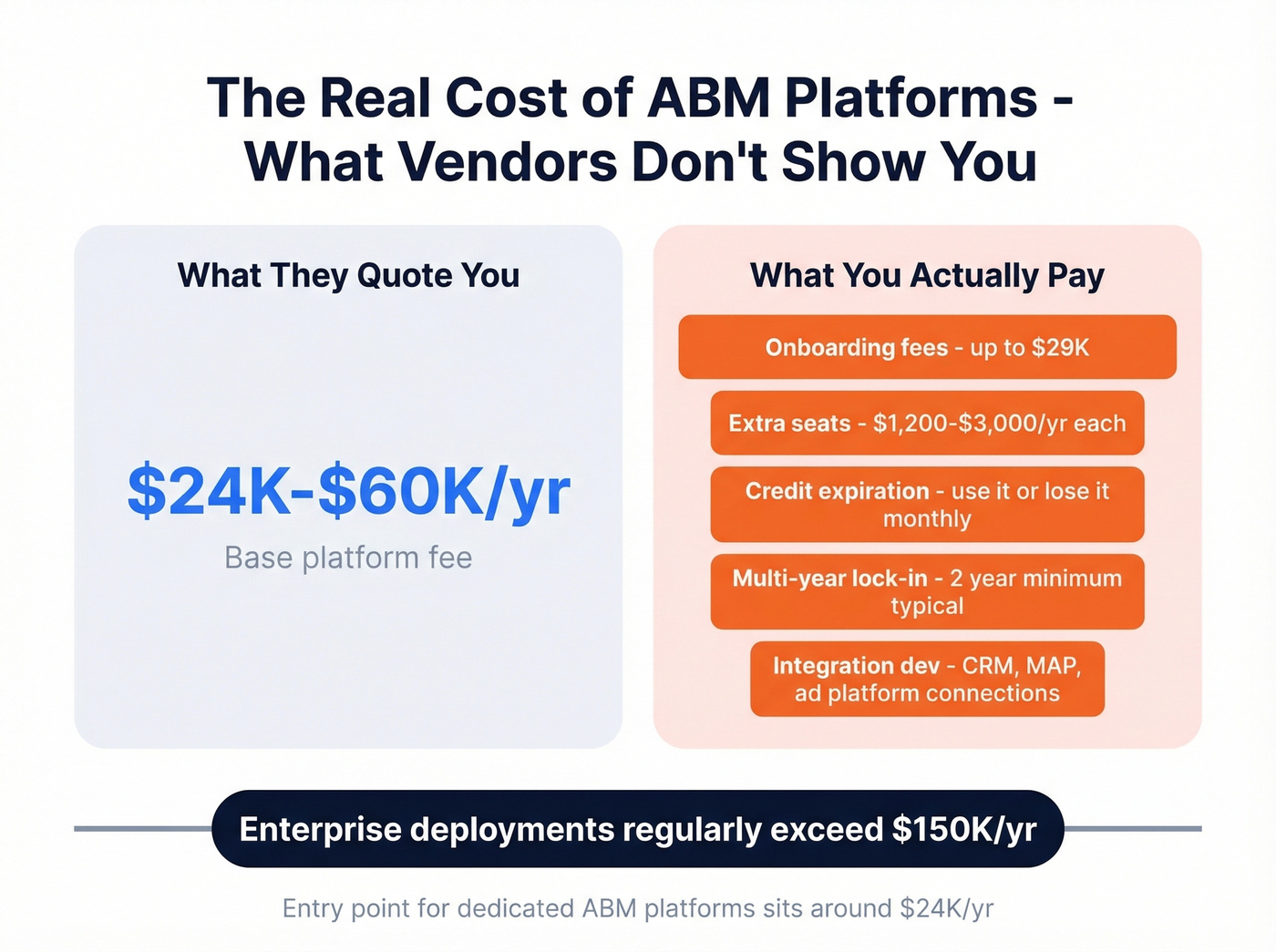
Beyond the sticker price, budget for these hidden costs:
- Onboarding fees: Demandbase charges ~$29K on top of the platform fee
- Extra seats: $1,200-$3,000/year each beyond the base license
- Credit expiration: 6sense credits don't roll over month-to-month
- Multi-year lock-ins: Most enterprise contracts require 2-year commitments
- Integration development: Connecting to your CRM, MAP, and ad platforms takes engineering time
The entry point for dedicated ABM platforms sits around $24K/year. Enterprise deployments regularly exceed $150K.

The article says it plainly: the biggest ABM waste isn't the wrong platform - it's paying $60K for orchestration while your contact data bounces at 30%. Prospeo delivers 98% email accuracy, 125M+ verified mobiles, and intent data across 15,000 topics at $0.01/email. That's your Tier 1 ABM foundation - without the six-figure contract.
Fix the data layer before you buy the orchestration layer.
How to Choose the Right ABM Tool
Demandbase One - Enterprise All-in-One
Demandbase is the 800-pound gorilla of ABM advertising. It operates the only DSP purpose-built for B2B, which means your display ads actually reach business buyers instead of getting lost in consumer inventory. The platform pulls in over 2 trillion signals per month across 133+ languages, and its predictive models deploy in under 24 hours.
Their own comparison data highlights stronger category scores than 6sense for core execution workflows: account-based advertising (8.2 vs 7.6), campaign measurement (8.4 vs 7.8), and retargeting (8.4 vs 7.9). Across 300+ global marketers, Demandbase found 81% higher ROI with ABM - a number that tracks with the broader industry data.
Pricing: Entry-level contracts start around $24K-$30K/year. Mid-market deployments typically land at $45K-$65K. Full enterprise stacks run $100K-$300K+. Add ~$29K for onboarding. Base contracts include roughly 10 user licenses; additional seats cost $1,200-$3,000/year each.
The tradeoff: Review roundups consistently flag pricing opacity - you can't get a number without a full sales cycle. Visitor identification stays at the company level, not person level. If you need to know who visited your site, you'll need to supplement with a contact-level tool.
Skip this if you're running fewer than 100 target accounts or your ABM budget is under $50K.

6sense - Predictive Intent Scoring
6sense's core strength is its AI-powered buying-stage prediction. The platform doesn't just tell you which accounts show intent - it predicts where they sit in the buying journey and scores them accordingly. Revenue AI dashboards give marketing and sales a shared view of pipeline probability, which is useful for prioritization when you're juggling hundreds of accounts.
The free plan offers 50 credits/month for company and people search, list building, alerts, and a Chrome extension - enough to test the data quality before committing.
Pricing: The median contract across 314 purchases is $58,617/year. The observed range runs from $10,621 to $151,709. Entry-level deployments start around $35K/year; full predictive AI stacks push $100K-$200K+.
The tradeoff: Implementation takes 3-6 months for enterprise deployments, plus another 2-3 months to reach capacity. Budget six months before expecting meaningful results. And those credits don't roll over - if you buy 500/month and use 300, you lose 200. That use-it-or-lose-it model frustrates a lot of teams.
Skip this if you don't have dedicated ABM headcount to manage the platform through a long ramp period.

HubSpot Marketing Hub - Mid-Market ABM
If you're already on HubSpot's CRM, adding ABM capabilities without another vendor makes obvious sense. Professional tier ($890/mo for 3 seats) includes target account dashboards, company scoring, and account-based reporting. Enterprise ($3,600/mo for 5 seats) adds predictive lead scoring and custom objects.
HubSpot's ABM features are solid add-ons to a marketing automation platform, but they don't compete with purpose-built ABM tools on depth. Think of it as "ABM-lite" - good enough for teams running 20-50 target accounts with content-led plays. You won't get dedicated ABM advertising, advanced intent data, or multi-channel orchestration here.
RollWorks - Budget ABM Ads
At $12K-$30K/year, RollWorks costs a fraction of what Demandbase or 6sense charges for account-based display advertising. For teams testing whether ABM ads move the needle before committing to a six-figure platform, that price point is hard to beat.
The AI is lighter than its enterprise competitors, and reporting requires manual stitching across channels. You also can't see who clicked your ads unless they fill out a form. But for a team spending $15K to validate account-based advertising as a channel, those limitations are acceptable tradeoffs. You'll outgrow it if ABM becomes a primary motion - but that's a good problem to have.
Influ2 - Contact-Level Targeting
Every other platform on this list targets accounts. Influ2 targets people. It shows you which specific person - not just which company - engaged with your ads across Meta, Google, Bing, and programmatic channels.
Contact-level targeting matters most for high-ACV deals where you're multi-threading into 5-10 person buying committees. You're not just warming up an account - you're putting your message in front of the CFO, the CTO, and the procurement lead individually. Influ2 is CCPA/GDPR compliant without cookies or IP targeting. Pricing isn't public; expect enterprise-tier quotes starting around $30K-$50K/year.
Terminus (DemandScience) - Multi-Channel Ads
Now operating under the DemandScience umbrella, Terminus focuses on multi-channel ad-led ABM with a median annual contract around $23K. It's a reasonable mid-tier option for programmatic + social ad orchestration without enterprise complexity. Expect $23K-$50K/year depending on channels and account volume.
Madison Logic - Content Syndication + Intent
Madison Logic combines intent-powered lead generation with content syndication - a niche play for teams whose ABM strategy centers on distributing whitepapers and reports to in-market accounts. Pricing starts around $3,000/month plus media spend, so budget $36K-$60K/year all-in.
Foundry ABM - Orchestration Playbooks
Foundry (formerly TechTarget's ABM platform) focuses on orchestration playbooks for enterprise teams. Expect $30K-$80K/year depending on account volume and channel mix. Best suited for organizations with mature ABM programs that need workflow automation across multiple channels.
A Note on ZoomInfo Marketing
ZoomInfo appears on every ABM listicle, but it's a data platform with ABM add-ons - not a purpose-built account-based marketing platform. Its Marketing module provides account-based advertising and intent signals, and pricing typically falls in the $15K-$100K/year range depending on seats, data, and modules. If you're already a ZoomInfo customer, activating the marketing module is a low-friction way to test ABM. If you're evaluating it purely for ABM, you'll get deeper orchestration from Demandbase or 6sense and better data economics from a dedicated B2B data provider.
Full Pricing Comparison
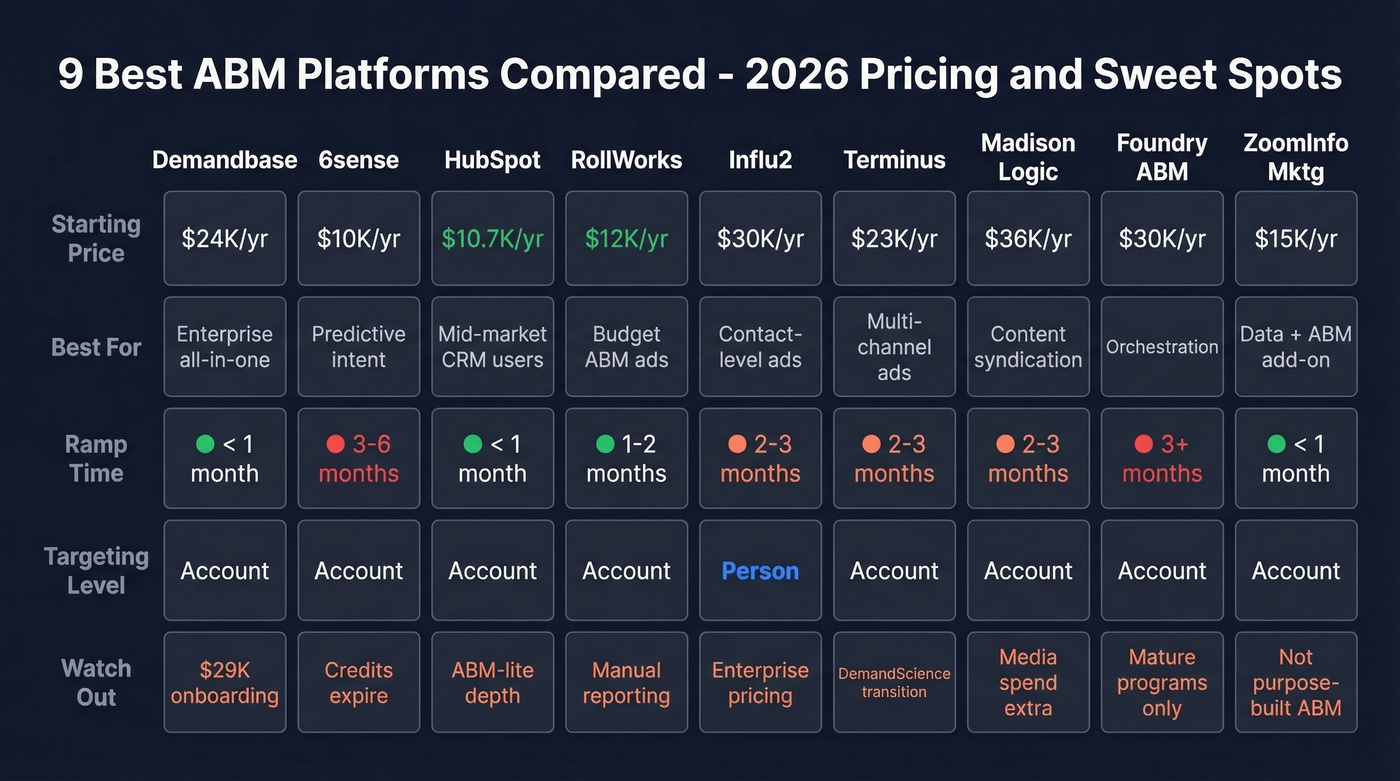
| Platform | Best For | Price Range | Pricing Model | Watch Out For |
|---|---|---|---|---|
| Demandbase | Enterprise ABM | $24K-$300K+/yr | Hybrid | ~$29K onboarding |
| 6sense | Predictive intent | $10K-$200K+/yr | Hybrid + credits | Credits don't roll over |
| HubSpot | Mid-market CRM users | $890-$3,600/mo | Seat + tier | Not a dedicated ABM tool |
| RollWorks | Budget ABM ads | $12K-$30K/yr | Ad spend + tier | Manual reporting |
| Influ2 | Contact-level ads | $30K-$50K/yr est. | Custom | Limited public pricing |
| Terminus | Multi-channel ads | $23K-$50K/yr | Custom | DemandScience transition |
| Madison Logic | Content syndication | $36K-$60K/yr | Media + platform | Media spend adds up |
| Foundry ABM | Orchestration | $30K-$80K/yr | Custom | Enterprise complexity |
| ZoomInfo Marketing | Data + ABM add-on | $15K-$100K/yr | Seat + tier | ABM is a bolt-on |
Account-Level vs Contact-Level ABM
Most ABM platforms operate at the account level. They tell you "Acme Corp is showing intent for your category" and serve ads to people at that company. Useful, but it's a blunt instrument when you're trying to reach the VP of Engineering specifically - not the intern who happens to browse from the same IP range.
Contact-level ABM targets specific individuals within accounts. For high-ACV deals with 5-10 person buying committees, this precision matters enormously, and it's the gap where we've seen the most frustration from sales teams who get "account engaged" alerts but have no idea which human to call.
| Approach | Platforms | Best For |
|---|---|---|
| Account-level | Demandbase, 6sense, RollWorks | Broad awareness at scale |
| Contact-level ads | Influ2 | High-ACV deals with buying committees |
Here's where most ABM platforms have a blind spot: they identify accounts but don't give you verified contact data for the people inside those accounts. Pairing account-level intent signals with a B2B data platform that provides verified emails and direct dials for specific decision-makers bridges that gap - so your outreach actually reaches the right people.
ABM Readiness Checklist
Before you sign anything, run through these prerequisites. We've watched teams skip this step and waste entire quarters trying to make a platform work without the foundation in place.
1. Define your ICP with specifics. "Enterprise SaaS companies" isn't an ICP. "Series B+ SaaS companies with 200-2,000 employees, using Salesforce, with a VP of Revenue Operations" is. Your ABM platform can't target what you haven't defined.
2. Clean your data first. Garbage in, garbage out. If your CRM is full of stale contacts with 30% bounce rates, no ABM platform will save you. Snyk's 50-person AE team went from 35-40% bounce rates to under 5% after switching to Prospeo's enrichment API - AE-sourced pipeline jumped 180% and they generated 200+ new opportunities per month. Run your existing database through an enrichment pass before committing to a $50K+ platform. That single step will improve every downstream metric.
3. Align sales and marketing on accounts. ABM fails when marketing picks target accounts in a vacuum. Sales needs to co-own the list. If your sales team doesn't know which accounts marketing is running campaigns against, you've already lost.
4. Build a content library. ABM without personalized content is just expensive display advertising. You need at least 3-5 content assets mapped to different buying stages before launching.
5. Measure revenue, not vanity metrics. Track CLV, ARR impact, and CAC by account tier - not clicks and impressions. 79% of buyer engagements are now buyer-initiated, which means your ABM program needs time to build awareness before those buyers come to you. Budget six months minimum before expecting pipeline impact, and judge results by pipeline generated, not ad engagement.
Let's be honest: most ABM programs fail not because of the platform, but because of poor governance, unclear KPIs, and treating ABM as ad tech instead of an orchestration strategy. Get the fundamentals right first.
Demandbase and 6sense identify accounts - but they still need accurate contact data to convert them. Prospeo's 7-day data refresh, 30+ search filters with buyer intent signals, and 92% enrichment match rate plug directly into your ABM stack via Salesforce, HubSpot, Clay, or API. Enterprise-grade targeting data without enterprise pricing.
Layer real contact data into your ABM workflow for $0.01 per lead.
FAQ
How much does an ABM platform cost?
Entry-level ABM platforms start around $24K/year, with mid-market deployments typically running $45K-$65K. The median 6sense contract is $58,617/year across 314 purchases. Enterprise full-stack deployments from Demandbase or 6sense can exceed $200K-$300K annually. Budget for onboarding fees ($10K-$30K) and additional seat costs on top of the platform price.
How long until ABM shows results?
Enterprise implementations take 3-6 months to deploy, plus another 2-3 months to reach capacity. Budget a minimum of six months before expecting meaningful pipeline impact. Mid-market tools like RollWorks or HubSpot can be operational in 2-6 weeks but still need time to generate statistically significant results.
Can I run ABM without a dedicated platform?
Yes - and most SMB teams should. A B2B data platform for verified contacts and intent signals, combined with matched audiences on your ad platforms and a website visitor identification tool, covers roughly 80% of ABM use cases. You don't need a six-figure orchestration suite to run account-targeted campaigns effectively.
What's the difference between ABM and demand gen?
ABM targets specific named accounts with personalized campaigns designed to penetrate buying committees. Demand gen casts a wider net to generate inbound interest across a broader market. Most mature B2B teams run both - ABM for top-tier accounts and demand gen for everything else. They're complementary strategies, not competing ones.
What data do I need before choosing an ABM platform?
You need a clean CRM with accurate company and contact records, a clearly defined ICP with firmographic and technographic criteria, and verified contact data for key personas within your target accounts. If your existing database has bounce rates above 10%, fix the data quality problem first - an enrichment pass at 98% email accuracy before you commit to a $50K+ platform will improve every downstream metric you care about.