

Best Cold Email Subject Lines: What 5.5 Million Emails Actually Tell Us
You've sent 500 cold emails this week. Open rate: 18%. Your manager wants to know if you've "tried better subject lines." Meanwhile, the real problem - that list you bought last quarter with a 12% bounce rate - goes unmentioned.
Here's what most advice about the best cold email subject lines won't tell you: the subject line is the last 20% of the equation. List quality, deliverability, and targeting are the first 80%. But that last 20% still matters, and we've got real data to guide it.
The Quick Version
- Keep subject lines to 2-4 words. That's the sweet spot - 46% open rate in a 5.5M-email study.
- Personalize or ask a question. Both hit 46% opens and roughly double reply rates compared to generic lines (7% vs 3%).
- If your open rate is below 15%, fix deliverability and inbox placement before you touch your copy. Clean your list first.
What 5.5 Million Emails Say
Belkins partnered with Reply.io and analyzed 5.5 million cold emails sent between January and December 2024. The findings are more useful than the recycled advice that keeps getting repackaged across every marketing blog.
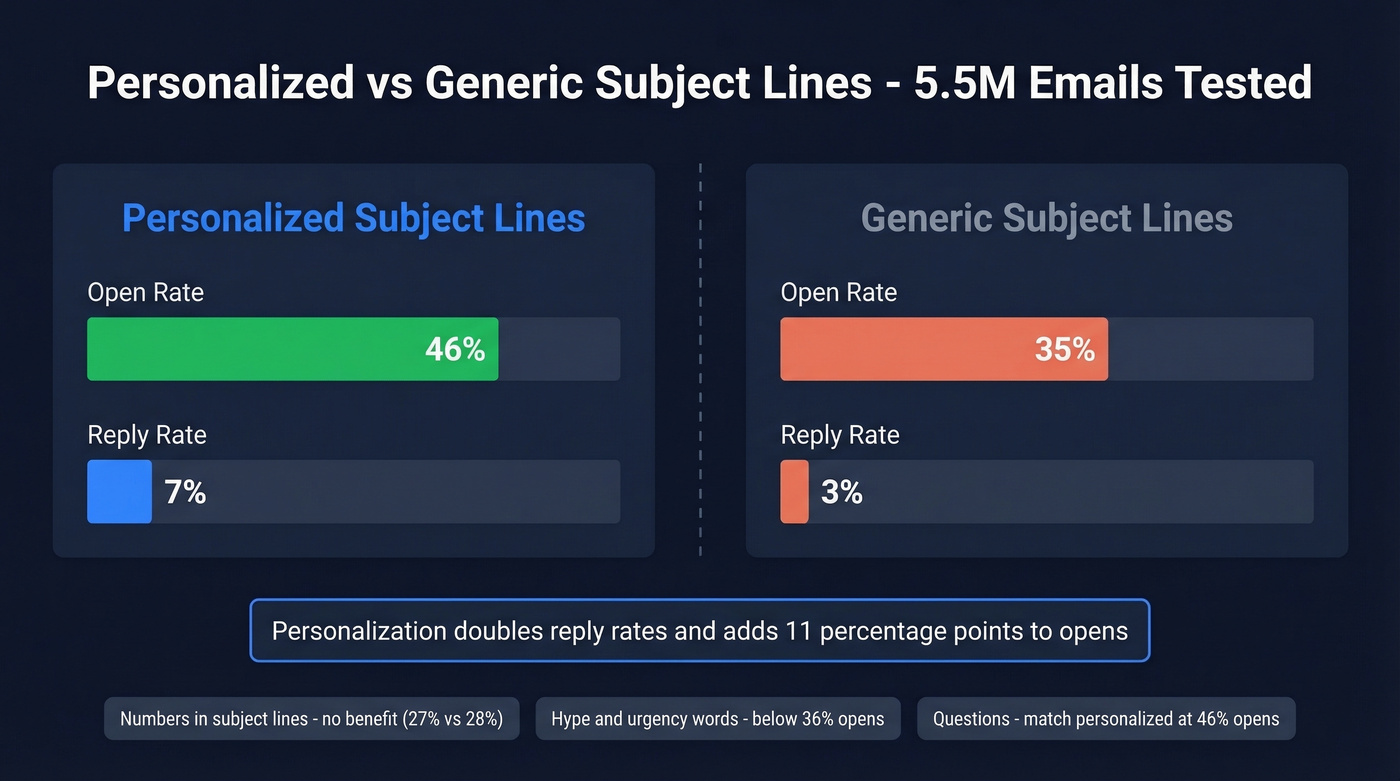
The headline number: personalized subject lines - ones that reference the recipient's name, company, or a specific pain point - hit a 46% open rate and a 7% reply rate. Generic subject lines? 35% opens, 3% replies. That's not marginal. That's the gap between a campaign that books meetings and one that doesn't.
Question-style subject lines performed equally well, averaging 46% opens. There's something about a question that creates a micro-commitment - the reader's brain starts answering before they've decided whether to open.
A few findings that challenge conventional wisdom: numbers in subject lines showed no benefit. 27% open rate with numbers versus 28% without. It's a small gap, but it kills the "use numbers for specificity" advice that every copywriting blog repeats. Hype and urgency words - "ASAP," "limited time," "exclusive offer" - pushed open rates below 36%. Your prospects aren't falling for manufactured urgency. They see right through it.
Casing was interesting but less dramatic. ALL CAPS hit 30%, title case 29%, and first-letter-only capitalization came in lowest at 25%. The takeaway isn't to shout. Standard sentence casing with a capitalized first letter slightly underperforms, while title case or natural capitalization works fine.
Ideal Length for Subject Lines
The data is clear: 2-4 words is the sweet spot at 46% open rate. Performance drops steadily from there - 39% at 7 words, 35% at 9 words, 34% at 10 words. One-word subject lines underperformed too, landing at 38%. You need enough context to spark curiosity, but not so much that you've told the whole story before they open.
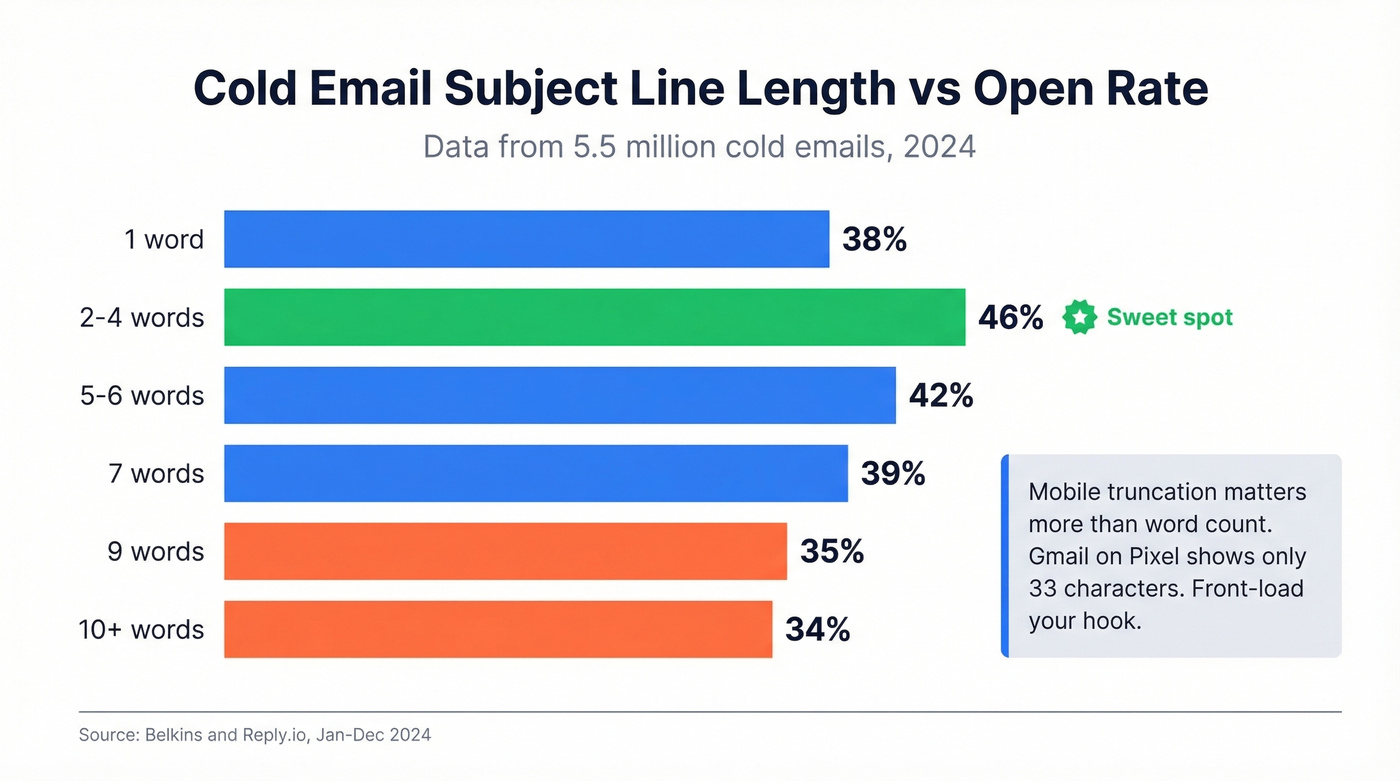
Here's the thing: length in words matters less than length in characters, because mobile truncation is the real constraint. A BuzzStream study of 6 million subject lines published a device character-limit table that every cold emailer should bookmark:
| Email Client | Character Limit |
|---|---|
| Gmail app (iPhone 14) | ~37 |
| Gmail app (Pixel 7) | ~33 |
| Gmail app (Samsung S22 Ultra) | ~36 |
| Gmail desktop (browser) | ~88 |
| Outlook desktop (browser) | ~51 |
Your VP prospect checking email on a Pixel sees 33 characters. That's it. Front-load your hook. If the first 33 characters don't create enough intrigue to tap, the remaining words don't exist.
For context, BuzzStream's data found that 9-13 words performed best - but that was PR outreach to journalists, not cold sales. Journalists expect descriptive subject lines. Prospects don't. Siege Media recommends "under 50 characters" as a general rule, and some practitioners swear by the AIDA framework for structuring email copy. But the 5.5M-email dataset says 2-4 words - typically 15-30 characters - beats all of it for cold B2B outreach.
Top-Performing Lines by Category
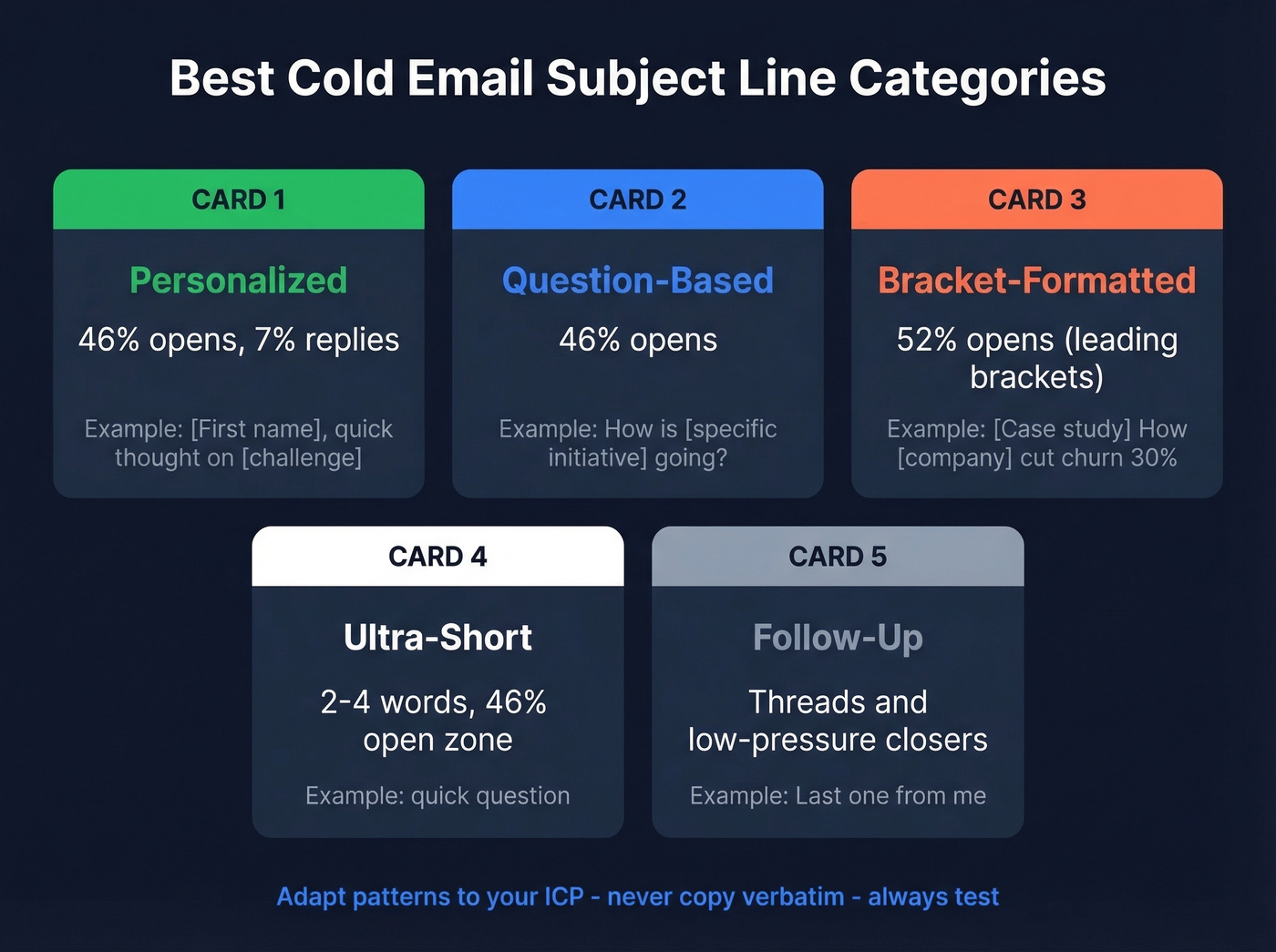
These are organized by style, with data backing for each. Don't copy them verbatim - adapt the pattern to your ICP and offer. Performance varies by vertical and audience, so treat these as starting templates and test within your specific market.
Personalized (Name / Company / Pain Point)
These tie directly to the study's top finding: 46% opens, 7% replies. The key is specificity. A first name alone isn't personalization - it's mail merge. Pair it with something that proves you've done 30 seconds of research.
- [First name], quick thought on [specific challenge]
- [Company name]'s [department] hiring spree
- Saw [company]'s Q3 numbers
- [First name] - [mutual connection] suggested I reach out
- Your [specific tech stack tool] setup
The best personalized subject lines reference something the prospect actually cares about - a recent hire, a product launch, a funding round. Generic "congrats on the new role" lines are getting stale.
Question-Based
Your prospect opened email #1 but didn't reply. They skimmed it, thought "maybe later," and forgot. A well-placed question in a follow-up - or a first touch - reopens that loop. The 5.5M-email dataset showed questions matching personalized lines at 46% opens, and the psychology is simple: an unanswered question nags.
- Struggling with [pain point]?
- How's [specific initiative] going?
- Still using [competitor/old method]?
- What's your plan for [upcoming event/deadline]?
- Quick question about [department/process]
Keep questions genuine. "Want to 10x your pipeline?" isn't a question - it's a pitch wearing a question mark. "How are you handling [specific operational challenge]?" feels like a peer asking, not a seller selling.
Bracket-Formatted
BuzzStream's 6M-email study found that subject lines leading with brackets hit a 52.08% open rate - the highest of any format they tested. Trailing brackets also performed well at 49% opens, though leading brackets edged them out. Brackets signal structured, valuable content and set expectations before the reader commits.
- [Case study] How [similar company] cut churn 30%
- [Idea] for [company]'s outbound
- [Quick video] [Company]'s pipeline gap
- [Data] [Industry] benchmark you'll want
Ultra-Short / Conversational
This is where the practitioner voice aligns perfectly with the data. A poster on r/coldemail reported that subject lines like "quick check-in" and "this might help" generated 2x higher open rates after they stopped writing subject lines that sounded like marketing copy. The 2-4 word sweet spot backs all of this up.
Ultra-short lines work because your prospect's inbox is full of polished marketing - a two-word subject line from an unfamiliar name creates curiosity precisely because it doesn't try hard. Think "quick question," "thoughts?," "worth a look," "for [first name]," "one idea." These look like internal emails, and that's the point.
Follow-Up Subject Lines
Most reps give up after one or two follow-ups. The ones who don't need subject lines that don't feel desperate.
- Re: [original subject] - simple, effective, threads the conversation
- Bumping this up
- Any thoughts, [first name]?
- Closing the loop
- Last one from me
"Last one from me" works surprisingly well because it removes the pressure of future follow-ups. It gives the prospect permission to engage on their terms.
Referral / Mutual Connection
Social proof is the strongest cold email lever. If you have a real connection, lead with it.
| Instead of... | Try... |
|---|---|
| A colleague mentioned you | [Name] said we should connect |
| Someone at your company referred me | [Name] from [company] intro |
| We have mutual connections | Fellow [group/community] member |
Don't fake referrals. "A colleague mentioned you" when no colleague did is a fast track to getting blocked - and potentially a CAN-SPAM violation, since deceptive subject lines are explicitly prohibited. These only work when the connection is genuine.

The study is clear: personalized subject lines hit 46% opens. But personalization requires accurate data - the right name, company, and pain point. Prospeo's 300M+ profiles with 30+ filters (buyer intent, technographics, job changes) give you the research ammo to write subject lines that actually convert - backed by 98% email accuracy so your emails land in inboxes, not bounce logs.
Stop perfecting subject lines for emails that bounce. Start with clean data.
Words and Formats to Avoid
The 5.5M-email data confirms it - hype words push open rates below 36%. Even well-crafted subject lines can't overcome spam filter penalties from trigger words. Modern spam filters use pattern-based ML, but word clusters still matter as signals within the broader reputation model.
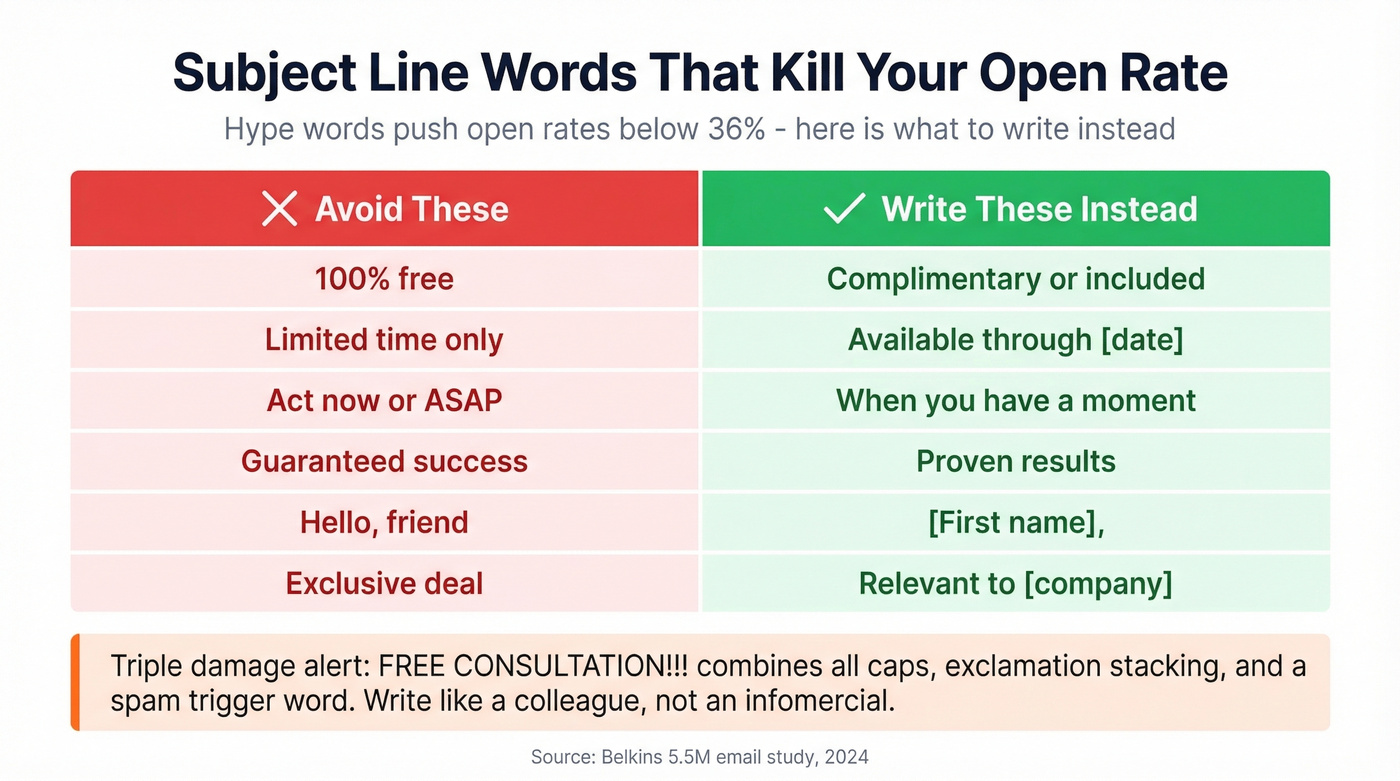
| Don't Write This | Write This Instead |
|---|---|
| 100% free | Complimentary / included |
| Limited time only | Available through [date] |
| Guaranteed success | Proven results |
| Act now / ASAP | When you have a moment |
| Hello, friend | [First name], |
| Exclusive deal | Relevant to [company] |
Beyond word choice, visual formatting kills deliverability. Excessive capitalization, multiple exclamation marks, dollar signs, and unusual spacing all trigger filters. "FREE CONSULTATION!!!" is doing triple damage - all caps, an exclamation stack, and a spam-trigger word. Write like a human colleague, not a late-night infomercial.
Bad Data Kills Good Subject Lines
Let's be honest about something most subject line articles skip entirely: if half your emails bounce, every test you ran last month was based on garbage data. You can't measure open rates when 20% of your list never received the email in the first place.
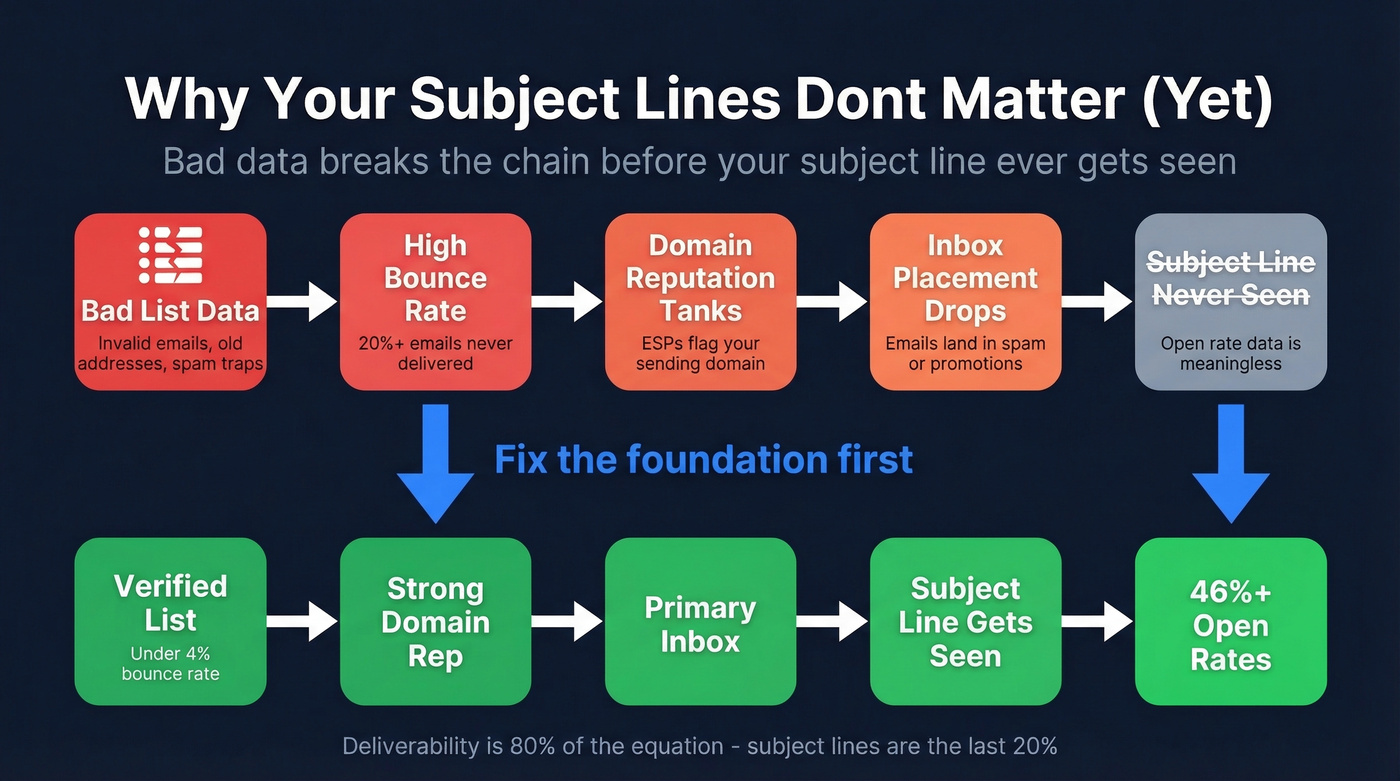
Bounce rates destroy domain reputation. Domain reputation determines inbox placement. Inbox placement determines whether your subject line ever gets seen. It's a chain, and bad data breaks the first link.
Before you test a single subject line variant, run your list through a verification tool. In our experience, this is the step most teams skip - and it's the one that matters most. Prospeo's email verification uses a 5-step process that catches invalid addresses, handles catch-all domains, and removes spam traps and honeypots. Stack Optimize built from $0 to $1M ARR running client campaigns with deliverability above 94% and bounce rates under 3%. Meritt dropped from a 35% bounce rate to under 4%. The best cold email subject lines are worthless if they bounce off invalid addresses.
This article proves that deliverability is 80% of the equation. A 35% bounce rate kills your domain reputation before any subject line gets a chance. Prospeo refreshes data every 7 days - not the 6-week industry average - and runs 5-step verification with spam-trap removal. Teams using Prospeo see bounce rates under 4% and book 26% more meetings than ZoomInfo users.
Your subject lines deserve an inbox. Get emails verified at 98% accuracy for $0.01 each.
How to Actually Test Subject Lines
Most teams "test" subject lines by sending two variants to 50 people each and declaring a winner. That's not a test - it's a coin flip. Here's a framework that produces reliable data, based on Instantly's A/B testing methodology.
Isolate one variable per test. If you change the subject line and the opening sentence, you don't know which moved the needle. Change the subject line only. Keep everything else identical.
Send to 250-500+ contacts per variant. Below 250, your results are noise. Two to three variants at a time is the max - more than that fragments your sample size.
Measure positive reply rate, not opens. This is the most important shift. Apple Mail Privacy Protection pre-fetches emails and inflates open tracking. Reply rate - specifically positive replies, not "please remove me" - is the only metric that correlates with pipeline. Recent benchmarks put the average positive reply rate around 4%, with top performers hitting 10%+. Aim for 5% or above.
Baseline your open rate for diagnostics only. A warmed, healthy sending setup should see 40-60% opens. Below 15% means you've got an inbox placement problem. Between 15-40% suggests your subject lines have room to improve. Above 40%, you're in good shape - focus on reply rate optimization instead.
Start every test with a verified list so your data actually means something.
The Bigger Lever
We've spent this entire article on subject lines, and here's the hot take: if your average deal size is under $10k, you probably don't need to obsess over subject lines at all. Targeting beats copywriting every time. A practitioner on r/coldemail reported that signal-driven segmentation - reaching out to prospects showing active buying signals rather than blasting a static list - produced 4x higher reply rates than any copy optimization.
The best cold email subject line won't save a message sent to the wrong person at the wrong time. Intent data, job change signals, funding events - these are the real multipliers. Subject lines are the polish on top of a well-built machine.
If you're going to test three subject line styles this week, make them count: a 3-word question, a personalized pain-point reference, and a bracket-formatted line. Run each against 300+ verified contacts. Measure replies, not opens. That's how you move the needle.
FAQ
What's a good open rate for cold emails?
A warmed, healthy sending setup should produce 40-60% open rates. Below 15% signals an inbox placement problem - your emails aren't reaching inboxes, so no subject line fix will help. Check your bounce rate, domain reputation, and sending infrastructure before optimizing copy.
How long should a cold email subject line be?
Two to four words hits the highest open rates at 46%, based on the 5.5M-email Belkins study. On mobile, keep your hook within 33 characters - anything beyond gets truncated on most devices. Front-load the most compelling word or phrase.
Should I use the recipient's name in the subject line?
Yes. Personalized subject lines average 46% opens and 7% replies versus 35% and 3% without. But a first name alone isn't enough - pair it with a relevant pain point, question, or company reference to signal genuine research.
Do emojis work in cold email subject lines?
No reliable large-scale data supports emojis improving cold B2B email performance. They can trigger spam filters and look unprofessional in enterprise inboxes. Skip them for cold outreach - save emojis for marketing newsletters where the audience expects them.
How do I fix low open rates before testing subject lines?
Start by verifying your email list - bounce rates above 5% destroy domain reputation and inbox placement. Once your bounce rate is under 3% and deliverability is above 94%, then A/B test subject lines with 250+ contacts per variant. Measure positive reply rate, not opens.