

Best Email Finder Tools in 2026, Ranked by What Actually Matters
Your SDR sent 500 cold emails last Tuesday, 47 bounced, and your domain reputation dropped overnight. That's not a hypothetical. It's the Tuesday after someone buys the wrong email finder. The perfect tool doesn't exist as a universal answer - every tool works with incomplete data, and the real question is which one won't torch your domain.
Our Picks (TL;DR)
| Tool | Best For | Email Accuracy | Free Tier | Starting Price | Data Refresh |
|---|---|---|---|---|---|
| Prospeo | Accuracy + freshness | 98% | 75 emails/mo | ~$0.01/email | 7 days |
| Findymail | Pay-only-for-valid | Low bounce (<5%) | 10 credits | $49/mo | Not public |
| Apollo.io | Free tier to start | Verify separately | Yes (generous) | $49/mo/user | ~6 weeks |
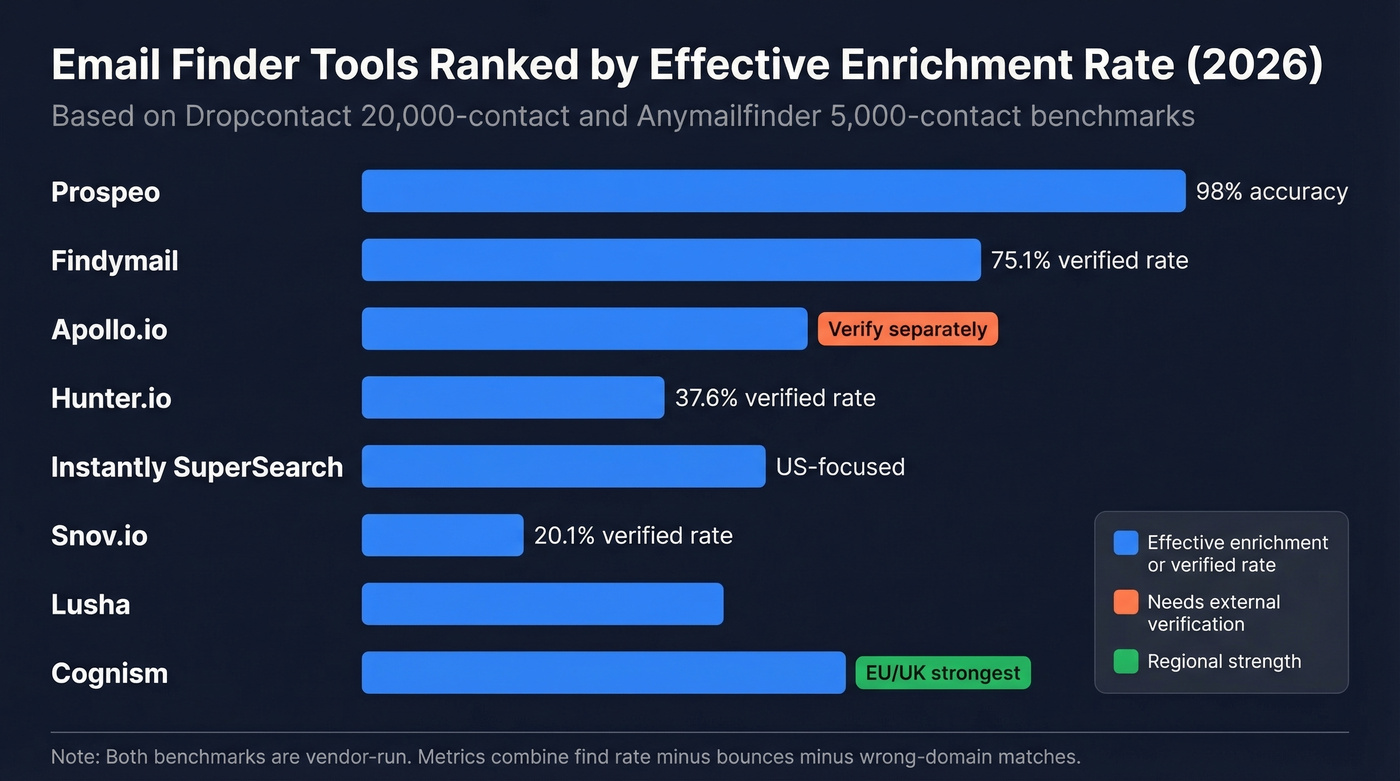
Enterprise pick: Cognism - GDPR compliance plus phone-verified EU/UK mobiles, DNC screening in 15+ countries.
Budget pick: Hunter.io - 50 free searches/month, enough for a solo founder doing targeted outreach.
How We Evaluated These Tools
We leaned on two independent studies that actually did the work - and we'll be upfront about their limitations.
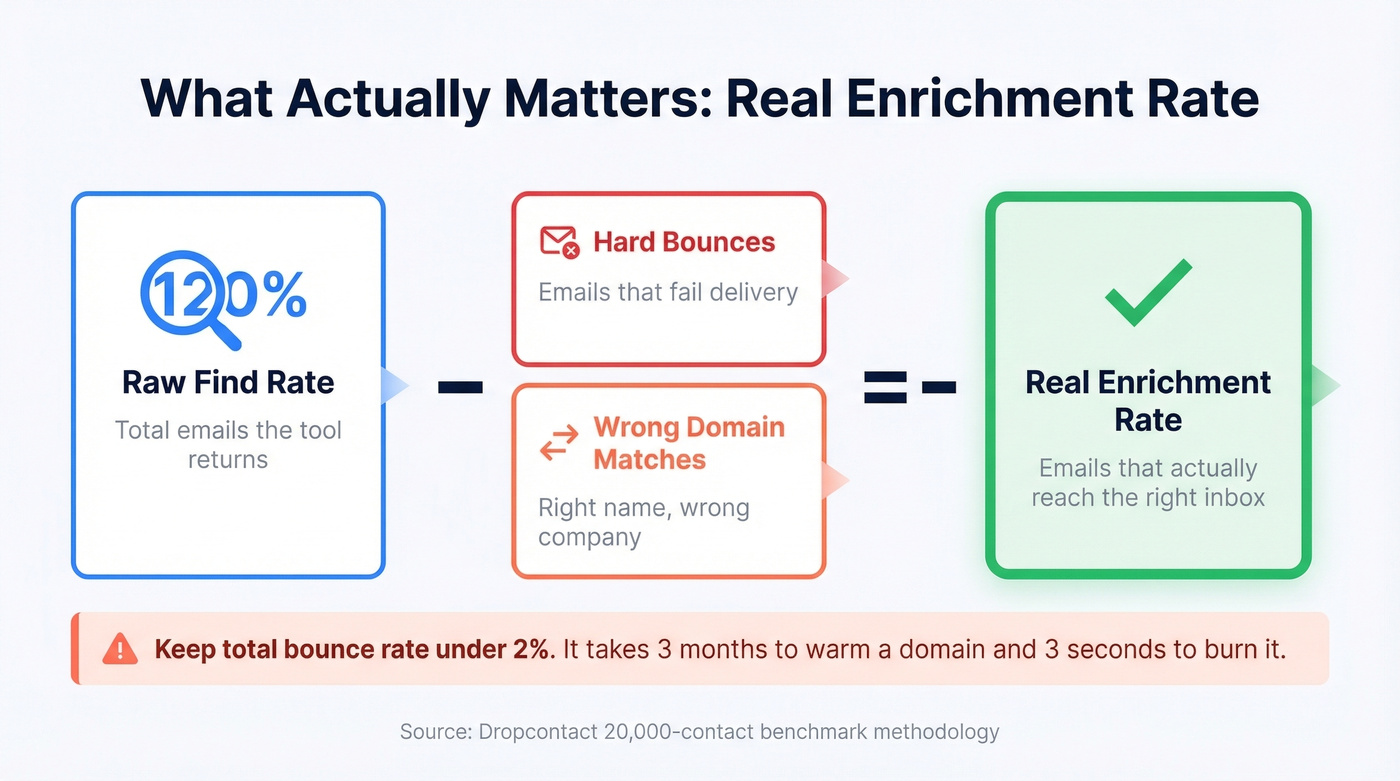
The first is Dropcontact's 20,000-contact benchmark. They tested 15 email finders using only first name, last name, and company name - no domains, no profile URLs. The dataset split roughly 9,800 US and 9,700 EU contacts, with 500 from the rest of the world. The critical detail: they verified results by actually sending emails and manually auditing domains to catch wrong-company matches, which gives us a metric worth caring about - what they call "real enrichment rate."
Real enrichment rate = raw find rate - hard bounces - wrong domain rate. That's the number of emails that actually reach the right inbox, not just the number a tool spits back at you.

The second study is Anymailfinder's 5,000-contact benchmark, most recently updated in September 2025 across the US, UK, France, Germany, and Saudi Arabia. They split contacts into domain-input and company-name-input files to test how tools handle messy data. Both benchmarks cross-validate each other on the tools they share.
Here's the uncomfortable part: both studies are vendor-run. Dropcontact funded theirs and tested themselves (they won). Anymailfinder ran theirs and tested themselves (they also won). We disclose this because nobody else does.
Beyond our top 10, tools like Dropcontact (54.9% effective enrichment), Fullenrich (48.3%), and Enrow (40.9%) posted strong numbers in the Dropcontact benchmark - worth watching if you need alternatives. We excluded Dropcontact from the main list because it's a verification-first tool rather than a prospecting database, but its benchmark performance is undeniable.
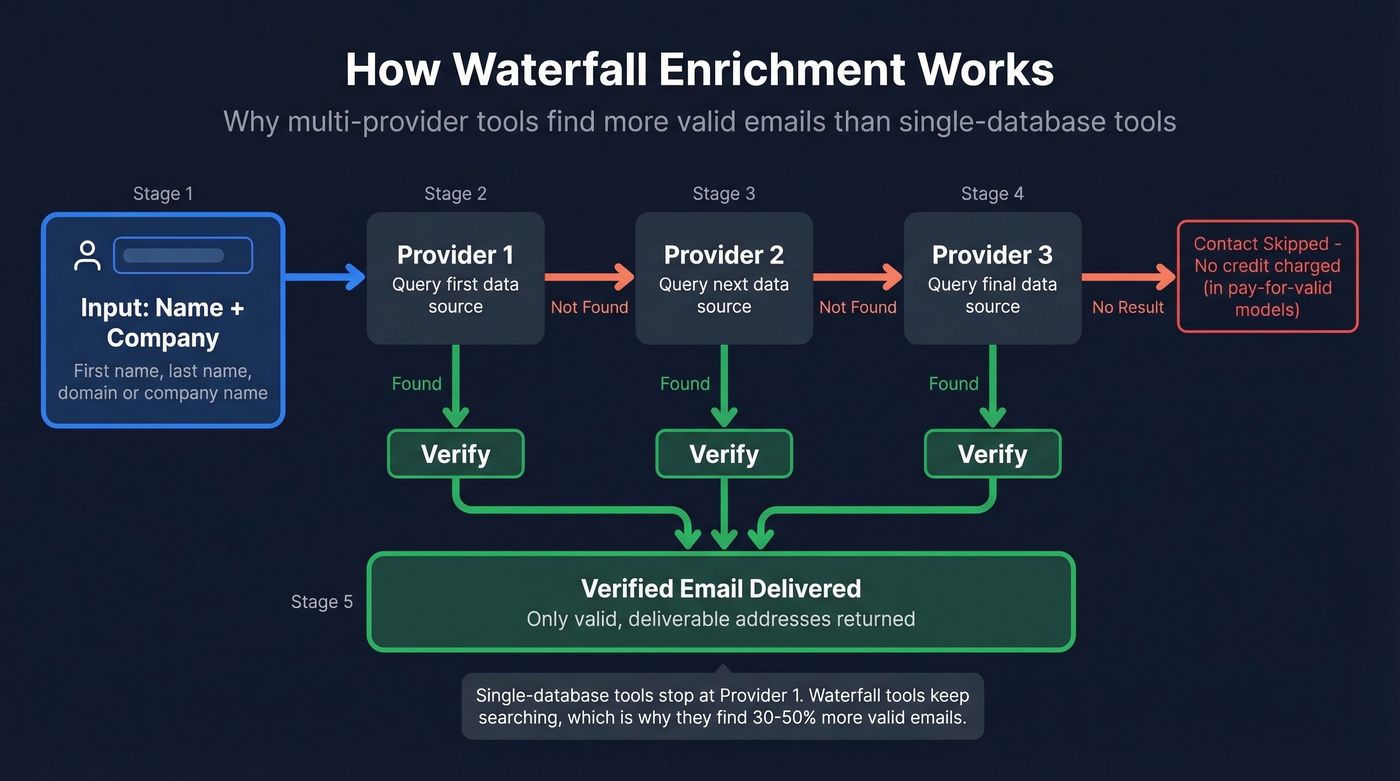
Waterfall enrichment matters. Tools that query multiple data providers sequentially find more emails than single-database tools. The bounce-rate guardrail is non-negotiable: keep total bounces under 2% . It takes three months to warm up a domain and three seconds to burn it with a bad list. And catch-all domain handling separates serious tools from toys - if a tool marks every catch-all as "valid," your bounce rate will spike.
Top 10 Email Finder Tools Compared
1. Prospeo - Highest Accuracy and Freshness
Use this if: You need the lowest possible bounce rate and can't afford domain damage. Outbound agencies running multiple client campaigns, SMB sales teams doing 500-5,000 emails per month, or anyone who's been burned by stale data from another provider.
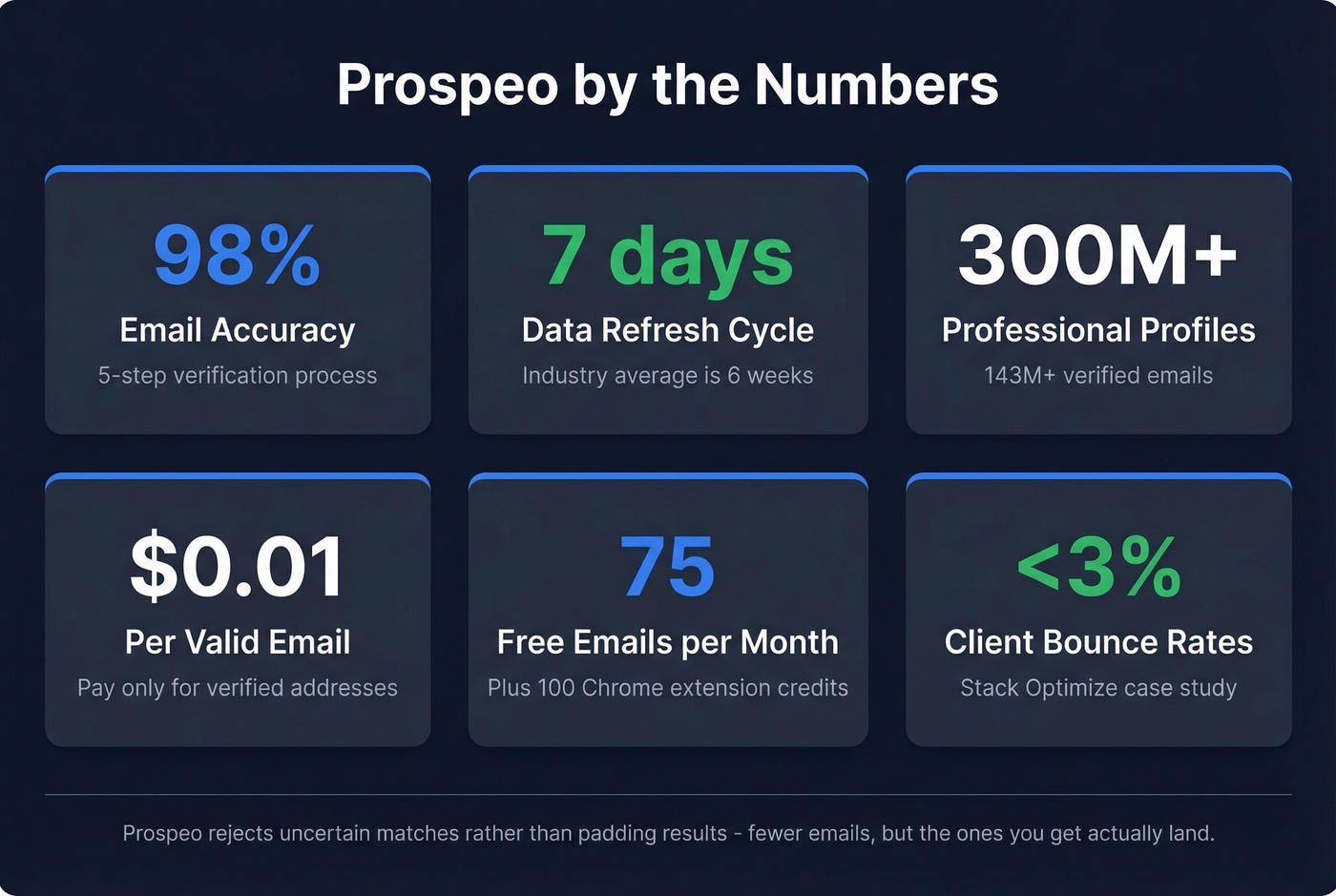
Prospeo's 98% email accuracy comes from a 5-step verification process with catch-all handling, spam-trap removal, and honeypot filtering - built on proprietary infrastructure rather than third-party email providers. The database covers 300M+ professional profiles with 143M+ verified emails and 125M+ verified mobile numbers, all refreshed on a 7-day cycle. For context, the industry average refresh is six weeks. That gap matters more than most people realize: B2B contact data decays at roughly 30% per year, so a six-week-old record is already carrying risk.

Prospeo's find rate in third-party benchmarks is lower than volume-first tools - by design. The 5-step verification rejects uncertain matches rather than padding results with unverifiable emails. Fewer results, but the ones you get actually land.
The 30+ search filters include buyer intent data powered by Bombora (15,000 topics), technographics, job changes, headcount growth, and funding. The Chrome extension has 40,000+ users and works across company websites and CRM pages. Stack Optimize, an outbound agency, built from zero to $1M ARR using Prospeo while keeping client deliverability above 94% and bounce rates under 3% across every campaign.
Pricing: Free tier gives you 75 emails + 100 Chrome extension credits per month. Paid plans run roughly $0.01 per email. You only pay for valid addresses. No contracts, no sales calls, cancel anytime.
Skip this if: You need a built-in email sequencer - pair with Instantly, Lemlist, or Smartlead for sending.
2. Findymail - Pay-Only-for-Valid Model
Findymail's billing model is the headline: you only burn credits on verified emails. Duplicates and invalids don't count. That alone makes it worth considering if you've been burned by tools that charge for garbage data.
The benchmark numbers back it up. Findymail posted a 75.1% verified rate in the Anymailfinder test and 39.9% effective enrichment in the Dropcontact study. Those are solid showings, and the pay-only-for-valid billing means your effective cost per usable email stays low. Most users report bounce rates under 5%.
Phone lookups cost 10 credits each, and unused credits roll over - but the balance caps at 2x your monthly allocation, so don't hoard them. Integrations cover HubSpot, Pipedrive, Lemlist, and Instantly.
Pricing: $49/mo (1,000 credits), $99/mo (5,000), $249/mo (15,000). Annual billing saves roughly 17%. Teams cap at 10 users below Enterprise.
Skip this if: You need a massive database for bulk lead generation - Findymail is a finder and verifier, not a lead database with intent filters.
3. Apollo.io - Best Free Tier to Start
Use this if: You're bootstrapping and need a CRM plus sales prospecting tool in one place without spending anything upfront.
The free plan is genuinely generous - you get contact access, limited sequences, and enough credits to test the waters. But let's be honest: Apollo is a great CRM with a mediocre email lookup tool bolted on. The contact data is frequently outdated. In r/DigitalMarketing, users note Apollo works best "if you're just working in the US" and flag stale contacts as a recurring problem, especially for EMEA prospecting.
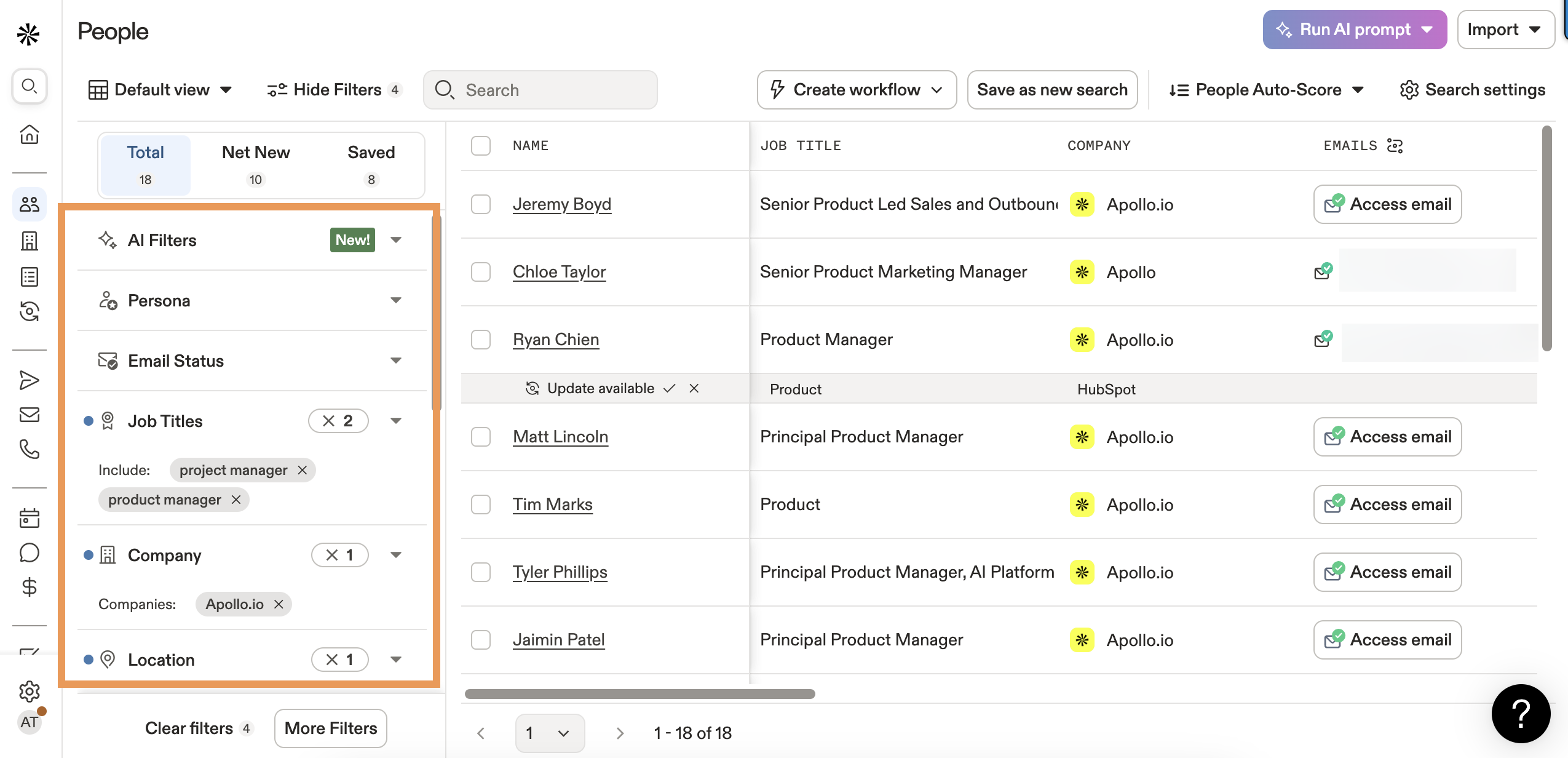
Credits don't roll over and expire each billing cycle, which catches teams off guard. Apollo does use waterfall enrichment behavior under the hood, querying multiple sources sequentially, but credit consumption varies depending on which source returns data. We've seen teams get great results from Apollo's search and sequencing, then watch their bounce rates climb because they skipped verification.
Pricing: Free, $49/mo, $79/mo, $119/mo (min 3 seats). Expect $50-$100/user/month for active outbound teams once overages kick in.
Skip this if: Deliverability is your top priority. Always run Apollo emails through a standalone email verification tool before sending.
4. Hunter.io - Domain Search Simplicity
Hunter is the Toyota Camry of email finders - reliable, boring, limited. The domain search feature is genuinely excellent: type in a company domain, get a list of associated emails with confidence scores. Built-in verification is a nice touch.
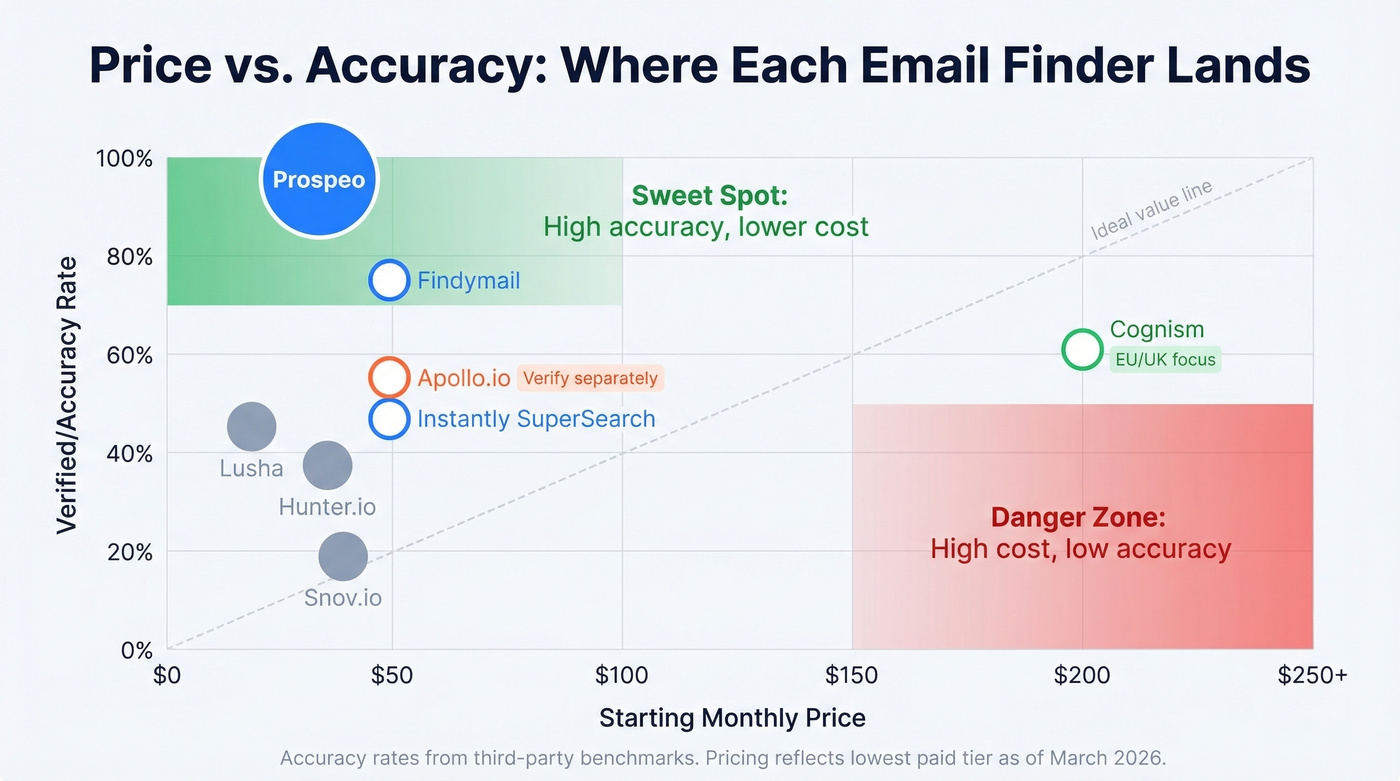
But the database is small. In the same r/DigitalMarketing threads, users call Hunter's database "small/tiny" - and the Anymailfinder benchmark confirms it at just 37.6% verified rate. Hunter's own email verification benchmark (15 verifiers, 3,000 emails) showed the best verifiers topping out around 70% accuracy - useful context for understanding the entire market's limitations.
Pricing: Free (50 searches/mo), Starter $34/mo (2,000 credits/mo), Growth $104/mo (10,000), Scale $204/mo (25,000).
Skip this if: You need volume. You'll outgrow Hunter's database fast once you're past the founder stage.
5. Instantly SuperSearch - Waterfall Enrichment
Instantly SuperSearch takes a multi-provider waterfall approach, querying several data sources sequentially until it finds a verified email. If you're already on Instantly's sending platform, this is the path of least resistance - everything stays in one ecosystem. The free trial gives you 100 credits to test.
Results are solid for US contacts, but international coverage is unproven. For EMEA-heavy prospecting, stick with Cognism.
Pricing: Nano $9/mo (150 credits), Growth $47/mo (1,500), Supersonic $97/mo (5,000).
6. Snov.io - All-in-One Outreach
Snov.io is better understood as an outreach platform that happens to include an email finder, not the other way around. The Anymailfinder benchmark showed a 20.1% verified rate - low by any standard. But if you need email finding, verification, drip sequences, and a lightweight CRM in one tool at a low price point, Snov.io bundles it all. The email finder is the weakest link in an otherwise decent cold email stack.
Pricing: Free trial (50 credits/mo), Starter $39/mo (1,000 credits), Pro $74.25/mo (5,000 credits).
7. Lusha - Quick Lookups
Lusha's Chrome extension is fast and frictionless - hover over a profile, get an email and direct dial. The data is partially community-sourced, which means coverage is strong for well-known companies and thinner for niche verticals. Individual reps love it for quick lookups during live prospecting sessions. It's less suited for bulk operations or API-driven workflows.
Where Lusha wins over ZoomInfo: speed and simplicity for individual reps. Where ZoomInfo still wins: database depth and workflow breadth.
Pricing: Free (40 credits/mo), Pro ~$22/mo (3,000 credits/yr), Premium ~$52/mo (7,200 credits/yr).
8. Cognism - GDPR-Compliant Prospecting
Cognism's edge is phone-verified mobiles in the EU and UK, plus DNC screening across 15+ countries. If you're selling into Europe, this is the compliance-first option that actually has usable data behind it.
The "unlimited" positioning comes with a "fair use" cap around ~2,000 records per user per month and daily export limits. Strongest in Europe, noticeably weaker in US and APAC. Annual contracts only. A related concern for GDPR-sensitive teams: several email finders route personal data through non-EU servers, raising FISA 702 and Cloud Act exposure - Cognism addresses this directly.
Pricing: Grow ~$22,500/yr (5 users), Elevate ~$37,500/yr (5 users) per Vendr benchmarks. Enterprise runs $30K-$100K+.
9. ZoomInfo - Enterprise-Grade, Enterprise-Priced
ZoomInfo is the default enterprise data platform, and it's priced accordingly. Professional starts around $15K/year, Advanced ~$25K, Elite ~$35K+. Annual contracts only, and renewals typically bump 10-20%. Credit unit economics run $0.20-$0.60 per credit depending on volume.
Here's the thing: ZoomInfo is still the most complete all-in-one B2B data platform. But most teams don't need all-in-one. They need accurate emails and a sending tool. Paying $15K+ for a platform you'll use 20% of is how budgets die.
10. UpLead - Accuracy Guarantees
UpLead offers a 95% accuracy guarantee with refunds for bounced emails - a confidence signal most competitors won't match. The 7-day free trial (5 credits) lets you test before committing. A solid mid-market option for teams that want accuracy assurance without enterprise pricing.
Pricing: Essential $99/mo (170 credits), Plus $199/mo (400 credits).

Every email finder on this list trades accuracy for volume - except one. Prospeo's 5-step verification rejects uncertain matches so you only get emails that land. 98% accuracy, 7-day data refresh, ~$0.01 per verified email.
Stop paying for emails that bounce. Start with 75 free lookups.
Pricing Comparison
The number that matters most isn't the monthly fee - it's cost per verified email.
| Tool | Plan | Monthly Price | Credits | ~Cost/Email | Free Tier | Contract |
|---|---|---|---|---|---|---|
| Findymail | Basic | $49 | 1,000 | ~$0.05 | 10 credits | Monthly |
| Apollo.io | Basic | $49/user | Usage-based | Varies | Yes | Monthly |
| Hunter.io | Starter | $34 | 2,000 | ~$0.02 | 50/mo | Monthly |
| Instantly | Growth | $47 | 1,500 | ~$0.03 | 100 credits | Monthly |
| Snov.io | Starter | $39 | 1,000 | ~$0.04 | 50/mo | Monthly |
| Lusha | Pro | ~$22 | 250/mo | ~$0.09 | 40/mo | Annual |
| Cognism | Grow | ~$1,875/mo | ~2K/user/mo | ~$0.94 | No | Annual |
| ZoomInfo | Professional | ~$1,250/mo | ~5,000 bulk | ~$0.20-$0.60 | No | Annual |
| UpLead | Essential | $99 | 170 | ~$0.58 | 5 credits | Monthly |
The spread is enormous. For a team sending 5,000 verified emails per month, Prospeo at ~$0.01 per email costs roughly $50. ZoomInfo at $0.20-$0.60 per credit runs $1,000+. That's a 20x+ difference - not a rounding error, a budget decision.
Email Finder Accuracy: What Nobody Tells You
Most comparisons conflate two very different metrics: find rate and accuracy of found emails. A tool that finds 80% of contacts but 15% of those bounce is worse than a tool that finds 40% where every single one lands. The Dropcontact benchmark made this distinction explicit - and the results were humbling for several popular tools.
Catch-all domain handling is the hidden differentiator nobody talks about. Roughly 30-40% of business domains are configured as catch-all, meaning they accept any email address without bouncing. Lazy tools mark these as "valid" and move on. Serious tools apply additional checks - catch-all verification, spam-trap removal, honeypot filtering - to determine whether the specific mailbox actually exists. This single capability is the difference between a 2% bounce rate and a 12% bounce rate.
Database size is the most overrated metric in this space. Gartner pegs the average cost of poor data quality at $12.9M annually. When someone changes jobs - and roughly 30% of B2B contacts turn over each year - a six-week-old database is sending you to their old company's inbox. Data refresh frequency matters more than database size. Full stop.
International coverage is where most B2B email lookup tools fall apart. The majority are US-centric, and the consensus on r/sales and r/DigitalMarketing confirms this repeatedly. If you're prospecting in EMEA or APAC, test with your actual target accounts before committing to an annual contract. We've watched teams sign $25K ZoomInfo contracts only to discover the European data was thin enough to see through.
How to Pick the Right Tool
Look, you don't need 12 tools. You need two, maybe three.
Agencies scaling multiple client campaigns need a provider that won't charge per-client and won't torch anyone's sender reputation. Enterprise teams with compliance requirements should look at Cognism for EU/UK coverage and ZoomInfo for US-heavy orgs - but be ready for annual contracts and five-figure invoices.
For teams already on Apollo for CRM, stay. But add a verification layer. Don't trust Apollo emails without a second check.
The pattern is always the same: teams buy the biggest database, realize 30% of it is stale, then spend three months rebuilding domain reputation. Start with accuracy. You can always add volume later.
Stack Optimize built a $1M agency on Prospeo data - zero domain flags, bounce rates under 3% across every client campaign. That's what happens when your email finder runs proprietary verification instead of reselling third-party data.
Find out why 15,000+ companies switched to data they trust.
FAQ
What is an email finder tool?
Software that discovers professional email addresses from names, companies, or domains. The strongest options verify emails in real time so you only pay for addresses that actually reach inboxes. Most combine finding and verification into a single workflow.
Are email finder tools legal?
Yes, when used for legitimate business outreach. GDPR-compliant tools like Cognism and Prospeo process data lawfully, honor opt-out requests, and offer DPAs. Always follow CAN-SPAM, GDPR, and local regulations - the tool handles data sourcing, but you're responsible for how you use it.
How accurate are email finders really?
Independent benchmarks show "real enrichment rates" ranging from 17% to 77% - far below the 95%+ that most tools claim in marketing. The gap comes from conflating "find rate" with "deliverable email rate." Always look at post-send bounce data, not the tool's self-reported accuracy.
Which email finder has the best free plan?
Hunter offers 50 searches/month, Apollo provides limited credits with CRM access, and Lusha gives 40 credits/month. Prospeo's free tier includes 75 emails plus 100 Chrome extension credits - the most generous for teams that need verified contacts without upfront cost.
How often should I re-verify email lists?
At minimum every 90 days. B2B data decays at roughly 30% per year, so a list that's six months old carries significant bounce risk. Tools with frequent refresh cycles (Prospeo refreshes every 7 days) reduce this burden automatically, but standalone re-verification before any major send is still smart practice.