

The Best Email Finder Tools in 2026: Tested, Ranked, and Honestly Reviewed
You just uploaded 5,000 contacts into your sequencer, hit send, and watched 900 of them bounce. Your domain reputation tanks. Deliverability craters for the next two weeks. Your SDR team is dead in the water - that's an 18% bounce rate, and it happens more often than anyone in this space wants to admit. Recovering from a domain reputation hit typically takes weeks of throttled sending and careful warm-up, which isn't just an inconvenience; it's lost pipeline that nobody budgets for.
Here's the uncomfortable truth: 8 out of 10 email finder tools charge you full price for emails that bounce. They'll brag about database size - 200M contacts! 300M contacts! - but database size is a vanity metric. Your bounce rate is the only number that matters. A tool that finds 50% fewer emails but delivers 98% of them will outperform a massive database with a 25% bounce rate every single time.
We've spent months testing, comparing, and running real outbound campaigns through these tools. What follows isn't a feature-list roundup. It's an honest ranking based on what actually works when you press send.
Our Picks
| Pick | Tool | Best For | Why |
|---|---|---|---|
| 🏆 Best overall | Prospeo | Accuracy + data freshness | 98% email accuracy, 7-day data refresh, ~$0.01/email |
| 🎯 Best bounce guarantee | Findymail | Zero bounce tolerance | <5% invalid guarantee, pay only for found emails |
| 🆓 Best free tier | Apollo.io | Getting started on a budget | 275M+ contacts, generous free plan, built-in sequencing |
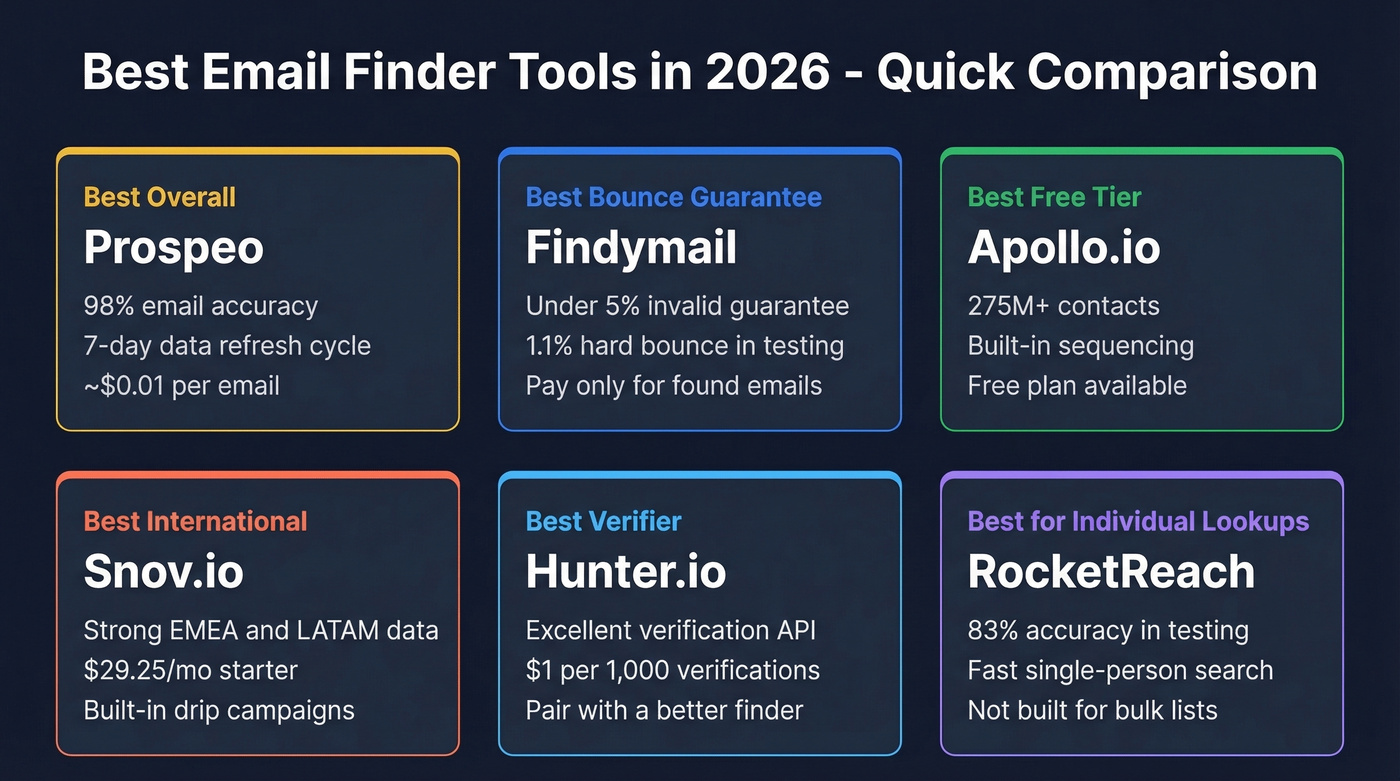
Best for international coverage: Cognism and Snov.io. If you're prospecting outside the US, most tools fall apart - these don't.
Best budget option: Snov.io at $29.25/mo for 1,000 credits, with built-in email automation and credit rollover on higher tiers.
The tool with the biggest database isn't the tool with the best results.
How We Evaluated These Tools
Most "best email finder" articles test 10 contacts and call it a day. We looked at three independent benchmarks to build a more complete picture.
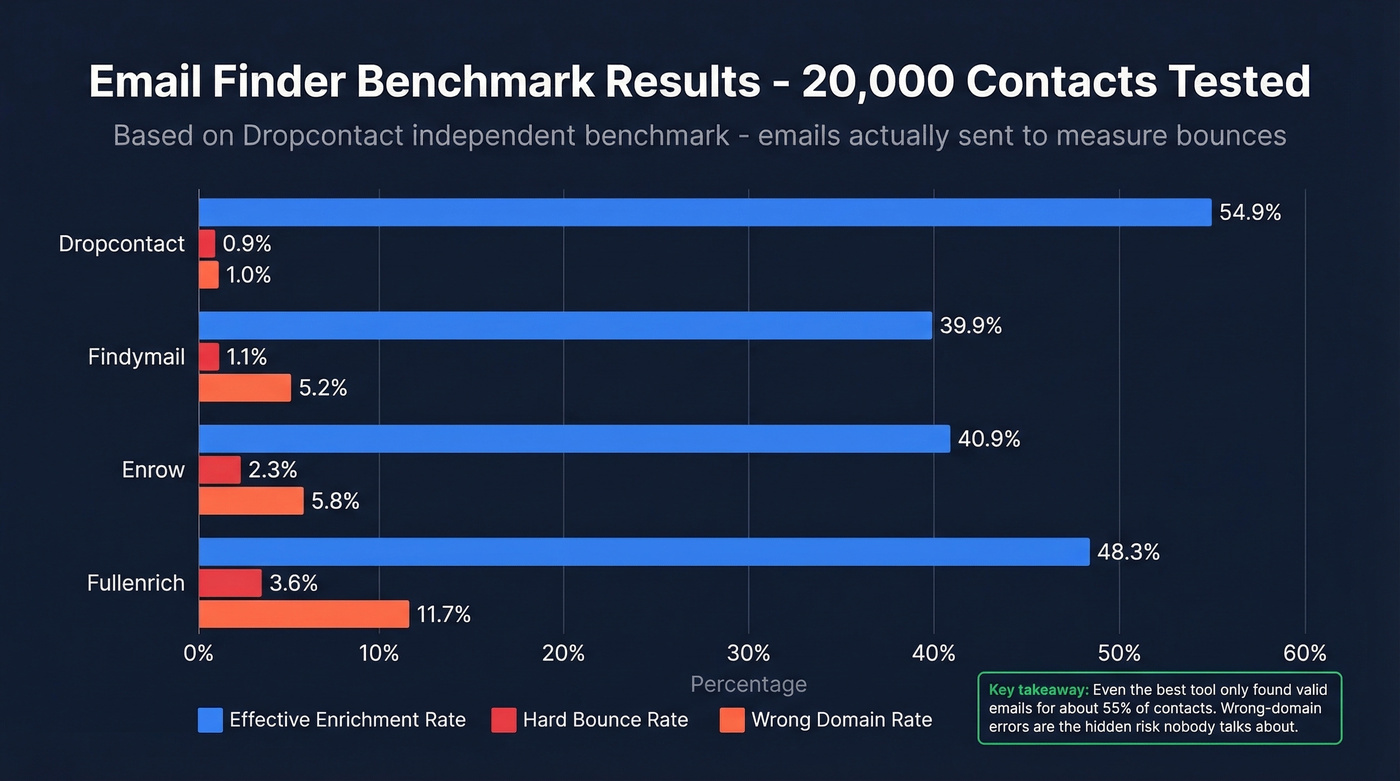
The most rigorous is Dropcontact's 20,000-contact benchmark, which tested 15 tools using only first name, last name, and company name - no domains, no profile URLs. The dataset split roughly 9,800 US contacts and 9,700 European contacts plus 500 from the rest of the world. What makes this benchmark stand out: they actually sent every email to measure hard bounces, and they ran a manual dual-entry protocol to catch wrong-domain errors, meaning emails that verify fine but go to the wrong company entirely. The top performers tell a sobering story:
| Tool | Effective Enrichment | Hard Bounce | Wrong Domain |
|---|---|---|---|
| Dropcontact | 54.9% | 0.9% | 1.0% |
| Findymail | 39.9% | 1.1% | 5.2% |
| Enrow | 40.9% | 2.3% | 5.8% |
| Fullenrich | 48.3% | 3.6% | 11.7% |
Even the best tool only found valid, deliverable emails for about 55% of contacts. That's the ceiling.
Wrong-domain rate is the metric nobody talks about. Tools returned emails that passed SMTP-style checks but belonged to the wrong company at rates from about 1% up to 11.7%. That's not just a bounce - it's a compliance risk and a wasted touch.
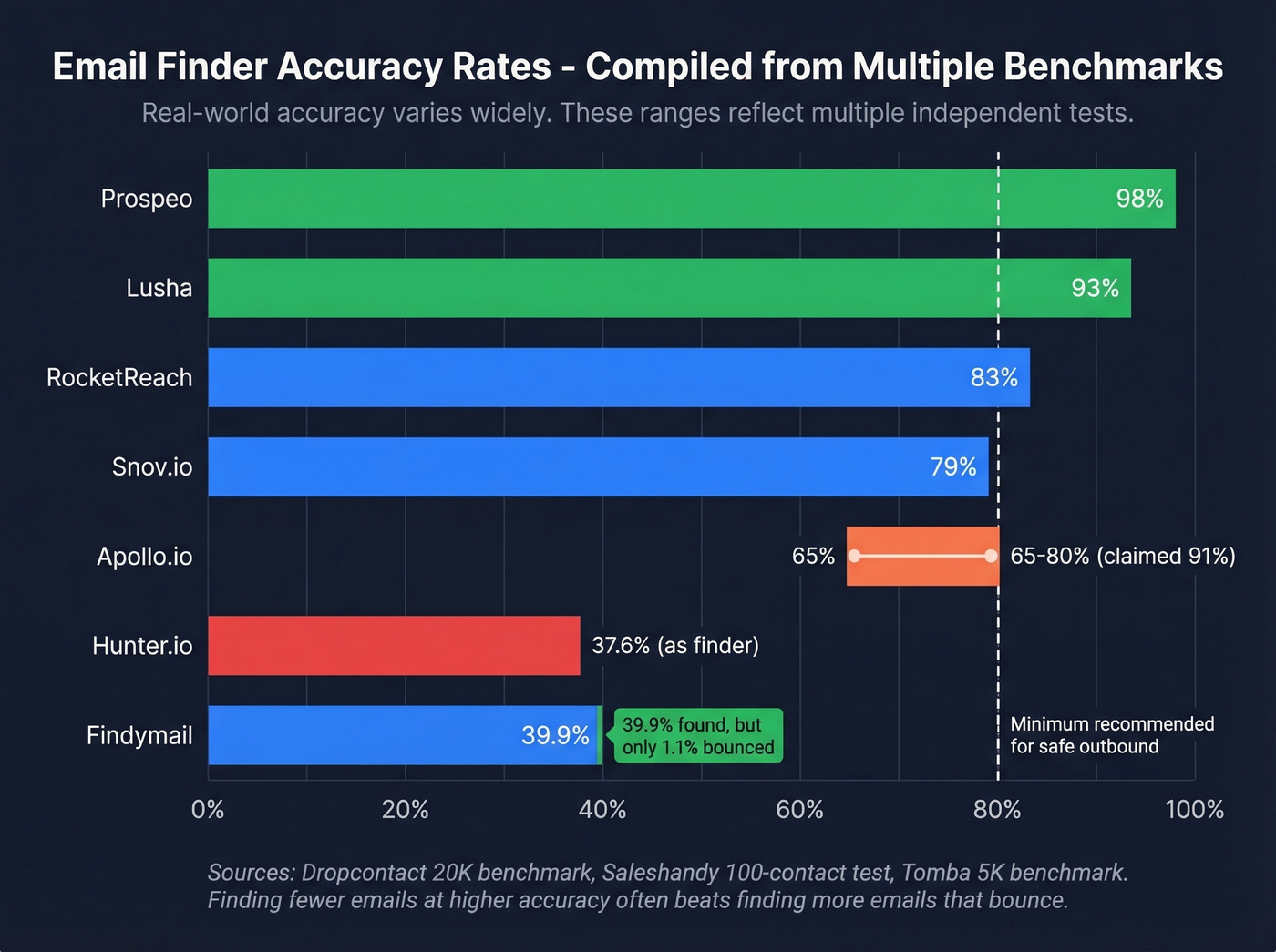
For contrast, Tomba ran a 5,000-search benchmark across 9 tools in February 2026. It's a vendor blog positioning Tomba as the winner, so take the absolute rankings with a grain of salt. But the relative spread is useful: accuracy ranged from 16.9% to 80.3% depending on the tool and search type. Company-name searches without a domain nearly broke several tools. Saleshandy's team tested across 95,000 cold emails before narrowing to a 100-contact accuracy test, with results ranging from 79% to 98% across 12 tools - smaller final sample, but it confirms the pattern that the gap between the best and worst tools is enormous.
Don't trust any single benchmark. Look for tools that perform consistently across multiple tests, and pay close attention to hard bounce rates and wrong-domain errors - not just match rates.
Top Email Finder Tools Ranked for 2026
Prospeo - Best for Accuracy and Data Freshness
Use this if: You need the freshest data with the lowest bounce rate, you're scaling outbound and can't afford domain reputation damage, or you're prospecting internationally.
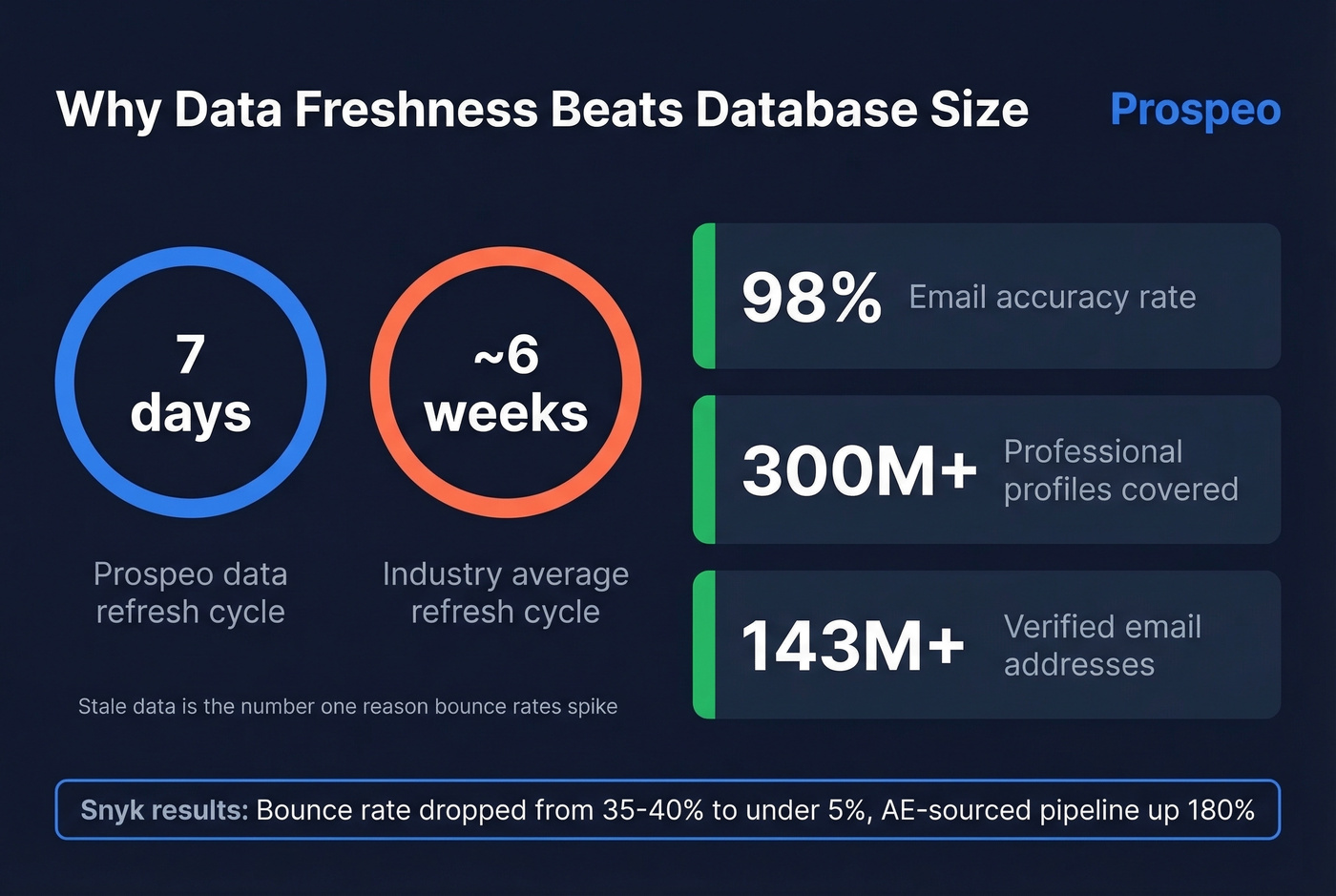
Prospeo's database covers 300M+ professional profiles, 143M+ verified emails, and 125M+ verified mobile numbers with a 30% pickup rate across all regions. The 98% email accuracy comes from a proprietary 5-step verification process that includes catch-all handling, spam-trap removal, and honeypot filtering - steps most competitors skip. You only pay for valid addresses; failed lookups don't consume credits.

The standout differentiator is the 7-day data refresh cycle. The industry average is roughly 6 weeks. That gap matters enormously - job changes, company pivots, and email migrations happen constantly, and stale data is the #1 reason bounce rates spike. Snyk's 50-person AE team saw their bounce rate drop from 35-40% to under 5%, with AE-sourced pipeline up 180% and 200+ new opportunities per month.
Search filters go deep: 30+ options including buyer intent powered by 15,000 Bombora topics, which lets you filter for companies actively researching solutions in your category so you're reaching out when they're already in-market. Technographics, job change signals, headcount growth, and funding data round out the filter set. Native integrations include Salesforce, HubSpot, Smartlead, Instantly, Lemlist, Clay, Zapier, and Make. Pricing runs ~$0.01 per email with a free tier of 75 emails per month. No contracts, no sales calls required.
If you want a deeper breakdown of tools that combine finding + validation, see our guide to email finder and verifier tools.
Findymail - Best Bounce Guarantee
Use this if: Your agency sends 500+ emails daily and a single bounce spike could torch your clients' domains. Or if you're tired of paying for emails that don't work.
Skip this if: You need EU phone numbers - Findymail only offers non-EU phone enrichment due to GDPR - or you want an all-in-one prospecting platform.
Findymail's core promise is simple: less than 5% invalid emails, guaranteed. You only pay for emails they successfully find. In the Dropcontact benchmark, Findymail hit 39.9% effective enrichment with just a 1.1% hard bounce rate, which is excellent.
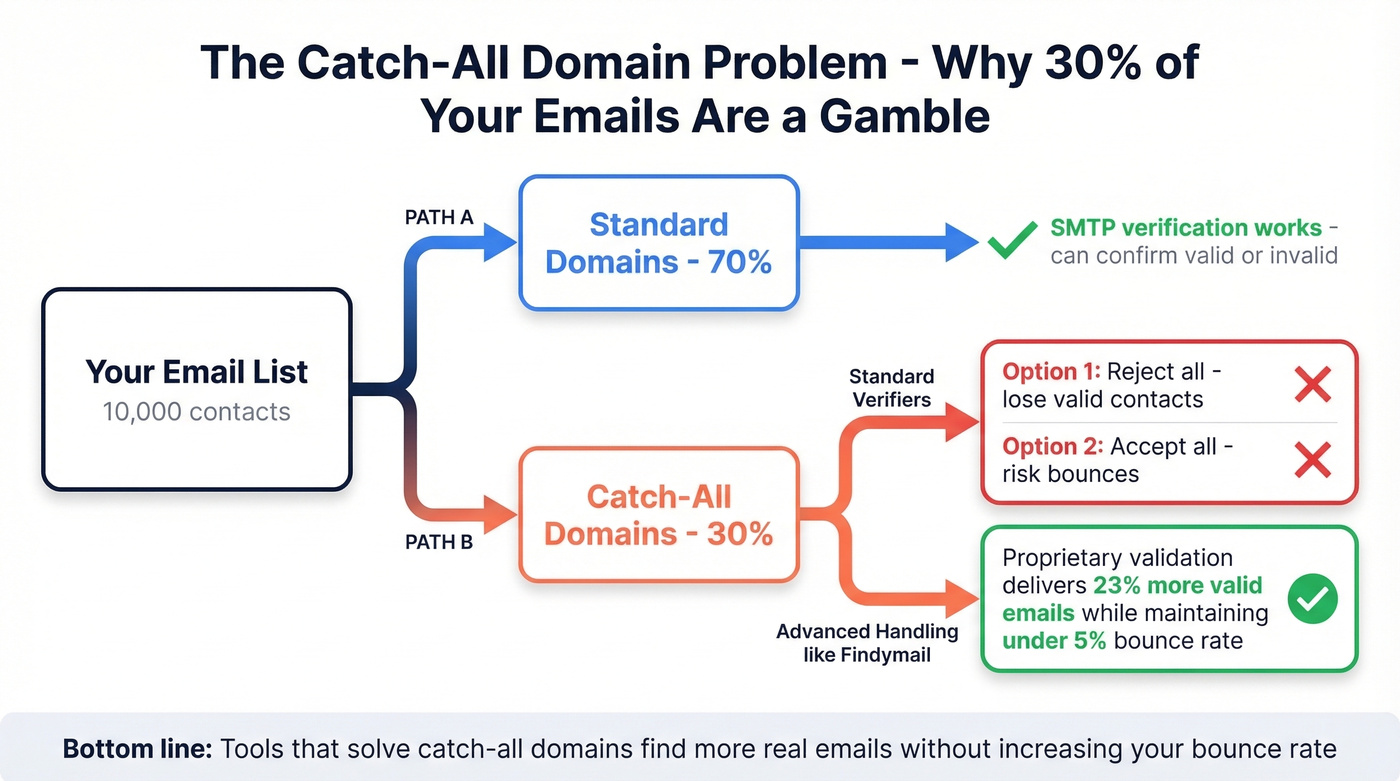
Where Findymail gets interesting is catch-all domain handling. Standard verifiers can't validate up to 30% of the audience due to catch-all domains - they either reject them and lose valid contacts, or accept them blindly and risk bounces. Findymail delivers 23% more valid emails than standard verifiers by solving this problem. Phone numbers cost 10 credits each, but only for non-EU contacts.
Pricing runs $49-$249/mo depending on volume. Integrations cover the major sequencers - Smartlead, Instantly, Lemlist, Woodpecker - plus HubSpot, Salesforce, and Zapier. It's not the cheapest option, but the bounce guarantee makes the math simple: you're paying for emails that actually work.
If you're trying to reduce bounces further, pair any finder with a dedicated email verification tool.
Apollo.io - Best Free Tier
Apollo has the biggest database in the space. That's not the same as the best database.
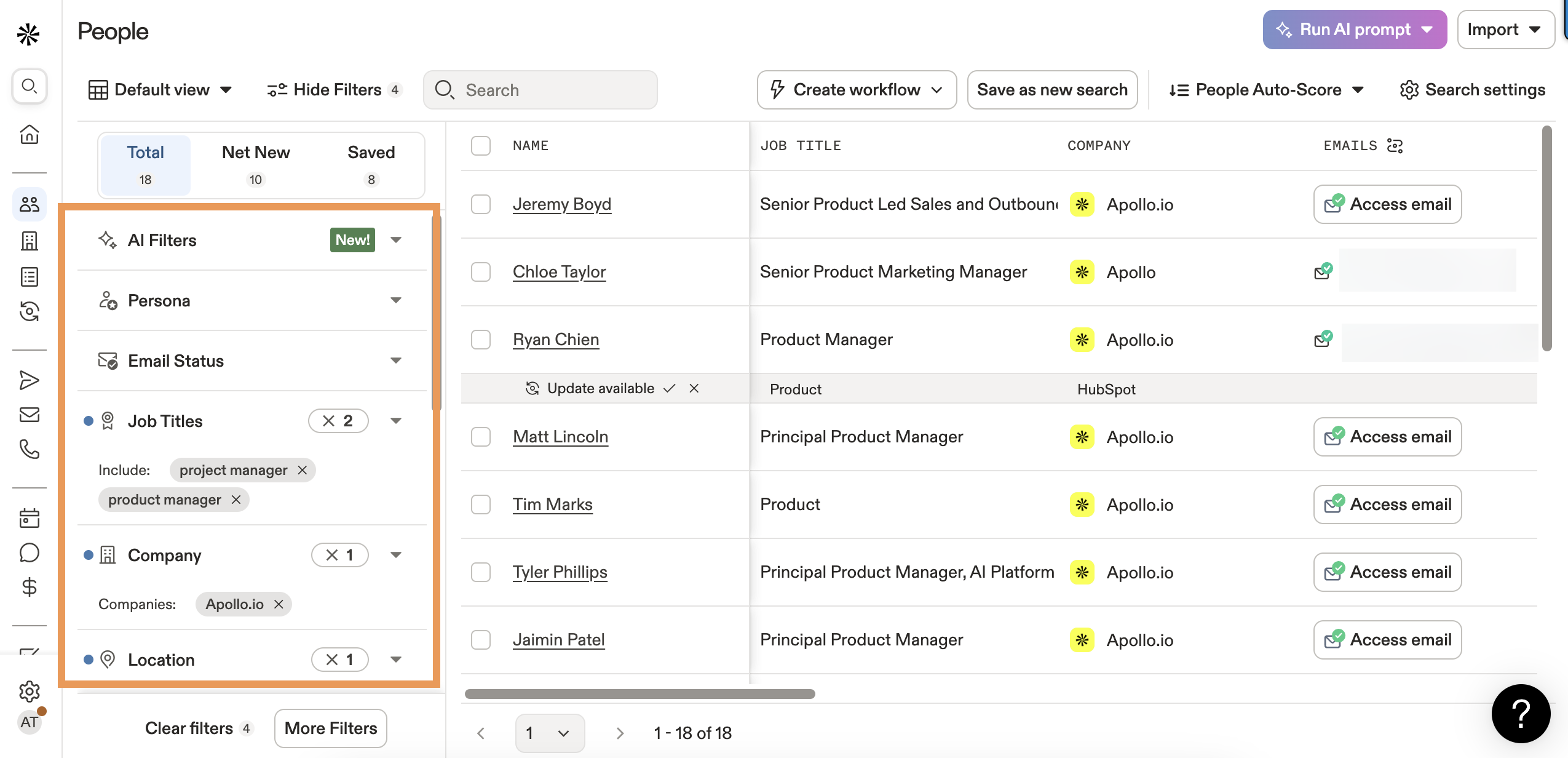
275M+ contacts and 60M+ company profiles, a generous free tier, and built-in sequencing that lets you go from search to send without leaving the platform. For teams just getting started with outbound, it's the obvious first stop. Among free email lookup options, Apollo's offering is hard to beat on sheer volume.
Apollo claims 91% email accuracy via a 7-step verification process, but real-world performance tells a different story. User reports consistently put accuracy in the 65-80% range, with bounce rates climbing to 35% on older contacts. The database is big, but it's not always fresh. The recurring theme on Reddit: "biggest database but contacts are out of date."
Skip this if: You're sending at scale and can't tolerate bounce rates above 10%, or your target market is primarily outside the US.
Paid plans start at $59/mo for Basic with 2,500 credits, $99/mo for Professional, and $149/mo for Organization. Per-seat pricing adds up fast - a 10-person team on Professional is $11,880/year before extras. The free tier is the real draw. Use it for exploration, but verify everything before you send.
For a deeper dive, see our full Apollo email finder review.
Hunter.io - Great Verifier, Mediocre Finder
Let's be honest: Hunter is two products in one, and one of them is mediocre. As a verifier, it's excellent - clean API, fast bulk processing, reliable results. As a finder, it's disappointing. The Tomba benchmark showed 37.6% accuracy on 5,000 searches, putting it in the bottom half of tools tested. The consensus on r/DigitalMarketing is blunt: "tiny database."
The free plan gives you 50 searches per month. Paid starts at ~$35-40/mo for 500 searches, with verification credits at $1 per 1,000 - dirt cheap. The Chrome extension works well for one-off lookups.
Our recommendation: use Hunter as a verification layer on top of a better lookup tool. Don't rely on it as your primary source. If you're comparing options, start with our list of email ID validators.
Snov.io - Best for International Teams
"Good for international leads" and "affordable credits" - those are the phrases that keep appearing in Reddit threads when someone asks about lead generation outside the US. Snov.io earned that reputation.
The built-in drip campaign engine is a genuine differentiator. You can find contacts, verify them, and sequence them without leaving the platform. For teams prospecting in EMEA, LATAM, or APAC, this matters because most tools are US-first with international coverage as an afterthought.
Skip this if: You need the absolute highest accuracy rates. Snov.io's strength is breadth and affordability, not precision - the Saleshandy test put accuracy at 79%.
Starter pricing is $29.25/mo for 1,000 credits, with Pro at $74.25/mo for 5,000 credits. Free tier gives you 50 searches per month. Credits roll over on higher tiers, which is a nice touch most competitors don't offer.
If you're doing a lot of one-off lookups, a dedicated person email finder can be a better fit.
RocketReach
Pros: Strong for individual lookups - paste a name and company, get a result fast. The Saleshandy benchmark showed 83% accuracy, which is solid mid-tier.
Cons: Pricing runs ~$50-150/mo depending on tier, with limited free lookups. The workflow is built around one-off searches, not list building at scale.
RocketReach is the tool you use when you need one specific person's email right now. It's not the tool you build a 5,000-contact campaign around. If you're evaluating it specifically, see our RocketReach email finder review.
Lusha
Lusha hit 93% accuracy in the Saleshandy benchmark - one of the highest in their test. Strong direct dial data alongside emails, and the Chrome extension is solid. The catch is per-user pricing from ~$49/mo, which adds up fast for teams. Five seats runs ~$250/mo minimum. The free tier is just 5 credits per month, barely enough to evaluate the tool. Best for small teams or individual contributors who need both emails and phone numbers. If you're comparing plans, check our updated Lusha pricing breakdown.
GetProspect
Free 50 emails per month with paid plans from $49/mo for 1,000 valid emails plus 2,000 verifications. Phone number finding is available alongside email lookup.
Here's the thing about GetProspect: accuracy varies wildly depending on who's testing. Tomba's benchmark showed 61.9%, while Saleshandy reported 95%. That massive discrepancy suggests performance depends heavily on your target market and the types of companies you're searching. It's a decent mid-tier option, but the inconsistency across benchmarks makes it a gamble.
Cognism
Strong for EU and UK targeting with a heavy compliance focus. Enterprise-level pricing, typically $1,000-3,000/mo for small teams. Reddit sentiment is clear: "great for EU/UK" but "pricing seems enterprise-level."
If you're selling into Europe and compliance is non-negotiable, Cognism is worth the premium. For everyone else, it's overkill for email finding alone.
Quick Mentions
Skrapp.io offers a free tier with paid plans from ~$49/mo. Credits are only charged for Valid or Catch-All results, which is a fair model. The Tomba benchmark put accuracy at 42.8% - below average, but the pay-for-valid-only policy softens the blow.
Voila Norbert gives you 50 free searches to start, with paid plans from $39/mo for 1,000 searches. Clean UI, limited feature set, and the Tomba benchmark showed just 36% accuracy. Fine for occasional lookups, not for scale.
Anymail Finder starts at $19/mo for 50 searches and $39/mo for 1,000 - no free plan. You only pay for fully verified results, and unused credits roll over. The Tomba benchmark showed 77.5% accuracy, which is surprisingly strong for a tool this affordable.
Instantly Lead Finder is worth watching. Instantly now offers a Lead Finder with waterfall enrichment that pulls from multiple data sources in sequence. It's newer and less battle-tested than the tools above, but if you're already running Instantly for email sequences, the native integration eliminates export/import friction.
Email Finder Pricing Comparison
Pricing across these tools is a mess. Hunter appears as EUR34/mo and $49/mo depending on which comparison you read, and some lists show different USD figures depending on region and billing terms.
Here's the simplest way to compare:
| Tool | Free Tier | Starting Price | Pay-for-Valid? |
|---|---|---|---|
| Findymail | No | $49/mo | Yes |
| Apollo.io | Yes (generous) | $59/mo | No |
| Hunter.io | 50 searches/mo | ~$35-40/mo | No |
| Snov.io | 50 searches/mo | $29.25/mo | No |
| RocketReach | Limited | ~$50/mo | No |
| Lusha | 5/mo | ~$49/mo/user | No |
| GetProspect | 50 emails/mo | $49/mo | No |
| Cognism | No | ~$1,000/mo | No |
| Skrapp.io | Yes | ~$49/mo | Partial |
| Voila Norbert | 50 searches | $39/mo | No |
| Anymail Finder | No | $19/mo | Yes |
The "pay only for valid" model at Prospeo, Findymail, and Anymail Finder means you're not burning budget on dead addresses. That distinction alone can cut your effective cost per usable email by 20-40% compared to tools that charge for every lookup regardless of result.
Hot take: ZoomInfo runs $15-40K+/year depending on seats and modules. If your average deal size is under five figures, you almost certainly don't need ZoomInfo-level data. Using it purely for email prospecting is like buying a semi-truck to deliver a pizza. A focused tool at $30-50/mo will get you 90% of the value at 2% of the cost.

Most email finders charge you for emails that bounce. Prospeo's 5-step verification - with catch-all handling, spam-trap removal, and honeypot filtering - delivers 98% accuracy. At ~$0.01/email, a single avoided domain reputation hit pays for itself.
Stop paying for bounces. Start with 75 free verified emails.
A Typical Email Finding Workflow
Here's what a real prospecting workflow looks like, start to finish:
- Build a target list of 500 prospects using filters - job title, industry, company size, funding stage
- Run bulk enrichment through your tool of choice
- Filter results to verified-only emails, discarding catch-all addresses you can't validate
- Export the clean list to your sequencer (Smartlead, Instantly, Lemlist, or whatever you use)
- Monitor bounce rates on the first 50-100 sends before scaling up
The entire process takes 15-30 minutes with a good tool. If it's taking you hours, you're using the wrong one. If you're doing this inside Chrome, consider dedicated email finder extensions.
What Real Users Say
The consensus on Reddit is remarkably consistent across threads. Apollo has the biggest database, but freshness is the recurring complaint. "Contacts are out of date" and "lots of bounces on older contacts" show up in nearly every thread that mentions it. One agency owner targeting 500-1,000 emails per day said their top priority was accuracy and an "under 5% bounce rate" - and Apollo wasn't cutting it.
Hunter gets respect for verification but frustration as a finder. "Tiny database" and "better as a verification layer than a primary source" are the phrases that keep appearing. Snov.io earns consistent praise for international coverage and affordable credits, especially from teams prospecting in EMEA and LATAM.
Findymail users consistently report sub-2% bounce rates, with the pay-for-success model earning praise from agencies running high-volume campaigns.
Data freshness is the #1 unaddressed complaint across all threads. Users don't just want more emails - they want emails that still work. We've seen this firsthand: teams that switch from stale-data providers to tools with weekly refresh cycles see immediate bounce rate improvements, sometimes dropping from 30%+ to under 5% within the first campaign.
How to Choose the Right Tool
Five questions that actually matter:
What's your bounce rate tolerance? If you can't afford more than 5% bounces - and most outbound teams can't - prioritize tools with pay-for-valid-only models like Findymail or Anymail Finder. Tools that charge for every lookup regardless of result will cost you twice: once in credits, again in domain reputation damage. If you want the numbers behind this, see the benefits of email verification.
US-only or international? If you're prospecting globally, your options narrow fast. Cognism and Snov.io have the strongest international coverage. Most other tools are US-first, with EMEA and APAC as afterthoughts.
Do you need just emails or also phone numbers? For direct dials, look at Lusha or Cognism. Most email lookup tools treat phone numbers as an add-on, not a core feature.
Self-serve or enterprise? If you want transparent pricing and no sales calls, avoid ZoomInfo and Cognism. Apollo, Hunter, and Snov.io all offer self-serve onboarding with published pricing.
How fresh does the data need to be? This is the question nobody asks until it's too late. The industry average for data refresh is about 6 weeks, which means after a month, a typical database has thousands of contacts who've changed jobs, switched emails, or left their companies entirely. If freshness is your top priority, check the vendor's refresh cycle before anything else.
One more thing most buyers overlook: catch-all domains. About 38% of domains globally are catch-all, meaning they accept any email address regardless of whether it exists. These domains carry 27x higher bounce risk. Tools that can't handle catch-all verification will either reject these contacts entirely - losing valid prospects - or accept them blindly and destroy your deliverability. Ask every vendor how they handle catch-all domains before you buy.
GDPR, CAN-SPAM, and Compliance
Using an email finder to prospect in the EU isn't illegal - but doing it wrong is expensive. Cumulative GDPR fines have crossed EUR5.88B across 2,245+ enforcement actions, with Spain alone accounting for over 1,000 fines. The average email violation fine runs EUR450K-EUR800K. Small-scale violations still cost EUR5K-EUR50K.
The legal basis for B2B cold email in most EU jurisdictions is legitimate interest under Article 6(1)(f) of the GDPR. The ICO's three-part test requires you to demonstrate a legitimate purpose, that the processing is necessary, and that the individual's interests don't override yours. For B2B prospecting to named business contacts about relevant products, this test is generally passable - but you need to document it.
Here's where it gets messy: legitimate interest under GDPR doesn't override ePrivacy rules, which vary by country. The ePrivacy Regulation effort was abandoned in early 2025, so the patchwork persists. Germany is stricter than the UK. France has its own rules. EDPB Guidelines 2/2023 expanded the scope to cover tracking pixels, URL tracking, and IP-based tracking originating from user devices, so your email sequences might trigger compliance obligations beyond just the initial send.
Email verification isn't just a nice-to-have for compliance. Sending to invalid addresses damages your domain reputation, which increases the chance your legitimate emails land in spam. A verified list is both a deliverability tool and a compliance safeguard - every email that bounces is a data point regulators can use to argue you weren't exercising due diligence.
If you need a practical SOP for cleaning lists before outreach, use our email verification list guide.
FAQ
What is an email finder and how does it work?
An email finder takes a person's name and company, then returns their business email address. Most tools combine pattern generation (guessing formats like first.last@domain.com), SMTP verification (pinging the mail server to check if the address exists), and database lookup (matching against previously collected records). The best tools layer all three and add catch-all domain handling on top.
How accurate are email finder tools, really?
Independent benchmarks show the best tools achieve 40-55% effective enrichment with sub-2% bounce rates. The Dropcontact 20,000-contact study found even the top performer hit only 54.9% after accounting for hard bounces and wrong-domain errors. Self-reported accuracy always runs higher than real-world results. Expect no tool to find every contact - but the best ones deliver nearly everything they find.
Are email finder tools legal under GDPR?
Yes, B2B email prospecting is legal under GDPR when you rely on legitimate interest under Article 6(1)(f) and pass the ICO's three-part test: legitimate purpose, necessity, and balancing against the individual's rights. You must honor opt-out requests immediately and document your legitimate interest assessment. Verification reduces compliance risk by ensuring you only contact real, active addresses.
Free vs paid - what's the real difference?
Free tiers cap you at 25-75 searches per month and often skip real-time verification, pulling from stale databases instead. Paid plans unlock bulk search, API access, CRM integrations, and live verification checks. Prospeo's free tier (75 emails/mo with full verification) and Apollo's generous free plan are the strongest no-cost starting points for teams evaluating their options.
Which email finder has the freshest data?
Prospeo refreshes its 300M+ profile database every 7 days - roughly 6x faster than the industry average of 6 weeks. Freshness matters more than database size because stale emails damage your sender reputation and waste outbound capacity. A weekly refresh cycle catches job changes, company pivots, and email migrations that monthly-refresh tools miss entirely.
Stale data is why your bounce rate spikes. Prospeo refreshes every 7 days - 6x faster than the industry average. Snyk's 50 AEs dropped from 35% bounces to under 5% and added 200+ opportunities per month.
Find emails that actually land. No contracts, no sales calls.