

The 10 Best Email Verification Tools in 2026, Ranked by What Actually Matters
Stop comparing accuracy percentages. Most email verification tools market 99%+ accuracy, and the numbers are meaningless without context. What matters is what the tool does with the 30-40% of many B2B lists sitting on catch-all domains. If the answer is "returns unknown," that tool just failed on a third of your data.
Only 23.6% of B2B marketers verify email lists before campaigns. Meanwhile, Office365 inbox placement dropped 26.73 percentage points year-over-year. The deliverability environment is getting harsher, and unverified lists are a liability.
Our Picks (TL;DR)
| Pick | Tool | Why | Price Anchor |
|---|---|---|---|
| Best accuracy + freshness | Prospeo | 98% accuracy, 7-day refresh | Free tier; ~$0.01/email |
| Best all-rounder | Bouncer | 4.8/5 G2, great support | ~$50 per 10K |
| Best for integrations | ZeroBounce | 45+ integrations, 100 free/mo | ~$64 per 10K |
| Best budget option | EmailListVerify | Lowest price, period | $24 per 10K |
| Best for speed | Emailable | 2M emails/hour, guarantee | ~$50 per 10K |
Now let's talk about why catch-all handling matters more than any of these headline numbers.
The Catch-All Problem
Most verifiers perform identically on easy emails. Corporate domains with standard MX records, known invalids, disposable addresses - every tool catches those. The separation happens on catch-all domains, where 30-40% of B2B email addresses live.
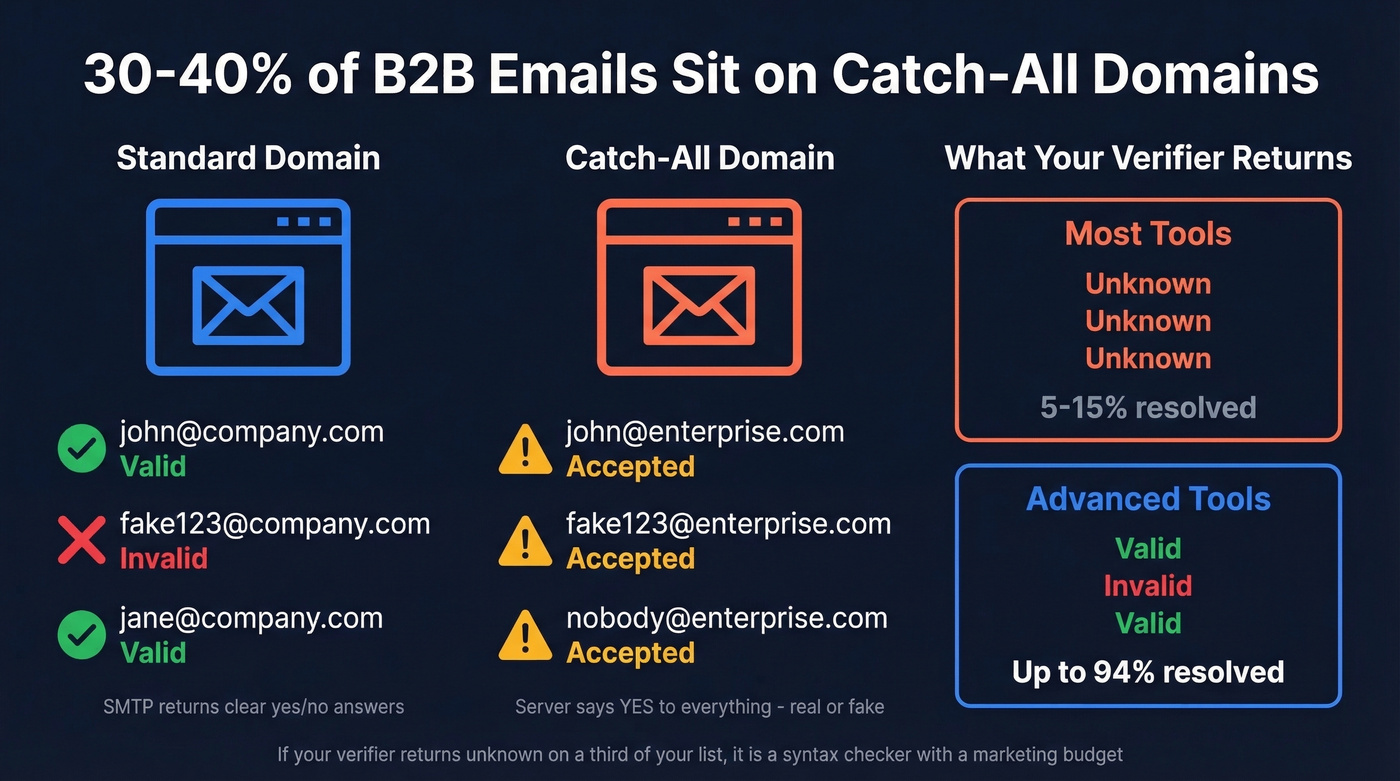
A catch-all domain accepts all incoming messages at any address, whether the mailbox exists or not. When a verification system runs an SMTP handshake against a catch-all server, it gets a "yes" regardless. Most tools return "unknown" or "accept-all." You paid for a verification and got a non-answer on a third of your list.

It gets worse. Enterprise Secure Email Gateways - Proofpoint, Mimecast, Barracuda, Microsoft Defender - actively block SMTP verification probes. Even when a mailbox genuinely exists behind the gateway, standard verifiers can't confirm it. More "unknowns."
One of the best available head-to-head benchmarks with catch-all data shows the spread clearly: the top tool resolved 94.2% of catch-all addresses. Most tools resolved 5-15%. That's not a rounding error - it's the difference between actionable data and a pile of question marks.
Tools that go beyond SMTP use domain behavior analysis, network pattern recognition, and identity matching to return a binary deliverable/undeliverable result. Some specialized tools like Allegrow and BounceBan even enforce verification at send time within your SEP or CRM, catching decayed addresses the moment you hit send rather than relying on a pre-campaign CSV check. That's a different approach worth knowing about, even if the tools below focus on the more common bulk and API verification workflow.
Here's the thing: if your verifier returns "unknown" on more than 10% of a B2B list, it's not a verification tool. It's a syntax checker with a marketing budget.
How We Evaluated
We weighted six criteria, in order of importance:
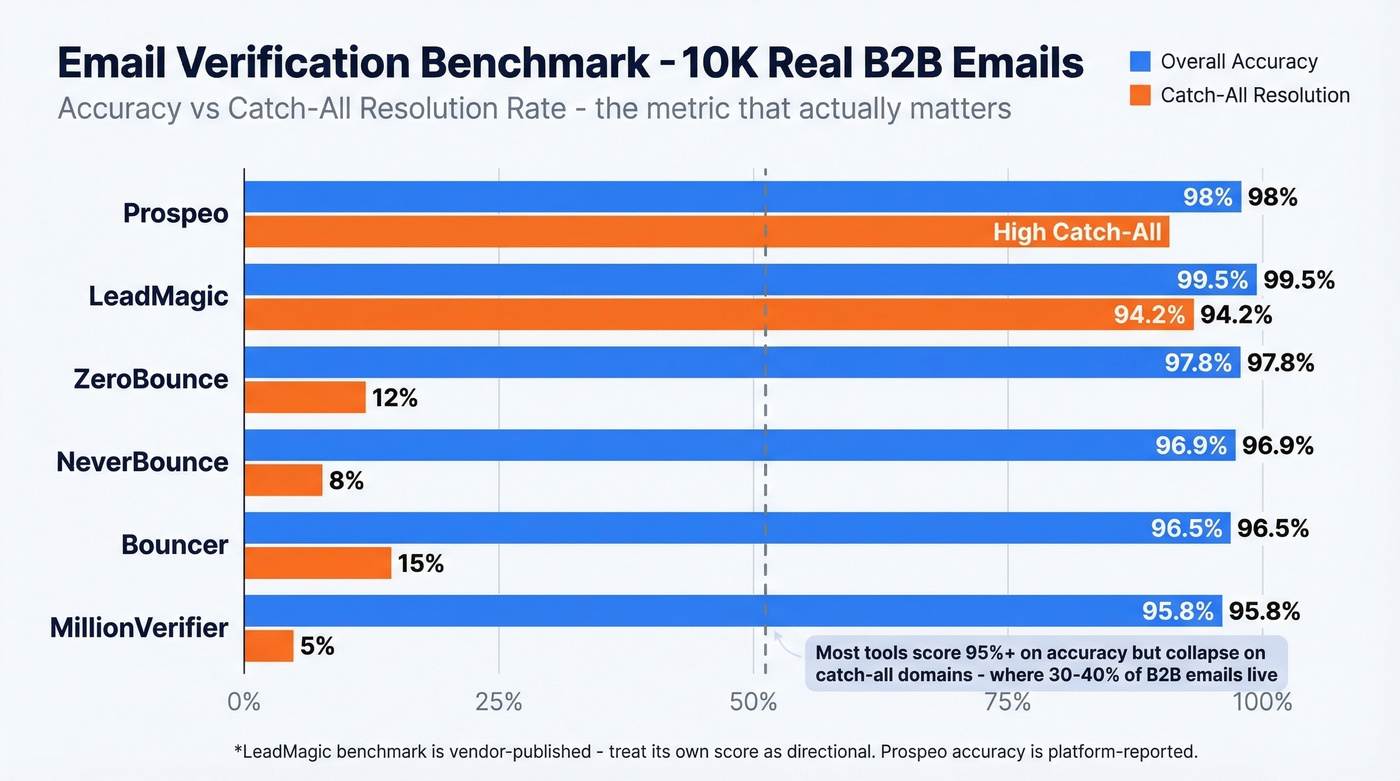
- Accuracy on hard emails - not the easy ones. We referenced the LeadMagic 10K benchmark (10,000 real B2B emails tested within a 48-hour window) as the best available head-to-head data, while noting it's a vendor blog that ranks its own tool first.
- Catch-all resolution rate - the percentage of accept-all addresses that get a definitive deliverable/undeliverable verdict instead of "unknown."
- Pricing at 10K - the volume where most SMB and mid-market teams operate. We compared pay-as-you-go rates, not enterprise contracts.
- Speed and integrations - how fast the tool processes bulk lists and whether it plugs into your existing stack without custom API work, including real-time API validation for signup forms.
- G2/Capterra ratings - weighted by review volume. A 4.8 with 332 reviews means more than a 4.9 with 12.
- Compliance and security - GDPR compliance and data deletion policies matter for enterprise buyers and any team handling EU contact data.
A quick note on false positives vs. false negatives: a false positive marks an invalid email as "valid" (you send, it bounces, your reputation takes a hit). A false negative marks a valid email as "invalid" (you lose a prospect but protect your domain). For B2B outbound, false positives are far more dangerous. We weighted accordingly.
| Tool | Accuracy | Catch-All % | FP Rate | Cost (10K) |
|---|---|---|---|---|
| LeadMagic* | 99.5% | 94.2% | 0.3% | ~$80 |
| ZeroBounce | 97.8% | 12% | 0.9% | ~$65 |
| NeverBounce | 96.9% | 8% | 1.4% | ~$50 |
| Bouncer | 96.5% | 15% | 1.2% | ~$55 |
| MillionVerifier | 95.8% | 5% | N/A | ~$6 |
LeadMagic ran this benchmark - treat its own results as directional, not gospel.

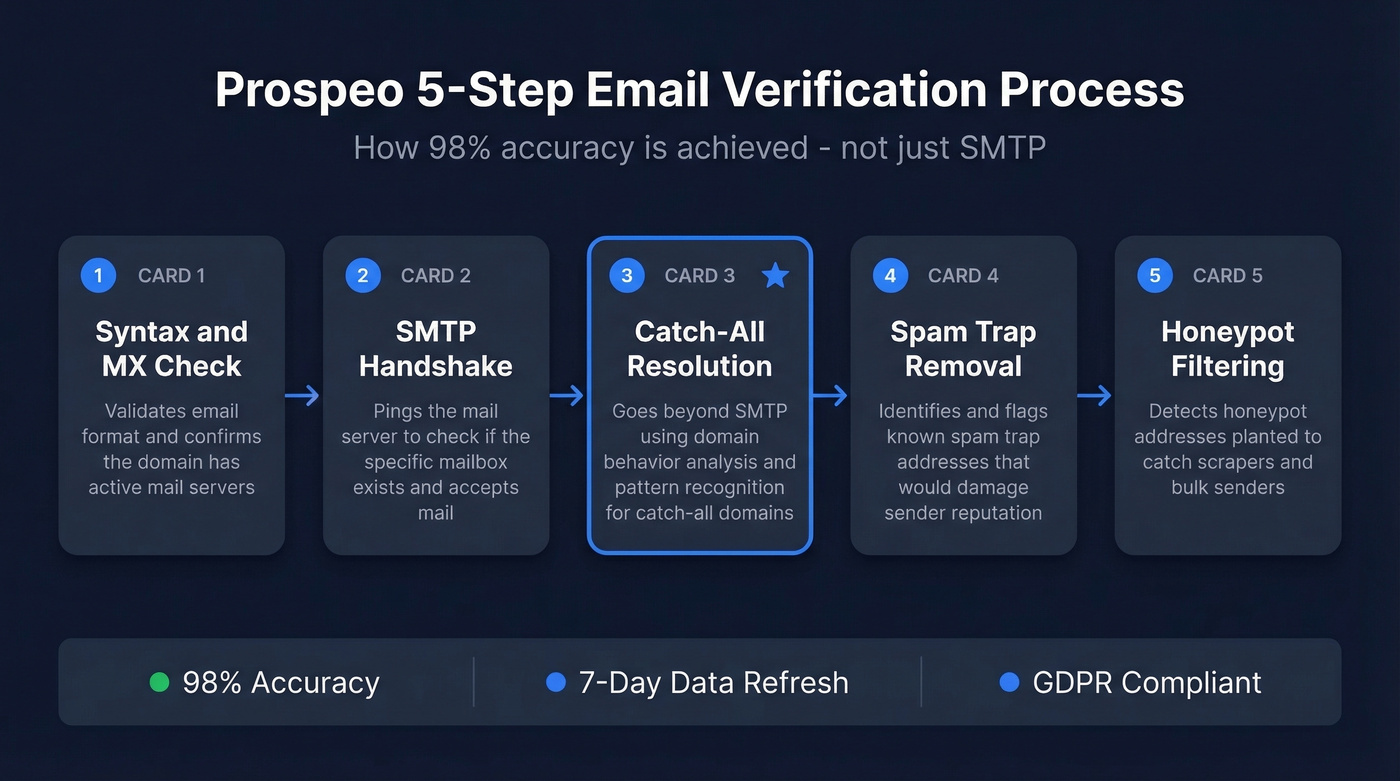
If your verifier returns "unknown" on 30-40% of your B2B list, you're paying for guesswork. Prospeo's 5-step verification resolves catch-all domains, strips spam traps and honeypots, and delivers 98% email accuracy - refreshed every 7 days, not every 6 weeks.
Stop paying for non-answers. Verify 75 emails free this month.
The 10 Best Email Verification Tools in 2026
1. Prospeo - Best for Accuracy and Freshness
Use it if you need more than just verification. Prospeo is a full B2B data platform with 300M+ professional profiles, 143M+ verified emails, and 125M+ verified mobile numbers. The verification layer runs a 5-step process: syntax and MX checks, SMTP handshake, catch-all domain resolution, spam-trap removal, and honeypot filtering. The result is 98% email accuracy across the entire database, with GDPR compliance baked in, DPAs available, and opt-out enforced globally.
The 7-day data refresh cycle is the real differentiator. The industry average is six weeks. A 98% accurate verification is worthless if the person changed jobs two weeks later. Snyk's sales team saw bounce rates drop from 35-40% to under 5% after switching, with AE-sourced pipeline up 180%.
The free tier gives you 75 emails/month plus 100 Chrome extension credits. Paid plans run about $0.01 per email. Native integrations cover Salesforce, HubSpot, Smartlead, Instantly, Lemlist, Clay, Zapier, and Make.
Snyk's 50 AEs went from 35-40% bounce rates to under 5% - and grew AE-sourced pipeline 180%. The difference wasn't a better verifier. It was a platform that keeps data fresh on a 7-day cycle and catches what SMTP-only tools miss.
Get 98% accurate emails at $0.01 each. No contract required.
2. Bouncer - Best All-Rounder
Bouncer is the tool we'd recommend to someone who says "I just need reliable verification and good support." It doesn't try to be a data platform or a sales engagement suite. It verifies emails, and it does it well.
G2 rates it 4.8/5 across 332 reviews. Capterra gives it 4.9/5 with 233 reviews. Customer service is a recurring theme in those reviews: actual humans who respond quickly. You get 100-1,000 free credits to test before committing, and pricing lands at $45-55 per 10K depending on volume tier.
The tradeoffs are real, though. The LeadMagic benchmark showed 96.5% accuracy and 15% catch-all resolution - solid but not top-tier on the catch-all front. Some G2 reviewers flag occasional verification inconsistencies. And with only 16 native integrations, you'll likely need Zapier to bridge the gaps.
Bouncer is the safe pick. You won't get burned, you won't overpay, and if something goes wrong, someone will actually help you fix it.
3. ZeroBounce - Best for Integrations
ZeroBounce has the largest G2 footprint in this category: 4.7/5 across 1,361 reviews. That volume of feedback tells you something - a lot of teams use this tool, and most of them are satisfied.
The integration story is the real draw. With 45+ native integrations, ZeroBounce plugs into virtually any marketing or sales stack without custom API work. The 100 free credits per month (refreshing, not one-time) let you test continuously without commitment. ZeroBounce also publishes GDPR/compliance documentation, which helps with procurement at larger orgs.
In the benchmark, ZeroBounce hit 97.8% accuracy with 12% catch-all resolution and a 0.9% false positive rate. At ~$64 per 10K, it's on the pricier side - and "expensive" is the top complaint on G2. At this price point, you're paying a premium for the ecosystem, not just the verification engine.
4. Emailable - Best for Speed
Use it if you're processing massive lists on tight deadlines. Emailable pushes 2M emails per hour, making it the fastest option on this list by a wide margin. For teams running time-sensitive campaigns - product launches, event invitations, flash promotions - that speed matters.
The deliverability guarantee puts skin in the game: if more than 1% of emails marked "deliverable" bounce, you get credits back. That's rare. Pricing lands at ~$50 per 10K with 250 free credits to start. Emailable also offers a real-time API for form-level verification, catching bad signups before they hit your list.
Skip it if catch-all resolution is your primary concern. Speed-optimized tools often trade depth for throughput. For standard corporate domains, Emailable is excellent. For messy B2B lists full of catch-all and enterprise gateway addresses, you'll want to pair it with a more thorough verifier or accept some "unknown" results.
5. NeverBounce
NeverBounce has built 80+ integrations. If your stack is complex and you need plug-and-play connectors, that's a legitimate advantage. The bounce-rate refund (credits back if your verified list bounces above 3%) adds accountability.
In the benchmark, NeverBounce hit 96.9% accuracy with 8% catch-all resolution - middle of the pack. At $50 per 10K, the pricing is fair. The G2 rating of 4.2/5 (141 reviews) is the lowest among the top-tier tools here, and the recurring complaints center on the credit system. Users feel nickel-and-dimed. If you can live with the credit mechanics, it's a dependable workhorse.
6. Hunter
Hunter makes sense as a verifier only if you're already using it for email finding and outreach sequences. The verification engine is competent, but at $149 per 10K, it's roughly 3x the market rate. That's not a typo.
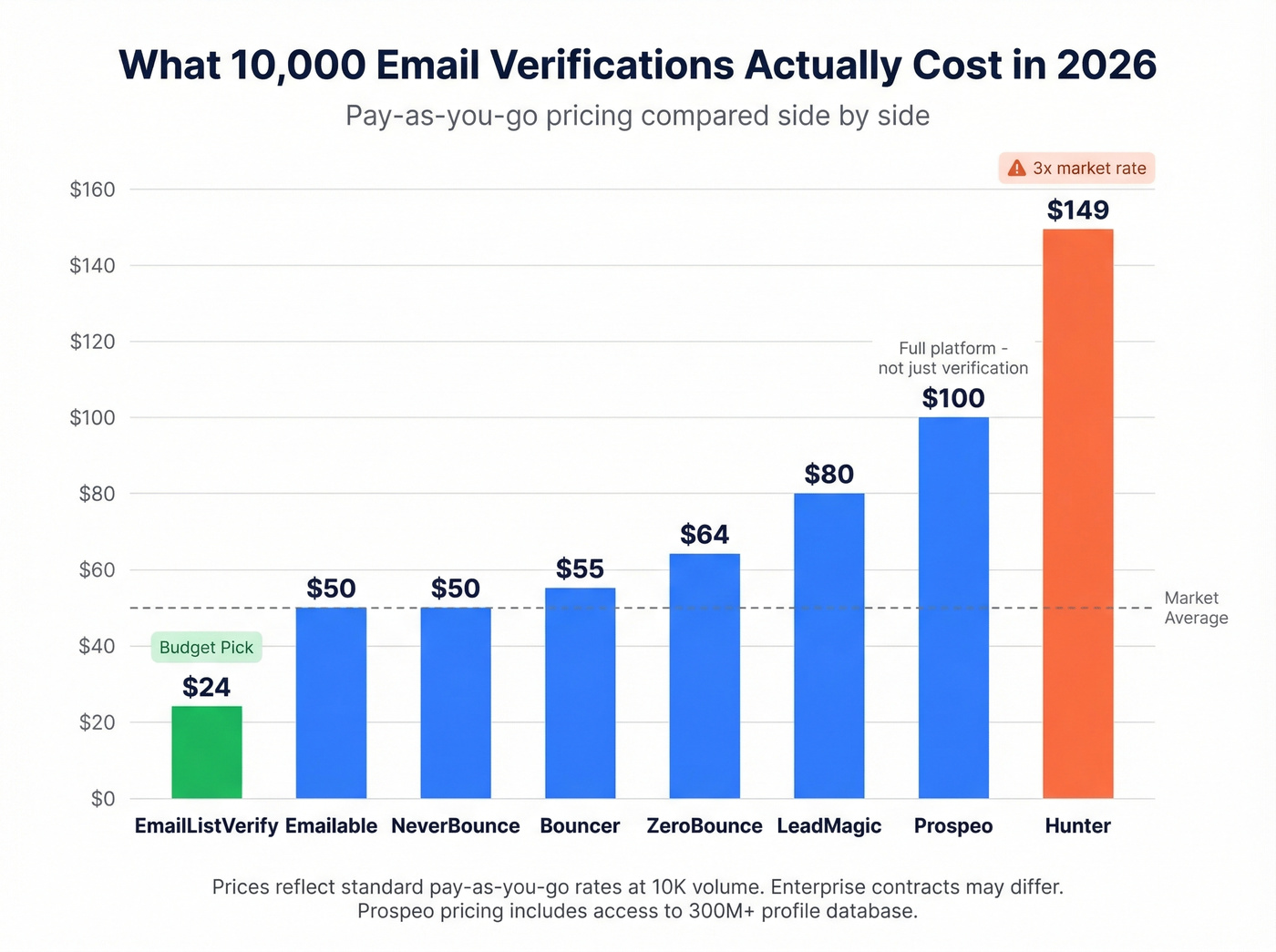
Bouncer charges $50 for the same volume. Emailable charges $50. You get 50-100 free verifications depending on your plan - barely enough to test. As a standalone email verification tool, Hunter is overpriced, full stop. But if you're running Hunter's full suite for finding, verifying, and sequencing, the verification becomes a convenient add-on rather than a separate line item. Context matters.
If you're comparing bundled find + verify stacks, see our breakdown of Hunter alternatives.
7. Clearout
Clearout is a credit-based verifier at $58 per 10K with 100 free credits to start. The tool handles both bulk CSV verification and real-time API validation for signup forms, which gives it a slight edge over tools that only do one or the other.
For teams that want a reliable mid-range option without the integration depth of ZeroBounce or the support reputation of Bouncer, Clearout fills the gap quietly.
8. Kickbox
Kickbox's differentiator is simple but meaningful: you don't pay for unknown results. Most verifiers charge per email checked regardless of outcome. Kickbox only bills for emails it can definitively classify.
At $80 per 10K for classified results, that looks expensive on paper. But run the math: if 30% of your list comes back "unknown" on other tools, you're paying $80 for 10K answers versus $50 for 7K answers and 3K shrugs. The economics flip depending on your list quality and how many catch-all domains you're hitting. Worth testing with the 100 free verifications to see where your list falls.
9. EmailListVerify
The budget leader at $24 per 10K with 100 free verifications. If cost sensitivity outweighs everything else, this is the obvious choice. Don't expect premium catch-all handling or white-glove support, but for newsletter lists and high-volume outbound where you can tolerate slightly higher bounce rates, the economics are hard to argue with. It covers the basics - syntax, MX, SMTP - without the advanced layers that pricier tools offer.
10. MillionVerifier
At ~$6 per 10K, MillionVerifier is the cheapest option by a wide margin. It comes up in Reddit threads on r/Emailmarketing as a budget pick for teams that prioritize volume over precision - and the benchmark confirms why. It showed 95.8% accuracy with only 5% catch-all resolution.
For newsletter hygiene where a few extra bounces don't threaten your domain, it works. For B2B outbound where every bounce chips away at sender reputation, steer clear. The gap between 95.8% and 98% accuracy sounds small until you multiply it across 50K sends.
Honorable mention: Snov.io deserves a nod for teams already in its outbound ecosystem. Like Hunter, it bundles verification with email finding and sequences. Pricing runs ~$39/month for 1,000 credits. It's not best-in-class at verification specifically, but the bundled workflow saves time if you're already a Snov.io user.
Pricing Comparison
Most tools cost $4-8 per 1,000 emails at standard volumes. Budget tools go as low as $0.60 per 1,000. At 10K emails, expect to pay $24-80, with Hunter as the outlier at $149.
| Tool | Free Credits | Cost/10K | G2 Rating | Notable |
|---|---|---|---|---|
| Prospeo | 75/mo + 100 ext. | ~$100 (full platform) | 4.8/5 | Finding + verification + mobile |
| Bouncer | 100-1,000 | ~$50 | 4.8/5 (332) | Best review scores |
| ZeroBounce | 100/month | ~$64 | 4.7/5 (1,361) | 45+ integrations |
| Emailable | 250 | ~$50 | 4.6/5 | Speed guarantee |
| NeverBounce | 1,000 | ~$50 | 4.2/5 (141) | 80+ integrations |
| Hunter | 50-100 | ~$149 | 4.4/5 | Overpriced standalone |
| Clearout | 100 | ~$58 | 4.7/5 | Bulk + real-time API |
| Kickbox | 100 | ~$80 | 4.6/5 | No charge for unknowns |
| EmailListVerify | 100 | ~$24 | 4.5/5 | Budget leader |
| MillionVerifier | Varies | ~$6 | 4.5/5 | Cheapest, lowest accuracy |
Prospeo's cost reflects its role as a full data platform - email finding, verification, and mobile numbers in one. The verification-per-email cost is ~$0.01. If you only need bare-bones CSV verification and already pay for a separate data provider, compare against the standalone tools.
If you're also cleaning and enriching records, compare these tools against dedicated data enrichment services.
5 Mistakes That Kill Deliverability
1. Verify-and-forget. A verified list starts decaying immediately. After four weeks, roughly 2% of your "valid" emails will be invalid - people change jobs, companies restructure, domains expire. Re-verify before every major campaign, or at minimum monthly.
2. Treating accept-all as valid. If your tool returns "accept-all" and you send to the entire batch, you're gambling. Accept-all addresses include real inboxes, dead mailboxes, and spam traps sitting on the same domain. Segment them, send cautiously, or use a tool that actually resolves them.
3. Waiting for bounces instead of verifying proactively. By the time you see a 5% bounce rate in your ESP dashboard, the damage is done. ESPs and inbox providers track sender reputation in real time. A single bad campaign can throttle your domain for weeks. (If you need a deeper benchmark-and-fix guide, start with email bounce rate.)
4. Thinking verification is a deliverability cure-all. A clean list is necessary but not sufficient. Warmup, sending volume, authentication (SPF, DKIM, DMARC), content quality, and engagement signals all matter. We've seen teams with perfectly verified lists land in spam because they skipped warmup or blasted 10K emails from a fresh domain on day one. For the full system, see our email deliverability guide.
5. Not filtering inactive contacts first. If a contact hasn't opened an email in six months, verify them before your next campaign - but also ask whether they belong on the list at all. Verifying 50K contacts when 20K are disengaged wastes credits and doesn't improve outcomes. Filter first, verify second.
FAQ
What is email verification and how does it work?
Email verification confirms whether an address can receive mail without actually sending a message. It runs through four stages: syntax check, MX record lookup, SMTP handshake, and disposable/role-based detection. Advanced tools add catch-all resolution and spam-trap filtering on top.
How often should I re-verify my list?
Re-verify before every major campaign, or at minimum monthly. Roughly 2% of a verified list goes invalid within four weeks due to job changes, domain expirations, and server reconfigurations. High-volume outbound teams should re-verify active segments weekly.
What's a safe bounce rate for cold email?
Under 2% long-term, ideally under 1%. Above 5% is critical - ESPs will throttle or suspend your sending domain. Most inbox providers track bounce rates on a rolling basis, so one bad campaign can haunt you for weeks.
Which email verification tool has the best free tier?
Prospeo gives 75 free verifications per month plus 100 Chrome extension credits - enough to test accuracy on a meaningful sample. ZeroBounce refreshes 100 free credits monthly, and Bouncer offers up to 1,000 one-time credits. Any of these free tiers will show you how a verifier handles your specific list quality before you commit.
Can one tool handle both email finding and verification?
Yes. A few platforms combine email finding and verification in a single workflow, which cuts out the friction of exporting from one tool and importing into another. If you're building lists from scratch rather than cleaning an existing database, a bundled platform will save you time and usually money compared to running two separate subscriptions.