

Best Sales Email Subject Lines for 2026: 50+ Examples and the Fix Most Guides Skip
A RevOps lead we work with ran a 2,000-email campaign last quarter. Open rate: 8%. The team spent a week rewriting subject lines before anyone checked the bounce report - 340 emails had bounced, torching sender reputation with every send. The subject line wasn't the problem. It was the last 10%.
That's the gap most advice about sales email subject lines ignores entirely. Your subject line matters, but it's downstream of deliverability, list quality, and whether you're measuring the right metric. Let's fix the foundation first, then build the swipe file.
The Short Version
- Fix your list first. Keep bounce rate at 1% or below and set up SPF/DKIM/DMARC. Subject lines can't save emails that never arrive.
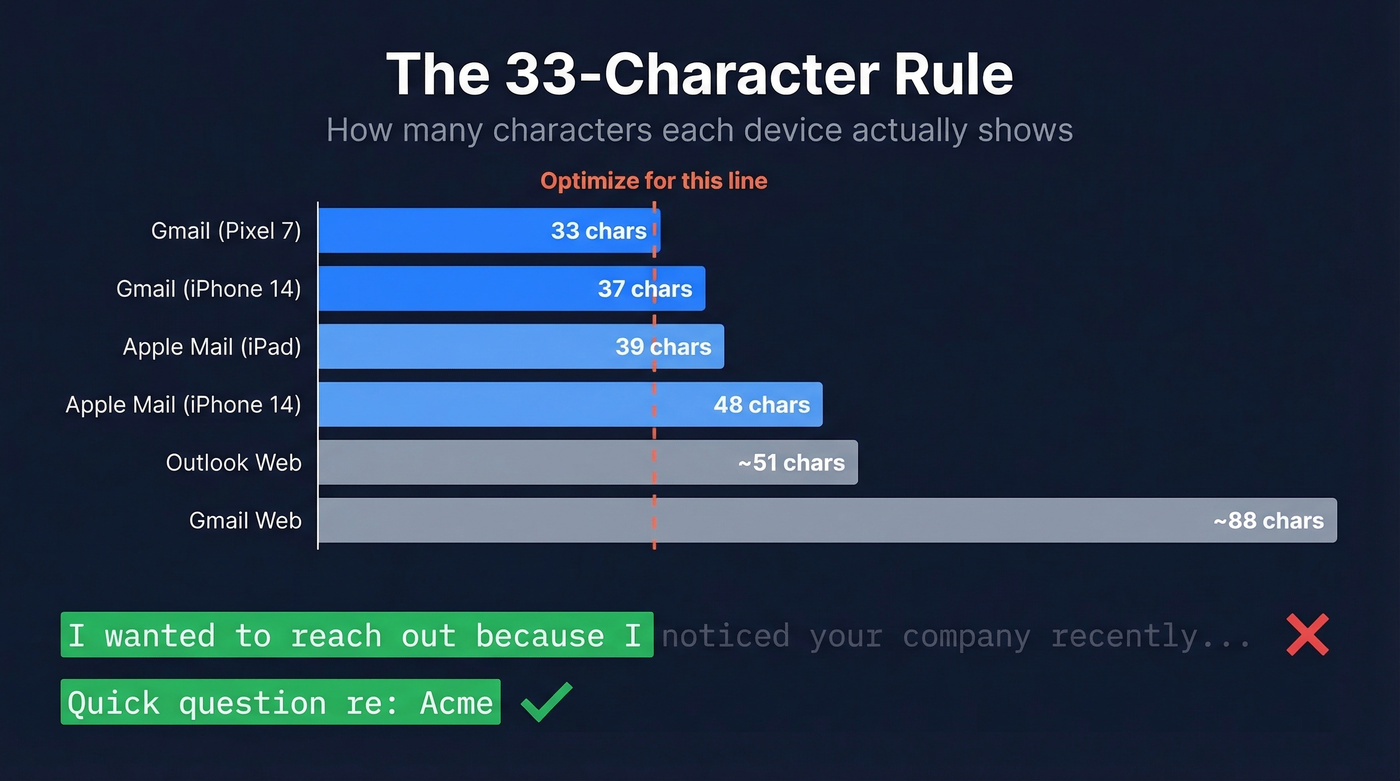
- Write for 33 characters. That's all Gmail mobile shows. Put the hook up front.
- Measure positive reply rate, not open rate. Apple MPP inflated opens by 18 points across 80,000+ accounts. A 42% open rate might mean nothing. Target 5%+ positive reply rate instead.
- Personalize beyond first names. 97.7% of emails use zero subject-line personalization. The bar to stand out is on the floor.
Your Open Rate Is Lying to You
Here's why benchmarks don't agree with each other: Mailchimp reports an all-user average open rate of 35.63%. HubSpot says 42.35%. That's a 7-point gap, and the explanation is Apple Mail Privacy Protection.
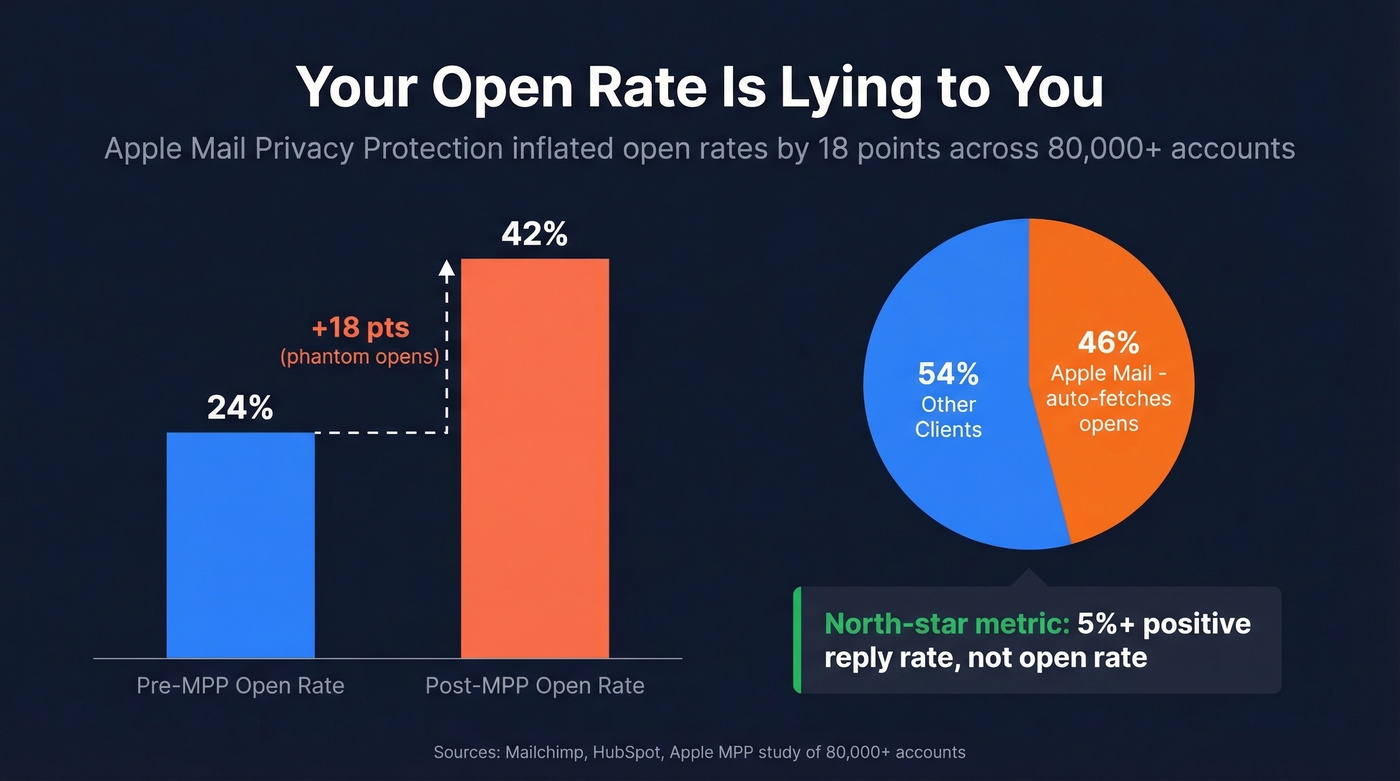
Apple Mail accounts for about 46% of email clients, and MPP auto-fetches opens for many of those users. A study of 80,000+ email marketing accounts found open rates rose 18 points within six months of MPP's rollout. Your "opens" include a huge chunk of phantom engagement from Apple's servers, not human eyeballs.
| Industry | Open Rate | Click Rate | Source |
|---|---|---|---|
| Business & Finance | 31.35% | 2.78% | Mailchimp |
| SaaS | 38.14% | 1.19% | HubSpot |
| Nonprofit | 40.04% | 3.27% | Mailchimp |
| All Users | 35.63% | 2.62% | Mailchimp |
| All Industries | 42.35% | 2.3% | HubSpot |
For cold outbound, reply rate is the north-star metric. Average cold email response rate sits around 4%. Anything above 5% means your targeting, messaging, and deliverability are working together - and that's why finding great subject lines matters less than fixing the infrastructure underneath them.
Fix Your List Before Your Subject Line
Around 160 billion spam emails are sent every day. Spam filters evaluate three signal buckets: content, reputation, and engagement. Authentication protocols like SPF, DKIM, and DMARC are table stakes. Without them, your emails land in spam regardless of how clever the subject line is.
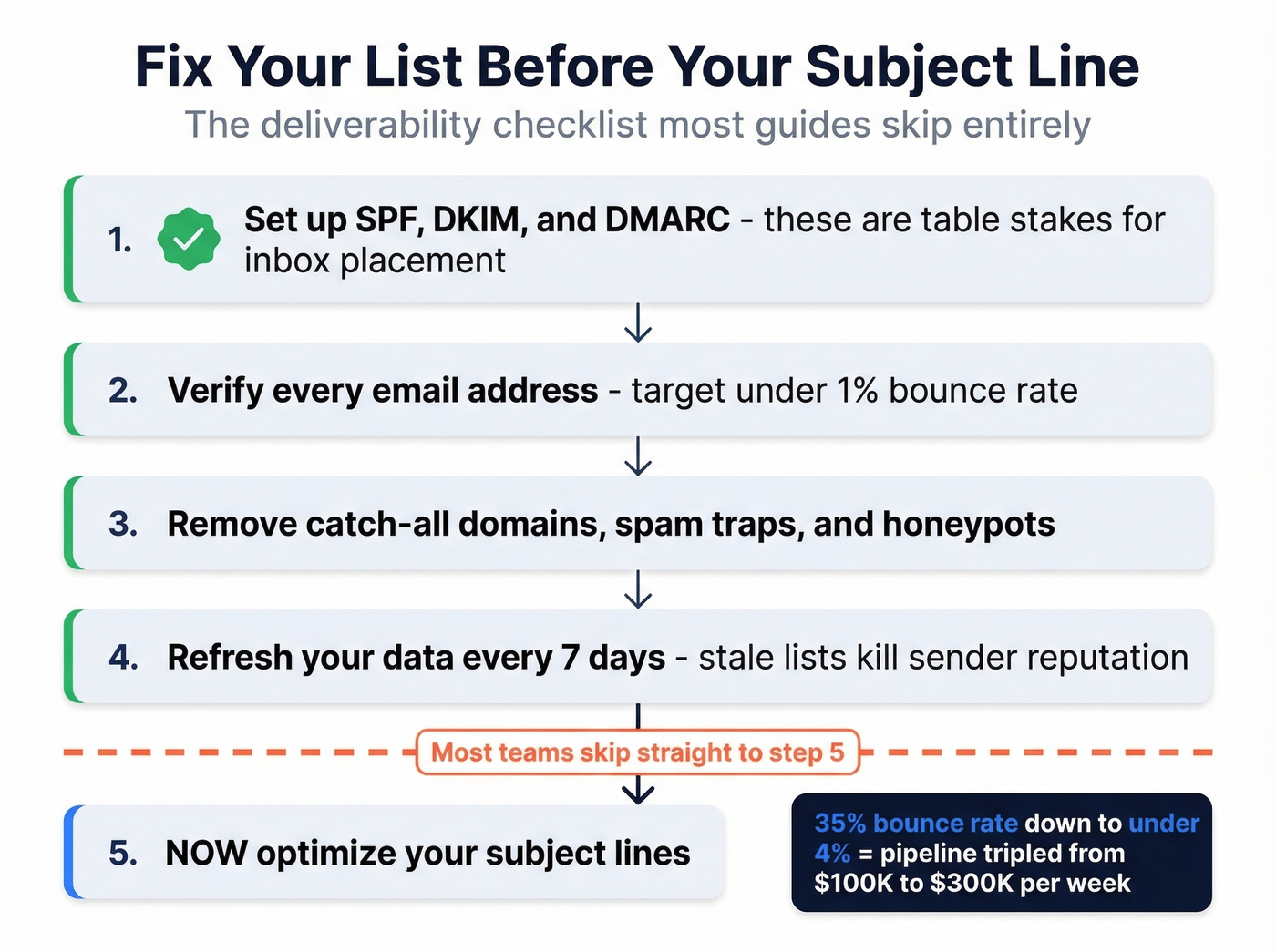
The bounce rate threshold that matters: 1% or below for healthy sending. We've seen this pattern across dozens of outbound campaigns - teams blame the subject line when the real culprit is stale data. Meritt, an outbound agency, was running a 35% bounce rate before overhauling their verification workflow. They dropped it under 4% and tripled pipeline from $100K to $300K per week.
Prospeo's 98% email accuracy and 7-day data refresh cycle solve this before you optimize a single word. The 5-step verification process catches spam traps, honeypots, and catch-all domains that six-week-old databases miss constantly.
The Psychology of Opens
The Information Gap. Loewenstein's curiosity theory explains why "Your Q4 pipeline has a leak" outperforms "Tips for better pipeline." The first creates a gap between what the reader knows and what they want to know. Open loops drive opens.
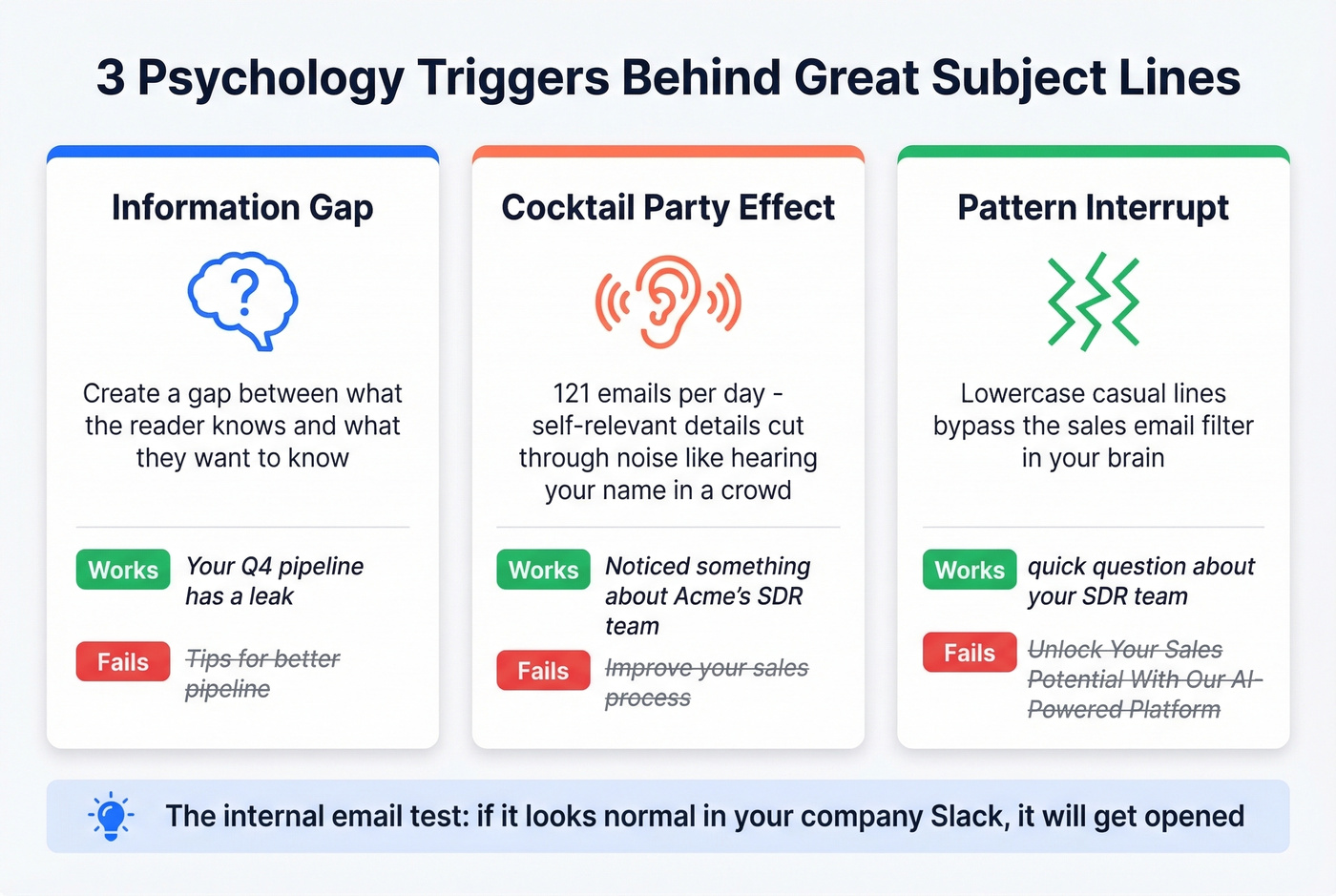
The Cocktail Party Effect. The average professional receives 121 emails per day. Self-relevant stimuli cut through noise the same way hearing your name across a crowded room grabs attention. A subject line referencing the prospect's company, tech stack, or a specific metric triggers this effect automatically.
Pattern Interrupt. Lowercase, casual subject lines bypass the brain's "sales email" filter. "quick question about your SDR team" looks like an internal message. "Unlock Your Sales Potential With Our Platform" screams vendor. Practitioners on r/GrowthHacking often report that lines like "quick check-in" and "this might help" pull 2x higher open rates than polished marketing copy. Understanding this psychology is what separates effective subject lines from forgettable ones.
Words that tank inbox placement: ALL CAPS, excessive punctuation (!!!), "$$$," "free," "act now," "limited time." No single word guarantees spam, but combinations of trigger words plus poor sender reputation will bury you. When in doubt, apply the internal-email test below.

The best sales email subject line in the world can't save an email that bounces. Prospeo's 98% email accuracy and 7-day data refresh keep your bounce rate under 1% - so every subject line you craft actually reaches an inbox.
Stop rewriting subject lines for emails that never arrive.
The 33-Character Rule
If your subject line doesn't land in the first 33 characters, most mobile users never see the hook. EmailToolTester measured exact truncation points across devices:
| Client / Device | Characters Shown |
|---|---|
| Gmail (Pixel 7) | 33 |
| Gmail (iPhone 14) | 37 |
| Apple Mail (iPhone 14) | 48 |
| Apple Mail (iPad 10th) | 39 |
| Gmail web (1400px) | ~88 |
| Outlook web (1400px) | ~51 |
Put the hook in the first 33 characters. Period. Desktop users get more room, but you're optimizing for the tightest constraint. "Quick question re: {company}" fits. "I wanted to reach out because I noticed your company recently..." doesn't even get started.
50+ Sales Email Subject Lines That Work
Cold Outreach (First Touch)
These include real subject lines collected from real campaigns, plus proven frameworks you can adapt. The pattern: short, specific, and they look normal in an internal inbox.
- "Exec reach out" - Mixpanel. Three words. No punctuation tricks. Implies seniority without saying "I'm a VP."
- "{company} + Delighted" - Delighted. The merge tag makes it personal; the format suggests partnership, not a pitch.
- "quick question about {role}"
- "saw your {recent trigger event}"
- "{mutual connection} suggested I reach out"
- "idea for {company}'s {specific problem}"
- "thoughts on {industry trend}?"
- "{company}'s approach to {topic}"
- "not sure if this is relevant"
- "one thing about your {department} team"
- "congrats on the {funding round / launch / hire}"
- "{company} + {your company} - quick thought"
- "noticed something about your {process}"
- "question about your {tech stack tool}"
- "this reminded me of {company}"
The curiosity-gap lines ("not sure if this is relevant") work because they create an open loop without being clickbaity. The specificity lines ("{company}'s approach to...") work because they signal research.
Here's the thing most guides won't tell you: the "best" subject line in the world decays within months. Once thousands of senders copy a template, spam filters learn the pattern and recipients develop blindness to it. The lines above work today because they're frameworks, not scripts. Customize them or they'll stop working. The most effective email subject lines for sales are the ones you adapt to your prospect, not the ones you copy verbatim from a swipe file.
Follow-Up Subject Lines
Follow-ups are the highest-converting category because the prospect already knows you. The subject line's only job is to trigger recognition. Keep it boring and specific.
| Subject Line | When to Use |
|---|---|
| "Re: Do you have a technical..." (LogDNA) | Mimics an ongoing thread - clever for cold-to-warm transitions |
| "next steps from our {day} call" | Same day or next morning |
| "the {specific thing} we discussed" | When you promised a resource |
| "forgot to mention this" | 24-48 hours post-call |
| "resource you asked about" | Delivering on a promise |
| "following up - {one-line summary}" | General purpose |
| "{first name}, one more thought" | Adding value after the initial follow-up |
| "the {metric} number I mentioned" | When you referenced data on the call |
No-Response Re-engagement
In our experience, the breakup email outperforms polite follow-ups every time. It triggers loss aversion - the prospect doesn't want to lose an option, even one they've been ignoring. Subject lines with "confirmation status" framing boost opens by roughly 30% in win-back sequences.
- "Who/When/How?" - Yieldify. Three words that demand a response because they're so ambiguous the prospect has to open it.
- "did I lose you?"
- "closing the loop on this"
- "worth another look?"
- "last thing, then I'll stop"
- "quick update since we last spoke"
- "{first name}?"
- "should I close your file?"
- "confirmation: removing you from my list"
- "tried you a few times"
- "is this still a priority?"
- "permission to close this out?"
Skip the polite "just checking in" - it signals low status and gives the prospect nothing to respond to.
Meeting Request
- "time to talk?" - CallRail. Lowercase, casual, four words. Doesn't oversell.
- "thoughts on Gusto?" - Gusto. Using your own brand name as a question is bold and works when the prospect already has awareness.
- "15 min this week?"
- "coffee chat - {topic}?"
- "{first name}, quick sync?"
- "open Thursday afternoon?"
- "10 min - I'll make it worth it"
- "got a slot Wednesday?"
Referral and Warm Intro
These convert at the highest rate of any category because they carry borrowed trust. The subject line's only job is to surface the connection name fast.
- "{name} said we should connect"
- "following up on {name}'s intro"
- "referred by {name} - quick question"
- "{name} from {company} mentioned you"
- "warm intro from {mutual connection}"
The "Internal Email" Test
The best filter for any subject line: would this look normal in your company's Slack or internal email? If yes, it'll get opened. If it screams "vendor," it won't.
"Exec reach out" passes. "Unlock 3X Pipeline Growth With Our AI-Powered Platform" fails spectacularly. Your subject line competes against internal messages in the same inbox. Look like one of them.
Personalization Beyond First Names
A Yes Lifecycle analysis of 7+ billion emails found non-personalized subject lines averaged a 14.1% open rate. Name-personalized lines hit 21.2%. Contextual personalization - company, industry, behavior - reached 22%. That's a 50% lift from adding a first name, and contextual personalization edges it out further.
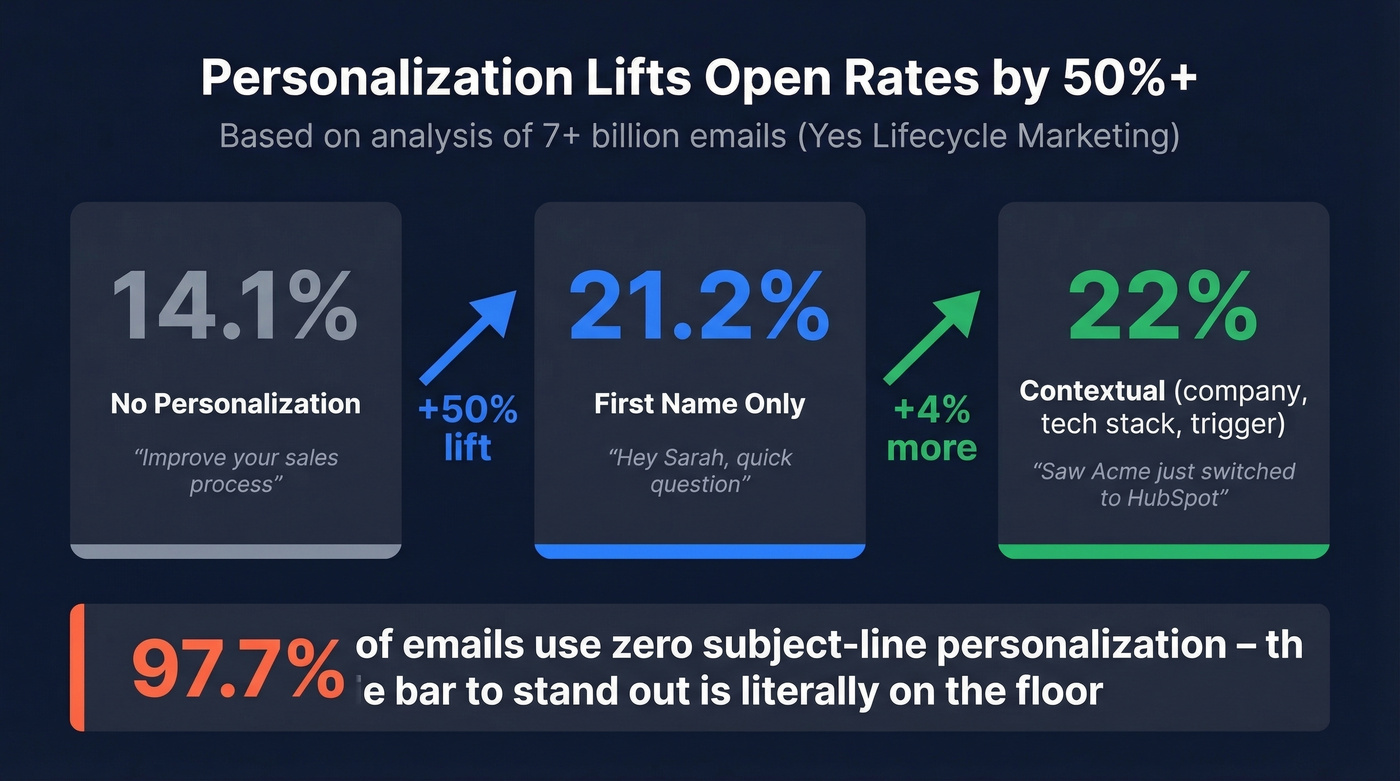
The adoption gap is staggering: 97.7% of emails in the study used zero subject-line personalization. "Hey {first name}" is table stakes. The real lift comes from referencing their company's tech stack, a recent funding round, or a job posting that signals a pain point. CTAs personalized by job function outperform generic ones by 22%.
Personalization requires accurate data. Stale CRM fields produce embarrassing subject lines that reference a job title the prospect left months ago. Prospeo's data enrichment returns 50+ data points per contact, so your merge tags reference something real - current role, department size, tech stack - not outdated records from a database that hasn't been refreshed in weeks.
How to Test Subject Lines
Isolate one variable per test. Change the subject line and nothing else - not the send time, not the body, not the list segment.
Use 250+ contacts per variant. For reply-rate tests, push to 500+. Smaller samples produce coin-flip results that look like insights.
Measure positive reply rate. Not opens, not clicks. Positive replies correlate with revenue. Everything else is vanity.
Run tests for 1-2 weeks minimum. B2B buyers don't check email on your schedule. Interesting data point from Omnisend's research: B2B click-through rates run 62% higher on weekends, so don't cut a test short on Friday.
If open rate drops below 15%, check inbox placement first. You've got a deliverability problem, not a subject line problem. Run a seed test before rewriting copy.
Use AI as variation fuel. AI-generated subject line variants deliver a 5-15% lift when used to generate test ideas you then refine - not when blindly copy-pasted. Tools like Instantly (~$47/mo) support A/B testing; the tool matters less than the discipline of actually running tests.
Let's be honest about one more thing: cold email doesn't exist in isolation. The best outbound teams pair email with touches on other channels. A prospect who saw your name elsewhere is more likely to open your email regardless of the subject line. Multi-channel sequences outperform email-only in virtually every outbound program we've seen.
Testing is the only reliable way to find what works in your specific market. What converts in SaaS will flop in financial services, and vice versa.
Personalized subject lines like "{company}'s approach to {topic}" only work when you have real data behind them. Prospeo gives you 50+ data points per contact - job title, tech stack, funding, intent signals - so every merge tag pulls something that matters.
Turn every subject line framework above into a personalized open-rate machine.
FAQ
How long should a sales email subject line be?
Under 33 characters to display fully on Gmail mobile, under 50 for broader compatibility. Front-load the hook - anything past character 33 is invisible to most mobile readers. Desktop clients show 51-88 characters, but always optimize for the tightest constraint.
Do emojis help open rates in sales emails?
No reliable data shows consistent lift in B2B cold outreach. Emojis signal "marketing email" to both spam filters and human pattern recognition. They fail the internal-email test - skip them for cold sales prospecting.
What are the best sales email subject lines I can copy right now?
Start with these frameworks: "quick question about {role}," "{company}'s approach to {topic}," and "saw your {recent trigger event}." They're short, specific, and pass the internal-email test. Swap in your prospect's details and A/B test two variants against each other with at least 250 contacts per group.
Why is my open rate high but reply rate low?
Apple MPP auto-opens emails for many Apple Mail users, inflating open rates by up to 18 points. Shift your north-star metric to positive reply rate and target 5%+. If replies are flat despite high opens, your body copy, offer, or targeting needs work - not your subject line.
How do I know if my list or my subject line is the problem?
Check bounce rate first. Above 1%, your list is the bottleneck - verify emails before touching subject lines. If bounce rate is under 1% and opens are still below 15%, run an inbox placement seed test. Only after deliverability checks out should you A/B test copy.