

Best Sales PowerPoint Presentations in 2026
Your champion loved the demo. They forwarded your 30-slide PowerPoint to the VP of Finance - walls of text, no narrative, zero context. The deal stalled for three weeks.
That's the reality of B2B sales presentations: the typical purchase involves 7.4 decision-makers, and 75% of B2B buyers prefer self-service over talking to a rep. Meanwhile, reps spend 31% of their time searching for or creating content instead of selling. Your deck sells when you're not in the room - or it doesn't sell at all.
Here's the short version: use a proven framework (Zuora Narrative Arc for enterprise, Problem-Solution-Benefit for mid-market), keep it to 10-15 slides under 10 minutes, and personalize ruthlessly. Personalized decks get 2.3x more internal shares and 41% more reading time. Generic decks die in inboxes.
Two Frameworks That Close Deals
Research from cognitive psychologist Jerome Bruner suggests facts wrapped in narrative are up to 22x more memorable. Both frameworks below use narrative structure, but they serve different deal types. They also share a core principle: the buyer is the hero, not your product.
The Zuora Narrative Arc (Enterprise)
Andy Raskin broke this down after studying Zuora Narrative Arc's sales deck, and it's become the gold standard for enterprise narratives. Five elements, in order:
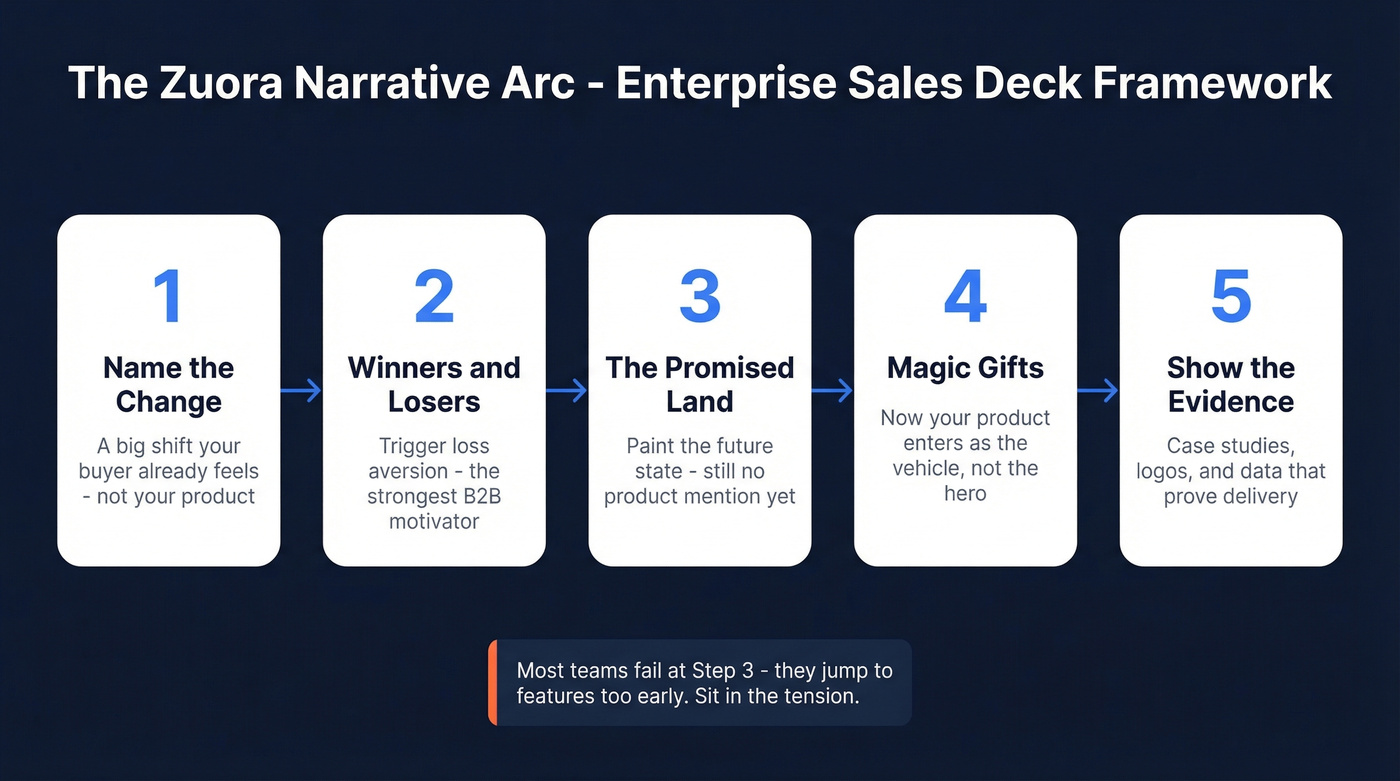
- Name a big, relevant change in the world. Not your product. A shift your buyer already feels.
- Show there'll be winners and losers. This triggers loss aversion - the most powerful motivator in B2B.
- Tease the promised land. Paint the future state without mentioning your product yet.
- Introduce features as "magic gifts." Now your product enters as the vehicle to the promised land, not the hero.
- Present evidence. Case studies, logos, data that prove you can deliver.
The key insight: starting with "problem" puts prospects on the defensive. Starting with "change" invites conversation. Where most teams fail with this framework is step three - they can't resist jumping to product features too early. Sit in the tension. The promised land only works if the audience feels the gap first.
Problem-Solution-Benefit (Mid-Market)
For shorter sales cycles, a 7-slide structure works better: Problem, Cost of the problem, Root cause, Solution, How it works (max 3 steps), Proof with numbers, Next step.
Spend 70% of your preparation time on slides 1-3. If you don't nail the problem, cost, and cause, your solution slide is just noise. Most reps rush to "here's what we do" by slide two. That's backwards. Build urgency first, then release it.
Design Rules for Sales Slides
Too many slides and too much text kill deals. People remember 10% of what they hear, but up to 65% when visuals are added. Gong's research found that winning sales presentations average 9.1 minutes - not 20, not 30. Nine minutes. That's roughly 10-15 slides if you're not rushing.
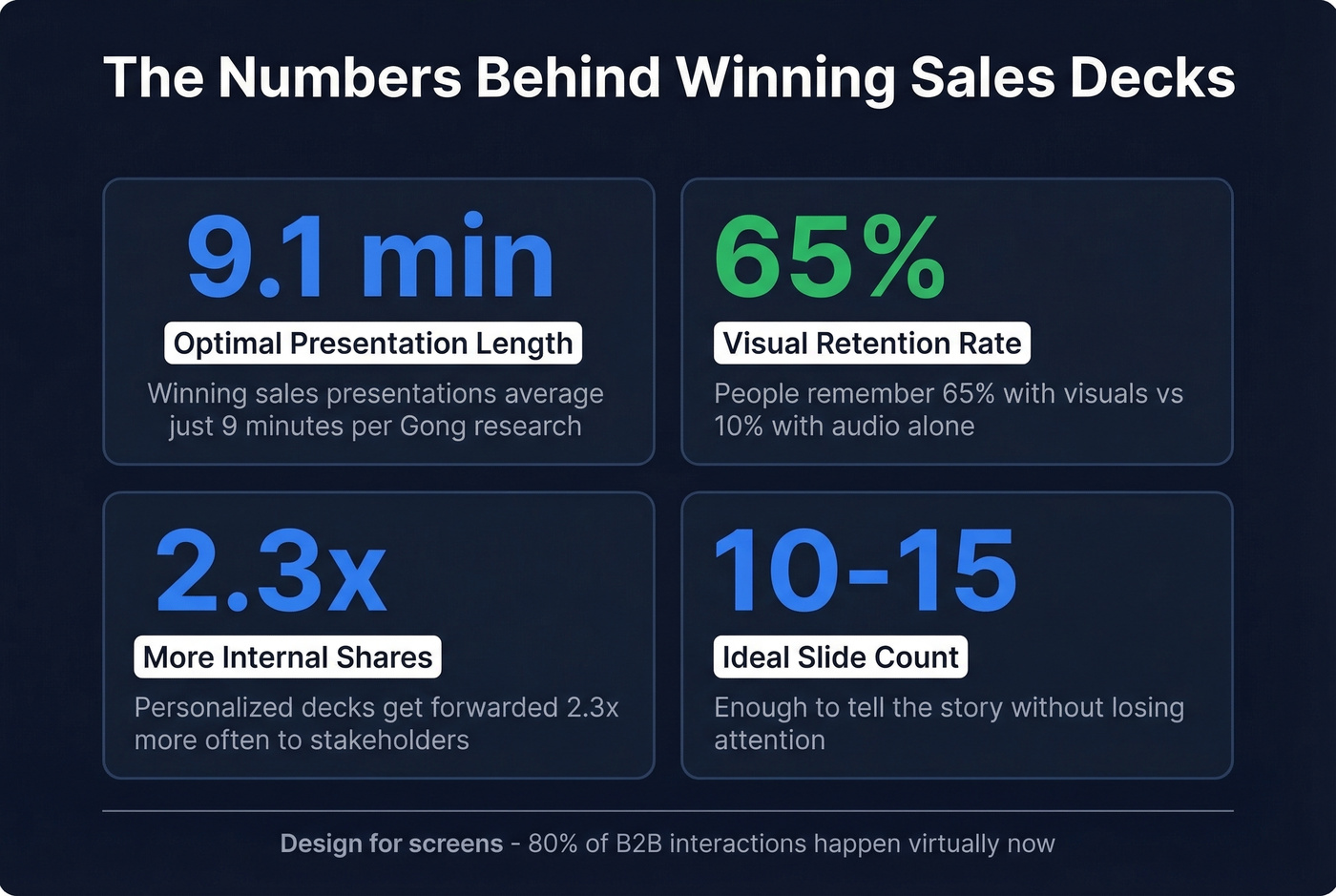
Keep text to a quarter of each slide maximum. Use diagrams, charts, and screenshots instead of bullet points. Design for virtual sales - 80% of B2B interactions happen on screens now, which means high contrast, large fonts, and minimal text. Your prospect is on a laptop, not in a conference room.
Every slide needs a single takeaway. If you can't summarize a slide's point in one sentence, split it into two.
Let's be honest about something: the strongest sales decks in 2026 aren't always PowerPoints at all. For deals with 5+ stakeholders, link-based presentations from tools like Storydoc, Trumpet, or Dock track who viewed what and give you analytics your PDF never will. But for 80% of mid-market deals, a clean, tight PowerPoint exported from a modern tool still wins.

You just spent hours building the perfect sales deck. Don't waste it on a bounced email. Prospeo's Email Finder delivers 98% accurate contacts on a 7-day refresh cycle - so your polished presentation actually reaches the decision-maker who can say yes.
Find verified emails for free. Send your deck to people who'll actually open it.
Mistakes That Kill Sales Decks
Information overload. Data dumping 40 slides of product specs doesn't demonstrate value - it demonstrates you don't know what matters to this buyer. We've reviewed decks from dozens of sales teams, and the worst offenders always have the most slides.
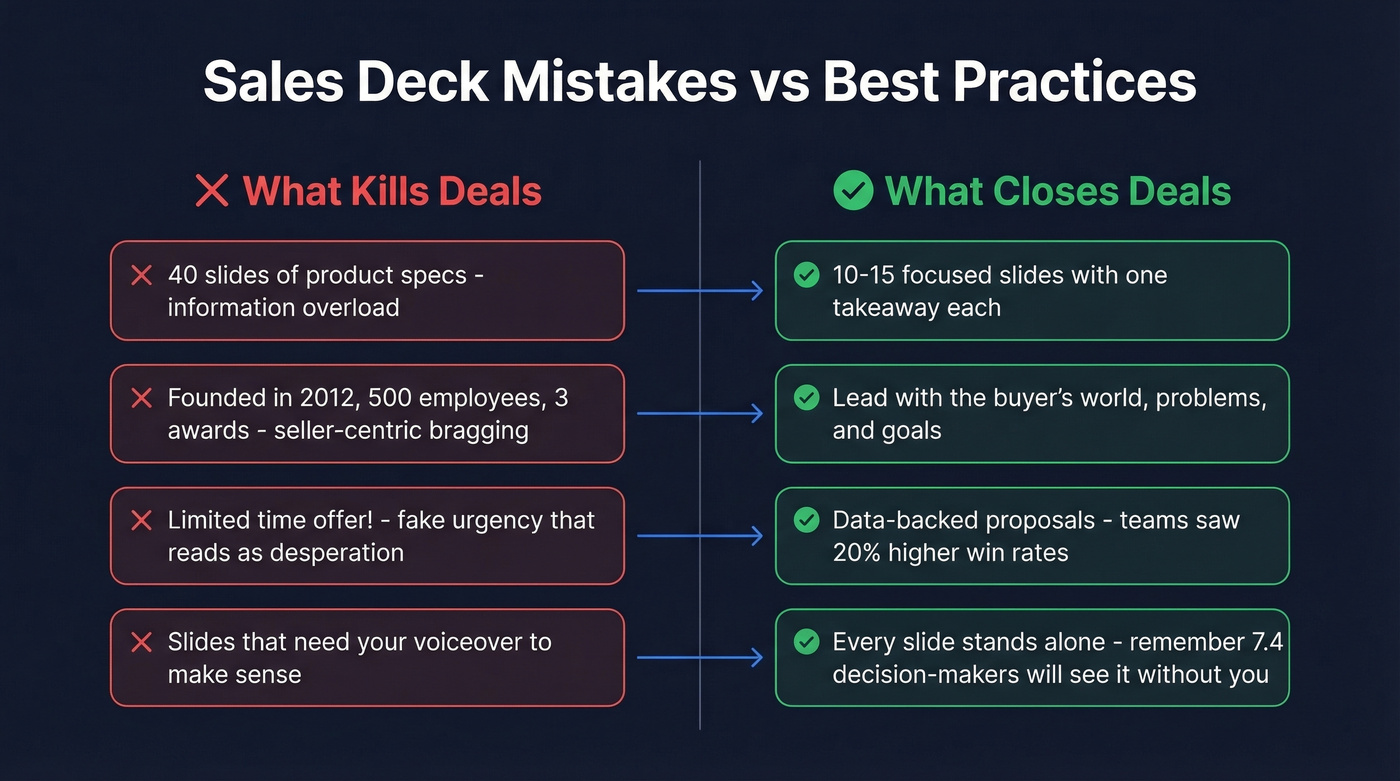
Seller-centric bragging. "We were founded in 2012, we have 500 employees, we won three awards." Your buyer doesn't care. Lead with their world, not yours.
Fake urgency. One team replaced scarcity CTAs with data-backed proposals and increased win rates by 20% over two quarters. "Limited time offer" reads as desperation in B2B. Skip this tactic entirely.
Forgetting the deck gets forwarded. Remember those 7.4 decision-makers? Most will see your deck without you presenting it. Personalized decks get shared internally 2.3x more often, so customize and make every slide stand on its own without your voiceover. Study sales deck storytelling and sales presentation examples from companies like Zuora and Drift to see how top teams build slides that communicate without a narrator.
AI Tools for Building Sales Decks
For repeatable sales motions, AI tools cut deck-building time from hours to minutes. Here's what we've found worth looking at:
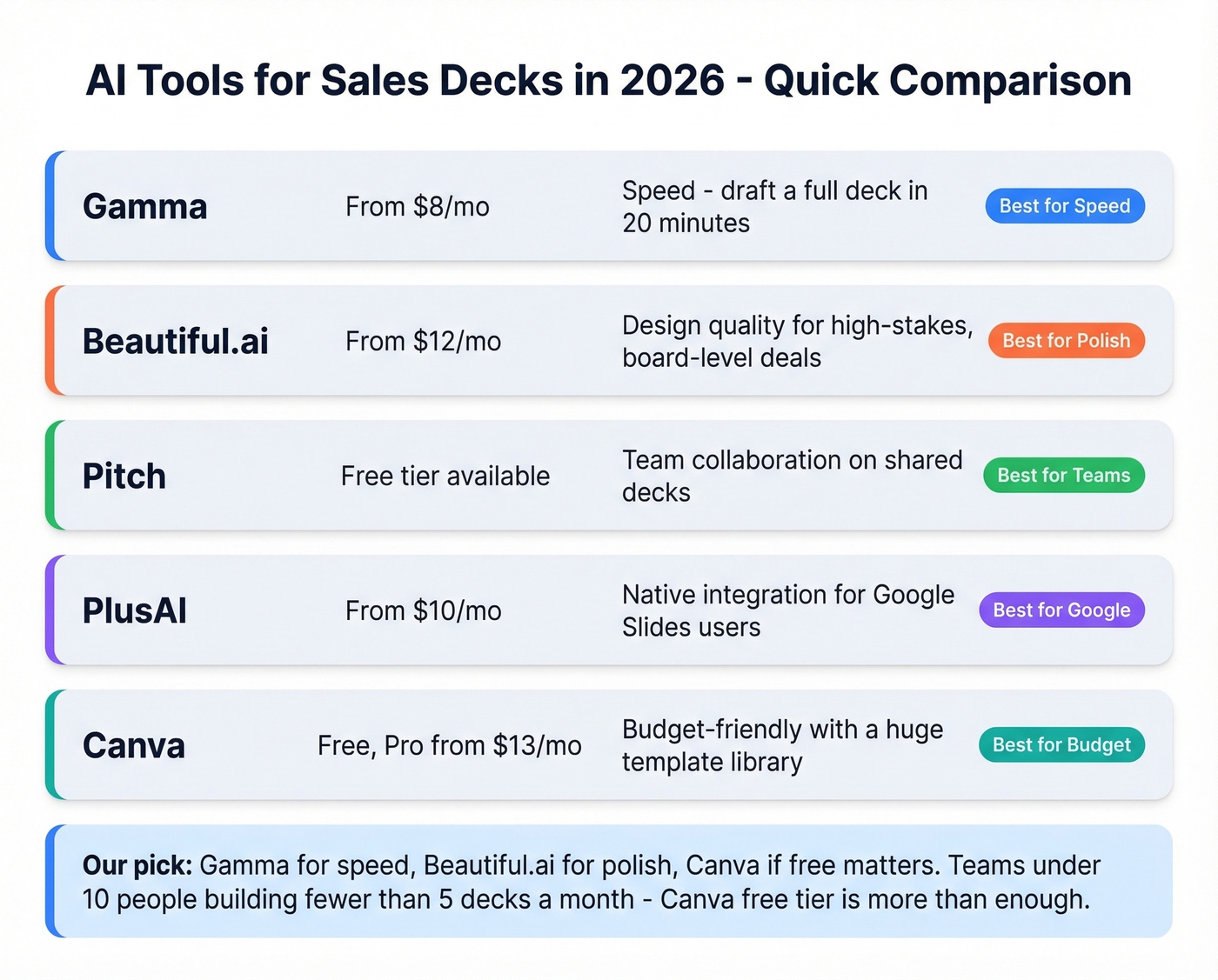
| Tool | Starting Price | Best For |
|---|---|---|
| Gamma | ~$8/mo | Speed - draft a full deck in 20 minutes |
| Beautiful.ai | ~$12/mo | Design quality for high-stakes deals |
| Pitch | Free tier available | Team collaboration |
| PlusAI | ~$10/mo | Google Slides users |
| Canva | Free; Pro ~$13/mo | Budget-friendly, huge template library |
Our pick: Gamma when you need a deck fast, Beautiful.ai when the deck needs to look polished for a board-level audience. Canva if you're already in the ecosystem and free matters. If your team is under 10 people and building fewer than 5 decks a month, don't overthink this - Canva's free tier is more than enough.
Before the Deck - Reach the Right Person
Here's the thing nobody talks about in "best sales PowerPoint presentations" advice: the deck doesn't matter if it never reaches the decision-maker.
We've watched teams spend weeks perfecting a deck, then send it to an email that bounces. If you're seeing deliverability issues, fix the root cause with an email deliverability guide and track your email bounce rate by segment. Snyk's sales team was dealing with bounce rates of 35-40% across 50 AEs. After switching to Prospeo for email verification, bounces dropped under 5% and AE-sourced pipeline jumped 180%, generating 200+ new opportunities per month.
Run your contact's email through Prospeo's Email Finder before you hit send - 98% accuracy on a 7-day data refresh cycle, with a free tier that gives you 75 verified emails per month. No contracts, no sales calls required.
Remember those 7.4 decision-makers? Snyk's 50 AEs cut bounce rates from 35% to under 5% with Prospeo and generated 200+ new opportunities per month. Your deck is built to get forwarded - make sure it starts with a real inbox.
Stop perfecting slides and start reaching buyers. 75 free verified emails per month.