

BetterMerge vs Seamless.AI: Different Tools, Different Jobs
You bought Seamless.AI because you wanted to "do outbound," but now you're staring at a Google Sheet full of contacts with no way to send from it. Or you grabbed BetterMerge to email 500 prospects a day and realized you have nobody to email. Either way, you're weighing BetterMerge vs Seamless.AI - two tools that don't actually compete with each other.
One sends emails. The other finds people to email. Comparing them is like comparing a rifle scope to a trigger - different parts of the same weapon. Here's what each one costs, what it does well, and the gap neither one fills.
30-Second Verdict
- BetterMerge if you already have a verified contact list and need to send personalized emails from Gmail/Sheets. Starts at $4.99/mo.
- Seamless.AI if you need to build a prospect database from scratch and you're comfortable with opaque, sales-led pricing. Expect ~$79/user/mo minimum.
- Neither if your real problem is getting verified emails and direct dials without credit burn or contracts. Prospeo gives you 98% accurate emails on a 7-day refresh cycle, self-serve, starting free.
What Each Tool Actually Does
BetterMerge
Use it when you have a list in Google Sheets and need to send personalized emails at scale through Gmail. Gmail added native mail merge back in 2023, but it's too limited for cold outreach - BetterMerge fills that gap with scheduling, open/click tracking, delivery automation, and personalized attachments. Unlike most Gmail mail merge tools, it includes a web dashboard, built-in email verification, and delivery features typically missing from competitors like YAMM. For a mail merge tool, it's well-built.
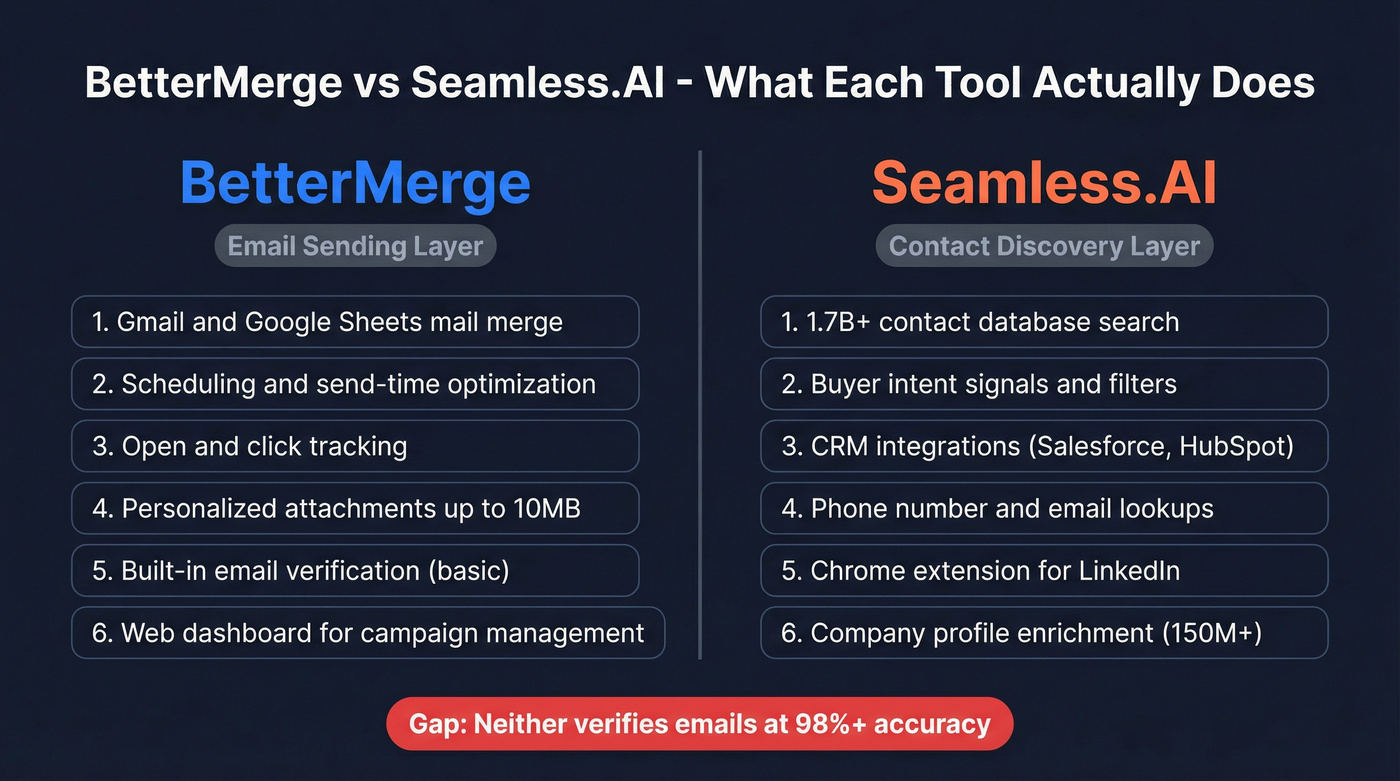
Skip it when you don't have contacts yet. BetterMerge doesn't find emails and doesn't build prospect lists - it's purely the sending layer. It also lacks HIPAA compliance and ISO 27001 certification, so it's off the table for healthcare or highly regulated industries. Custom tracking domains and automated follow-ups are marked as "coming soon" on their site but aren't available yet. We couldn't find a G2 or Capterra listing during our research, so you're trusting published features and pricing rather than community validation.
Seamless.AI
Use it when you need to build a contact database with buyer intent signals and CRM integrations. Seamless.AI claims 1.7B+ contacts and 150M company profiles, backed by a 4.4/5 rating from 5,319 G2 reviews. The breadth is real - users consistently say it surfaces emails they can't find elsewhere.
Skip it when you care about pricing transparency or deliverability. Here's the thing: the #1 complaint on Reddit and G2 isn't the data quality - it's the business model. Credits burn faster than expected, pricing requires a sales call, and cancellation/auto-renewal issues are a recurring headache. Phone number accuracy runs around 60% in practice, and email accuracy sits around 85%. That means 15 out of every 100 cold emails could bounce and torch your domain reputation. The consensus on r/sales is that Apollo offers a more transparent alternative for teams that want visible pricing.

BetterMerge sends emails. Seamless.AI finds contacts at ~85% accuracy. Neither solves the verification gap that torches your domain. Prospeo sits between sourcing and sending - 98% email accuracy, 125M+ verified mobiles, 7-day data refresh, and $0.01/email with no sales calls or annual contracts.
Stop feeding BetterMerge dirty data. Start with 75 free verified emails.
Pricing and Limits
These tools operate on completely different cost models, which is part of why comparing them head-to-head is misleading.
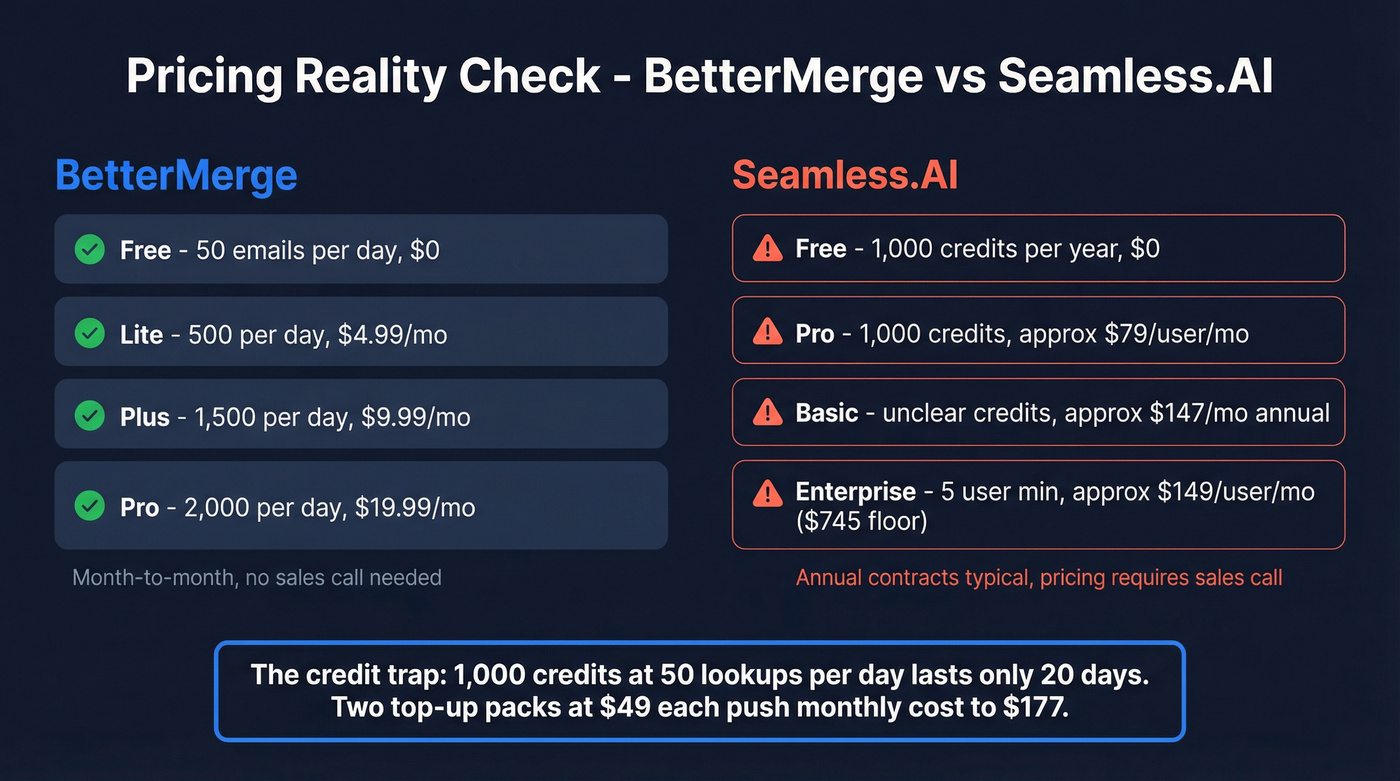
| BetterMerge | Seamless.AI | |
|---|---|---|
| Starting price | Free (50/day) | Free (1,000 credits/user/yr) |
| Mid-tier | $9.99/mo (1,500/day) | ~$79/user/mo (Pro) |
| Top tier | $19.99/mo (2,000/day) | ~$149/user/mo (Enterprise) |
| Pricing model | Flat monthly | Credits + sales call |
| Contract | Month-to-month | Annual typical |
| Best for | Sending from Gmail | Building prospect lists |
BetterMerge's pricing page is refreshingly transparent. Free gets you 50 emails/day. Lite at $4.99/mo bumps that to 500/day with 2MB attachments. Plus at $9.99/mo hits 1,500/day with 5MB attachments. Pro at $19.99/mo maxes out at 2,000/day with 10MB attachments. One critical caveat: Gmail.com accounts cap at 500/day regardless of your plan - you need Google Workspace to unlock higher limits. Annual billing saves two months, and BetterMerge offers purchasing power parity pricing in 30+ countries. For context, GMass Premium runs $29.95/mo and Mailmeteor starts at $9.99/mo, so BetterMerge undercuts both.
Seamless.AI is a different story entirely. The pricing page shows plan names but no dollar amounts above Free. Based on user-reported numbers from Reddit, Pro runs ~$79/user/mo with 1,000 credits. There's also a Basic tier typically around $147/mo on annual billing, though details are scarce. Enterprise starts at ~$149/user/mo with a 5-user minimum - that's a $745/mo floor before you've looked up a single contact. Extra credits cost $49 per 500.
Let's do the credit math that actually matters: at 50 lookups/day, your 1,000 Pro credits last about 20 days. Buy two top-up packs to finish the month and your effective cost jumps to $177/mo. Add-ons can push total costs 40-60% above the base license. The fact that Seamless doesn't publish any of this is genuinely frustrating, and we've heard the same complaint from dozens of sales teams we've talked to.
Most teams under 5 reps don't need Seamless.AI's scale. You're paying enterprise prices for a contact database when your actual bottleneck is email accuracy and deliverability - not volume.
When to Use Which
We've seen teams overcomplicate their outbound stack over and over. Three scenarios, three answers:
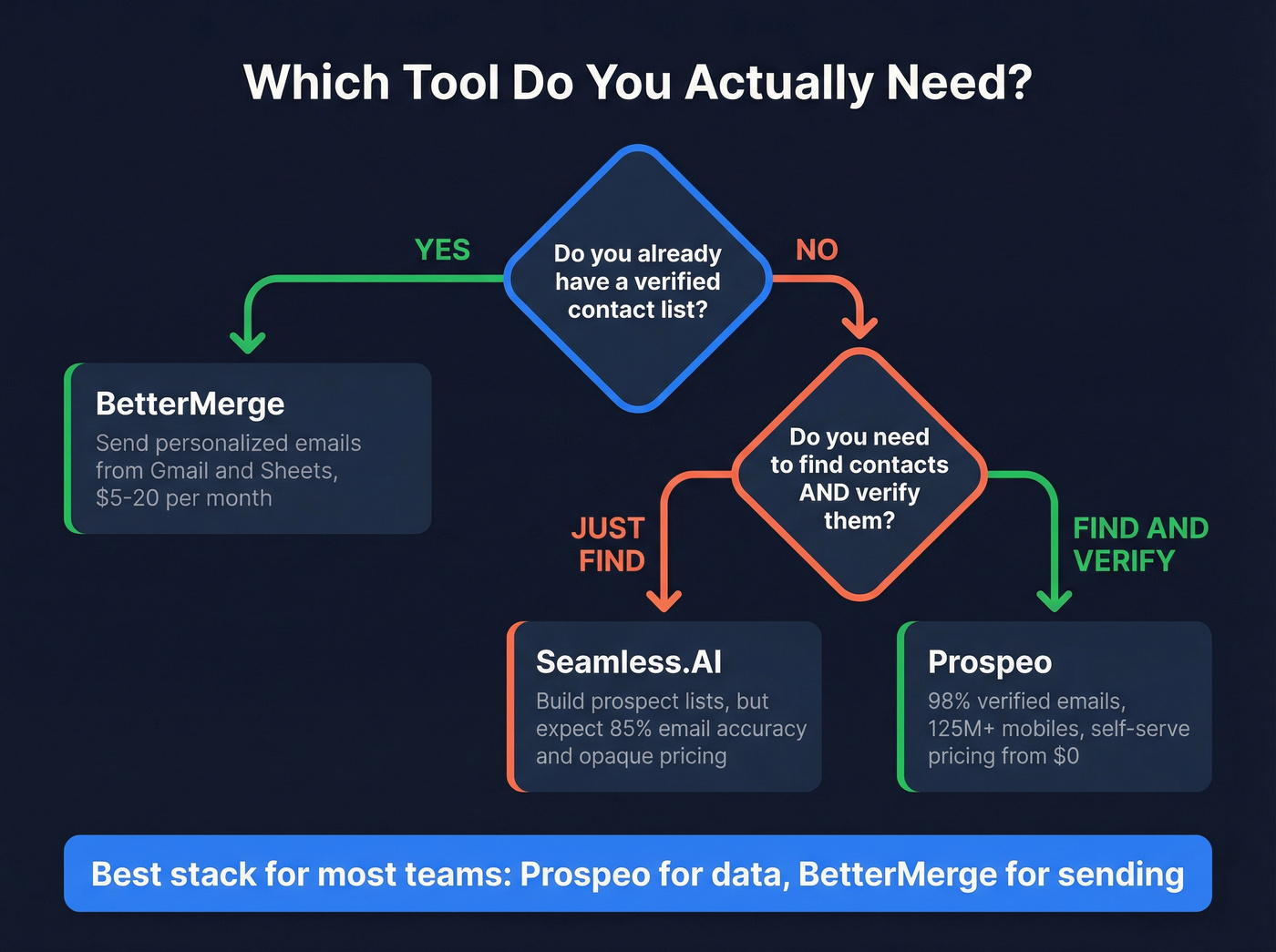
"I have a list, I need to send from Gmail/Sheets." BetterMerge. It's $5-20/mo and does exactly this. Don't overthink it.
"I need verified emails and phones to feed my sending tool." This is the data-and-verification layer that sits between sourcing and sending. You need 98% email accuracy and verified mobiles, then push contacts straight into BetterMerge, Instantly, or whatever runs your sequences.
The Missing Layer: Verified Data
Neither BetterMerge nor Seamless.AI solves the verification problem well. BetterMerge assumes your list is clean. Seamless.AI gives you contacts at ~85% email accuracy, which means 15 out of every 100 emails bounce. We've seen teams - one agency client in particular comes to mind - cut bounce rates from 15%+ to under 4% just by adding a verification step between sourcing and sending. That single change saved their primary domain from a spam folder death spiral (see email bounce rate benchmarks and fixes).
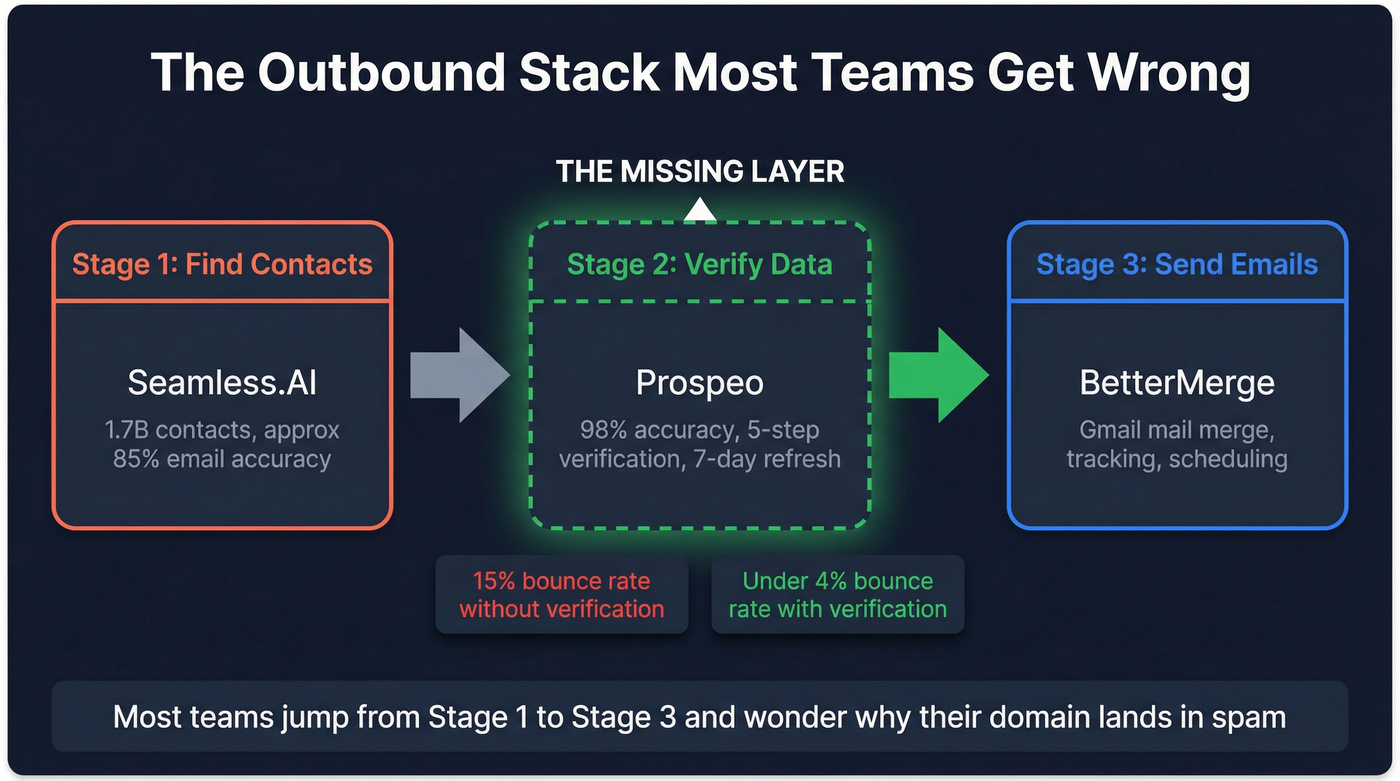
For teams running cold email from Gmail, the stack is simple: Prospeo for verified data, BetterMerge for sending (and if you're scaling, follow an email deliverability checklist and watch email velocity).
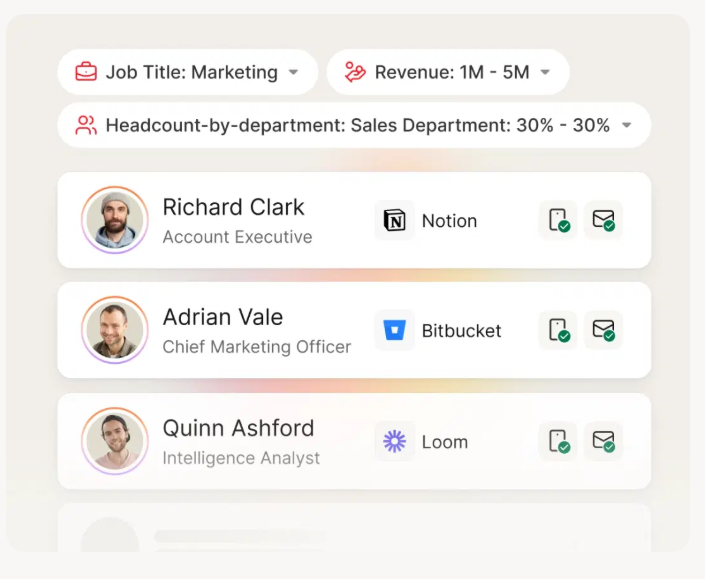
Seamless.AI burns credits on unverified contacts and hides pricing behind sales calls. Prospeo gives you 300M+ profiles with 30+ filters, self-serve pricing starting free, and emails verified through a 5-step process - not scraped and shipped. Teams using Prospeo book 35% more meetings than Apollo users.
Transparent pricing, verified data, zero credit games. See for yourself.
FAQ
Can I use BetterMerge and Seamless.AI together?
Yes - they handle different jobs. Seamless.AI finds contacts, BetterMerge sends personalized emails from Gmail and Sheets. But sending unverified Seamless contacts through BetterMerge risks bounces that damage your domain. Add a verification layer between them to keep bounce rates under 4%.
How fast do Seamless.AI credits run out?
At 50 lookups per day, 1,000 Pro credits last about 20 days. One $49 top-up pack pushes your monthly cost to ~$128; two packs puts you at $177. Credits are the hidden cost most buyers underestimate - budget 40-60% above the base license.
What's the cheapest way to run outbound from Gmail?
BetterMerge Lite at $4.99/mo for sending, paired with Prospeo's free tier (75 emails/month) for contacts. That's under $5/mo to start running personalized outbound from Google Sheets with verified data. Scale up on either side as volume grows.