

Blind Introduction Emails: Why They Backfire and What to Do Instead
You just got CC'd on a thread with someone you've never met. A mutual contact thought you two "should connect" - no context, no ask, no warning. Now you're stuck. Ignore it and look rude. Decline and it's awkward. Take the meeting and lose 30 minutes you'll never get back.
That's the blind introduction email in action, and it just added one more obligation to a mailbox already averaging 121 messages a day.
What Is a Blind Introduction Email?
A blind introduction email is when someone connects two people over email without asking the recipient first. The introducer CCs both parties, often with a vague "you two should chat," and walks away. The recipient never consented.
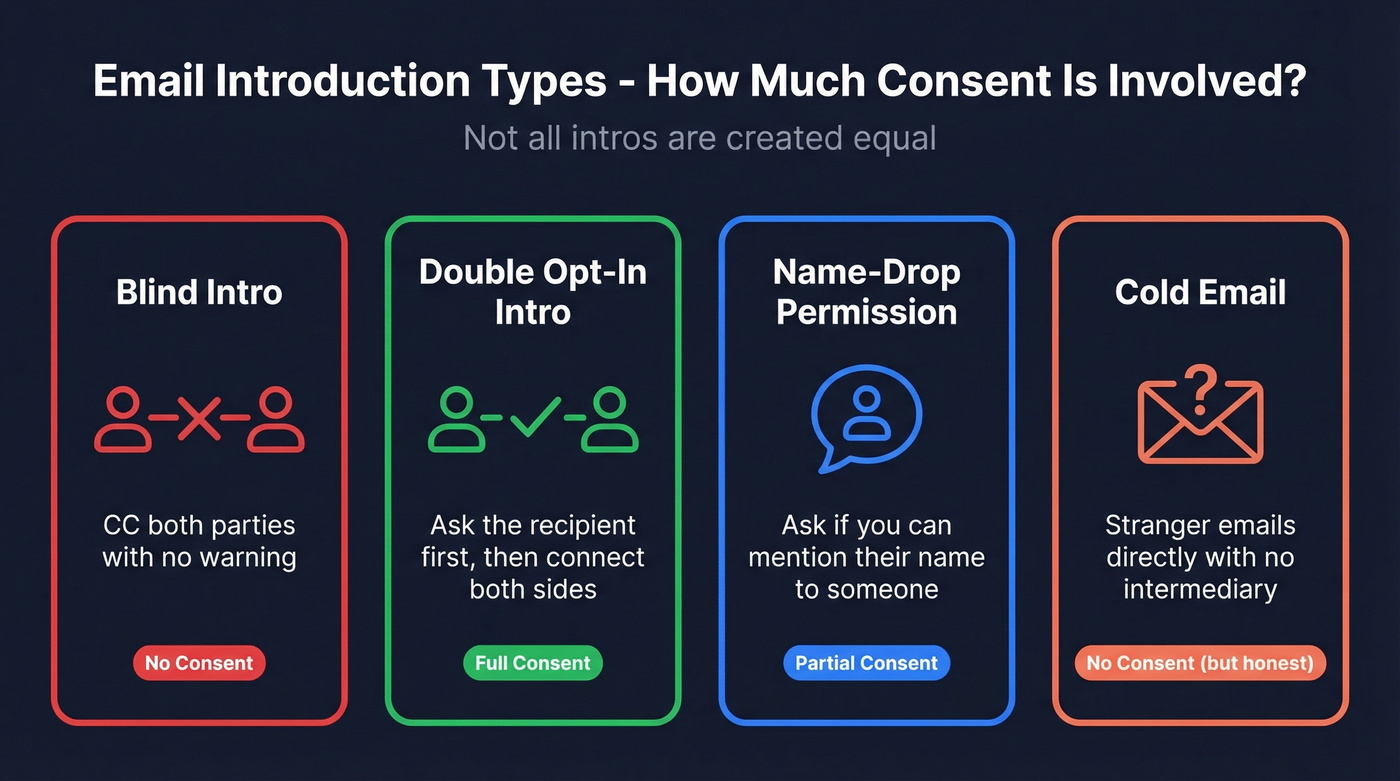
| Type | How It Works | Consent Level |
|---|---|---|
| Blind intro | CC both parties, no warning | None |
| Double opt-in intro | Ask recipient first, then connect | Full |
| Name-drop permission | "Can I mention your name?" | Partial |
| Cold email | Stranger emails directly | None (but expected) |
Here's the thing: a cold email is honest about what it is. A blind intro hides behind a mutual relationship, turning a pitch into a social obligation.
Why Blind Intros Backfire
Elad Gil laid this out clearly: blind intros hurt everyone involved. The recipient gets forced into an awkward position. The introduced person gets set up for ghosting. And the introducer burns social capital with both sides.
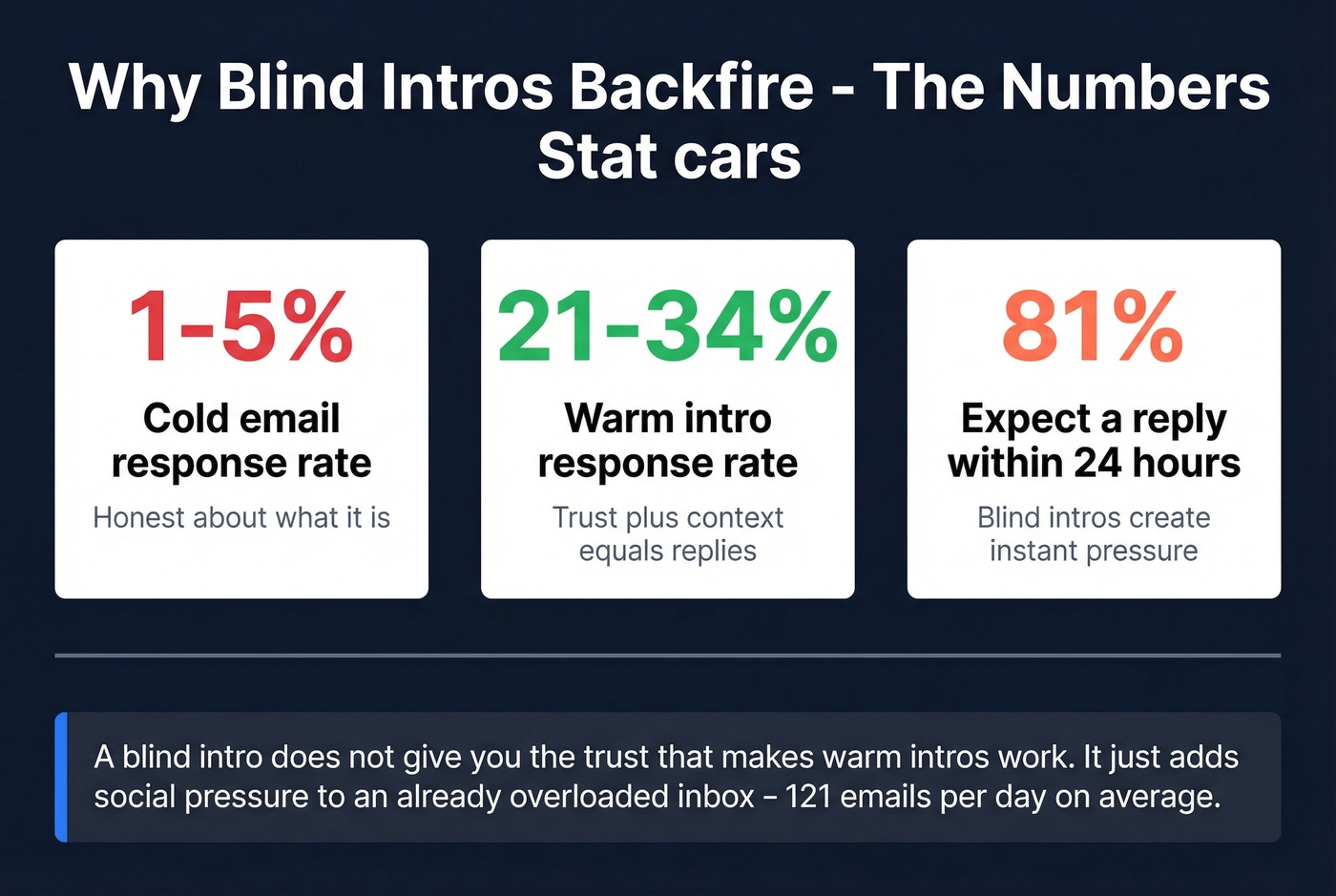
The numbers are stark. Cold emails pull a 1-5% response rate. Warm introductions via a mutual connection land between 21-34%. But an unsolicited intro doesn't give you the trust and clarity that makes warm intros work - it just creates extra social pressure for the recipient.
And that pressure is real. 81% of professionals expect replies within one business day, which means the recipient now feels obligated to respond within 24 hours to something they never asked for. With email already consuming 28% of the average workweek, that's not a small ask.
Blind intros hit hardest when there's a power imbalance. A junior founder gets CC'd with a senior investor, and declining feels high-stakes. We've watched founders ghost entire threads rather than deal with that awkwardness - and in VC circles, angel investors explicitly warn against blind intros because it's an easy way to annoy an investor who replies harshly, reflecting badly on the connector too. Over on r/startups, the consensus is blunt: unsolicited CC'ing "betrays trust and stymies a good 1:1 relationship."
If you wouldn't cold-call someone on the recipient's behalf, you shouldn't blind-intro them either. The email version just feels more polite. It isn't.
The 3 Exceptions
Blind intros aren't always wrong. Three situations justify skipping the opt-in:
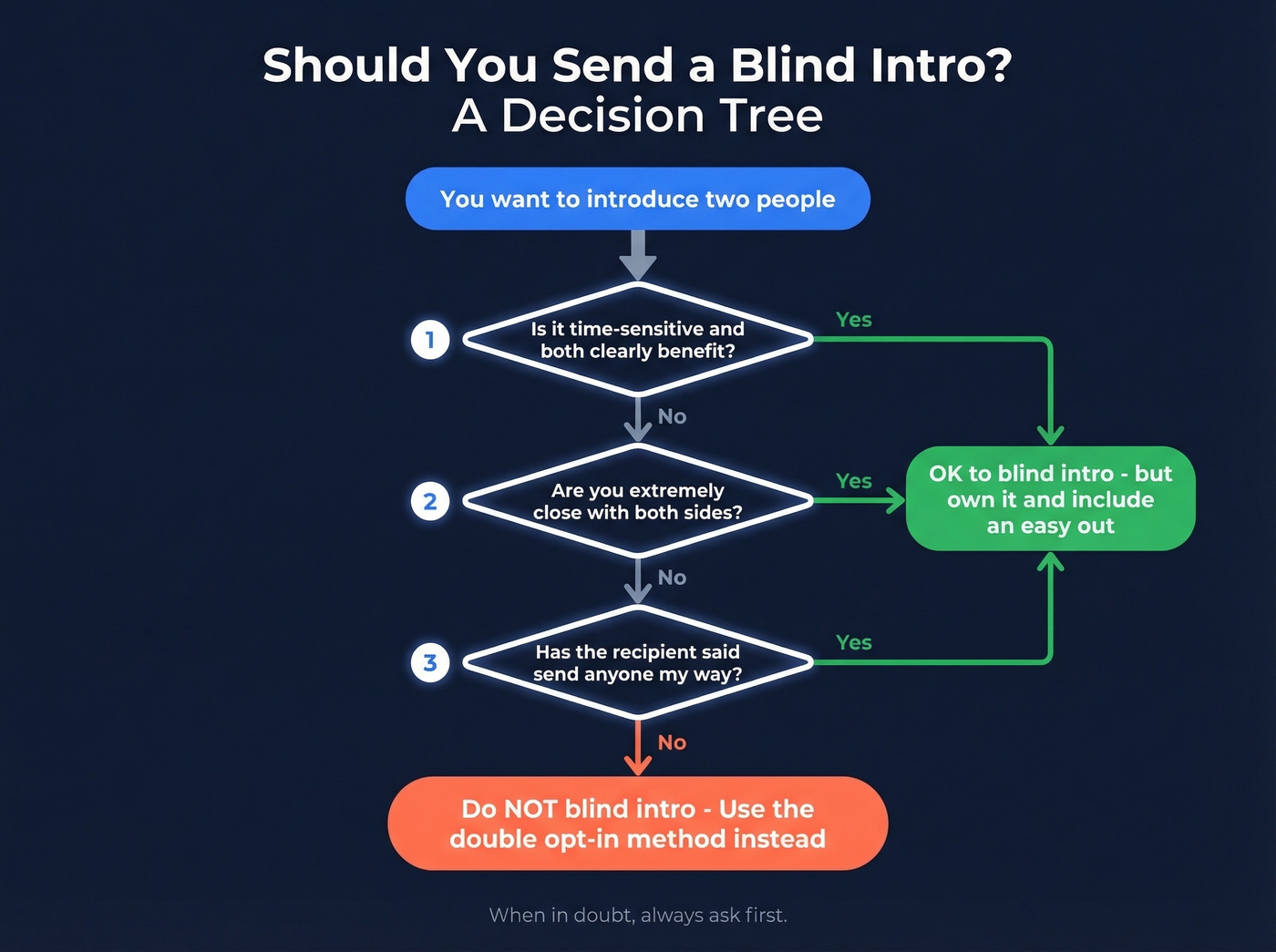
- It's time-sensitive and both parties clearly benefit. A hiring manager needs a candidate by Friday, and you know the perfect person.
- You're extremely close with both sides. If you'd bet your reputation that both people want this connection, the formality of asking first adds friction without adding value.
- The recipient has explicitly said "send anyone my way." Some founders, community builders, or investors in active deployment mode genuinely mean it.
If you must send an unsolicited intro outside these cases, own it: "I'm making this intro without checking first because [reason], and I apologize if the timing is off." Include an explicit out so people can ignore the email without guilt. But the better move? Ask first. Every time.

Warm intros convert 4x better than cold outreach - but only if the email lands. Prospeo's 5-step verification catches bad addresses before you hit send, so your carefully brokered introduction never bounces. 98% accuracy across 143M+ verified emails.
Stop wasting social capital on emails that bounce.
The Double Opt-In Introduction
The double opt-in method is simple: ask both sides before connecting them. Let's break it down.
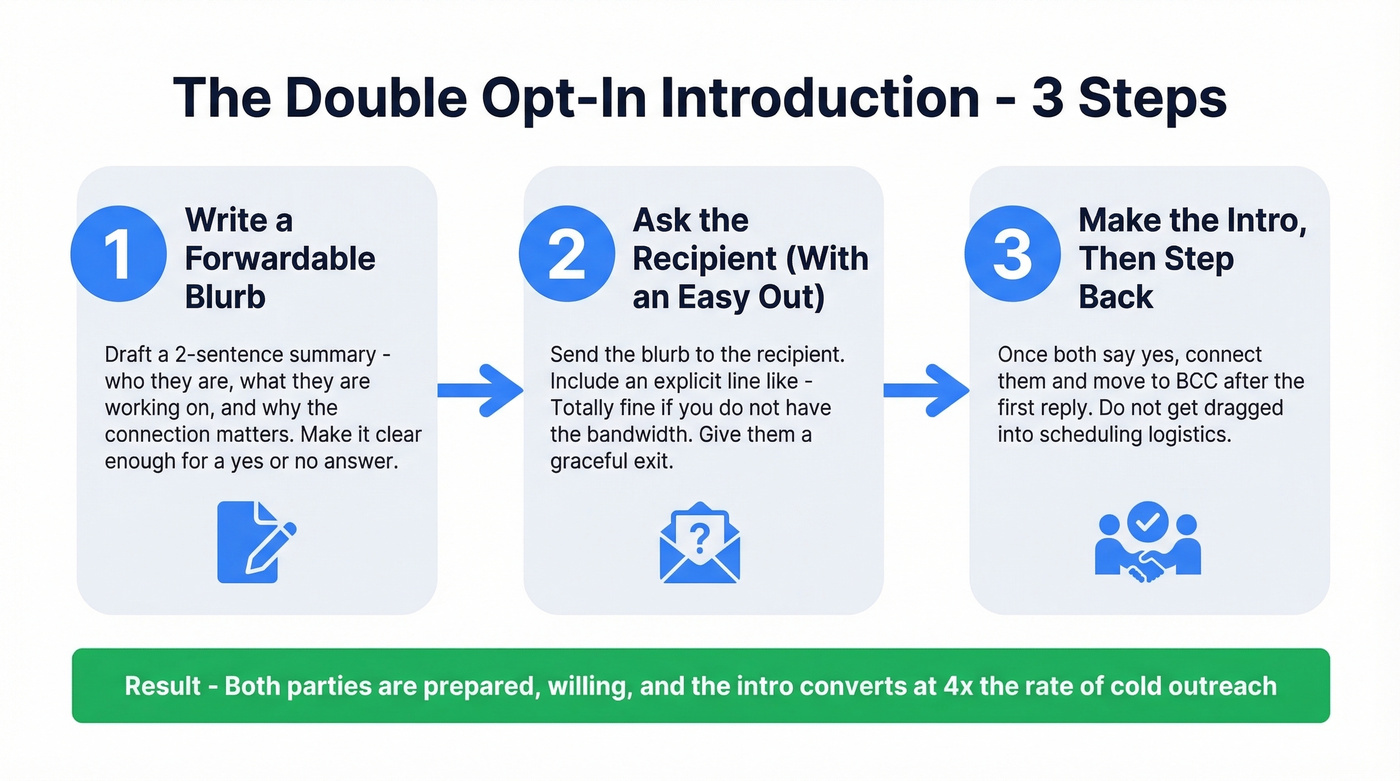
Step 1: Write a forwardable blurb. Draft a two-sentence summary of the person you want to introduce - who they are, what they're working on, and why the connection matters. This blurb should be clear enough that the recipient can say yes or no without a follow-up question. (If you want examples, see our sample elevator pitches.)
Step 2: Ask the recipient, with an easy out.
Subject: Quick intro - Sarah Chen at RemoteHire?
Hey [Recipient], a friend of mine, Sarah Chen, is building a hiring platform for remote teams and mentioned she's looking for exactly the kind of ops talent you specialize in placing. Would you be open to a quick intro? Totally fine if you don't have the bandwidth - no pressure either way.
That last line gives the recipient a graceful exit without guilt.
Step 3: Make the intro, then step back. Once both sides say yes, send the introduction and get out of the way. In our experience, the most underused mechanic in email is the BCC handoff - after the first reply, the introduced person moves you to BCC: "Thanks for the intro - moved to BCC so you don't get buried in scheduling." (For more handoff language, use these handoff email templates.) This keeps the connector informed without dragging them into logistics.
Scripts for Every Role
If You Received a Blind Intro
Hi [Introduced Person], thanks for reaching out. Could you share a bit more context on what you were hoping to discuss? That'll help me figure out if I'm the right person.
Polite, sets a boundary, doesn't burn the bridge. Separately, message the introducer privately and ask them to check with you first next time.
Declining an Intro Request
I appreciate you thinking of me for this. [Recipient] is pretty slammed right now, so I don't want to add to their plate. I might be able to help directly though - can you share what you're trying to accomplish?
Adapted from OfficeNinjas' decline templates, this protects the recipient without making the requester feel rejected.
If You Were Blind-Introduced
Hi [Name], nice to e-meet you. I want to be respectful of both our time - could you share what prompted the intro? Happy to chat if there's a fit.
Short, professional, honest. Nobody gets offended by someone who values their own time.
Skip the scripts entirely if the intro is clearly spam or a mass-networking play. You don't owe a response to someone who's treating introductions like a numbers game. If you do reply, a few sales follow-up templates can help you keep it crisp.
Verify Before You Intro
A warm intro that bounces is worse than no intro at all. It makes the connector look careless and the introduced person look unprofessional. Referred leads convert 4x more often than other channels - too valuable to lose to a bad email address. If you're troubleshooting deliverability, start with email bounce rate benchmarks and fixes, then work through an email deliverability guide to address root causes.
Double opt-in intros only work when you have the right contact info. Prospeo finds and verifies professional emails in real time - no third-party guesswork. 75 free lookups per month, no credit card required.
Every great introduction starts with a verified email address.
FAQ
Is a blind intro the same as a cold email?
No. A blind introduction email uses a mutual contact to create a social obligation the recipient never agreed to, while a cold email comes directly from a stranger with no intermediary. Cold emails are upfront about the relationship. Blind intros disguise a pitch as a favor.
How should I respond to an unsolicited intro?
Reply asking for context - "Could you share what prompted this?" - then privately tell the introducer to check with you before connecting people in the future. This sets a boundary without embarrassing anyone on the thread.
What's the best way to introduce two people over email?
Use a double opt-in: message the recipient first with a two-sentence forwardable blurb, get a yes, then connect both parties and step back via BCC. This method respects everyone's time and consistently earns higher response rates than blind intros.
How do I make sure an introduction email doesn't bounce?
Verify the address before sending. Tools like Prospeo check deliverability in real time with 98% accuracy - the free plan covers 75 verifications per month, which is plenty for most connectors and networkers.