

Boost Inbox Review: Pricing, Pros & Cons, and What Users Actually Say
Finding straight answers on Boost Inbox is frustrating. Third-party sources contradict each other, the review footprint is nearly nonexistent, and pricing pages across the web show wildly different numbers. We did the digging so you don't have to.
30-Second Verdict
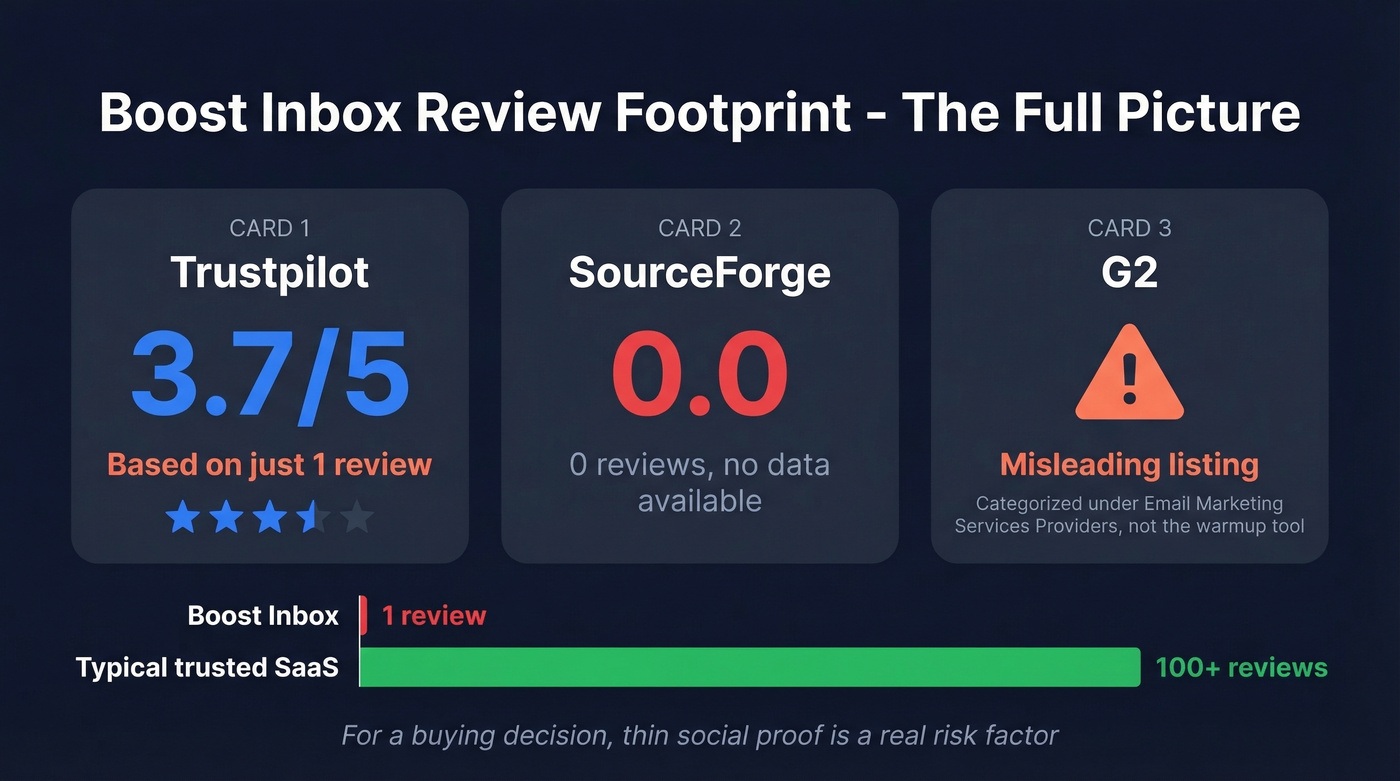
Boost Inbox claims a 200,000+ inbox warmup network and GPT-3-generated emails, but the public evidence backing those claims is thin. There's one Trustpilot review, zero SourceForge reviews, and a confusing G2 listing that appears to be for an email marketing services provider category - not the warmup SaaS.
What Is Boost Inbox?
Boost Inbox is an email warmup service designed to improve inbox placement and sender reputation. You connect your inbox, and Boost Inbox sends and receives warmup emails through a network of 200,000+ real inboxes, generating positive engagement signals - opens, bookmarks, replies - that tell email providers your domain is trustworthy.
The warmup emails are generated using GPT-3, which produces more natural-looking interactions than template-based alternatives. It supports Gmail, Outlook 365, Amazon SES, Yahoo Mail, and SMTP connections. The site claims "2,000+ advertisers" use the platform, and reporting dashboards track your inbox reputation over time. On paper, it checks the boxes. The question is whether reality matches.
Boost Inbox Pricing Breakdown
Boost Inbox does publish a pricing page with monthly and annual options, including "2 months free with yearly plan."
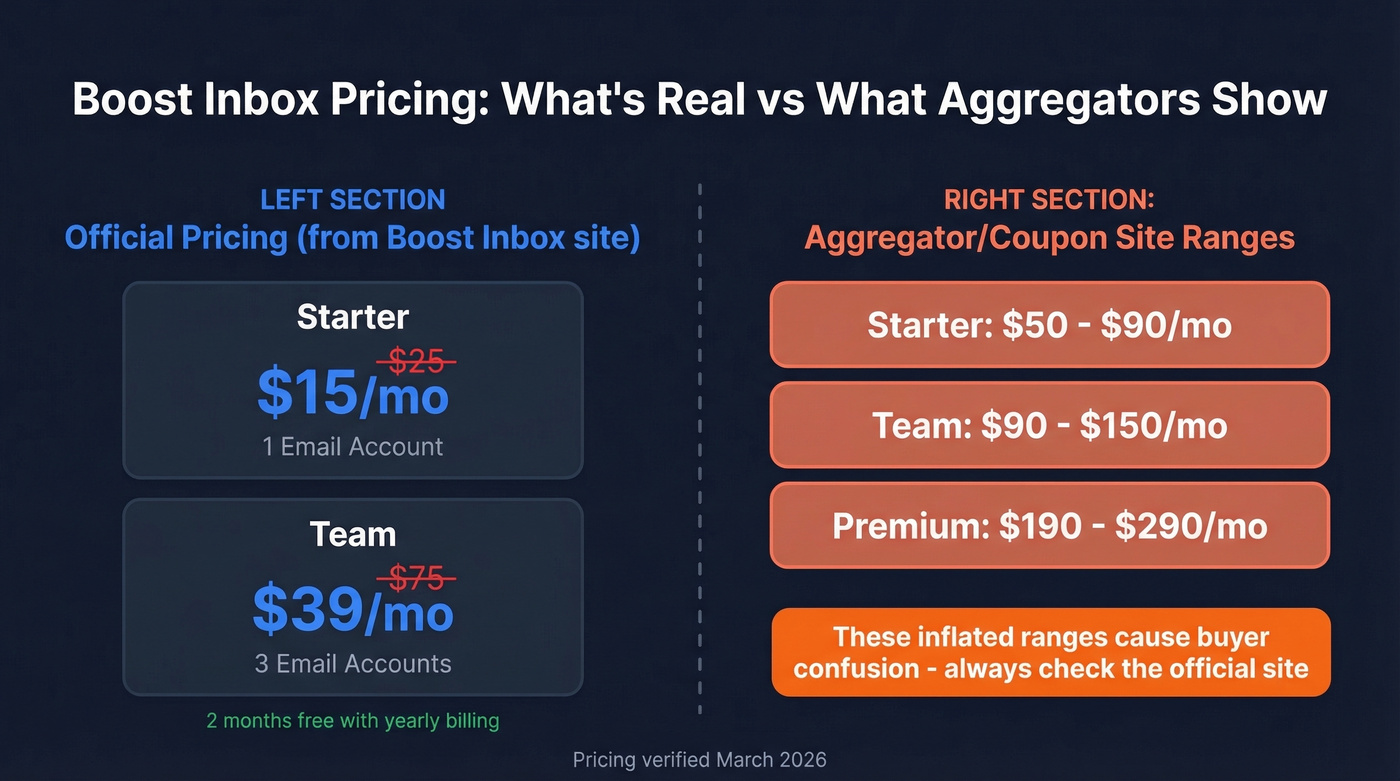
Here's what we found:
- Starter: $15/month for 1 email account (shown as "was $25")
- Team: $39/month for 3 email accounts (shown as "was $75")
A coupon/deals site lists much higher ranges (Starter $50-$90, Team $90-$150, Premium $190-$290), while SourceForge's comparison page says "No information available." That mismatch is a big reason buyers get confused.
For context, warmup tools commonly start around $15/month and can run $149+/month at the premium end. At $15, Boost Inbox sits near the low end - not the inflated ranges those aggregator sites suggest.
What Users Actually Say
There's almost nothing to work with here. That's not an exaggeration.
Boost Inbox's Trustpilot page shows a 3.7 out of 5 rating based on exactly one review. That single review, dated September 2024, claims two years of use across multiple clients and calls the results "mind blowing" with "exceptional customer service." It's positive, but it's one data point.
SourceForge shows zero reviews and a 0.0 rating. The G2 situation is confusing - searching "Boost Inbox" surfaces a listing categorized under Email Marketing Services Providers alongside agencies like WebFX and KlientBoost. That's not the warmup tool, and it can make it look like G2 reviews exist when they don't.
For a buying decision, this thin footprint matters. You're trusting vendor claims with very little independent verification. Compare that to Warmup Inbox with on-page testimonials, or MailReach with published deliverability benchmarks. The gap in social proof is significant.

Warmup tools help your reputation recover. But if your contact list is full of invalid emails, you're just warming up a domain that bounces keep destroying. Prospeo delivers 98% email accuracy through 5-step verification - so you stop the damage before it starts.
Fix the data first. 75 free email verifications, no credit card required.
Pros and Cons
Pros:
- Large claimed warmup network at 200,000+ inboxes - bigger than Warmup Inbox's 20,000+
- Broad email provider compatibility across Gmail, Outlook 365, Amazon SES, Yahoo Mail, and SMTP
- GPT-3-generated warmup emails produce more natural-looking interactions than templates
- Analytics and reporting for tracking reputation over time
Cons:
- Near-zero public reviews: 1 on Trustpilot, 0 on SourceForge, and a misleading G2 listing
- Conflicting pricing info across the web, even though official pricing exists
- No published deliverability benchmarks or case studies
- "2,000+ advertisers" claim is vague and impossible to validate from the outside
How Boost Inbox Compares
Let's skip the pretense of having perfect data for every vendor's network size and trial terms. Here's the cleanest comparison based on what's actually verifiable.
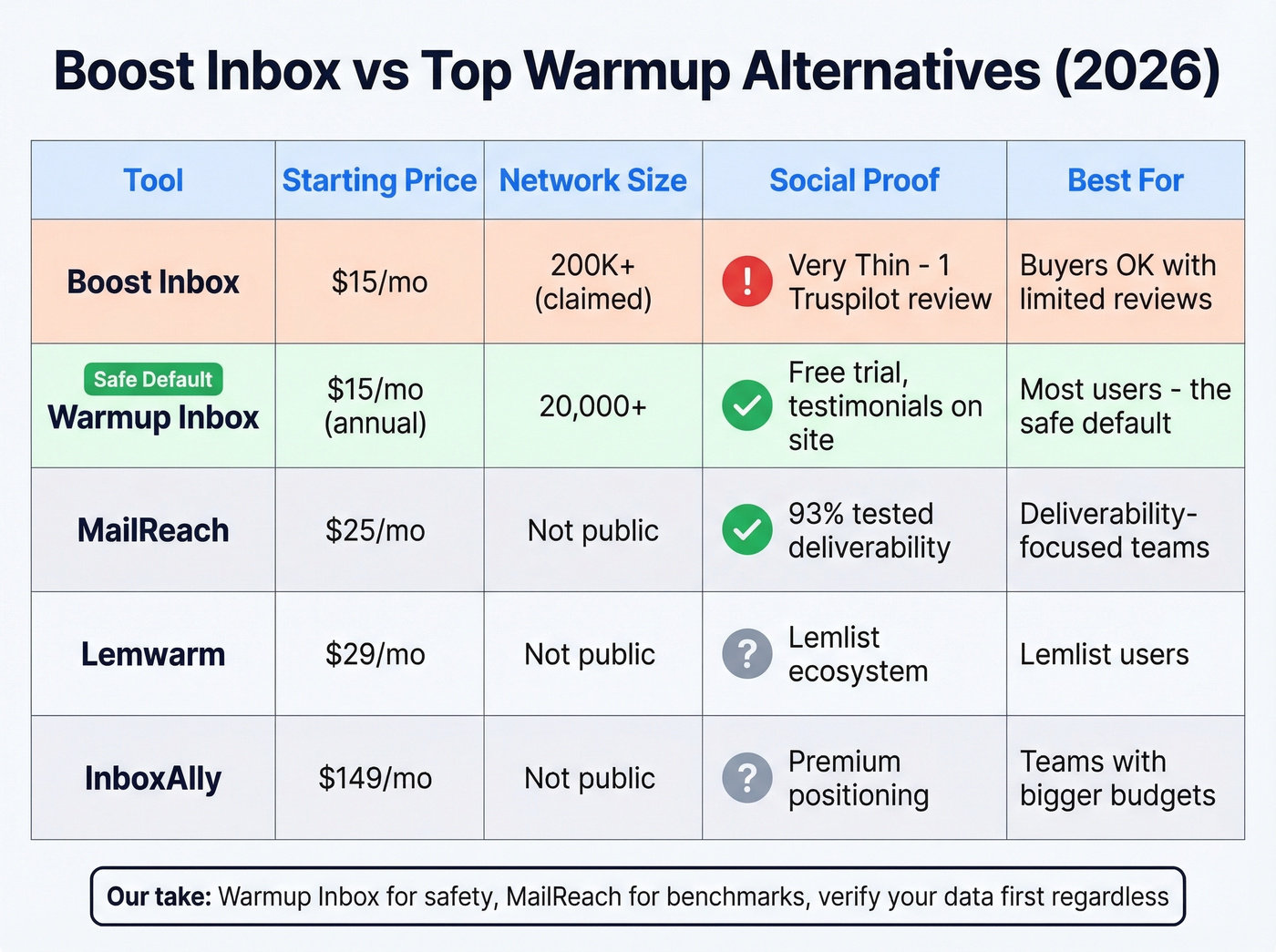
| Tool | Starting Price | Network Size | Key Differentiator | Best For |
|---|---|---|---|---|
| Boost Inbox | $15/mo (Starter) | 200K+ (claimed) | GPT-3 warmup emails | Buyers OK with limited reviews |
| Warmup Inbox | $15/mo (annual) / $19 monthly | 20,000+ (claimed) | 7-day free trial, no CC required | Most users - the safe default |
| MailReach | $25/mo | Not public | 93% deliverability in editorial testing | Deliverability-focused teams |
| Lemwarm | $29/mo | Not public | Lemlist ecosystem integration | Lemlist users |
| InboxAlly | $149/mo | Not public | Premium warmup positioning | Teams with bigger budgets |
Warmup Inbox: The Safe Default
Warmup Inbox costs $19 per inbox/month or $15 per inbox/month on annual billing, and it offers a 7-day free trial with no credit card required. It also claims access to a network of 20,000+ real inboxes. If you want one recommendation and nothing else, this is it. The free trial alone makes it easy to test before committing.
MailReach: The Benchmark-Driven Pick
MailReach starts at $25/month and earned a 93% deliverability rate in editorial testing. If you care less about network size claims and more about published inbox-placement results, MailReach is the stronger option.
Skip InboxAlly Unless Budget Isn't a Factor
At $149/month, InboxAlly is 10x the cost of Boost Inbox's Starter plan. For most small teams and solo operators, that's hard to justify when cheaper tools exist with better public track records.
A Note on Built-In Warmup
Practitioners on r/coldemail regularly criticize built-in warmup inside outreach platforms like Instantly and Smartlead as "rudimentary." They also debate sending-volume guidance heavily - some recommend ~25-30 campaign emails/day, others push ~100/day after warmup, depending on the tool and domain age. The consensus is that standalone warmup tools generally outperform built-in features.
Warmup Won't Fix Bad Data
Here's a pattern we see constantly: teams invest in warmup, run it for weeks, and still land in spam. One Reddit user reported running 320 Instantly inboxes with warmup active, sending just ~30 emails/day per inbox, and still watching deliverability crater after a couple months. Warmup wasn't the problem. The data was.

The logic is simple. Bad contact data causes bounces. Bounces damage sender reputation. Damaged reputation sends you to spam. Warmup helps with the reputation piece, but if the list is bad, you're pouring water into a leaking bucket.
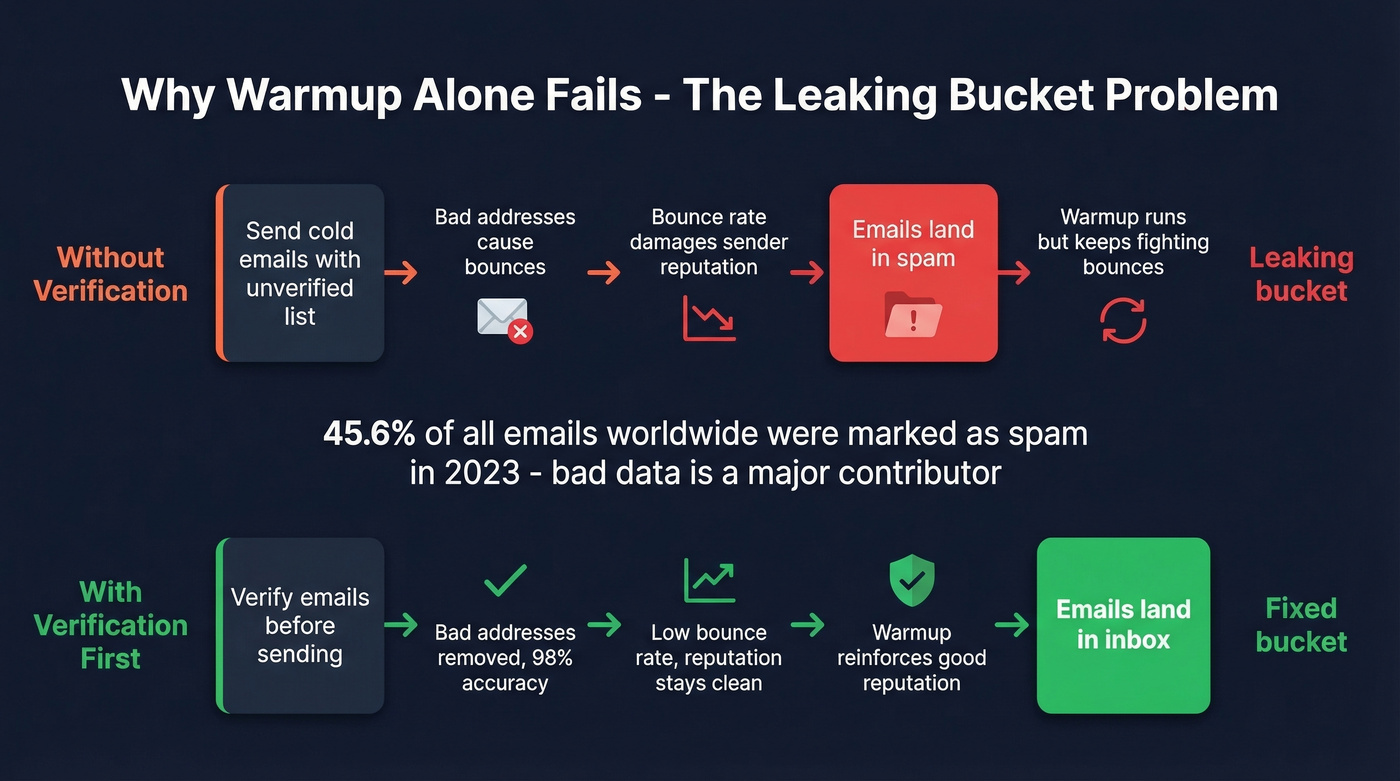
In 2023, roughly 45.6% of all emails worldwide were marked as spam, and bad data is a major contributor. Before spending money on warmup, verify your email list. Prospeo's free tier gives you 75 verifications per month - enough to audit whether bad data is your real deliverability problem. Threads on r/Emailmarketing are increasingly skeptical about warmup as a category, with users calling it an "echo chamber." Data quality is the boring fix that actually works. If you want a deeper framework, start with an email deliverability guide and then track your email bounce rate.
Is Boost Inbox Worth It?
Boost Inbox might work perfectly well. A 200,000+ inbox network with GPT-3-generated emails is a compelling pitch. But in 2026, when Warmup Inbox publishes transparent pricing with a free trial and MailReach posts 93% deliverability benchmarks, choosing a tool with one Trustpilot review and zero SourceForge reviews is a leap of faith we wouldn't take with our own domains.
Go with Warmup Inbox if you want the safest standalone option. Go with MailReach if deliverability benchmarks matter most. And remember: if bounces are the issue, verification comes first. To keep your sending stable long-term, monitor sender reputation and your email velocity.
That Reddit user running 320 inboxes with warmup and still hitting spam? Bad data was the root cause. Prospeo's emails are verified on a 7-day refresh cycle - not the 6-week industry average - so your lists stay clean and your sender reputation stays intact.
Stop pouring money into warmup while bad data leaks out the bottom.
Frequently Asked Questions
Is Boost Inbox legit?
Boost Inbox is a real product with a functional website and a claimed 200,000+ inbox network. That said, it has only one Trustpilot review and zero SourceForge reviews, and the G2 listing that appears in search is categorized under email marketing services providers - not the warmup tool. Independent verification is difficult with that thin a footprint.
How much does Boost Inbox cost?
Boost Inbox starts at $15/month for 1 email account (Starter) and $39/month for 3 accounts (Team), with 2 months free on yearly billing. Some coupon and aggregator sites show much higher ranges, which is why pricing looks inconsistent across the web.
What are the best Boost Inbox alternatives?
Warmup Inbox (from $15/month annual, 7-day free trial) and MailReach (from $25/month, 93% tested deliverability) are strong standalone warmup tools with clearer third-party validation. For the upstream data-quality problem, Prospeo's free tier includes 75 email verifications per month at 98% accuracy - useful for catching bad addresses before they tank your sender reputation.
Does email warmup actually work?
Warmup can improve inbox placement for new or damaged domains, but it's not a silver bullet. Practitioners on r/coldemail often argue that built-in warmup in outreach platforms is rudimentary compared to standalone tools. More importantly, warmup alone won't fix deliverability if your contact data is causing bounces - verify your emails first to address the upstream problem.