

Business Development vs Sales: What Actually Matters (and What Doesn't)
The business development vs sales debate trips up more careers than it should. A RevOps lead we know spent three months trying to hire an "Enterprise Partnerships" role. Every strong candidate had "Enterprise AE" on their resume - same quota, same deal sizes, same buyer personas. Hiring managers rejected them anyway because the title didn't say "partnerships." The actual work overlaps more than anyone admits, but the labels create real career friction that costs people money and time.
What Separates Sales from Business Development?
Business development creates new opportunities where none exist. That means identifying untapped markets, building partnership channels, and generating qualified pipeline for the sales team to work. BD professionals think in quarters and years. Their success shows up as partner-sourced revenue, new market entries, and strategic relationships that compound over time.
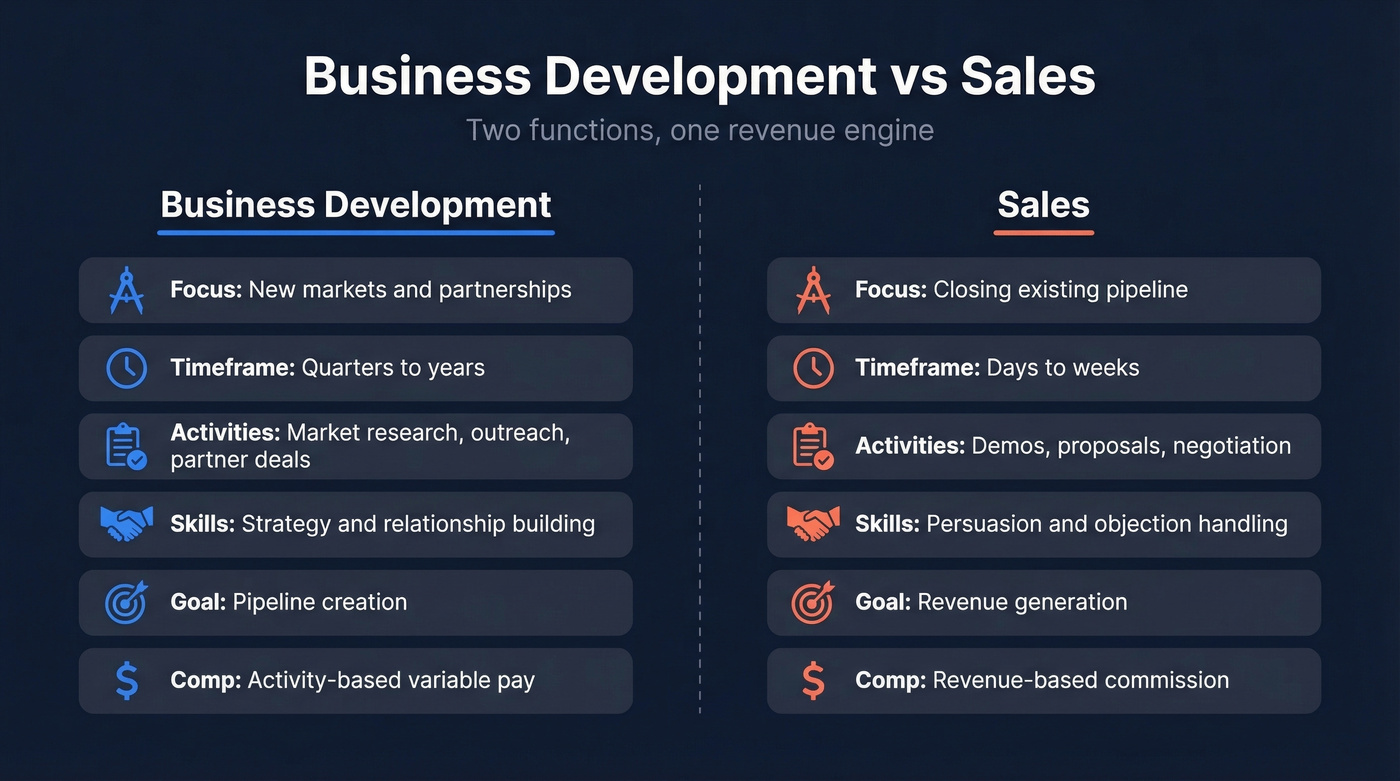
Sales converts existing opportunities into revenue. AEs run demos, negotiate contracts, handle objections, and close. The feedback loop is tight - you know within days or weeks whether your approach is working, and compensation reflects that directness through variable pay tied to closed revenue.
| Dimension | Business Development | Sales |
|---|---|---|
| Focus | New markets, partnerships | Closing existing pipeline |
| Timeframe | Quarters to years | Days to weeks |
| Key activities | Market research, outreach, partner deals | Demos, proposals, negotiation |
| Core skills | Strategy, relationship building | Persuasion, objection handling |
| Goal orientation | Pipeline creation | Revenue generation |
| Comp structure | Activity-based variable | Revenue-based commission |
| Typical KPIs | Meetings booked (15-20/mo), partner pipeline 20-30% | Close rate (20-30%), ACV, quota attainment |
The Title Mess: SDR, BDR, AE, and the Rest
Let's untangle the alphabet soup, because this is where careers get derailed.
- SDR (Sales Development Rep): Qualifies inbound leads, books meetings for AEs. Entry-level, high-volume.
- BDR (Business Development Rep): Generates outbound pipeline through cold outreach and prospecting. Entry-level, high-volume.
- AE (Account Executive): Runs demos, manages deals, closes revenue. Mid-level, quota-carrying.
- AM (Account Manager): Owns post-sale relationships, renewals, expansion. Mid-level, retention-focused.
- BD Manager: Identifies new markets and partnership opportunities. Mid-to-senior, strategic.
- Partnership Manager: Manages existing partner relationships and co-selling motions. Mid-to-senior, relationship-focused.
At many companies, "BDR" and "SDR" are used interchangeably. The distinction exists in theory but collapses in practice. This creates real friction when you're job hunting - your resume says BDR, the role says SDR, and the ATS doesn't know they're the same thing.
One r/sales thread captures this perfectly: the OP describes a role marketed as "Enterprise Partnerships" that was functionally an Enterprise AE seat, then got rejected for actual partnership roles because their experience "didn't match." Same work, wrong label.
How the Split Evolves by Company Stage
At a 10-person startup, the founder does both BD and sales. There's no org chart to argue about.
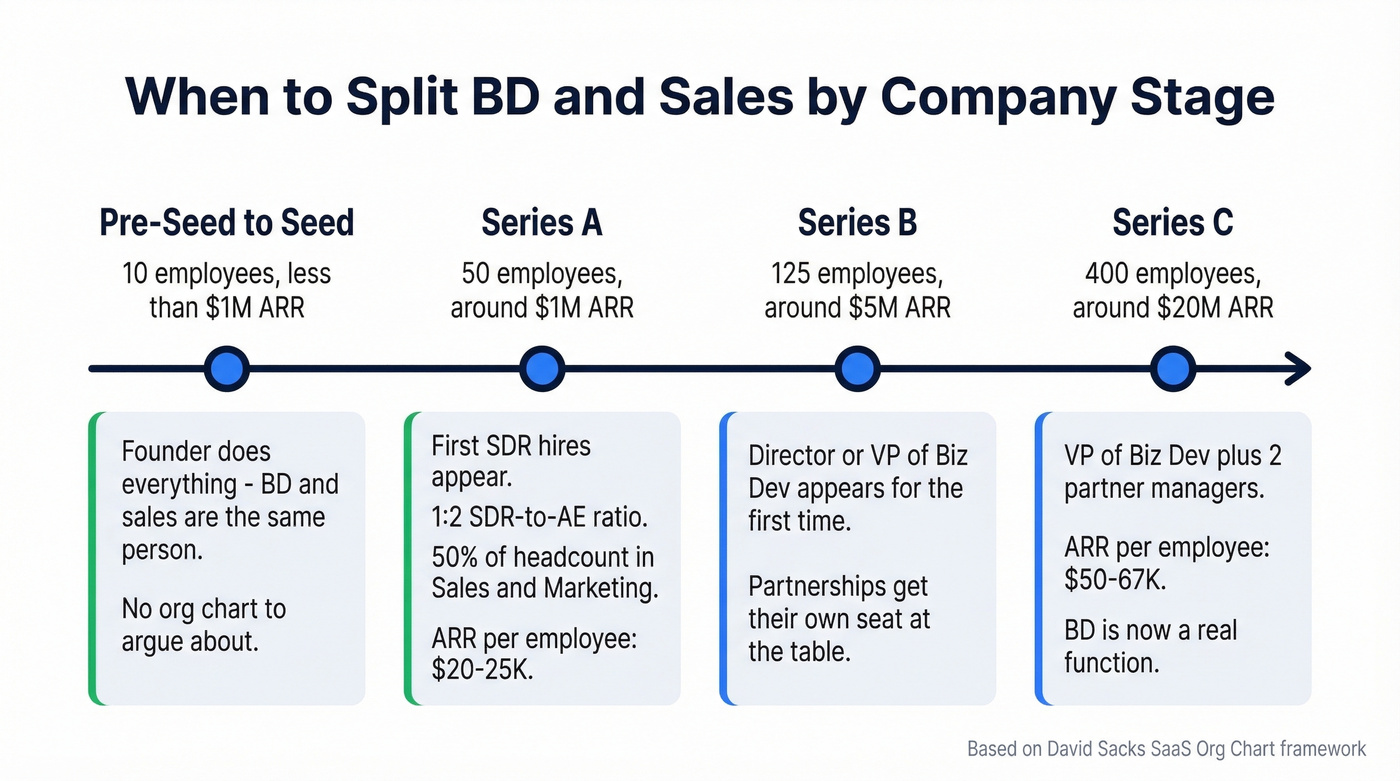
This role blending is normal and necessary until roughly $1M ARR, when the volume of conversations makes specialization unavoidable. David Sacks' SaaS org-chart framework lays out how this evolves with real numbers.
At Series A (around 50 employees, ~$1M ARR), there's no separate BD function. Sales is a handful of AEs with SDR support at roughly a 1:2 SDR-to-AE ratio, and about 50% of headcount sits in Sales & Marketing. By Series B (~125 employees, ~$5M ARR), a Director or VP of Biz Dev/Partnerships appears for the first time. At Series C (~400 employees, ~$20M ARR), that becomes a VP of Biz Dev plus two partner managers. ARR per employee climbs from $20-25K at Series A to $50-67K at Series C, eventually hitting $100K at IPO scale.
Here's the thing: if you're at a sub-50-person company debating whether to create a BD function, you're almost certainly too early. Let your AEs and SDRs handle pipeline work until deal complexity or partnership opportunities genuinely demand a dedicated role. Splitting BD and sales prematurely creates coordination overhead that kills velocity - two people in a Slack channel debating lead handoff criteria instead of one person picking up the phone.

Whether your org splits BD and sales or runs them as one motion, pipeline quality starts with data quality. Prospeo gives BDRs 300M+ verified profiles with 30+ filters - buyer intent, technographics, job changes - so every meeting booked is a real opportunity, not a dead number.
Stop debating titles and start filling pipeline that converts.
What These Roles Actually Pay
Compensation is where the BD vs sales distinction gets concrete. Here's what we've found across multiple benchmarking sources.
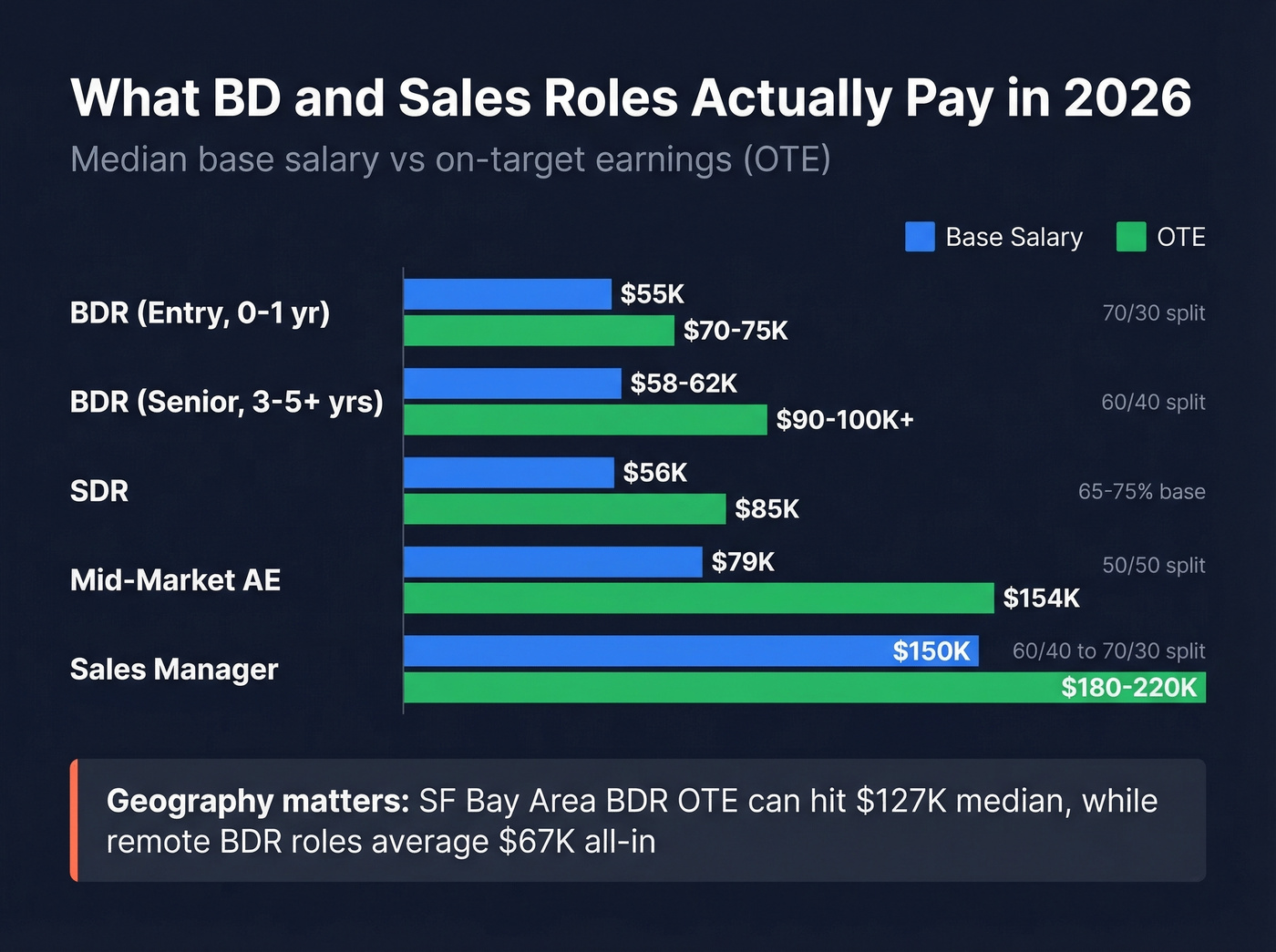
| Role | Median Base | OTE | Variable Split |
|---|---|---|---|
| BDR (entry, 0-1 yr) | ~$55K | $70-75K | 70/30 |
| BDR (mid, 1-3 yrs) | ~$55-59K | $80-90K | 65/35 |
| BDR (senior, 3-5+ yrs) | ~$58-62K | $90-100K+ | 60/40 |
| SDR | ~$56K | ~$85K | 65-75% base |
| Mid-market AE | ~$79K | ~$154K | 50/50 |
| Sales Manager | ~$150K | $180-220K | 60/40 to 70/30 |
These numbers draw from Everstage's compensation analysis and SaleSso's BDR benchmarks.
BDRs typically earn $150-200 per qualified demo booked, roughly $200 per sales-accepted opportunity, or 1-4% of contract value on a revenue-share model. AEs are almost always on a percentage of closed revenue, which is why the 50/50 base-to-variable split makes sense - when you close a $200K deal, that variable check needs to be meaningful.
Geography matters enormously. A BDR in Seattle can hit $160K OTE, while the same role in a mid-tier market caps around $85K. SF Bay Area BDR base salaries run about $80K before variable, with median OTE around $127K. Remote BDR roles average about $67K all-in. Industry vertical shifts the floor too - BLS data shows median sales wages of $102K in securities and investments, $64K in finance and insurance, $46K in real estate, and $35K in retail. If you're benchmarking your comp, the role title matters less than the industry and metro area.
Career Reality Check
Here's a number that should bother every sales leader: average BDR quota attainment is 54%. Roughly half of all BDRs miss their number at any given time.
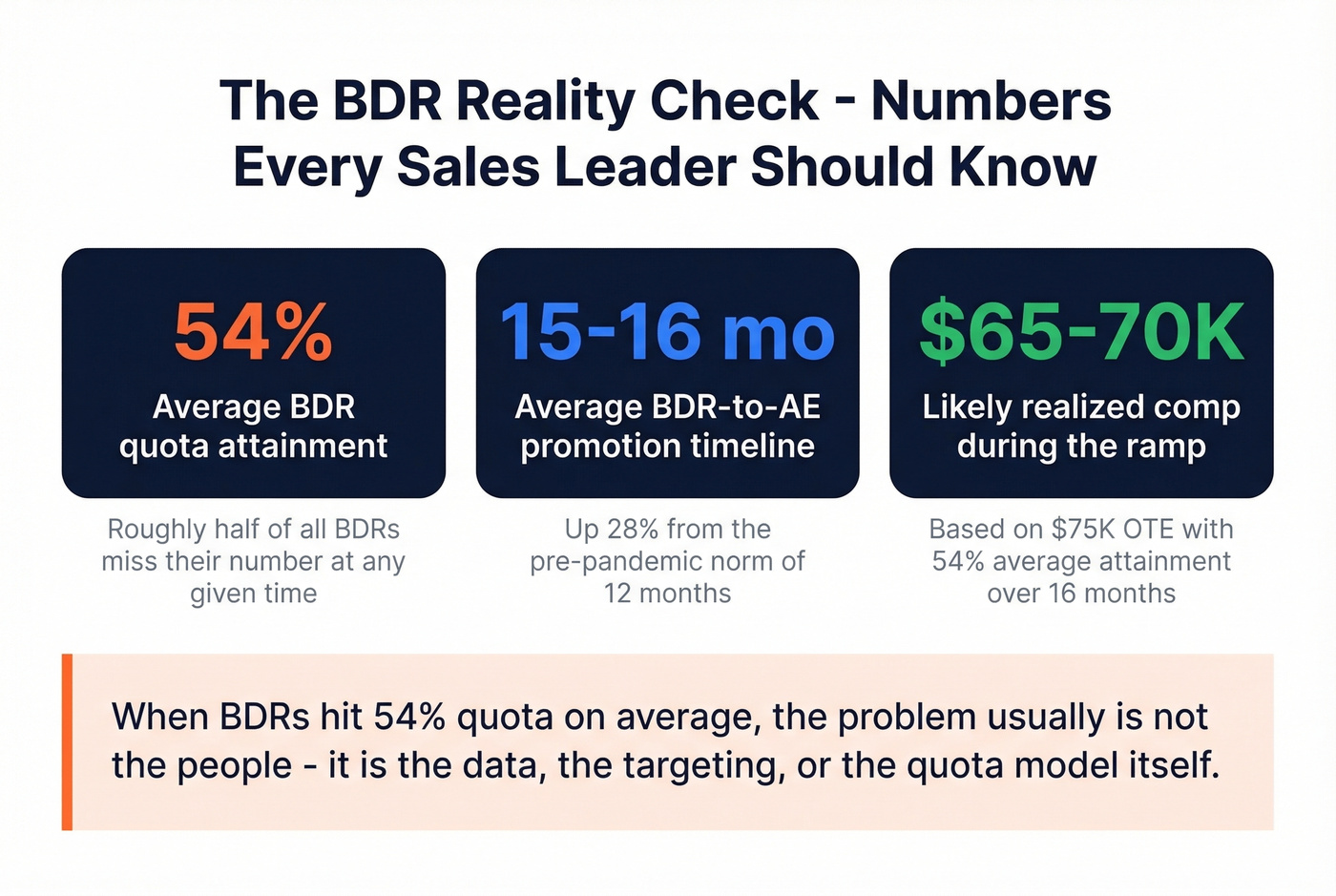
The BDR-to-AE promotion timeline has stretched to 15-16 months on average, up 28% from the pre-pandemic norm of 12 months. If you're a BDR watching that timeline stretch, negotiate your OTE accordingly. A 16-month ramp at $75K OTE with 54% average attainment means you're likely earning $65-70K realized comp for over a year before you get a shot at an AE seat.
We've seen this pattern repeatedly: when BDRs hit 54% quota on average, the problem usually isn't the people. It's the data, the targeting, or the quota model itself. If half your dials go to disconnected numbers, your activity metrics look fine but your pipeline doesn't. Verified contact data fixes the input side of that equation - tools like Prospeo with 143M+ verified emails at 98% accuracy and 125M+ verified mobile numbers mean reps spend time in conversations, not leaving voicemails on dead lines.
For career pathing, the distinction between BD and sales comes down to temperament. BD rewards patience, strategic thinking, and comfort with ambiguity - you might work a partnership for six months before it generates a dollar. Sales rewards urgency, resilience, and competitive drive. Neither is "higher" than the other, but they attract different people.
Which Should You Hire First?
Close.com's framework nails this decision with two questions.
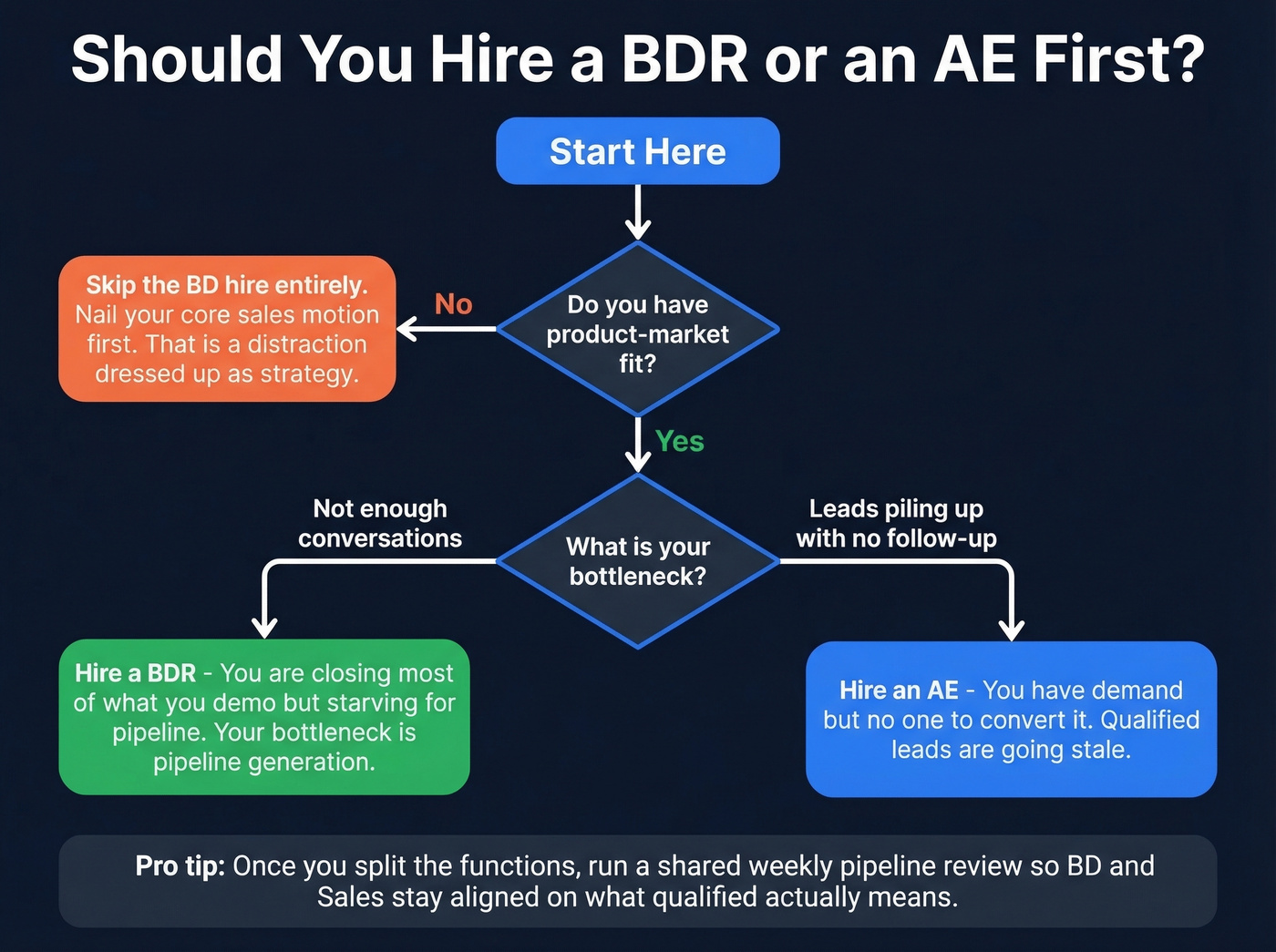
Are you closing most of what you demo, but starving for conversations? Hire a BDR. Your bottleneck is pipeline generation, not closing capacity.
Are qualified leads piling up with no one to follow up? Hire an AE. You've got demand - you need someone to convert it.
Skip the BD hire entirely if you're pre-product-market-fit. You don't need someone building partnership channels when you haven't nailed your core sales motion yet. That's a distraction dressed up as strategy.
Once you do separate the functions, don't let them drift apart. The best teams we've worked with run a shared weekly pipeline review where BD and sales sit in the same room, review handoff quality, and calibrate on what "qualified" actually means. Without that cadence, the two functions start optimizing for different definitions of success and the pipeline leaks at the seam.
Tools That Power Each Role
Both BD and sales teams depend on the same foundation: reaching the right person with accurate contact information. BD teams lean on CRMs like Salesforce and HubSpot alongside partnership management platforms and market research tools. Sales teams stack CRMs with engagement platforms like Outreach and Salesloft for high-volume sequencing.
Both functions converge on one dependency: data quality. Stale data is the fastest way to burn your domain reputation and waste rep hours. Whether you're a BD manager reaching out to a potential channel partner or an SDR running a 500-contact sequence, verified contact data with a short refresh cycle is the difference between productive outreach and wasted effort.

Average BDR quota attainment is 54%. Half of that gap is bad data - disconnected numbers, bounced emails, outdated contacts. Prospeo delivers 98% email accuracy and a 30% mobile pickup rate on 125M+ verified numbers, refreshed every 7 days. Your reps hit quota when their dials actually connect.
Fix the data and watch your BDRs blow past 54% attainment.
FAQ
Is business development higher than sales?
Neither is inherently senior. BD is strategic and long-cycle; sales is execution-focused and short-cycle. In most orgs, they're parallel functions reporting to the same CRO or VP of Revenue. Seniority depends on the specific role level - a VP of BD and a VP of Sales are peers, not a hierarchy.
Can one person handle both BD and sales?
Yes, at early-stage companies under ~50 employees - and they usually do. Founders handle both until lead flow and deal complexity force specialization, typically around $1M ARR. Splitting too early creates more coordination overhead than value.
What tools do BD and sales teams share?
CRMs like HubSpot and Salesforce, prospecting platforms for verified contact data, and engagement tools for sequencing outreach. Both BD managers sourcing partner contacts and SDRs building outbound lists need the same accurate data foundation - that's the one tool category neither function can skip.
What's the difference between business development and sales?
Business development creates new opportunities through partnerships, market expansion, and pipeline generation. Sales converts those opportunities into closed revenue. BD thinks in quarters; sales thinks in weeks. The distinction matters most when structuring comp plans, defining KPIs, and deciding which role to hire next.