

Business Email Openings: What the Data Says About Getting Replies
The average office worker receives 121 emails a day. Most open with "I hope this finds you well," and most get ignored. The business email opening you choose - the greeting and the sentence right after it - is the difference between a reply and the archive folder. It's not about finding a fancier template. It's about understanding what the data actually says.
The Short Version
Three rules, backed by data from a 300,000+ email thread analysis:
- "Hi [First Name]" is your default. Casual greetings pull a 64% response rate vs. 56.5% for "Dear."
- First sentence = your purpose. Skip the throat-clearing.
- Under 125 words at a simple reading level. Emails in the 50-125 word range consistently outperform longer ones.
You don't need 100 templates. You need a framework and three or four openers you understand when to deploy.
Email Greeting Performance Data
Boomerang's analysis of 300,000+ email threads is one of the most-cited public datasets on email greetings and response rates.
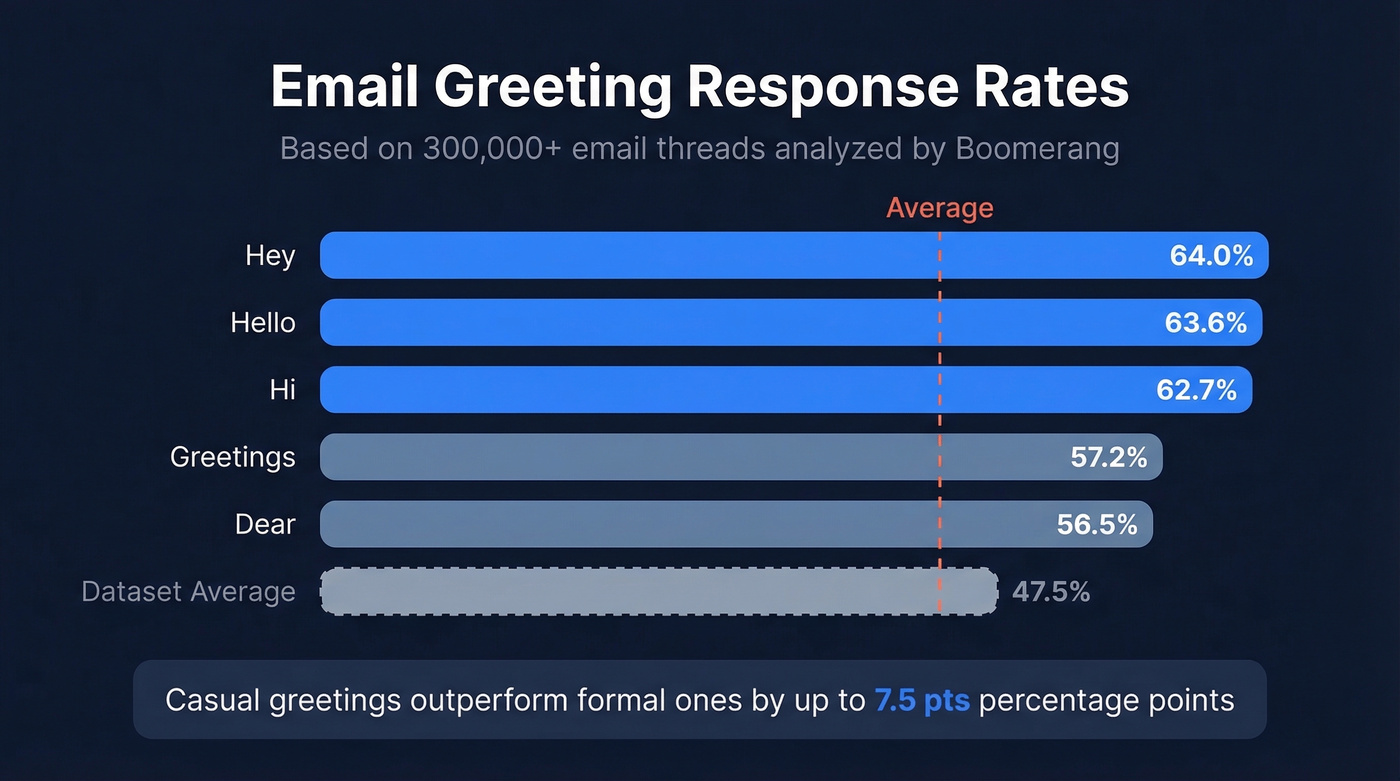
| Greeting | Response Rate |
|---|---|
| Hey | 64.0% |
| Hello | 63.6% |
| Hi | 62.7% |
| Greetings | 57.2% |
| Dear | 56.5% |
| All emails (dataset average) | 47.5% |
The gap between "Hey" and "Dear" is 7.5 percentage points. That's not noise - it's a pattern across hundreds of thousands of threads. Casual greetings win, and it isn't close.
Two things jump out. Conversational openings ("Hi/Hello/Hey") correlate with more replies than formal ones ("Dear/Greetings"). And including any greeting at all correlates with higher response rates than the dataset average - by roughly 9 to 16.5 points.
A related finding worth pairing: emails written at a 3rd-grade reading level see a 36% lift in response rates over college-level writing. Simple words, short sentences, relaxed tone. The data points in one direction.
Choosing the Right Formality
The data favors casual, but context still matters. You wouldn't open with "Hey" to a federal judge or a first-time email to a C-suite executive in Frankfurt.
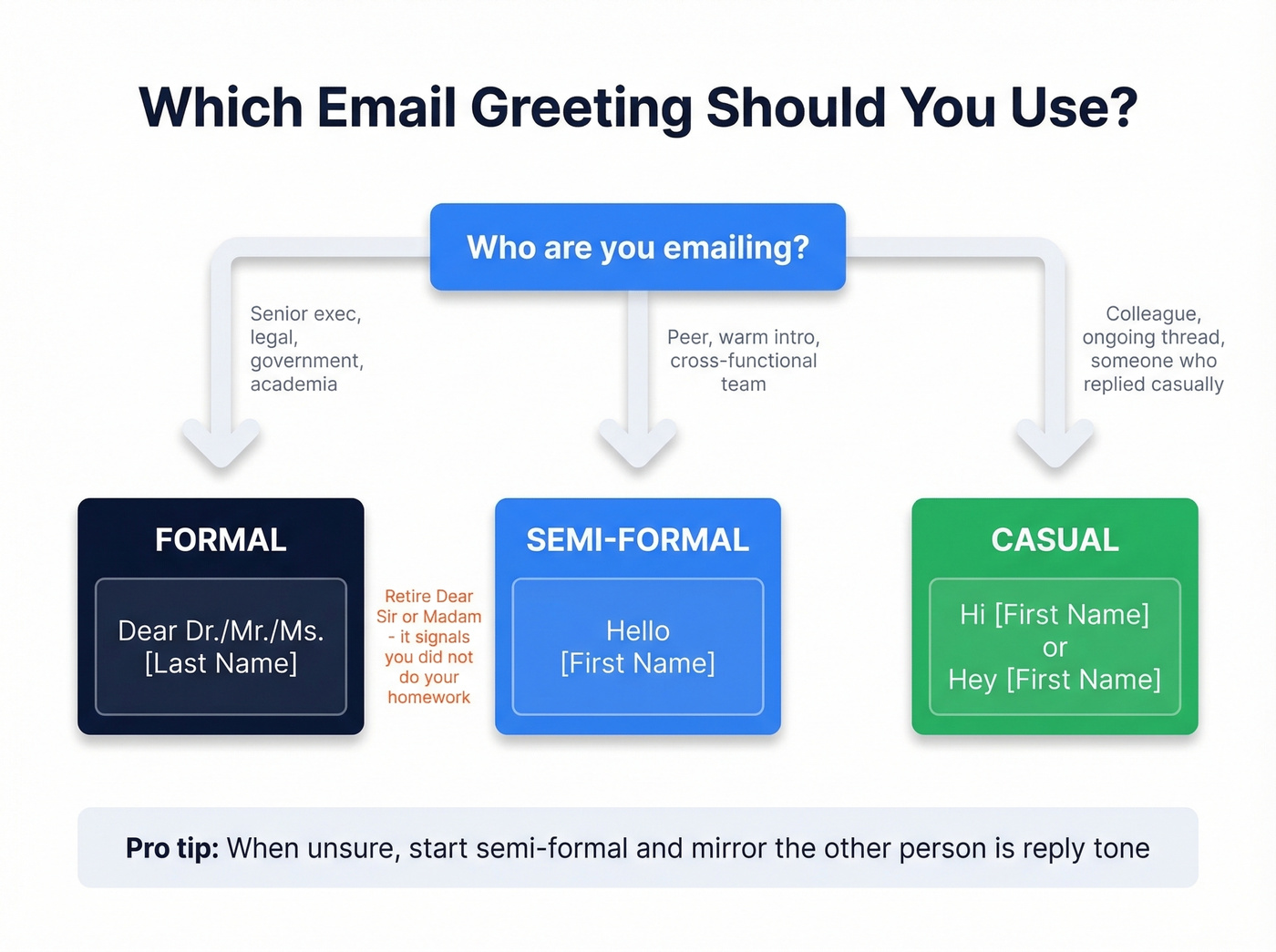
| Formality | Greeting | When to Use |
|---|---|---|
| Formal | Dear Dr./Mr./Ms. [Last Name] | First contact with senior execs, legal, academia, government |
| Semi-formal | Hello [First Name] | First contact with peers, warm intros, cross-functional teams |
| Casual | Hi [First Name] / Hey [First Name] | Ongoing threads, colleagues, anyone who's already replied casually |
The safe default for 80% of professional email is "Hi [First Name]." It's warm without being sloppy, and the data backs it up. If you're unsure, start semi-formal and mirror whatever formality the other person uses in their reply. Mirroring works because it signals social awareness - you're telling the other person "I'm paying attention to how you communicate," which reduces friction and builds rapport without you having to say a word about it.
One thing to retire immediately: "Dear Sir or Madam". It signals you didn't bother to learn the recipient's name. If you genuinely don't know their name, use "Hello," "Hello team," or a role-based greeting like "Dear Hiring Manager."
Opening Lines That Work
The greeting earns you a glance. The first sentence earns you a read. That same 300,000-thread dataset shows that emails with slightly positive or slightly negative sentiment get 10-15% more replies than completely neutral ones. Have a point of view. Don't be bland.
Direct Request Openers
When you need something specific and the relationship is established, get to it:
- "Quick question - do you have bandwidth to review the vendor shortlist this week?"
- "I need 10 minutes on your calendar to align on the launch date."
Rapport-Building Openers
Best for first contact with someone you'll work with repeatedly. Generic compliments feel hollow, but a concrete reference proves you've done your homework:
- "Enjoyed your talk at [event] - your point about [specific detail] stuck with me."
- "Saw your team's announcement about [milestone]. Congrats - that's a big move."
Follow-Up Openers
Most people apologize for following up. Don't. The person who apologizes is the person whose email gets deprioritized. Add new information or restate the ask with a tighter deadline instead. "Circling back on the proposal I sent Thursday - happy to walk through any questions" works because it offers something. "Sorry to bother you again" works against you because it frames your own email as a burden.
Referral Openers
Referral openers are the highest-performing category in cold outreach, and the reason is simple: they borrow trust. We've seen referral-based cold emails outperform every other opener type in the campaigns we track. Lead with the mutual connection and make the reason for the intro immediately clear: "[Name] suggested I reach out - she mentioned you're leading the [project] initiative."

The perfect opening line won't save an email sent to a dead address. Prospeo delivers 98% verified email accuracy across 300M+ professional profiles - refreshed every 7 days, not every 6 weeks. Your cold emails land in real inboxes so your carefully crafted openers actually get read.
Stop perfecting copy that bounces. Start reaching real inboxes.
Cold Email Openings: 2026 Benchmarks
Cold email is a different game. You're writing to someone who didn't ask to hear from you. Belkins analyzed 16.5 million cold emails across 93 industries and found an average reply rate of 5.8% - down from 6.8% the prior year.
Here's what matters for your opening line: emails with 6-8 sentences hit a 6.9% reply rate. A single email with no follow-up sequence actually produced the highest reply rate at 8.4%. And targeting 1-2 contacts per company yielded 7.8% reply rates vs. 3.8% when blasting 10+ people at the same org.
Personalization isn't optional. Using the recipient's name and a relevant detail can drive up to 142% higher reply rates. Emails with a single clear CTA get 371% more clicks than those with multiple asks. One ask. One email.
Here's the thing: if your average deal size is under $10k, you probably don't need a 12-touch, multi-channel sequence. A single well-researched email with a timeline hook will outperform a lazy seven-email drip every time.
Timeline Hooks vs. Problem Hooks
Data from The Digital Bloom breaks cold openers into two categories, and the performance gap is massive.
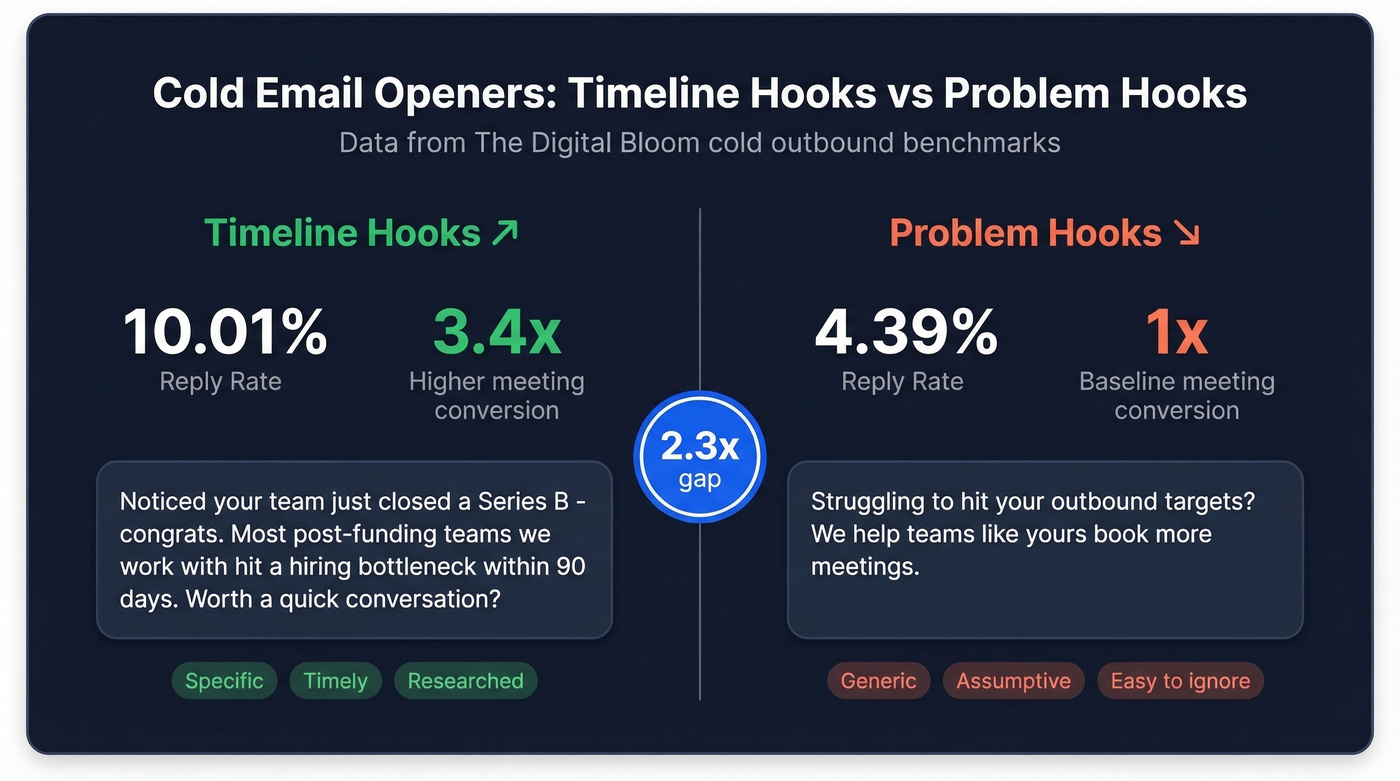
Timeline hooks reference a specific event, trigger, or deadline tied to the prospect's world. They average a 10.01% reply rate. Problem hooks lead with a pain point or challenge. They average 4.39%. That's a 2.3x gap - and it extends beyond replies. Timeline hooks convert to meetings at 3.4x the rate of problem hooks.
Here's what each looks like:
- Timeline hook: "Noticed your team just closed a Series B - congrats. Most post-funding teams we work with hit a hiring bottleneck within 90 days. Worth a quick conversation?"
- Problem hook: "Struggling to hit your outbound targets? We help teams like yours book more meetings."
The timeline hook wins because it proves you did your homework. It's specific, timely, and harder to ignore. The problem hook feels generic - and in 2026, generic gets deleted.
One counterintuitive finding from the same dataset: disabling open-rate tracking pixels actually increased response rates by 3%, likely because it improves deliverability. If you're obsessing over open rates at the expense of reply rates, you're optimizing the wrong metric.
Perfect Opener, Wrong Address
You can craft the perfect timeline hook, nail the 6-8 sentence length, personalize every line - and none of it matters if the email bounces. High bounce rates don't just waste sends. They damage your domain reputation, which drags down deliverability for every email that follows.
Prospeo verifies emails in real time with 98% accuracy across 300M+ professional profiles, refreshed every 7 days. Before you launch any cold campaign, run your list through verification. The free tier gives you 75 email verifications per month to start.
Format Your Opening for Mobile
Over 60% of emails are opened on mobile. On a phone, your subject line and opening line function as a single unit: the subject line earns the open, and the first sentence earns the scroll. If either one is weak, you lose them.
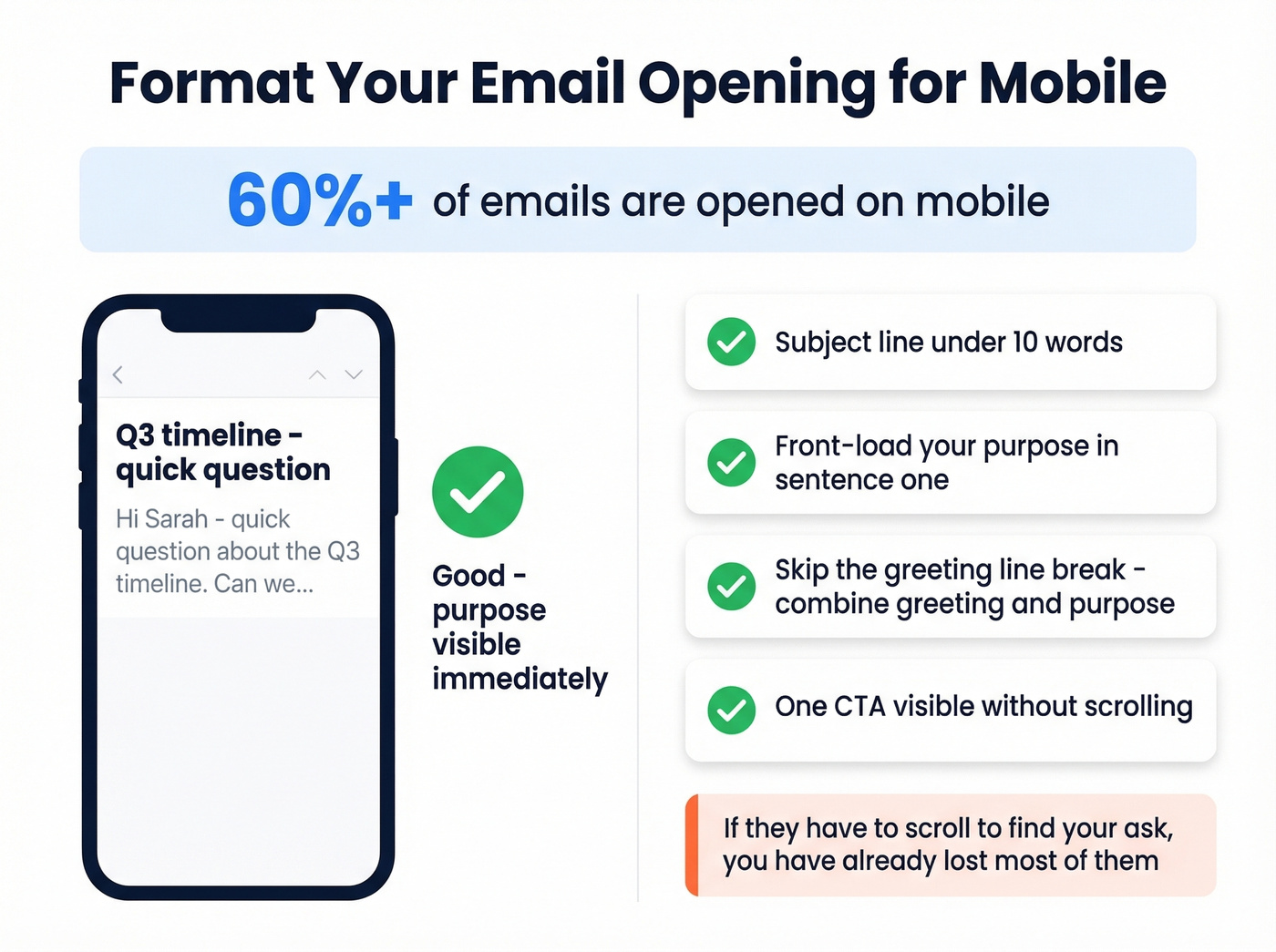
- Subject line under 10 words.
- Front-load your purpose. The first sentence should tell them why you're writing.
- Skip the greeting line break. "Hi Sarah - quick question about the Q3 timeline" reads better on mobile than a greeting on one line and the purpose buried three lines down.
- One CTA, visible without scrolling. If they have to scroll to find what you're asking, you've already lost most of them.
If you want swipeable options, pull from these email subject line patterns and adapt them to your opener.
Cross-Cultural Email Etiquette
When in doubt, go more formal than you think necessary. You can always dial it back once the other person signals informality. Going too casual on a first email to someone in a high-formality culture can end the conversation before it starts. In our experience, the biggest mistakes happen when people default to American-casual with contacts in Germany, Japan, or the Middle East - and then wonder why they never hear back.
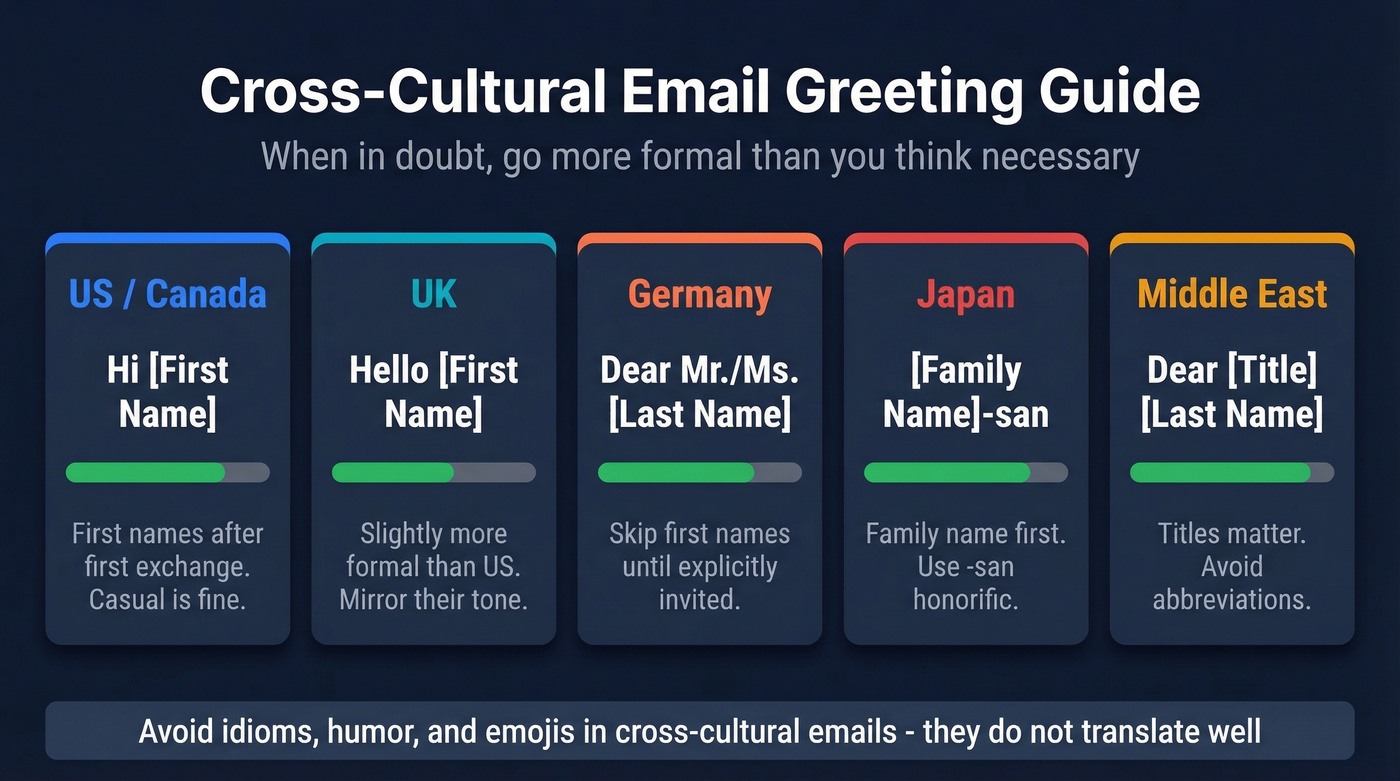
The greeting is only half the equation. You also need to match cultural expectations around directness, titles, and name order.
| Region | Default Greeting | Key Norms |
|---|---|---|
| US/Canada | Hi [First Name] | First names after first exchange; casual is fine |
| UK | Hello [First Name] | Slightly more formal than US; mirror their tone |
| Germany | Dear Mr./Ms. [Last Name] | Skip first names until explicitly invited |
| Japan | [Family Name]-san | Family name first; use "-san" honorific |
| Middle East | Dear [Title] [Last Name] | Titles matter; avoid abbreviations |
Avoid idioms, humor, and emojis in cross-cultural emails - they don't translate well. Be mindful of name order differences; in many East Asian cultures, the family name comes first. Getting someone's name wrong in the greeting is worse than using a generic "Hello."
Inclusive Email Greetings
Japan Airlines retired "ladies and gentlemen" in favor of "hello everyone" and "all passengers." For group emails, swap gendered greetings for neutral ones: "Hello everyone," "Hi team," or "Good morning, all." For individual emails where you aren't sure of someone's pronouns, "Hello [First Name]" sidesteps the issue entirely. Adding your own pronouns to your email signature normalizes the practice and makes it easier for others to share theirs.
What to Avoid
"I hope this email finds you well." The most overused opener in professional email. Skip it and get to the point. It adds zero information and burns your most valuable real estate.
"To Whom It May Concern." Signals you didn't try to find a name. With modern search tools and company sites, there's almost always a way to find the right person.
"Sorry to bother you." Starting with an apology undermines your credibility before you've made your point.
No greeting at all. The data is clear: including an opening correlates with higher response rates than the dataset average.
Excessive exclamation marks or emojis. One exclamation mark is fine. Three is a red flag. Emojis in a first email to someone you've never met? Skip it.
Inconsistent formality in threads. If they went casual, match them. Don't swing back to "Dear Mr. Thompson" after they signed off with "Cheers, Dave."
If you're sending follow-ups, use a proven structure from these follow-up templates and keep the opener consistent.
Timeline hooks outperform problem hooks 2.3x - but only if you know when prospects change roles, raise funding, or expand teams. Prospeo tracks job changes, headcount growth, and buyer intent across 15,000 topics so you can write openers tied to real triggers, not guesses.
Turn prospect signals into opening lines that actually convert.
FAQ
Is "Dear" too formal for business emails?
For most contexts, yes. A 300,000-thread analysis shows "Dear" pulls 56.5% response rates - 7+ points behind "Hi" at 62.7%. Reserve it for legal, government, or academia.
How should I open a cold email to a stranger?
Lead with a timeline hook tied to something specific about their company - a funding round, product launch, or leadership change. Timeline hooks average 10.01% reply rates vs. 4.39% for generic problem hooks. Verify the address before sending so a bounced email doesn't waste the effort and hurt your domain.
Should I use "Hi" or "Hello" in a professional email?
Both perform nearly identically - "Hi" at 62.7% and "Hello" at 63.6%. The difference is negligible. "Hi [First Name]" is the safest default for 80% of business situations.
What's a simple business email opening template?
Let's break it down to three lines: "Hi [First Name] - [one sentence referencing something specific about them or their company]. [One sentence explaining why you're reaching out]. [One clear ask or CTA]." That structure consistently outperforms longer, more elaborate openings. Adapt formality based on the guidelines above.