

The Business to Business List Guide: What to Buy, What to Skip, and What It Really Costs
A RevOps lead we know bought a large business to business list last year. It looked fine on paper - 50,000 contacts, decent segmentation, reasonable price. Then bounce rates spiked, deliverability tanked, and the sales team spent weeks rebuilding sender reputation instead of booking meetings. That experience isn't unusual, and it's exactly why we wrote this.
What Is a B2B List?
A business to business list is a structured dataset of company and contact information used for outbound sales, marketing, or direct mail. It typically includes firmographic data - company name, industry via SIC or NAICS codes, employee count, revenue - alongside contact details like work emails, direct dials, and mailing addresses. Some lists also include segmentation selects like HQ vs. branch location and employee band filters.
The core problem is freshness. Roughly 28% of B2B email data goes stale annually. Any static mailing list you buy today starts decaying immediately. That single fact should shape every purchasing decision you make.
What You Need (Quick Version)
Three paths, depending on where you sit:
- Enterprise with budget and a full GTM stack - ZoomInfo. You'll pay ~$15,000-$45,000+/year, and you get strong company insights plus intent context and workflow tooling.
- Traditional direct mail or one-time campaigns - NAICS Association. Per-record pricing starting at $0.10/record with a $300 minimum order.
Building your own verified list almost always beats buying a pre-packaged one. The tools exist to make it fast, and self-built lists outperform purchased CSVs because you control targeting, verification, and refresh cadence.
Three Types of B2B List Providers
Traditional per-record brokers sell static lists priced by the record. NAICS Association charges $0.10-$0.30 per record depending on data depth, and emails can be added for up to $0.45/record. You get a CSV - no refresh, no verification after delivery. These work for direct mail campaigns where you need deliverable postal addresses, but they're a poor fit for email outreach.

API and dataset providers serve data teams, not sales reps. Coresignal provides 75M company records for programmatic access starting at $49/month. Bright Data sells raw datasets starting at roughly $250 per 100,000 records. Building blocks, not ready-to-use prospecting lists.

The article above shows how bought lists decay at 2.1% per month. Prospeo refreshes every 7 days - not 6 weeks like competitors. Search 300M+ profiles with 30+ filters, export only 98% verified emails, and pay roughly $0.01 per contact. No stale CSVs, no compliance guesswork.
Build the exact business to business list you need in minutes, not days.
What a B2B Contact List Actually Costs
If a provider won't show you pricing, that's a red flag. Here's what the market looks like:
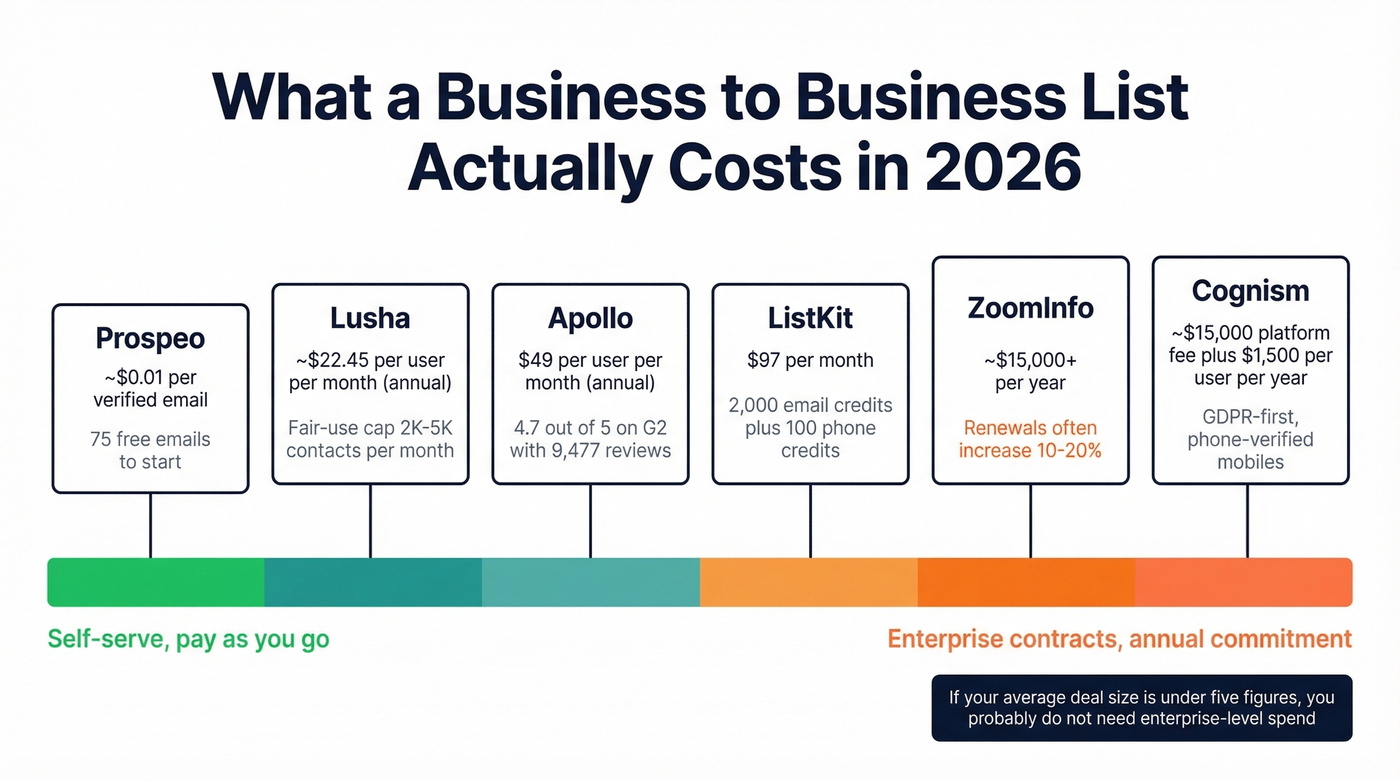
| Provider | Type | Starting Price | Best For | Key Note |
|---|---|---|---|---|
| Apollo | Self-serve | $49/user/mo (annual) | Mid-market teams | 4.7/5 G2 (9,477 reviews) |
| NAICS Association | Per-record broker | $0.10/record ($300 min) | Direct mail | Email add-on up to $0.45/record |
| ListKit | Self-serve | $97/mo | Agencies | 2,000 email credits + 100 phone credits |
| Lusha | Self-serve | ~$22.45/user/mo (annual) | Quick lookups | Fair-use cap ~2K-5K contacts/mo |
| ZoomInfo | Enterprise | ~$15,000/yr | Full GTM stack | 4.5/5 G2 (9,035 reviews) |
| Cognism | Enterprise | ~$15,000 platform fee + $1,500/user/yr | GDPR-first teams | Phone-verified mobiles |
ZoomInfo renewals deserve a callout. Annual renewals often come in at +10-20%, and totals climb further when teams add seats or modules.
Here's the thing: if your average deal size sits below five figures, you almost certainly don't need ZoomInfo-level spend. A self-serve platform in the ~$49-$99/user/month range gets you most of the value at a fraction of the cost.
Why Data Quality Beats List Size
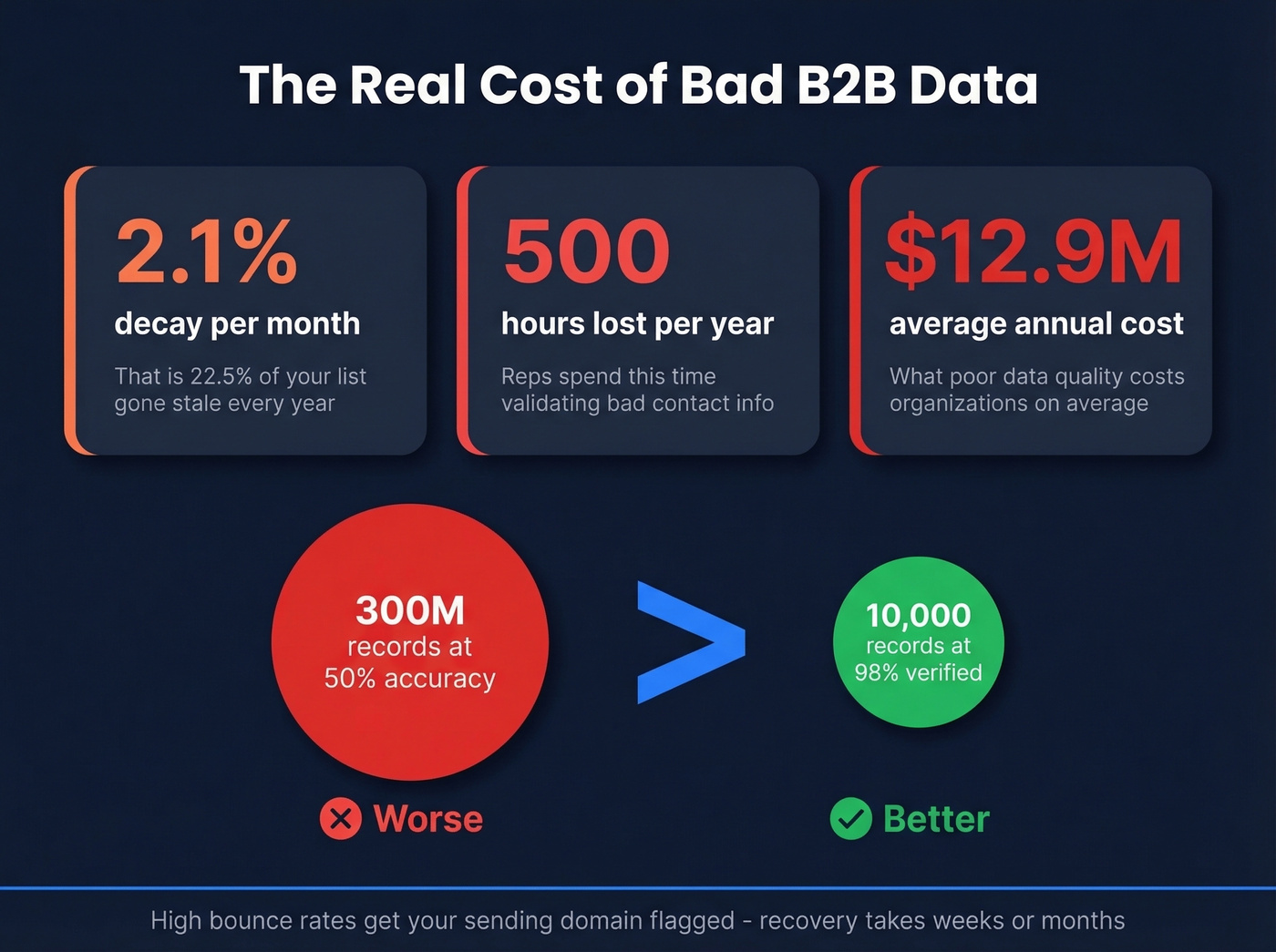
Contact data decays at roughly 2.1% per month - that's 22.5% annually. Reps lose an estimated 500 hours per year validating bad contact info, and poor data quality costs organizations $12.9M annually on average.

A 300M-record database at 50% accuracy is worse than 10,000 contacts at 98% verification. The math isn't close. High bounce rates get your sending domain flagged, and recovery takes weeks - sometimes months. Prioritize email verification over volume every time.
We've seen this play out firsthand. Teams like Snyk cut bounce rates from 35-40% to under 5% after switching to Prospeo's 5-step verification process, which includes catch-all handling, spam-trap removal, and honeypot filtering. That kind of accuracy difference compounds fast across thousands of sends.
Is It Legal to Buy a B2B List?
Buying isn't illegal. Using the data wrong is where it gets expensive.
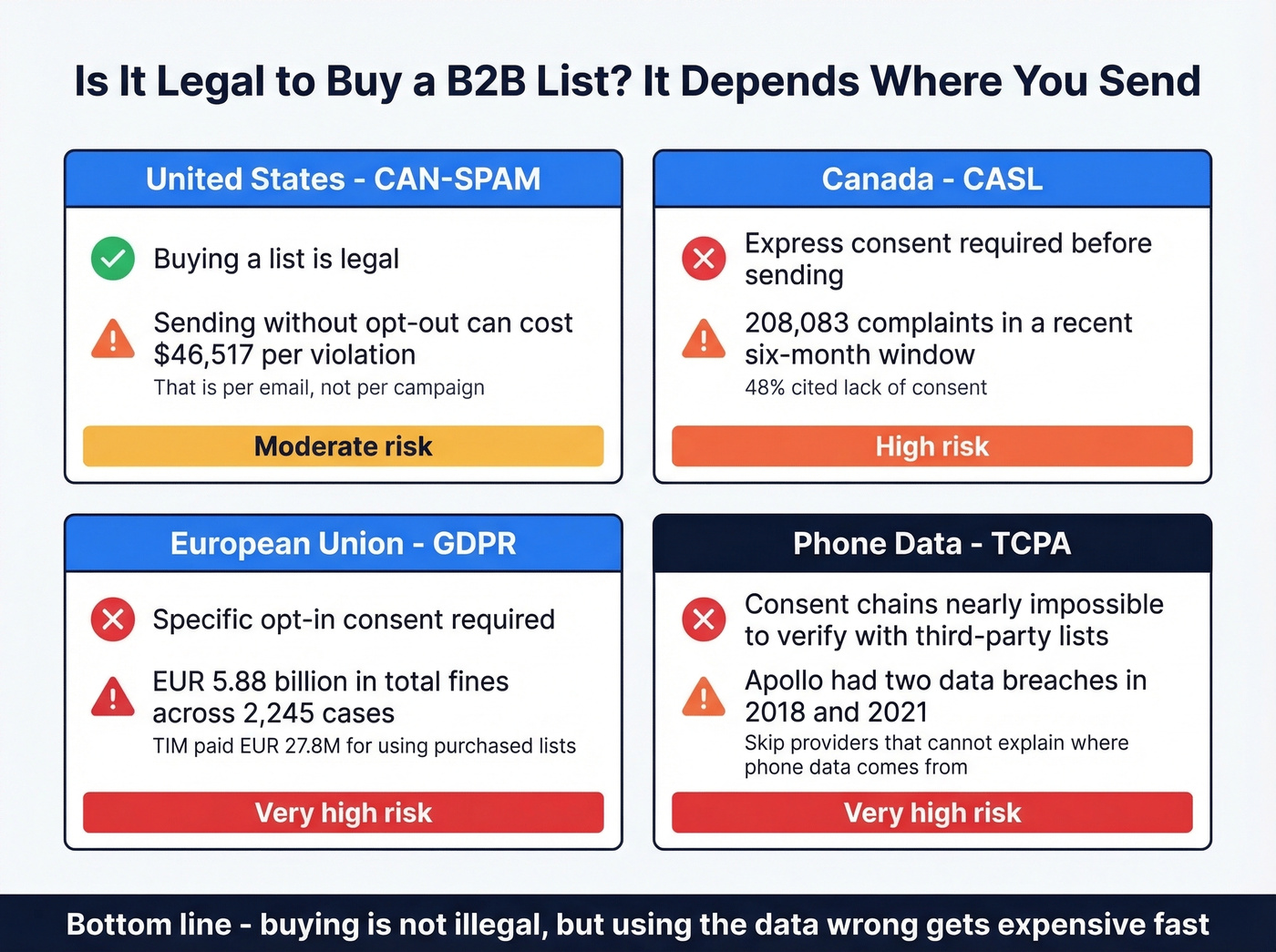
US (CAN-SPAM): Purchasing a list is legal, but sending without proper opt-out mechanisms can cost up to $46,517 per violation - per email, not per campaign.
Canada (CASL): Express consent required before sending. In a recent six-month window, regulators received 208,083 complaints, 48% citing lack of consent.
EU (GDPR): Total fines have reached EUR5.88B across 2,245 cases. TIM paid EUR27.8M specifically for using purchased lists without proper opt-in consent.
Phone data carries its own risk. TCPA consent chains are notoriously hard to verify with third-party lists. Apollo's two data breaches in 2018 and 2021 are a reminder that even major platforms aren't immune to compliance exposure. Skip any provider that can't clearly explain where their phone data comes from and how consent was obtained.
Buy or Build Your Own B2B List?
Buying gets you speed. You can have 10,000 contacts in your CRM by tomorrow. But you're trading data quality, compliance confidence, and conversion rates for that speed.
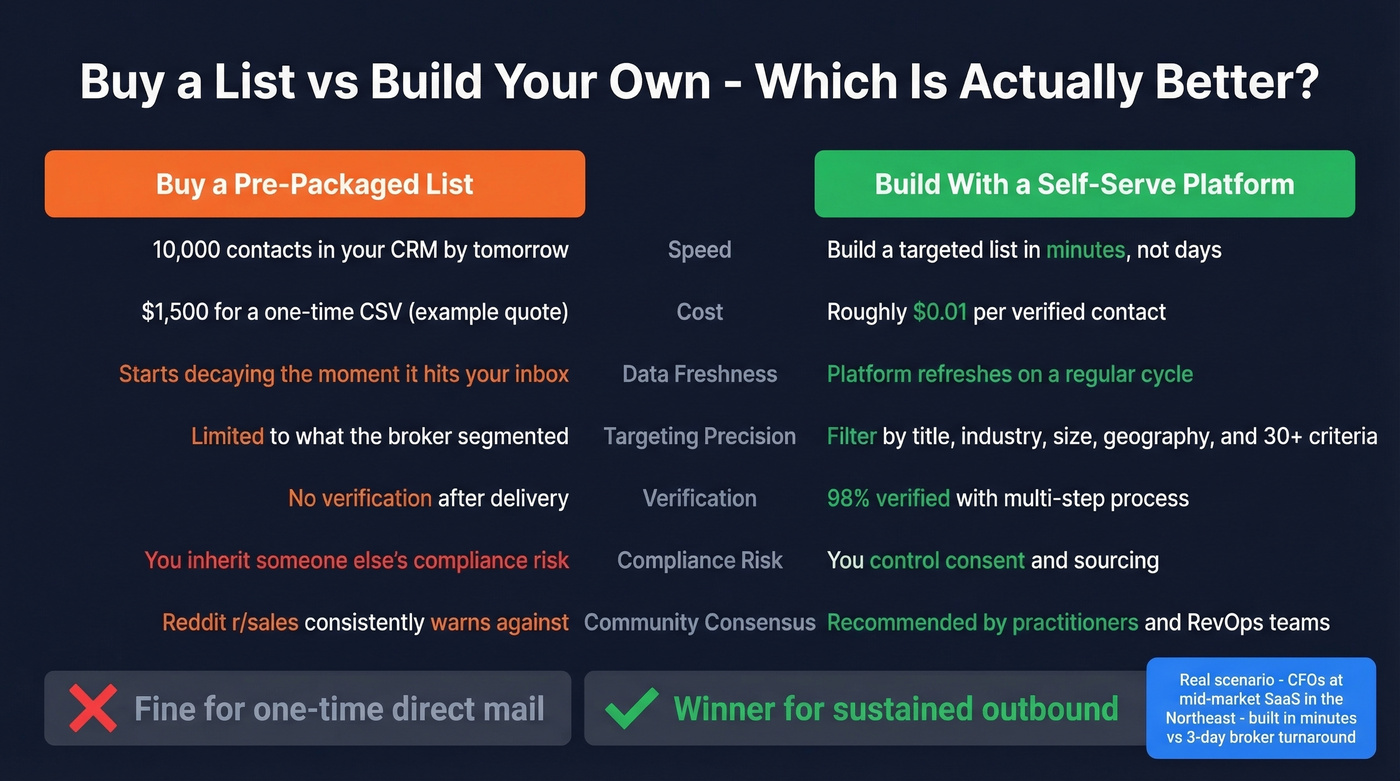
Let's walk through a real scenario. Your team needs CFOs at mid-market SaaS companies in the Northeast. A broker quotes $1,500 for a CSV delivered in three days. With a self-serve platform, you'd build that list yourself in minutes - search by job title, industry, company size, and geography, then export verified contacts at a fraction of the cost. The data stays fresh because the platform refreshes it on a regular cycle, compared to a CSV that starts decaying the moment it hits your inbox.

In our experience, the consensus on r/sales leans the same direction: build, don't buy. The threads consistently warn against pre-packaged lists, and for good reason. You lose control over targeting precision, you can't verify freshness, and you inherit someone else's compliance risk. For teams running any kind of sustained outbound motion, self-serve platforms win on cost, accuracy, and flexibility.
Teams using bad B2B lists lose 500 hours/year validating contacts and risk domain reputation. Prospeo's 5-step verification - with catch-all handling, spam-trap removal, and honeypot filtering - is why companies like Snyk cut bounce rates from 35% to under 5%. Start with 75 free verified emails, no credit card required.
Stop buying lists that bounce. Start building lists that convert.
FAQ
How much does a business to business list cost?
Per-record brokers charge $0.10-$0.45 per record. Self-serve platforms start free and scale to roughly $0.01 per verified email. Enterprise platforms like ZoomInfo typically run ~$15,000-$45,000+/year with annual contracts and common renewal increases of 10-20%.
Are purchased B2B email lists legal?
In the US, buying a list is legal under CAN-SPAM - but sending without opt-out mechanisms can cost $46,517 per violation. In the EU, GDPR requires specific consent, and fines have reached EUR5.88B across 2,245 enforcement actions. Always verify compliance before sending.
How fast does B2B contact data go stale?
Contact data decays roughly 2.1% per month - about 22.5% per year. A list you buy today will be nearly a quarter outdated within 12 months without continuous refresh. Look for platforms that refresh on a weekly cycle rather than the 4-6 week industry average.
What's a good free option for building a B2B list?
Prospeo offers 75 free verified emails per month plus 100 Chrome extension credits - enough to test outbound without spending anything. Apollo also has a free tier, though its email accuracy trails at around 79% compared to 98%. Both beat buying a static CSV for small-scale campaigns.