

Business to Government Sales: The 2026 Playbook
Your CEO just read that the federal government spent $833.83B on contracts last year and asked why you're not selling to them. Fair question. Business to government sales isn't impossibly complex - it's just slow, procedural, and allergic to shortcuts. That's roughly $3.3B per business day flowing through federal procurement alone, and fewer companies are winning that work: 105,044 firms took home federal contracts in FY25, down from 108,899 the year before. Incumbents are consolidating. Breaking in requires sharper positioning than ever.
What Is B2G Sales?
B2G sales means selling products or services to government agencies through formal procurement processes, contract vehicles, and regulated buying rules. Compared to B2B - where a typical software deal closes in about 90 days - you'll deal with more compliance, more stakeholders, and cycles that run 2-6x longer. But the contracts are bigger and stickier once you're in.
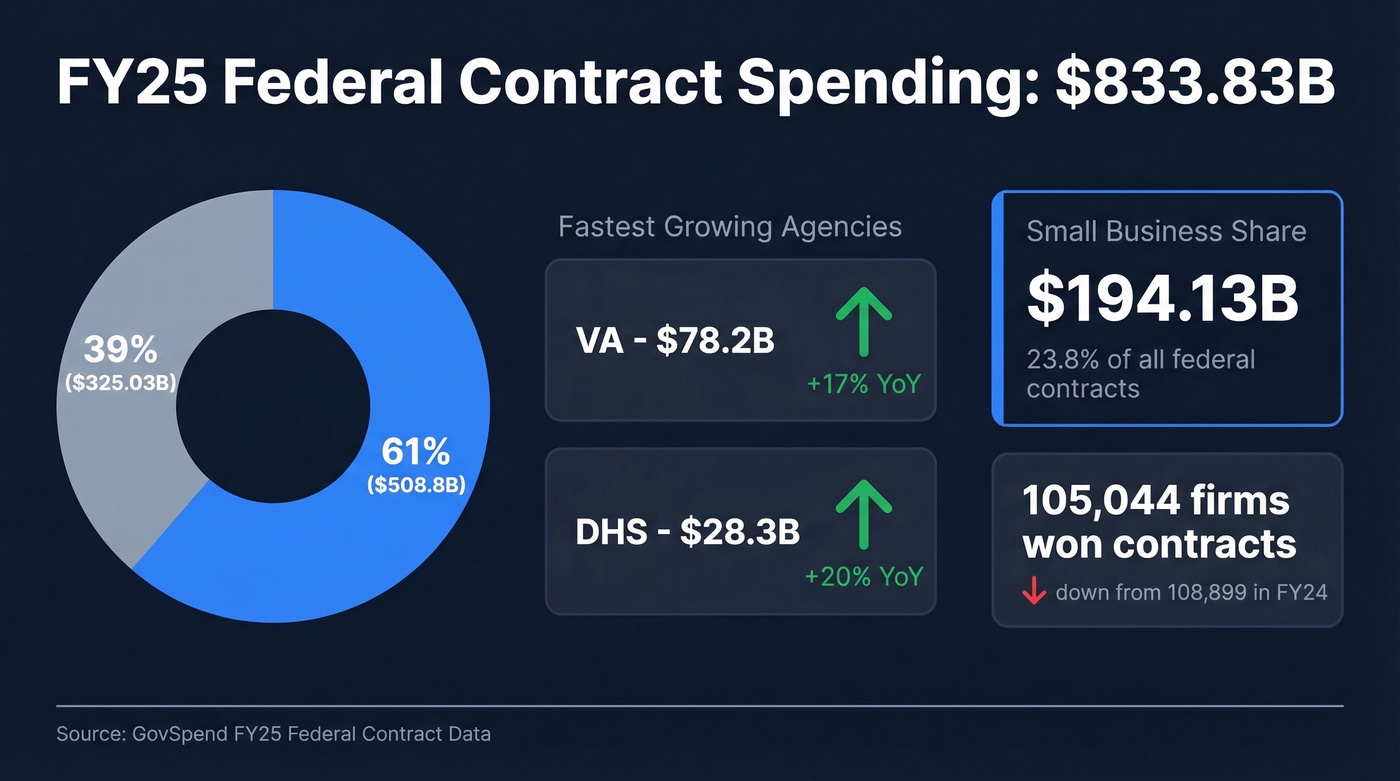
The U.S. federal market hit $833.83B in FY25, and $194.13B of that - 23.8% - went to small businesses. Defense agencies accounted for 61% of the total at $508.8B, while VA ($78.2B, up 17%) and DHS ($28.3B, up 20%) are growing fast and worth targeting if your product fits.
Four things change your go-to-market immediately. Buying is procurement-led, governed by rules, thresholds, and documentation. Timelines stretch across quarters, not weeks. Past performance carries real weight, which is why subcontracting helps early on. And compliance - FAR/DFARS, cybersecurity, reporting - isn't optional.
What You Need to Get Started
Do these three things first:
- Get a UEI - you'll receive it during SAM.gov registration
- Register on SAM.gov - free, mandatory for federal work
- Pick your NAICS codes - don't guess, be deliberate
Reality check: expect 6-18 months to your first federal win. You can move faster by subcontracting under a prime or landing a small pilot under local thresholds.
Start with these tools:
- SAM.gov for opportunities and registration
- GovTribe for affordable intel and tracking
- Prospeo to find the actual humans behind the org chart
Federal vs. State & Local
SLED (state, local, education) is the "move faster, deal with chaos" side of government. Federal is the "move slower, deal with rules" side. We've seen teams win SLED deals quickly, then struggle when they try the same approach on federal - the compliance burden alone can stall a team for months.
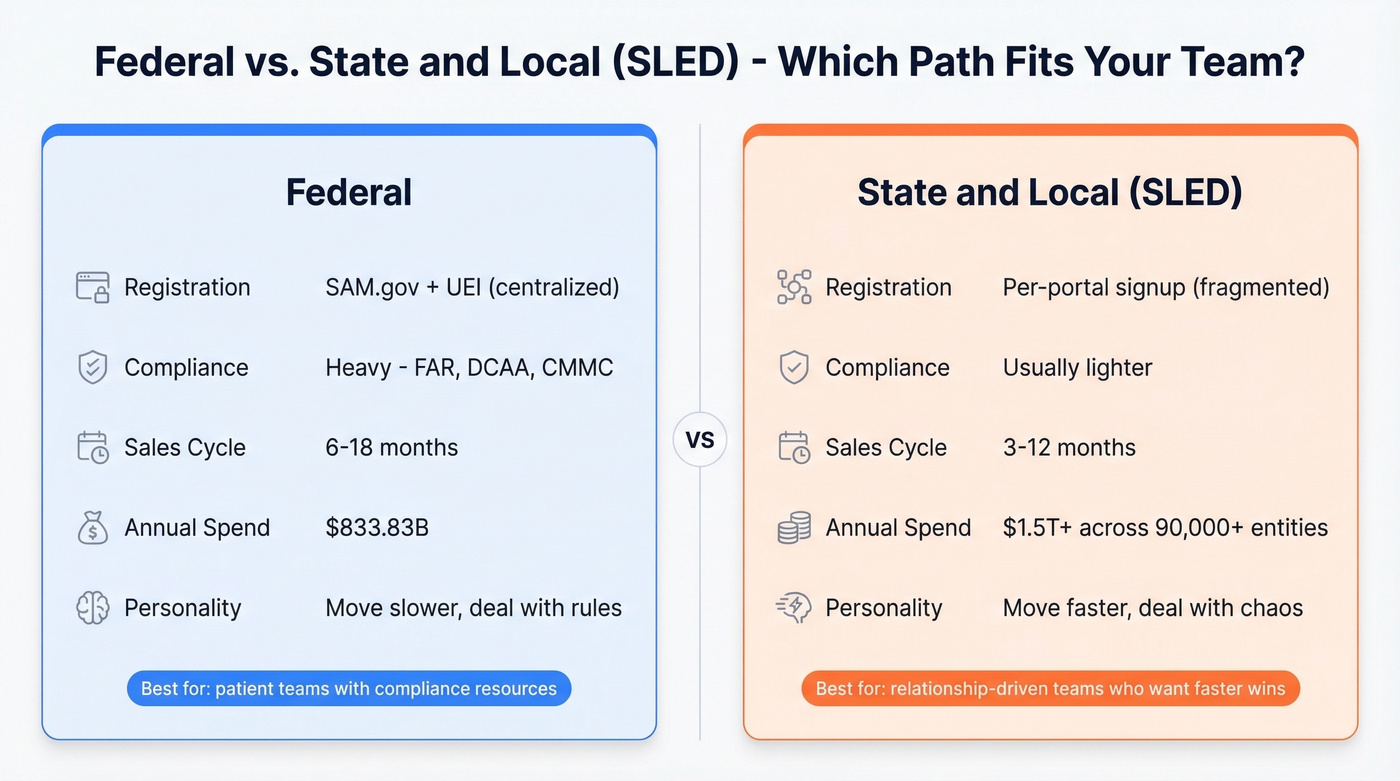
| Dimension | Federal | State & Local |
|---|---|---|
| Registration | SAM.gov + UEI | Per-portal signup |
| Compliance | FAR/DCAA/CMMC | Usually lighter |
| Sales cycle | 6-18 months | 3-12 months |
| Spend | $833.83B (FY25) | $1.5T+ / year |
| Portals | SAM.gov | Cal eProcure, VendorNet, etc. |
SLED is massively fragmented - 90,000+ local entities is a good mental model - but that fragmentation is also why newer vendors can break in with the right local champion. In practice, relationship-building is usually the deciding factor in SLED deals, not price or tech specs.
How Government Procurement Works
Government buying runs on standardized documents. You need to know what you're looking at before you burn a week writing the wrong thing.
RFI (Request for Information) is early market research. The agency is shaping requirements and testing what's possible; you're educating and positioning. RFQ (Request for Quote) means specs are mostly known and they want pricing and delivery terms. RFP (Request for Proposal) is the complex buy where they're scoring your approach, team, and risk profile - not just price. GSA's acquisition portal has solid breakdowns of each document type.
A typical public-sector RFP cycle runs 3-6 months from release to award. Evaluation usually breaks down as technical 30-40%, experience 20-30%, pricing 20-30%, and staffing/team 15-20%.
Procurement thresholds vary by jurisdiction, but the competitive "you must get multiple quotes/bids" band is often $5K-$50K. That's why small pilots can be a smart wedge - you can land work below the threshold where a single contracting officer can say yes.

B2G sales cycles run 6-18 months. You can't afford to waste that time emailing the wrong people. Prospeo gives you 98% accurate emails and 125M+ verified mobile numbers so you reach the actual contracting officers and program managers behind every solicitation.
Stop guessing who to call inside the agency. Start connecting.
How to Sell to Government Step by Step
- Decide prime vs. subcontractor. Prime means you bid and hold the contract. Subcontractor means you join a prime's team for a slice of scope. The SBA's become a federal contractor guide covers the rules you'll run into - FAR/DFARS, size standards, subcontracting limits.
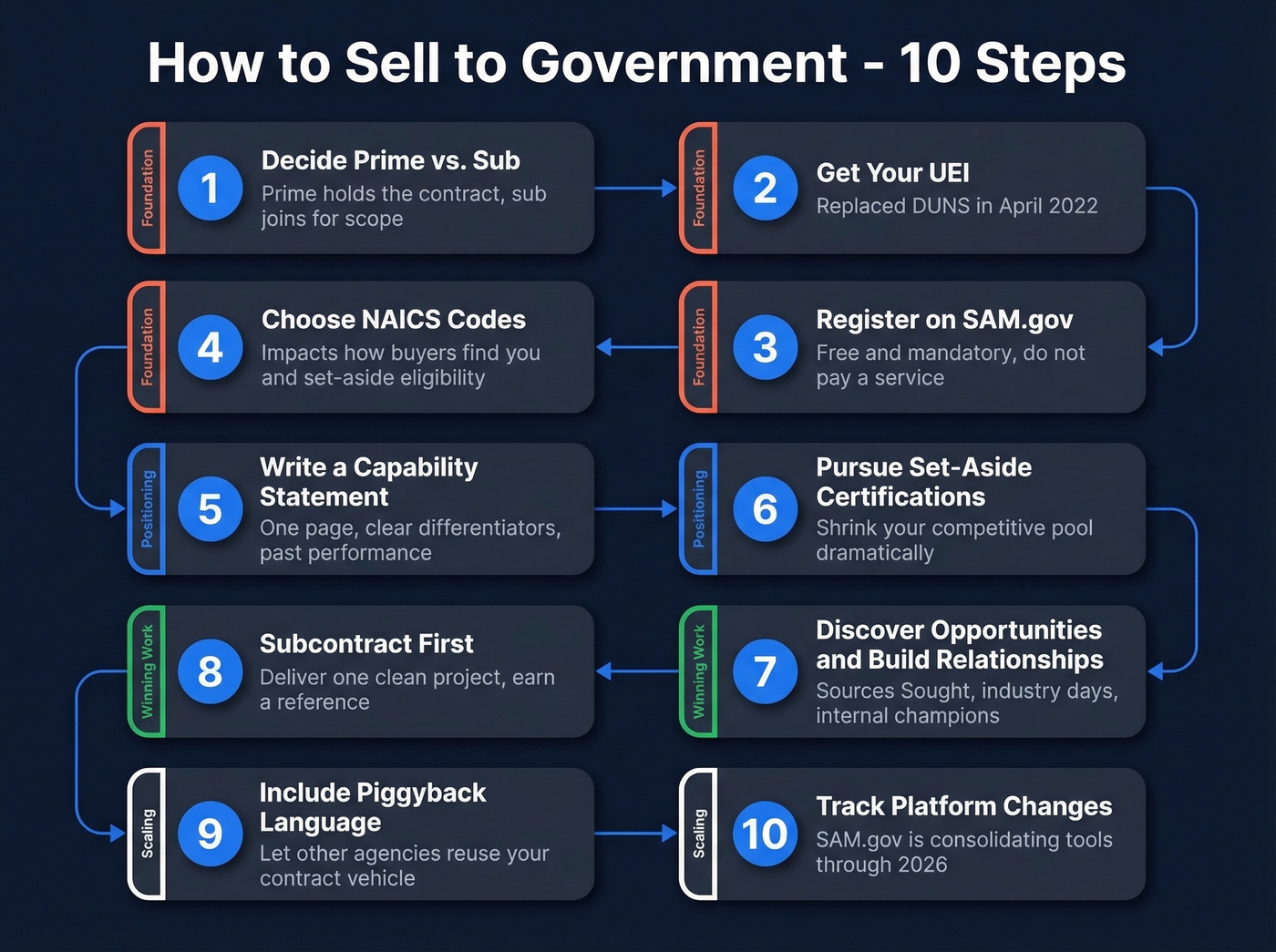
Get your UEI. UEI replaced DUNS in April 2022 and is now the identifier you'll use everywhere in federal procurement.
Register on SAM.gov - it's free and mandatory. Don't pay a "registration service" to do it for you. We've watched companies waste money and still end up with broken registrations.
Choose NAICS codes like you mean it. NAICS impacts how buyers find you, how set-asides apply, and whether you look credible. Pick a tight set that matches what you actually deliver.
Write a capability statement. One page. Clear differentiators. Past performance - even commercial projects count. Contract vehicles you're on, if any. And a "what we do for agencies like yours" section that doesn't read like a generic brochure.
Pursue set-aside certifications if you qualify. These can shrink your competitive set dramatically. Use the SBA's MySBA Certifications portal to start.
Start opportunity discovery on SAM.gov and build relationships early. Federal solicitations over $25,000 show up there. Don't just chase open RFPs - respond to Sources Sought notices so you influence requirements and get on the radar. Attend industry days. Find an internal champion inside the agency. Some startups have done unpaid co-development pilots lasting 3-4 months to prove value and build trust before a formal solicitation drops.
Use subcontracting as your entry ramp. No past performance? Sub under a prime, deliver one clean project, and turn it into a reference. This is the fastest path to credibility without waiting a year for a prime win.
Include cooperative/piggyback language in your contracts. This lets other agencies reuse your contract vehicle without a new solicitation - it's how one win can cascade into multiple revenue streams.
Track platform changes. SAM.gov has meaningful 2026 shifts: FPDS.gov ezSearch retired in February 2026 with award search moving into SAM.gov, eSRS.gov retired with subcontracting reporting moving into SAM.gov, and modernized FAR/DFARS reps & certs land March 24, 2026.
Set-Aside Programs Worth Pursuing
Set-asides are one of the few "unfair advantages" in B2G that's totally legitimate. If you qualify, they can turn a 30-bidder knife fight into a much smaller pool.
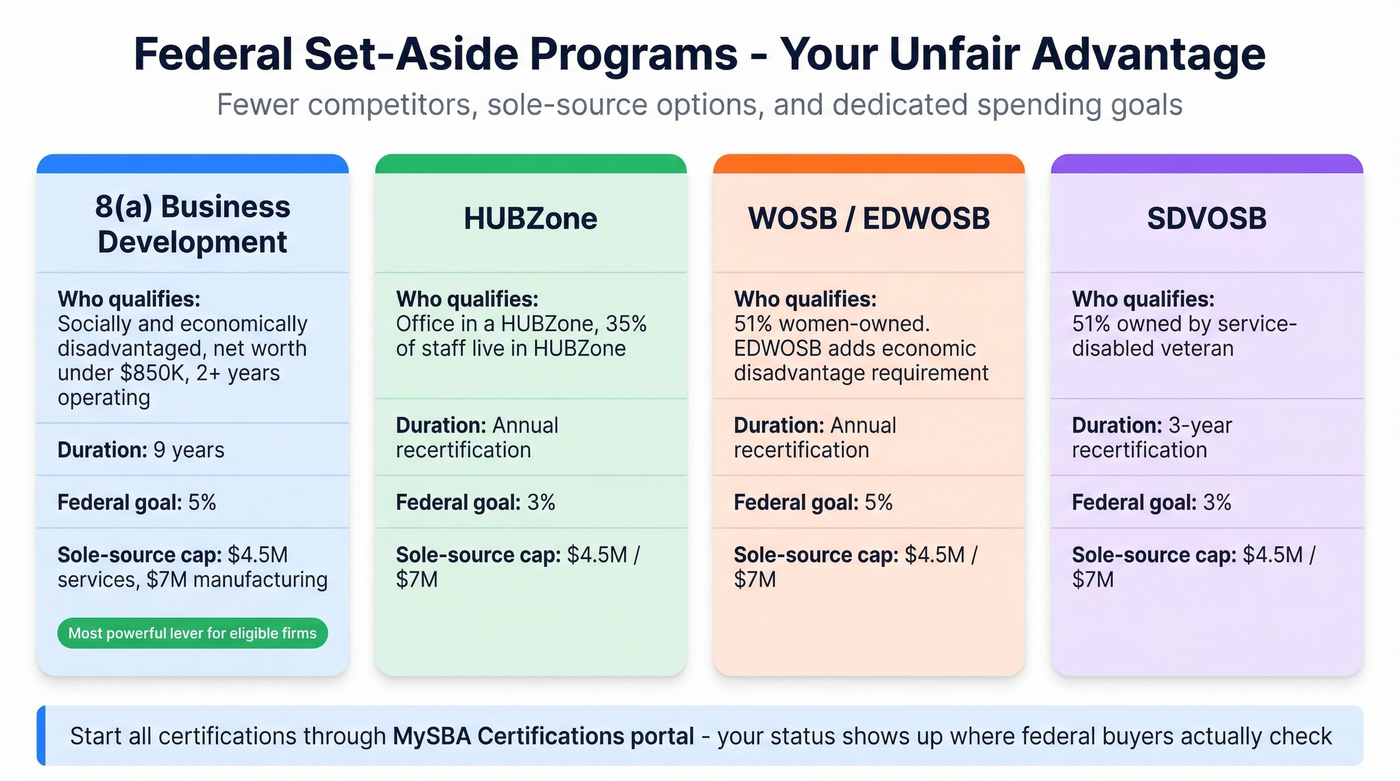
8(a) is the most powerful lever for many firms because it's a structured 9-year program - but it's also the most involved to get into. Here's the thing: if you qualify for even one of these, the ROI on the certification effort is enormous because you're competing against a fraction of the market.
| Program | Eligibility | Duration | Goal % | Sole-Source Cap |
|---|---|---|---|---|
| 8(a) | Disadvantaged; NW < $850K; 2+ yrs operating (waivable) | 9 yrs | 5% | $4.5M / $7M |
| HUBZone | Office + 35% staff in HUBZone | Annual recert | 3% | $4.5M / $7M |
| WOSB/EDWOSB | 51% women-owned (EDWOSB adds economic disadvantage) | Annual recert | 5% | $4.5M / $7M |
| SDVOSB | 51% SD veteran-owned | 3-yr recert | 3% | $4.5M / $7M |
Start the process through MySBA Certifications so your status shows up where buyers actually check.
Mistakes That Kill First-Time Bids
- Broken SAM registration - legal name, UEI, and IRS records don't match.
- Wrong NAICS codes, so you look irrelevant or ineligible for the set-asides you want.
- Chasing everything instead of building a tight agency + use-case focus.
- Generic proposals that don't mirror the RFP language and evaluation criteria.
- No relationship-building before bidding. Industry days, Sources Sought, and pre-RFP conversations exist for a reason.
- Underestimating the timeline and staffing. B2G is a marathon with paperwork.
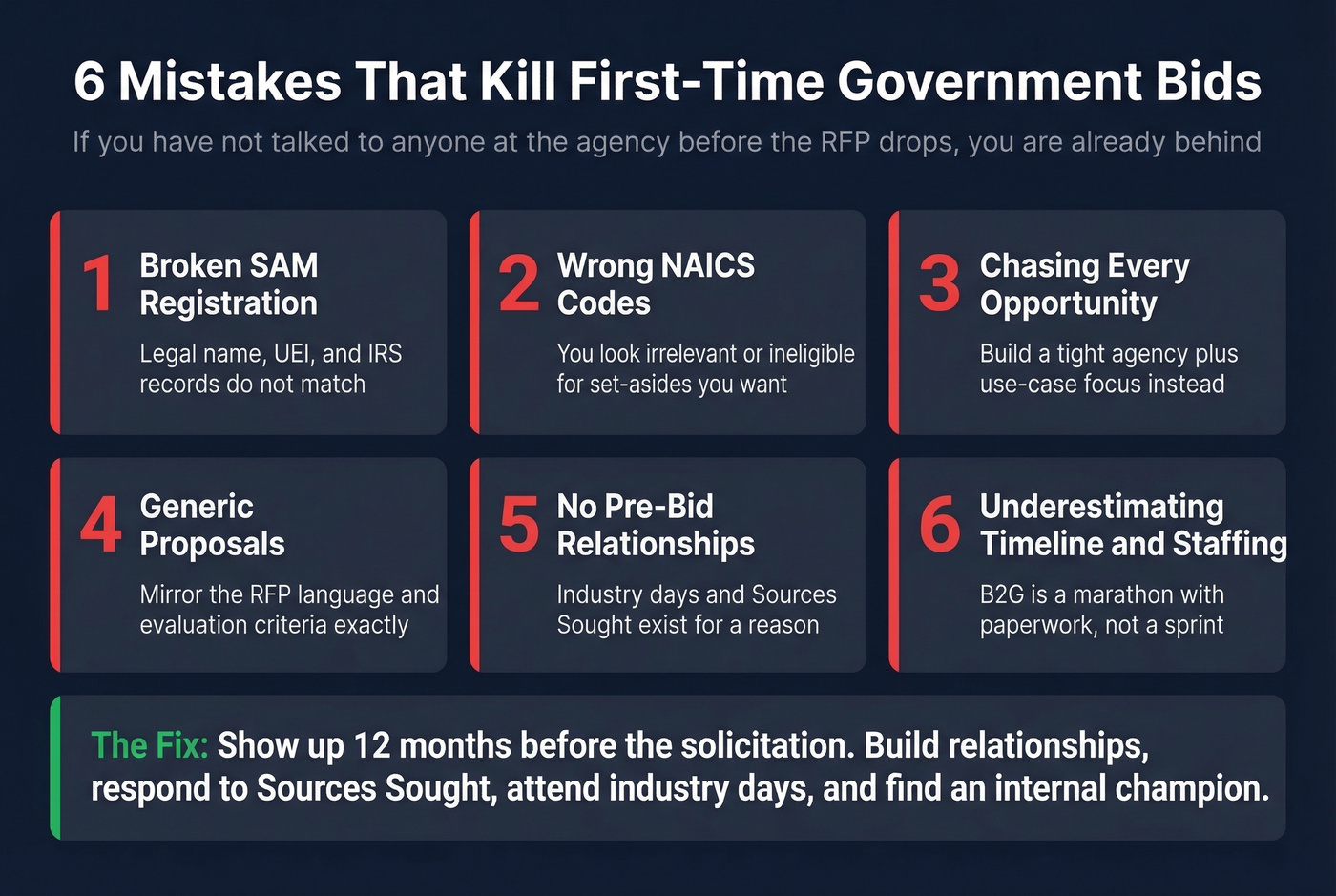
The government will happily let you spend 60 hours writing a proposal that never had a real champion inside the agency. Don't let them. If you haven't talked to anyone at the agency before the RFP drops, you're already behind.
Let's be honest about why most companies fail at B2G. It isn't because the process is too hard. They fail because they treat it like B2B with extra paperwork. It's not. It's a fundamentally different sales motion where the relationship and compliance work happens before the opportunity, not during it. The consensus on r/GovContracting echoes this constantly - the companies that win are the ones who showed up 12 months before the solicitation.
Essential Tools for B2G Sales
You need two layers: find the opportunities, then map the humans and influence the deal before it's a PDF on a portal.
| Tool | Type | Best For | Price |
|---|---|---|---|
| SAM.gov | Free | Fed opps + registration | $0 |
| USAspending.gov | Free | Award history research | $0 |
| GSA eBuy | Free* | RFQs on Schedule | $0* |
| GovTribe | Paid | Tracking + intel | $100-$300/mo |
| Prospeo | Paid (free tier) | Agency decision-makers | Free tier + ~$0.01/email |
| GovWin IQ | Paid | Enterprise intel | $2K-$5K+/mo |
| Procura | Paid | Pipeline + alerts | $399/mo |
*GSA eBuy is free to use, but you'll need an active GSA Schedule to participate.
Finding an RFP is step one. Finding the program owner, contracting officer, and technical evaluators is step two - and government directories are notorious for outdated titles, generic inboxes, and main switchboards. Skip GovWin if you're a smaller shop; the price tag only makes sense at scale. For teams under 10 reps, the free tools plus GovTribe and a solid contact database will cover 90% of what you need.

Relationship-building decides government deals - but you need to find the right humans first. Prospeo's 300M+ profiles with 30+ filters let you pinpoint agency buyers by department, seniority, and role, then verify their contact data in real time at $0.01 per email.
Turn every government org chart into a pipeline of verified contacts.
FAQ
How long does it take to win a government contract?
Plan on 6-18 months from SAM registration to first federal win, while state and local deals often land in 3-12 months. Subcontracting under an established prime is the fastest way to build past performance and shorten the path to revenue.
Can small businesses compete for government contracts?
Yes - small businesses won $194.13B of federal contract dollars in FY25, about 23.8% of the total. Set-aside programs narrow competition to qualifying firms, and subcontracting lets you participate even before you've built a federal track record.
What's the difference between B2G and B2B sales?
B2G procurement is regulation-driven, with FAR/DFARS compliance, formal evaluation criteria, and cycles averaging 6-18 months. B2B software deals typically close in 90 days with fewer stakeholders. The tradeoff: government contracts are larger, stickier, and often multi-year.
How do I find government decision-makers?
Use a mix of public-sector events like industry days, early-market notices such as Sources Sought, and direct contact discovery tools. Government org charts are often outdated, so verified contact data with a short refresh cycle saves weeks of dead-end outreach.
Business to government sales is a long game, but the contracts are worth it. Get registered, build one relationship, win one sub, and compound from there.