

The Buyer Decision Making Process: What the Textbook Gets Wrong
A marketing team we worked with built a 12-piece content sequence mapped perfectly to the five stages of the buyer decision making process. Beautiful funnel. Clean handoffs. One problem: their average deal involved a buying committee spanning four departments, and the content assumed a single buyer moving in a straight line. The sequence barely converted.
86% of B2B purchases stall before they close. Not because buyers don't want to buy - because internal alignment is harder than evaluation. The five-stage model gives you a starting point. What follows is what actually happens after that.
The Five Stages (Quick Version)
Need recognition, information search, evaluation of alternatives, purchase decision, post-purchase evaluation. Every marketing textbook covers these. Most stop there.
The model is more than a century old - John Dewey, 1910 - built to explain how individuals think through problems. In B2B, the average purchase involves 13 stakeholders, 86% of deals stall, and 81% of buyers end up dissatisfied with the provider they chose. The neat funnel doesn't survive contact with a buying committee.
What actually moves customer buying decisions isn't a content sequence mapped to stages. It's stakeholder alignment across departments, involvement level (which determines whether buyers even complete all five stages), and data quality - because you can't influence a committee you can't reach.
What Is the Buying Decision Process?
The buying decision process is the sequence of cognitive steps a person moves through when recognizing a need, researching options, evaluating alternatives, making a purchase, and reflecting on that purchase afterward. It's a foundational framework in consumer behavior research.
The model traces back to philosopher John Dewey, who outlined a reflective thinking framework in 1910. Marketing scholars later adapted it into the five-stage purchase decision model we use today. Dewey was describing how individuals think through problems - not how a B2B committee navigates a $200K software purchase.
Herbert Simon's concept of bounded rationality adds useful context here. Buyers don't optimize. They satisfice. They work with incomplete information, limited time, and cognitive shortcuts. The five-stage model assumes more rationality than most humans actually bring to a decision, and that gap - rooted in buyer decision making psychology - is where deals stall, committees fracture, and marketers lose control of the narrative.
5 Stages of the Buyer Decision Journey
Need Recognition
Every purchase starts with a gap between where the buyer is and where they want to be. Something changed, and the status quo stopped working.
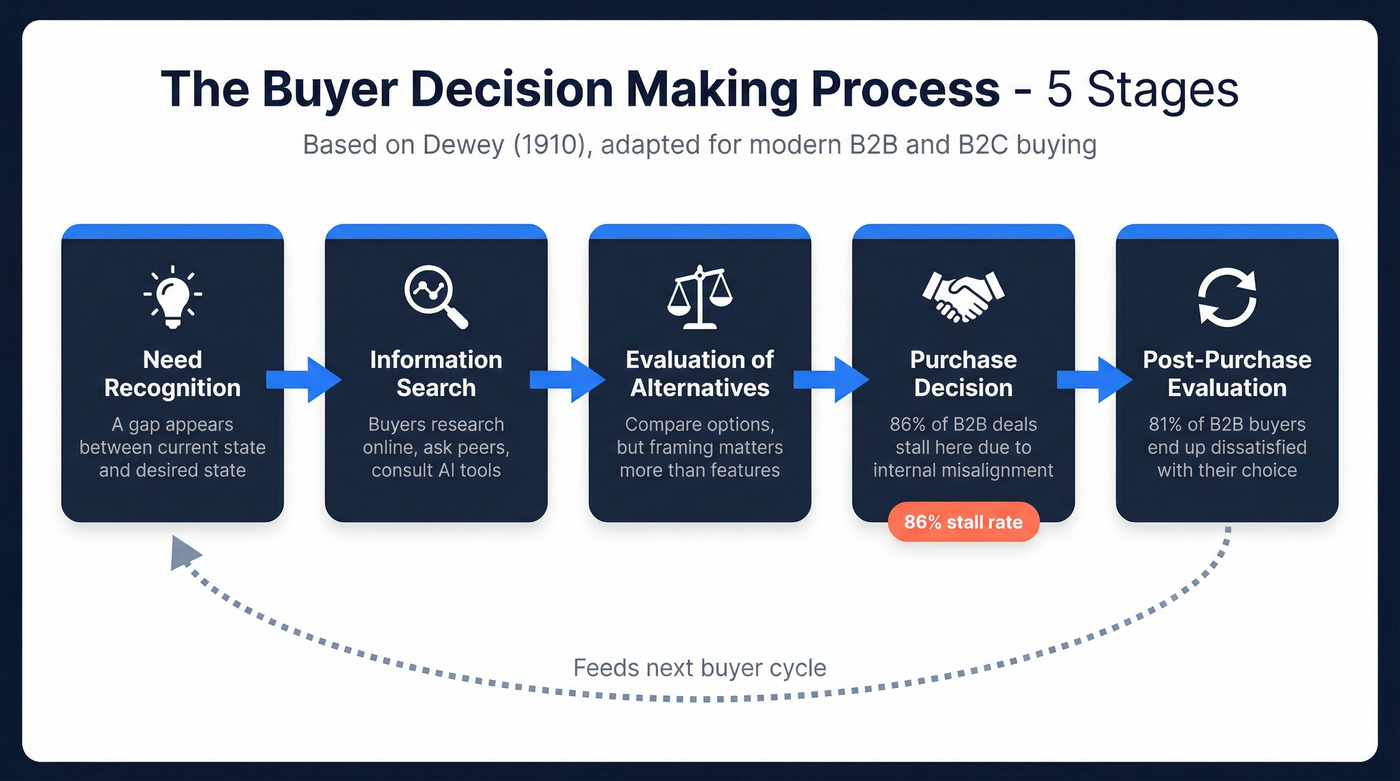
In B2C, your running shoes wear out, you notice knee pain, you start thinking about replacements. In B2B, need recognition is messier. Maybe you're outgrowing your CRM and reps are building workarounds in spreadsheets. Maybe a new VP arrives and questions why the team uses five tools that should be one.
The move here is cost-of-inaction content. Don't lead with your product - lead with the problem getting worse. "What happens if you don't fix this?" is a more powerful trigger than "here's what our product does." Practitioners in r/b2bmarketing consistently emphasize that content quantifying the cost of inaction moves deals faster than feature-focused material.
Information Search
Once a buyer recognizes a need, they research. Google coined the term Zero Moment of Truth (ZMOT) in 2011 to describe this online research phase. 81% of buyers research before purchasing, 93% read reviews, and 65% use comparison sites - and those numbers are probably low for B2B.
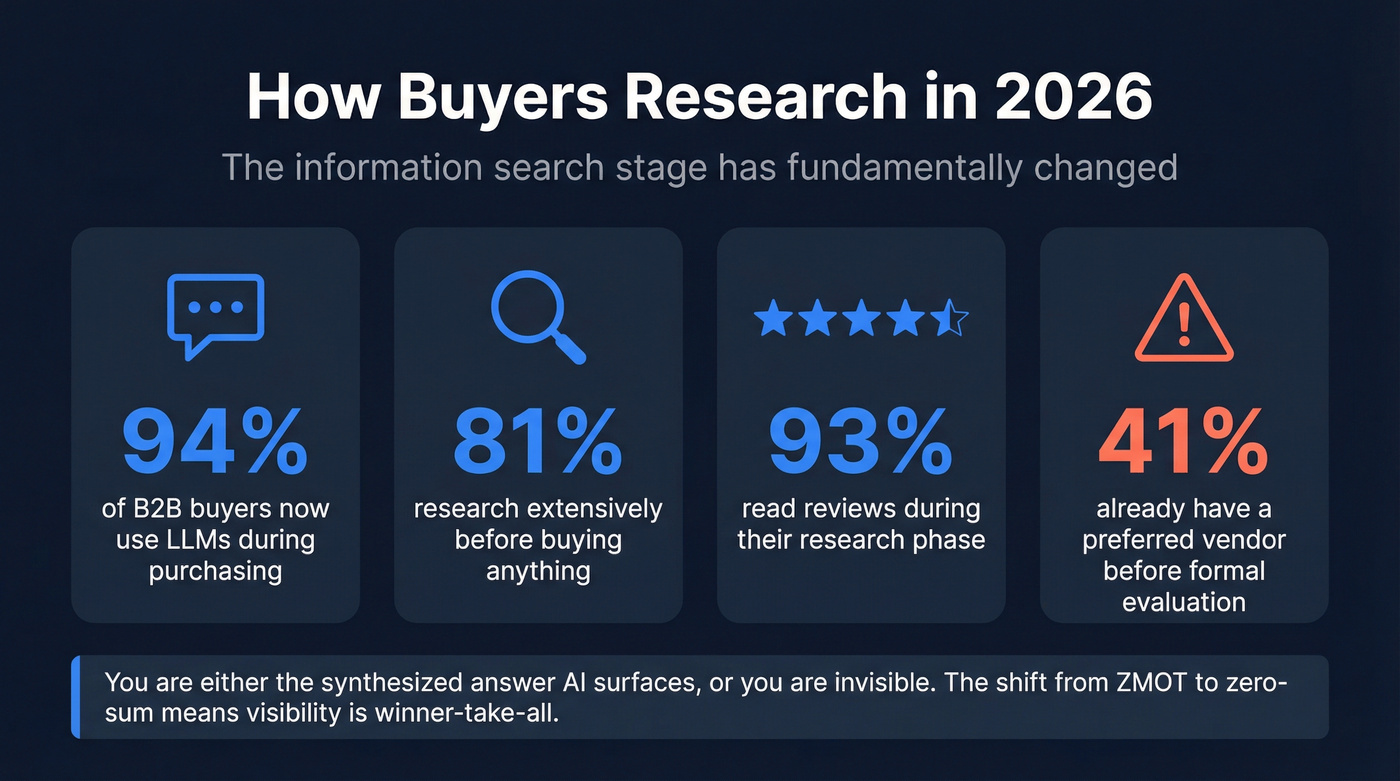
Here's the thing: 94% of B2B buyers now use LLMs during purchasing. ChatGPT, Perplexity, and similar tools compress weeks of research into minutes. This is the shift from ZMOT to the "zero-sum moment" - AI engines provide one synthesized answer, making visibility winner-take-all. You're either the answer or you're invisible.
The marketer's job at this stage isn't to produce more content. It's to be the synthesized answer - structured, specific, comparison-ready content that AI can parse and surface.
Evaluation of Alternatives
This is where the textbook version gets most misleading. The model implies a rational comparison of features, prices, and benefits. Reality is messier.
A Nature field experiment with 126,614 shoppers proves it. Researchers added precise yearly energy cost information alongside standard efficiency labels on refrigerators. The result: buyers shifted toward lower-priced products while maintaining similar overall energy costs. How you frame information matters as much as what information you present.
A Nielsen global study of 40,000 respondents found that 89% of people most trust recommendations from people they know. Only 23% trust influencer ads. Your best "marketing" at this stage is making it easy for champions to sell internally.
Then there's the values-action gap - and this one should make every marketer uncomfortable. About 30% of consumers report being very concerned about environmental issues, yet ethical foods hold roughly 5% market share. Stated preferences don't predict purchases. In B2B, this translates directly: buyers say they want "best-in-class" but often choose "good enough and easy to implement."
41% of B2B buyers already have a preferred vendor before formal evaluation begins. The evaluation stage isn't always a genuine comparison - it's often a validation exercise. If you're not the preferred vendor going in, you need to disrupt the frame, not just compete on features.
Purchase Decision
B2B breaks the model here. 86% of purchases stall. Not because buyers chose a competitor - because the internal process collapsed. Stakeholder misalignment, budget freezes, priority shifts, procurement bottlenecks.
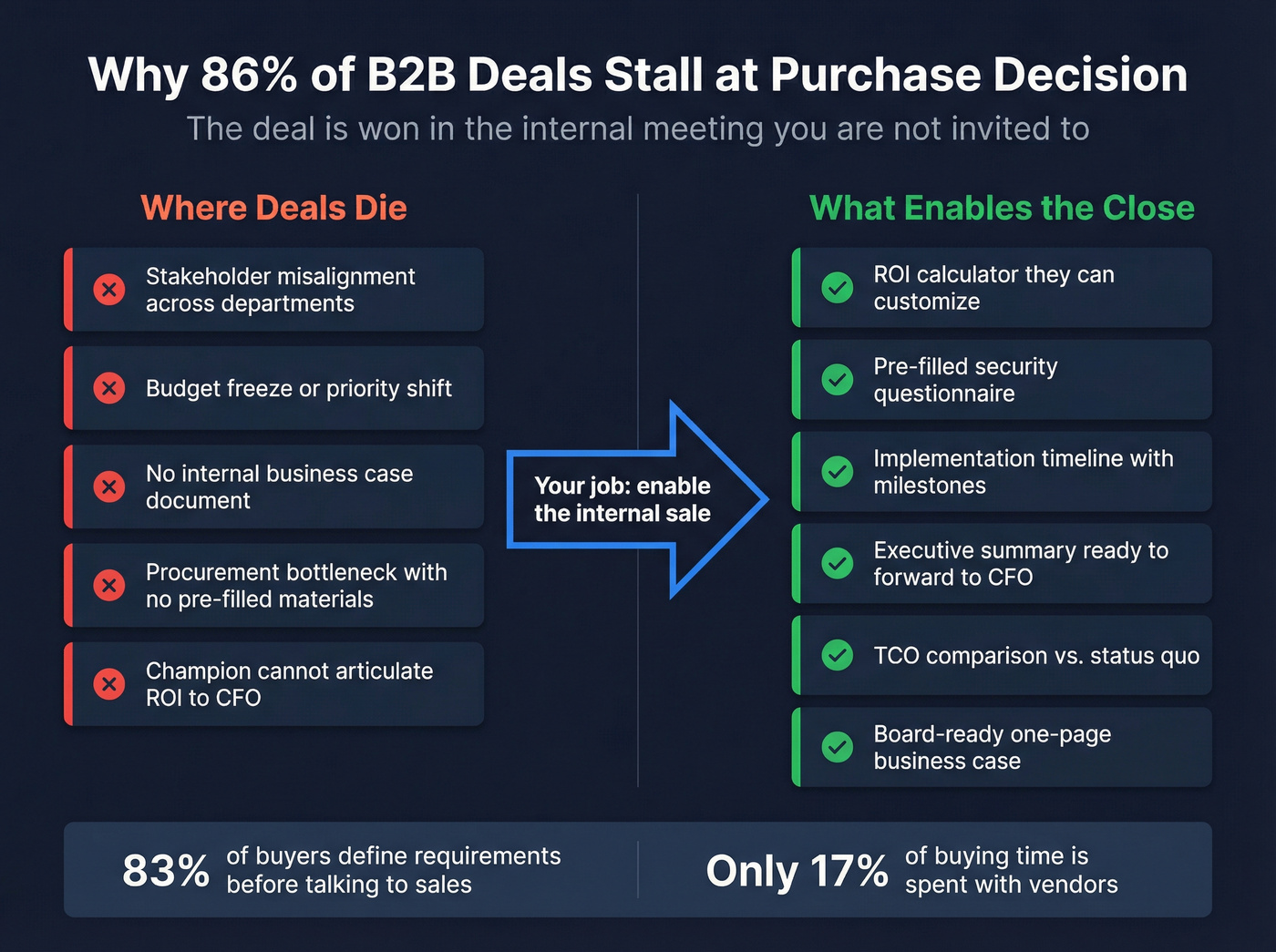
83% of B2B buyers mostly or fully define requirements before speaking with sales. They spend only 17% of their total purchasing time meeting with vendors. The other 83% is internal - building the business case, getting sign-offs, navigating procurement.
Your job at this stage isn't to pitch harder. It's to enable the internal business case. Give your champion the ROI calculator, the security questionnaire, the implementation timeline, the executive summary they can forward to the CFO. The deal isn't won in your demo - it's won in the internal meeting you're not invited to.
Post-Purchase Evaluation
High-involvement purchases trigger cognitive dissonance. The buyer wonders: did I make the right call?
The numbers are brutal. 81% of B2B buyers are dissatisfied with the provider they chose. That's not a product quality problem - it's an expectations management and onboarding problem. The gap between what was sold and what was experienced creates dissonance that erodes retention and kills referrals.
Marketers who stop at the purchase are leaving money on the table. Post-purchase reassurance - onboarding sequences, early wins documentation, executive check-ins, advocacy programs - reduces churn and turns buyers into the personal recommendations that 89% of people trust most. The post-purchase stage feeds directly back into need recognition for the next buyer.
When Buyers Skip Steps
Not every purchase gets the full five-stage treatment. Involvement level - driven by price, risk, and complexity - determines how many stages a buyer actually completes.
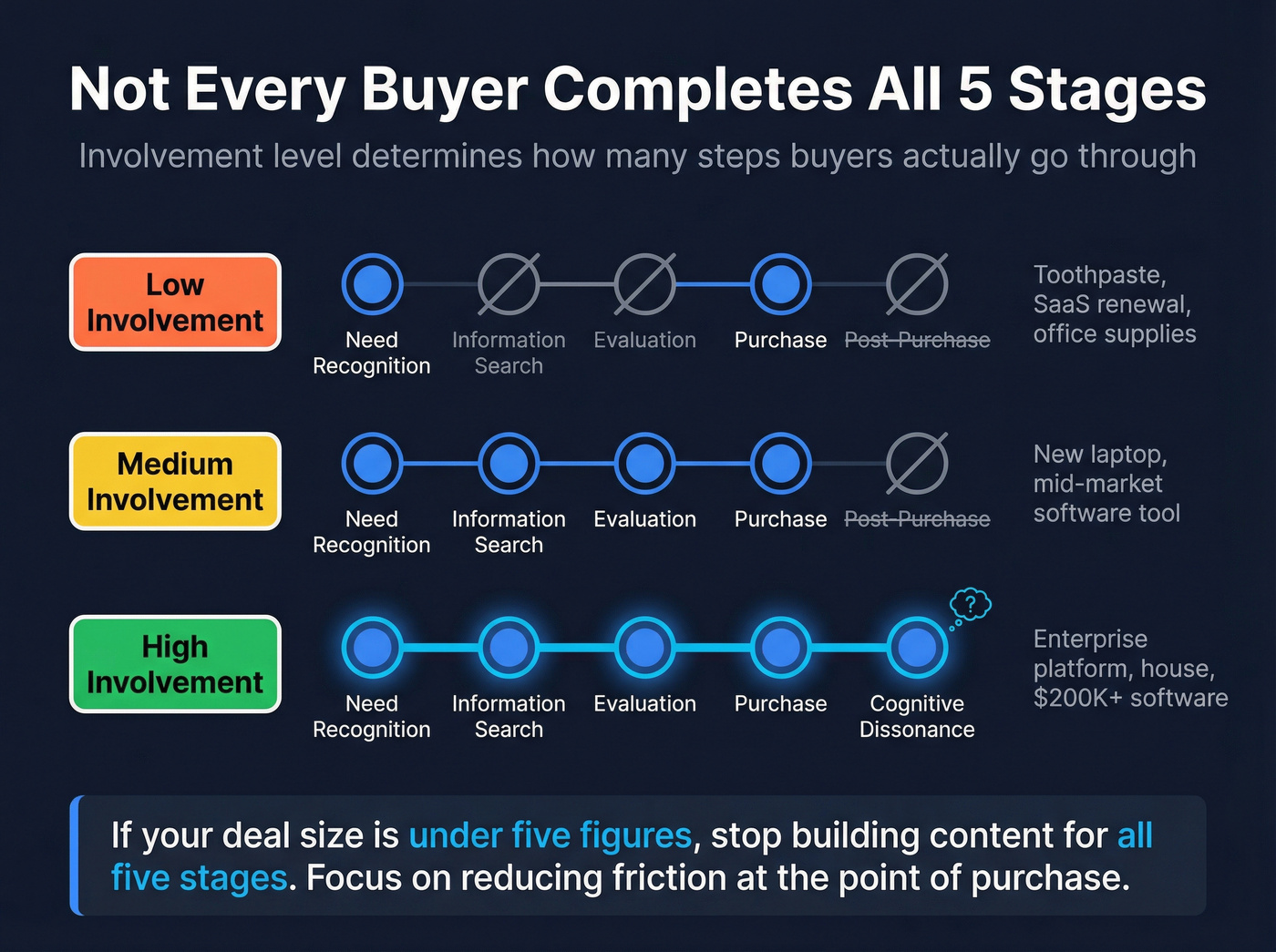
| Involvement Level | Behavior | Stages Used | Examples |
|---|---|---|---|
| Low | Routine response | Skip to purchase | Toothpaste, SaaS renewal |
| Medium | Limited problem solving | Brief search + evaluate | New laptop, mid-market tool |
| High | Extended problem solving | All 5 stages + dissonance | House, enterprise platform |
Low-involvement purchases are essentially automatic. The buyer has experience, the risk is minimal, and the price is low. Nobody runs a bake-off for a $50/month SaaS renewal. High-involvement purchases activate every stage and then some - the buyer compares features extensively, consults colleagues, loses sleep, and after purchasing, experiences the nagging doubt that they chose wrong.
If your deal size is under five figures, most of your buyers are in limited problem-solving mode. Stop building content for all five stages and focus on reducing friction at the point of purchase. You're over-engineering the funnel for a decision that takes two meetings, not twelve.

You can't influence a 13-person buying committee you can't contact. Prospeo's 300M+ profiles with 98% email accuracy and 125M+ verified mobiles let you reach every stakeholder - not just your champion.
Stop losing deals in meetings you're not invited to.
The B2B Buying Committee
Who's Actually Deciding
The five-stage model assumes one buyer. B2B reality involves a committee. Forrester puts the average at 13 stakeholders, with roughly 89% of decisions crossing multiple departments. Gartner's research says complex buying groups typically have 6-10 decision makers, each bringing 4-5 pieces of independently sourced research to share internally. That's not a funnel. That's a network.
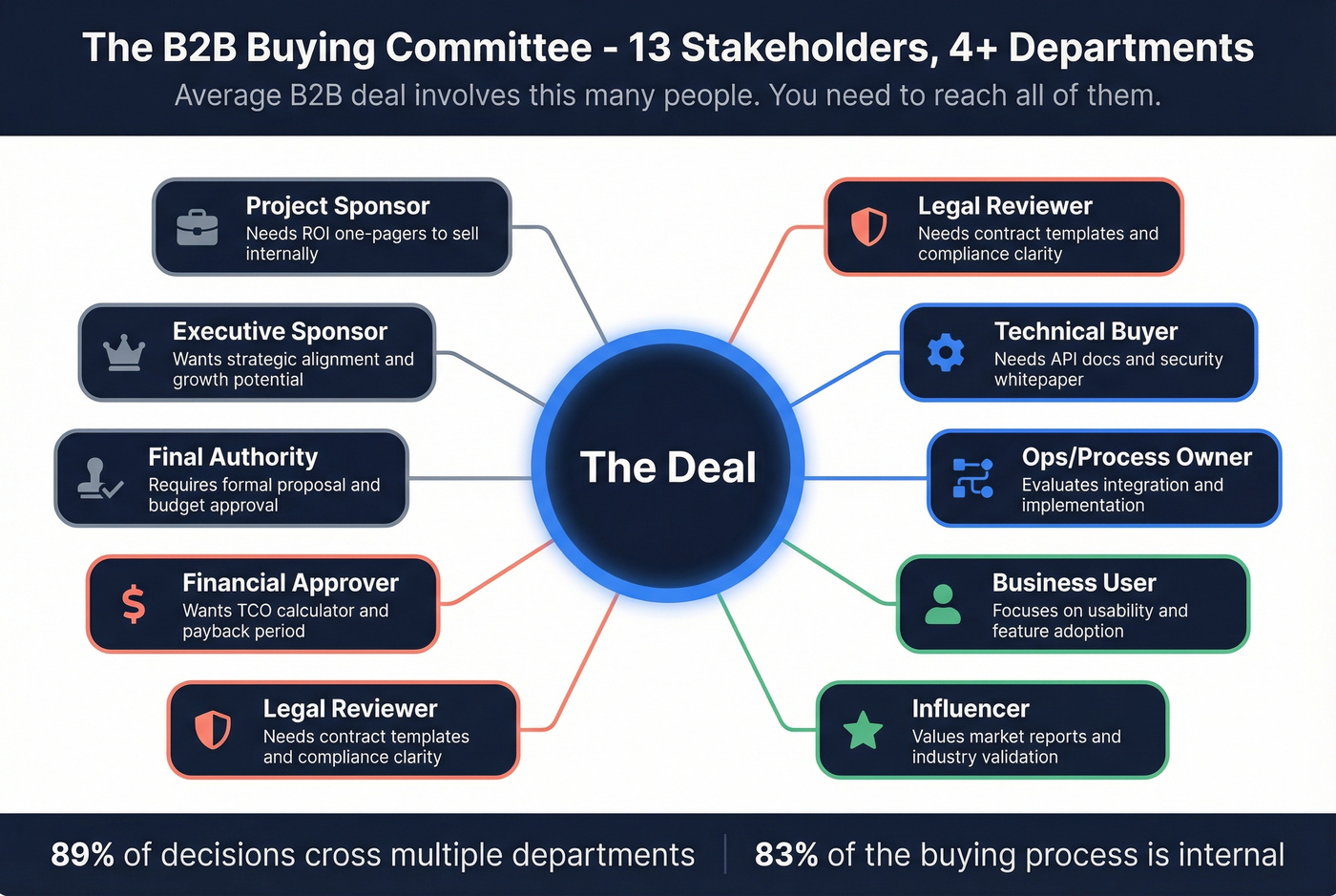
First vendor contact has moved from 69% to 61% of the buyer journey - about 6-7 weeks earlier than before. Committees are reaching out sooner, but they're arriving more informed and more fragmented.
| Role | What They Care About | How to Reach Them |
|---|---|---|
| Project Sponsor | Business case, timeline | Executive briefing, project roadmap |
| Champion | Internal advocacy, proof | Internal case studies, ROI one-pagers |
| Executive Sponsor | Strategic alignment, budget | Board-ready summary, competitive landscape |
| Financial Approver | ROI, total cost | TCO calculator, payback period analysis |
| Technical Buyer | Integration, security, specs | Security whitepaper, API docs, architecture diagram |
| Ops/Process Owner | Workflow impact, change mgmt | Implementation playbook, migration timeline |
| Business User | Usability, daily workflow | Interactive demo, user testimonials |
| Legal Reviewer | Compliance, contract terms | DPA, compliance certifications, redline-ready MSA |
| Influencer | Industry credibility, peers | Analyst reports, peer case studies |
| Final Authority | Risk, strategic fit | Risk assessment, executive summary |
Each of these roles has different questions, different objections, and different content needs. Treating them as one audience is why 86% of deals stall.
How to Message Each Layer
The Demand Gen Report breaks buying committees into three practical layers. Decision makers - roughly 15-20% of the group - care about strategic value and budget impact. Influencers (managers and directors) drive the evaluation and build the business case. Executors (hands-on users) care about usability and implementation burden.
The mistake most teams make is messaging only the champion or only the executive. Parallel stakeholder enablement - tailoring content to each layer simultaneously - is what accelerates internal alignment. We've seen teams map all 10 roles and still lose deals because they only had the champion's email. Finding verified contact data for 13 stakeholders across multiple departments is where B2B data platforms like Prospeo justify their existence.
What the Textbook Gets Wrong
Let's be honest: the five-stage model implies a linearity that doesn't exist.
Buyer A recognizes a need, searches for information, evaluates alternatives, purchases, and reflects. Clean. Sequential. Wrong. In reality, buyers loop back, skip stages, and restart with different stakeholders - especially when the decision is high-risk or committee-driven. With 94% of B2B buyers using LLMs during purchasing, the research phase is compressing even further, and sales cycles have dropped from 11.3 months to 10.1 months.
The five-stage model is a useful teaching framework, not a strategy document. Buyers loop back, stall for months, restart with different stakeholders, and make decisions based on factors the model doesn't account for - internal politics, budget cycles, a competitor's aggressive discount, or simply the champion changing jobs. Non-linearity isn't the exception. It's the norm. Anyone asking "what is the buying process?" deserves an honest answer: it's a messy, recursive loop, not a clean funnel.
Hidden Decision Drivers
Framing Effects
The Nature refrigerator experiment deserves a second look beyond the evaluation stage, because the mechanism is universal. The same product, presented with different information framing, produces different purchase outcomes. This isn't about deception - it's about salience. Which numbers you put in front of buyers, and how you contextualize them, shapes what they optimize for.
In B2B, this means your pricing page layout, your ROI framing, and even the order of your feature comparison all influence the purchasing decision more than most teams realize. I've watched a team double their close rate just by restructuring their proposal to lead with cost savings instead of feature lists. Same product, same price, different frame.
Time Pressure
A systematic review covering research from 1983 to 2025 found consistent patterns: under time pressure, buyers spend less time searching, reduce browsing, rely on heuristics, and prefer easy-to-evaluate options. They also return products more often - speed and satisfaction trade off against each other.
In B2B, time pressure manifests as procurement deadlines, end-of-quarter urgency, and budget-use-it-or-lose-it cycles. Sellers who understand these timing dynamics can structure deals around them.
Situational Influences
Philip Kotler introduced the concept of atmospherics in 1973 - controllable environmental cues designed to influence emotional state and purchase likelihood. These aren't just retail concepts. In B2B, the "atmosphere" includes conference environments where demos happen, the design of your pricing page, the friction in your procurement process, and even the mood of the committee during the final presentation. A demo at a noisy trade show booth produces different outcomes than the same demo in a quiet conference room. Context shapes decisions in ways the five-stage model doesn't capture.
How to Operationalize This Framework
Understanding the model is academic until you translate it into workflows. Here's a four-step framework we use with our own outbound.
1. Define your ICP. Go beyond firmographics. Map the buying committee roles for your typical deal - which of the 10 roles show up, who has veto power, and what disqualifies an account before you invest resources. If you're selling to companies with fewer than 50 employees, you probably don't have a 13-person committee. Adjust accordingly.
2. Map Jobs-to-Be-Done. What "job" is the buyer hiring your product to do? Pull exact phrases from customer interviews, G2 reviews, and recorded sales calls. The language buyers use to describe their problem is the language your marketing should use. Don't translate it into corporate-speak.
3. Match messaging to awareness stages. A problem-aware buyer who doesn't know your category exists needs different content than a product-aware buyer comparing you to three competitors. Bucket your voice-of-customer phrases into pains (problem-aware), benefits (solution-aware), and features (product-aware). Then map content to each bucket.
4. Verify your contact data and layer intent signals. You've mapped the buying committee. You know the 10 roles. You've built messaging for each layer. Now you need verified emails and direct dials to actually reach them - and intent data to know which accounts are actively in-market. Prospeo covers 300M+ professional profiles with 98% email accuracy and a 7-day refresh cycle, plus intent data tracking 15,000 topics so you can prioritize accounts showing active buying signals. When 86% of B2B deals stall, you can't afford to add "bounced email" or "wrong timing" to the list of reasons.

83% of B2B buyers define requirements before talking to sales. That means your window is the information search stage - and you need verified contacts to shape the conversation early. Prospeo refreshes data every 7 days so you're never pitching stale leads.
Reach decision-makers before they've already picked a vendor.
FAQ
What are the 5 stages of the buyer decision making process?
Need recognition, information search, evaluation of alternatives, purchase decision, and post-purchase evaluation. The model originated with John Dewey in 1910 and remains the standard framework in marketing education. Modern B2B buying with multi-stakeholder committees is rarely this linear, but the stages work as a diagnostic lens.
How does B2B buying differ from B2C?
B2B purchases involve an average of 13 stakeholders across multiple departments, compared to one or two consumers in B2C. Decisions are committee-driven, take months, and 86% stall before completion. The five-stage model applies loosely but breaks under the weight of internal politics and procurement processes.
Why do buyers skip stages?
Involvement level determines how many stages a buyer completes. Low-involvement purchases - low price, low risk, repeat buys - trigger routine response behavior where buyers skip straight to purchase. High-involvement decisions activate all five stages plus post-purchase dissonance.
How has AI changed the buying decision process?
94% of B2B buyers now use LLMs during purchasing, compressing information search from weeks to minutes. First vendor contact has moved 6-7 weeks earlier in the journey. If your product isn't surfaced in AI-synthesized responses, you won't make the consideration set.
How do you reach all stakeholders in a buying committee?
Map the 10 common committee roles - champion, financial approver, technical buyer, executive sponsor, and others - then use a B2B data platform to find verified emails and direct dials for each stakeholder. Parallel outreach to multiple roles accelerates internal alignment and reduces stall risk.