

Buyer Intent Data: What Works in 2026 (+ What Doesn't)
Your dashboard lights up: 847 accounts showing "high intent" this week. You've got four reps. No verified contacts for any of them. The intent data vendor is celebrating adoption metrics while your pipeline stays flat. This is the $4.49B buyer intent data market in a nutshell - 91% of B2B marketers use it, but only 24% report exceptional ROI. One practitioner on r/LeadGeneration summed it up after testing 6sense, ZoomInfo, and Bombora: "mostly disappointed" - not because the signals were wrong, but because nothing happened after they fired.
The gap isn't the data. It's what happens next.
What You Need (Quick Version)
Three things separate the 24% who get ROI from the 76% who don't:
- Prioritize first-party signals. Your own pricing page visits and demo requests are more accurate than any third-party co-op data. Start there.
- Activate within 48 hours. Intent signals decay fast. A high-priority signal that sits in a dashboard for two weeks is worthless.
- Resolve accounts to people. Account-level intent is a starting point. You need verified emails and direct dials for the actual decision-makers at those accounts.
What Is Buyer Intent Data?
Buyer intent data is the collection of behavioral signals - content consumption, product research, competitor comparisons, pricing page visits - that indicate a company or individual is actively evaluating a purchase. The concept is simple: someone's getting ready to buy. The data part is where it gets complicated.
67% of the buyer journey happens before a prospect ever talks to sales. That's the dark funnel - all the research, internal discussions, and vendor shortlisting that your CRM never sees. Intent data tries to catch buying signals before the hand-raise, and understanding what these signals actually represent (and what they don't) is the first step toward using them well.
The market is consolidating fast. Clearbit is now part of HubSpot's Breeze Intelligence, and HG Insights acquired TrustRadius in mid-2025. Expect fewer standalone providers and more intent baked into existing platforms.
Types of Intent Signals
Not all intent data comes from the same place, and the source determines how much you should trust it.
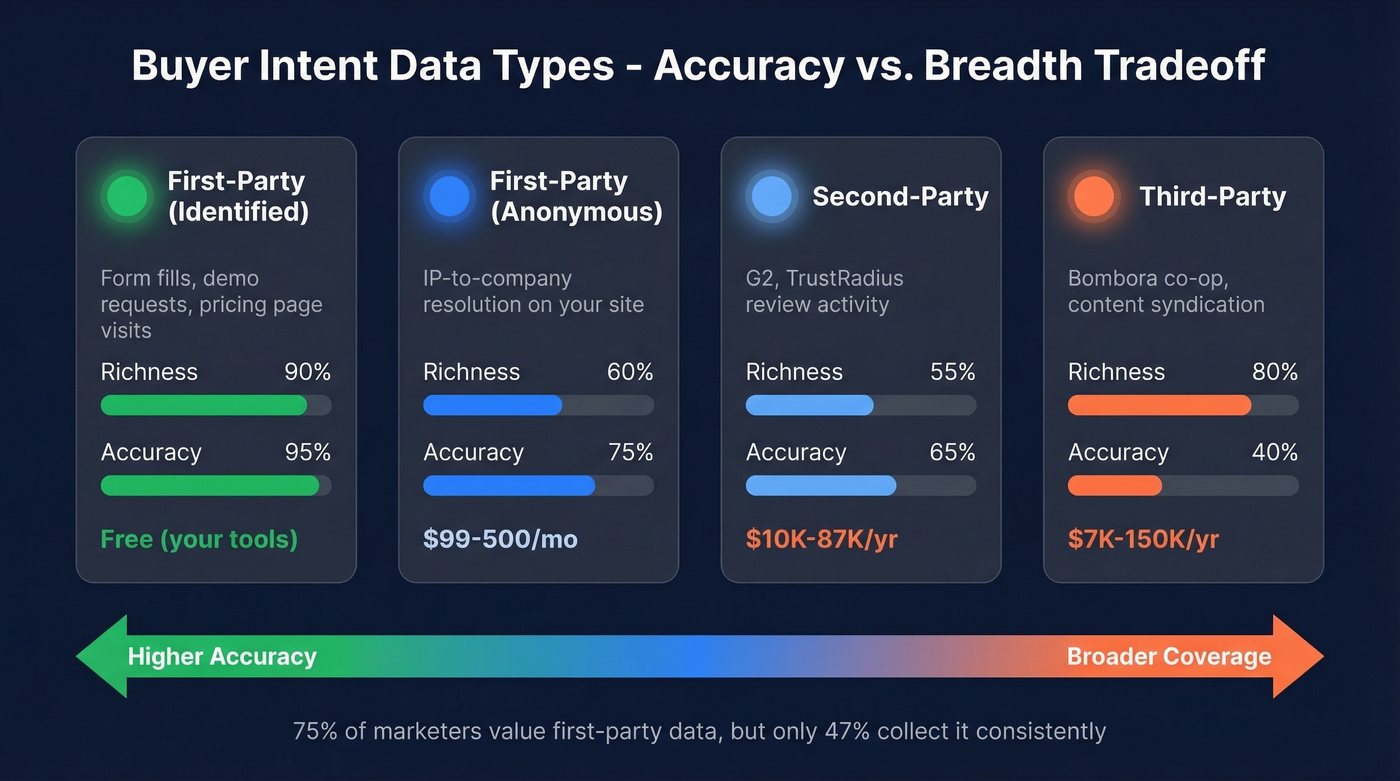
| Type | Source Examples | Richness | Accuracy | Typical Cost |
|---|---|---|---|---|
| First-party (identified) | Form fills, demo requests, pricing page visits | High | Highest | Free (your tools) |
| First-party (anonymous) | IP-to-company resolution on your site | Medium | High | $99-500/mo |
| Second-party | G2, TrustRadius review activity | Medium | Medium-high | $10K-87K/yr |
| Third-party | Bombora co-op, content syndication | Broad | Lower than first-party | $7K-150K/yr |
First-party identified data - someone fills out a form on your site - gives you a contact, a company, an action, and a timestamp. That's the gold standard. Third-party data from a co-op network like Bombora gives you breadth across 5,000+ websites and 12,000+ topics, but it's less precise. The signal is directional, not definitive.
Here's the thing: 75% of marketers say they value real-time first-party behavioral data, but only 47% collect it consistently. Most teams over-index on expensive third-party feeds while neglecting the highest-accuracy signals they already own. Fix your first-party capture before you spend $25K on Bombora.
How is this data collected in practice? First-party signals come from your own website analytics, marketing automation, and CRM event tracking. Second-party data is gathered from review platforms and publisher networks where prospects actively research solutions. Third-party providers like Bombora aggregate anonymized browsing behavior across thousands of B2B websites through data co-ops, then map that activity to company-level accounts using reverse-IP lookup and cookie-based tracking. One privacy note: make sure your provider can document consent, data provenance, and how signals are collected and shared. If they can't explain where the signal came from, don't use it.
Not All Intent Signals Are Equal
A demo request and a blog visit are both "intent signals." They're not remotely equal.
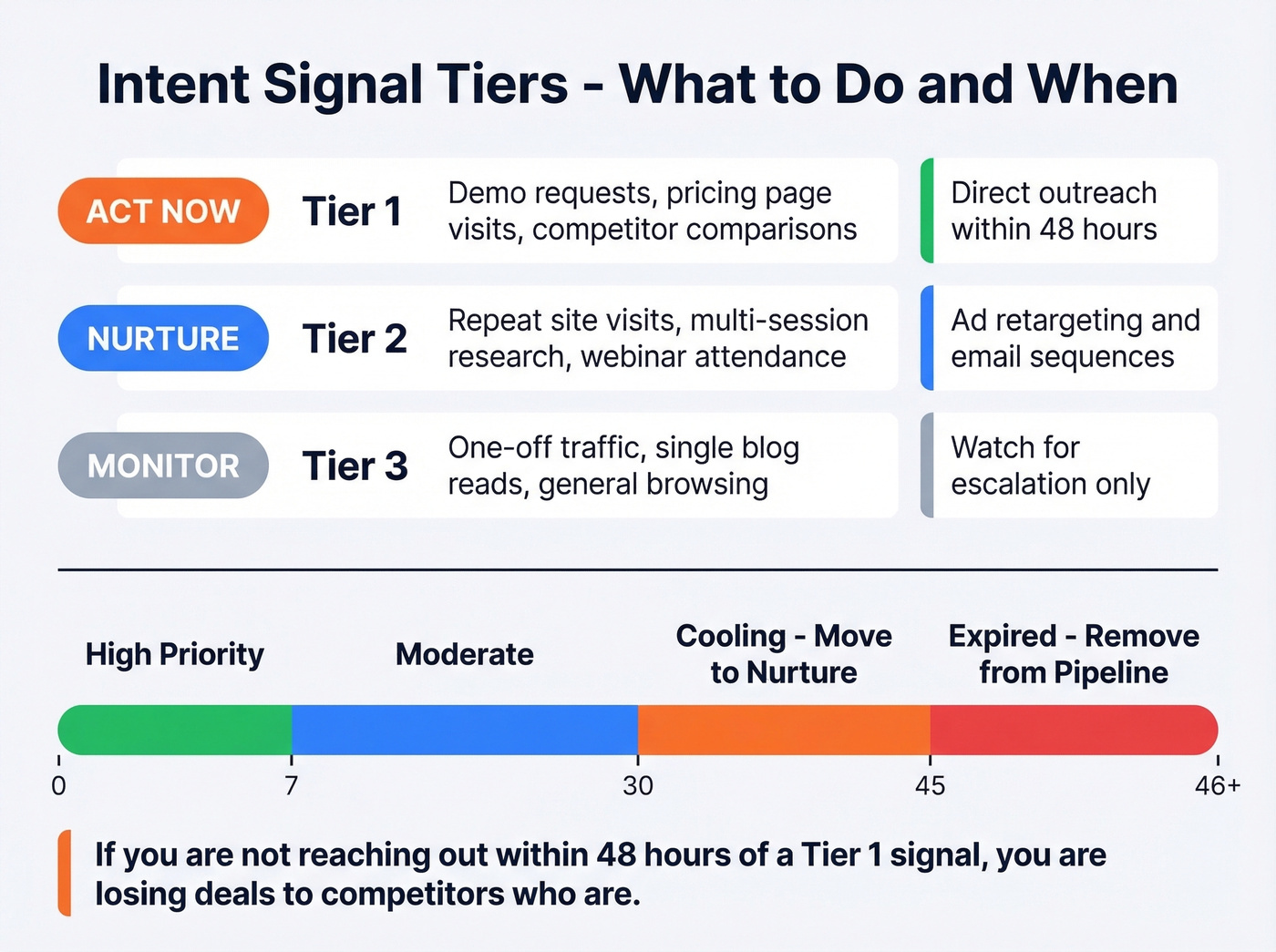
Tier 1 - Act now: Demo requests, pricing page visits, product-specific research, competitor comparison pages. Drop everything and reach out.
Tier 2 - Nurture aggressively: Repeat website engagement, topic-level research across multiple sessions, webinar attendance. The account is warming but hasn't committed to evaluation.
Tier 3 - Monitor only: One-off traffic, general industry browsing, single blog reads. Noise unless it escalates.
Weight signals by who's showing the behavior, not just what the behavior is. A CTO visiting your pricing page is a fundamentally different signal than a junior analyst browsing a blog post. Companies that recently raised funding are 2.5x more likely to buy new solutions - layer firmographic signals like funding events and headcount growth on top of behavioral intent for a much sharper picture. This kind of layering is what separates actionable data from noise.
The decay model matters just as much as the hierarchy. Days 0-7 after a signal fires: high priority. Days 8-30: moderate. Days 31-45: cooling, move to nurture. Day 46+: expired - delete it from your active pipeline. If you're not reaching out within 48 hours of a Tier 1 signal, you're losing deals to competitors who are.

Intent signals decay in days. Account-level data without contact resolution is a dead end. Prospeo layers Bombora intent data across 15,000 topics with 300M+ verified profiles - so you go from "this account is surging" to a verified email and direct dial in seconds, not weeks.
Resolve intent signals to real decision-makers at $0.01 per email.
How to Activate Intent Data for Sales
The consensus on r/gtmengineering is that most intent tools are "strong at signals but weak at identity, context, and activation." We've seen the same pattern across dozens of teams we've talked to. For every signal that hits your workflow, answer five questions:
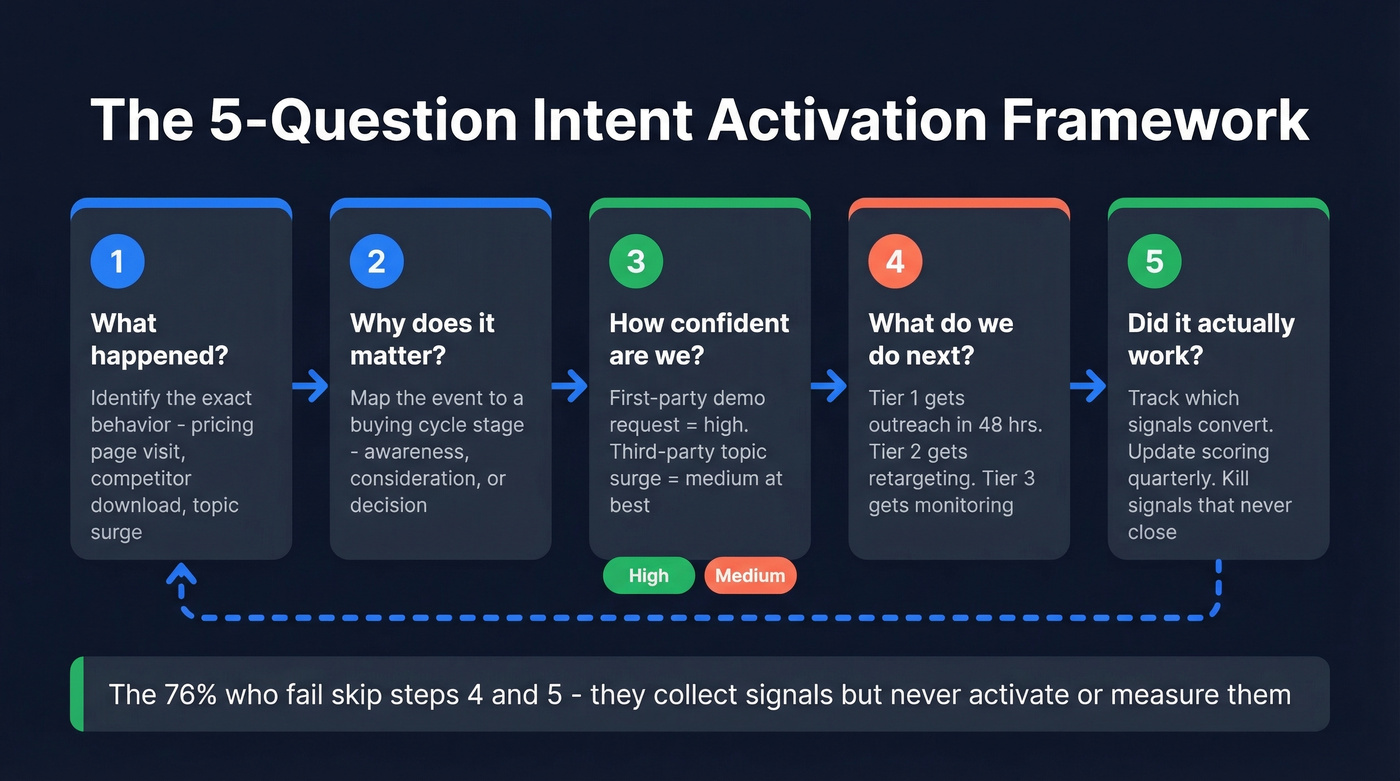
- What exact event happened? Specify the behavior - pricing page visits, competitor comparison downloads, category research on Bombora's network.
- Why does this matter? Map the event to your buying cycle stage.
- What's the confidence level? First-party demo request = high. Third-party topic surge = medium at best.
- What's the recommended action? Tier 1 gets direct outreach within 48 hours. Tier 2 gets ad retargeting. Tier 3 gets a monitoring list.
- Does the feedback loop confirm this works? Track which signals convert. If "topic research" signals never close, stop prioritizing them. Update your scoring model quarterly so it reflects what's actually converting.
Let's be honest about something: some teams skip dedicated intent platforms entirely, using Clay workflows to build custom signal stacks from multiple APIs for a fraction of the cost. If your average deal size is under $15K, that's probably the smarter move. Intent data ROI scales with deal size - the math doesn't work on $3K deals no matter how good the signal is.
What Does It Cost?
Budget 15-25% above the license cost for implementation, integration, and optimization overhead - the hidden line item most vendors don't mention.
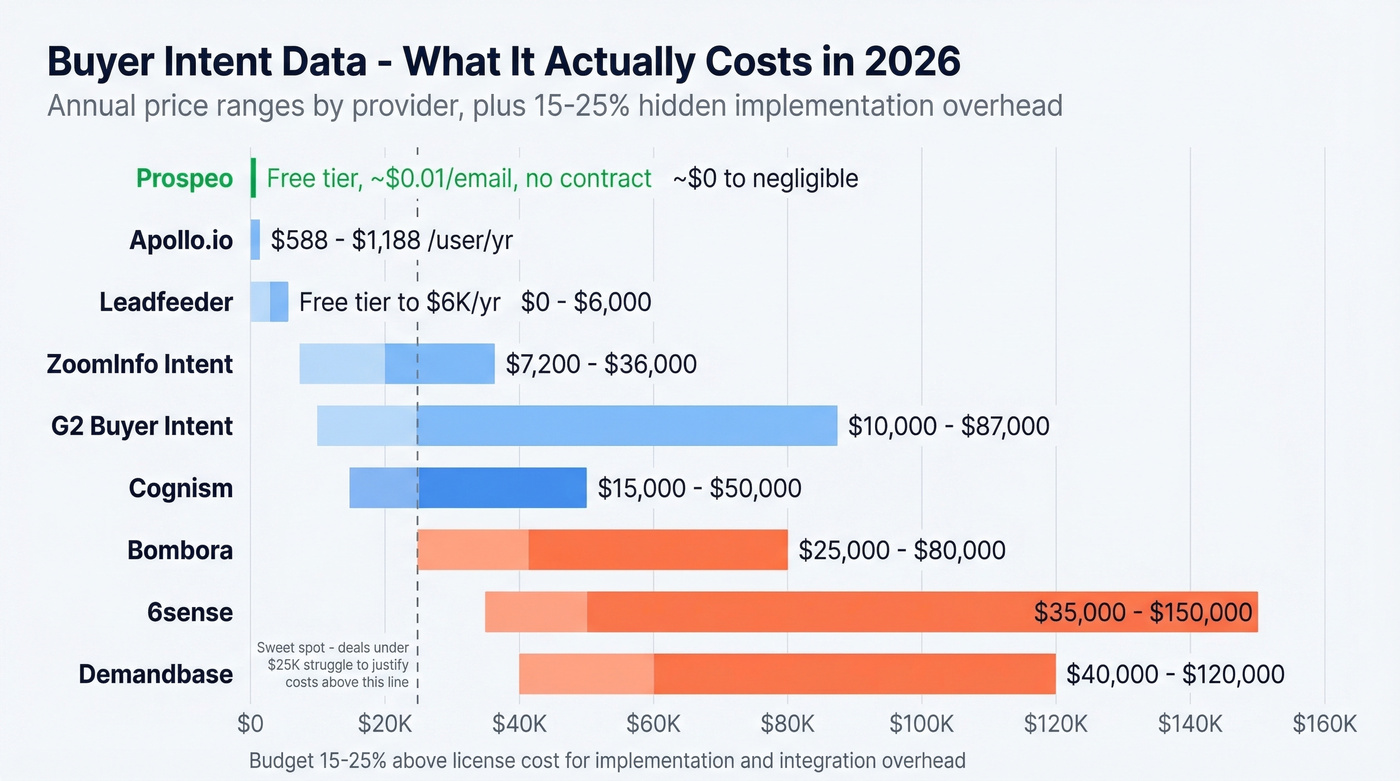
| Provider | Starting Price | Annual Range | Contract | Best For |
|---|---|---|---|---|
| Prospeo | Free tier | ~$0.01/email | No contract | Intent + verified contacts |
| Leadfeeder | Free tier | $1,188-$6,000/yr | Monthly | First-party visitor ID |
| ZoomInfo Intent | ~$7,200/yr | $7,200-$36,000 | Annual | Mid-market add-on |
| G2 Buyer Intent | ~$10,000/yr | $10,000-$87,000+ | Annual | SaaS review signals |
| Cognism | Custom | ~$15,000-$50,000/yr | Annual | EMEA-focused teams |
| Bombora | ~$25,000/yr | $25,000-$80,000 | Annual | Standalone 3P dataset |
| 6sense | ~$35,000/yr | $35,000-$150,000+ | Annual | Enterprise ABM |
| Demandbase | ~$40,000/yr | $40,000-$120,000 | Annual | ABM + display ads |
| Apollo.io | $49/user/mo | $588-$1,188/user/yr | Monthly/Annual | Budget prospecting |
Expect 4-12 weeks to get a data-feed tool like Bombora or ZoomInfo Streaming Intent fully operational. Full ABM platforms like 6sense and Demandbase take three to six months before you see real value. For teams evaluating B2B intent solutions, total cost of ownership - not just the license fee - should drive the decision.
Top Intent Data Providers in 2026
Prospeo
Prospeo solves the problem that kills most intent data investments: the account-to-person gap. It layers 15,000 Bombora-powered intent topics on top of 300M+ professional profiles with 143M+ verified emails at 98% accuracy and 125M+ verified mobile numbers. You go from "Acme Corp is in-market" to "here's the VP of Engineering's verified email and direct dial" in one platform.
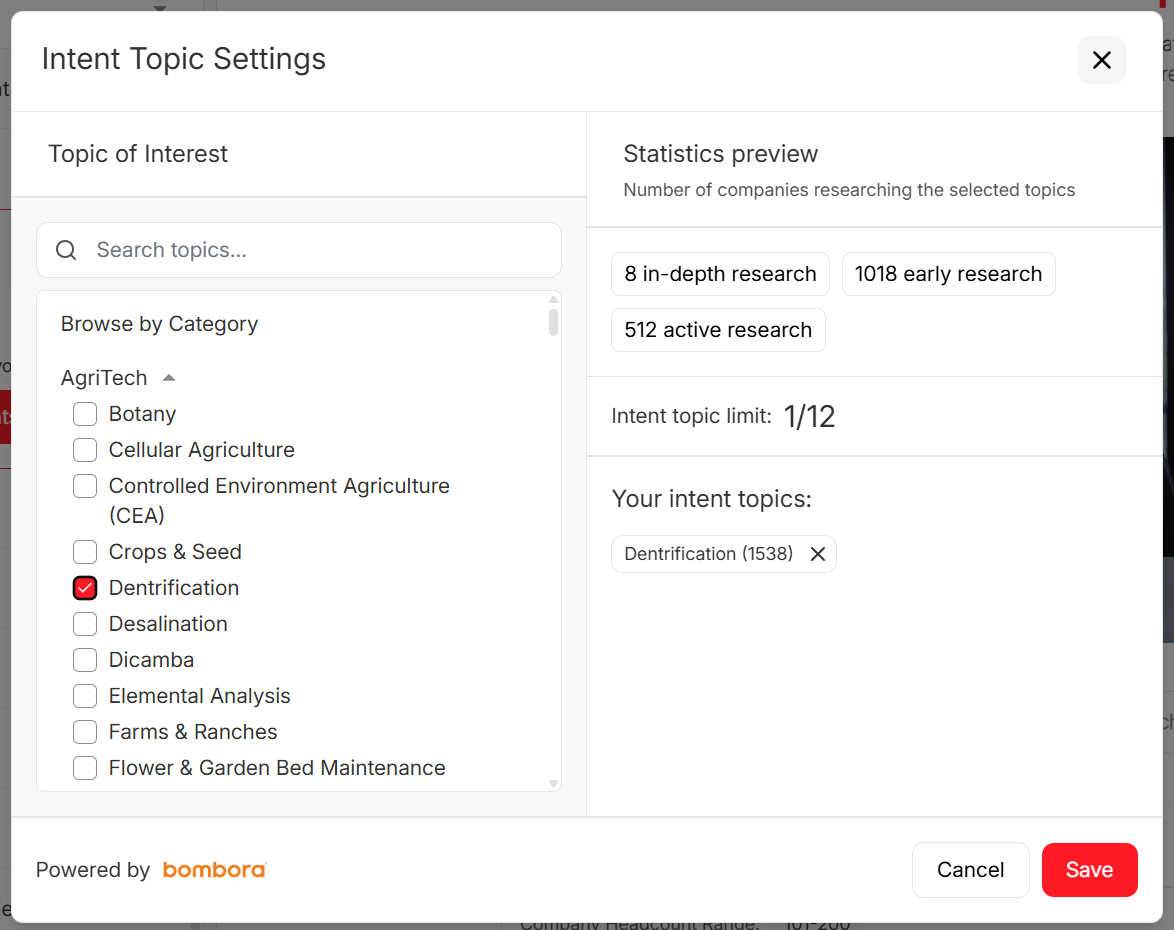
The 7-day data refresh cycle is a real edge - the industry average is six weeks, which means most platforms serve stale contacts for accounts showing real-time intent. No annual contracts. Free tier available, paid plans from ~$0.01 per email. For teams that need actionable intent signals without enterprise pricing, it's the obvious starting point.
Bombora
Bombora is the backbone of B2B intent data. Its co-op network spans 5,000+ B2B websites monitoring 12,000+ intent topics, and 70% of that dataset is exclusive. Most other providers - including Cognism and 6sense - license Bombora data as their intent layer.

Use Bombora if: You already have an activation stack (CRM, sequencer, enrichment tool) and need a standalone intent dataset to feed it.
Skip Bombora if: You don't have the infrastructure to act on account-level signals. Bombora tells you which companies are surging - not who to call.
Starting at ~$25K/year with annual contracts, it's a serious investment. But cross-referenced with first-party data and a data enrichment tool, the signal quality justifies the spend for teams with deal sizes above $25K.
6sense vs. Demandbase
These two compete head-to-head at the enterprise level, and the choice comes down to your primary use case. 6sense has stronger predictive models and "Dark Funnel" de-anonymization technology - pick it if your priority is account scoring and buying-stage prediction. Starting at ~$35K/year, scaling past $150K. Demandbase has tighter advertising integration - pick it if you're running account-based display ads alongside intent-driven outreach, starting at ~$40K/year.
Both require months of implementation and a dedicated ops person. If nobody on your team has "ABM" or "demand gen ops" in their title, you'll underutilize either one.
ZoomInfo
Streaming Intent runs $7,200+/year on top of your existing ZoomInfo contract. It's the most accessible entry point for mid-market teams already in the ZoomInfo ecosystem - intent signals and contact data in one platform, no additional integration work. The intent layer isn't as deep as Bombora's standalone product, but the convenience factor is real.
Skip ZoomInfo if you're not already a customer. Buying a ZoomInfo contract just for intent data is overkill.
Cognism
European-headquartered with strong EMEA data coverage and GDPR-compliant phone-verified mobiles. Licenses Bombora for intent signals. Custom pricing, typically $15K-$50K/year depending on team size and data volume. Best for teams with significant European pipeline who need intent layered on compliant contact records.
G2
Second-party intent from software research behavior - companies reading reviews, comparing vendors, visiting category pages. Starting at ~$10K/year. Uniquely high-confidence for SaaS: if someone's reading your G2 reviews, they're evaluating you. Useless for non-SaaS businesses.
Leadfeeder
First-party website visitor identification. Free tier available, paid plans up to $99/month. Shows you which companies visit your site right now. A solid starting point for teams with zero intent infrastructure - pair it with a verified contact database to close the account-to-person gap.
Apollo.io
Budget sales intelligence with basic intent signals baked in, from $49/user/month. Don't buy Apollo for intent data - the capabilities are shallow compared to dedicated providers. Use the intent layer if you already have Apollo for prospecting and sequencing.
The article's math is clear: 48-hour activation windows, Tier 1 signals that expire fast, and reps who need contacts - not dashboards. Prospeo combines buyer intent tracking with 98% accurate emails and 125M+ verified mobiles, refreshed every 7 days. One platform. Signal to send.
Stop watching intent scores climb while your pipeline stays flat.
Mistakes That Kill Intent Data ROI
Forrester identified ten major intent data mistakes. In our experience, these five are the ones that actually kill deals:
- Treating all sources the same. A first-party pricing page visit and a third-party topic surge aren't equivalent. Weight them differently in your scoring model.
- Ignoring data decay. Without decay rules, every company eventually shows intent. Enforce the 0-7 / 8-30 / 31-45 / 46+ framework ruthlessly. Stale intent is worse than no intent.
- Treating intent as qualification. Intent means interest, not readiness. A company researching your category might be writing a blog post, not buying software.
- Settling for one source. Cross-referencing first-party, second-party, and third-party signals dramatically reduces false positives.
- Ignoring first-party intent. If you're spending $40K/year on Bombora but haven't instrumented your pricing page with proper tracking, you've got the priorities backwards.
Nobody wants to explain to finance why a $40K/year investment generated 12 meetings last quarter. The answer is almost always one of these five mistakes.
FAQ
Is buyer intent data worth the investment?
For most B2B teams, yes - but only if you activate signals within 48 hours and resolve account-level data to verified contacts. That 24% exceptional-ROI stat reflects teams that bought intent feeds without an activation workflow. Fix the workflow first: instrument your site, set decay rules, and connect a contact enrichment tool before adding third-party sources.
First-party vs. third-party - which matters more?
First-party intent is more accurate and cheaper. Start there. Third-party extends reach to accounts that never visit your site, but it's noisier. Cross-referencing both reduces false positives significantly. Teams spending $25K+ on Bombora without proper website tracking have the priorities backwards.
Can small teams use intent signals without a $30K budget?
Absolutely. Leadfeeder offers first-party visitor identification from $99/month. Prospeo provides intent data across 15,000 topics with verified contacts starting free - no annual contract required. You don't need an enterprise ABM platform to act on buying signals; you need a workflow that moves fast on high-priority accounts.