

The Buyer Persona Template That Actually Gets Used
Most buyer persona templates produce a pretty one-pager that sits in a shared drive and never changes a single decision. You fill in "age: 35-45, likes podcasts, drinks oat milk" and somehow that's supposed to help your sales team close deals. It doesn't. 71% of companies that exceed revenue goals have documented buyer personas - but the operative word is documented, not decorated. One HubSpot team changed a single headline based on interview-driven persona work and lifted conversions by 40%.
The difference between a persona that drives revenue and one that gathers dust comes down to what fields you include, how you research them, and what you do with the finished product.
What You Need (Quick Version)
- Grab the template below - it covers demographics, psychographics, buying behavior, and disqualification signals. Most templates skip at least two of those.
- Lead with psychographic fields. "Biggest fears" and "decision levers" matter more than job title for messaging. Demographics tell you who. Psychographics tell you why they'll buy.
- Start with 1-3 personas. More than that and you'll dilute your messaging before any persona gets properly validated.
- Don't stop at the document. The step every guide skips: turning your finished persona into an actual prospect list of real, verified contacts you can reach today. We cover that at the end.
What Is a Buyer Persona?
A buyer persona is a semi-fictional representation of your ideal buyer, built from real research - interviews, CRM data, support tickets, and behavioral patterns. It captures not just who someone is, but why they buy, how they decide, and what keeps them from pulling the trigger.
HubSpot's framework lays out four guardrails worth memorizing:
- Not a demographic profile. Age, income, and location are inputs, not the persona itself.
- Not a static document. If you built it two years ago and haven't touched it since, it's fiction.
- Not an assumption. Personas built on gut instinct instead of research solve the wrong problems.
- Not an individual customer profile. It represents a pattern across many buyers, not one person's story.
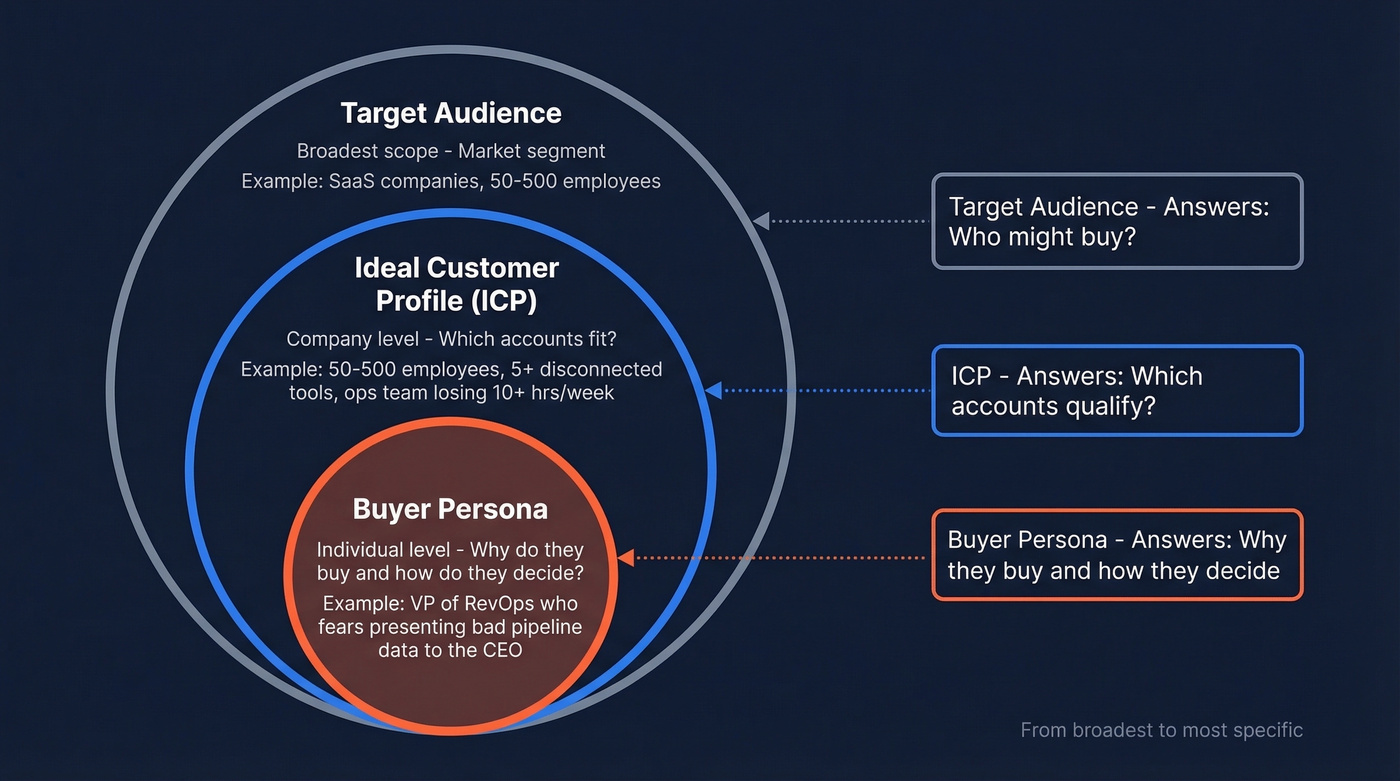
The confusion between buyer persona, ICP, and target audience trips up even experienced teams:
| Concept | Scope | Answers | Example |
|---|---|---|---|
| Target audience | Market segment | Who might buy? | SaaS companies, 50-500 employees |
| ICP | Company profile | Which accounts fit? | Zapier's ICP: 50-500 employees, 5+ disconnected tools, ops team losing 10+ hrs/week |
| Buyer persona | Individual | Why do they buy, and how do they decide? | VP of RevOps who fears presenting bad pipeline data to the CEO |
Think of it as layers: the target audience is the broadest circle, the ICP narrows to qualified companies, and the buyer persona zooms into the actual human you're writing messaging for. A customer profile focuses on the company level, while the persona focuses on the individual decision-maker within that company. When both the ICP and persona are documented, sales and marketing share a common language for qualifying accounts and scoring leads - instead of arguing about what "good fit" means.
Why Personas Drive Revenue
Personas exist to change behavior - your team's behavior. They should reshape how you write emails, which channels you prioritize, which objections your sales deck addresses, and who you prospect. If a persona doesn't change at least one of those things, it's a slide deck decoration.
Over 90% of companies that exceed lead generation and revenue goals use buyer personas. That's not because the document itself is magic - it's because the research process forces you to understand why people buy, not just that they buy.
Here's the thing: a persona that captures "terrified of presenting inaccurate pipeline forecasts to the CEO" is infinitely more useful than one that says "cares about data quality." The first gives your copywriter a hook. The second gives them nothing.
Choose the Right Template Type
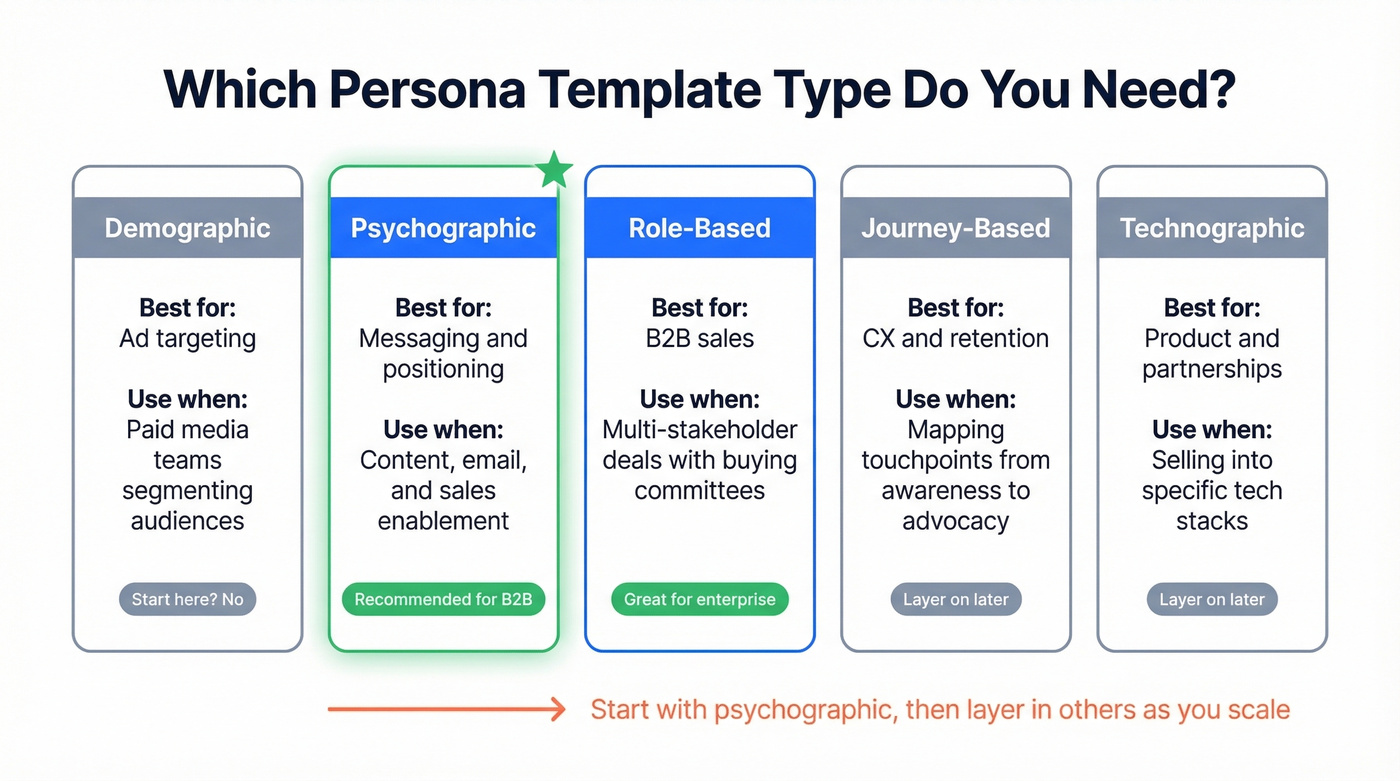
Not every persona framework serves the same purpose. Zendesk identifies five types, and picking the wrong one is why so many personas feel irrelevant to the teams that are supposed to use them.
| Template Type | Best For | When to Use |
|---|---|---|
| Demographic | Ad targeting | Paid media teams segmenting audiences |
| Psychographic | Messaging & positioning | Content, email, and sales enablement |
| Role-based | B2B sales | Multi-stakeholder deals with buying committees |
| Journey-based | CX & retention | Mapping touchpoints from awareness to advocacy |
| Technographic | Product & partnerships | Selling into specific tech stacks |
For B2B teams, start with psychographic or role-based. Demographic personas are fine for running Facebook ads, but they won't help your SDR write a cold email that resonates. If you're selling into enterprise accounts with 6-10 stakeholders, you'll eventually need role-based profiles for each committee member - but don't start there. Get one psychographic persona right first.
Tools Worth Knowing About
If you want a visual builder rather than a blank document, a few options stand out. HubSpot's Make My Persona is a free guided tool that walks you through each field with AI-powered suggestions - solid for teams that want structure without starting from scratch. Xtensio treats personas as living documents with version history and real-time team collaboration, which makes it easier to keep personas updated. For design-forward layouts, Canva and Venngage both offer polished, customizable templates in their galleries - great if your persona needs to look good in a stakeholder presentation.
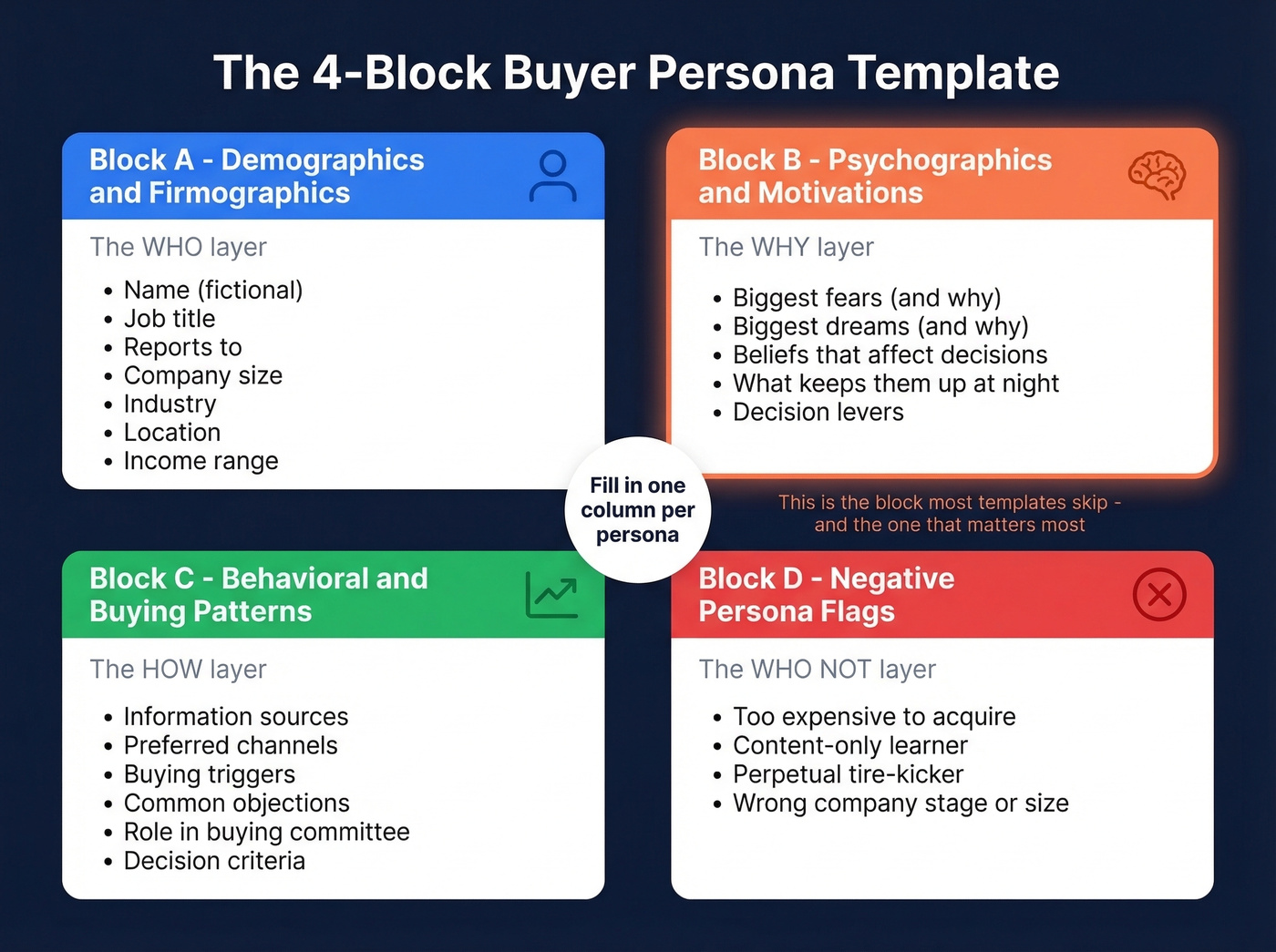
The template below is a psychographic-first hybrid. It includes demographic and firmographic fields because you need them for targeting, but the core is Block B - the emotional and motivational drivers that actually shape messaging.
The Free 4-Block Template
Copy these four tables into Google Docs, Notion, or a spreadsheet. Fill in one column per persona. This isn't a reference guide - it's the actual framework your team should use.
Block A - Demographics & Firmographics
| Field | Your Persona |
|---|---|
| Name (fictional) | |
| Job title | |
| Reports to | |
| Company size (headcount) | |
| Industry | |
| Location / region | |
| Income range |
This is the targeting layer. These fields map directly to search filters in any sales prospecting databases or ad platform. They answer who - but not why.
Block B - Psychographics & Motivations
| Field | Your Persona |
|---|---|
| Biggest fears (and why) | |
| Biggest dreams (and why) | |
| Beliefs that affect decisions | |
| What keeps them up at night | |
| Decision levers |
This is where most templates fall short. The Reddit "Avatar" framework nails it: your persona should capture fears, dreams, and beliefs - then keep asking "why" until you hit the emotional root. "Wants better data" is useless. "Terrified of presenting a pipeline number that's 30% inflated because the CRM is full of garbage" is a messaging goldmine.
Block C - Behavioral & Buying Patterns
| Field | Your Persona |
|---|---|
| Information sources | |
| Preferred channels | |
| Buying triggers | |
| Common objections | |
| Role in buying committee | |
| Decision criteria |
This block tells you how they buy. Where do they research solutions? What event triggers a purchase? What objections will they raise in the second meeting? If your sales team can't answer these questions about your persona, the persona isn't done.
Block D - Negative Persona Flags
| Signal | Description |
|---|---|
| Too expensive to acquire | |
| Content-only learner | |
| Perpetual tire-kicker | |
| Wrong company stage/size |
Negative personas save you from wasting pipeline. HubSpot's framework includes exclusionary signals - people who look like buyers but never convert. The content-only learner downloads every ebook but has zero budget authority. The tire-kicker books demos at three vendors every quarter and never signs. Documenting these patterns keeps your team focused on deals that actually close.

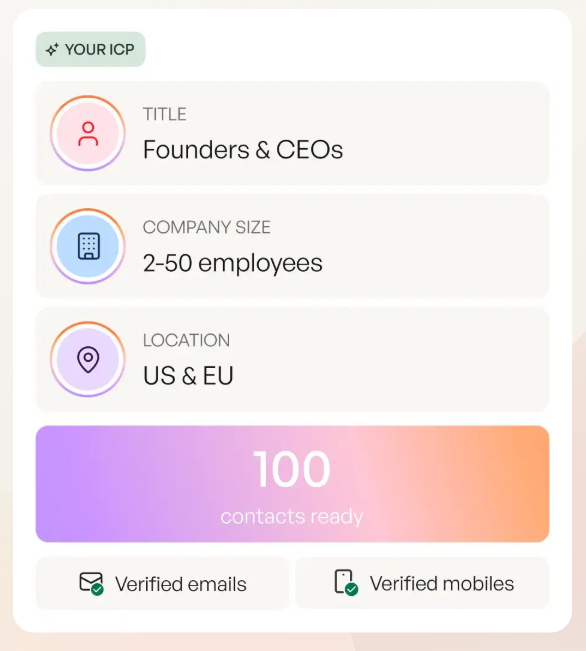
Your persona template maps the who and why. Prospeo turns it into a list of real, verified contacts you can reach today. Use 30+ filters - job title, company size, industry, intent signals, technographics - to match your persona fields to 300M+ profiles with 98% email accuracy.
Stop at the template and it's just a document. Add real contacts and it's pipeline.
Filled-In Example
Here's what the template looks like for a realistic B2B persona.
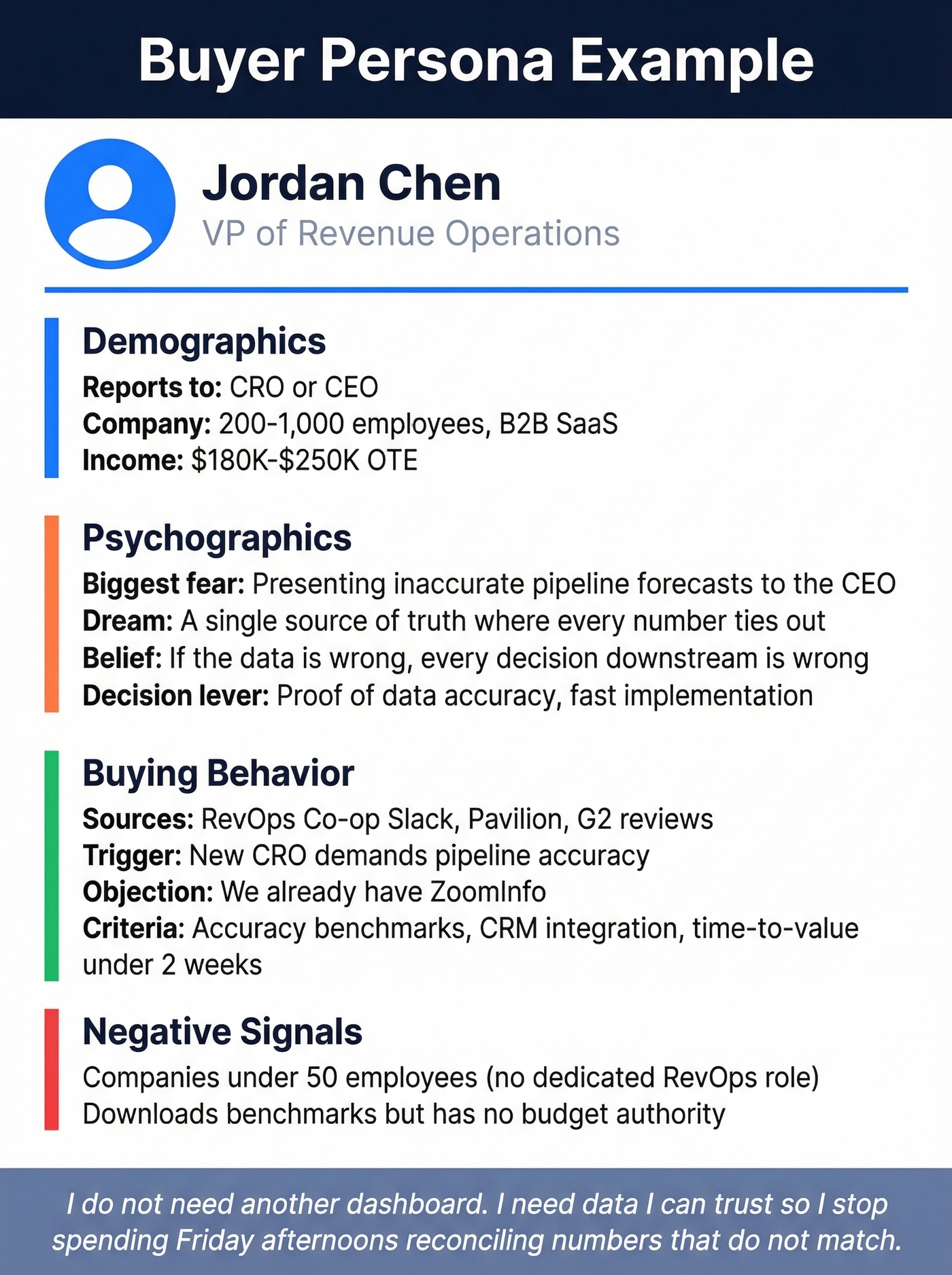
Block A - Demographics & Firmographics
| Field | Details |
|---|---|
| Name | "Jordan Chen" |
| Job title | VP of Revenue Operations |
| Reports to | CRO or CEO |
| Company size | 200-1,000 employees |
| Industry | B2B SaaS |
| Income range | $180K-$250K OTE |
Block B - Psychographics & Motivations
| Field | Details |
|---|---|
| Biggest fears | Presenting inaccurate pipeline forecasts to the CEO. Being the person who "let bad data in." |
| Biggest dreams | A single source of truth where every number ties out - and getting home by 6 PM because the fire drills stopped. |
| Beliefs | "If the data is wrong, every decision downstream is wrong." Distrusts tools that promise magic without showing methodology. |
| Decision levers | Proof of data accuracy, fast implementation, not adding another tool the team won't adopt. |
Block C - Behavioral & Buying Patterns
| Field | Details |
|---|---|
| Information sources | RevOps Co-op Slack, Pavilion community, G2 reviews |
| Buying triggers | New CRO demands pipeline accuracy; board prep reveals data gaps |
| Common objections | "We already have ZoomInfo." "My team doesn't have bandwidth for another migration." |
| Decision criteria | Accuracy benchmarks, CRM integration depth, time-to-value under 2 weeks |
Block D - Negative Persona Flags
| Signal | Description |
|---|---|
| Too expensive to acquire | Companies under 50 employees (no dedicated RevOps role) |
| Content-only learner | Downloads benchmarks but has no budget authority |
Jordan's voice: "I don't need another dashboard. I need data I can trust so I stop spending Friday afternoons reconciling numbers that don't match."
How to Build Your Persona
Define Your Goal First
Before you open a blank template, answer two questions: what decisions will this persona inform, and which teams will use it? A persona built for content marketing looks different from one built for outbound sales. monday.com's framework recommends documenting the persona's purpose, the departments involved, and the success metrics you'll track. This prevents scope creep into a 15-page document nobody reads.
Research Your Buyers
This is where most persona projects either succeed or fail. Analytics tell you what buyers do. Interviews reveal why.
Start with what you already have: CRM data, support tickets, sales call recordings, website analytics, and customer feedback. These give you patterns - which titles convert, which industries churn, which objections kill deals. Adobe's framework recommends social listening for brand and industry sentiment, which surfaces language your buyers actually use.
Then talk to real people. UXPressia's guidance is practical: interview 5-30 people per role. Trends start appearing after about five conversations. Stop when new interviews aren't revealing new insights. Budget $50-$150 per interview for B2B executive incentives, and expect the full research cycle to take 1-2 weeks.
Four interview questions that consistently surface the insights you need:
- "What was happening in your business when you started looking for a solution?" - This reveals the buying trigger, not the feature wish list.
- "Walk me through how you evaluated your options." - This maps the actual decision process, not the one you assume.
- "What almost stopped you from buying?" - This hands you objection-handling language on a silver platter.
- "Who else was involved in the decision, and what did they care about?" - This maps the buying committee without asking directly.
HubSpot's full question bank has dozens more, organized by category. Worth bookmarking.
For surveys, mix factual questions ("Which features matter most?") with driver questions ("What's your biggest frustration with your current tool?") and open text fields to capture customer language verbatim. Keep surveys to 10-15 questions for completion rates that actually produce usable data.
Segment by Behavior, Not Demographics
Demographics tell you who to target with ads. Behavior tells you how to message and what to build. UXPressia's segmentation method deserves more attention than it gets: define 8-12 behavioral attributes, place each interview participant on a scale for each attribute, and look for clusters. When people group together across 5-9 scales, you've found a real segment - not an assumed one.
We've used this approach with B2B teams across industries, and the persona profiles that emerge from behavioral clustering are dramatically more useful than ones built on "35-45, director-level, lives in Austin." The clusters reveal motivation patterns that demographics simply can't.
Synthesize Into the Template
Compress your research into a one-page format. Nobody reads a 10-page persona document - we've watched stakeholders glaze over by page three. Add a humanizing image and a compiled quote that captures the persona's voice in their own words. Heinz Marketing recommends this for making the persona feel like a real person rather than a spreadsheet row.
Consider Zendesk's four buyer psychology types as a messaging lens: Competitive (wants to win), Spontaneous (decides fast on emotion), Humanistic (values relationships), and Methodical (needs data and proof). Knowing which type your persona skews toward shapes everything from email subject lines to demo structure.
Validate and Pressure-Test
A persona isn't done when you fill in the template. Test it against your last 10 won deals and your last 10 lost deals. Does the persona explain why you won? Does it predict the objections that killed the losses? If not, something's off.
Share the draft with your sales team for a gut-check. Reps talk to buyers every day - they'll spot inaccuracies fast. We've seen persona drafts get torn apart in a 30-minute sales meeting, and the result is always better for it. Set a cadence: quarterly light reviews against recent win/loss data, and an annual deep refresh with new interviews. Markets move. Personas built on last year's data won't reflect how 2026 buyers evaluate and purchase.
Map the B2B Buying Committee
B2B deals involve 6-10 stakeholders on average. A single persona won't cut it.
You need profiles for each key role: the Champion (who finds you and sells internally), the Decision Maker (who signs the contract), the Blocker (who raises objections), and the End User (who lives with the product daily). Heinz Marketing's adapted "Nine Questions" framework gives you a solid structure for each committee member: What's their role and title? Where do they get information? What's their relationship to other committee members? What are their individual goals and specific pain points? What will they champion - and what will they block?
For persona count, Zendesk's guidance scales with company complexity: 3-5 personas for mid-market teams, 10-20 for enterprise organizations. But don't build 10 personas on day one. Start with the Champion and Decision Maker - those two drive 80% of your messaging needs. Add Blocker and End User personas once the first set is validated and actively used.
From Persona to Prospect List
Every buyer persona guide ends the same way: "Congratulations, you have a persona!" And then nothing. The document sits in a shared drive. Nobody turns it into pipeline.
Look - your completed persona is a search query. Map the fields directly to database filters. Your persona says "VP of RevOps at a 200-1,000 person SaaS company using Salesforce, actively evaluating data tools." That's not a description - it's a search query. Job title becomes a title filter. Company size becomes a headcount filter. Tech stack becomes a technographic filter. "Actively evaluating" becomes an intent data filter.
Prospeo lets you run exactly this search across 300M+ professional profiles using 30+ filters that map directly to persona fields - job title, industry, company size, technographics, headcount growth, and buyer intent data tracking 15,000 topics. The result is a verified prospect list of real people who match your persona, with 98% email accuracy and verified mobile numbers. Data refreshes every 7 days, so your list stays current as people change jobs or companies grow.
I'll be blunt: if your deal size is under $10K, you probably don't need a 15-persona framework or a six-figure data contract. You need one sharp persona, one good prospect list, and the discipline to iterate on both every quarter. Complexity is the enemy of execution.
Five Persona Mistakes That Waste Time
1. Building too many personas at once. Start with 1-3. Teams that launch with seven personas end up with seven mediocre documents and zero actionable messaging. Get one right, validate it, then expand.
2. Relying on assumptions instead of interviews. UXPressia's warning is blunt: without real research, your persona's goals and pain points describe imaginary customers. Even five interviews will surface patterns you didn't expect.
3. Demographic-only fields with no psychographics. The consensus on r/SaaS is clear - role-only personas like "CFO at a 500-person company" don't explain why someone buys. Fears, dreams, and beliefs are the fields that actually change your messaging.
4. Creating personas that never get updated. Markets shift. Buying committees change. At minimum, review annually. Quarterly light checks against win/loss data are better.
5. Over-personalizing website content per persona. Terakeet flags a real risk: creating separate landing pages for every micro-persona can fragment your SEO. Target audience segments broadly on-site, then tailor messaging by channel and sequence - not by building 12 different homepages. Skip this trap entirely if you're a team under 50 people.
You just defined your persona's job title, company size, industry, and tech stack. Those map directly to Prospeo's 30+ search filters - including buyer intent data across 15,000 topics. Build a verified prospect list from your persona in minutes, not days, at roughly $0.01 per email.
Every field in your persona is a filter in Prospeo. Start searching.
FAQ
How many buyer personas should I create?
Start with 1-3 personas. Companies maintaining more than five active personas often dilute messaging before any single one is validated and adopted by sales and marketing. Add more only after the first set is driving real decisions.
What's the difference between a buyer persona and an ICP?
A buyer persona describes the individual - their goals, fears, and decision triggers. An ICP describes the company - industry, size, budget, and tech stack. You need both: the ICP qualifies which accounts to pursue, and the persona shapes how you talk to the humans inside those accounts.
How often should I update my personas?
Run a quarterly light review against recent win/loss data and a full annual refresh with new interviews. Markets shift faster than most teams realize - personas built on older research won't reflect how 2026 buyers evaluate and purchase.
Can I build a useful persona without customer interviews?
You can start with CRM data, support tickets, and sales team insights, but interviews reveal the why behind behavior that quantitative data can't surface. Even five 30-minute conversations dramatically improve persona quality and often uncover objections nobody on your team anticipated.
How do I turn a finished persona into a real prospect list?
Map each persona field to a database filter - job title, company size, industry, tech stack, and intent signals. Tools like Prospeo match these fields directly with 30+ search filters, returning verified emails and mobile numbers so you can start outreach the same day your persona is finalized.