

The Buying Cycle: What the Data Actually Says in 2026
Your biggest deal just went dark. The champion who was "totally aligned" hasn't responded in three weeks, and the CFO you never met just pulled the budget review forward. You're not alone - 86% of B2B purchases stall during the buying cycle, and the average now runs 10.1 months from first problem recognition to purchase.
Most guides hand you a neat four-stage funnel and call it a day. Reality is messier, and the data tells a very different story.
What Is the Buying Cycle?
The buying cycle is the complete timeline a buyer moves through - from recognizing a problem to completing a purchase. It's their journey, not yours. That distinction matters more than most sales teams realize.
Sellers tend to think in terms of pipeline stages: demo booked, proposal sent, negotiation. But the buyer is doing something entirely different. They're researching independently, building internal consensus, looping back to re-evaluate options they thought they'd eliminated. Your pipeline view is a straight line. Their experience is a web.
Understanding this means accepting that you don't control the timeline - you influence it. The first step to influencing it is knowing what the buyer is actually doing at each phase and where deals break.
Buying Cycle vs. Sales Cycle vs. Sales Process
These three terms get used interchangeably, and that confusion costs teams real forecasting accuracy.
| Buying Cycle | Sales Cycle | Sales Process | |
|---|---|---|---|
| Perspective | Buyer's timeline | Seller's timeline | Seller's playbook |
| Measures | Problem to purchase | Lead to closed deal | Repeatable steps |
| Who controls it | The buyer | Shared | The sales org |
| Example | 10.1 months avg | ~1-6 months for many teams; enterprise often 6-9 months | 7-stage methodology |
The buying cycle is what the buyer does. The sales cycle is how long it takes you to close. The sales process is the repeatable system your team follows. Companies with a formal sales process see 18% higher revenue growth - but only if that process mirrors how buyers actually buy, not just how your CRM is configured.
The 6 Stages of the Buying Cycle
Forget the classic awareness-consideration-decision funnel. Gartner's research describes B2B buying as six "buying jobs" that buyers loop through repeatedly. They don't move in a straight line - they circle back, revisit earlier stages, and often restart entire phases when new stakeholders enter the conversation.
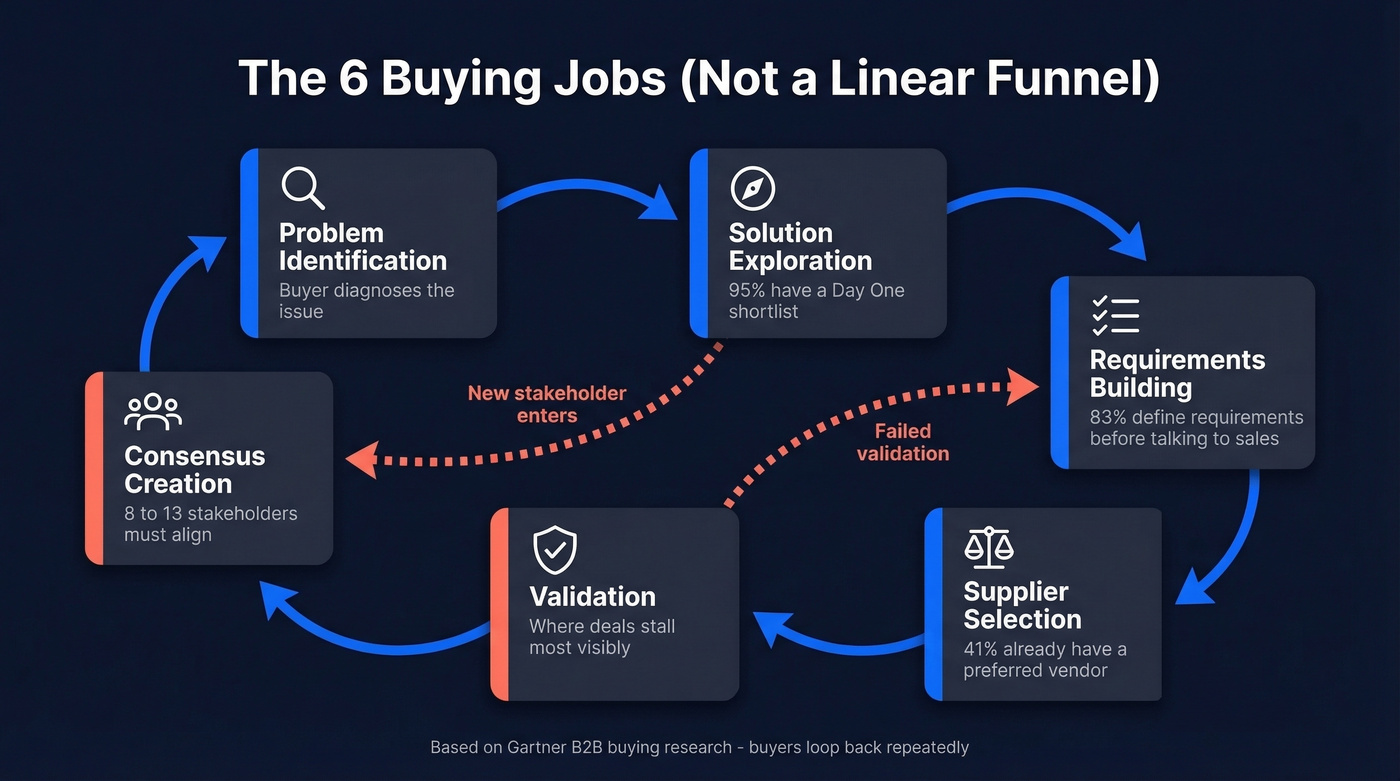
Here's the thing: 75% of B2B buyers prefer a rep-free experience, and 83% mostly or fully define their purchase requirements before ever speaking to sales. Your job isn't to guide them through a funnel. It's to be useful at whichever job they're working on right now.
Problem Identification
The buyer recognizes something isn't working. Pipeline velocity dropped, or the team is burning 15 hours a week on manual data entry. At this stage, they're not shopping - they're diagnosing.
Content that helps them frame the problem (benchmarks, diagnostic frameworks, industry data) earns trust here. This is also where individual sellers can act as mini-marketers: a well-timed post with original data or a sharp take on an industry trend does more than any cold email. Sales outreach at this stage usually gets ignored, but thought leadership doesn't.
Solution Exploration
This is where the shortlist forms - and it forms fast. The winning vendor is on the buyer's Day One shortlist 95% of the time. If you're not already on their radar when they start exploring, you're fighting uphill. Brand awareness, content marketing, and peer recommendations do the heavy lifting here, not cold outreach.
Requirements Building
The buyer translates their problem into specific criteria: must integrate with Salesforce, needs to handle 50K contacts, can't exceed $30K/year. 83% of buyers complete this stage before talking to a rep. By the time they reach out, they've already decided what matters. If your product doesn't match their self-built requirements, you're already behind.
Supplier Selection
Now they're comparing vendors against those requirements. 92% of buyers start with at least one vendor in mind, and 41% already have a preferred vendor before formal evaluation begins. Demos, pricing pages, G2 reviews, and peer conversations dominate this phase. The rep's job here is to remove friction, not create it.
Validation
The buyer pressure-tests their choice. They run pilots, check references, read case studies, and look for reasons not to buy. This is where deals stall most visibly - legal reviews, security questionnaires, and CFO sign-offs all cluster here.
We've seen deals that sailed through evaluation die in validation because the seller couldn't produce a SOC 2 report fast enough. Have your compliance docs, reference customers, and ROI calculators staged and ready before a buyer ever asks.
Consensus Creation
The hardest job. The buyer needs to align 8.2 to 13 stakeholders - each with their own priorities, each gathering 4-5 pieces of information independently. One new stakeholder entering the conversation can send the entire group back to solution exploration. This is where the non-linear nature of the buying cycle becomes painfully obvious.
What comes after closing: Some models extend the cycle into post-purchase stages - retention, expansion, advocacy. For subscription businesses, this matters enormously. A buyer who closes but churns in six months didn't really complete the process. The best sales orgs treat closed-won as the start of the next buying cycle, not the end of the current one.
Buying Cycle Benchmarks
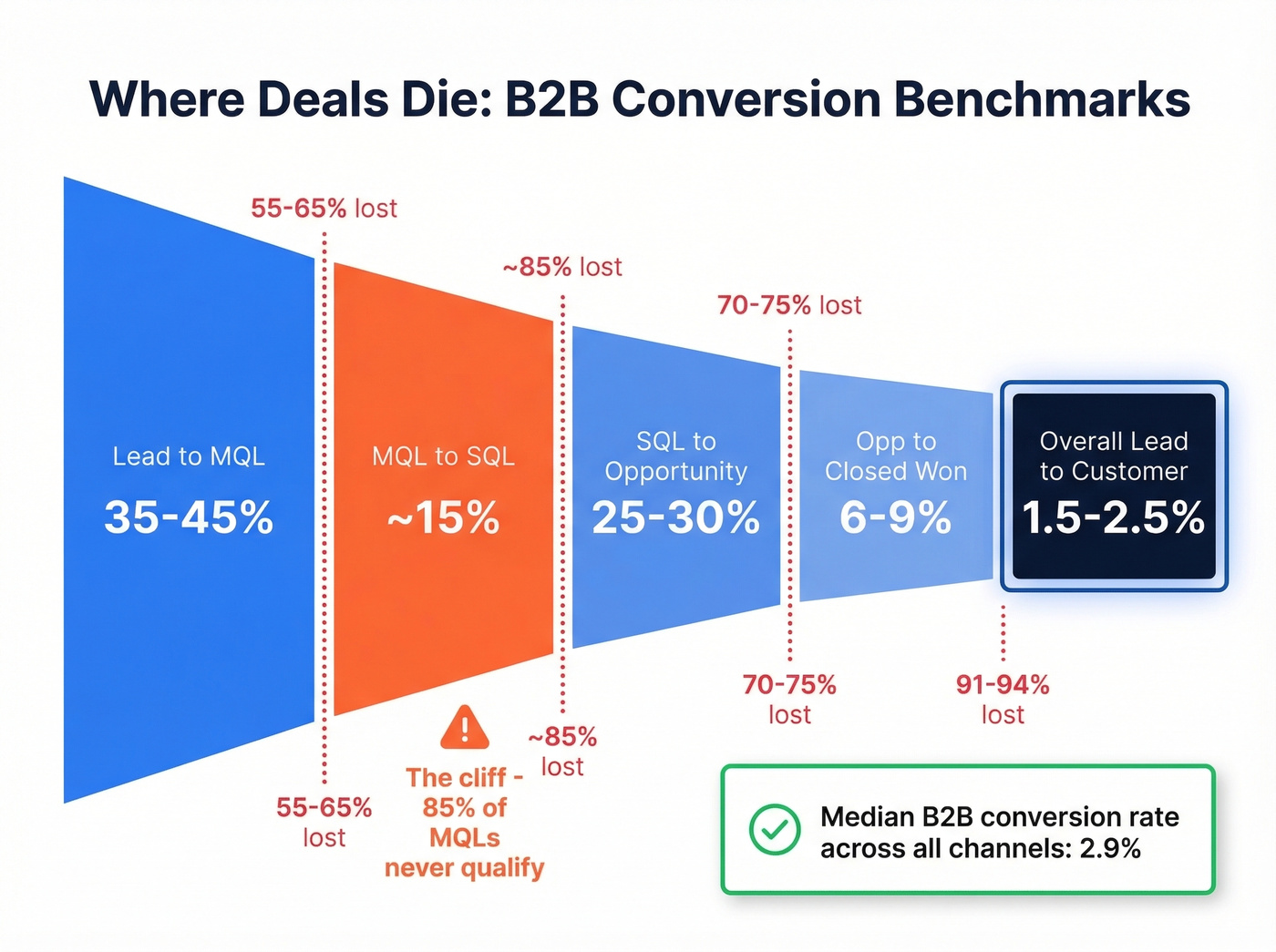
Here's where deals actually die, stage by stage.
| Stage | Conversion Rate | What This Means |
|---|---|---|
| Lead to MQL | 35-45% | Decent - most leads at least show intent |
| MQL to SQL | ~15% | The cliff. 85% of MQLs never become qualified |
| SQL to Opportunity | 25-30% | Qualification helps, but timing kills deals |
| Opp to Closed-Won | 6-9% | Only the best-run deals survive to close |
| Overall lead to customer | 1.5-2.5% | The brutal math of B2B |
The median B2B conversion rate across all channels sits at 2.9%, with a typical range of 2.0%-5.0%. If you're above 5%, your qualification is either excellent or your definition of "conversion" is generous.
That MQL-to-SQL drop-off is the headline. In our experience, the MQL-to-SQL cliff is where most teams lose the plot - not because the leads are bad, but because the buyer isn't ready, the timing is wrong, or the qualification criteria are too loose. If your team is celebrating MQL volume, you're measuring the wrong thing.
The broader context makes this even more striking. First contact now happens at 61% of the buying journey - earlier than the 69% mark measured in 2024. That shift of roughly 6-7 weeks means buyers are engaging sellers sooner. The driver is economic pressure: 49% of buyers say economic conditions shortened their cycles, and 62% say it pushed them to engage sellers earlier. But earlier contact doesn't mean easier deals. It means buyers are bringing sellers into a more chaotic, less-defined process.

Buyers complete 83% of their requirements before talking to sales. The only way to influence the buying cycle earlier is to already be on their radar - with accurate contact data that actually connects. Prospeo's 98% email accuracy and 125M+ verified mobiles mean your outreach lands with the right stakeholders, not in a bounce log.
Stop losing deals to bad data. Start reaching buyers who are already in-market.
Why Deals Stall
The Buying Committee Problem
The average buying group for complex B2B solutions involves 8.2 stakeholders - up 21% since 2015. Enterprise deals often reach ~13 decision-makers. Each of those people is gathering 4-5 pieces of information independently, often reaching different conclusions.
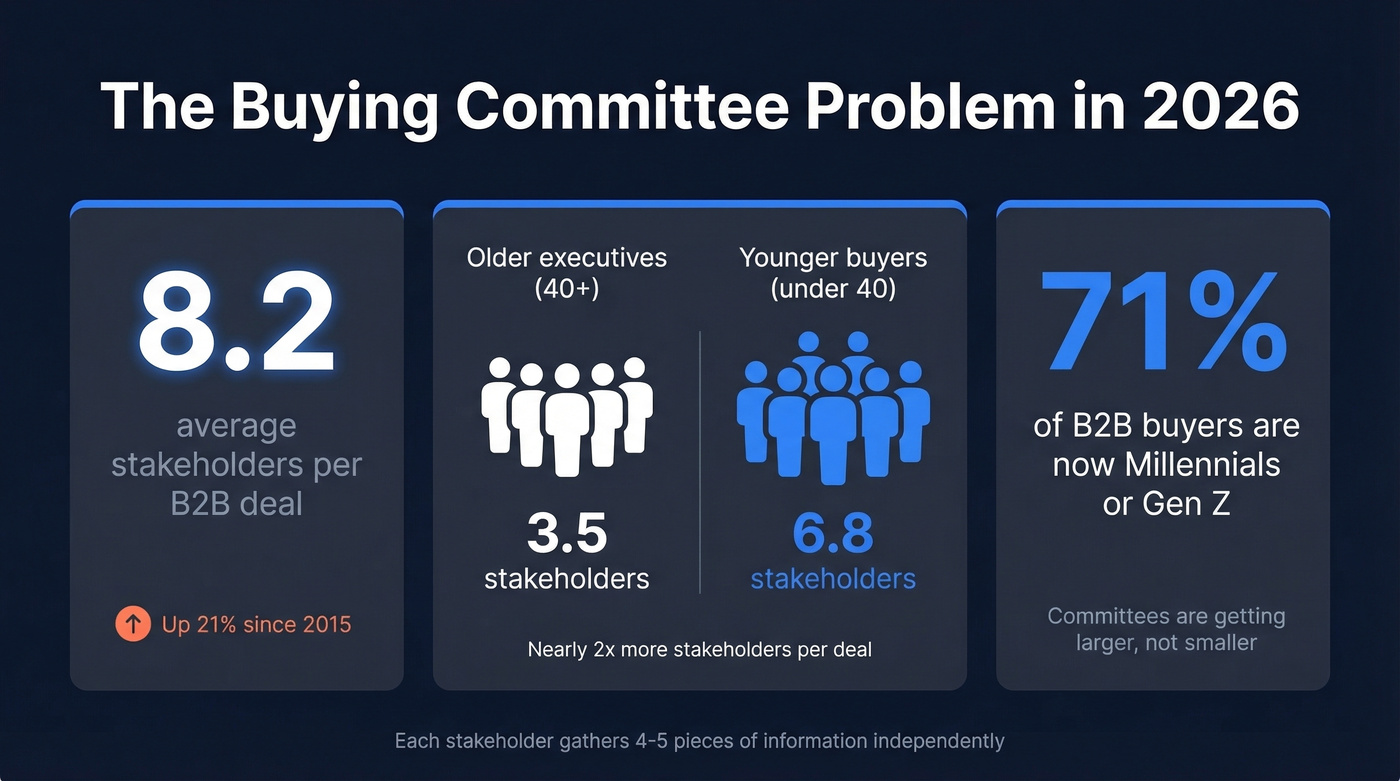
The generational shift makes this worse. Younger decision-makers (under 40) involve roughly 6.8 stakeholders per purchase, compared to 3.5 for older executives. With Millennials and Gen Z now representing 71% of B2B buyers, buying committees are getting larger, not smaller. More voices means more friction, more loops back to earlier stages, and longer consensus timelines.
Hidden Blockers: CFO and Legal
The champion stopped responding. Three weeks later, legal flagged the contract and the CFO pulled budget.
Sound familiar? CFOs have the final say in 79% of IT and software purchases. Legal teams block or slow decisions in 61% of cases. These aren't edge cases - they're the norm. And 81% of buyers end up dissatisfied with the provider they ultimately choose, which tells you the process itself is broken, not just slow.
Bad contact data is the silent killer here. If you can't reach the CFO or legal lead, you can't unblock the deal. You need verified direct dials and emails for the people who actually hold the pen - not just the champion who took the first demo.
B2B vs. B2C Buying Cycle
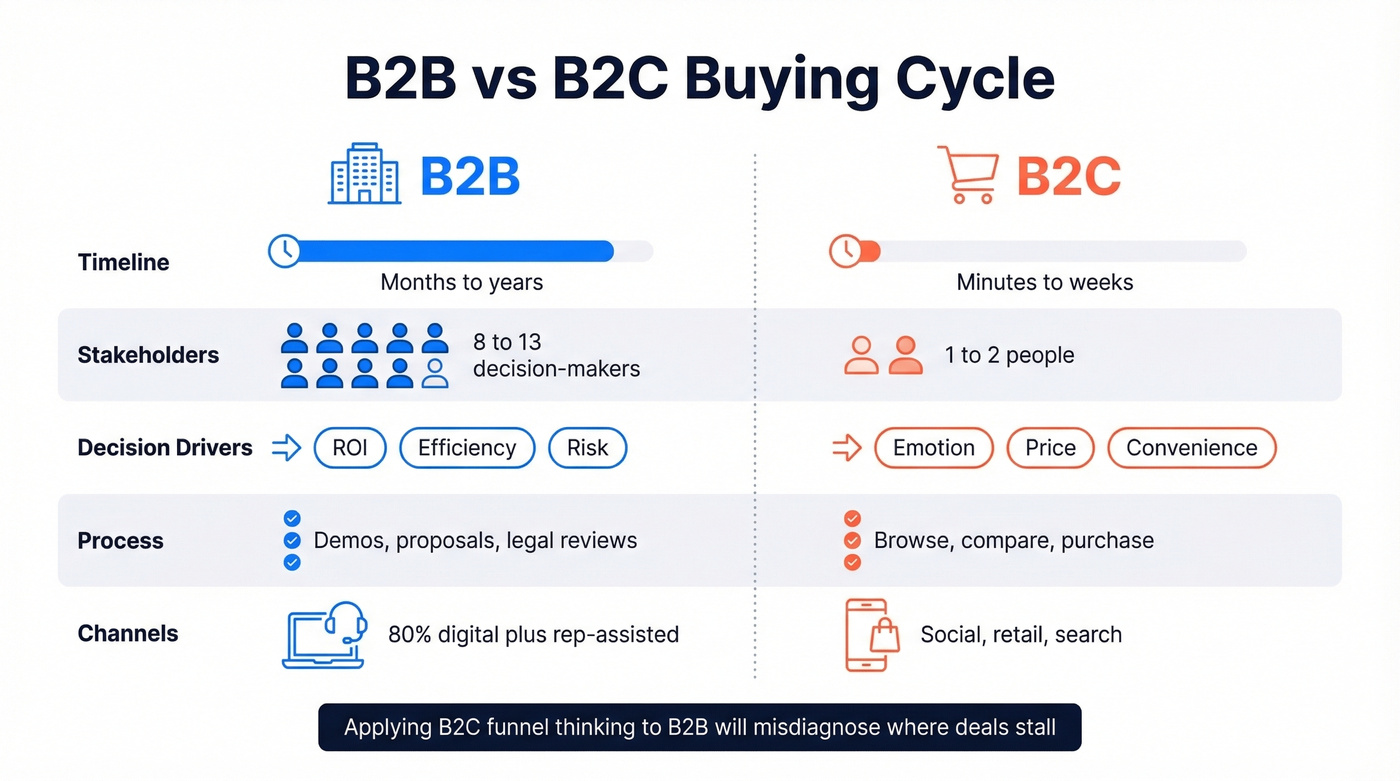
Not every purchase decision is a 10-month enterprise marathon.
| Dimension | B2B | B2C |
|---|---|---|
| Timeline | Months to years | Minutes to weeks |
| Stakeholders | 8-13 decision-makers | 1-2 (individual/household) |
| Decision drivers | ROI, efficiency, risk | Emotion, price, convenience |
| Typical stages | Demos, proposals, legal | Browse, compare, purchase |
| Key channels | 80% digital, rep-assisted | Social, retail, search |
A consumer can move from awareness to purchase in a single browsing session. A B2B buyer doing the same evaluation takes six months and involves a dozen people. If you're applying B2C funnel thinking to a B2B context, you'll misdiagnose where deals stall and why.
How AI Is Reshaping the Buying Cycle
The buying process is being compressed by AI-driven research. 72% of buyers encountered Google AI Overviews during their research, and 90% clicked at least one cited source. Buyers aren't just searching anymore - they're getting synthesized answers and then diving deeper into the sources AI surfaces.
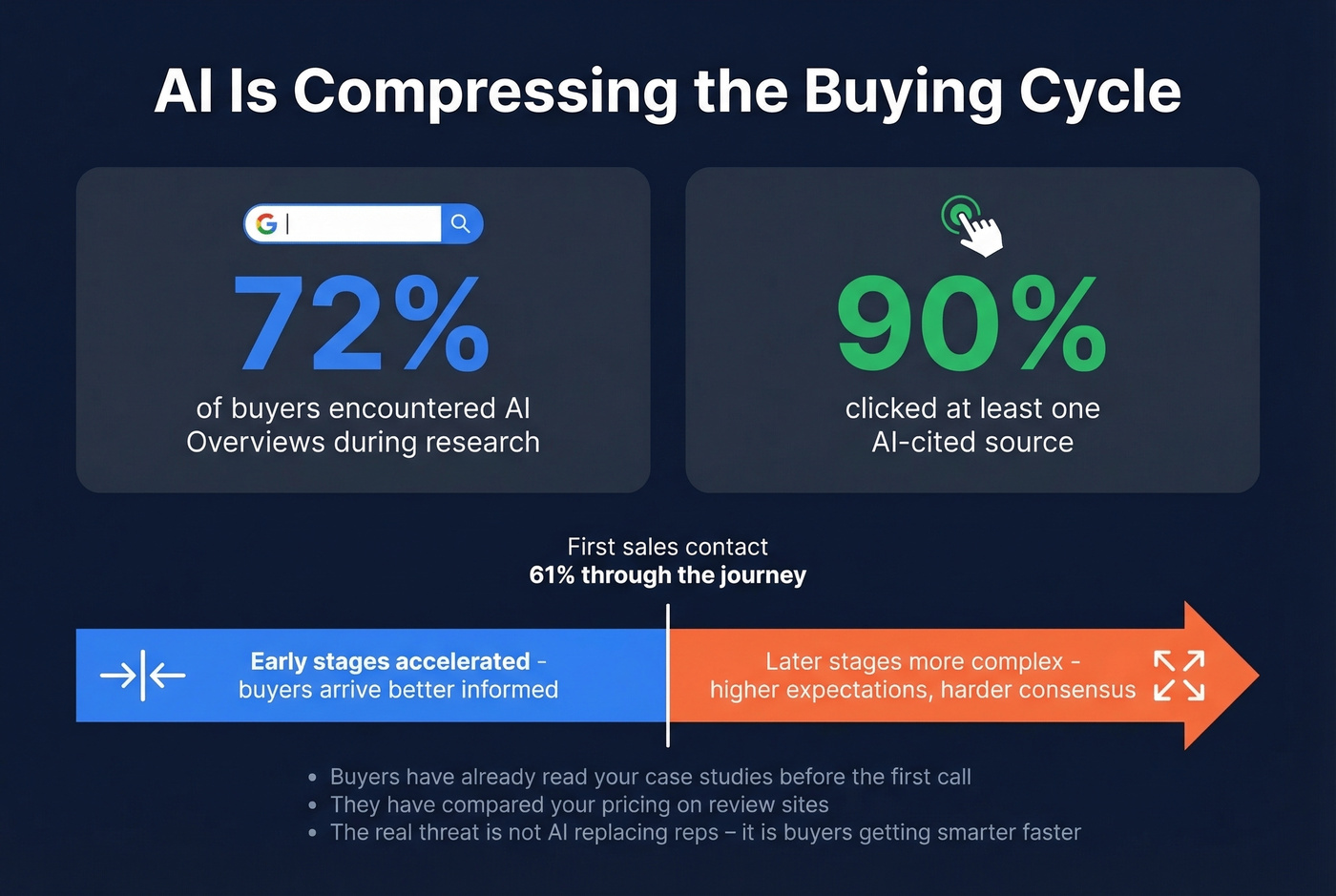
This accelerates the early stages while making the later stages more complex. Buyers arrive at supplier selection better informed but with higher expectations. They've already read your case studies, compared your pricing, and checked your G2 reviews before the first call.
Let's be honest: most sales teams are preparing for the wrong problem. They're worried about AI replacing reps. The real threat is that AI makes buyers smarter faster, which means the gap between a well-prepared seller and a lazy one gets wider every quarter. The data backs this up - buyers who use supplier-provided digital tools alongside a sales rep are 1.8x more likely to complete a high-quality deal than those who buy independently. The takeaway isn't to fight the self-service trend - it's to equip it. Build the digital experience buyers want, then be ready when they surface for human conversation.
How to Shorten the Buying Cycle
Disqualify Early
The MQL-to-SQL conversion rate is roughly 15%. That means 85% of the leads your team is working will never become qualified opportunities. The fastest way to shorten your cycle isn't to speed up deals - it's to stop wasting time on deals that were never going to close.
We've watched teams cut their average cycle by 30% just by tightening qualification criteria - not by adding steps, but by being honest about which deals deserve full pursuit. BANT still works for transactional sales. For complex enterprise deals, MEDDIC gives you more granularity, especially around the economic buyer and decision process. Either way, the principle is the same: qualify hard, disqualify fast, redirect your team's energy toward the 15% that actually convert.
Skip this step if you're already converting above 5% lead-to-customer. Your qualification is working. Focus on the next two levers instead.
Multithread Every Deal
A single-threaded deal is a dead deal walking. With 6-10 decision-makers per purchase, each gathering information independently, relying on one champion is a recipe for stalls. When that champion goes on vacation, changes roles, or loses internal political capital, your deal goes dark.
You can't multithread with one contact. You need verified emails and direct dials for every stakeholder on the buying committee - the VP who owns the budget, the director who'll manage the rollout, the legal lead who'll review the contract, and the CFO who signs the check. Prospeo pulls verified contact data from 300M+ professional profiles, refreshed every 7 days, with 98% email accuracy - so you reach the people who actually influence the decision instead of leaving voicemails that never get returned.

Mirror the Buyer's Process
Companies with a formal sales process see 18% higher revenue growth. But the process only works if it mirrors how buyers actually buy - not how your CRM stages are labeled.
Map your internal pipeline stages to the buyer's six jobs. If your "discovery" stage doesn't account for the fact that 83% of buyers have already defined requirements, you're running discovery calls that feel redundant to the buyer. Align your stages to their reality, and you'll stop creating friction that extends the cycle. This principle applies across industries - whether you're navigating a complex enterprise deal or managing an education purchasing cycle where budget approvals follow academic calendars and committee structures are even more layered.
If you want a practical framework for tightening stage definitions, use sales process optimization to remove steps buyers don’t value.
Consensus creation across 8-13 stakeholders is where buying cycles die. You need direct access to every decision-maker in the room - not just your champion. Prospeo's 30+ search filters let you map entire buying committees by title, department, and seniority, with verified contact data refreshed every 7 days.
Reach the full buying committee before a new stakeholder resets the deal.
FAQ
How long is a typical B2B buying cycle?
The average B2B buying cycle is 10.1 months, down from 11.3 months in 2024. Enterprise deals with new vendors often skew longer, while mid-market renewals can close in 1-3 months. Economic pressure is compressing timelines, but committee complexity keeps them long.
What's the difference between a buying cycle and a sales cycle?
The buying cycle is the buyer's decision timeline - from recognizing a problem to completing a purchase. The sales cycle is the seller's timeline for converting a lead to a closed deal. Your sales cycle might be 4 months, but the buyer's journey started 6 months before they ever talked to you.
Why do most B2B deals stall?
86% of B2B purchases stall during the process. The top causes: buying committee misalignment across 8-13 stakeholders, CFO budget holds (79% of IT purchases), and legal review delays (61% of deals). Consensus creation is the stage where most stalls happen - too many voices, not enough alignment.
How can you reach all stakeholders in a buying committee?
Multithreading - engaging multiple contacts per account - requires verified emails and direct dials for every decision-maker. Tools like Prospeo let you pull the full committee from a single company search with 98% email accuracy, so you're not dependent on one champion who goes dark.
Is the buying cycle really non-linear?
Yes. Gartner describes B2B buying as six "buying jobs" that buyers loop through repeatedly - not a clean funnel. A new stakeholder entering the process can reset entire stages, sending the group back to solution exploration even after supplier selection seemed complete.