

Buying Intent: The Practitioner's Guide to Identifying and Acting on In-Market Signals
A RevOps lead we know pulled 200 "high-intent" accounts from their intent platform last quarter. One problem: no verified emails, no direct dials, and three hours of manual research before a single rep could send outreach. By the time they'd enriched the list, half the accounts had gone dark.
That's the buying intent gap nobody talks about. 67% of the buyer's journey happens digitally before a prospect ever talks to sales, but most teams can't move fast enough to act on the signal.
The Short Version
- Define your signal stack. Combine first-party signals (pricing page visits, demo requests) with third-party intent data (topic surges, competitor research). Never rely on a single trigger.
- Score by signal combination, not individual events. A pricing page visit plus a competitor comparison download plus a hiring signal is Tier 1. A single blog visit is noise.
- Use a tool that pairs intent with verified contacts. Company-level intent is useless if you can't reach the right person before the signal decays.
What Is Buying Intent?
Buying intent is the inferred likelihood that a company or individual is actively researching, evaluating, or preparing to purchase a product or service. It's measured through behavioral signals - content consumption, search patterns, review-site engagement, and interactions with your own properties.
The terminology is a mess. Buyer intent, purchase intent, and behavioral intent are functionally synonymous. Some vendors draw a line between behavioral signals and stated purchase intent, but in practice most B2B teams treat them identically.
What intent data reveals, per Demandbase's framework: what companies are researching, how intensely they're researching, and who's involved. That last piece - who - is where most intent data falls short, and where the real operational challenge begins.
Why Intent Data Matters Now
Teams using intent data report 3x higher conversion rates, 40% shorter sales cycles, and 25% improvement in lead quality. The pattern is consistent across studies: knowing who's in-market before they raise their hand compresses the entire pipeline.
Here's the thing. The average B2B salesperson spends 28% of their week actually selling. The rest is research, admin, and chasing accounts that aren't ready. Intent signals fix the worst part - wasting cycles on accounts outside a buying window.
The buying committee keeps growing, too. Gartner puts the average B2B buying group at 14-23 stakeholders. You need to identify the right cluster of people at the right time, and that requires signal, not guesswork.
Three Stages of Buy Intent
Not all intent is equal. The distinction matters for how you respond:
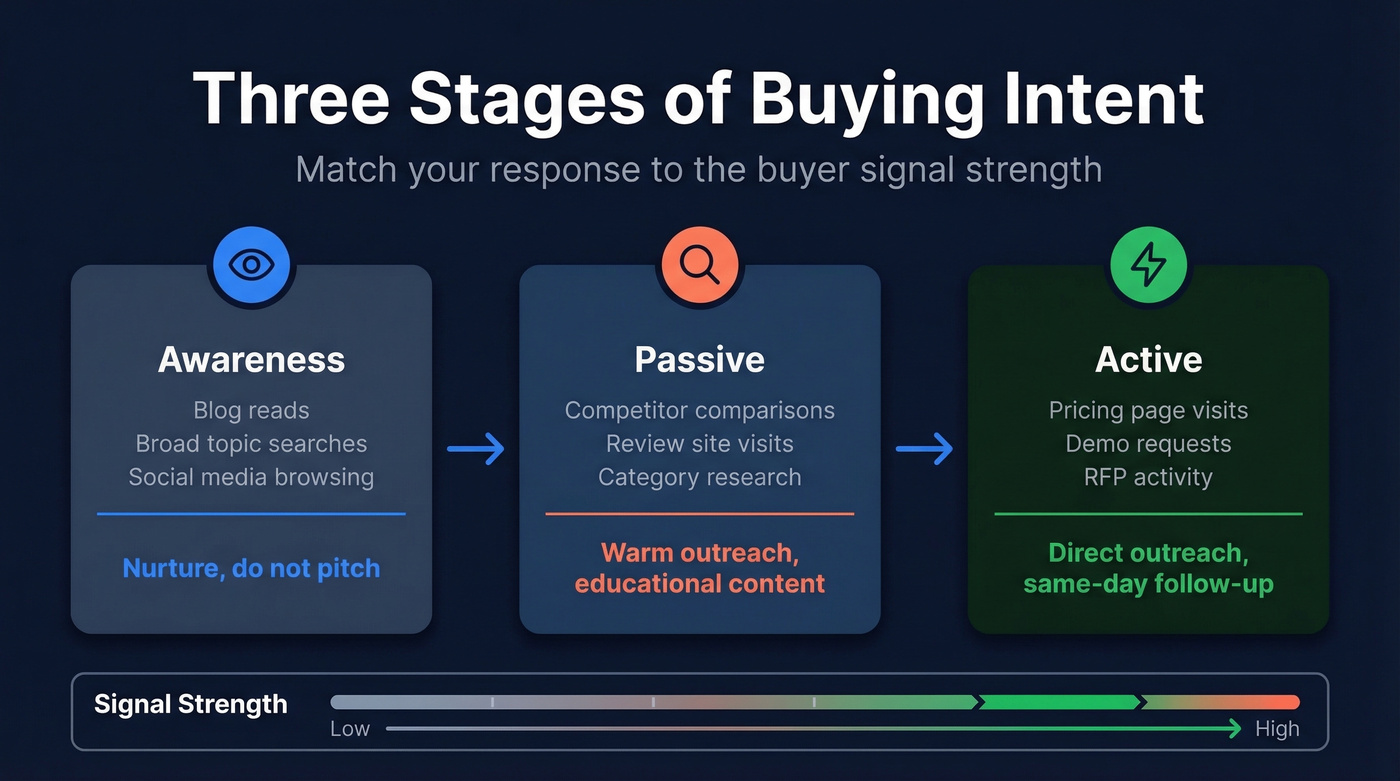
| Stage | Signal Examples | Your Move |
|---|---|---|
| Awareness | Blog reads, broad topic searches | Nurture, don't pitch |
| Passive | Competitor comparisons, review-site visits | Warm outreach, educational content |
| Active | Pricing page visits, demo requests | Direct outreach, same-day follow-up |
The multi-stakeholder angle makes this more complex. Picture a company evaluating a CRM: IT is reading comparison articles (passive), the CFO is downloading pricing guides (active), and the CTO is reviewing technical docs somewhere between passive and active. Each stakeholder sits at a different stage, but the account as a whole is clearly in-market. Your scoring model needs to account for the cluster, not just individual signals.
Types of Intent Data
| Type | Source | Strength | Weakness |
|---|---|---|---|
| First-party | Your website, CRM, webinars | Highest confidence | Limited to known visitors |
| Second-party | G2, TrustRadius | Strong lower-funnel signal | Narrow coverage |
| Third-party | Bombora co-op, publisher networks | Broadest reach | Noisiest, requires filtering |
First-party intent is your most reliable signal. You own the data, you control collection, and you don't depend on third parties for GDPR compliance. The limitation is reach - you only see buyers who've already found you.
Second-party intent comes from someone else's first-party data. G2 and TrustRadius are the classic B2B examples. When a prospect reads reviews of your category, that's a strong lower-funnel indicator.
Third-party intent provides the broadest view. Bombora's co-op model aggregates consumption data from thousands of B2B sources, tracking 18,000+ intent topics across billions of consumption events monthly, with 86% of that data shared exclusively through their network. It's the industry standard for scale, but you need to layer it with other signals to separate real interest from noise.

Intent data without verified contacts is just a list of company names. Prospeo pairs Bombora intent signals across 15,000 topics with 143M+ verified emails and 125M+ direct dials - so you reach the right buyer the same day the signal fires, not three hours later.
Close the gap between intent signal and booked meeting.
How to Build an Intent Signal Stack
Most teams waste intent data because they treat it as a magic list of accounts to spam. A practitioner on r/b2bmarketing nailed it: the value isn't in any single signal - it's in cascading logic that combines multiple signals into tiers.
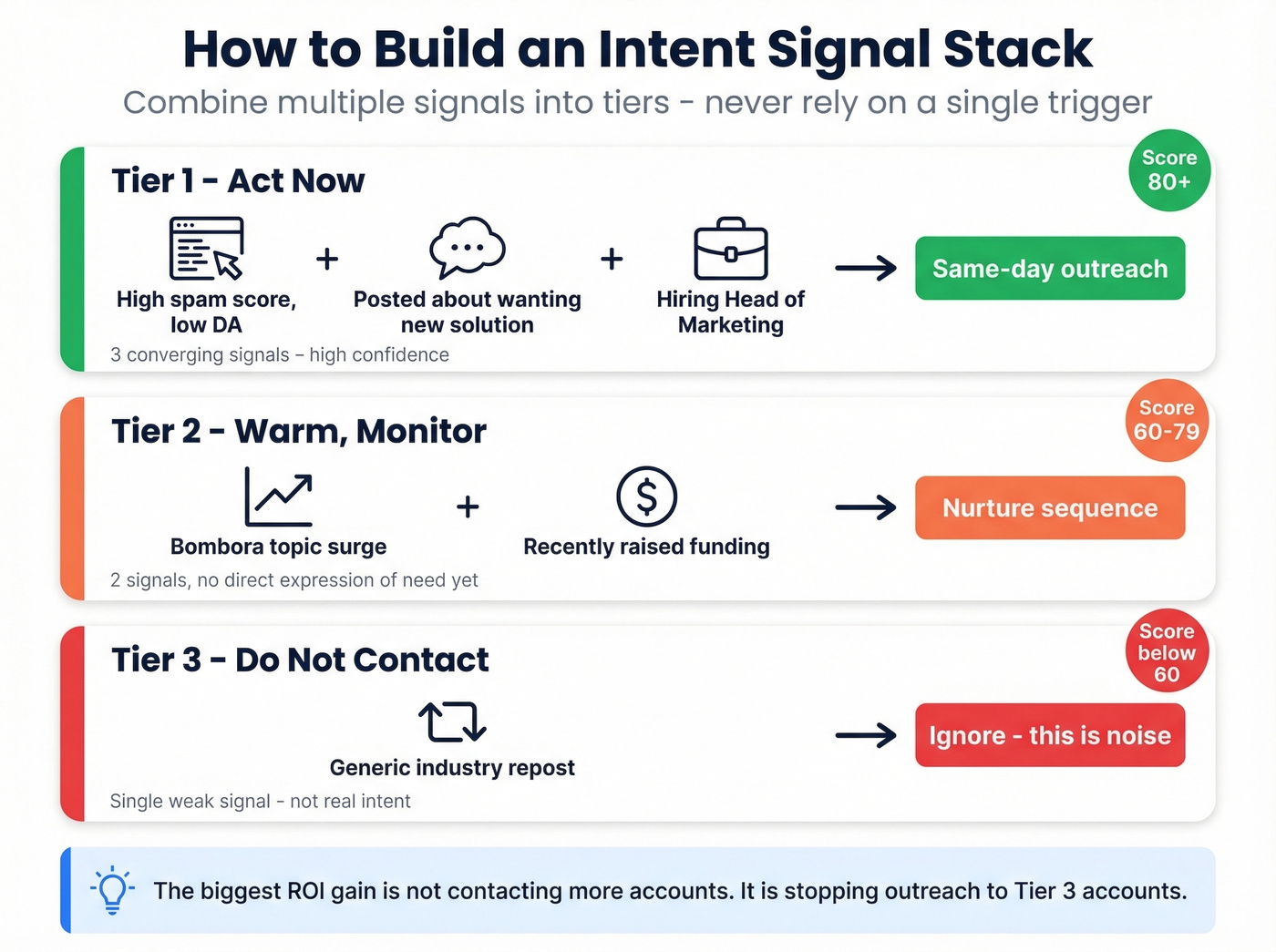
Here's a concrete example for a web design agency:
Tier 1 - Act now (score 80+): Prospect's site has a high spam score and low domain authority, they posted about wanting a new website, and they're hiring a Head of Marketing. Three converging signals. Same-day outreach.
Tier 2 - Warm, monitor (score 60-79): Prospect is researching web design topics via a Bombora topic surge and they recently raised funding. Two signals, but no direct expression of need yet. Nurture sequence.
Tier 3 - Don't contact (score below 60): Prospect posted a generic industry repost with no website anomalies. Single weak signal. This isn't intent - it's noise.
For Bombora-style scoring inside Apollo, intent scores run 0-100. Apollo categorizes those as low (0-61), mid (62-75), and high (75-100). Use those bands to decide which accounts trigger outreach vs. monitoring vs. ignore.
Let's be honest about where the biggest ROI gain actually comes from. It's not contacting more accounts. It's stopping outreach to Tier 3 accounts. We've seen teams double reply rates just from that one change.
Hot take: If your average deal size is under $10K, you probably don't need a $40K intent platform. Combine first-party signals with an affordable tool that bundles intent and contacts, and you'll capture 80% of the value at 10% of the cost.
Intent Mistakes That Kill Pipeline
These anti-patterns come up constantly, informed by Forrester's research on intent data mistakes:
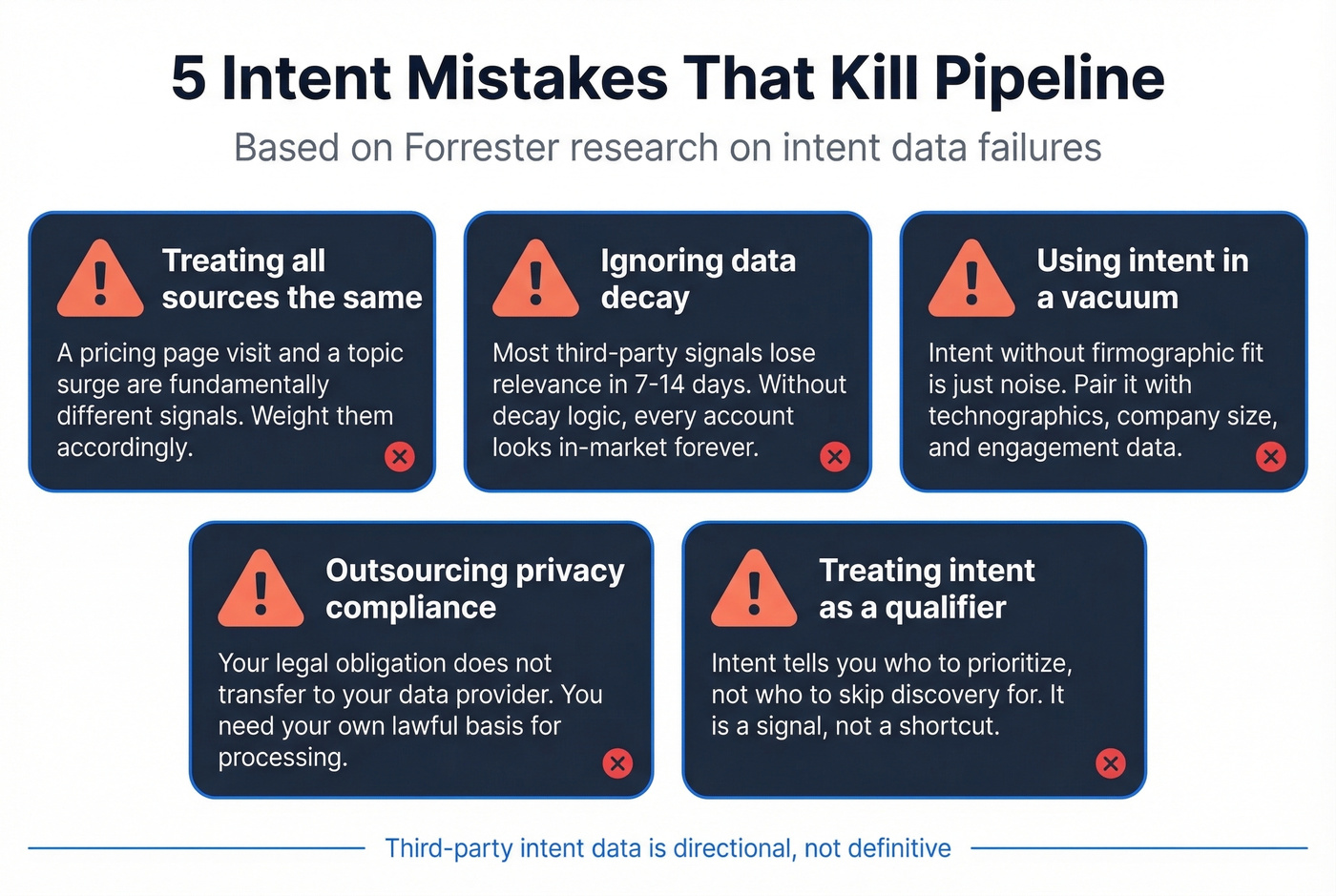
- Treating all intent sources the same. First-party pricing page visits and third-party topic surges are fundamentally different signals. Weight them accordingly.
- Ignoring data decay. Most third-party intent signals lose relevance within 7-14 days. Without decay logic, every account looks in-market forever.
- Using intent in a vacuum. Intent without firmographic fit is just noise. Pair it with technographics, company size, and engagement data.
- Relying on vendors for privacy compliance. Your legal obligation doesn't transfer to your data provider. You need your own lawful basis for storing and acting on prospect data.
- Treating intent as a qualifier. Intent tells you who to prioritize, not who to skip qualification for. It's a prioritization signal, not a replacement for discovery.
Third-party intent data is directional, not definitive. If you're treating a topic surge as proof that an account wants to buy your product, you're going to burn a lot of rep time on false positives.
Buying Intent Tools & Pricing
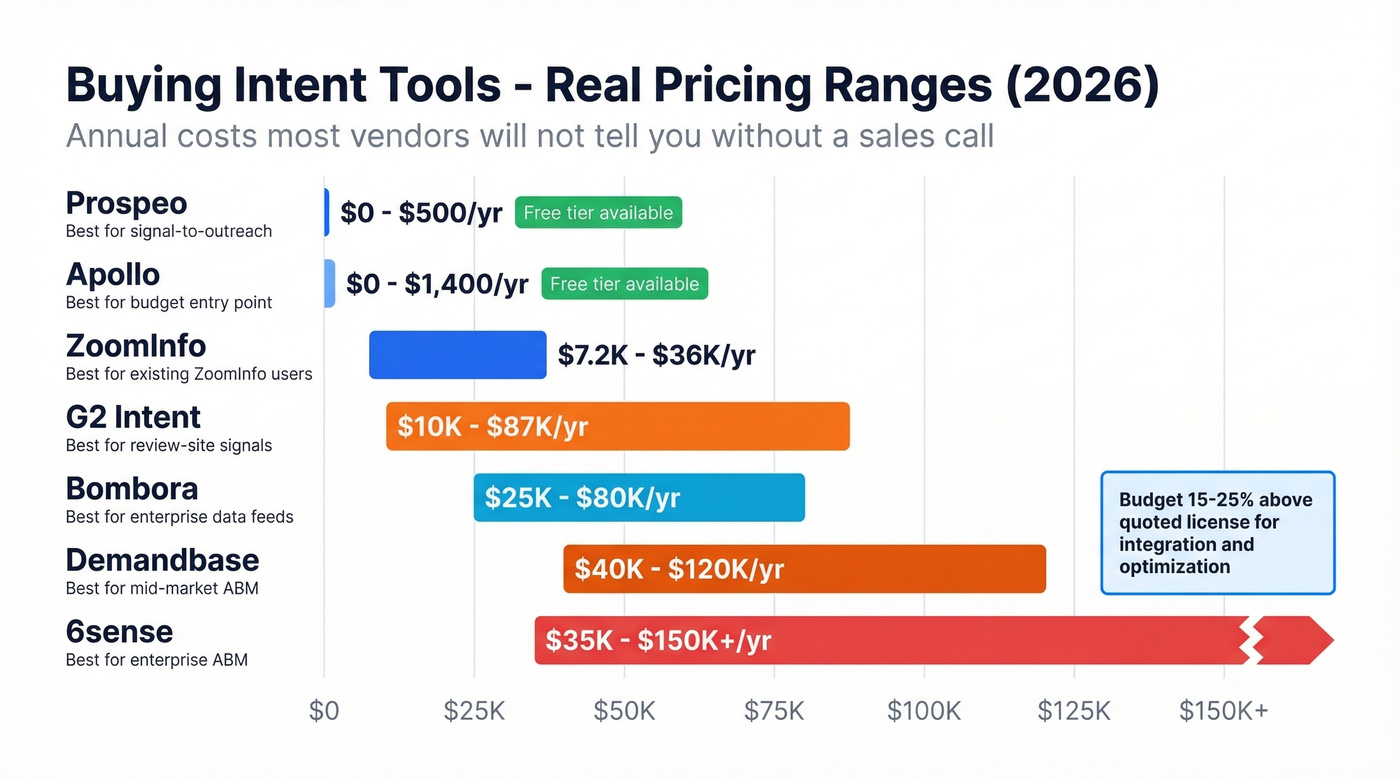
The intent vendor market is absurdly opaque on pricing. Annual costs range from $7,000 to $150,000+, and most vendors won't give you a number without a sales conversation. We're publishing real ranges because someone should. Budget 15-25% above the quoted license for integration and optimization.
| Tool | Starting Price | Full Range | Best For |
|---|---|---|---|
| Prospeo | Free tier | ~$39/mo+ | Signal-to-outreach |
| Bombora | ~$25K/yr | $25K-$80K/yr | Enterprise data feeds |
| 6sense | ~$35K/yr | $35K-$150K+/yr | Enterprise ABM |
| Demandbase | ~$40K/yr | $40K-$120K/yr | Mid-market ABM |
| ZoomInfo | ~$7.2K/yr | $7.2K-$36K/yr | Existing ZoomInfo users |
| G2 Intent | ~$10K/yr | $10K-$87K+/yr | Review-site signals |
| Apollo | Free tier | ~$49-$119/mo | Budget entry point |
Prospeo
Prospeo combines 15,000 intent topics (powered by Bombora) with verified contact data - 300M+ professional profiles, 143M+ verified emails, 125M+ verified mobile numbers, and 98% email accuracy - in a single self-serve tool. That solves the last-mile problem: going from company-level intent to person-level outreach without a three-hour enrichment detour. Snyk's 50 AEs cut bounce rates from 35-40% to under 5% and grew AE-sourced pipeline 180% after switching.
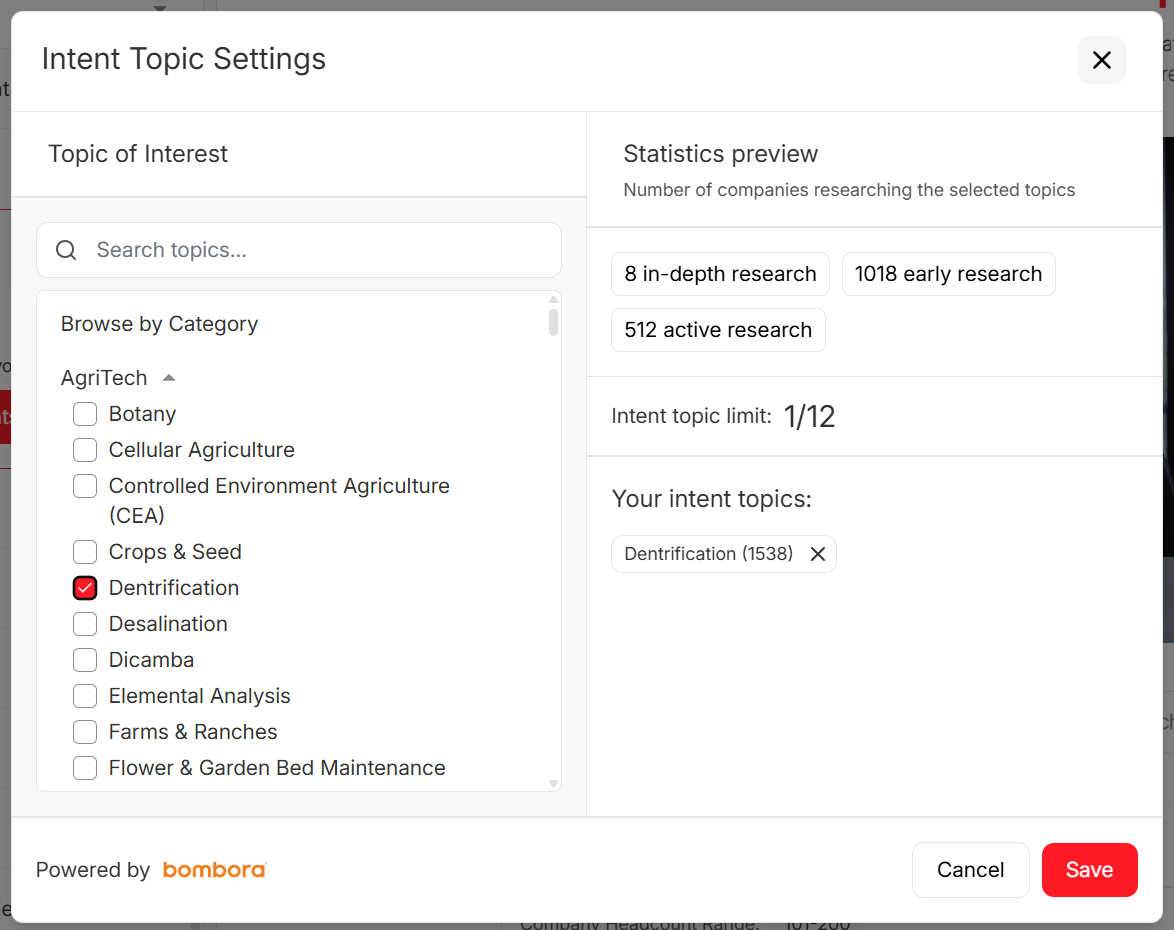
The search interface layers intent signals with 30+ filters including technographics, job changes, headcount growth, and funding. Credit-based pricing runs about $0.01 per email, with a free tier and no contracts. Free tier includes 75 emails plus 100 Chrome extension credits per month. Data refreshes every 7 days - compared to the 6-week industry average, that's a meaningful edge when intent signals decay in under two weeks.
Bombora
Bombora is the raw intent data standard. Their B2B Data Co-op aggregates consumption signals from thousands of publishers, tracking 18,000+ topics with 86% exclusive data. Case studies show 50% CPL decreases and 2-3x reply rates when Bombora signals are properly activated.

The catch: Bombora is a data company, not a platform. You need somewhere to pipe the signals - a CRM, an ABM tool, or a platform that integrates Bombora natively. Pricing starts at ~$25K/year and scales to $80K+. Best for enterprise teams that already have an activation layer.
6sense
Full revenue AI platform with intent baked into the ABM engine. 6sense predicts where accounts are in the buying journey and recommends actions. The tradeoff is complexity and cost: $35K-$150K+/year, multi-month implementation, and a dedicated admin. Enterprise ABM teams only.
Demandbase
Strong intent data paired with account identification and ABM orchestration. Their three-stage intent taxonomy is one of the clearest frameworks in the space. Pricing runs $40K-$120K/year. Skip this if you're under 50 employees or don't have a dedicated ABM motion.
ZoomInfo Streaming Intent
Use this if you're already on ZoomInfo and want intent without another vendor. Skip this if you're buying ZoomInfo just for intent - the module runs $7.2K-$36K/year on top of a base contract that can hit $15-40K/year.
G2, HubSpot, Apollo
G2 Buyer Intent provides second-party signals from review-site behavior. Strong lower-funnel signal, narrow coverage. $10K-$87K+/year as an add-on.
HubSpot offers a Buyer Intent tool that identifies companies meeting configured intent signals and helps prioritize which accounts to focus on. It matches website visits to companies using IP-to-company identification via the HubSpot tracking code, and it uses HubSpot Credits for certain actions like adding net-new companies to the CRM.
Apollo provides intent signals via partners Bombora and LeadSift. Users can choose from over 14,000 Bombora intent topics, and Apollo updates intent signals weekly. Free tier available, paid plans from ~$49-$119/mo per user.
Compliance and Privacy in 2026
Privacy enforcement crossed a line in 2025 - regulators now test opt-outs in practice, clicking through flows and evaluating whether choices actually change data flows. The gray zone that intent vendors operated in for years has narrowed significantly.
Concrete dates: CCPA's updated regulations took effect January 1, 2026, with risk-assessment duties now active. ADMT requirements kick in January 1, 2027. On the GDPR side, auditability expectations continue to tighten. If you can't demonstrate where your data came from, how consent was obtained, and how opt-outs propagate, you're exposed. This isn't theoretical risk anymore - it's operational reality.
From Signal to Booked Meeting
Every intent guide tells you to identify in-market accounts. None tell you what to do at 9:15 AM on Tuesday when the signal hits your dashboard. So let's walk through it.
Detect and qualify. Your intent platform flags a topic surge - a target account researching your category at 3x baseline. That's your trigger, but only if it's Tier 1 or 2 in your scoring model.
Identify stakeholders and find contacts. Company-level intent is useless without knowing who to reach. You need the VP evaluating solutions, the director running the project, the finance lead approving budget. Pull verified emails and direct dials filtered by role and seniority - don't waste time on generic info@ addresses.
Personalize and send fast. Reference the signal without being creepy. "I noticed your team is evaluating [category]" works. "I saw you downloaded a whitepaper at 2:47 PM" doesn't. Same-day follow-up for Tier 1 signals, within 48 hours for Tier 2. If you're waiting a week, you've already lost the window.
Your Tier 1 accounts are researching right now. Prospeo combines buyer intent, technographics, and job change filters with 98% accurate emails at $0.01 each - no $40K platform required. Data refreshes every 7 days, not 6 weeks, so you act on signals before they decay.
Stop paying enterprise prices for intent data you can't operationalize.
FAQ
What's the difference between buying intent and purchase intent?
Functionally, no difference. The terms are interchangeable across the industry. Some teams informally use "purchase intent" for later-stage signals like pricing page visits, but there's no standardized distinction between the two.
How fast do intent signals decay?
Most third-party intent signals lose relevance within 7-14 days. High-intent surges - like a sudden spike in competitor research - should trigger outreach within hours, not days. Storing signals without decay logic makes every account look perpetually in-market.
Is intent data worth it for small teams?
Yes, but skip the $40K+ standalone platforms. Combine free first-party signals from Google Analytics and your CRM with a tool that bundles Bombora intent data with verified contacts on a free tier. You don't need enterprise infrastructure to act on in-market signals.
What are the best first-party intent signals?
Pricing page visits, demo requests, competitor comparison page views, repeat visits to product pages, and webinar attendance. These are the highest-confidence signals you own, and they cost nothing to collect. Track these before investing in third-party data.
How does B2B intent differ from consumer intent?
B2B intent involves longer sales cycles, multiple stakeholders, and higher contract values. A consumer might search and checkout in minutes, while a B2B buying committee researches across weeks with signals scattered across 14-23 different roles. Account-level scoring - not individual lead scoring - is what matters for B2B teams.