

C-Level Decision Makers: How to Find & Reach Them in 2026
You sent 200 emails to C-level decision makers last quarter. 47 bounced. Three replies came back from the wrong person - someone who left the company six months ago. The rest? Silence.
That's not a messaging problem. It's a data and strategy problem, and most content about "reaching decision makers" gives you a definition of what a CEO does instead of showing you how to actually get one on the phone.
Let's fix that.
The Short Version
Four things actually move the needle when selling to the C-suite:
- The CEO is rarely your first contact. Target the functional leader who owns the problem your product solves. They evaluate, champion, and pull the CEO in when it matters.
- Map the full buying committee first. The average B2B deal involves 6-10 stakeholders. Enterprise tech deals can hit 20+. One email to one person isn't a strategy.
- Get verified contact data. Bouncing on a CFO's inbox doesn't just waste a touch - it damages your domain reputation and kills credibility.
- Lead with strategic relevance, not features. C-level buyers filter for board-level outcomes. If your first sentence mentions your product, you've already lost.
What Are C-Level Executives?
C-level - or C-suite - refers to the highest-ranking executives in an organization: the "Chief" titles who set strategy, allocate budget, and make final purchasing decisions. Here's the core roster:
| Role | Primary Responsibility |
|---|---|
| CEO | Overall strategy, vision |
| CFO | Financial planning, ROI |
| COO | Operations, execution |
| CTO | Technology, engineering |
| CMO | Marketing, brand, demand |
| CRO | Revenue, sales alignment |
| CIO | IT infrastructure, data |
The C-suite has expanded over the last decade. You'll now encounter a Chief AI Officer (CAIO) at enterprise companies navigating AI adoption, a Chief Data Officer (CDO) owning data governance, a Chief Sustainability Officer (CSO) managing ESG commitments, and a CHRO driving workforce strategy. These newer roles matter because they often control budget for emerging categories - if you're selling AI tooling, the CAIO might be a more relevant target than the CTO.
The practical implication: "C-level" isn't a monolith. A 50-person startup might have three executives who all weigh in on every purchase. A Fortune 500 company might have 15+ chiefs, each with distinct priorities and purchasing authority. Your job is figuring out which one actually owns the problem you solve.
How Executives Actually Buy
The Buying Committee Reality
Here's the thing most sellers underestimate: executives almost never buy alone. Gartner's research shows the typical B2B purchase involves 6-10 decision makers, each consuming 4-5 pieces of content independently before they ever talk to a vendor. Corporate Visions puts the number even higher - 11-13 stakeholders on average, with 52% of those buying groups including VP-level or above.
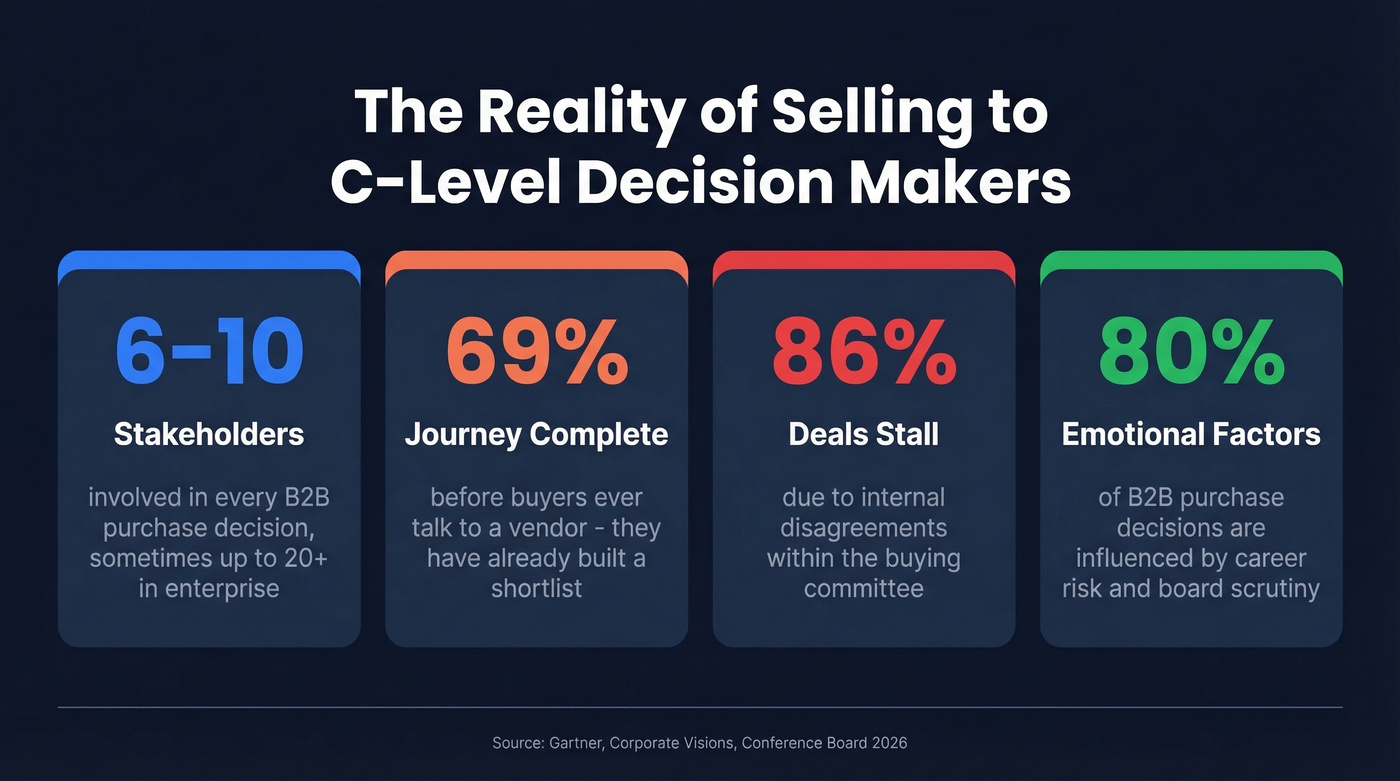
By the time they reach out to you, 69% of the buying journey is already complete. They've read the G2 reviews. They've asked peers in Slack communities. They've built an internal shortlist. You're not educating them - you're competing for a slot they've already half-filled.
The scariest stat: 86% of purchases stall due to internal disagreements. And according to Gartner, 80% of B2B purchase decisions are influenced by emotional factors - career risk, board scrutiny, the fear of championing a vendor that fails publicly. Selling to the C-suite means navigating politics as much as product fit.
The 6 Stakeholders in Every Deal
Every significant B2B purchase involves some version of these six roles:
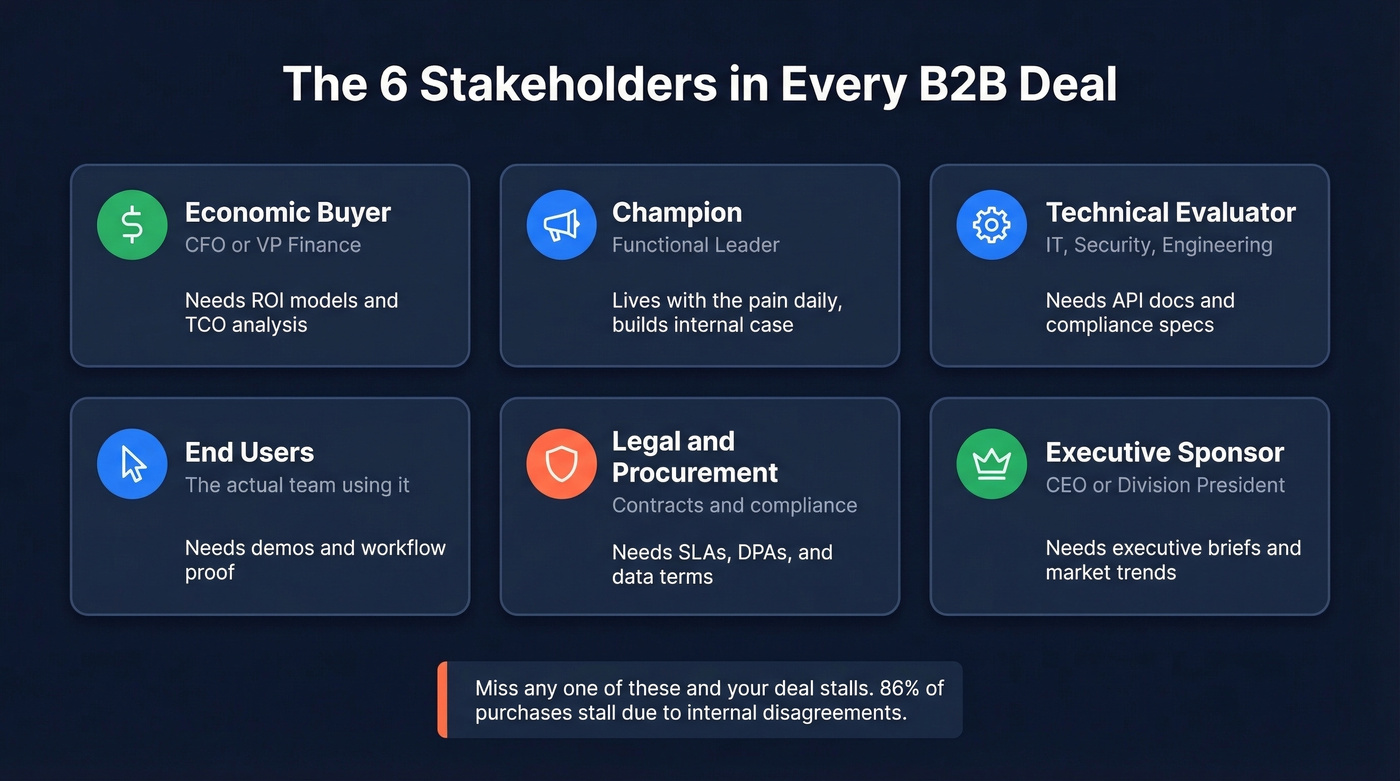
- Economic buyer - typically the CFO or VP Finance - needs ROI models, TCO analysis, and case studies with hard numbers.
- Champion - the functional leader who lives with the pain daily - needs internal pitch materials, competitor comparisons, and implementation guides they can forward.
- Technical evaluator - IT, security, or engineering - needs API documentation, security certifications, and compliance specs.
- End users - the team who'll actually use the product - needs demos, workflow guides, and usability proof.
- Legal/procurement - needs contract terms, SLAs, data processing agreements, and compliance documentation.
- Executive sponsor - the CEO or division president - needs executive briefs, market trends, and competitive positioning.
Miss any one of these, and your deal stalls. We've seen teams close the champion and the economic buyer, only to lose the deal in legal review because nobody prepped a DPA.
What Executives Care About in 2026
The Conference Board's C-Suite Outlook 2026 surveyed 1,700+ C-suite executives and 770+ CEOs globally. The top concerns heading into this year:
- Economic and geopolitical uncertainty - tariffs, supply chain fragility, and recession risk dominate boardroom conversations
- AI ROI scrutiny - CEOs who greenlit AI investments in 2024-2025 are now demanding measurable returns, not more pilots
- Workforce transformation - hiring, retention, and reskilling in a market that keeps shifting
- Cost discipline funding growth - a strong majority of CEOs prioritize cost optimization to fund expansion
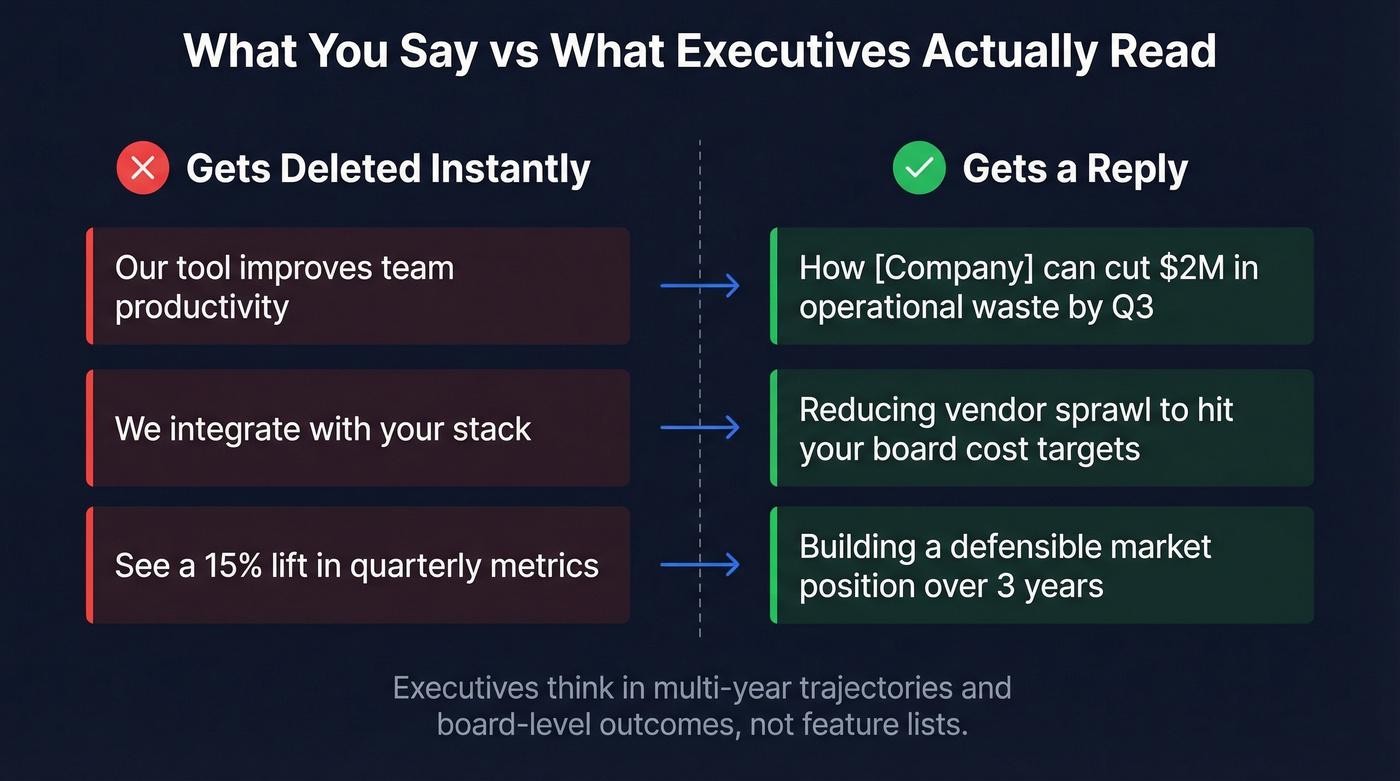
Your outreach should map to these priorities, not your product roadmap. Communicating with senior executives starts with speaking their language - board-level outcomes, not feature lists.
| Tactical Messaging (Ignored) | Strategic Messaging (Gets Read) |
|---|---|
| "Our tool improves team productivity" | "How [Company] can cut $2M in operational waste by Q3" |
| "We integrate with your stack" | "Reducing vendor sprawl to hit your board's cost targets" |
| "See a 15% lift in quarterly metrics" | "Building a defensible market position over 3 years" |
Executives think in multi-year trajectories and board-level outcomes. If your email reads like it was written for a mid-level manager, it'll be treated like one.

You just read that 47 bounced emails kill your domain reputation and your credibility with the C-suite. Prospeo's 5-step verification delivers 98% email accuracy, and our 7-day data refresh means you're never emailing an exec who left six months ago. At $0.01 per email, bad data is no longer an excuse.
Stop guessing which C-level contacts are still valid. Verify them instantly.
Why Executives Ignore Outreach
Decision-making time in B2B sales has increased by 60% compared to just a few years ago. Executives are slower to respond, harder to reach, and more skeptical than ever. Here's the trust hierarchy they use to filter inbound:
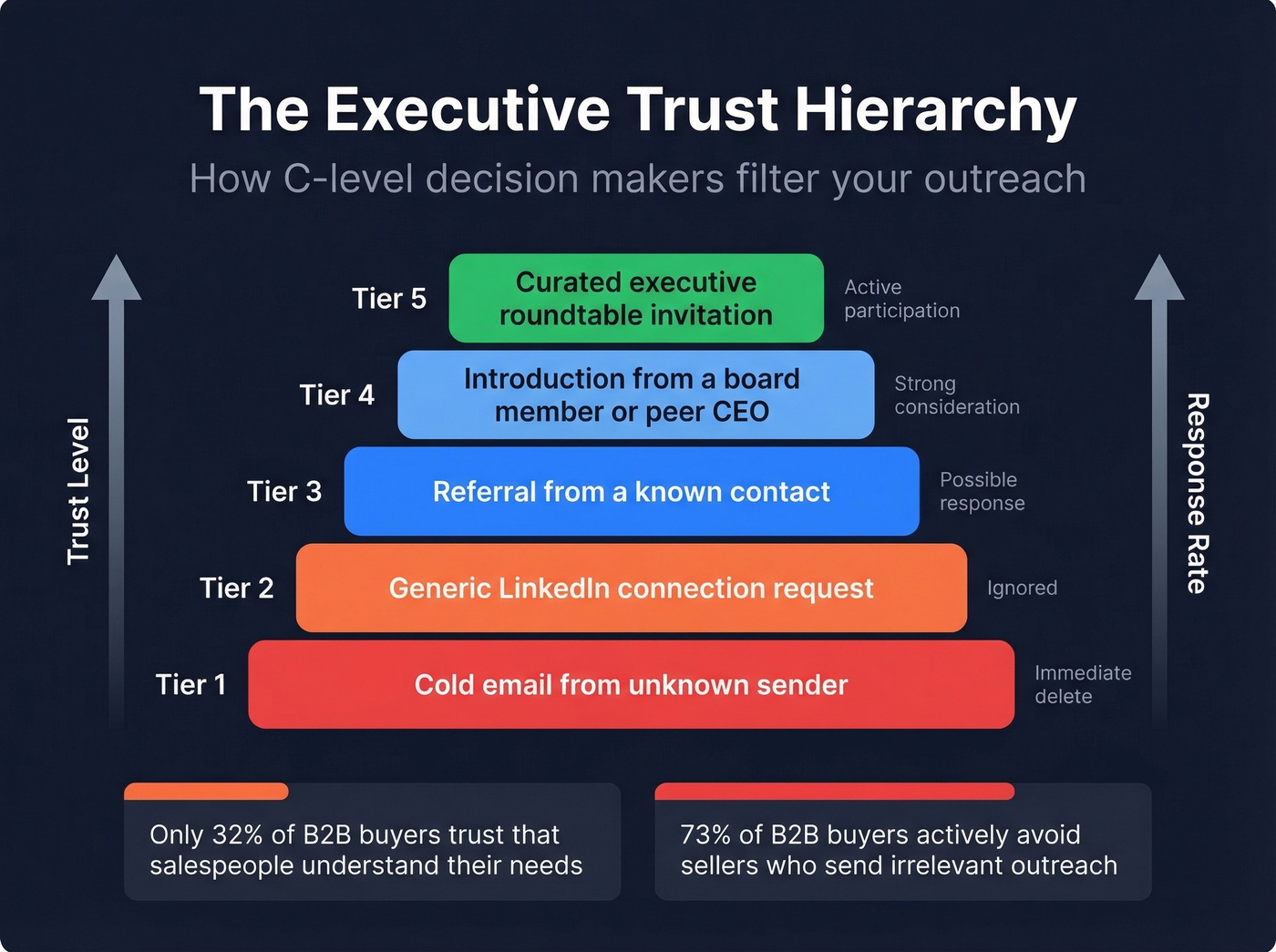
- Cold email from unknown sender - immediate delete
- Generic connection request - ignore
- Referral from a known contact - possible response
- Introduction from a board member or peer CEO - strong consideration
- Invitation to a curated executive roundtable - active participation
Only 32% of B2B buyers trust that salespeople fully understand their needs. And 73% of B2B buyers actively avoid sellers who send irrelevant outreach. You're not just competing with other vendors - you're competing with every terrible cold email that hit their inbox this week.
The pattern is so predictable it's almost comical - "Hi [First Name], I noticed [Company] is growing fast. We help companies like yours..." gets deleted before the second sentence.
Here's our hot take: most guides recommend 10 channels and 15 tools. You need accurate data, a phone, and one compelling reason to talk. That's it. If your deal size is under $10K, you probably don't need ZoomInfo-level data or a 14-step multi-channel sequence. A verified email, a direct dial, and a message that connects to a real business problem will outperform a $40K tech stack with bad targeting every single time.
How to Find C-Level Decision Makers
The tools market for finding executive contact data is crowded. Here's what actually matters: email accuracy, mobile number coverage, and data freshness. A huge database is worthless if a meaningful chunk of emails bounce and the phone numbers are stale.
| Tool | Best For | Email Accuracy | Pricing | Free Tier |
|---|---|---|---|---|
| Prospeo | Verified exec data | 98% | From ~$39/mo | 75 emails/mo + 100 extension credits/mo |
| Apollo | All-in-one prospecting | ~79% | ~$49-99/mo/user | Yes |
| ZoomInfo | Enterprise GTM | ~87% | $15K-40K/yr | No |
| Cognism | EU coverage + intent | High (phone-verified) | ~$1K-3K/mo | No |
| Hunter.io | Email-only lookups | Good | $34-349/mo | 25 searches/mo + 50 verifications |
| Lusha | Quick lookups | Good | ~$49/mo | Yes |
| Kaspr | European contacts | Good | $65/mo/user | Yes |
Prospeo
Prospeo covers 300M+ professional profiles with 98% email accuracy and 125M+ verified mobile numbers - one of the strongest mobile datasets in a self-serve platform. The 30% mobile pickup rate matters enormously for executive outreach, where getting someone on the phone is often the difference between a deal and a dead lead.
The platform includes 30+ search filters - including intent data tracking 15,000 topics via Bombora - so you can target executives actively researching solutions in your category, not just anyone with a C-level title. The Chrome extension, used by 40,000+ teams, lets you pull verified contact data from any website or CRM without switching tabs. Data refreshes every 7 days, compared to the 6-week industry average, which is a massive gap when you're targeting executives who change roles and contact details frequently.

The proof point that sticks with us: Snyk's 50-person sales team was running 35-40% bounce rates before switching. After the switch, bounces dropped below 5%, and AE-sourced pipeline jumped 180%. When you're prospecting into the C-suite, every bounced email is a credibility hit you can't afford. The free tier gives you 75 emails per month to test - no contracts, no sales calls required.
Apollo
Apollo's the obvious starting point for teams that want prospecting, sequencing, and data in one platform. The free tier is generous, and paid plans run ~$49-99/mo per user. The database is large and the workflow tools are genuinely useful.
The tradeoff: email accuracy sits around 79%. That means roughly 1 in 5 emails bounce - and bouncing on a CFO's inbox is a credibility death sentence. For high-volume SDR work targeting mid-level contacts, Apollo's fine. For targeted C-suite outreach where every touch matters, you'll want to run Apollo's data through a dedicated email checker before hitting send.
ZoomInfo
ZoomInfo has one of the largest B2B databases and a deep feature set - intent data, conversation intelligence, workflow automation, the works. For a 200+ person sales org running outbound, ABM, and intent from one platform, it earns its price tag.
That price tag runs $15,000-40,000/year depending on seats and modules. For a team that just needs verified emails and direct dials to reach 50 executives per month, it's overkill. You're paying for an aircraft carrier when you need a speedboat.
Cognism
Use this if you're selling into Europe. Cognism covers 90%+ of director-level and above contacts in the EU, with phone-verified mobile numbers and intent data baked in. They emphasize GDPR compliance, and the EU mobile coverage is hard to replicate elsewhere.
Skip this if your ICA is US-only and you don't need intent signals. Custom pricing typically runs $1,000-3,000/mo for small teams.
Hunter.io, Lusha, and Kaspr
These three tools serve different niches but share a common trait: they're supplementary, not primary. Hunter.io is a solid email-only tool with paid tiers from $34 to $349/mo and a free option that includes 25 monthly searches plus 50 verifications. If you just need to find and verify an email address, it does the job without the complexity of a full platform.
Lusha works well for quick lookups with a free tier and paid plans from ~$49/mo, though the database skews toward more common titles and industries. Kaspr starts at $65/mo per user with a free plan and is particularly strong for European contacts. None of these three replace a full prospecting database, but they're useful for filling gaps when your primary tool comes up short on a specific contact.
How to Reach C-Level Decision Makers
Phone First
57% of C-level buyers prefer to be contacted by phone. That surprises people who've been told cold calling is dead, but it makes sense - executives are busy, and a 90-second phone conversation is faster than reading and responding to an email thread.
The key is bypassing the gatekeeper entirely. Use mobile numbers instead of office lines. Verified mobiles with a 30% pickup rate make this practical at scale - you're calling the executive directly, not navigating a switchboard.
When you do hit a gatekeeper, reframe them as allies rather than obstacles. Ask for guidance, not favors: "I'm trying to reach Sarah about their recent funding round. Could you point me to the right person if she's not the one handling this?" That collaborative posture works dramatically better than "Can you put me through?"
Cold Email That Works
Belkins analyzed 16.5 million cold emails across 93 business domains in 2024. The average reply rate was 5.8% - down from 6.8% in 2023. For C-level outreach specifically, expect 2-4% for well-targeted campaigns. Email still works for reaching senior executives, but only when every element - data accuracy, message relevance, and timing - is dialed in.
The benchmarks that matter for executive emails:
- Length: 6-8 sentences, under 200 words hit a 6.9% reply rate. Executives don't read essays.
- Sequence depth: Single-email sends hit 8.4% reply rate. Adding a third email can drop reply rates by up to 20%. Less is more.
- Timing: Thursday is the best day at 6.87% reply rate. Evening sends between 8-11 PM peak at 6.52%.
- Targeting: Contacting 1-2 people per company yields 7.8% reply rates. Blasting 10+ drops you to 3.8%.
One deliverability trick most teams miss: Belkins found that turning off open-tracking pixels improved response rates by 3%. Executives' email servers are more likely to flag pixel-tracked emails as promotional, shunting your carefully crafted message straight to spam. It's a small change that compounds across every campaign.
Before you send a single email, verify your list. A 98% accuracy rate means under 2% bounce rates - the difference between building sender reputation and destroying it.
Referrals and Executive Events
Warm introductions outperform cold outreach by 10-15x. If you can get a mutual connection to make an intro, that single email is worth more than a 12-touch automated sequence.
For high-value accounts, executive events are the highest-leverage channel. Executives from invitation-only events convert at 5-10x the rate of digital leads - a 30-person executive dinner creates two hours of relationship time, compared to three minutes at a conference booth. The investment is higher, but the conversion math is dramatically better.
Webinars can work too, but only if they're genuinely exclusive. 73% of B2B marketers rank webinars among the best channels for high-quality leads, yet most executive-focused webinars fail because they're thinly veiled product demos. If the content wouldn't be valuable without your product existing, executives will smell it immediately and disengage. Curate a panel of their peers discussing a shared challenge, and you'll fill the room.
Multi-Threading the Buying Committee
Successful campaigns contact 11+ people per account. But you don't start with 11 emails on day one.
Start with 2-3 key contacts - typically the functional leader who owns the problem and one adjacent stakeholder - then expand based on engagement signals like email opens, website visits, and content downloads from the same company domain. The consensus on r/sales is pretty clear: jumping straight to the CEO without building internal support first is the fastest way to get ghosted or, worse, create political friction that kills the deal entirely.
The CEO is almost never the right first contact. Target the VP or director who lives with the pain daily. They'll evaluate your solution, build the internal case, and pull the CEO in when it's time to sign.
Tailor content to each stakeholder's role. Send ROI models to the economic buyer, security documentation to the technical evaluator, and internal pitch decks to your champion. The champion especially needs ammunition - they're selling your product internally when you're not in the room. Forrester found that companies using detailed buyer personas for each stakeholder see 73% higher conversion rates from response to MQL. That's not a marginal improvement; it's the difference between a pipeline that moves and one that stalls at "we'll get back to you."
Mapping a 6-10 person buying committee means finding verified emails and direct dials for every stakeholder - from the CFO to the technical evaluator. Prospeo gives you 300M+ profiles with 30+ filters including job title, seniority, department headcount, and buyer intent across 15,000 topics. Build the full committee in minutes, not weeks.
Multi-thread every enterprise deal with verified contact data for the entire buying committee.
FAQ
What does C-level mean?
C-level refers to the highest-ranking executives in an organization, where the "C" stands for "Chief." Core roles include CEO, CFO, CTO, COO, CMO, and CRO. Newer additions like Chief AI Officer and Chief Data Officer reflect how the suite has expanded to cover emerging strategic priorities.
How many stakeholders are in a B2B buying committee?
The average B2B buying committee includes 6-10 stakeholders, and enterprise tech deals can involve 20+. Each person consumes 4-5 pieces of content independently before engaging a vendor. Multi-threading with role-specific messaging is essential for closing complex deals.
What's the best way to contact a C-level executive?
Phone is preferred by 57% of C-level buyers, making direct calls the highest-converting first touch. Combine calls with short cold emails under 200 words and warm introductions when possible. Accurate contact data - verified emails and direct mobile numbers - is the non-negotiable foundation.
How do you get a senior executive's attention?
Lead with strategic outcomes, not product features. Executives filter every message through one lens: does this help me hit a board-level goal? Reference something specific to their company - a recent earnings call, a strategic initiative, or a publicly stated priority. Generic outreach gets deleted; relevance earns a reply.