

The Complete C-Level Hierarchy: Who Outranks Whom (and Why)
Most c-level hierarchy guides are just glossaries. They define what a CFO does, list a dozen titles, and never tell you who actually outranks whom. That's the part that matters when you're selling to the C-suite, building an org chart, or figuring out who signs off on a $200k deal.
Here's a practical hierarchy, ranked by authority and backed by compensation data that reveals the real pecking order.
C-Suite Hierarchy, Ranked by Authority
| Tier | Role(s) | Reports To |
|---|---|---|
| Board | Board of Directors | Shareholders |
| Tier 1 | CEO | Board |
| Tier 2 | COO, CFO | CEO |
| Tier 3 | CTO, CIO, CMO, CHRO, CLO, CRO | CEO |
Tier 3 roles are peers on paper. Their relative power shifts based on industry, company stage, and business model - a SaaS company's CTO wields more influence than its CMO, while at a consumer brand, that's reversed. The top three (CEO, COO, CFO) are consistent across virtually every organization.
The Full Chain of Command
The C-suite doesn't sit at the very top of a corporation. The full governance chain runs: shareholders, board of directors, CEO, C-suite, SVPs/VPs, directors, managers. Shareholders elect the board, and the board hires and fires the CEO. Everything below that is the CEO's domain.
Boards include inside directors who are company executives and outside directors who are independent members with no operational role. The outside directors exist to keep management accountable, though board independence varies widely in practice.
Within the executive team itself, the default reporting model is straightforward. The CEO reports to the board, and other C-level executives report to the CEO. Some companies run matrix structures with dual reporting lines, but the standard is a clean top-down model.
Every C-Level Role Explained
CEO - The Top of the Pyramid
The CEO is the highest-ranking executive in any company. Full stop. They set the strategic vision, represent the company to the board and shareholders, and make the final call on major decisions. In a public company, the CEO reports to the board of directors. In the S&P 500, CEOs earned about $18.9M on average in total compensation - a number that reflects just how much authority concentrates at this single position.
COO - Second in Command
The COO is typically second in command and owns day-to-day operations. It's also the most misunderstood role in the C-suite. At one company, the COO runs everything from supply chain to HR. At another, they're essentially a chief of staff. The scope varies because the role historically absorbed whatever the CEO didn't want to manage directly, and as tech and data functions have spun off into standalone positions, the COO's portfolio has narrowed considerably.
CFO - Third in Command
The CFO owns financial strategy, reporting, capital allocation, and investor relations. In the 1980s and '90s, the CFO was arguably the most powerful role after CEO. That influence has diluted as CTO and CRO roles have gained strategic weight, but no major decision - hiring, M&A, expansion - happens without the CFO's sign-off on the numbers.
CTO vs. CIO - The Most Confused Pair
| CTO | CIO | |
|---|---|---|
| Focus | Product tech, R&D | Internal IT systems |
| Orientation | Customer-facing | Operations-facing |
| Builds | What you sell | What your team uses |
The CTO drives product innovation and customer-facing technology. The CIO manages internal IT infrastructure - ERP systems, security, internal tools. If a company only has one, it's usually titled CTO at startups and CIO at legacy enterprises.
CMO, CHRO, CLO, and CRO
These are the functional chiefs operating as Tier 3 peers. The CMO owns brand, demand generation, and market positioning. The CHRO manages talent strategy, culture, and organizational design. The CLO handles legal risk, compliance, and governance. The CRO owns the full revenue engine - sales, sometimes marketing, sometimes customer success.
Here's the thing: below the top three, hierarchy is entirely company-specific. A regulated financial firm's CLO wields more operational power than the CTO. A product-led SaaS company's CTO outranks everyone except the CEO and maybe the CFO. We've seen this debated endlessly in executive recruiting communities, and the answer always comes back to context. Treating these roles as having a fixed rank is a mistake.
One common point of confusion: Chief of Staff isn't a C-level role. It's an operational coordinator that reports to the CEO, not a strategic peer in the hierarchy.

Understanding the C-level hierarchy is step one. Step two is actually reaching them. Prospeo gives you verified emails and direct dials for 300M+ professionals - including C-suite decision-makers - with 98% email accuracy and 30+ filters to target by title, seniority, and company size.
Stop mapping org charts. Start booking meetings with the right executive.
Compensation Proves the Pecking Order
Titles can be inflated. Pay ratios don't lie. Harvard Law's analysis of Russell 3000 companies shows exactly how much each C-suite role earns relative to the CEO:
| Role | % of CEO Pay (Russell 3000) |
|---|---|
| COO | ~42% |
| CFO | ~37-39% |
| CMO | ~33% |
| CLO | ~30% |
| CHRO | ~30% |
COO and CFO cluster together at roughly 37-42% of CEO compensation - a significant gap above the functional chiefs. In the S&P 500, the spread widens further: the COO earns ~38% of CEO pay while the CHRO drops to ~22%. The CEO earns more than double what the next-highest-paid executive takes home.
Let's be honest: if you're trying to determine who holds real power at a company, skip the org chart and look at the proxy statement. Compensation tells you who the board considers indispensable. Everything else is politics.
How the Executive Hierarchy Scales
The answer depends entirely on stage and scale:
| Company Size | Typical C-Suite Size |
|---|---|
| Small / Startup | 2-3 |
| Midsize | 7-8 |
| Large Enterprise | 17+ |
A practical scaling path: at Seed, you need a CEO and CTO. Series A typically adds a CFO or COO - whichever the founder isn't already covering. Series B and beyond is when functional chiefs start making sense as headcount and complexity grow.
In our experience, the Series A CFO hire is the one most founders delay too long, and it costs them in fundraising leverage. A 30-person startup with 12 C-suite titles is cosplaying as a Fortune 500. Titles are free to hand out, but they create expectations - both internally and with candidates you'll recruit later who expect those titles to mean something.
Emerging Roles Reshaping the C-Suite
The C-suite is expanding. Robert Half's research found that 77% of publicly listed businesses expect the CTO's influence to grow over the next decade, and 60% expect the Chief Communications Officer to gain significant ground.
Newer additions like the Chief AI Officer, Chief Data Officer, Chief Ethics & Compliance Officer, and Chief Sustainability Officer are increasingly common in larger organizations. Whether all of these survive as permanent fixtures or get absorbed back into existing functions is the open question. Some "new" C-level roles tend to spike during major shifts - new regulation, new platforms, AI adoption - and then get folded into core functions once the change becomes business-as-usual. We wouldn't be surprised if half of today's CAIO titles disappear within five years as AI becomes everyone's job.
How to Reach C-Level Decision-Makers
You've mapped the hierarchy. Now you need to actually reach these people. C-level executives change roles frequently, and stale data means you're emailing someone who left six months ago.
Prospeo's B2B database covers 300M+ professional profiles with 30+ search filters, so you can filter by C-level title, company size, industry, and in-market intent topics. With 143M+ verified emails, 125M+ verified mobile numbers, 98% email accuracy, and a 7-day data refresh cycle, you're reaching the right person in the right role - not a ghost.
If you're building lists at scale, lead enrichment and data enrichment services help you fill gaps and standardize records before outreach.
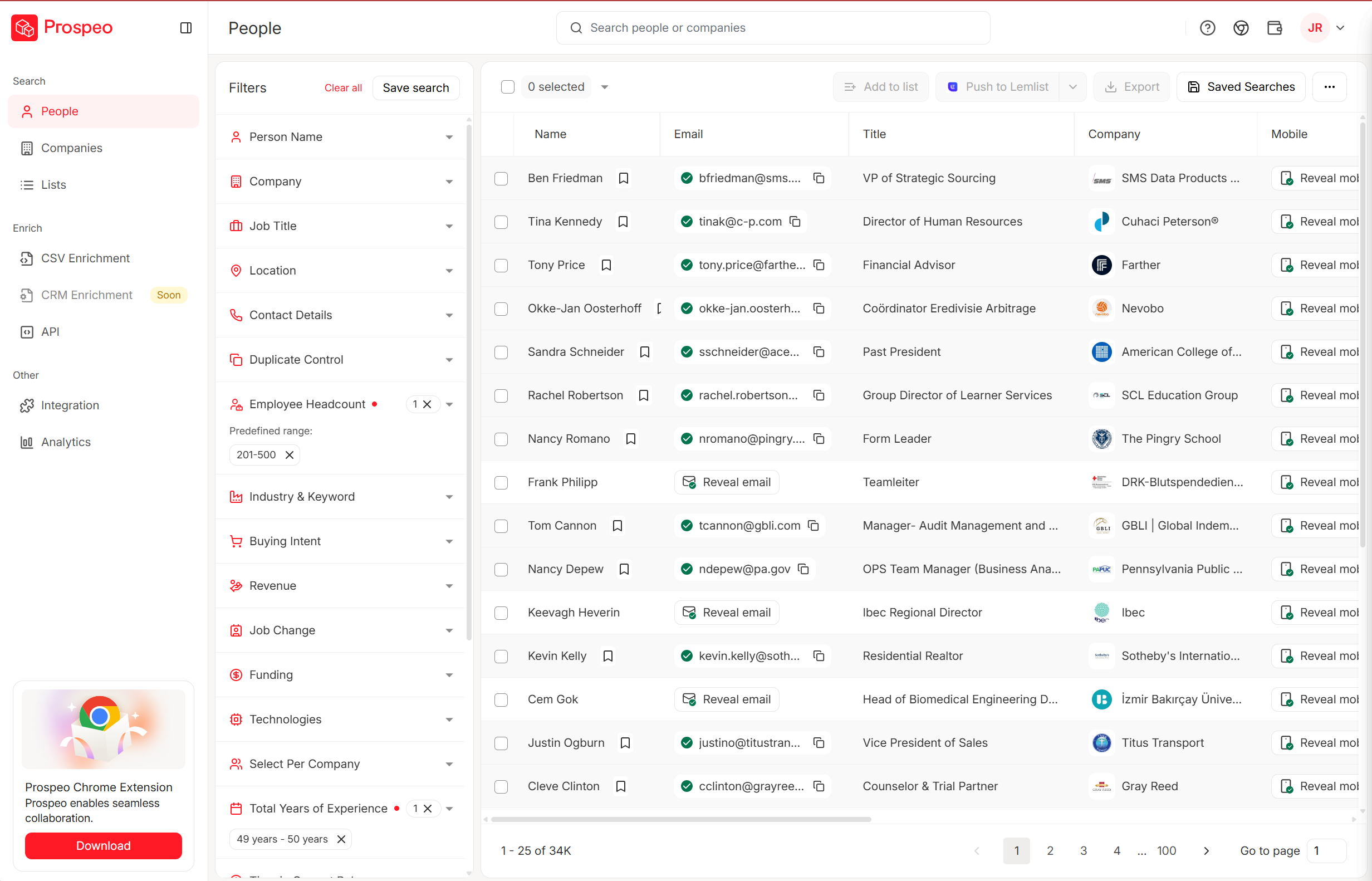
Compensation data tells you who holds real power. Prospeo's intent data and technographic filters tell you which of those executives are actively in-market. Layer buyer intent across 15,000 topics with job title targeting to reach the CEO, CFO, or CRO at exactly the right moment - with 125M+ verified mobile numbers and a 30% pickup rate.
Reach the decision-maker who actually signs off on your deal.
FAQ
What does C-level mean?
"C-level" refers to the highest-ranking executives in a company whose titles start with "Chief" - Chief Executive Officer, Chief Financial Officer, Chief Technology Officer, and so on. These leaders set enterprise strategy and typically report to the CEO, with the CEO reporting to the board of directors.
Is the COO always higher than the CFO?
In most organizations, yes - the COO is second in command and the CFO third. Compensation data supports this: COOs earn ~42% of CEO pay versus ~37-39% for CFOs. In finance-heavy industries like banking and insurance, however, the CFO can wield equal or greater operational influence.
Who is above the CEO in a company?
The board of directors sits above the CEO. Shareholders elect the board, and the board has the authority to hire, evaluate, and terminate the CEO. In practice, a strong CEO shapes the board's agenda, but the formal governance chain places the board above the CEO.
How do you use the c-level hierarchy when selling to enterprises?
Start by identifying which executive owns the budget and the business problem you solve. Mapping the decision chain - who influences, who evaluates, who signs - prevents you from pitching the wrong person. In most B2B deals above $150k, the CFO or COO will need to approve the spend even if a Tier 3 chief is your champion. Skip this step if you're selling a sub-$10k tool; at that price point, a VP or director usually has signing authority and you don't need to map the full C-suite.