

Sales Call Planning: How to Close More Deals Without Wasting Your Afternoon
It's 2:45 PM. You've got a discovery call in 15 minutes with a VP of Operations at a mid-market SaaS company. You know her name, her title, and basically nothing else. Your CRM note says "inbound - downloaded pricing guide." That's it.
What does effective call planning actually look like with 15 minutes on the clock?
Only 11% of sales professionals report feeling confident on customer calls. The other 89% are winging it, over-preparing, or somewhere in between - and the gap between those approaches is the gap between a booked next step and a polite "we'll circle back."
The Quick Version
Match your prep time to the call type: 2 minutes for cold calls, 15 minutes for discovery, 30 minutes for enterprise. Plan your questions, not your pitch - top performers ask 39% more questions than average reps. And verify your prospect's contact data before you plan anything else. A perfect call plan with a dead phone number is worthless.
What Call Planning Actually Is
Most advice boils down to "research your prospect." That's not a plan. That's a research project with no deadline and no deliverable.
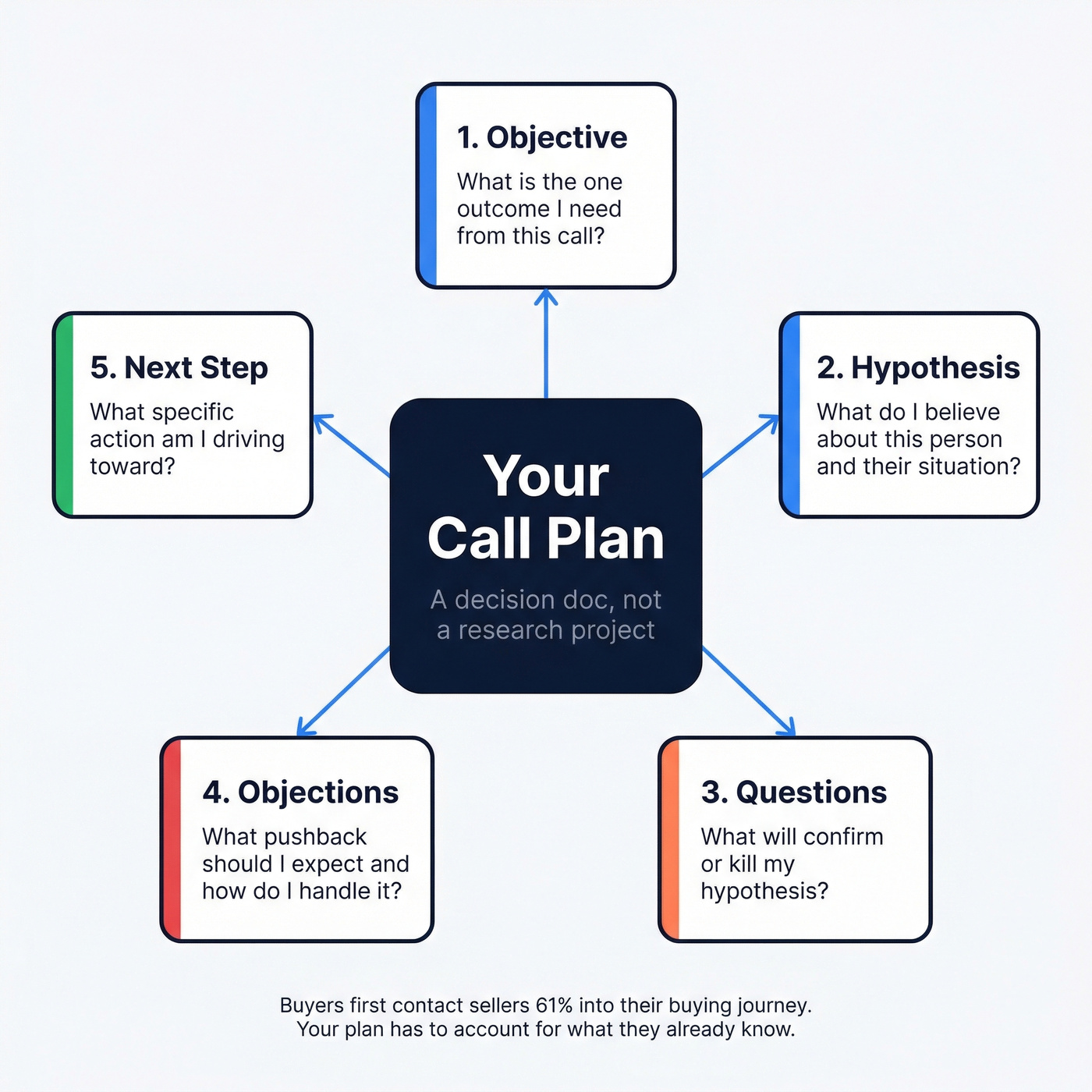
A call plan is a decision doc. It answers five questions: What's my objective? What do I hypothesize about this person's situation? What questions will confirm or kill that hypothesis? What objections should I expect? And what's the specific next step I'm driving toward?
This matters more now than it did five years ago. According to 6sense's Buyer Experience Report, buyers first contact sellers around 61% into their buying journey - a process that averages 10.1 months. The pre-contact favorite wins roughly 80% of the time, and 95% of the time the winner is already on the Day One shortlist. By the time someone takes your call, they've already formed opinions. Your job isn't to educate. It's to confirm you understand their world better than the other vendors on their list.
Forrester found that 86% of B2B purchases stall during the buying process, and Gartner's research shows 6-10 stakeholders in a typical buying decision. The call you're about to make isn't just a conversation. It's one move in a multi-month, multi-stakeholder chess game, and planning with that context is what separates reps who advance deals from reps who collect "let me think about it."
The Timeboxed Prep System
HubSpot research shows reps spend only 33% of their time actually selling. The rest goes to admin, internal meetings, and over-researching prospects they'll talk to for three minutes. If you've spent time in r/sales, you've seen the complaint: reps falling down research rabbit holes for prospects who won't pick up. Timeboxing your preparation isn't laziness. It's discipline.
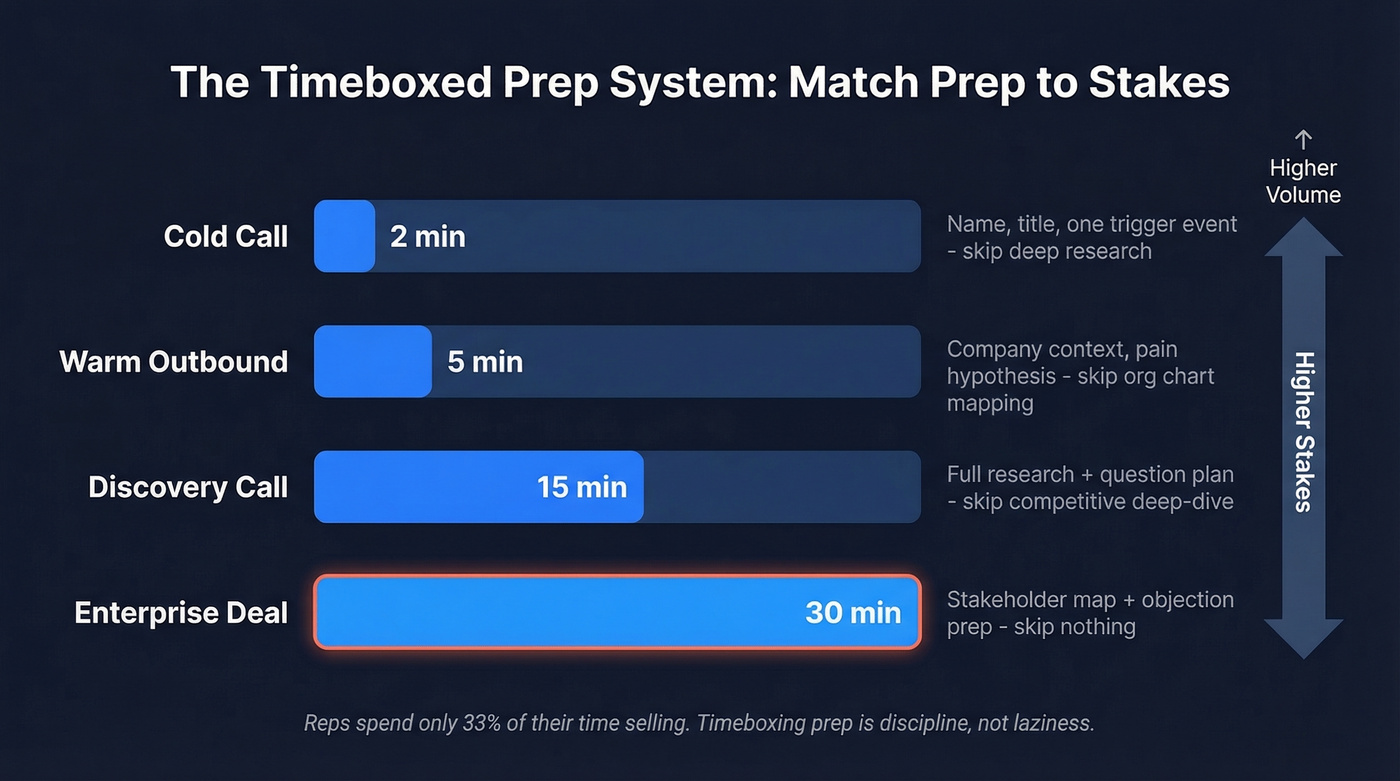
Sandler's rule of thumb is to spend about 50% of the meeting length on prep. That's a decent starting point, but it breaks down at the extremes. You don't need 15 minutes to prep a cold call, and 15 minutes isn't enough for a $500K enterprise deal with four stakeholders on the line.
The data backs this up. Cold call conversion benchmarks vary dramatically by price band - calls targeting $500-$10K deals convert at roughly 2.64%, while $1M-$5M deals convert at about 1.16%. Higher-stakes calls are harder to convert, which means the prep you put into them has to be sharper.
| Prep Time | Call Type | What You Cover | What You Skip |
|---|---|---|---|
| 2 min | Cold call | Name, title, one trigger | Deep research |
| 5 min | Warm outbound | Company context, pain hypothesis | Org chart mapping |
| 15 min | Discovery | Full research + question plan | Competitive deep-dive |
| 30 min | Enterprise | Stakeholder map + objection prep | Nothing |
Cold Calls: 2-Minute Prep
You've got a list. You're dialing. For each call, you need three things: the person's name and title, one sentence about the company, and one trigger event (funding round, job change, hiring spike) that gives you a reason to call. Cold calls average 2-3 minutes. Spending 15 minutes prepping for a conversation that lasts 90 seconds is a losing trade.
Warm Outbound: 5-Minute Prep
The prospect opened your email, visited your pricing page, or downloaded something. Now you've got context. Spend two minutes reviewing what they engaged with, two minutes scanning their company (size, industry, recent news), and one minute writing down your opening question. The goal is a hypothesis - "I think they're evaluating tools because they just raised a Series B and are scaling their outbound team" - not a research paper.
Discovery Calls: 15-Minute Prep
This is the default for most scheduled calls, and it deserves a real breakdown:
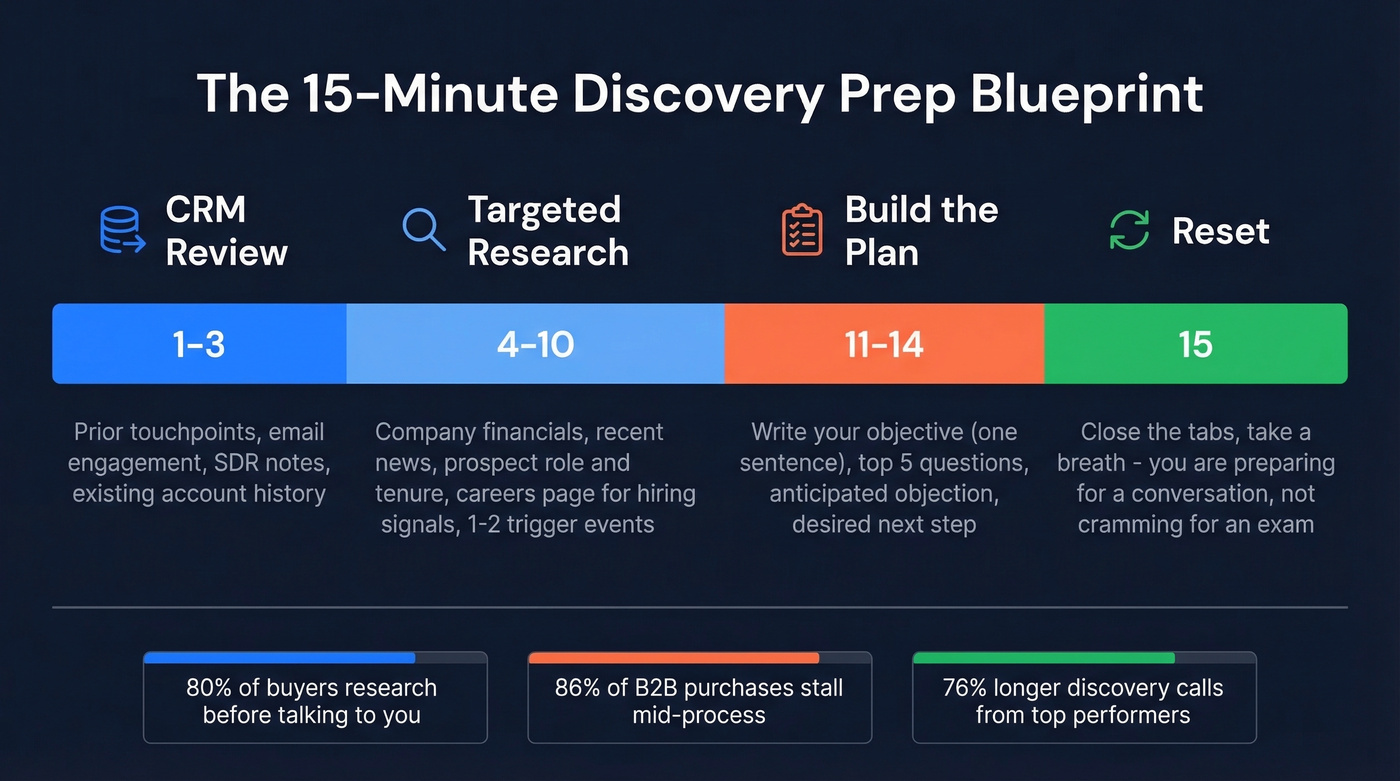
- Minutes 1-3: CRM review. What do you already know? Prior touchpoints, email engagement, any notes from the SDR who booked the meeting.
- Minutes 4-10: Targeted research. Company financials, recent news, the prospect's role and tenure, and one or two trigger events. Check their careers page - what they're hiring for tells you where they're investing.
- Minutes 11-14: Build the plan. Write your objective (one sentence), your top 5 questions, your anticipated objection, and your desired next step.
- Minute 15: Reset. Close the tabs. Take a breath. You're preparing for a conversation, not cramming for an exam.
Enterprise: 30-Minute Prep
Multi-stakeholder calls, executive presentations, and deals above six figures deserve the full treatment. Map every attendee - role, likely priorities, potential objections. Prepare stakeholder-specific questions. Have a client success story ready that mirrors their situation. Build a mutual action plan draft you can propose at the end.
Here's the thing: tailoring your communication style to each attendee shifts outcomes more than most reps realize. Sandler's framework emphasizes collaboration, confirmation, and clarity as planning pillars, and adjusting your approach to different personality types (analytical vs. expressive, for instance) can change the trajectory of a high-stakes call entirely. This is where prep directly correlates with win rate.
What to Research Before Every Call
Not all research is equal. We've seen reps spend 20 minutes reading a prospect's blog posts and zero minutes checking whether the phone number in their CRM still works. Prioritize ruthlessly.
Company intel. Revenue range, funding stage, employee count, recent news, and tech stack. You don't need to memorize their 10-K. You need enough context to ask intelligent questions and avoid saying something embarrassing ("So, are you guys profitable?" to a public company).
Person intel. Title, tenure in role, reporting structure, and any recent professional activity. A VP who's been in the role for three months has different priorities than one who's been there four years. New leaders buy things. Established leaders optimize things.
Trigger events. Funding rounds, leadership changes, hiring surges, product launches, acquisitions. These are your "reason to call" and your hypothesis engine. A company that just raised $30M and posted 12 SDR openings is almost certainly evaluating outbound tools.

Plan Your Questions, Not Your Pitch
Your call plan should be 80% questions, 20% everything else. Top performers ask 39% more questions than average reps, and their discovery calls run 76% longer. They're not talking more - they're listening more, because they asked better questions.
Gartner's research reinforces this: buyers complete roughly 80% of their research before talking to a rep, and 44% of Millennial B2B buyers prefer a seller-free sales experience. If your call plan is a pitch deck in disguise, you're solving a problem the buyer already solved for themselves. Questions are how you add value they can't get from your website.
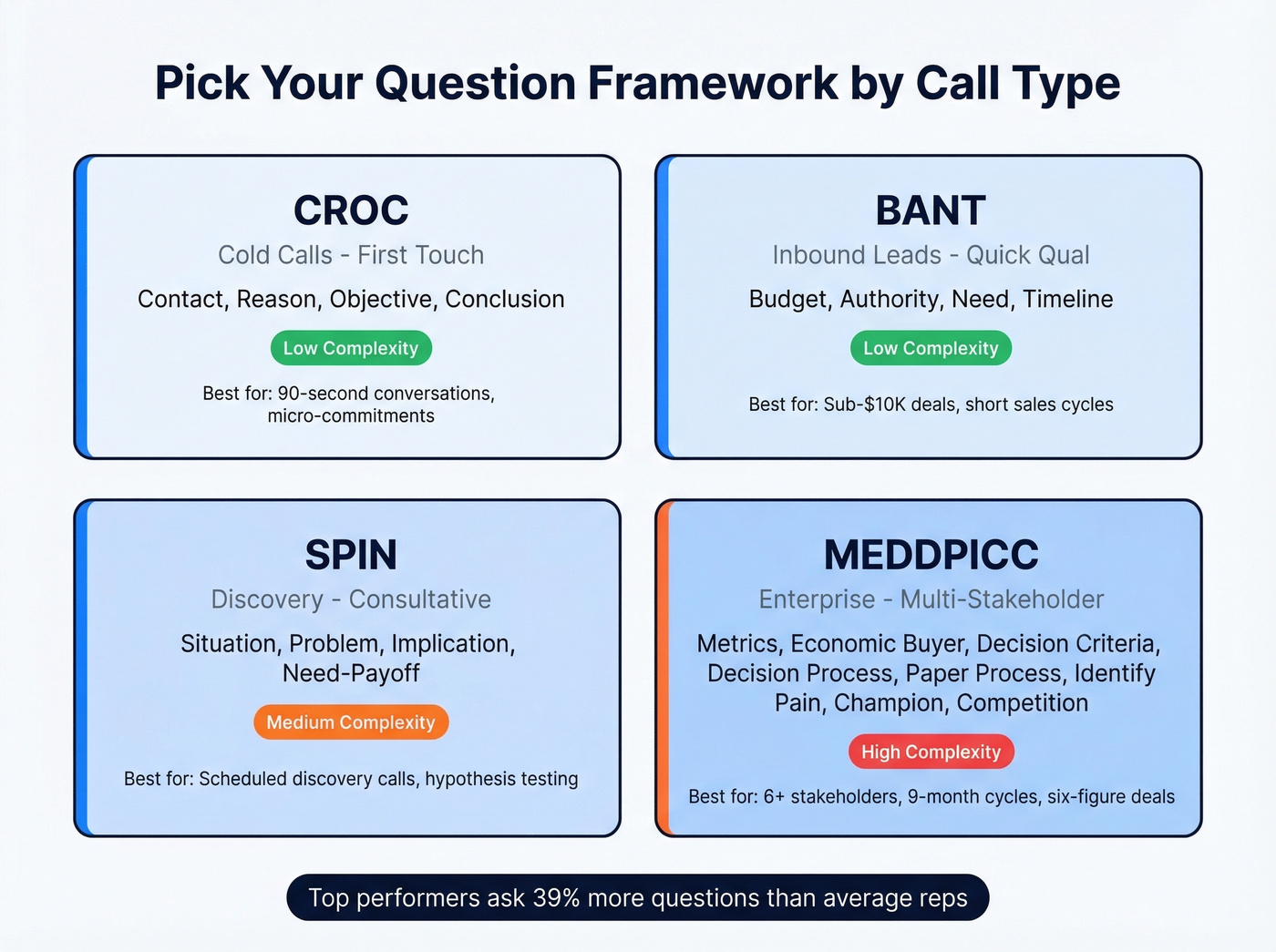
The framework you use depends on the call type. Pick one, internalize it, move on.
| Framework | Best For | Complexity | Call Type |
|---|---|---|---|
| CROC | Cold calls | Low | First touch |
| SPIN | Discovery | Medium | Consultative |
| BANT | Quick qual | Low | Inbound leads |
| MEDDPICC | Enterprise | High | Multi-stakeholder |
CROC: The Cold Call Skeleton
CROC stands for Contact, Reason, Objective, Conclusion. Dead simple, which is exactly what you need when you've got 90 seconds of someone's attention. Confirm you're talking to the right person. State why you're calling - one sentence, tied to a trigger. Drive toward a micro-commitment: a 15-minute meeting, not a demo. Summarize and confirm the next step.
Two example questions: "I noticed you're hiring three SDRs - is outbound a new motion for you?" and "Would it make sense to spend 15 minutes on how teams your size are solving this?"
SPIN: For Consultative Discovery
SPIN (Situation, Problem, Implication, Need-Payoff) is the workhorse for discovery calls. Start with situation questions to confirm your hypothesis ("Walk me through how your team handles X today"). Move to problem questions ("Where does that process break down?"). Then implication questions to quantify the pain ("What does that cost you in pipeline per quarter?"). Close with need-payoff questions that let the prospect sell themselves ("If you could cut that cycle in half, what would that mean for your Q3 number?").
BANT vs. MEDDPICC: Match to Deal Size
BANT (Budget, Authority, Need, Timeline) works for straightforward deals with short cycles. If you're qualifying an inbound lead for a sub-$10K annual product, BANT gets you there in 10 minutes.
MEDDPICC is for complex enterprise deals where you need to map Metrics, Economic Buyer, Decision Criteria, Decision Process, Paper Process, Identify Pain, Champion, and Competition. If there are 6+ stakeholders and a 9-month sales cycle, BANT will leave you blind. The single habit that separates prepared reps from everyone else: write at least 5 great open-ended questions before every call.

You just read it: a perfect call plan with a dead phone number is worthless. Prospeo gives you 125M+ verified mobile numbers with a 30% pickup rate and 98% email accuracy - refreshed every 7 days, not every 6 weeks.
Stop planning calls to numbers that don't ring.
Preparing by Stakeholder Type
Gartner's 6-10 stakeholders stat isn't just a number - it means you'll have different conversations with different people about the same deal. Planning the same call for every stakeholder is like wearing the same outfit to a board meeting and a barbecue.
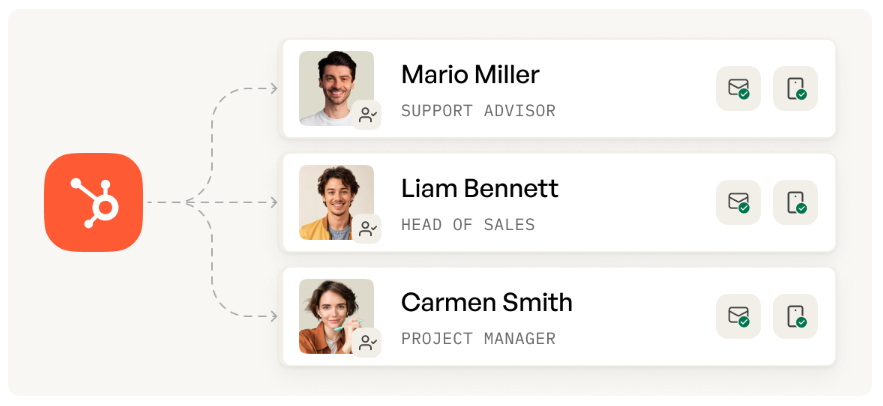
Economic Buyer. They care about ROI, cost justification, and strategic alignment. Ask: "What does success look like for this investment in 12 months?" and "How does this fit into your broader priorities for the year?" Skip the feature tour. Lead with business outcomes.
Technical Evaluator. Integration, security, and implementation risk keep them up at night. Ask: "What does your current tech stack look like, and where are the friction points?" and "What would a failed implementation look like from your team's perspective?" Come with architecture answers, not marketing slides.
Champion. Your internal advocate - but only if they can actually sell for you when you're not in the room. Test them early: "If you were presenting this to your VP, what would you lead with?" If they fumble the answer, they're an enthusiast, not a champion. You've got more coaching to do before this deal advances.
End User. The biggest mistake reps make here is overcomplicating the conversation. End users don't care about your platform's architecture or your company's Series C. They care whether this thing will make their Tuesday less painful. Ask: "What's the most frustrating part of your current process?" and "If this tool added 30 minutes to your day, would you actually use it?" Keep it grounded.
Blocker. Procurement, compliance, or a skeptical executive. Don't avoid them - they're the reason deals die in "legal review" for six weeks. The best approach is preemptive: "What concerns would need to be addressed before this moves forward?" and "What's killed similar initiatives in the past?" If you can name their objection before they raise it, you've already defused half of it.
Call Plan Templates (Copy-Paste Ready)
No email gate, no PDF download. Just use them.
Cold Call Example (CROC Framework)
- Objective: Book a 15-minute discovery call
- Prospect context: Sarah Chen, Director of Sales Ops at a 200-person fintech. Company raised Series B ($28M) three months ago. Posting for 4 SDR roles.
- 3 Questions: (1) "I saw you're scaling the outbound team - is that a new motion or are you rebuilding?" (2) "How are you handling data and list building for the new reps?" (3) "Would it make sense to spend 15 minutes on how similar teams have solved this?"
- Anticipated objection: "We're already evaluating tools." Response: "That's great - happy to be a data point in that evaluation rather than a pitch."
- Desired next step: Calendar invite for 15-min discovery
- Success story ready: "A similar-stage fintech cut SDR ramp time from 8 weeks to 4 by fixing their data layer first."
Discovery Call Example (SPIN Framework)
- Objective: Qualify opportunity and identify 2-3 pain points
- Prospect context: Mark Rivera, VP of Revenue at a 500-person B2B SaaS. Current customer of a competitor (contract renews in Q3). Mentioned "data quality issues" in the initial email exchange.
- 3 Questions: (1) Situation: "Walk me through how your team sources and verifies prospect data today." (2) Problem: "You mentioned data quality - where specifically does that show up? Bounce rates? Wrong numbers?" (3) Need-Payoff: "If you could guarantee 98%+ email accuracy with weekly refreshes, what would that unlock for your Q3 pipeline targets?"
- Anticipated objection: "Switching costs are high." Response: "Totally fair. Most teams run a parallel test for 30 days before committing."
- Desired next step: Technical evaluation with Sales Ops + one SDR manager
What to Do After the Call
48% of sales reps never follow up after the first call. Another 44% give up after one attempt. Meanwhile, calling leads within the first minute of lead creation can improve conversion rates by roughly 400%. The math is brutal and obvious: most reps lose deals not because of bad calls, but because of what happens after.
The single most important rule: schedule the next step before you hang up. Not "I'll send you some times" - an actual calendar invite, accepted, while you're still on the call. Every call that ends without a booked next step is a call that's likely to go dark.
CRM log within 5 minutes. Key pain points, stakeholders mentioned, objections raised, next step confirmed. Future you will thank present you.
Follow-up email within 1 hour. Summarize what you discussed, confirm the next step, and attach anything you promised. Speed signals professionalism. If you want a starting point, use a few proven follow-up email formats.
Mutual action plan for deals past discovery. Send a shared doc outlining milestones, owners, and dates. This turns a vague "sales process" into a project both sides own.
Common Mistakes That Kill Deals
Opening with a product pitch. Research from Advantage Performance shows successful calls correlate with buyers talking more and sellers asking more questions. Leading with "I'd love to tell you about our platform" is the fastest way to lose attention.
Research rabbit holes without time limits. Reading the prospect's entire blog archive isn't prep - it's procrastination. Set a timer. Stick to it.
No next step planned. If you don't know what outcome you're driving toward before the call starts, you won't get one.
Planning the pitch instead of questions. Your call plan isn't a script. It's a conversation guide. If your plan is three paragraphs of what you want to say, throw it out and write five questions instead (or pull from a bank of discovery questions).
Using stale contact data. You spent 15 minutes building a perfect plan, and the phone number is disconnected. With data decaying 2.1% monthly, verify your list through a tool like Prospeo's Email Finder before you plan a single call.
AI Tools That Speed Up Prep
AI isn't replacing call planning - it's compressing the research phase so you can spend more time on the parts that require human judgment. We've tested a few approaches on our own team, and the consensus on r/sales tracks with our experience: using ChatGPT to synthesize company research in seconds instead of tabbing through five browser windows is the right instinct.
Prep tools. ChatGPT and Perplexity can synthesize a company's recent news, financials, and competitive position in 30 seconds. Pair that with a verified data source for contact info and enrichment (see data enrichment), and your 15-minute prep window covers twice the ground.
Live coaching. Gong, Chorus, and Dialpad offer real-time conversation intelligence - talk-time ratios, question frequency, sentiment shifts. These tools work best when reps feel supported rather than surveilled. The adoption difference between "coaching tool" and "monitoring tool" is everything. If you're evaluating options, compare a few Dialpad alternatives.
Post-call intelligence. Fireflies.ai and Avoma handle transcription, but the real shift is toward multi-meeting deal intelligence that stitches together conversations across an entire deal cycle, flagging risk signals and recommending next actions. AI call analysis can improve success rates by roughly 50% - but only if reps actually use the insights. (If Avoma is on your shortlist, see Avoma pricing.)
Let's be honest: if your average deal size is under $15K, you probably don't need Gong-level call intelligence. A $15/month transcription tool and a solid call plan will get you 80% of the way there. Save the enterprise coaching stack for enterprise deals.
Trigger events, hiring signals, tech stack, funding stage - Prospeo's 30+ search filters surface every data point in your 15-minute prep window. Layer buyer intent data across 15,000 topics so your hypothesis is built on signal, not guesswork.
Turn your 2-minute cold call prep into an unfair advantage.
FAQ
How long should I spend on call planning?
Match prep to call type: 2-5 minutes for cold calls, 15 minutes for discovery, 20-30 minutes for enterprise. Sandler's rule is about half the meeting length on preparation. Never spend more time planning than the call itself will last.
What's the difference between a call plan and a script?
A script tells you what to say. A call plan tells you what to ask, what to listen for, and what outcome to drive. Scripts are brittle - one unexpected answer and you're lost. Plans keep conversations productive when they go sideways.
What should I research before a cold call?
Three things: the company (industry, size, recent news), the person (role, tenure), and a trigger event (funding, hiring surge, job change). Two minutes of targeted research beats twenty minutes of unfocused browsing. Verify the phone number first - B2B data decays fast, and a 7-day refresh cycle on your contact data keeps direct dials current.
Which framework works best for sales call planning?
CROC for cold calls, SPIN for consultative discovery, BANT for quick inbound qualification, MEDDPICC for complex enterprise deals with 6+ stakeholders. Match the framework to the deal's complexity, not to what your manager learned at a conference in 2019.