

Call Reluctance: Why Your Brain Fights the Phone (and How to Win)
The 9:01 AM Spiral
It's 9:01 AM. The call list is open. And suddenly it's also time to check Reddit, refill your coffee, reorganize your Salesforce views, and scroll through posts you've already read. Thirty minutes vanish. The list hasn't moved.
That avoidance loop has a name: call reluctance. And 48% of B2B salespeople fear cold calls. You're not broken - you're nearly half the profession. The difference between reps who push through and reps who spiral isn't willpower. It's infrastructure, routine, and understanding what's actually happening in your head.
The quick version:
- Your brain treats rejection as a physical threat. Willpower alone won't override that.
- Fix three things: your data (so dials actually connect), your routine (warm-up + time blocks), and your metrics (track effort, not outcomes).
- Most sales orgs create this problem through bad data and bad management - then blame the rep.
What Is Call Reluctance?
Call reluctance is the internal resistance - thoughts, feelings, avoidance behaviors - that keeps otherwise capable salespeople from prospecting consistently. George W. Dudley and Shannon L. Goodson introduced the concept in their 1986 book The Psychology of Call Reluctance, and the framework is still widely used today.
The numbers from the [Behavioral Sciences Research Press](https://callreluctance.com/callreluctance) are stark. Up to 80% of new salespeople fail within their first year because they don't initiate contact consistently. 40% of veteran sales professionals admit to episodes of sales call fear severe enough to threaten their continuation in sales. The average reluctant salesperson misses 15.25 new business opportunities every month - that's not a motivation problem, that's a revenue leak.
Why Outbound Is Harder Now
Cold calling dread isn't happening in a vacuum. The math behind outbound has gotten genuinely worse.
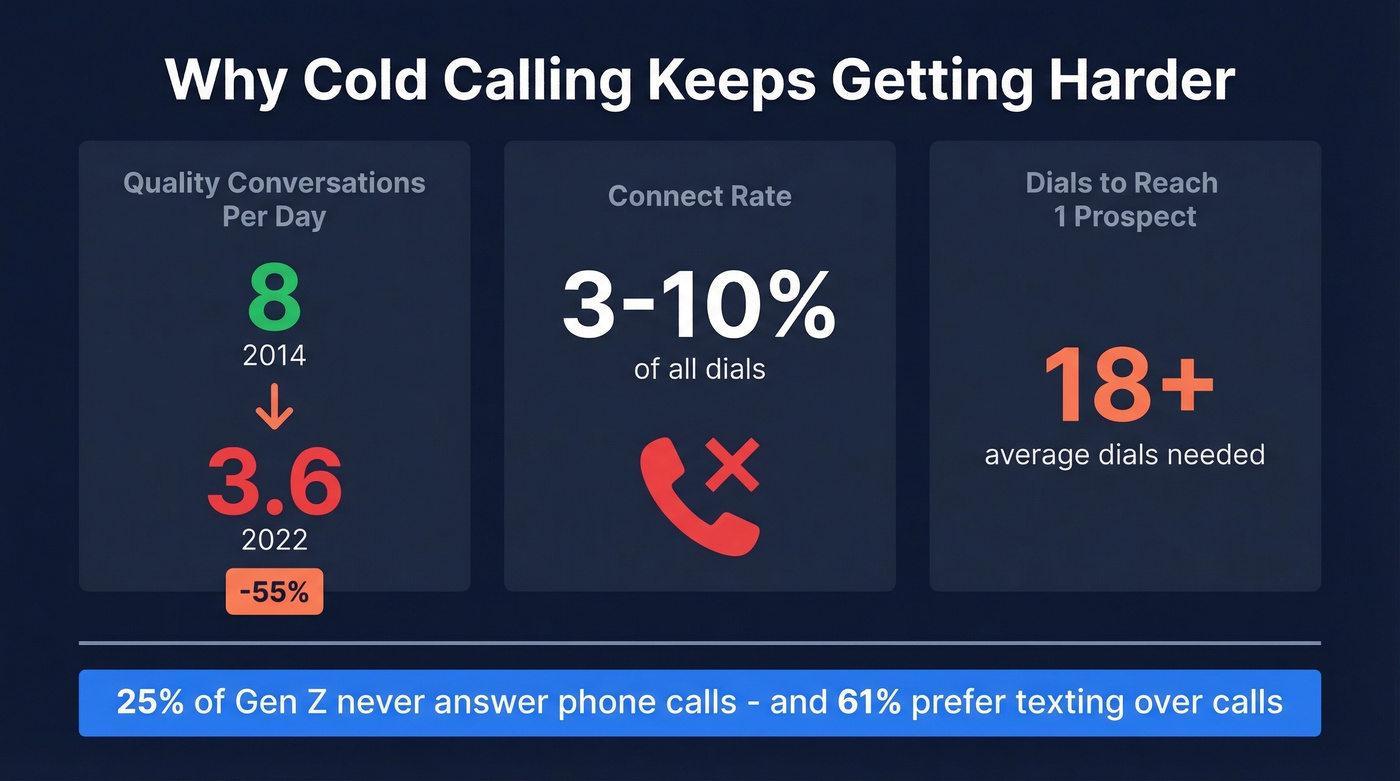
Quality conversations per day dropped from 8 in 2014 to 3.6 in 2022 - a 55% decline. [Connect rates sit at 3-10%](https://pipeline.zoominfo.com/sales/cold-calling-statistics) of dials. Meeting booking rates hover around 2-3%. The most recent SalesHive data puts cold call success rates at roughly 2.3%, with 18+ dials needed to reach a single prospect.
Then there's the generational shift. A 2024 Uswitch study found nearly 25% of Gen Z respondents never answer phone calls, and 61% prefer text-based communication in almost every scenario. Your prospects aren't just busy - they're actively avoiding the phone too.
When 7 out of 10 dials go nowhere, your brain isn't irrational for wanting to skip the next one. It's doing exactly what brains do: protecting you from repeated failure. Better mobile data reduces dead dials and gives you more chances to reach a live person, but even with good numbers, the environment is tougher than it was five years ago.
The Psychology Behind It
Research by Belschak, Verbeke, and Bagozzi found that up to 40% of salespeople suffer from intense sales call anxiety, and more than 60% experience it occasionally. This isn't garden-variety nervousness. It's a cognitive disruption that sabotages working memory and biases your attention toward threat cues.
Here's what that looks like in practice. When you're anxious before a call, your brain starts scanning for danger signals. A prospect's neutral "who is this?" becomes hostile in your mind. A brief pause before they respond feels like rejection loading. Your working memory - the mental workspace you need for active listening, objection handling, and thinking on your feet - gets hijacked by the anxiety itself. That's like asking someone to do mental math while someone shouts numbers at them.
This is why "just push through it" fails. You're not asking reps to overcome laziness. You're asking them to perform a complex cognitive task while their brain runs a threat-detection subroutine in the background.

Half of call reluctance is bad infrastructure, not bad mindset. When 90% of dials hit voicemail or dead numbers, your brain learns to avoid the phone. Prospeo's 125M+ verified mobile numbers refresh every 7 days - not every 6 weeks - so more dials reach real people. Teams using Prospeo see a 30% pickup rate vs. the 11-12% industry average.
Stop training your brain to fear the phone. Start connecting to live prospects.
Signs and the 16 Types
Dudley and Goodson identified 16 distinct types, each with different triggers. Generic coaching fails because it doesn't address the specific fear.
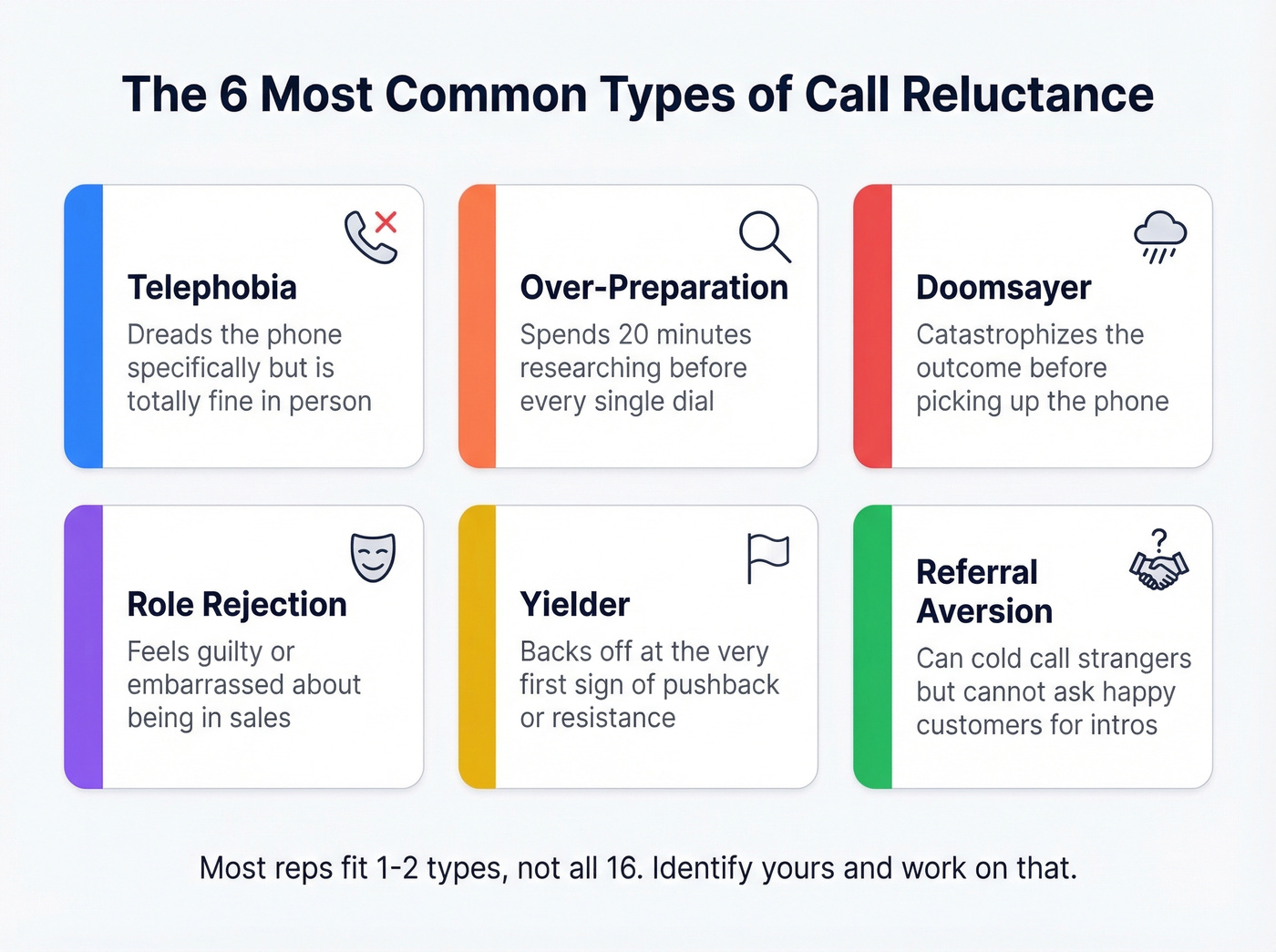
Before getting into the types, it helps to recognize the common warning signs: excessive pre-call research, chronic CRM busywork during call blocks, rationalizing why "now isn't a good time" to dial, and a sudden urge to handle email the moment a session begins. We've all done at least one of these. The six most common types, with a gut check for each:
| Type | Gut Check |
|---|---|
| Telephobia | Phone-specific dread; fine in person |
| Over-Preparation | 20 min of research before every dial |
| Doomsayer | Catastrophizing before you pick up |
| Role Rejection | Guilt about being "in sales" |
| Yielder | Backs off at first sign of resistance |
| Referral Aversion | Can cold call but can't ask for intros |
The remaining ten - Hyper-Pro, Stage Fright, Social Self-Consciousness, Separationist, Emotionally Unemancipated, Online Prospecting Discomfort, Oppositional Reflex, Complex Selling, Sales Extensions, and Arranging Payments - are less common but worth exploring through the SPQ*GOLD assessment if none of the six above fit. Most reps don't fit all sixteen. Identify your one or two, and you've got something to actually work on.
Root Causes
The causes typically fall into three buckets:
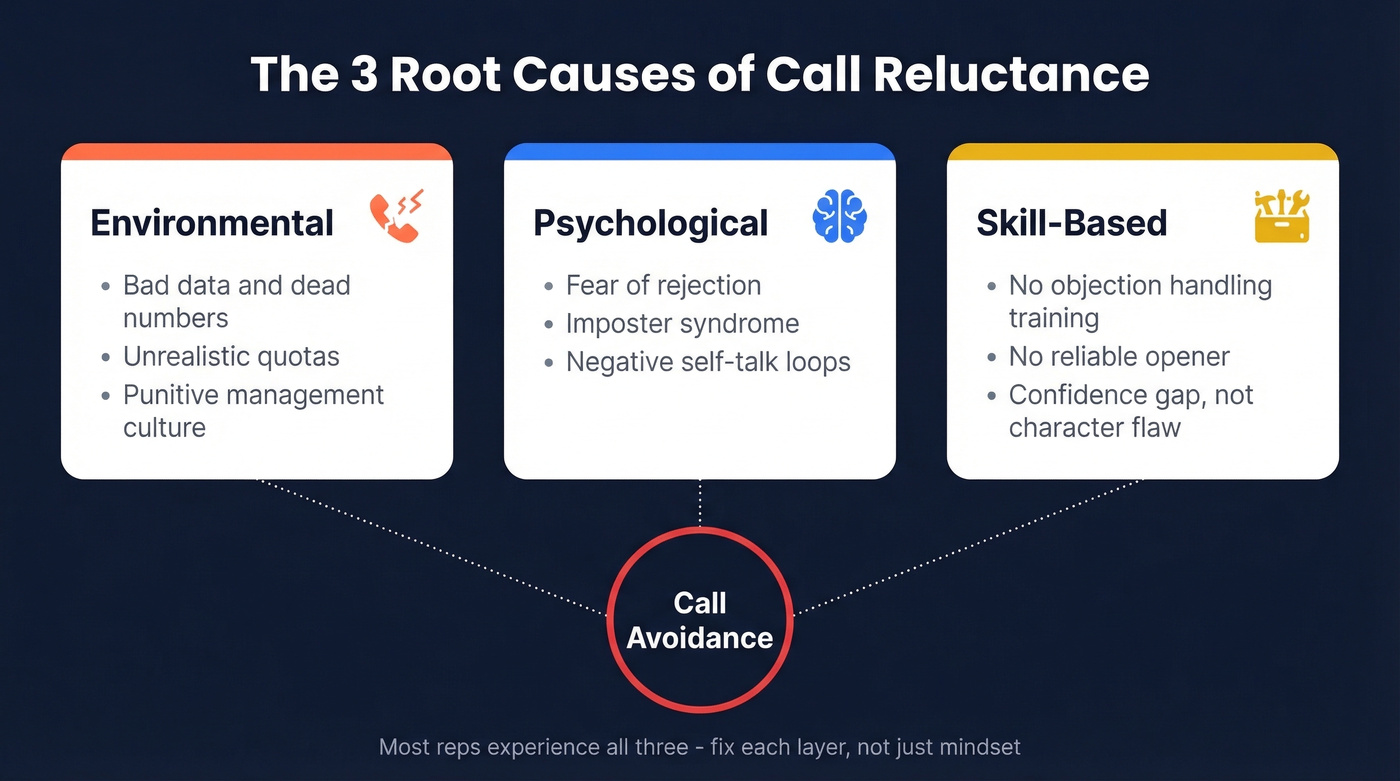
Environmental causes. Bad data, unrealistic quotas, and a punitive management culture all train reps to associate the phone with failure. When 90%+ of dials go to voicemail or disconnected numbers, sales call hesitation is a rational response to a broken system.
Psychological causes. Fear of rejection, imposter syndrome, and negative self-talk create an internal narrative that the next call will go badly. Past experiences - a hostile prospect, a public call review that felt humiliating - reinforce the pattern.
Skill-based causes. Reps who haven't been trained on objection handling or don't have a reliable opener often avoid calling because they genuinely don't know what to say after "hello." Cold call anxiety in this case is a confidence gap, not a character flaw.
Most reps experience a combination of all three. Effective solutions need to address each layer, which is why the next section covers infrastructure and mindset together.
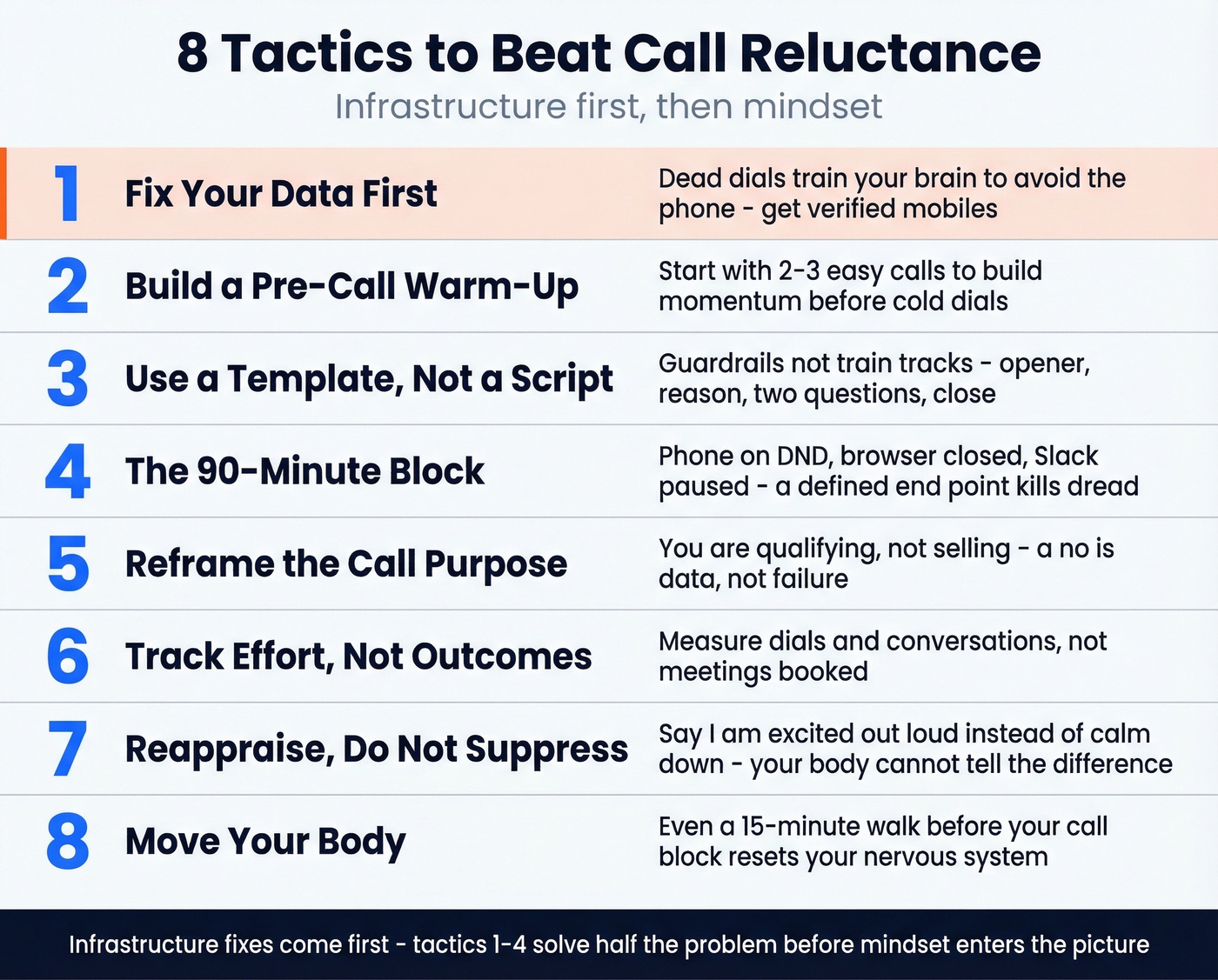
8 Tactics to Overcome Call Reluctance
Most guides focus entirely on mindset. That's only half the problem. The other half is infrastructure.
Fix Your Data First
Look, this is the one nobody talks about, but it matters more than any breathing exercise. Bad numbers create dead dials. Dead dials create demoralization. Demoralization creates avoidance. Inaccurate data can waste 546 hours per rep per year - that's 546 hours of your brain learning that "pick up the phone" means "hear a disconnected tone."
We've seen teams cut avoidance behaviors dramatically just by swapping their data provider. Prospeo's Mobile Finder covers 125M+ verified mobile numbers with a 30% pickup rate, refreshed every 7 days vs. the industry average 6-week cycle. When dials connect to real humans, the negative feedback loop breaks.
Build a Pre-Call Warm-Up
Don't start with the hardest dial on your list. Start with a warm lead or existing customer - two or three easy conversations build momentum and remind your brain that phones aren't exclusively instruments of rejection. This simple warm-up is one of the most effective ways to reduce phone anxiety without relying on sheer willpower.
Use a Template, Not a Script
Scripts create a different kind of anxiety: the fear of going off-book. Templates give you an opener, a reason for the call, two questions, and a close - without locking you into exact words. Guardrails, not train tracks. If you need a starting point, borrow a few talk track examples and adapt them to your voice.
The 90-Minute Block
Ninety minutes of focused calling. Phone on DND. Browser closed. Slack paused. The constraint reduces anxiety because there's a defined end point - you're not "making calls all day," you're making calls until 10:30. That distinction sounds trivial, but in our experience, it's the single biggest behavior change for reps who struggle with open-ended call sessions.
Reframe the Call's Purpose
You're not selling. You're qualifying. Most calls should end in "no" - that's the job working correctly. When the goal shifts from "book a meeting" to "figure out if this person has the problem we solve," a "no" becomes data, not failure. This is also where better sales prospecting techniques help: you’re not guessing who to call next.
Track Effort, Not Outcomes
Dials and conversations, not meetings booked. When your scoreboard is "did I make 60 dials?" instead of "did I book 3 meetings?", you remove the shame spiral from low conversion rates. Process-based metrics protect reps from outcome variance that's often outside their control. If you want a clean list of what to track, use these sales activities examples as your baseline.
Reappraise, Don't Suppress
Instead of trying to "calm down," re-label the feeling as energy you can use. Before your next call block, say "I'm excited" out loud instead of "calm down." It sounds ridiculous. In practice, it helps a lot of reps stop fighting the sensation and start channeling it. The research on anxiety reappraisal backs this up - your body can't easily tell the difference between excitement and dread, so you get to pick the label.
Move Your Body
A workout before your call block - even a 15-minute walk - can take the edge off and reset your nervous system. One rep on r/sales mentioned working out six days a week and doing BJJ 2-3x/week specifically to manage phone anxiety. The body and the brain aren't separate systems.
Coaching Reluctant Reps
The hardest part of managing this issue is that it looks like productivity. The reluctant rep isn't scrolling Instagram - they're writing the perfect email, doing "one more round of research," tweaking their talk track for the fifth time. They're busy. They're just avoiding the thing that moves pipeline.
Make it safe. If reps get punished for admitting they're struggling, they'll hide it. Identify the specific type - a Yielder needs different coaching than a Doomsayer. Track effort first: measure dials and conversations before meetings. And fix the infrastructure before addressing behavior. When reps know their numbers are current and verified, the "this is pointless" narrative loses its power.
Let's be honest: most sales orgs create call reluctance through bad onboarding, bad data, and bad management - then blame the rep. If your team's connect rate is below 5%, the problem isn't your people. It's your list. Skip the motivational speeches and audit your data first. A quick data enrichment pass can also help you salvage lists you already paid for.
546 hours per rep per year wasted on bad data. That's 546 hours of your brain reinforcing the avoidance loop. Prospeo's mobile numbers are verified through a 5-step process and refreshed weekly - so when you dial, someone answers. At $0.01 per lead, fixing your data costs less than one lost deal.
Kill dead dials before they kill your confidence.
When It's More Than Reluctance
There's a spectrum between "I don't love cold calling" and something that needs professional support. Most reluctance lives in the manageable middle - uncomfortable but workable with the right tactics.
But if you recognize yourself in this Reddit post - "Every worknight I lay in bed dreading the next day... horrible task on a loop that never ends" - that's worth paying attention to. Back-to-back calls with no ability to breathe, no recovery time between rejections, compounds into something that outlasts the workday. Persistent dread that follows you home, physical symptoms like chest tightness before call blocks, and an inability to function even after trying every tactic on this list are signs the problem has moved beyond normal reluctance into clinical anxiety territory.
There's no shame in that. A good therapist who understands performance anxiety can do more in a few sessions than any sales training ever will. If you’re rebuilding your system from scratch, start with a simple cold calling system so the process feels predictable again.
FAQ
Is call reluctance the same as laziness?
No. It's a psychological barrier rooted in anxiety, not low motivation. Reluctant reps often work extremely hard in other areas - email, research, CRM hygiene - they just avoid the phone. Dudley and Goodson's research shows it affects top performers as often as underperformers.
How common is cold call anxiety?
48% of B2B salespeople fear cold calls, and 40% of veterans report episodes severe enough to threaten their sales career. Up to 80% of new reps fail in year one partly because they don't initiate enough contact. You're not alone - it's the norm, not the exception.
What's the fastest way to reduce phone anxiety before a call block?
Start with 2-3 warm dials to existing customers or inbound leads, do a 15-minute walk or workout, and set a hard 90-minute end time. Reframing the goal from "book meetings" to "qualify prospects" also removes the pressure that fuels avoidance.
Do better contact data tools actually help with reluctance?
Yes - dead dials are the single biggest reinforcer of avoidance behavior. When 90% of numbers are wrong, your brain learns that dialing equals failure. Verified mobile numbers with higher pickup rates mean more live conversations and fewer demoralizing dead ends. Conversation intelligence platforms like Gong also help reps analyze what's working so they build confidence from real data.
Should managers punish low call volume?
No. Punishing avoidance increases shame, which worsens the problem. Identify the specific fear type, track effort metrics like dials and conversations, and fix the data and tools your reps are working with before addressing behavior. Infrastructure changes first, coaching second.