

Best Calling Software for Sales Teams in 2026
A RevOps lead we know ran a 3-tool dialer bake-off last quarter. The winner wasn't the tool with the best AI features or the slickest dashboard - it was the one connected to verified phone numbers. The other two dialers burned through caller IDs dialing disconnected lines before reps even got warmed up.
That's the dirty secret of calling software in 2026. 57% of senior buyers prefer phone contact over any other channel, yet cold outbound connect rates still hover around 5-10%. The gap isn't your dialer. It's your data.
Here are 12 tools ranked by what actually matters, plus the data layer that separates teams booking meetings from teams burning through caller IDs. We evaluated these based on published pricing, G2 reviews from 3,600+ users, and deployment feedback from sales teams we work with.
Our Picks at a Glance
| Use Case | Pick | Starting Price | Why |
|---|---|---|---|
| SMBs (1-10 reps) | CloudTalk | €19/user/mo | No minimums, 160+ countries |
| Mid-market (10-50) | Nextiva | $15/user/mo | 4.5/5 on G2, strong support |
| Enterprise (50+) | Five9 or RingCentral | $119/seat or $65/agent | Omnichannel, workforce mgmt |
| Verified contact data | Prospeo | Free tier available | 125M+ mobiles, 30% pickup rate |
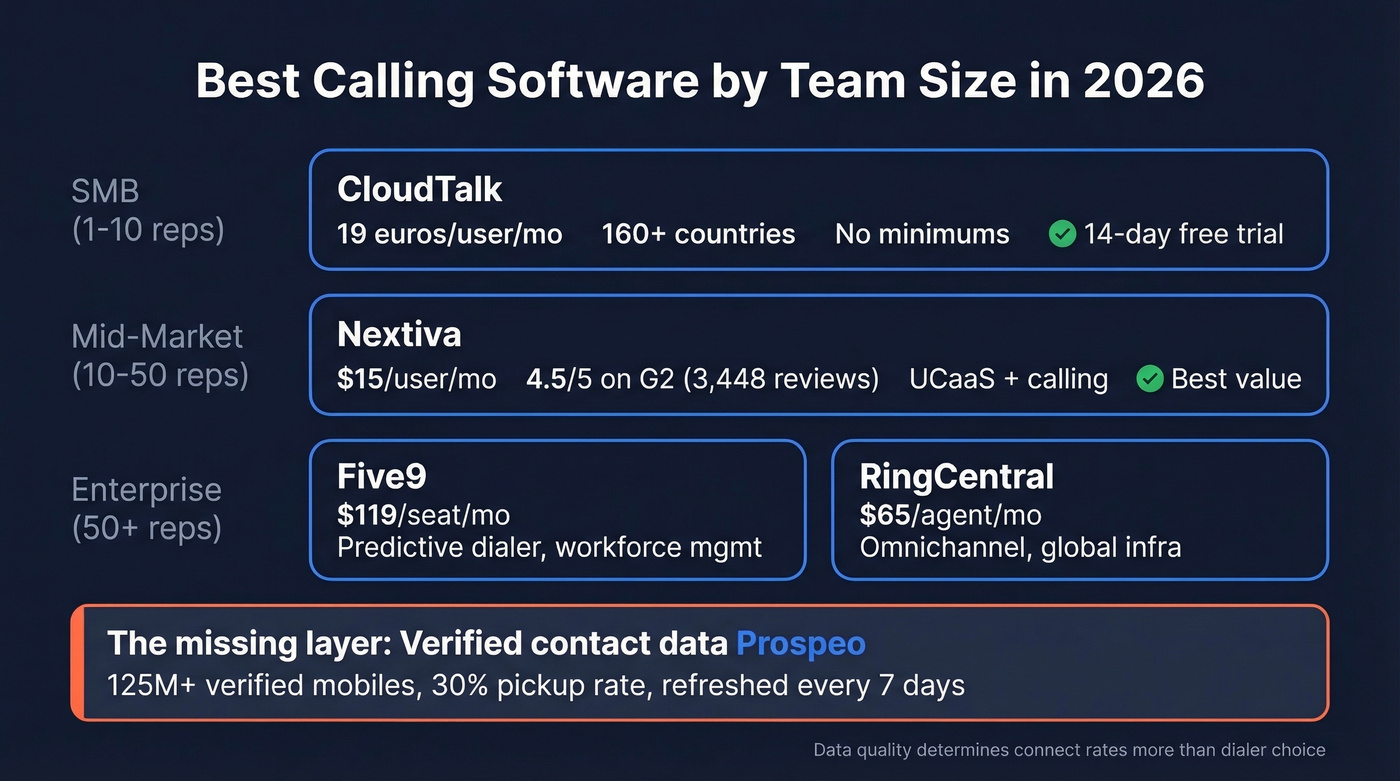
The first three rows are about which dialer to pick. The fourth is about making sure your dialer actually connects.
Fix Your Data Before Your Dialer
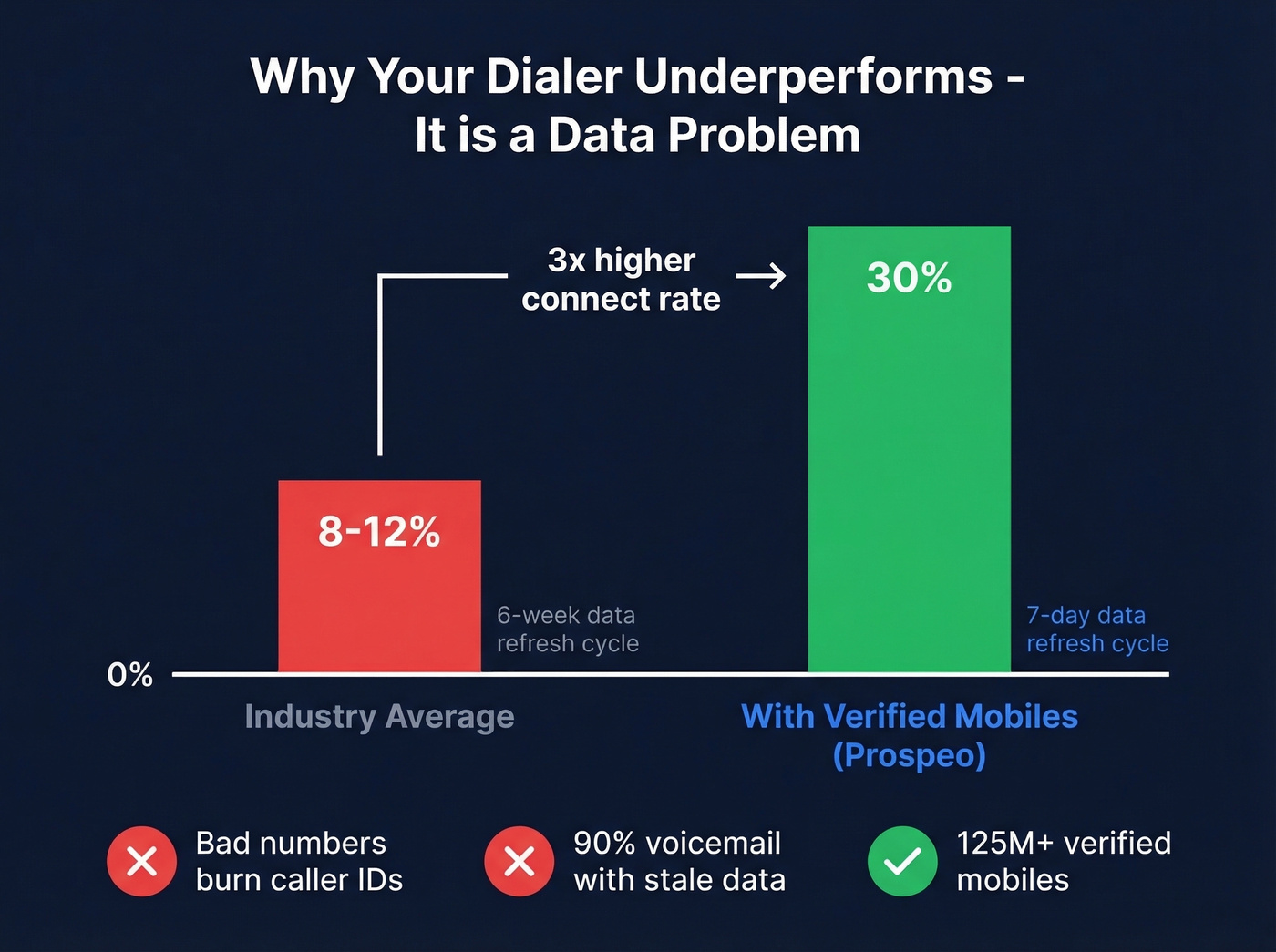
Your calling software ROI depends entirely on data quality. Bad numbers burn caller IDs, waste rep time, and tank connect rates. We've seen teams spend $500/mo on a dialer and $0 on data verification - then wonder why reps hit voicemail 90% of the time.
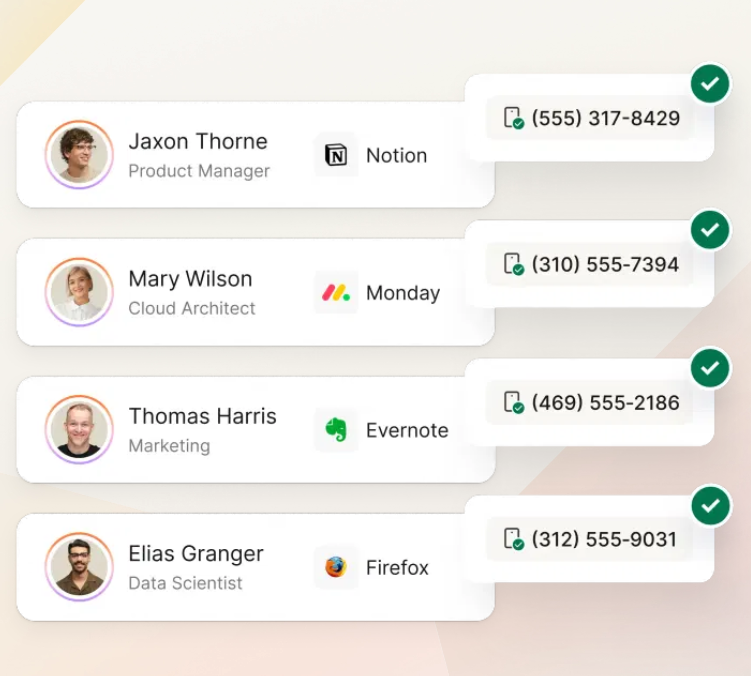
Prospeo's database spans 300M+ professional profiles, including 125M+ verified mobile numbers with a 30% pickup rate across all regions - compared to the 8-12% most teams see. A 7-day data refresh cycle versus the 6-week industry average means you're not dialing numbers that went stale a month ago. (If you're evaluating vendors, compare against other data enrichment services too.)
The 12 Best Calling Software Tools
Nextiva
Nextiva is the most underrated option on this list. Starting at $15/user/mo, it's a low-friction entry point for a full-featured business phone system - and it backs that up with a 4.5/5 rating across 3,448 G2 reviews. That's thousands of teams validating the product, not a niche score from 50 early adopters.

Customer support is consistently praised on G2, and ease of use is a top positive across reviews. Contact center plans start at $75/agent/mo for omnichannel, and you get unified communications and calling in one UCaaS platform. On the downside, configuration gets complex for larger deployments, and it isn't purpose-built for high-volume outbound - it's a UCaaS platform with calling, not a dedicated sales dialer.
Hard to beat for the money. If you're a mid-market team that needs reliable calling without enterprise complexity, Nextiva should be your first demo.
Aircall
Aircall is the name everyone knows in SMB sales dialing. The problem is the pricing math. The headline says $30/license/mo billed annually - but that's before the add-ons start stacking.
For a 5-rep team on Professional, the real cost looks like this: base seats run 5 x $50/mo at $250, two additional numbers add $12/mo, the analytics add-on costs 5 x $15/mo at $75, and AI features tack on 5 x $9/mo at $45. Total: ~$382/mo - not the $150/mo you'd expect from the headline.
The UI is clean, onboarding is fast, and CRM integrations with HubSpot, Salesforce, and Pipedrive work well. Call recording is included on Essentials and Professional, and the 3-user minimum is reasonable for small teams. But call quality complaints are persistent - jitter and dropped calls show up in reviews regularly, the mobile app lags, and support is 24/5 chat on lower tiers, so Friday evening outages wait until Monday.
The $30/seat number gets people in the door. The $70-85/seat reality is what hits the credit card. Do the math before you commit.
RingCentral
RingCentral is the enterprise default. RingCentral Contact Center starts at $65/agent/mo, and the full suite runs $65-145/agent/mo depending on modules. Powerful and proven, but complex enough to justify a dedicated admin.
True omnichannel - voice, chat, email, social in one platform - with workforce management and analytics built in at higher tiers. The integration ecosystem is massive, and global infrastructure supports distributed teams well. That said, its G2 rating sits at 4.1/5 across 185 reviews, with "call issues" and "call functionality" as recurring negatives, and implementation can stretch weeks for the full suite.
RingCentral wins when you need a platform handling everything from inbound support to outbound sales to internal communications. For a 50+ seat operation with multiple channels, it earns its price. For a 10-person SDR team? You're buying a freight truck to deliver groceries.
CloudTalk
Use this if: You're running an international or remote sales team and need local numbers in dozens of countries without per-number surcharges. CloudTalk's Lite plan starts at €19/user/mo billed annually, includes local numbers in 160+ countries, and has no user minimums. SOC 2, GDPR, and HIPAA compliant out of the box.
Skip this if: You need a built-in power or parallel dialer on day one. CloudTalk lists those as add-ons, not included in the base plan. Budget for them separately.
Five9
Use this if: You're running a 50+ seat contact center and need workforce management, omnichannel routing, and enterprise-grade uptime. Five9 starts at $119/seat/mo - enterprise pricing that delivers enterprise capabilities.
Skip this if: You have fewer than 25 reps. No free trial, heavy onboarding, and you're paying for workforce optimization tools that only matter at scale. Under 25 reps, you're overpaying by 3x compared to Nextiva or CloudTalk.
Dialpad
Use this if: AI-native features matter and budget is tight. Dialpad starts at ~$15/user/mo with a 14-day free trial.
Skip this if: You need a dedicated outbound sales dialer with parallel lines. Dialpad is a business communications platform, not a power-dialing machine. (If you're comparing options, see our Dialpad alternatives.)
Kixie
Parallel dialing is Kixie's whole identity. The Multi-Line PowerDialer supports up to 10 simultaneous lines, and the AI Human Voice Detection add-on (+$30/month) filters out voicemails so reps only connect with live humans. The 7-day free trial requires no credit card.
The catch: as of early 2026, Kixie's pricing page lists plans and features but doesn't show dollar amounts. Not publishing pricing in 2026 is a red flag. Expect $75-150/user/mo based on comparable parallel dialing tools. For context, enterprise parallel dialers like ConnectAndSell run $1,495/mo per rep - so Kixie sits in a reasonable middle ground between budget dialers and the high end.
Gong
Gong runs ~$6,000+/year per rep, delivers 94% transcription accuracy, and is genuinely phenomenal for understanding why deals win or lose. But it doesn't dial. It records and analyzes conversations - it's a coaching layer you add on top of a dialer, not a replacement for one.
Vonage
Vonage is a legacy VoIP player that's also a major CPaaS and UCaaS platform. Contact center pricing is quote-based; expect around $60-120/agent/mo depending on features. Vonage's API-first architecture makes it a strong pick for teams with developer resources who want to customize call flows, but it's overkill if you just need a straightforward dialer.
Allo
SMB-focused cold calling tool with a Starter plan at $18/user/mo and Business at $32/user/mo. Offers a 7-day trial. Worth a look if you're a small team that wants a simple, purpose-built outbound dialer without UCaaS overhead.
JustCall
CCaaS platform with built-in auto-dialers starting at $29/user/mo billed annually. Offers a 14-day free trial. Solid middle ground between a basic phone system and a full contact center, though it lacks the depth of Five9 or RingCentral at the enterprise level.
CallTools
Quote-based pricing with no published rates - talk to sales. The pitch is unlimited minutes and zero commitment, plus a built-in CRM. Based on comparable predictive dialing platforms, expect $100-200/user/mo. I haven't tested CallTools deeply enough to recommend it confidently, but it's worth requesting a demo if unlimited minutes matter to your cost model.
Honorable mentions: Squaretalk, Readymode, and PhoneBurner ($149/user/mo) all deserve a look depending on your specific use case. Nooks is worth watching too - teams report 215% connect rate improvements with their AI-powered parallel dialer at $95-195/mo.

Every dialer on this list dials the same way. The difference is what happens when the call connects - or doesn't. Prospeo gives your reps 125M+ verified mobile numbers with a 30% pickup rate, refreshed every 7 days. That's 3x the connect rate most teams see with stale data.
Stop burning caller IDs on disconnected lines.
Pricing Comparison
Every tool side by side. These are starting prices - your actual cost depends on seats, add-ons, and billing cycle.
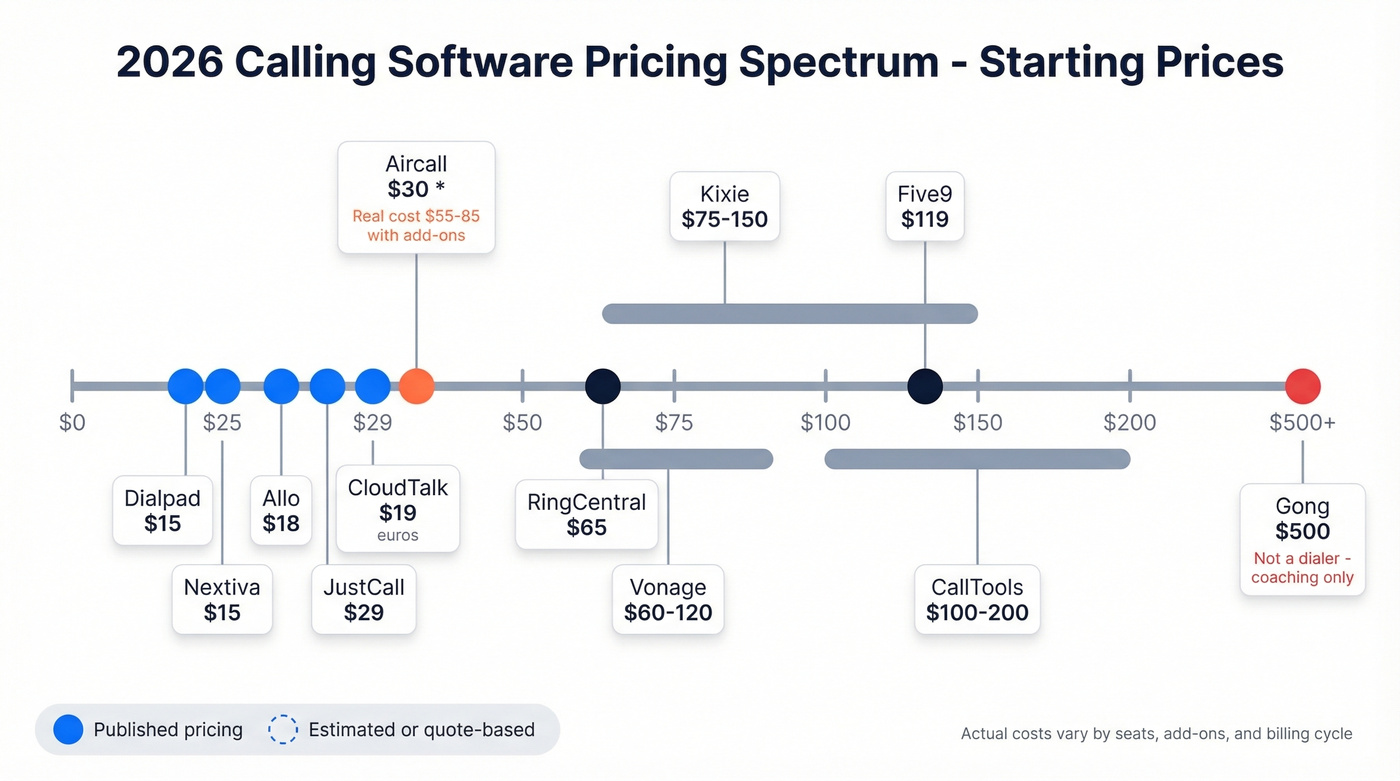
| Tool | Starting Price | Free Trial | Min Users | Dialer Type |
|---|---|---|---|---|
| Nextiva | $15/user/mo | No | 1 | Standard |
| Aircall | $30/license/mo* | 7-day | 3 | Power (add-on) |
| RingCentral | $65/agent/mo | No | 1 | Omnichannel |
| CloudTalk | €19/user/mo | 14-day | 1 | Power/parallel (add-on) |
| Five9 | $119/seat/mo | No | Contact sales | Predictive |
| Dialpad | $15/user/mo | 14-day | 1 | Standard |
| Kixie | ~$75-150/user/mo | 7-day | Contact sales | Parallel (10 lines) |
| Vonage | ~$60-120/agent/mo | No | 1 | Standard/CCaaS |
| Gong | ~$500/user/mo | No | Contact sales | Not a dialer |
| Allo | $18/user/mo | 7-day | 1 | Power |
| JustCall | $29/user/mo | 14-day | 1 | Auto |
| CallTools | ~$100-200/user/mo | No | Contact sales | Predictive |
*Aircall's $30 base jumps to $55-85/seat with analytics ($15), AI ($9), and extra numbers ($6 each).
TCPA Compliance in 2026
This isn't optional. If your outbound dialer doesn't help you stay TCPA-compliant, you're building on a legal landmine.
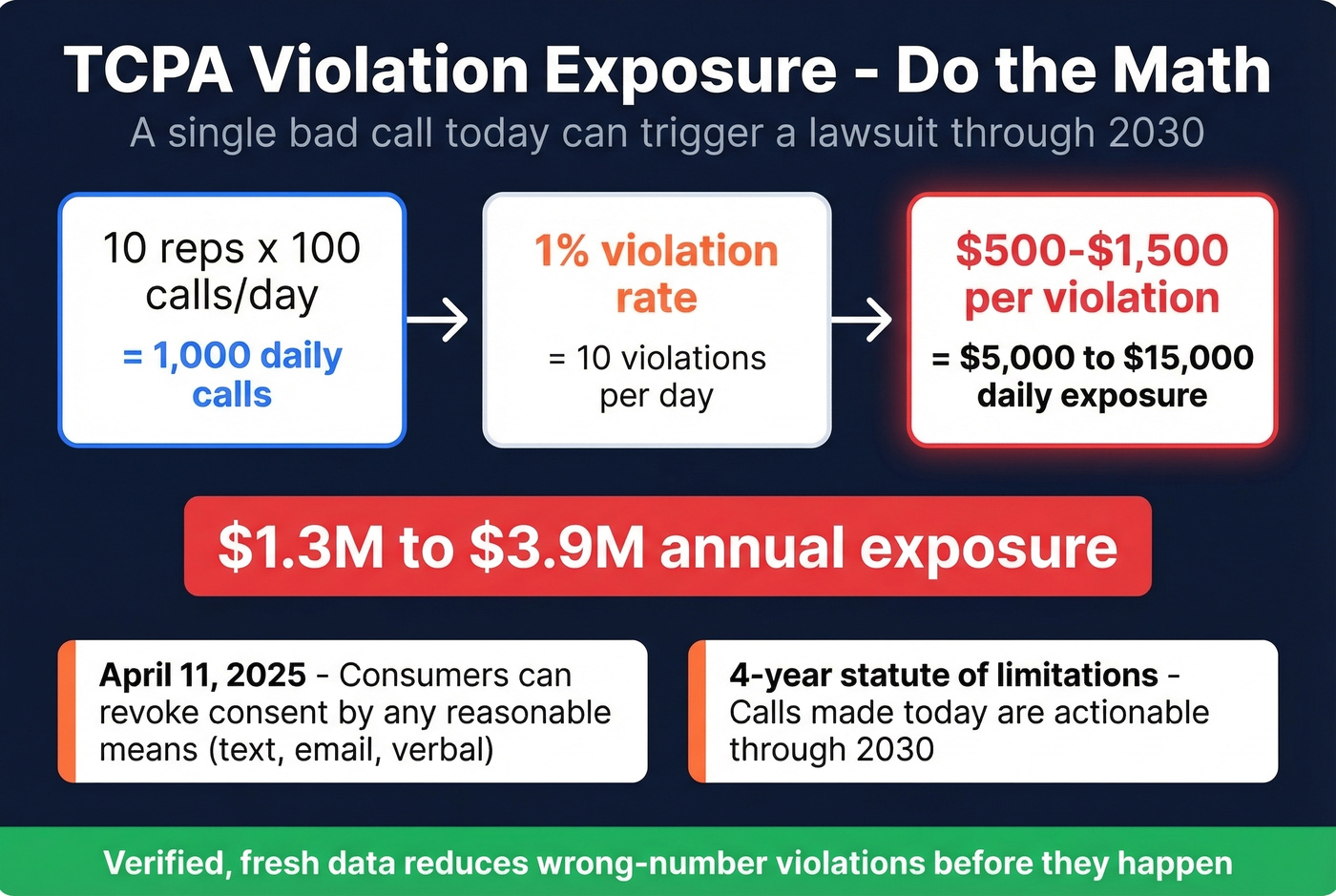
Penalties run $500-$1,500 per violation with a 4-year statute of limitations. A call you make today can trigger a lawsuit in 2030. For a 10-rep team making 100 calls per day, even a 1% violation rate adds up to terrifying exposure.
The biggest regulatory shift landed on April 11, 2025, when consumers gained the right to revoke consent by any reasonable means - not just texting "STOP." A reply email, a voicemail, even a social media message now counts. Your team has 10 business days to honor that revocation. A broader universal revocation provision took effect April 11, 2026, expanding the scope across message types.
Carrier-level blocking is the other headache. Even compliant calls get mislabeled as spam by carrier analytics. Your reps can be doing everything right and still get flagged.
Your calling software must support:
- Automatic DNC list scrubbing before every dial session
- Consent tracking with timestamps and source documentation
- Opt-out automation that processes revocations within 10 business days
- Number reputation monitoring and caller ID rotation
Any tool on this list that doesn't offer at least DNC scrubbing and consent tracking should be disqualified immediately.
The Real Cost of Calling Software
Let's run two scenarios for a 5-rep team.
Scenario 1: Aircall "full stack." Aircall Professional with analytics and AI add-ons runs ~$382/mo for 5 reps. Add a CRM at $0 for HubSpot free or $75+/mo for Salesforce Starter, and you're at $382-$457/mo. That's $76-$91 per rep per month just for dialing and basic CRM.
The industry benchmark for a practical value stack runs $350-$400/mo per rep when you include dialer, CRM, transcription, and data. Most teams can get under $200/mo per rep by choosing tools that do one thing well instead of platforms bundling features they'll never activate.
Here's the thing: if your average deal size sits below $10k, you almost certainly don't need a $119/seat enterprise dialer. A $15-30/seat dialer paired with verified data will outperform a $500/mo all-in-one platform with stale phone numbers every single time. The data layer is where connect rates live - not the dialer chrome. (If you're building the rest of your outbound stack, start with an SDR tools shortlist.)
Teams spend $50-$145/seat/mo on calling software, then feed it unverified numbers. Prospeo's verified mobiles cost $0.10 each and pick up 30% of the time - compared to the 8-12% industry average. Your dialer doesn't need an upgrade. Your data does.
Fix your data layer and watch your connect rates triple.
How to Choose by Team Size
1-10 reps: Keep it simple. CloudTalk or Dialpad for the dialer, HubSpot free for CRM. Total cost under $50/rep/mo. At this size, you don't need workforce management or omnichannel routing - you need reps making calls to numbers that actually connect. (If you're still standardizing your process, build a repeatable cold calling system.)
10-50 reps: Nextiva becomes the sweet spot. The $15/user/mo entry point scales well, customer support is genuinely excellent, and the contact center tier at $75/agent/mo is there when you need it. Layer in conversation intelligence at this stage - AI-personalized calls show 36% higher meeting conversion rates. Coaching ROI starts compounding here. If you're also tightening outbound messaging, borrow proven sales prospecting techniques.
50+ reps: Five9 or RingCentral. You need workforce management, predictive routing, and enterprise compliance features. The $119+/seat price tag hurts, but at this scale you're optimizing for utilization rates and handle times, not just connect rates.
FAQ
Is cold calling still legal in 2026?
Yes, cold calling is legal in 2026 with proper TCPA compliance. You must scrub against the National DNC registry, obtain and document consent where required, and honor opt-out requests within 10 business days. Penalties run $500-$1,500 per violation with a 4-year statute of limitations, so compliance isn't optional - it's existential.
What's the best free trial for sales dialers?
No fully free dialer is worth recommending for outbound teams. CloudTalk and Dialpad offer 14-day trials; Kixie gives 7 days with no credit card required. Use trials to test call quality and CRM integration before committing. For the data side, Prospeo offers a permanent free tier with 75 verified emails and 100 extension credits per month.
Do I need a separate CRM with my dialer?
You need a CRM - the question is whether it's bundled or separate. Most tools on this list integrate natively with HubSpot and Salesforce. Nextiva and RingCentral bundle light CRM features, but dedicated CRMs handle pipeline management better. Start with HubSpot free and upgrade when you outgrow it.
How do I improve cold call connect rates?
Start with verified phone numbers - that's the single biggest lever. After data quality, use local presence dialing so your caller ID matches the prospect's area code, call between 10-11 AM and 4-5 PM in the prospect's timezone, and rotate caller IDs to avoid spam flags.
Power dialer vs. predictive dialer?
Power dialers call one number at a time automatically, advancing to the next as soon as a call ends - ideal for teams under 25 reps. Predictive dialers call multiple numbers simultaneously and connect reps only when someone answers, delivering higher throughput but risking "dead air" if the algorithm misfires. Parallel dialers like Kixie's sit in the middle with multiple lines and AI detection to filter voicemails.