

Catch-All Email Verification: What Works in 2026
A cold email agency running 20+ client accounts hit a nasty surprise last quarter: two catch-all verification tools were returning false-positive "valid" results, and bounce rates climbed the moment those contacts were actually mailed. That's the core problem with catch-all email verification - a "green" label can still burn you.
The scale is brutal. Somewhere between 40% and 60% of B2B email addresses sit on catch-all domains, especially at mid-market and enterprise companies. If your verification tool can't handle them, it can't handle your list.
Here's the short version: no catch-all verifier is 100% accurate - the protocol makes it impossible. The best dedicated options are Scrubby (send-and-watch), BounceBan (SEG pattern analysis), and ZeroBounce (activity scoring). But the smarter move is starting with cleaner data upstream so catch-alls never become your problem in the first place.
What Is a Catch-All Email?
A catch-all (or "accept-all") server accepts every email sent to its domain, regardless of whether the specific mailbox exists. Companies configure them to catch typos, block address enumeration, and keep routing flexible.
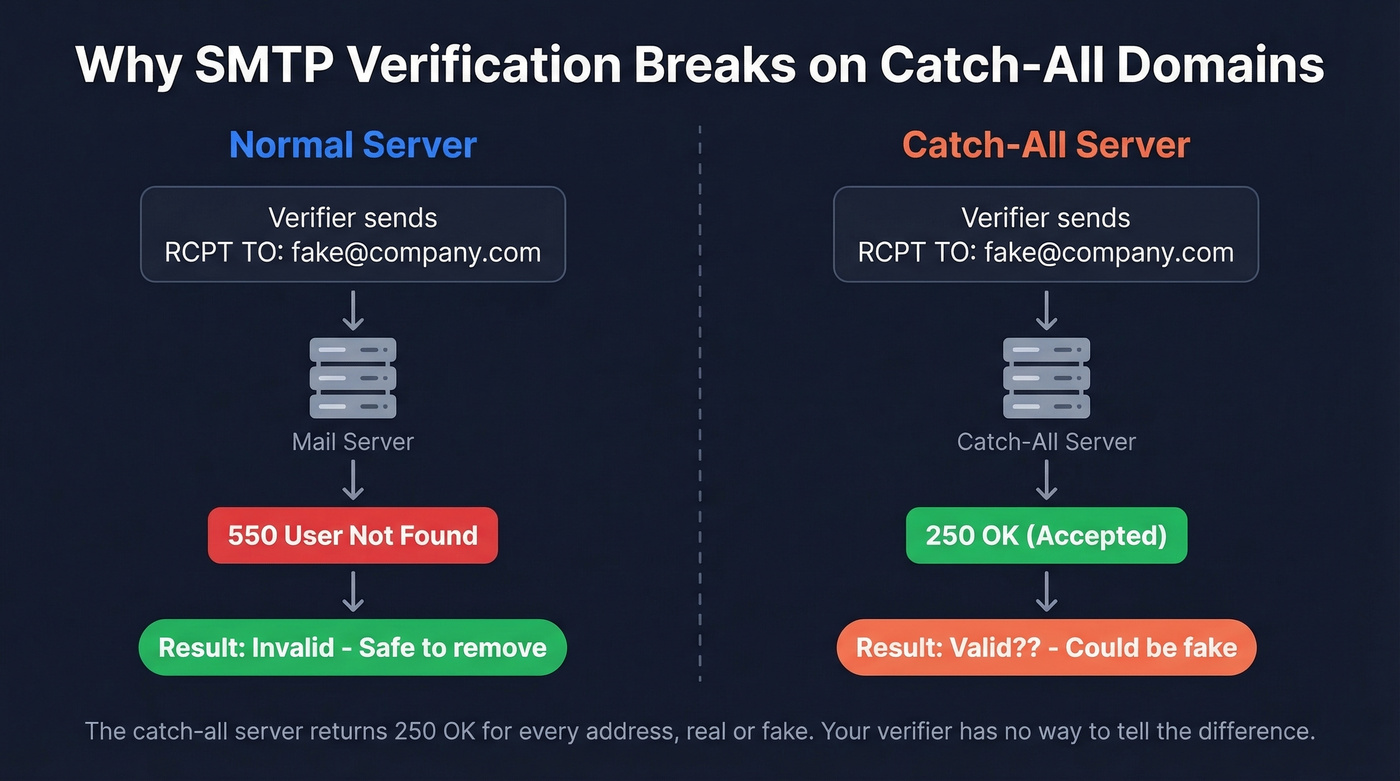
The problem shows up at the SMTP level. When a standard verification tool sends an SMTP RCPT TO command for a nonexistent address, a normal server replies [550 User not found](https://en.wikipedia.org/wiki/List_of_SMTP_server_return_codes). A catch-all server replies [250 OK](https://datatracker.ietf.org/doc/html/rfc5321) - for real addresses and fake ones alike. Send RCPT TO: xyzrandom123@enterprise.com and you'll get the same 250 OK as the CEO's actual inbox.
The protocol literally can't tell the difference.
Most verifiers detect catch-all domains by probing with a random nonsense address. If the server accepts it, the domain gets flagged as catch-all. But that only tells you the domain is catch-all - it says nothing about whether your specific contact's mailbox is real. This is why verifying addresses on accept-all domains remains one of the hardest problems in email deliverability.
Why Standard Verification Fails
Standard SMTP verification relies on the server rejecting bad addresses. When the server accepts everything, the entire model collapses. Your verifier sees 250 OK, marks the email "valid," and moves on - with no way to know it just validated a nonexistent mailbox.
Enterprise gateways like Mimecast, Proofpoint, and Barracuda make this worse. They sit in front of the actual mail server and accept inbound mail without returning the rejection signals verifiers depend on. Even if the underlying mailbox doesn't exist, the gateway swallows the message. Your verifier never sees a rejection, and your campaign analytics might not see a bounce either. The email just vanishes. Some providers - Yahoo, iCloud, ProtonMail - block SMTP checks entirely, making any verification result on those domains a guess.
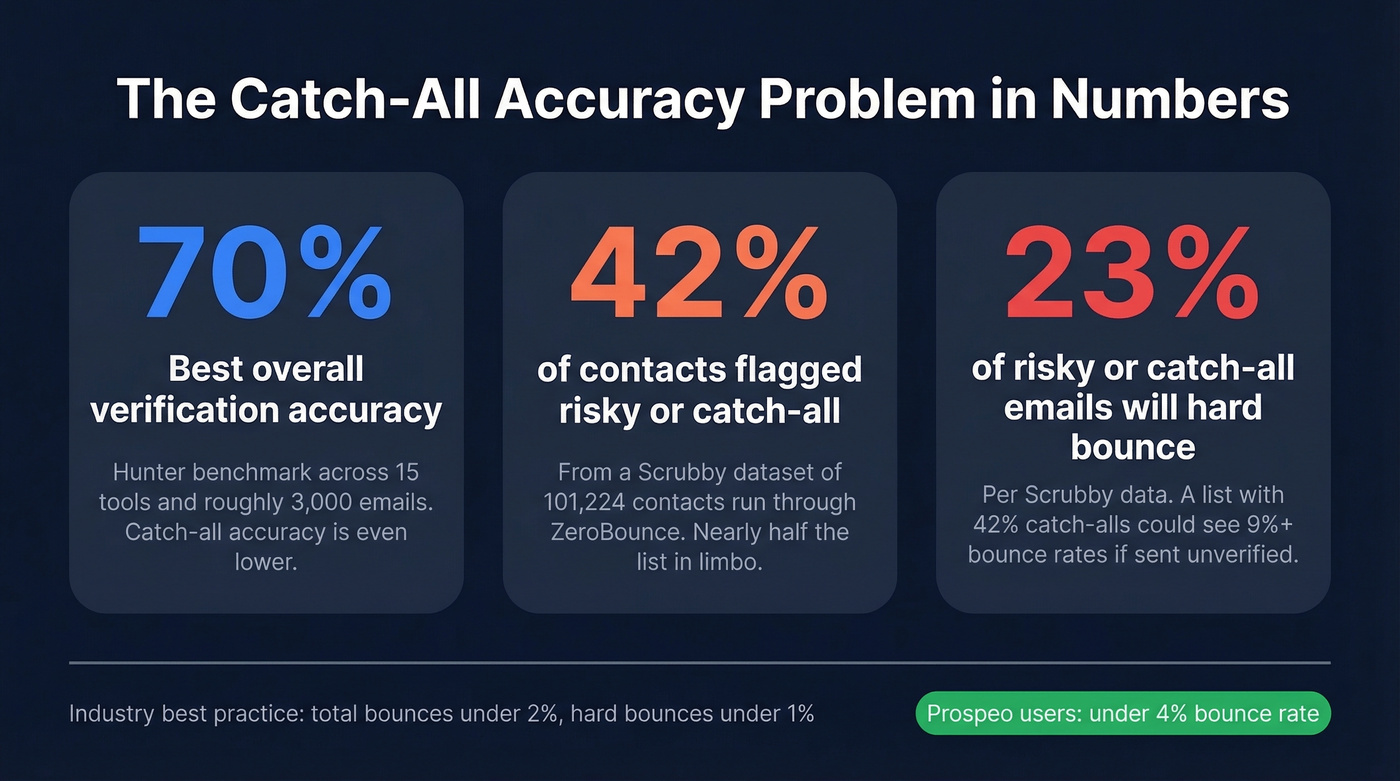
Scrubby's data suggests 23% of risky or catch-all emails will hard bounce. A list with 42% catch-alls could see a 9%+ bounce rate if sent unverified, and industry best practice is keeping total bounces under 2%, with hard bounces under 1%. One bad batch is all it takes to flag your domain with major inbox providers (and force you into sender reputation cleanup mode).
4 Methods to Verify Catch-All Emails
Since SMTP alone is useless on catch-all domains, dedicated tools have developed four alternative approaches. Each has real limitations.
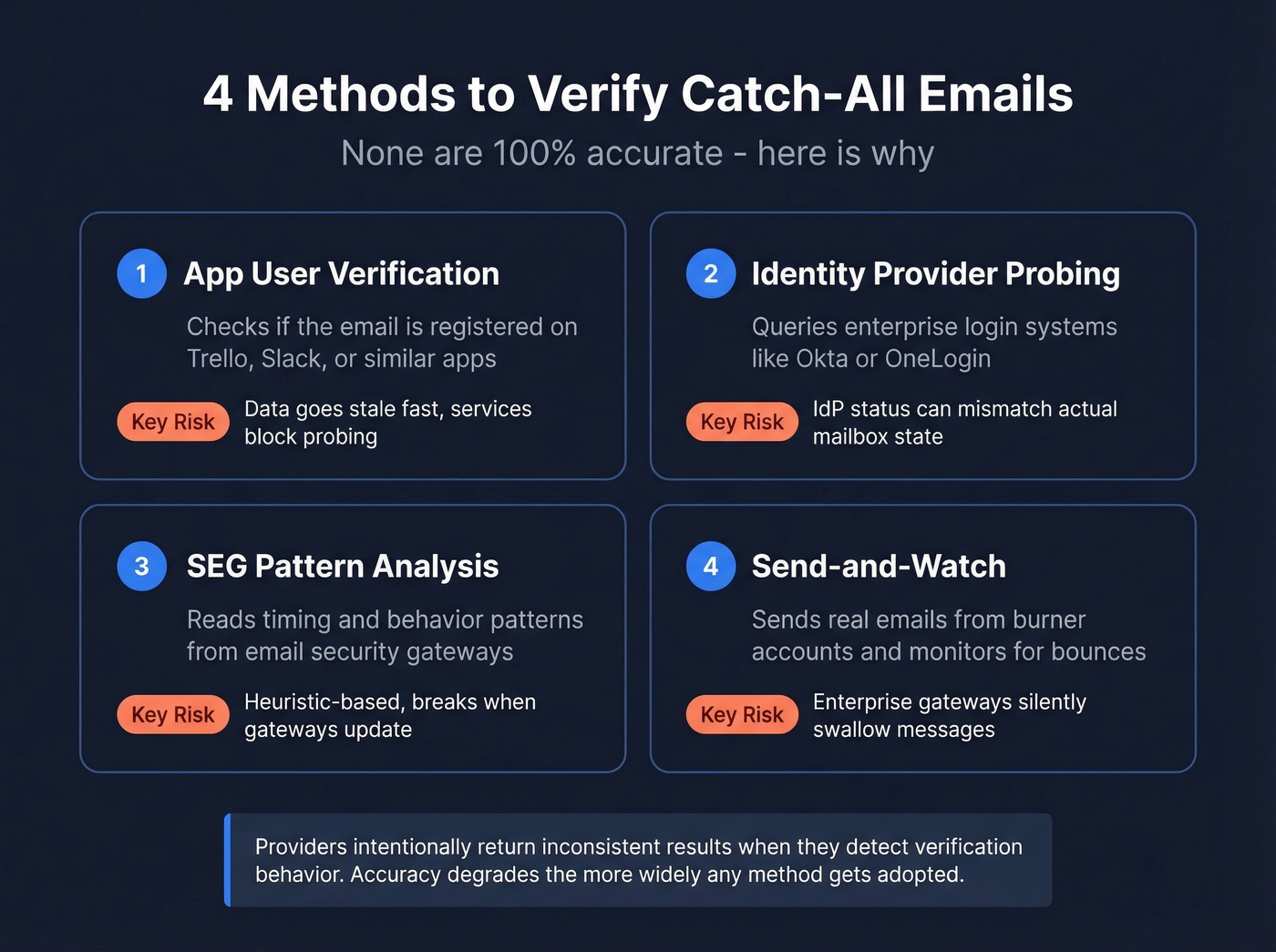
| Method | How It Works | Key Limitation |
|---|---|---|
| App User Verification | Checks third-party signups (Trello, Slack) for "account exists" signals | Can be stale; increasingly blocked |
| Identity Provider Probing | Queries enterprise IdPs like Okta or OneLogin | Authoritative but can mismatch mail state |
| SEG Pattern Analysis | Infers status from gateway behavior and timing | Heuristic-heavy; breaks when gateways update |
| Send-and-Watch | Sends real emails via burner accounts, monitors bounces | Enterprise servers may silently swallow messages |
None of these are reliable in isolation. Providers intentionally return inconsistent results when they detect verification behavior, which means accuracy degrades the more widely a method gets adopted. Any tool promising 100% accuracy is selling something the protocol can't support.

42% of your list stuck in catch-all limbo? That's a downstream problem. Prospeo's proprietary 5-step verification - with catch-all handling, spam-trap removal, and honeypot filtering - resolves addresses before they ever hit your list. 98% email accuracy. Under 2% bounce rates without a single extra tool.
Fix the data upstream and catch-all verification becomes irrelevant.
The Accuracy Reality Check
We've tested multiple catch-all verifiers and consistently see the same pattern: confident labels, unreliable results. A Hunter benchmark tested 15 verification tools against roughly 3,000 real business emails. The top overall accuracy score was 70% - and that was Hunter topping its own benchmark, using a dataset derived from Hunter's activity that likely advantages it. Accuracy on accept-all domains specifically would be lower, because those are the hardest addresses to validate.
On Reddit, one practitioner dropped their bounce rate from 2.1% to 0.9% after they stopped trusting their verification service and started inspecting raw signals manually. Another on r/coldemail called NeverBounce's approach "sketchy AI" - reflecting widespread distrust of opaque scoring methods. The community consensus is blunt: nobody trusts any single tool to accurately validate catch-alls.
Here's what surprised us: a Scrubby dataset showed that out of 101,224 contacts run through ZeroBounce, 42% came back as risky or catch-all. That's nearly half the list in limbo, and there's no clean answer for how to handle that volume with downstream tools alone.
Tools Compared for 2026
| Tool | Approach | Pricing | Notes |
|---|---|---|---|
| Scrubby | Send-and-watch (burner accounts) | $27/mo (1K) - $247/mo (10K) | Most aggressive; enterprise servers may not bounce |
| BounceBan | SEG pattern analysis | Free single checks; ~$1.45/1,000 at scale | Cheapest at volume; heuristic accuracy unverified |
| ZeroBounce | Activity scoring + SMTP | 100 free/mo; ~$0.01--$0.00275/email | Flags catch-alls; activity scoring helps triage |
| Catch-all Verifier | Dedicated SMTP+ | 100 free trial; 5K for $35 | Limited methodology transparency |
| Listmint | Combined SMTP + catch-all | $99/mo (20K + 5K catch-all) | Separate credit pools for standard vs. catch-all |
| Allegrow | Signal-based analysis | 1K free; ~$200 - 400/mo est. | Enterprise-focused; pricing not public |
| Instantly | Catch-All Verification (credit-based) | Included via credits; free trial includes 100 | Tied to Instantly ecosystem |
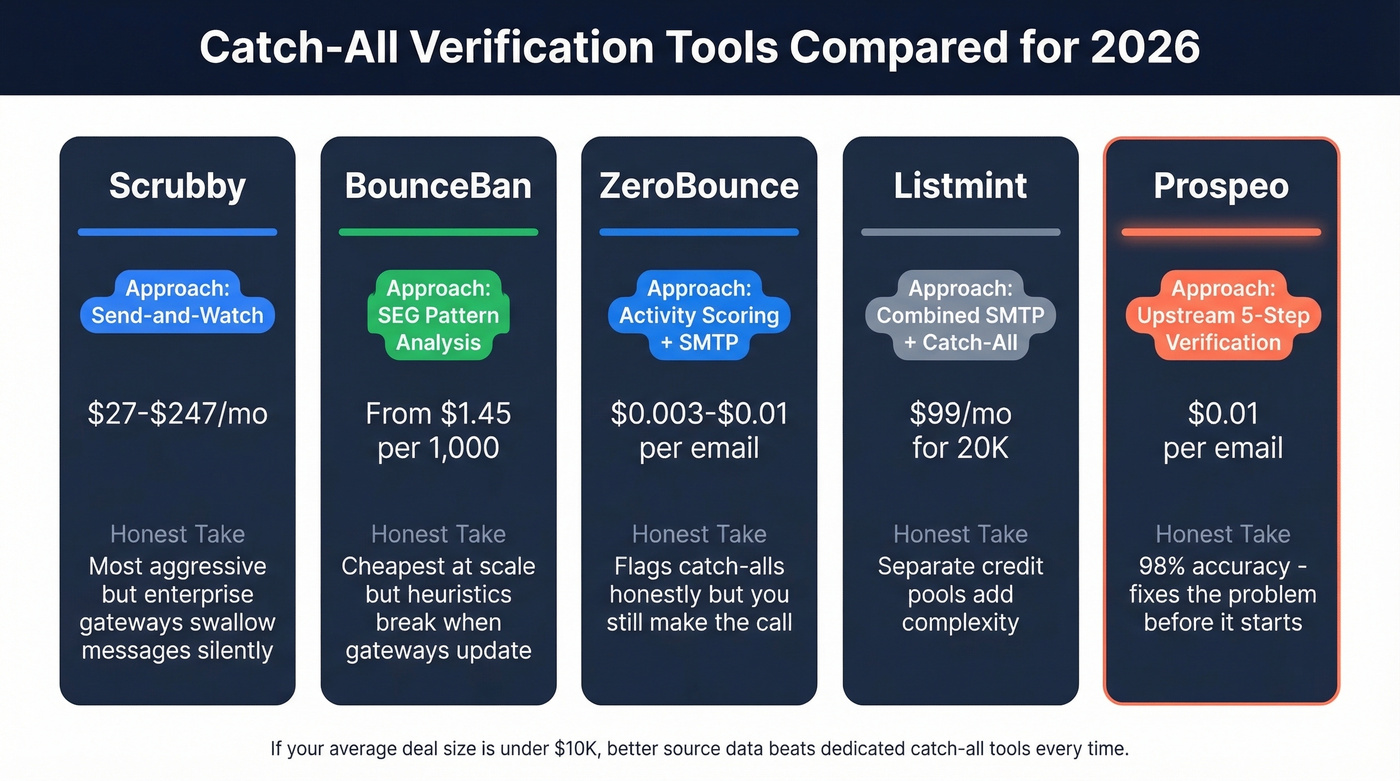
Scrubby is the most aggressive option - it literally sends emails from burner accounts and watches what bounces. At $27/mo for 1,000 credits, it's affordable for targeted verification on high-value contacts. The catch: it won't work when enterprise gateways silently swallow messages instead of bouncing them, which is exactly what Mimecast and Proofpoint do.
BounceBan is cheaper at scale (about $1.45 per 1,000 at the 1M-credit level) but more fragile than Scrubby's brute-force approach. Gateway vendors update their systems regularly, and the patterns BounceBan relies on shift underneath it. In our experience, the 40-60% catch-all prevalence figure is conservative for enterprise-heavy lists, which makes BounceBan's heuristic approach a gamble on exactly the domains that matter most.
ZeroBounce is the most established name, but catch-alls are still a decision problem for it, not a certainty problem. It flags catch-all behavior and layers in activity scoring so you can decide whether to keep, warm, or suppress those contacts. That's honest, at least - but it means you're still making the call.
Let's be honest about something: if your average deal size is under $10K, you probably don't need dedicated catch-all verification at all. The cost of these tools plus the time spent managing them exceeds the cost of just starting with better source data (and tightening your sales prospecting techniques so you email fewer, better-fit accounts).
Start With Better Data Instead
If 42% of your list is catch-all, your data source is the problem. Running a bad list through a catch-all verifier is treating symptoms.
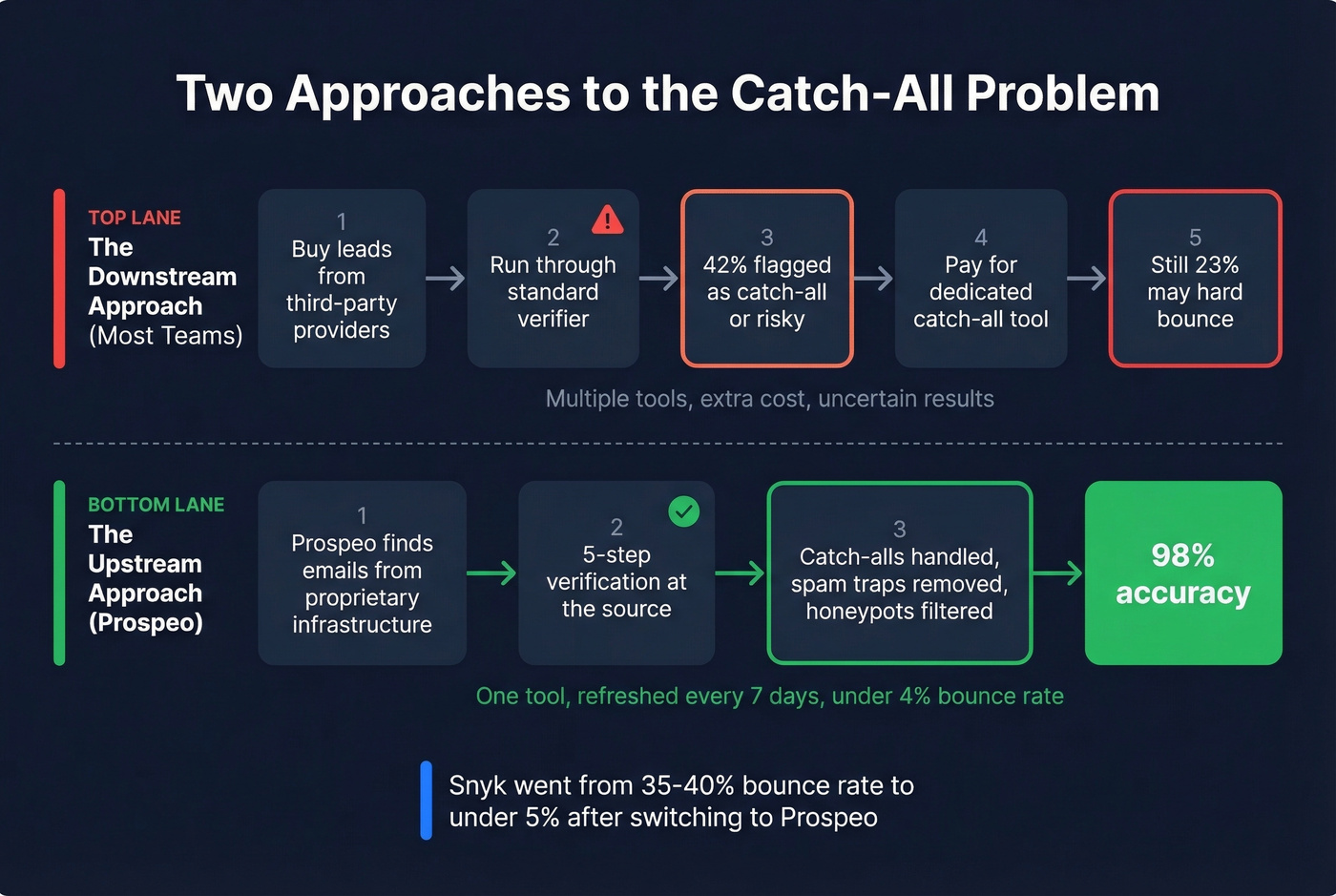
Prospeo's 5-step verification process handles catch-all domains, removes spam traps, and filters honeypots before an email ever enters your pipeline. Because it runs proprietary email-finding infrastructure rather than pulling from third-party providers, the verification happens at the source - with all records refreshed on a 7-day cycle versus the 6-week industry average. The result is 98% email accuracy across 143M+ verified addresses (and fewer headaches from spam trap removal).
The proof is in the deliverability numbers. Snyk's team of 50 AEs went from a 35-40% bounce rate to under 5% after switching. Stack Optimize maintains 94%+ deliverability and sub-3% bounce rates across all their clients. When your source data is clean, you don't need a dedicated catch-all verifier to clean it up after the fact.
Skip dedicated catch-all tools unless you're working with legacy lists you can't replace. For anything new, start upstream (or use a modern email list provider that refreshes and verifies at the source).
Every tool on this list is patching a problem that starts with bad data. Prospeo refreshes 300M+ profiles every 7 days - not 6 weeks - and verifies emails through proprietary infrastructure at $0.01 per address. Teams using Prospeo see bounce rates under 4%, even on enterprise-heavy lists full of catch-all domains.
Skip the catch-all guessing game. Start with emails that actually land.
FAQ
Does catch-all verification confirm a real inbox?
No. Catch-all servers accept all addresses by design, so SMTP can't distinguish real from fake mailboxes. Dedicated tools use indirect methods - app signups, IdP probing, send-and-watch - that improve outcomes but never guarantee accuracy. In controlled benchmarks, overall verification accuracy tops out around 70%, and catch-all accuracy is lower.
Should I email catch-all addresses or skip them?
For high-value accounts where deals run above $25K, verify with a dedicated tool like Scrubby and send cautiously at low volume. For bulk campaigns, skip unverified catch-alls - one bad batch can push bounces past 2% and flag your domain with inbox providers. The difference between a healthy sender reputation and a blacklisted domain is knowing when to suppress.
What's a good free option for handling catch-all emails?
Prospeo offers 75 free emails per month with its 5-step verification that includes catch-all handling, spam-trap removal, and honeypot filtering. ZeroBounce provides 100 free monthly verifications with activity scoring. BounceBan offers free single-email checks. For ongoing campaigns, source-level verification beats downstream cleanup every time.