

Champion Tracking: How to Stop Losing Deals When Your Advocate Disappears
Your champion just accepted a new role. They updated their profile on a Tuesday, cleared out their desk on a Friday, and nobody on your team noticed until the deal review six weeks later. By then, the $150K opportunity had gone cold - not because the product lost, but because the person selling it internally walked out the door.
Most B2B deals involve a buying committee, not a single decision-maker. Role changes are constant. The longer your sales cycle, the higher the odds your advocate leaves mid-deal. Champion tracking is how you stop bleeding revenue to turnover you should've seen coming.
What You Need (Quick Version)
A working system has five layers:
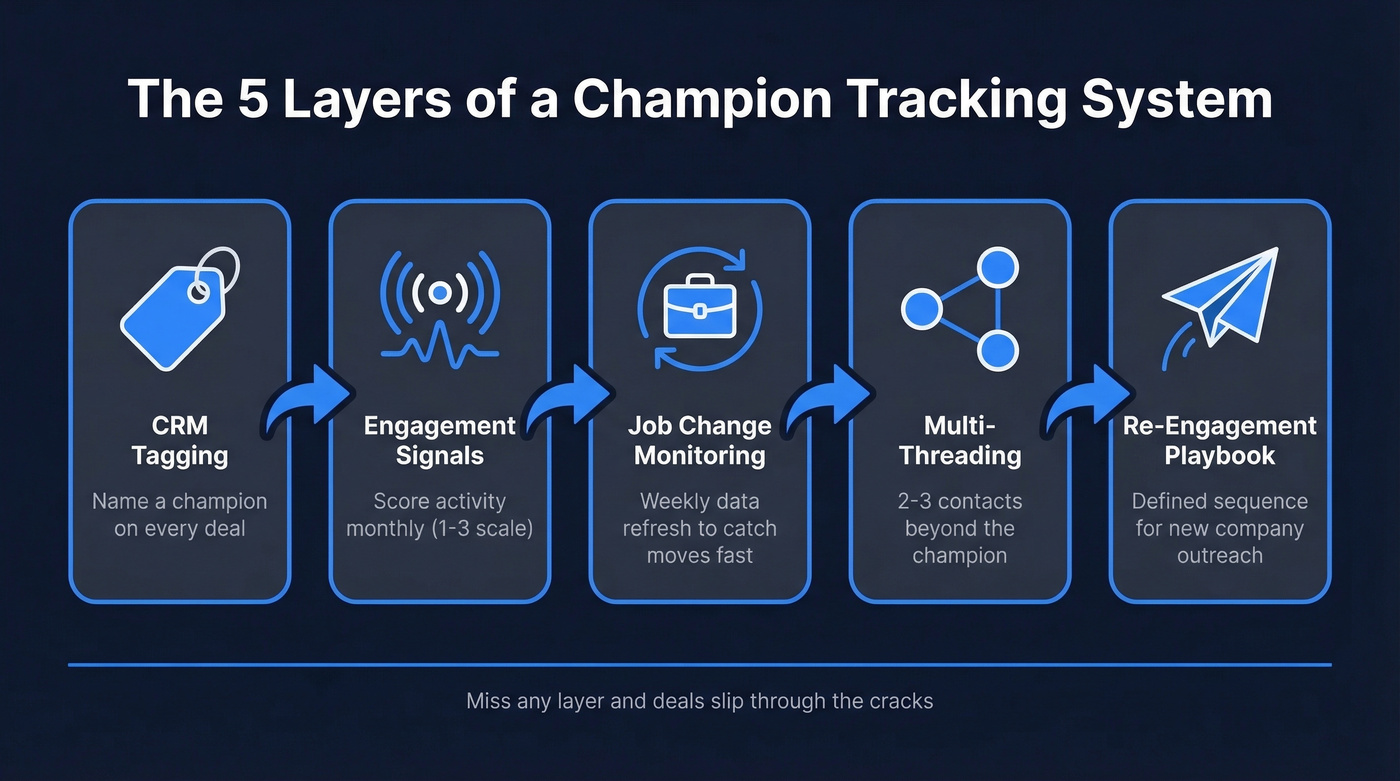
- CRM tagging - every deal gets a named champion, flagged in your contact roles
- Engagement signals - a simple scoring model that tells you when a champion's going cold
- Job change monitoring - a data platform with weekly refresh so you catch moves fast
- Multi-threading - at least two to three contacts beyond the champion on every deal
- Re-engagement playbook - a defined sequence for when a champion lands somewhere new
What Is B2B Champion Tracking?
If you've worked with MEDDIC or MEDDPICC, you know the "C" stands for Champion - the internal advocate who sells your solution when you're not in the room, fights for budget, rallies stakeholders, and pushes the deal forward through internal politics you'll never fully see.
In practice, this discipline means monitoring that person's engagement, influence, and tenure throughout the deal cycle and beyond. Most sales methodologies tell you to identify a champion. The harder part - and the part most teams skip - is tracking what happens to them over weeks and months. Did they get promoted? Disengage? Leave entirely? You need to track the person driving the deal, not just the deal itself.
Why Single-Threaded Deals Collapse
Here's the thing. We've all lived through this QBR scenario: you're explaining why a $150K deal slipped from Q3 to "closed-lost." The champion left in month three. Nobody noticed until month five. The new stakeholder had different priorities, a different vendor preference, and zero context on why your solution was the frontrunner.
Single-threaded deals are the riskiest line items in any pipeline. When your entire deal hinges on one person's enthusiasm and that person disappears, the deal dies. MEDDIC tells you to identify a champion - it doesn't tell you what to do when they leave. That gap between methodology and execution is where deals collapse, and it's exactly what systematic advocate monitoring closes. This is a recurring theme on r/sales - reps consistently cite champion departure as the top reason late-stage deals die quietly.
If your average sales cycle runs longer than six months and you aren't actively monitoring your key advocates' job changes, you're not running a pipeline. You're running a lottery.

Most teams lose deals because they find out about champion departures 6 weeks too late. Prospeo refreshes 300M+ profiles every 7 days - so you catch the move, get a 98% accurate email, and re-engage before the window closes.
Stop losing pipeline to job changes you should've seen coming.
Five Signals Your Champion Is Going Cold
1. Response times are stretching. Your champion used to reply same-day. Now it's three days, then five. A shift in cadence is the earliest warning sign.
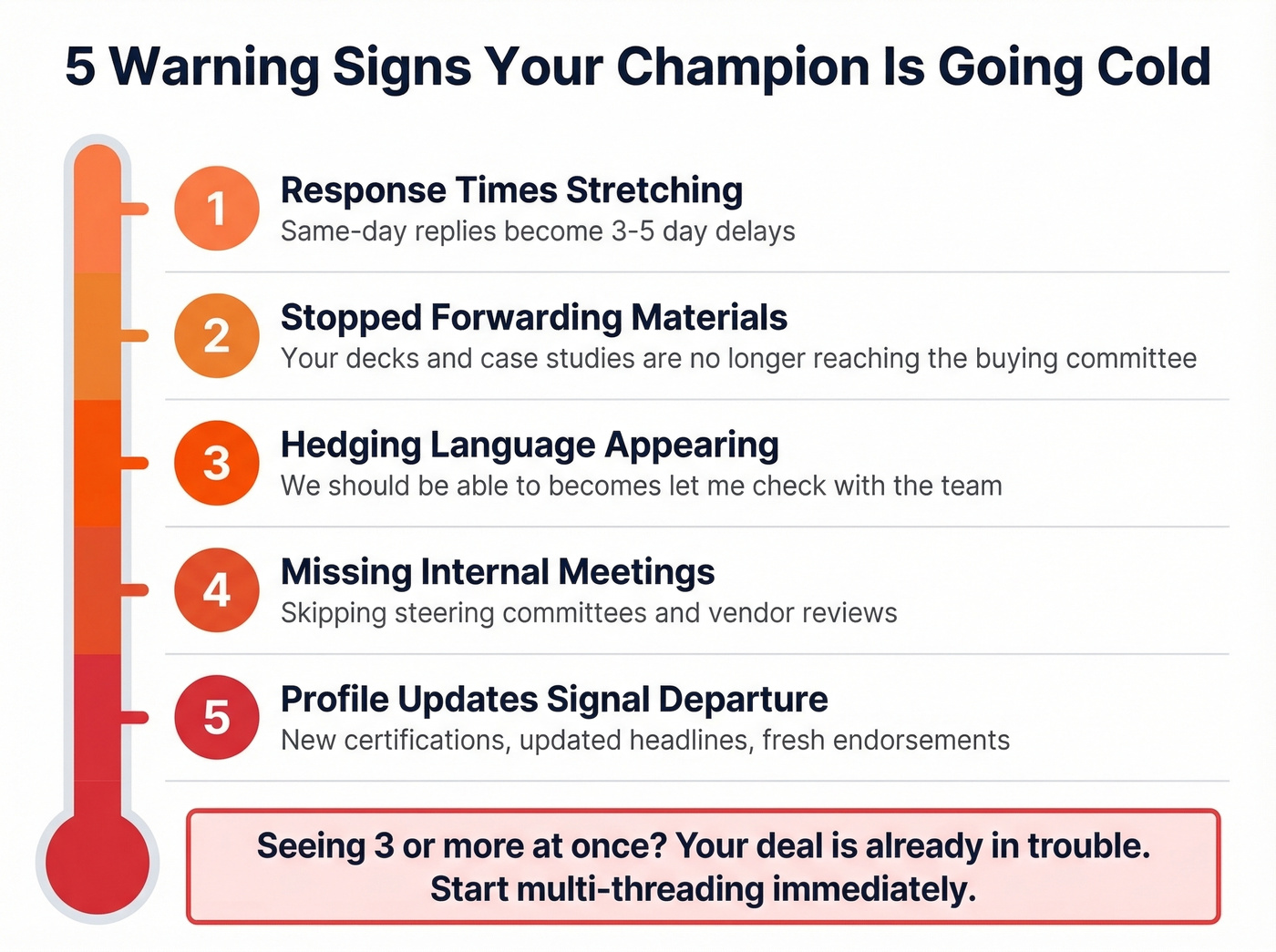
2. They've stopped forwarding materials internally. Champions distribute your decks, ROI models, and case studies to the buying committee. When that stops, they've either lost influence or lost interest.
3. Hedging language is replacing commitment language. "We should be able to move forward" becomes "let me check with the team." That shift from certainty to ambiguity is a red flag - and it's one you'll only catch if you're paying attention to word choice, not just meeting frequency.
4. They're missing internal meetings. If your champion skips the steering committee or the vendor review, their organizational gravity is weakening.
5. Profile updates suggest a role change. New certifications, updated headlines, fresh endorsements - these are leading indicators of a departure.
If you're seeing three of these at once, your deal is already in trouble. Don't wait for confirmation. Start multi-threading immediately.
Building Your Champion Tracking System
This isn't a feature you buy. It's a discipline you build from four interlocking habits.
Tag Champions in Your CRM
Add a "Champion" contact role in Salesforce or HubSpot. Every deal gets at least one tagged champion. No tag means no champion - and that should be a red flag in every pipeline review. We've found that simply enforcing this rule surfaces deals at risk that would otherwise sail through reviews unchallenged.
Monitor Job Changes Weekly
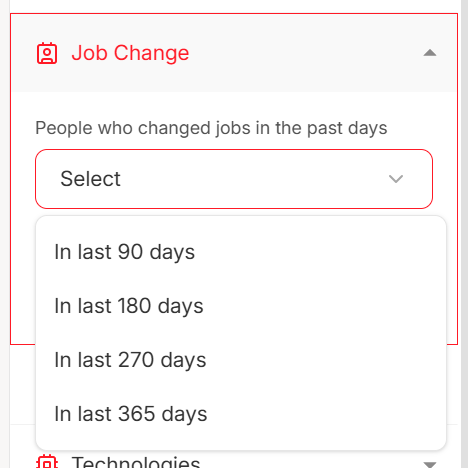
This is where most teams fall apart. Manual checking once a quarter isn't fast enough.
Prospeo's B2B database refreshes every 7 days across 300M+ professional profiles, so when your champion updates their role, you've got their new verified email at 98% accuracy before the week is out. Compare that to the industry average of six weeks - by which point your deal is already dead. Layer in intent data across 15,000 Bombora topics, and you can detect when a champion's new company is actively researching solutions in your category.
Score Engagement Monthly
Track email opens, meeting attendance, and internal referral activity for every tagged champion. Keep it simple - a 1-3 scale works: active, cooling, cold. When a champion scores "cold," start building relationships with other stakeholders. Tools like Gong or Clari can surface engagement patterns across your pipeline, but even your email platform's built-in analytics will do the job if you're consistent about checking.
If you want a tighter framework for what to measure, treat this like pipeline health: define the signals, set thresholds, and review them on a cadence.
Multi-Thread Every Deal
Multi-threading isn't a backup plan. It's the plan.
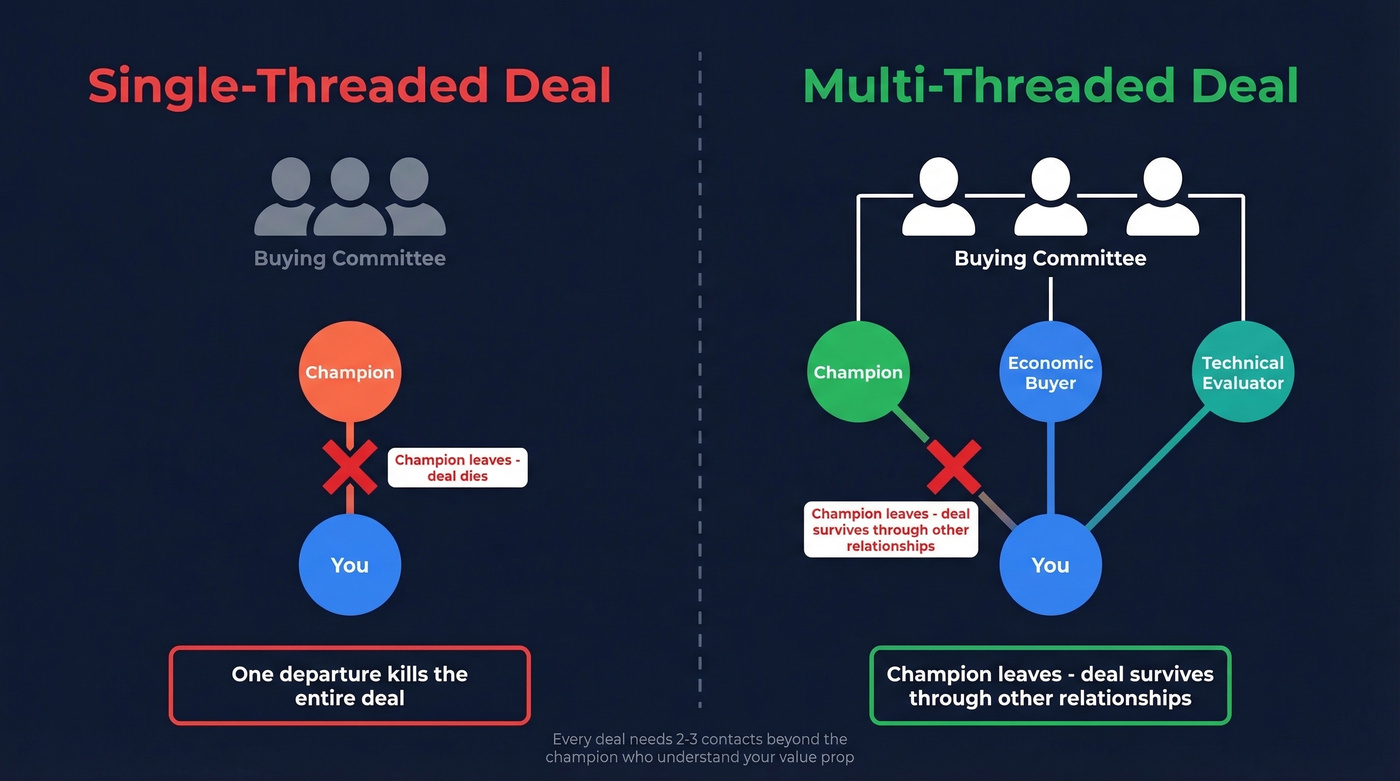
Every deal needs two to three contacts beyond the champion who understand your value prop and have a stake in the outcome. Map the buying committee early, build relationships with at least the economic buyer and a technical evaluator, and keep all three threads warm throughout the cycle. Let's be honest - most reps know this intellectually and still don't do it because it feels like extra work when the champion is engaged. That's exactly when you should be doing it.
If you need a practical way to structure this, borrow from team selling: assign roles, align messaging, and keep stakeholders engaged in parallel.
Re-Engaging a Champion at Their New Company
When a champion lands at a new company, you've got a two-to-four-week window before they're buried in onboarding. Move fast:
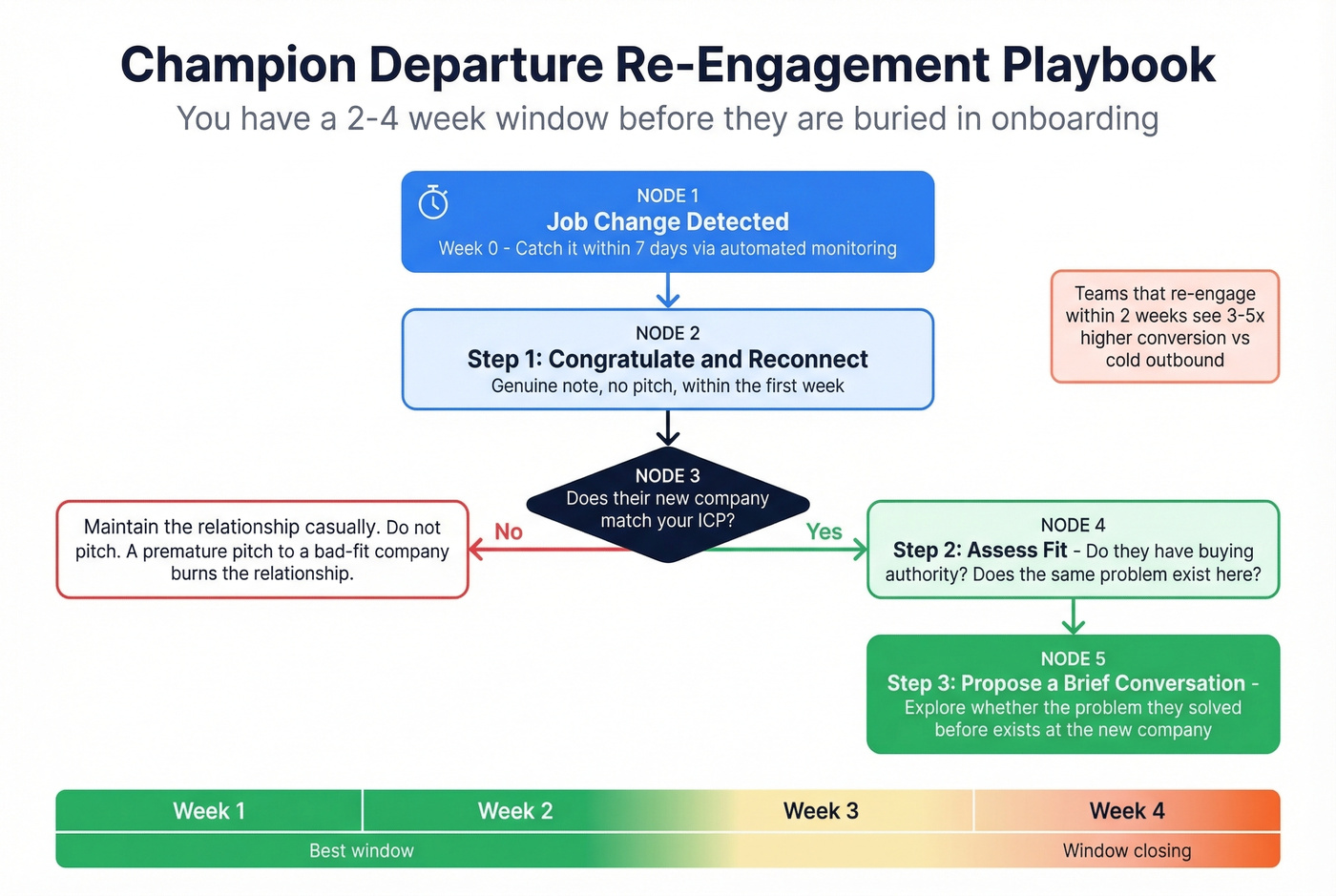
- Congratulate and reconnect. A genuine note within the first week. No pitch.
- Assess fit. Does their new company match your ICP? Do they have buying authority?
- Propose a conversation. If the fit is there, suggest a brief call to explore whether the problem they solved at their last company exists here too.
We've seen teams recover deals in under two weeks when they catch the departure early. Stale contact data kills re-engagement - if your email and mobile info is outdated, you'll miss the window while your champion is still setting priorities and open to vendor conversations.
To speed up the outreach side, keep a few sales follow-up templates ready so reps can move the same day the job change hits.
Skip this step if the champion's new company is clearly outside your ICP. Not every job change is an opportunity, and a premature pitch to someone at a 10-person startup when you sell enterprise infrastructure will burn the relationship faster than losing the original deal did.
Your champion just landed at a new company. Do you have their verified email and direct dial? Prospeo gives you 143M+ verified emails and 125M+ mobile numbers - updated weekly, not monthly. Layer in intent data across 15,000 topics to see if their new company is already in-market.
Re-engage departed champions before competitors even notice the move.
Champion Tracking FAQ
What's the difference between a champion and an economic buyer?
A champion is the internal advocate who sells your solution when you're not in the room; the economic buyer controls the budget. Sometimes they're the same person, but usually they're not. Losing your champion means losing your voice inside the account - even if the economic buyer is still technically engaged.
How often should I check on my champions?
Weekly for active deals in late stages, monthly for early-stage or nurture deals. Automate job change monitoring so you catch departures immediately - manual checking once a quarter isn't fast enough to protect a deal already in motion.
What tools help with monitoring advocate job changes?
You need three layers: a CRM with champion tagging, a data platform with fast refresh for job change alerts, and an engagement layer like Gong or your email platform's analytics. UserGems specializes in buyer tracking workflows, while 6sense and Clari add pipeline intelligence on top.
Can champion tracking help with expansion revenue?
Former champions who move to new companies are your warmest outbound leads. They already trust your product and know the ROI. Teams that systematically track these moves and re-engage within two weeks report 3-5x higher conversion rates compared to cold outbound to the same accounts. That's not a marginal improvement - it's a different category of pipeline entirely.