

ChatGPT for Sales Emails: The Full System Behind Emails That Get Replies
The average cold email reply rate in 2026 is 3.43%. Top quartile senders hit 5.5%+. The top 10% reach 10.7%. Everyone else hovers somewhere between "disappointing" and "why did we bother."
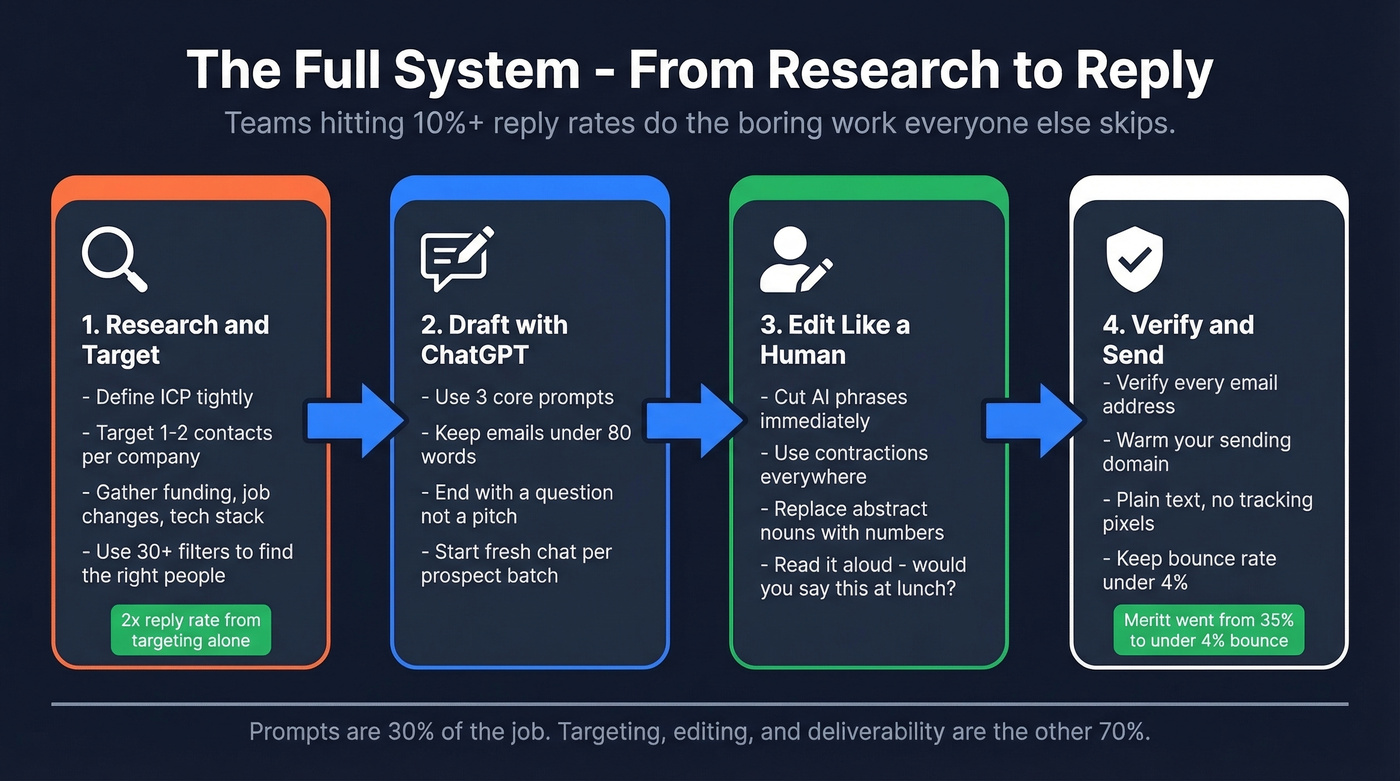
Using ChatGPT for sales emails can produce a decent draft in seconds, but teams that treat it as a magic wand end up with polished messages nobody reads. Sacrificing real AI email personalization for AI-generated volume produces 13x lower reply rates. The prompt isn't the problem. Everything around it is.
What You Need (Quick Version)
Three things separate teams that get replies from teams that get ignored:
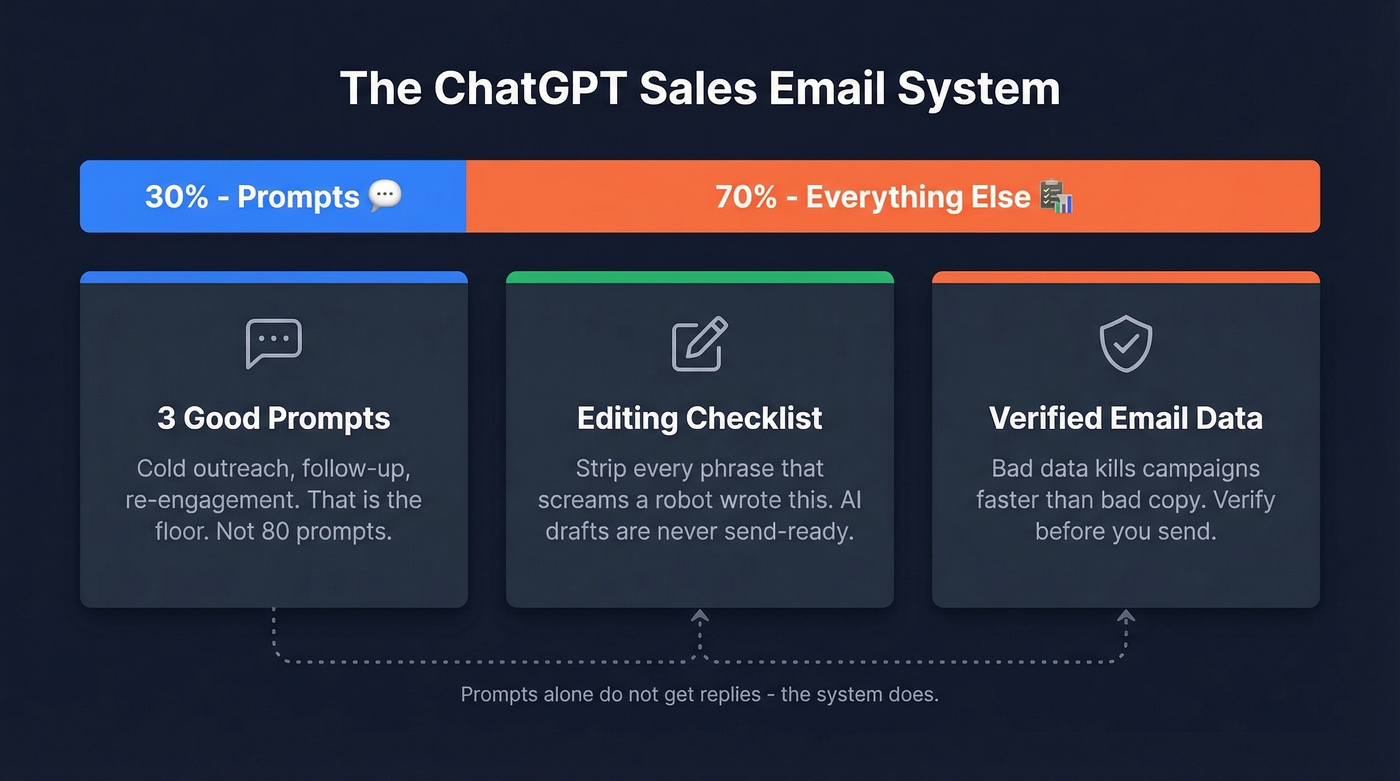
- 3 good prompts (not 80). One for cold outreach, one for follow-ups, one for re-engagement. That's the floor.
- An editing checklist to strip out every phrase that screams "a robot wrote this." AI-drafted sales emails are never ready to send as-is - the first output always needs a human pass.
- Verified email data so your domain doesn't burn. Bad data kills campaigns faster than bad copy ever will.
Prompts are 30% of the job. Targeting, editing, and deliverability are the other 70%.
Before You Prompt: Research First
Most teams skip research entirely and jump straight into prompting. That's backwards.
Belkins analyzed 16.5M cold outreach emails across 93 business domains and found that targeting 1-2 contacts per company produced a 7.8% reply rate. Blasting 10+ contacts at the same company? 3.8%. That's a 2x difference from targeting alone, before you write a single word. Even more striking: single-email campaigns pulled the highest reply rate in their dataset at 8.4%, which tells you that less really is more - and that the obsession with long drip sequences is often counterproductive.
Before you open ChatGPT, define your ICP tightly and gather real context on each prospect: recent funding, job changes, tech stack, public statements. A Reddit practitioner who sent 17M+ emails confirmed it: plain-text emails to 20-50 highly specific recipients outperform branded HTML blasts to thousands. That context is what makes your prompt useful.
5 Prompts That Actually Work
A note on length: Instantly's data favors emails under 80 words. Belkins found 6-8 sentences hit a 6.9% reply rate. Either way, shorter wins.
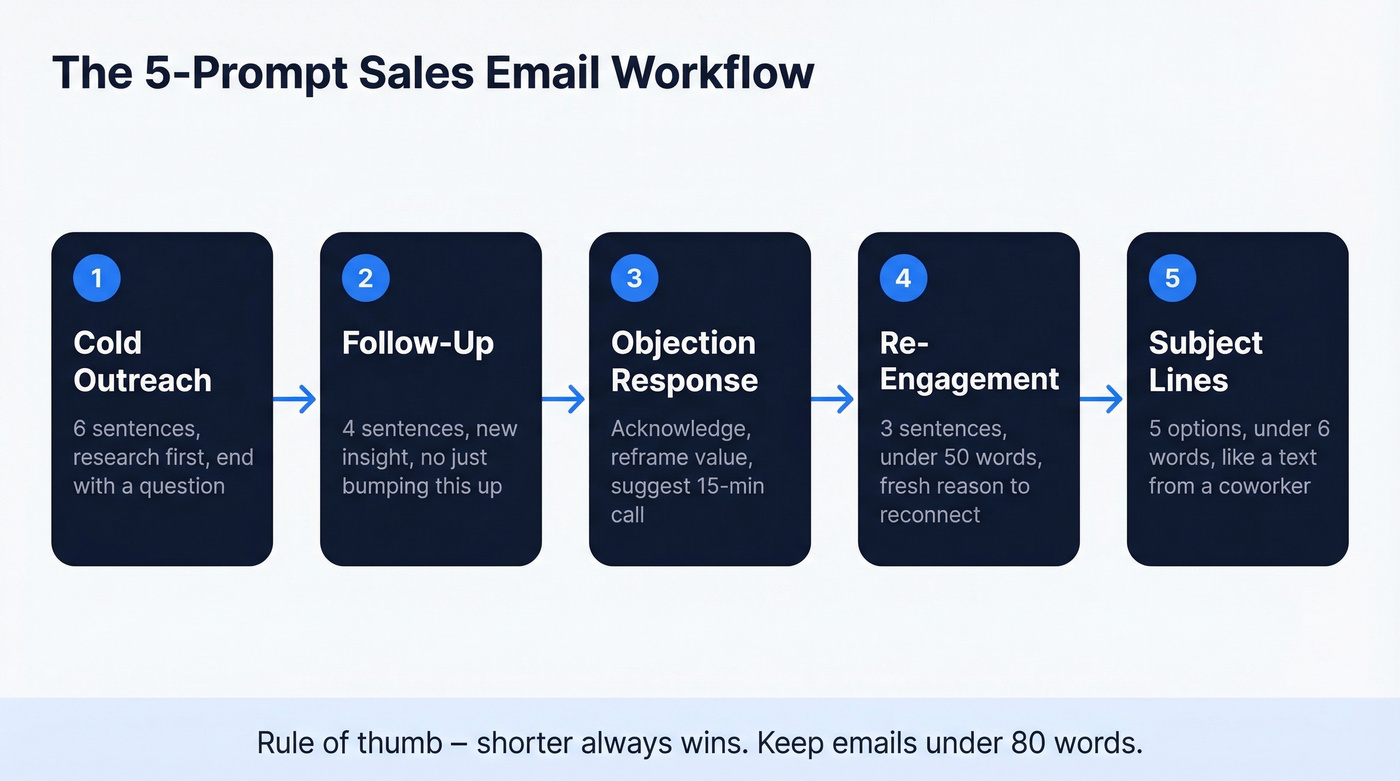
Cold Outreach
Find publicly available information on [prospect name] at [company].
Write a 6-sentence cold email from [your name/role] introducing [your product's
one-line value prop]. Tone: conversational, no buzzwords. End with a
question, not a pitch. Include one specific detail about the prospect's
company or role.
This pattern - borrowed from Zapier's tested framework - forces ChatGPT to research before writing. Most prompt lists skip this step, which is why their outputs sound generic.
Follow-Up (3 Days Later)
Write a 4-sentence follow-up to the cold email below. Don't repeat the
original pitch. Add one new insight about [prospect's industry challenge].

Tone: casual, like a colleague checking in. No "just bumping this up."
[Paste original email]
Objection Response
This one's different. Instead of showing you a prompt, here's the before and after.
Prospect writes: "We already have a solution for this."
Bad ChatGPT response: "I completely understand! Many of our clients felt the same way before discovering how our platform could transform their workflow..."
Good ChatGPT response (after proper prompting): "Makes sense - switching tools is a pain. Quick question though: are you seeing [specific metric] from your current setup? We helped [similar company] move that number from X to Y in 6 weeks. Worth a 15-min look?"
The prompt that produces the good version:
A prospect replied with this objection: "[paste objection]."
Write a 5-sentence reply that acknowledges their concern, reframes the value
around [specific outcome], and suggests a 15-minute call. No defensiveness.
Re-Engagement (60+ Days Cold)
Write a 3-sentence email to re-engage [prospect name] who went silent 60 days
ago. Reference [original context]. Offer one new reason to reconnect - a case
study, a market shift, or a product update. Keep it under 50 words.
After 60 days of silence, the prospect has forgotten your original pitch. A short, low-pressure nudge with fresh information resets the conversation without the baggage.
Subject Lines
Skip the referral-request template - you'll write that naturally. What you actually need is a subject line prompt, because every email lives or dies in the inbox preview:
Write 5 subject lines under 6 words for the email below.
No clickbait, no ALL CAPS, no emojis. Tone: like a text from a coworker.
[Paste email]
ChatGPT Memory Warning: Memory can bleed context between prospect conversations. If you're writing emails for different prospects in the same chat, ChatGPT will mix details. Turn memory off or start a fresh chat per prospect batch.

You just built a prompt system that produces great copy. Now don't waste it on bad data. Prospeo delivers 98% verified emails on a 7-day refresh cycle - so every AI-crafted message actually reaches a real inbox. Bounce rates drop below 4%, just like Meritt's did when they tripled pipeline to $300K/week.
Stop burning domains. Start with emails that actually exist.
Kill These Phrases Before Sending
ChatGPT's first draft will sound like ChatGPT. It takes 8-10 iterations to nail a marketing email that resonates. Here's what to cut immediately.
| AI Phrase | Human Replacement |
|---|---|
| "I trust this email finds you well" | Cut entirely |
| "Revolutionize your workflow" | "Cut [specific task] from 4 hours to 20 minutes" |
| "Leverage our platform" | "Use [product] to..." |
| "Unlock your potential" | State the specific outcome |
| "Synergize across teams" | "Get sales and marketing on the same list" |
Use contractions everywhere. Replace every abstract noun with a concrete number. Read the email aloud - if you'd never say it to a colleague at lunch, rewrite it. The Topo blog has a longer list of AI giveaways worth bookmarking.
Deliverability: What AI Can't Fix
You wrote the perfect email. Now make sure it reaches a real inbox.
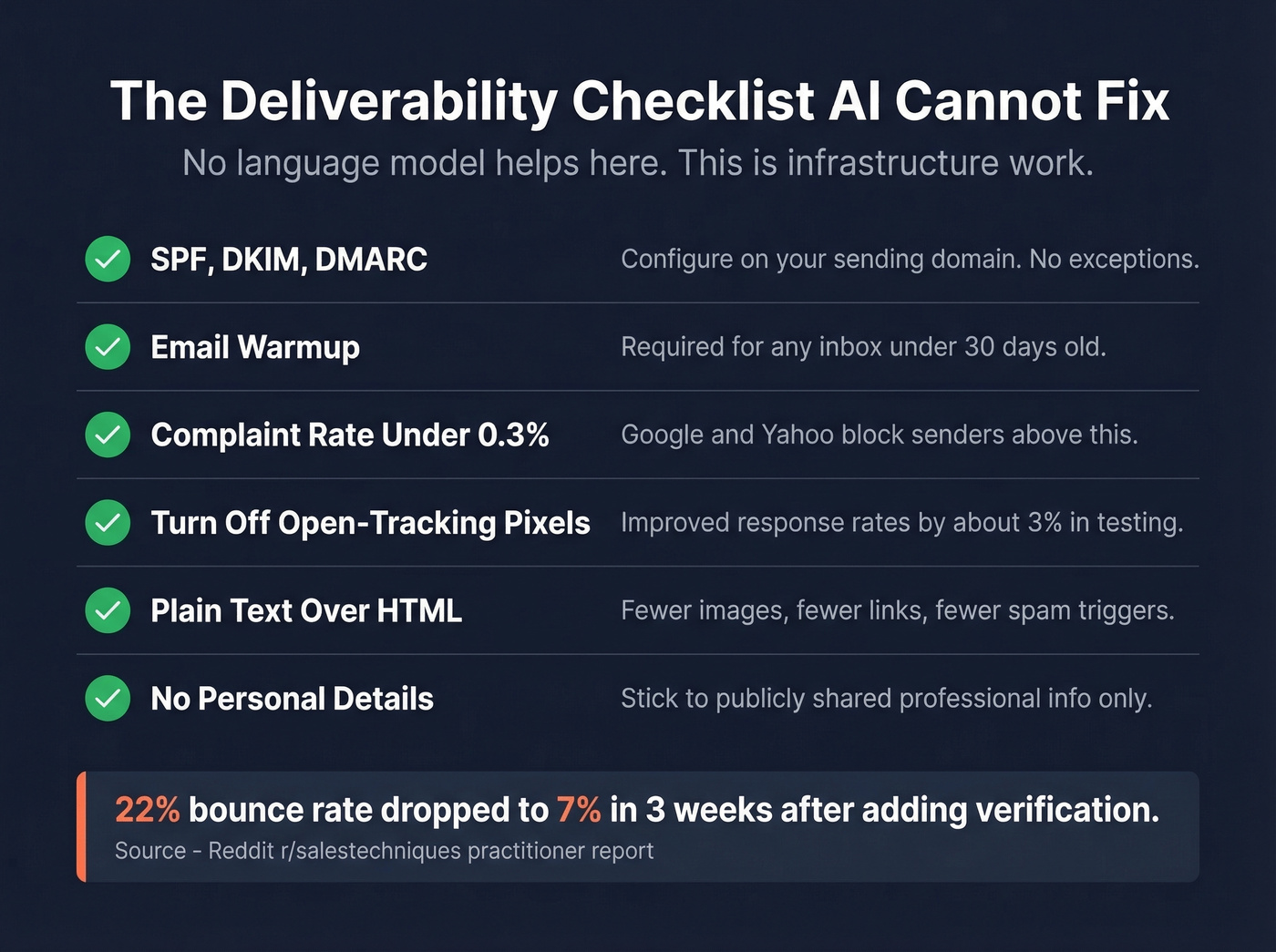
Here's the thing: no language model can help you here. This is infrastructure work. And if your average deal size is under $10k, you probably don't need a $20k/year sales engagement platform. But you absolutely need clean data and a warmed domain. Most teams get this backwards - they invest in tools and neglect the plumbing.
The non-negotiable checklist:
- SPF, DKIM, and DMARC configured on your sending domain. No exceptions. (If you need the full setup, start with sender authentication.)
- Email warmup for any inbox under 30 days old. New inboxes have no reputation, and providers treat that like bad reputation. (See Gmail warm up for a practical schedule.)
- Complaint rate under 0.3%. Google and Yahoo block senders who exceed this threshold. Belkins' data shows spam complaints escalate from 0.5% on the first email to 1.6% by the fourth - keep sequences short.
- Turn off open-tracking pixels. Belkins found this alone improved response rates by ~3%. Tracking pixels are spam triggers. (More detail: email tracking tools.)
- Plain text over HTML. Fewer images, fewer links, fewer spam triggers.
- Don't reference a prospect's salary, personal social media, or family details - even if ChatGPT surfaced them. Stick to publicly shared professional information.
One pattern we see constantly: teams invest hours crafting emails, then send them to lists with 20%+ bounce rates. A Reddit user reported their team's bounce rate sat at 22% before adding verification - it dropped to 7% within three weeks.
Prospeo's 5-step verification catches invalid addresses, handles catch-all domains, and removes spam traps before they torch your sender reputation. Meritt cut bounce rates from 35% to under 4% after switching, and their pipeline tripled. The free tier gives you 75 email verifications per month at 98% accuracy - enough to validate your first campaigns before you scale. (If you're comparing options, see best email verifier tools.)
The article said it: targeting 1-2 contacts per company doubles your reply rate. Prospeo's 30+ filters - buyer intent, job changes, tech stack, funding - let you find exactly those contacts with verified emails at $0.01 each. That's the research step ChatGPT can't do for you.
Nail the targeting so your prompts actually matter.
ChatGPT vs Claude vs Gemini for Sales Drafts
All three cost $20/mo for consumer plans. Here's how they stack up for writing outbound email copy.
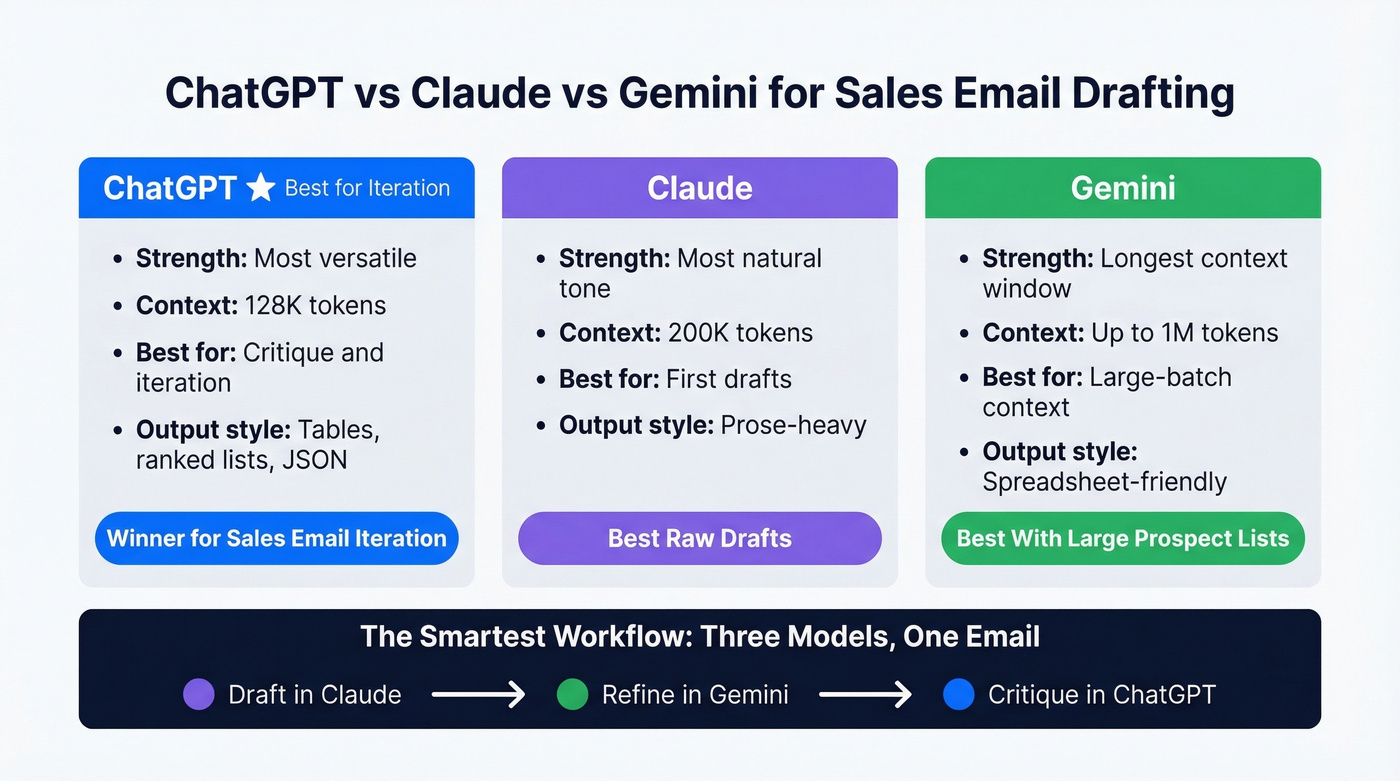
| ChatGPT | Claude | Gemini | |
|---|---|---|---|
| Strength | Most versatile | Most natural tone | Longest context |
| Context window | 128K tokens | 200K tokens | Up to 1M tokens |
| Best for | Critique + iteration | First drafts | Large-batch context |
| Structured output | Tables, ranked lists, JSON | Prose-heavy | Spreadsheet-friendly |
| Winner for sales emails | Best for iteration | Best raw drafts | Best with large prospect lists |
For sales email iteration specifically, ChatGPT's critique mode gives it the edge. But the smartest workflow we've found - and the consensus on r/PromptEngineering backs this up - is to draft in Claude for natural tone, refine in Gemini with full prospect context loaded, then run the final version through ChatGPT as a critic. Three models, one email, better output than any single tool produces alone.
Let's be honest though: most reps won't run three models per email. If you're picking one, start with ChatGPT for the iteration loop and train yourself to edit aggressively. That gets you 80% of the way there.
The Full System
You don't need 80 prompts. You need 3 good ones and clean data.
Write with ChatGPT, edit like a human, verify your list, send through a warmed domain. The teams hitting 10%+ reply rates aren't using secret AI prompts - they're doing the boring work around the prompt that everyone else skips. ChatGPT for sales emails is a drafting tool, not a strategy. The strategy is everything else. (If you want the infrastructure-first version, read business cold email.)
FAQ
How many prompts do I actually need?
Three. One cold outreach prompt, one follow-up, and one re-engagement. Belkins' 16.5M-email study found single-email campaigns hit 8.4% reply rates - volume of prompts matters far less than targeting precision and editing quality.
Will AI-written emails hurt my deliverability?
The AI text itself won't trigger spam filters. What kills deliverability is sending to unverified lists with 20%+ bounce rates, skipping SPF/DKIM/DMARC setup, and using tracking pixels. Verification is the fix - Meritt dropped from 35% to under 4% bounce rate after adding a proper verification step.
Should I use ChatGPT or Claude for cold emails?
Draft in Claude for the most natural first output, then refine in ChatGPT using critique mode. ChatGPT excels at iterating - it takes 8-10 rounds to produce a send-ready email. Using both models together outperforms either one alone.
What reply rate should I expect from AI-drafted emails?
Top-performing teams hit 5.5-10.7% reply rates in 2026. The average sits at 3.43%. The difference isn't the AI - it's targeting 1-2 contacts per company, editing out robotic phrasing, and sending through warmed domains with verified data.