


Clay Reviews 2026: Pricing, Credits & Honest Verdict
You just watched $700 disappear in two weeks. The enrichments ran, the credits burned, and half the emails bounced anyway. That's not a hypothetical - it's a real user's first experience with Clay, and it's more common than Clay's marketing suggests.
After reading hundreds of Clay reviews across G2, Trustpilot, and Reddit, here's what the platform actually delivers, what it costs after the March 2026 pricing overhaul, and whether it's worth your time.
30-Second Verdict
Clay is the most powerful enrichment orchestration tool on the market - and also the most expensive way to find an email address. It pulls from 150+ data providers, chains enrichment steps with conditional logic, and lets AI agents research prospects in ways no other tool can match. G2 reviewers give it 4.7/5 from 189 reviews. Trustpilot users give it 2.2/5 from 9 reviews. Both ratings are honest - they just reflect different users.
Clay hit $100M ARR and a $5B valuation and a $5B valuation per its latest tender offer in 2026. The product is real. But if your team doesn't have a dedicated RevOps operator building multi-step waterfall workflows, you're paying for a Formula 1 car to drive to the grocery store.
What Clay Actually Is
Clay isn't a database like ZoomInfo. It isn't a CRM. It isn't a sequencer like Instantly. Think of it as a pre-sequencing engine - an AI-powered spreadsheet that connects to 150+ external data providers, enriches and scores leads through multi-step waterfalls, then pushes clean data to your CRM or outreach tool.
The core workflow goes like this: import a list, run it through a waterfall of enrichment providers, apply conditional logic to route leads, use Claygent (Clay's AI research agent) to pull unstructured data from websites and documents including PDFs, then sync everything to HubSpot, Salesforce, or your sequencer. It's powerful. It's also complex enough that most users spend around five to six hours in their first week just learning the basics.
One thing that trips people up: Clay stops short of execution. It enriches and scores leads but doesn't run multi-step email sequences on its own. You'll still need a sequencer like Instantly or Smartlead downstream, which means more tool-hopping than the marketing implies.

Pricing After March 2026
Clay dropped its biggest pricing overhaul on March 11, 2026, simplifying three self-serve tiers into two and splitting the old credit system into Data Credits and Actions.
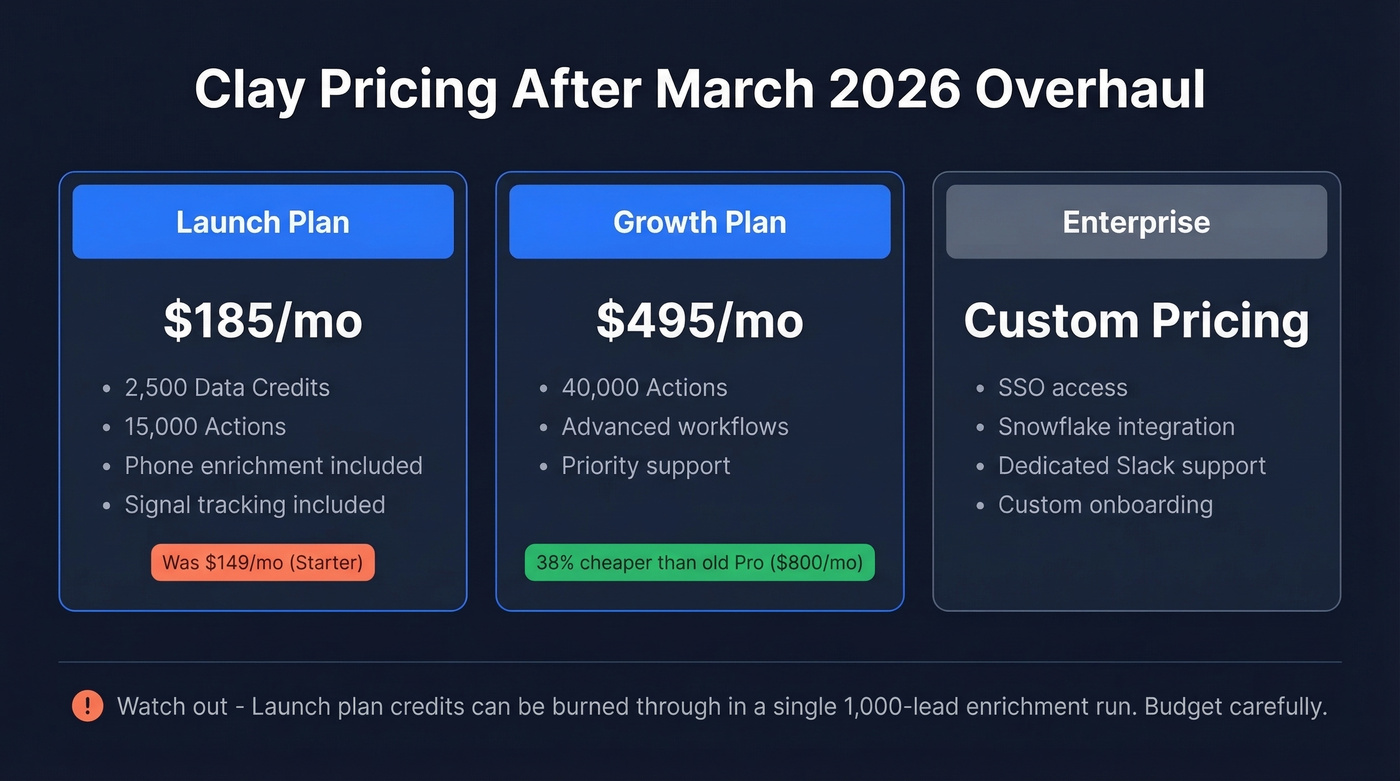
Data Credits pay for data from providers. Actions cover platform operations - enrichment steps, AI calls, API requests, CRM pushes, exports. Each action costs under $0.01. If an enrichment returns no result, you aren't charged for either.
| Legacy Plan | Legacy Price | New Plan | New Price | Key Change | |
|---|---|---|---|---|---|
| Entry | Starter | $149/mo (2K credits) | Launch | $185/mo (2.5K Data + 15K Actions) | Phone enrichment + signal tracking added |
| Mid | Explorer | $349/mo (10K credits) | - | Eliminated | - |
| Pro | Pro | $800/mo (50K credits) | Growth | $495/mo (40K Actions) | 38% cheaper |
| Enterprise | Custom | Custom | Enterprise | Custom | SSO, Snowflake, dedicated Slack support |
For context, most 20-person sales teams spend $25,000-$60,000 annually on sales intelligence. Clay's Launch plan at $2,220/year looks cheap by comparison - until credit overages kick in.
The Growth plan at $495/mo is genuinely cheaper than the old Pro at $800/mo. But the Launch plan at $185/mo is $36 more than the old Starter, and whether 2,500 Data Credits plus 15,000 Actions actually goes further depends entirely on your workflow complexity. Legacy customers had until April 10, 2026 to switch between old plans before migration locked in.
How Credits Actually Work
This is where Clay gets tricky. Credit consumption varies wildly by enrichment type:
- Basic contact verification: ~1 credit
- Company info lookup: ~2 credits
- Advanced firmographic data: 3-5 credits
- Full profile enrichment: 5-10 credits
Before Clay can enrich anything, you need what practitioners call "corner pieces"--a domain plus company profile URL for companies, or a full name plus personal profile URL for people. Without these, your waterfall stalls.
Clay publishes its own provider benchmarks, and the variance is striking. Catch-all email verifiers inside Clay range from 76.47% to 94.99% data quality, with credit costs per lookup spanning 0.0015 to 0.3 credits. That transparency is rare, but it also means you need to know which providers to pick or you'll burn credits on low-quality results.
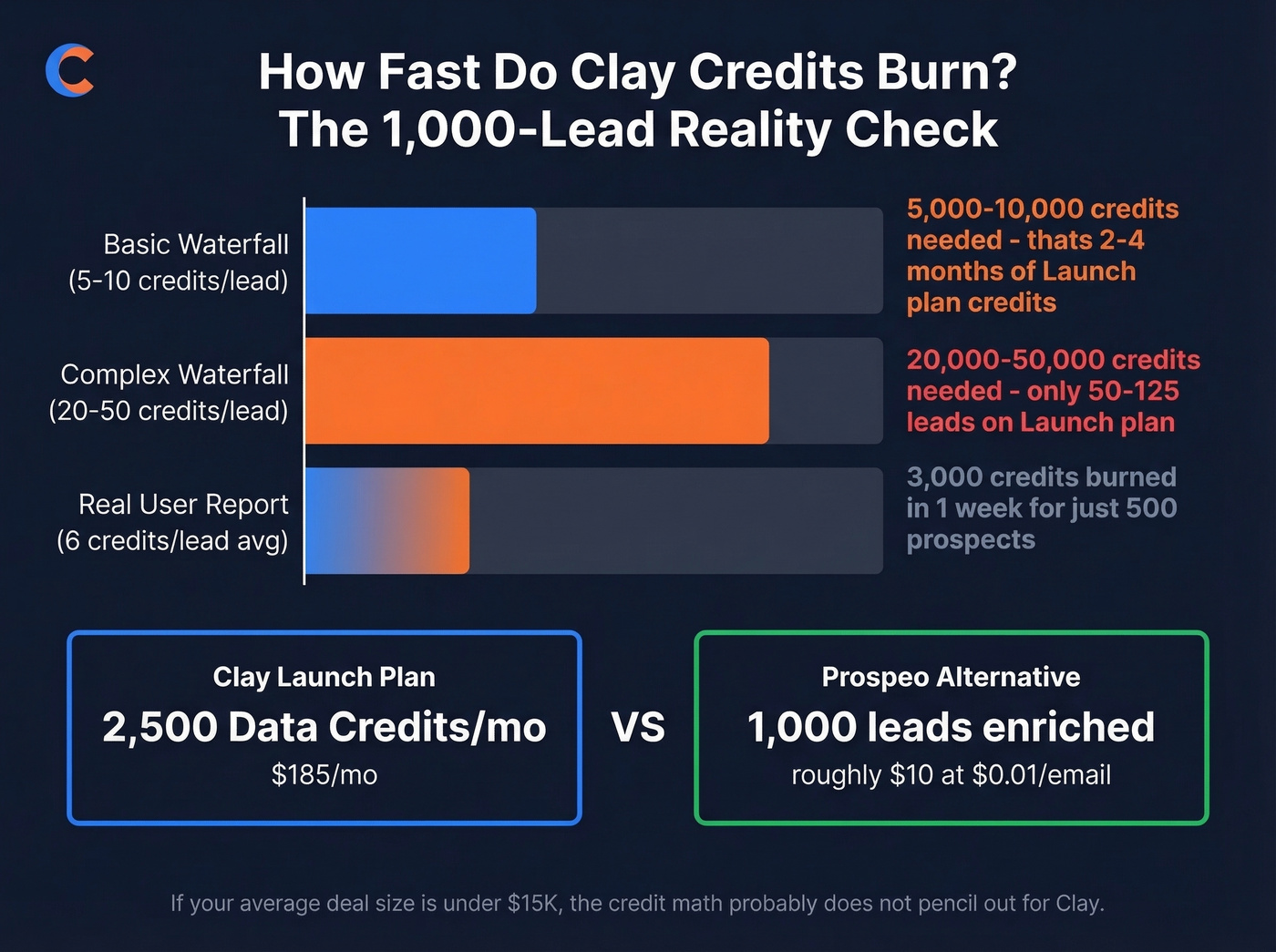
Let's break down the 1,000-lead scenario. On the Launch plan you get 2,500 Data Credits per month. A basic waterfall - email, phone, company data - often lands around 5-10 credits per lead. To enrich 1,000 leads at that rate, you'd need 5,000-10,000 Data Credits, blowing through two to four months of Launch credits in a single run. Complex waterfalls consuming 20-50+ credits per lead? You're looking at 50-125 leads before you're tapped out. One practitioner reported burning 3,000 credits in a single week enriching just 500 prospects with multiple data points.
Here's the thing: if your average deal size is under $15K, you probably don't need Clay-level orchestration. The credit math just doesn't pencil out when a simpler tool gets you 80% of the data at 10% of the cost.

Clay users burn 5,000+ credits to enrich 1,000 leads - and still get bounces. Prospeo gives you 98% verified emails at $0.01 each, with no waterfall setup, no credit math, and no 5-hour learning curve. Just accurate data, ready to send.
Get the emails Clay charges you to guess at.
What Users Actually Say
The G2/Trustpilot split tells the whole story. G2's 189 reviewers - mostly power users who invested weeks learning the platform - praise ease of use for list management (18 mentions), CRM integrations (18), lead gen capabilities (15), and time-saving automation (15).
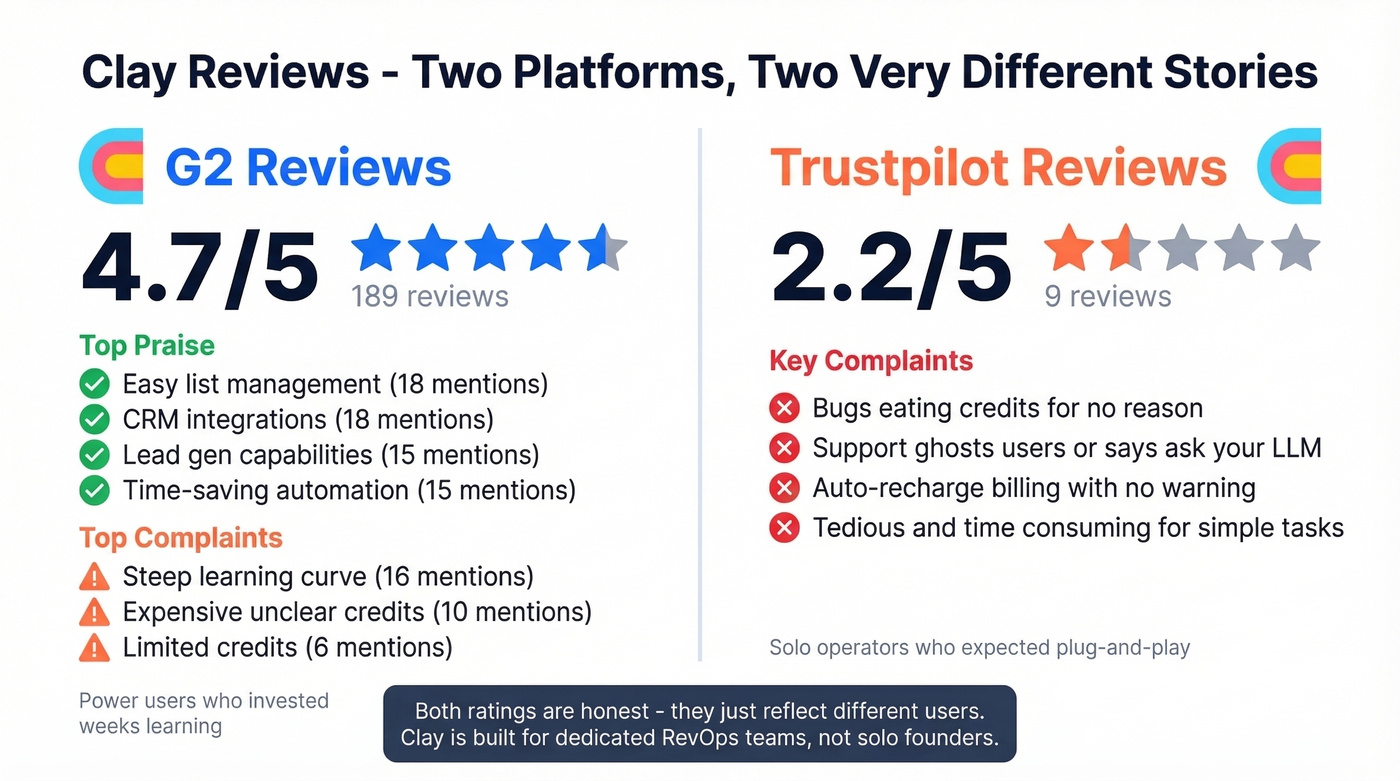
The cons on G2 are just as consistent: steep learning curve (16 mentions), expensive and unclear credit consumption (10), and limited credits (6). These aren't edge cases. They're the dominant complaint themes.
Trustpilot paints a darker picture. The 9 reviews there skew toward users who churned early, and their complaints are specific: bugs eating credits for no reason, support that ghosts users or tells them to "ask your LLM for help debugging," and auto-recharge billing with no advance reminders. On r/coldemail, one thread starter called Clay "tedious, time consuming" for simple tasks - a sentiment echoed by users who expected a simpler tool and got burned.
Both ratings are accurate. G2 reflects teams with dedicated RevOps operators who've climbed the learning curve. Trustpilot reflects solo operators who expected plug-and-play and got a workflow IDE.
How to Cut Clay Costs
Power users don't pay full credit prices. We've seen teams get cost-per-lead under $0.05 with these tactics:
Bring your own API keys. Connect your own OpenAI or Anthropic keys through Clay's HTTP API action. This runs 30-35x cheaper than Clay's built-in AI credits.
Hybrid stack for heavy processing. Push scraping and bulk operations to n8n ($20/mo) and Apify ($49/mo), then use Clay only as the orchestration layer. One team running this setup processed 50k-row tables for $10-15 - versus $1,500+ on Clay credits alone.
Conditional logic on expensive steps. Don't run phone enrichment on every lead. Trigger expensive lookups only on leads that pass qualification filters first.
Formulas over AI for simple transforms. Extracting a first name from a full name field doesn't need an AI credit. Use Clay's formula columns instead.
In our experience, unoptimized workflows run $0.10-$0.50 per lead. With BYOK and conditional logic, that drops consistently under $0.05.
Who Clay Is For
Use Clay if you're a technical RevOps team juggling 5+ data sources, building custom waterfall workflows, and you've got the budget and patience for a 2-3 week ramp. Nobody else connects 150+ providers with conditional logic and AI research agents in one interface.
Skip Clay if you're a solo founder or small team that just needs verified emails and direct dials. Prospeo covers 300M+ professional profiles with 98% email accuracy and 125M+ verified mobiles - no waterfall configuration, no credit math, no learning curve. It starts free and runs roughly $0.01/email on paid plans, with data refreshing every 7 days versus the 4-6 week industry average.
Maybe Clay if you're an agency scaling outbound across multiple clients. The platform is powerful enough, but only with BYOK keys and a hybrid stack. Without those optimizations, credit costs will eat your margins. Budget around five to six hours in the first week and two to three weeks before your workflows are reliable.
Real talk: if your team doesn't have a dedicated RevOps person, Clay will cost you more in wasted credits than it saves in time.
Alternatives Worth Considering
Prospeo
The accuracy-first play. Prospeo delivers 143M+ verified emails at 98% accuracy and 125M+ verified mobiles with a 30% pickup rate, all on a 7-day data refresh cycle. Teams using Prospeo book 26% more meetings than ZoomInfo users and 35% more than Apollo users. The Chrome extension (40,000+ users) finds verified contacts from any website or CRM in one click. With 30+ search filters including buyer intent powered by Bombora, technographics, and job-change signals, it covers most outbound use cases without the orchestration overhead. Self-serve pricing starts free with 75 emails/month and no contracts.
Apollo.io
The simpler all-in-one. Apollo combines a built-in database with sequencing at $49/user/mo, making it the obvious starting point for SMB teams running high-volume outbound. You won't get Clay's waterfall enrichment or conditional logic, but you'll be sending emails on day one instead of configuring workflows for a week.
Freckle.io
Freckle covers 40 data sources compared to Clay's 150+ at $99/mo for 2,500 credits. Its natural-language column creation hides provider complexity - you describe what you want, and Freckle picks the right enrichment source. Best for teams that want multi-source enrichment without the learning curve.
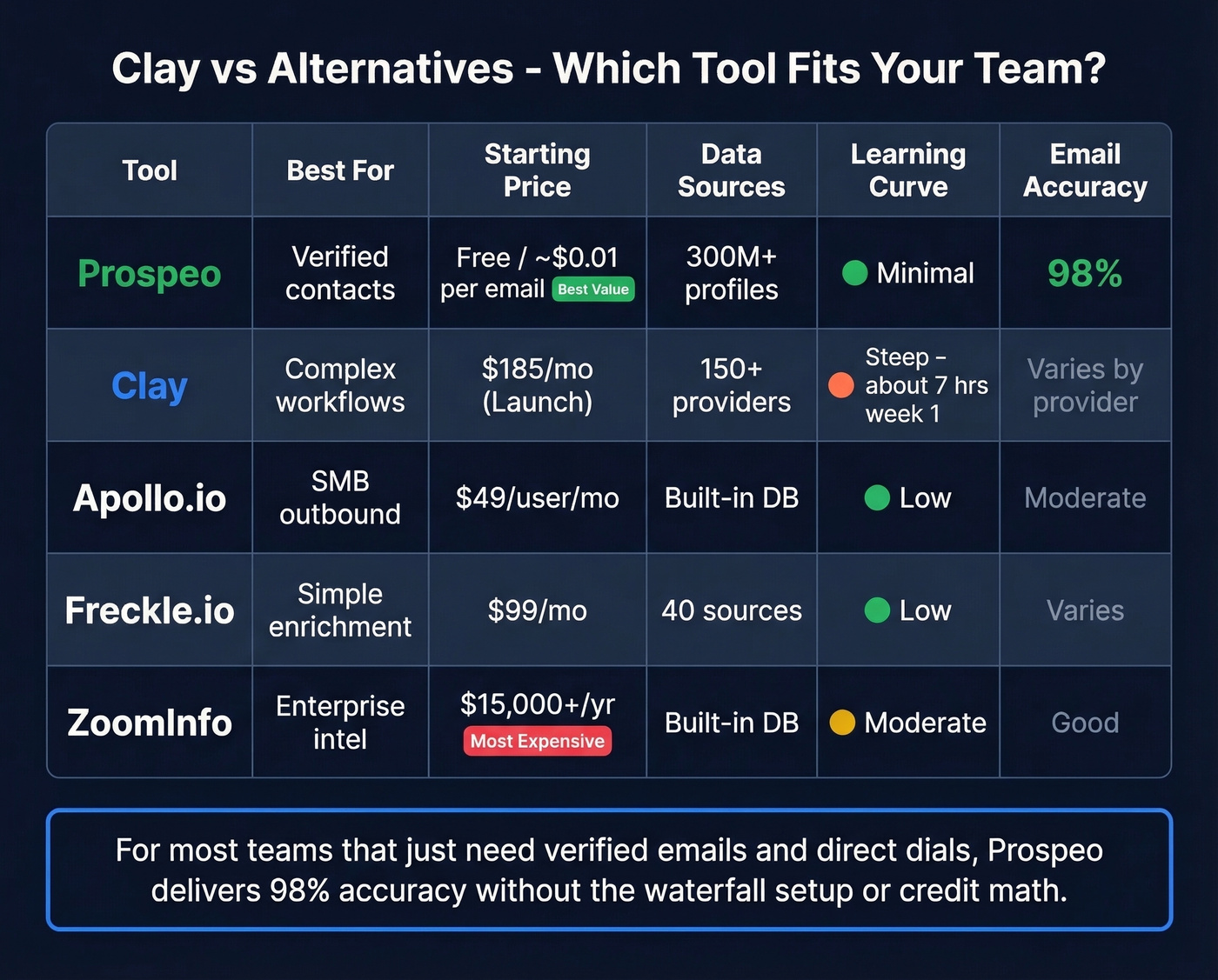
| Tool | Best For | Starting Price | Data Sources | Learning Curve |
|---|---|---|---|---|
| Prospeo | Verified contacts | Free / ~$0.01/email | 300M+ profiles | Minimal |
| Clay | Complex workflows | $185/mo (Launch) | 150+ | Steep (~7 hrs week 1) |
| Apollo.io | SMB outbound | $49/user/mo | Built-in DB | Low |
| Freckle.io | Simple enrichment | $99/mo | 40 | Low |
| ZoomInfo | Enterprise intel | $15,000+/yr | Built-in DB | Moderate |
Final Verdict
Most Clay reviews tell you it's amazing or terrible. The truth is more boring: Clay is a workflow tool, not a magic button. It rewards technical users who invest time in learning conditional logic, BYOK optimization, and waterfall design. It punishes everyone else with confusing credit burn and a steep ramp.
Start with the free tier - 1,200 credits per year - and track exactly how many credits your actual workflows consume before committing to Launch at $185/mo. If you find yourself building 10-step waterfalls across multiple providers, Clay earns its price. If you're just looking up emails and phone numbers, save yourself the headache and pick a tool that does one thing well. (If you're comparing vendors, our breakdown of data enrichment services can help.)
If your average deal size doesn't justify $185/mo in orchestration credits, you don't need a Formula 1 car. Prospeo's 300M+ profiles, 143M+ verified emails, and 125M+ mobile numbers refresh every 7 days - no BYO API keys, no workflow debugging, no credit overages.
Skip the complexity. Start with data that's already verified.
FAQ
Is Clay worth it for small teams?
Only if you have a technical operator willing to invest five to six hours learning the platform in week one. Without that commitment, credit burn on misconfigured waterfalls will exceed the enrichment value within the first billing cycle.
How much does Clay cost per lead?
Unoptimized workflows run $0.10-$0.50 per lead. With BYOK API keys and conditional logic gating expensive steps, power users consistently get under $0.05. Prospeo runs ~$0.01/email with no workflow setup required.
Why is Clay's Trustpilot rating so low?
The 2.2/5 comes from just 9 reviews, heavily skewed toward users who churned in the first month. G2's 4.7/5 from 189 reviews reflects invested power users who climbed the learning curve - both samples are real but represent very different audiences.
What changed in Clay's March 2026 pricing?
Three self-serve tiers collapsed into two: Launch at $185/mo and Growth at $495/mo. Credits split into Data Credits (for provider data) and Actions (for platform operations). No charge when an enrichment returns no result.
What's a good alternative if Clay is too complex?
For teams that need verified contacts without orchestration overhead, Prospeo offers 98% email accuracy, 125M+ verified mobiles, and a free tier with 75 emails/month. Apollo works well if you also need a built-in sequencer at $49/user/mo.