

What Does "Close a Deal" Mean? Definition, Techniques & Benchmarks
84% of sales reps missed quota last year. Not because they couldn't pitch - because they couldn't close. If you've ever wondered what "close a deal" actually means in practice, you already sense the gap between a great conversation and a signed contract. That gap is where revenue lives and dies, and most teams don't have a systematic approach to bridging it.
What Does It Mean to Close a Deal?
To close a deal means to conclude a negotiation and consummate an agreement - the moment both parties commit to terms and the transaction becomes official. In sales, it's the final stage of the funnel where a prospect becomes a customer.
Closing happens at the bottom of the sales funnel, after prospecting, qualifying, presenting, and handling objections. It involves getting commitment, finalizing terms, and processing paperwork or payment. Here's the mindset shift that separates good closers from everyone else: closing isn't about pressure or manipulation. The close is confirming the decision the buyer has already made. Your job is to make that confirmation easy, not to force a hand.
A couple of examples of how it sounds in the wild:
- "We closed the deal with Acme after a 3-month sales cycle."
- "The team closed on the deal Friday - contract's signed."
The Short Version
Definition: Closing a deal means reaching a mutual agreement where the buyer commits to purchase and the seller delivers on promised terms.
Average B2B close rate: 29%, with win rates around 21%. If you're above 29%, you're beating the average.
The mindset reframe: The best closers spend 80% of their effort upstream - qualifying hard, mapping stakeholders, building consensus - so the final ask is a formality.
Close vs. Seal vs. Finalize
People use these interchangeably, but each carries a different tone.
| Phrase | Connotation | Best Used When |
|---|---|---|
| Close a deal | Standard, professional | Everyday sales contexts |
| Seal the deal | Idiomatic, emphatic | Celebrating wins |
| Finalize a deal | Formal, administrative | Legal & procurement |
| Clinch a deal | Informal, competitive | Hard-won victories |
"Close" is the default in professional sales. "Seal" adds emphasis when the outcome felt uncertain. "Finalize" belongs in legal and procurement contexts. "Clinch" has a sports-commentary edge - it implies you beat someone else to the finish line.
Where Closing Fits in the Sales Process
The traditional funnel runs: prospecting, qualifying, presenting, handling objections, closing. Closing sits at the very bottom - the point where all prior work either pays off or doesn't.
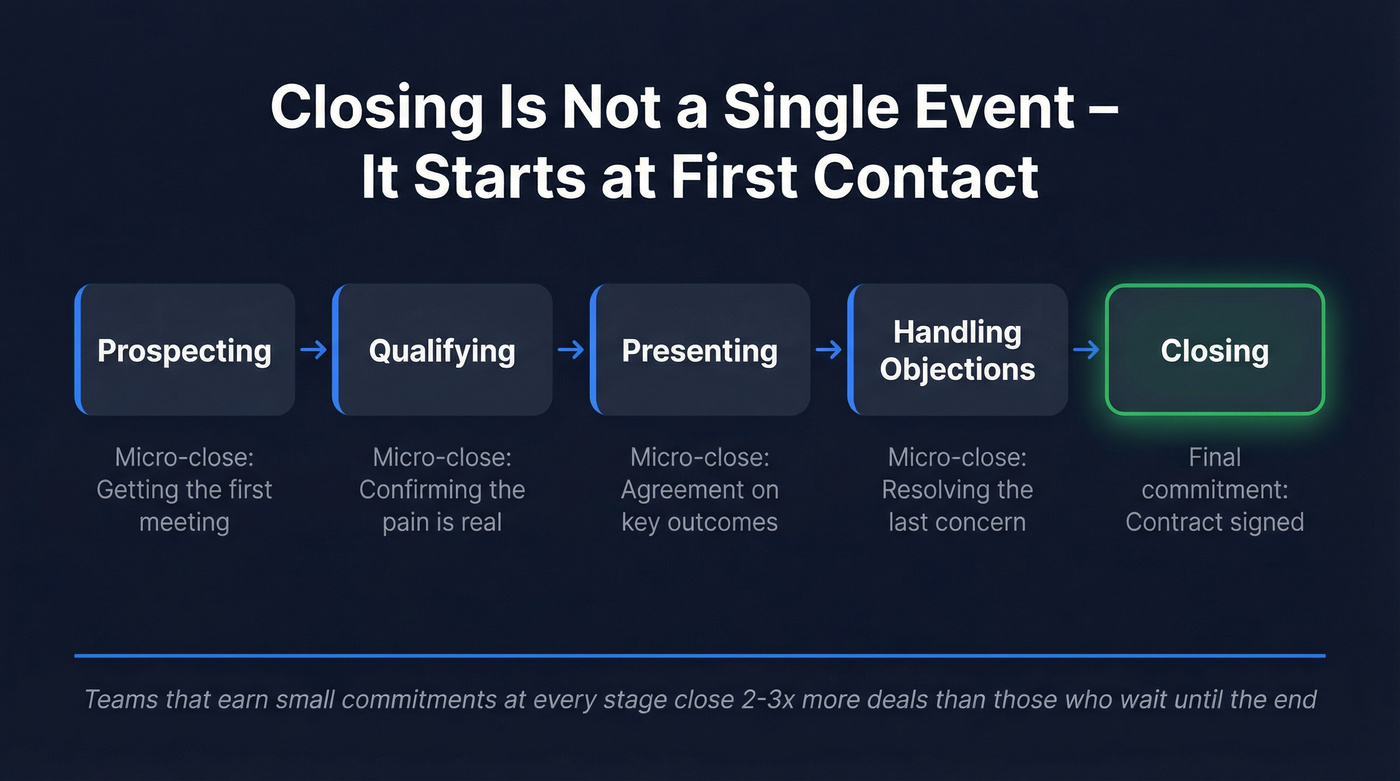
But most definitions miss something critical: closing begins at the first interaction. Every question you ask in discovery, every objection you handle in a demo, every stakeholder you loop in - those are micro-closes that make the final ask feel natural. We've seen this pattern repeatedly across our own sales conversations: teams that treat closing as a single event at the end consistently underperform teams that treat it as a continuous process of earning small commitments along the way.

Deals don't stall because your pitch is weak - they stall because your emails bounce and your calls hit gatekeepers. Prospeo gives you 98% accurate emails and 125M+ verified mobile numbers so your closing effort actually reaches the people who can sign.
Stop losing deals to bad contact data. Start reaching decision-makers directly.
Why Closing Is Harder in 2026
Closing a B2B deal today looks nothing like it did a decade ago.
80% of B2B sales interactions now happen through digital channels. Buyers engage across roughly 10 different touchpoints during a purchase - up from 5 in 2016. And 33% of all buyers prefer a completely seller-free experience, jumping to 44% among millennials. Buyers spend just 17% of their buying time meeting suppliers; the rest is independent research and internal alignment.
The buying committee has ballooned too. Mid-market deals often involve around 7 stakeholders, and enterprise buying committees regularly reach 11. Modern buyers complete 60-70% of their research before they ever talk to a rep.
Let's be honest about what this means in practice: roughly 80% of B2B deals stall because of lack of consensus, not active rejection. The buyer didn't say no - they just couldn't get alignment internally. That consensus problem is often a reach problem. If you can't get the CFO on the phone, the deal stalls - and that's a data issue, not a closing issue. Tools like Prospeo verify emails and phone numbers in real time so your closing effort actually reaches the decision-makers who can say yes.

What's a Good Close Rate?
Close Rate = (Closed-Won Deals / Total Opportunities) x 100
So if you closed 12 deals out of 50 opportunities, your close rate is 24%.
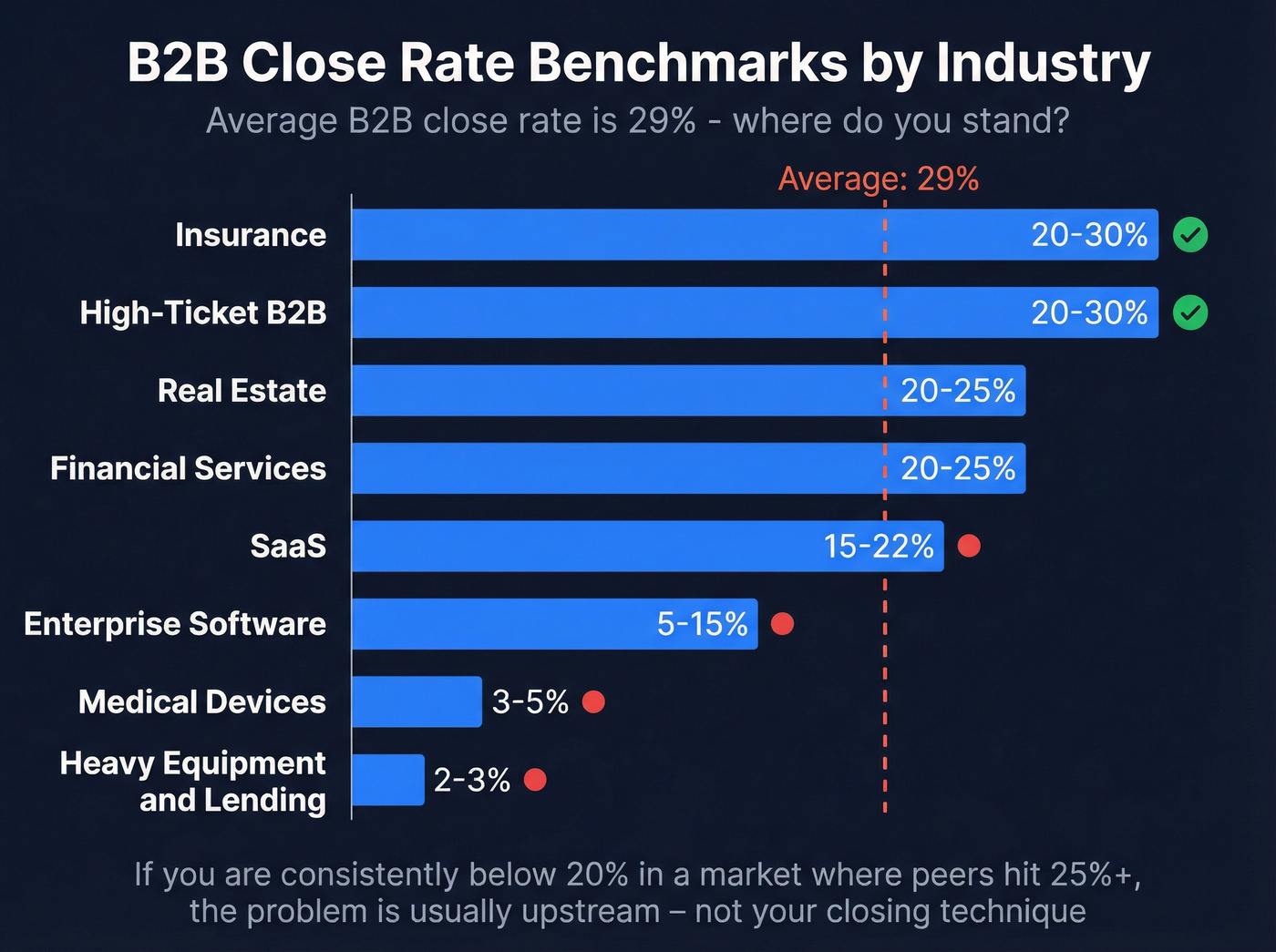
The average B2B close rate sits at 29%, with win rates around 21%. But averages hide massive variation. Here's what "good" looks like across sectors:
| Industry | Close Rate Range |
|---|---|
| SaaS | 15-22% |
| Enterprise Software | 5-15% |
| Real Estate | 20-25% |
| Insurance | 20-30% |
| Financial Services | 20-25% |
| High-Ticket B2B | 20-30% |
| Medical Devices | 3-5% |
| Heavy Equipment / Lending | 2-3% |
If you're consistently below 20% in a market where peers hit 25%+, the problem usually isn't your closing technique. It's upstream - bad lead data, weak qualification, or pitching stakeholders who can't actually sign. Fix the inputs before you overhaul the close.
Proven Techniques to Close a Deal
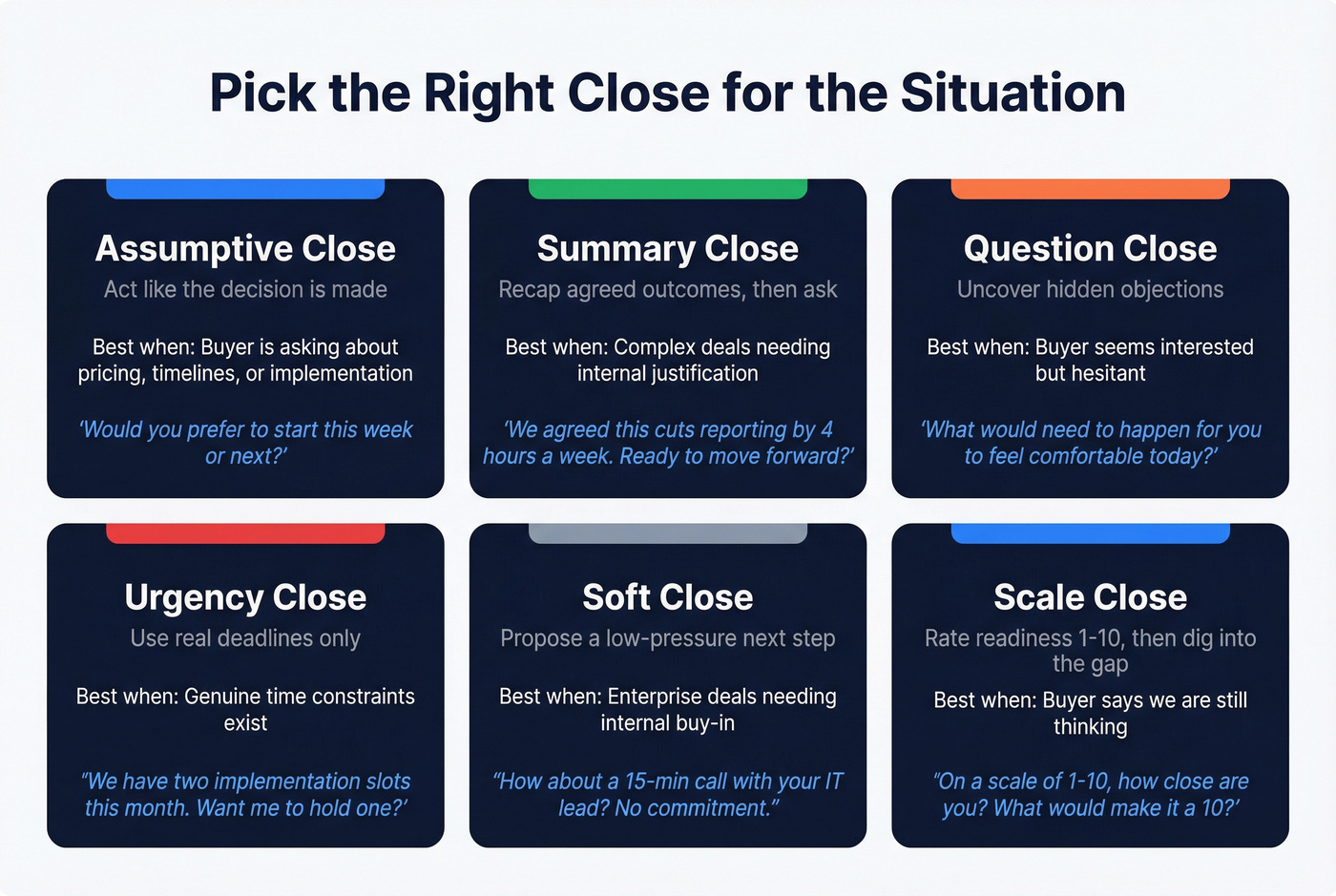
No single technique works every time. The best closers read the situation and pick the right approach. Here are six we've seen work across different deal types and buyer profiles.
The Assumptive Close
Act as if the decision has already been made and move straight to logistics. Use this when buying signals are strong - pricing questions, implementation discussions, approval timelines mentioned unprompted.
"Would you prefer to start implementation this week or next?"
The Summary Close
Recap the key outcomes you've agreed on, then ask for commitment. This one's especially effective in complex deals where the buyer needs to justify the decision internally, because you're essentially writing their business case for them.
"So we've agreed this solves your pipeline visibility gap and cuts reporting time by 4 hours a week. Ready to move forward?"
The Question Close
| When to use | When to skip |
|---|---|
| Buyer seems interested but hesitant | Buyer has already given clear buying signals |
| You sense hidden objections | You're past the objection stage |
"What would need to happen for you to feel comfortable moving forward today?"
The Urgency Close
Use real deadlines - end-of-quarter pricing, implementation windows, expiring terms. What doesn't work is manufacturing fake urgency. Buyers see through it instantly, and it destroys trust.
"Our implementation team has two slots open this month. After that, the next window is mid-Q3. Want me to hold one?"
The Soft Close
Propose a low-pressure next step instead of asking for the full commitment. Ideal for enterprise deals where the buyer needs internal buy-in before they can commit.
"How about a 15-minute call with your IT lead to walk through the integration? No commitment - just making sure it fits."
The Scale Close
Ask the buyer to rate their readiness on a 1-10 scale, then dig into the gap. This turns a vague "we're still thinking" into a specific conversation about what's missing.
"On a scale of 1 to 10, how close are you to moving forward? ... What would make it a 10?"
Mistakes That Kill Deals
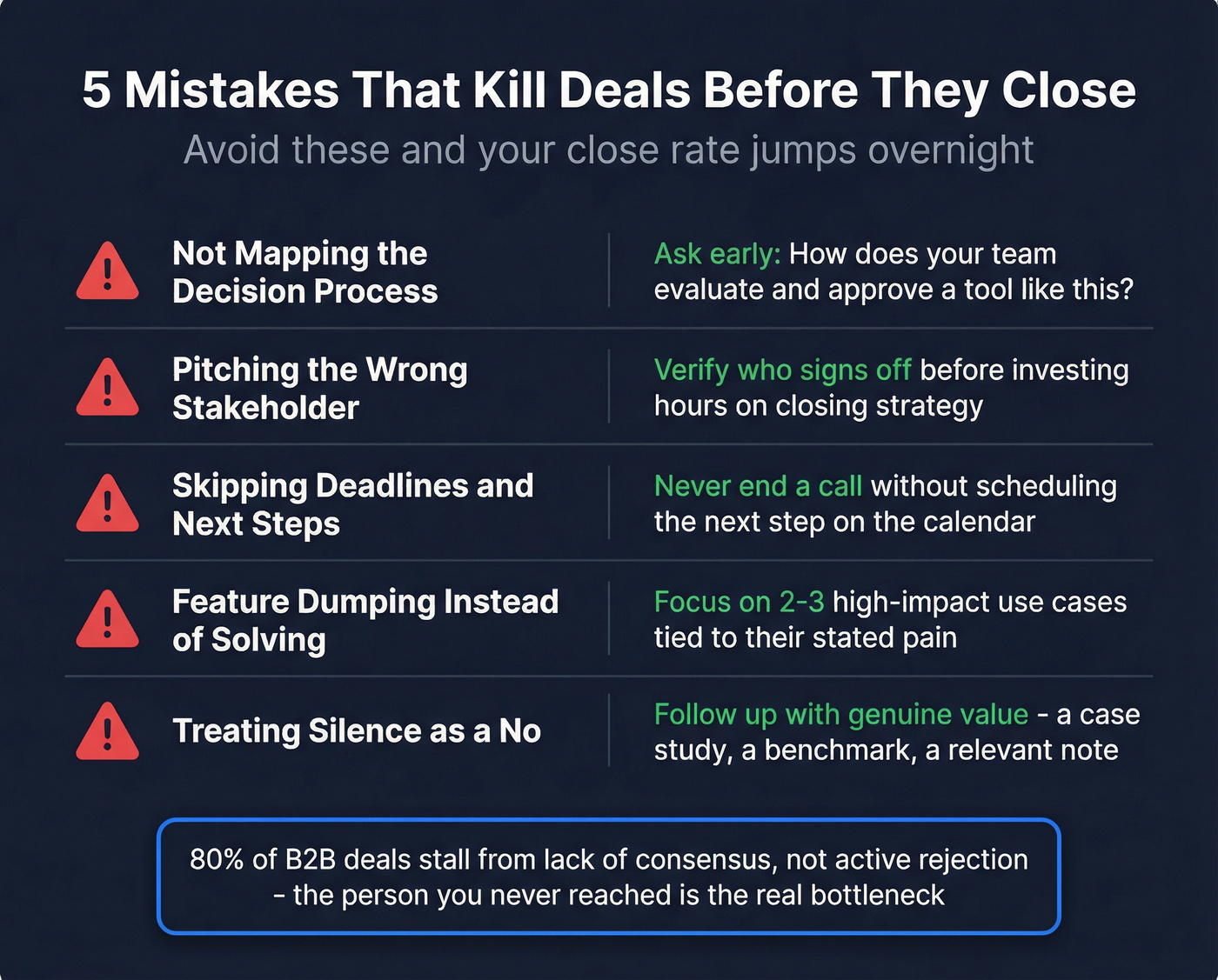
Closing technique matters, but avoiding these five mistakes matters more. We've watched deals die to every single one of these, sometimes in the same quarter.
Not Mapping the Decision Process
Most reps ask "Are you the decision-maker?" and move on. That's not enough. Ask early: "How does your team typically evaluate and approve a tool like this?" Then map every step and every person involved - legal, compliance, budget holder, executive sponsor. Skip this and you'll find yourself blindsided by a stakeholder you didn't know existed.
Pitching the Wrong Stakeholder
You can run a flawless sales process and still lose if you're selling to someone who can't sign. Before investing hours on a closing strategy, verify you have the right person's direct line. Ask the champion: "Who signs off once you've chosen a tool?"
Skipping Deadlines and Next Steps
Deals without deadlines fade. Never end a call without scheduling the next step. The moment you say "I'll follow up next week," you've lost control of the timeline.
Feature Dumping Instead of Solving
Focus on 2-3 high-impact use cases tied directly to the buyer's stated pain points. If they care about pipeline visibility, talk about pipeline visibility - not your 47 other features. The temptation to show everything you've built is real, but it dilutes the message and makes the buyer's internal pitch harder, not easier.
Treating Silence as a "No"
Ask any rep on r/sales what kills deals, and ghosting comes up more than price objections. Silence usually means the buyer is busy or navigating internal politics, not that they've decided against you. The reps who follow up consistently with genuine value - a relevant case study, a benchmark, a note tied to their last conversation - close deals that the "I don't want to be annoying" reps leave on the table.
You read it above: 80% of B2B deals die from lack of internal consensus, not rejection. That means the CFO or VP you never reached is the real bottleneck. Prospeo's 7-day data refresh and 30% mobile pickup rate connect you to every stakeholder on the buying committee - not just the ones who replied to your first email.
Reach the full buying committee. Close the deal that's been stuck for weeks.
FAQ
What does it mean to close a deal in sales?
Closing a deal means concluding a negotiation where both parties agree to terms - the buyer commits to purchase, the seller commits to deliver. It's the final funnel stage, but effective closing is a continuous process of micro-commitments that starts with the first conversation.
What's a good close rate for B2B sales?
The average B2B close rate is 29%, with win rates around 21%. SaaS companies typically range 15-22%, while enterprise software drops to 5-15%. If your rate is consistently below 20%, the issue is usually upstream - poor lead quality or missing stakeholders - not your technique.
How do you close a deal without being pushy?
Use trial closes throughout the sales cycle instead of saving everything for one high-pressure moment. Ask "What would need to happen for you to move forward?" rather than pushing for an immediate yes. Summarize agreed outcomes and propose logical next steps - and make sure you're reaching the actual decision-maker with verified contact data, since the best technique in the world won't help if you're pitching someone who can't sign.