

How to Follow Up with a Client Without Sounding Desperate
You sent the proposal Monday. It's Thursday. Your inbox is empty, and you're hovering over the "just checking in" button like it's a detonator.
Here's the thing: knowing how to follow up with a client is the difference between closing and getting ghosted - and only about 2% of deals close on first contact. The other 98% require follow-up. Most people are terrible at it. You don't need 15 templates. You need a system that forces you to use three good ones, consistently, without sounding like you're begging.
The Short Version
- Set the next step before you leave any meeting or call. This single habit eliminates most follow-up anxiety because you're not chasing - you're confirming.
- Use the 3-7-7 cadence. Follow up on Day 3, again on Day 10, breakup email on Day 17. Simple, repeatable, works.
- Make sure your contact data is accurate first. Bounced emails kill cadences silently. Run your list through Prospeo's email verification before launching anything - 98% accuracy means your messages actually land.
Why Clients Go Silent
The silence isn't personal. It almost never is. Only 3% of your market is actively buying, 56% aren't ready, and 40% are about to start looking - and 63% won't buy for at least three months. A consistent follow-up strategy is how you stay present for the other 97%.
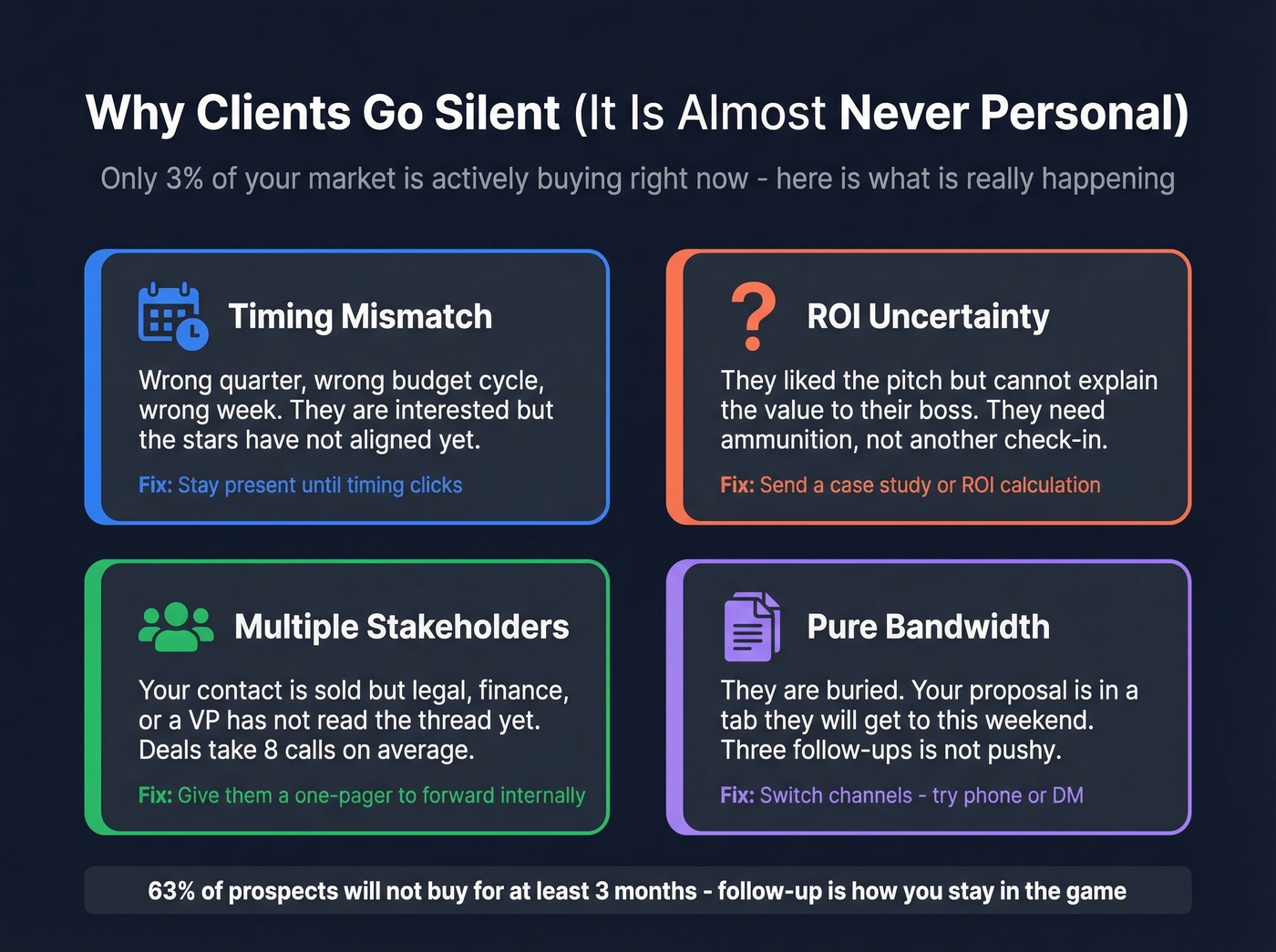
Timing mismatch. They're interested but it's not the right quarter, budget cycle, or week. Follow-up keeps you present until timing aligns.
ROI uncertainty. They liked the pitch but can't articulate the value to their boss. They need ammunition, not another "touching base" email.
Multiple stakeholders. Your contact is sold, but they're waiting on legal, finance, or a VP who hasn't read the thread. Closing a deal takes eight sales calls on average - partly because decisions involve more people than you think.
Bandwidth. They're buried. Your proposal is sitting in a tab they'll get to "this weekend." Three follow-ups isn't pushy. Giving up after one is lazy.
The #1 Rule: Set the Next Step
The best follow-up is one you don't have to improvise. American Express's business team recommends agreeing on a follow-up plan before the conversation ends - and if the prospect hesitates to commit to a next step, something isn't aligned.
Here's what this sounds like in practice: "Great conversation. Let's lock in 15 minutes next Thursday at 2 PM so I can walk you through the implementation timeline. I'll send a calendar invite before end of day."
No ambiguity. No "I'll follow up sometime next week." No guessing.
When you leave a meeting without a scheduled next step, you've volunteered for the worst part of sales - the cold follow-up into silence. End every call with a date, a time, and a clear agenda for the next touch.
Follow-Up Templates by Scenario
After a Meeting (Same Day)
Send a recap within two hours. Attach a brief summary of what you discussed, the action items each side owns, and the date of the next conversation. This makes it easy for your contact to forward the thread to their boss with context intact.
Template: "Hi [Name], thanks for the time today. Quick recap: we discussed [X], you're evaluating [Y], and we agreed to reconnect [date]. I've attached a one-page summary. Let me know if I missed anything."
Send same day, ideally within the hour. The recap should land while the conversation is fresh.
After a Proposal or Quote
This is where most people default to the worst follow-up message ever written: "Just following up - did you receive our quote? Let me know if you have any questions!" The r/sales subreddit is full of people asking how to escape this exact script, and for good reason. It adds zero value and screams desperation.
Instead, pair your follow-up with something new. A relevant case study. A quick insight about their industry. A specific ROI calculation you ran after the call. We've found that attaching a one-page comparison doc or a short Loom walkthrough gets replies at roughly double the rate of a plain text nudge.
Template: "Hi [Name], wanted to share a quick case study from [similar company] - they saw [specific result] after implementing what we discussed. Thought it might help as you're evaluating. Happy to walk through the numbers Thursday."
Send this on Day 3. Not Day 1 (too eager), not Day 7 (too late). If you want more options, pull from these sales follow-up templates and adapt them to your deal stage.
When a Client Goes Silent
Two emails with no reply? Switch channels. If you've been emailing, pick up the phone. If the phone goes to voicemail, try a direct message on a professional platform.
Most "ghosted" deals aren't dead - they're just stuck in someone else's inbox. Silence usually means "busy," not "not interested."
If you've exhausted channels and hit Day 17, send the breakup email: "Hi [Name], I haven't heard back, so I'll assume the timing isn't right. No hard feelings - I'll check in next quarter. If anything changes before then, I'm here."
The breakup email gets more replies than any other touch in the sequence. People respond to finality.
Re-Engaging a Past Client
Past clients are your warmest leads, and most teams ignore them completely. A monthly check-in with genuine value - an industry report, a product update, a congratulations on a recent milestone - keeps the relationship alive without feeling transactional.
Template: "Hi [Name], saw [their company] just [milestone]. Congrats. Also wanted to flag [industry trend] - thought it might be relevant given what you're building. Would love to catch up for 15 minutes this month."
You're not selling. You're staying present until timing aligns again.

Every follow-up that bounces is a dead touchpoint in your cadence. Prospeo verifies emails with 98% accuracy and refreshes data every 7 days - so your Day 3, Day 10, and breakup emails actually reach the inbox.
Stop following up with email addresses that don't exist.
When NOT to Follow Up
Not every silence calls for action. Skip the follow-up when the timeline you agreed on hasn't passed yet - reaching out before a deadline you set together signals impatience, not diligence. If you have nothing new to share, wait until you do. And if the delay is on your side because you owe them a deliverable, a revised quote, or an answer, fix that first. Following up while you're the bottleneck is a bad look.
The Cadence That Gets Responses
The 3-7-7 cadence is a simple framework that balances persistence with professionalism. Structured cadences typically run 8-12 touchpoints across channels for complex B2B sales; this covers the critical early window. If you want the deeper breakdown, see when should I follow up on an email.
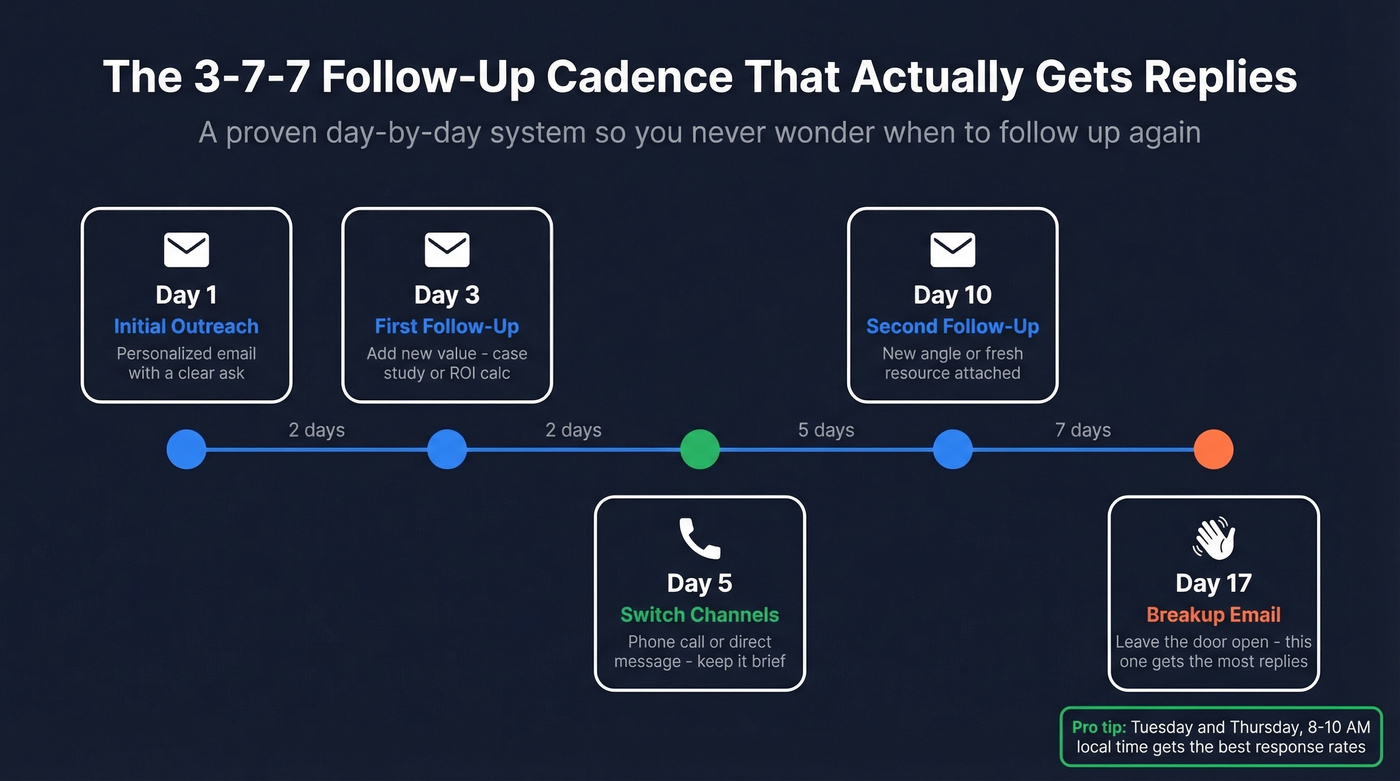
| Day | Action | Channel | Notes |
|---|---|---|---|
| 1 | Initial outreach | Personalized, clear CTA | |
| 3 | First follow-up | Add new value (case study) | |
| 5 | Touchpoint | Phone/DM | Switch channel; keep it brief |
| 10 | Second follow-up | New angle or resource | |
| 17 | Breakup email | Final touch; leave the door open |
That first follow-up matters more than you think - it can boost replies by around 49% compared to a single send. By the third follow-up, returns drop, which is why the breakup email at Day 17 is a clean exit, not a desperate fifth ask.
Timing within the day matters too. Tuesday and Thursday between 8-10 AM local time are the sweet spots. Second-best window: 4-5 PM, when people are clearing their inbox before leaving. Avoid 1-2 PM - response rates crater during the post-lunch slump. For more data, use this best time to send cold emails guide as a baseline.
If two full weeks pass with zero engagement across all channels, disengage. You've done your job. Circle back next quarter.
Five Mistakes That Kill Deals
1. "Bumping" with no new information. Every follow-up that says "just circling back" is a wasted touch. GMass gives a great example of the fix: instead of "checking in," try "we added 10-15 warm leads to your target market in January. Want me to walk through them?" That's a reason to reply. If you need better phrasing, here’s how to say just checking in professionally.
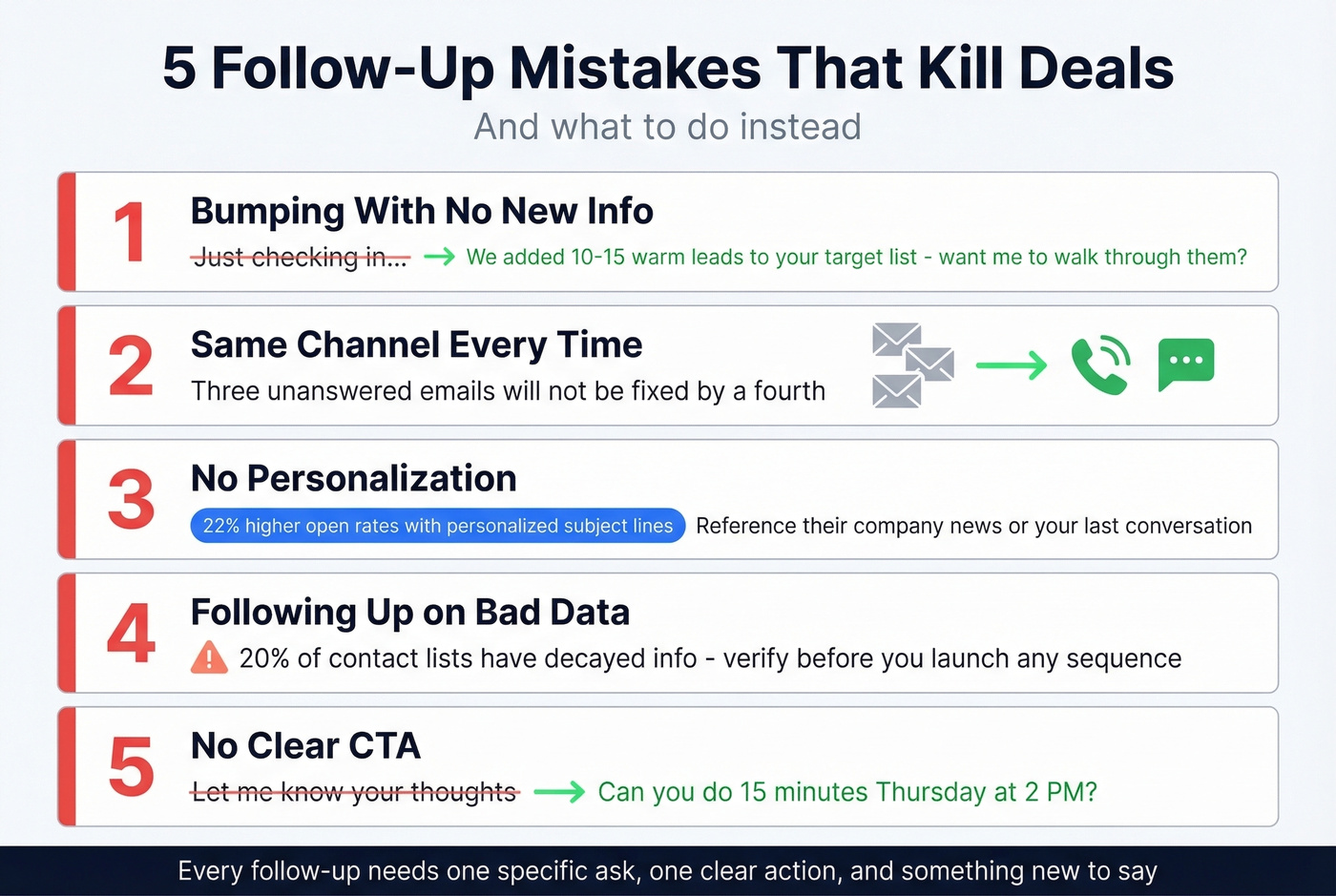
2. Same channel every time. Three unanswered emails won't be fixed by a fourth. Switch to phone, then a direct message. Multi-channel cadences outperform single-channel ones consistently. If you’re building a repeatable calling motion, borrow from a cold calling system.
3. No personalization. Generic subject lines get ignored. Personalized ones generate 22.2% higher open rates. Reference their specific situation, their company's recent news, or something from your last conversation. It takes 30 seconds and doubles your odds. Keep a swipe file of email subject line examples so you’re not reinventing this every time.
4. Following up on bad data. If your emails are bouncing, you don't have a follow-up problem - you have a data problem. We've seen teams run beautiful five-touch cadences where 20% of the list had decayed contact info. Verify your list before launching any sequence; one bad batch can tank domain deliverability for weeks. If you’re troubleshooting bounces, start with email bounce rate benchmarks and fixes.
5. No clear CTA. Every message needs one specific ask. Not "let me know your thoughts" - that's not an ask, it's a shrug. Try "Can you do 15 minutes Thursday at 2 PM?" One question. One action. If you want a tighter framework, use these email call to action rules.
Tools That Make Follow-Up Consistent
CRM with task automation. HubSpot's free CRM handles basic follow-up reminders. Paid Sales Hub plans add sequences and task queues. If a prospect opens your email three times in an hour, that's a timing signal worth acting on. If you’re comparing options, start with these examples of a CRM.
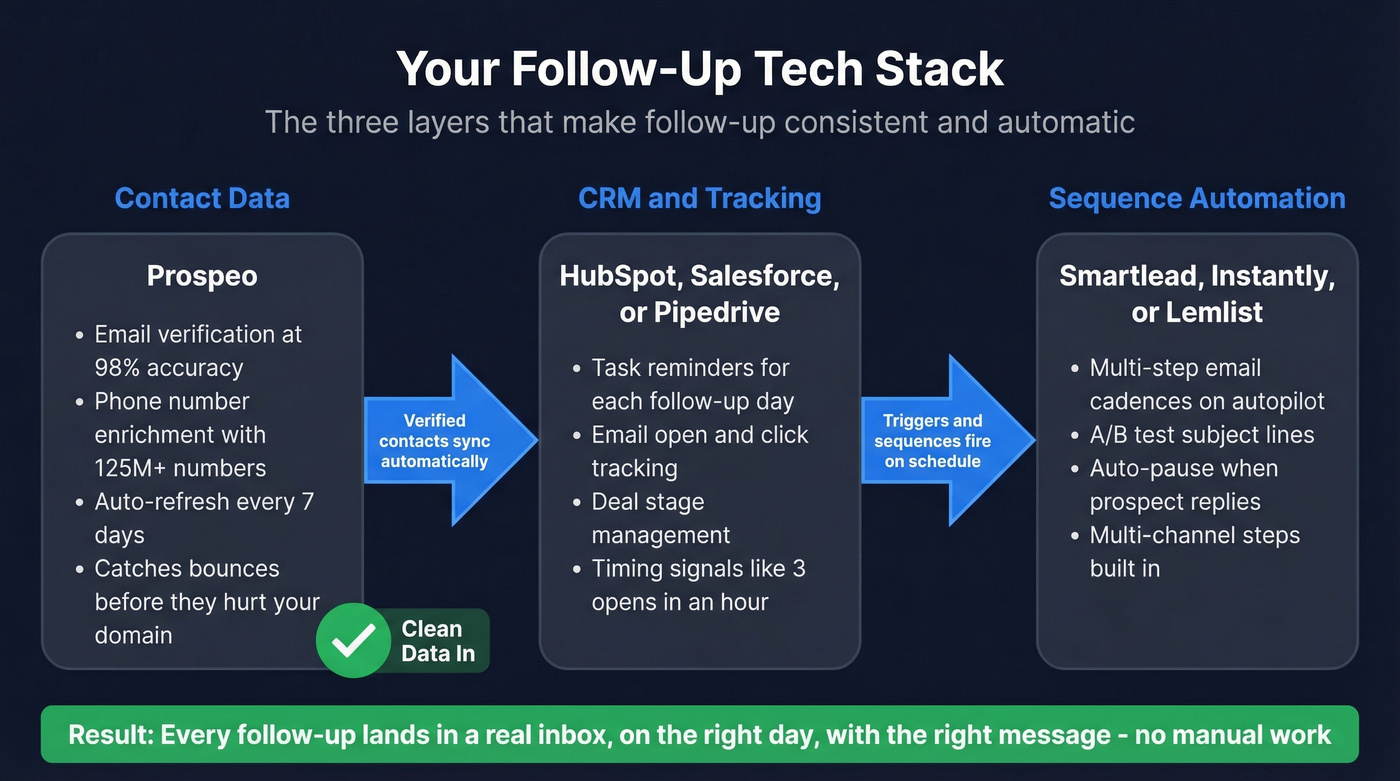
Email sequence tools. Smartlead, Instantly, or Lemlist automate multi-step cadences so you're not manually sending each touch. Pick one that integrates with your CRM. If you’re shopping, here’s a shortlist of follow up email software.
Contact data verification. Your cadence is only as good as the data feeding it. A perfectly crafted follow-up email that bounces is worse than no email at all. Prospeo plugs into HubSpot, Salesforce, Smartlead, and Instantly, keeping your database clean on a 7-day refresh cycle without manual work. If you’re evaluating vendors, compare data enrichment services before you commit.
Let's be honest - most follow-up failures aren't about copywriting. They're about consistency and clean data. Nail those two things and the templates almost write themselves.
When email follow-ups go silent, switching to phone changes everything. Prospeo gives you 125M+ verified mobile numbers with a 30% pickup rate - so your Day 5 channel switch actually connects you to a real person.
Get direct dials that pick up when emails don't.
FAQ
How many follow-ups should I send?
Three to five touches close most deals. The 3-7-7 framework - Day 3, Day 10, Day 17 - covers the critical early window. Complex B2B sales with multiple stakeholders often need 8-12 touchpoints across email, phone, and direct messages.
What's the best time to send a follow-up email?
Tuesday and Thursday between 8-10 AM in the recipient's local time zone consistently outperform other windows. Second-best: 4-5 PM. Avoid the 1-2 PM post-lunch dead zone when open rates drop sharply.
How do I follow up without being annoying?
Add new value with every touch - a case study, an industry insight, a useful resource. If every message teaches something or solves a problem, you're helpful, not annoying. The moment you send "just checking in" with nothing attached, you've crossed the line.
When should I stop following up?
After two weeks with zero engagement across all channels - email, phone, and direct messages. Send a breakup email, leave the door open, and circle back next quarter. Persistence past that point damages the relationship.
What if my follow-up emails keep bouncing?
Bounced emails mean stale contact data, and they actively hurt your sender reputation. Verify your list before launching any cadence - one bad batch can tank domain deliverability for weeks.