

Co-Selling: What It Is, Why It Works, and How to Build a Program That Closes Deals
You're leaving money on the table every time you sell alone into an account where a partner already has the relationship. Partners who co-sell frequently see 51% higher revenue growth than those who don't. That's not a marginal improvement - it's the difference between hitting plan and blowing past it.
TL;DR: Co-selling is when two companies jointly sell complementary solutions to shared target accounts. It beats simple referrals and pure reselling when you need joint positioning, shared access, and faster trust. To start, you need a co-sell partner, an account mapping tool like Crossbeam, and verified contact data to reach the buyers you've identified together.
What Is Co-Selling?
The legal term "co-seller" refers to a party jointly liable in a sales transaction - that's not what we're covering here. In B2B, co-selling means two companies with complementary solutions jointly engaging a shared prospect to close a deal together.
You sell a data warehouse, your partner sells a BI layer. Instead of competing for the same budget, you walk into the meeting together, pitch a combined solution, and split the win. Both companies keep their own customer relationship, brand, and contract. Nobody's reselling anybody else's product.
This model has become one of the dominant partnership strategies in B2B SaaS because hyperscalers like AWS and Microsoft have built strong incentive structures around it. AWS sellers get quota credit, and that changes the math for everyone involved.
Why Joint Selling Drives Better Results
The data isn't subtle. A Canalys study cited by AWS found ISVs who co-sell frequently close deals 65% more often and land deals that are 54% larger. Those same partners saw 51% higher average revenue growth. A separate Forrester study found ISVs experience 50% faster deal closure when transacting through AWS Marketplace, and 80% of those partners say Marketplace is an important part of their co-sell motion.
On the operator side, a Tackle.io leader shared a method that delivered 200% pipeline growth after launching a structured co-sell program - with teams reaching co-sell ready status in as few as 60 days.
The buyer side tells the same story. An EY survey of 1,400 enterprise leaders found 69% actively engage in collaborative ecosystems, and 71% would prioritize vendors that can orchestrate other vendors into a deal. Buyers don't want to be the integration layer between your product and your partner's product. When you co-sell, you remove that burden, and procurement sees a unified solution instead of two separate vendor evaluations.
Co-Selling vs. Referrals vs. Reselling
These three models get conflated constantly. They shouldn't be.
| Dimension | Referral | Co-Selling | Reselling |
|---|---|---|---|
| Who promotes | Partner refers | Both jointly | Reseller only |
| Who negotiates | Vendor only | Joint or separate | Reseller |
| Brand sold under | Vendor's brand | Both brands | Reseller's brand |
| Customer ownership | Vendor | Shared or vendor | Reseller |
| Pricing model | Commission | Commission | Markup |
Referrals are lightest-touch - your partner sends a lead, you close it, they get a cut. Simple, but the partner has zero skin in the game after the handoff. Reselling gives partners full control but sacrifices your margin and your customer relationship.
Co-selling sits in the middle and, for most B2B SaaS companies in 2026, it's the best bet. You keep your pricing and your customer relationship while gaining a warm introduction and a joint value proposition neither company could deliver alone.
Here's the thing: if your average deal size is under $15K, you probably don't need a formal co-sell program yet. Focus on referral partnerships until your deal sizes justify the operational overhead of joint selling.
How to Build a Co-Sell Program
The programs that actually produce pipeline follow a deliberate sequence. We've watched teams skip steps and regret it. Don't.
Get Executive Buy-In and Set KPIs
Co-selling touches product, engineering, CS, marketing, and sales. If it lives only in the partnerships team, it'll die there. Get executive sponsorship and define KPIs before launch: pipeline influenced, win rate on co-sell deals, deal velocity, and revenue contribution.
Build a Joint Value Proposition
Run workshops with your partner to align on messaging. What does the combined solution do that neither product does alone? Talk to shared customers about how they use both products together - their language becomes your pitch. This step takes longer than anyone expects, and rushing it is the fastest way to produce a co-sell deck that neither sales team actually uses.
Map Your Accounts
Use Crossbeam or Reveal to cross-reference your pipeline with your partner's customer base. You're looking for overlaps where your partner has a relationship and you have an open opportunity, or the reverse.
Launch Co-Marketing First
Start with "Better Together" stories and joint webinars before you start the co-sell motion. This creates inbound demand that feeds joint selling and gives both sales teams something to reference when they pick up the phone.
Execute the Co-Sell
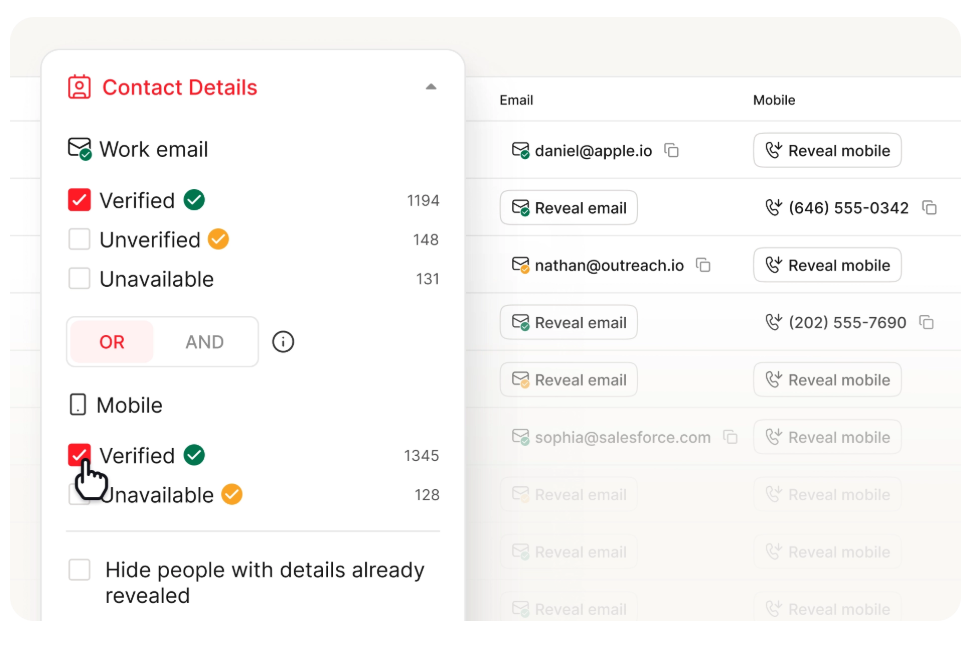
Warm intros, joint demos, coordinated outreach. This is where most programs stall - the accounts are mapped, the value prop exists, but nobody's actually reaching out. Once account mapping reveals overlaps, you need verified emails and direct dials for the decision-makers so co-sell leads don't die on a bounced email. We've used Prospeo for this step because the 7-day data refresh means contacts are current, not stale.
Track and Optimize
Measure pipeline sourced vs. influenced, win rates on co-sell deals vs. solo deals, and velocity differences. We've seen teams abandon co-selling because they didn't track it separately from their core pipeline - and then couldn't prove ROI when budget season came around. Don't be that team.

Account mapping reveals the overlaps. But co-sell deals stall when nobody can reach the decision-makers. Prospeo gives you verified emails and direct dials for 300M+ professionals - refreshed every 7 days so your co-sell outreach never bounces.
Turn mapped accounts into booked meetings at $0.01 per email.
Co-Selling with AWS, Microsoft, and Google Cloud
The hyperscaler co-sell programs are the biggest game in town. If you're starting from scratch, begin with AWS - lowest barrier to entry and the most structured incentive program.
AWS
The path runs through the AWS Partner Network (APN), then ACE (APN Customer Engagement), then ISV Accelerate and the SaaS co-sell benefit.
Since January 2025, AWS has offered the SaaS co-sell benefit to all ISV Accelerate partners transacting through AWS Marketplace - previously invite-only. AWS sellers receive quota credit when they co-sell partner solutions, which means their reps are actively motivated to bring you into deals. AWS has also rolled out a generative AI tool that matches partners to opportunities using ACE and Marketplace data. ACE eligibility and an AWS Specialization are minimum requirements to be recommended. Tackle.io reports teams achieving co-sell ready status in 60 days.
Microsoft
Microsoft's co-sell ladder runs In Market, then Co-sell Ready, then Azure IP Co-sell Eligible, then Business Applications Co-sell Eligible. The critical threshold for Azure IP co-sell eligibility is $100K in trailing-12-month Azure Consumed Revenue or Marketplace Billed Sales, plus a transactable Marketplace offer. The payoff is that Azure IP co-sell eligible offers can contribute toward customers' MACC commitments, which makes procurement dramatically easier.
Google Cloud
Google Cloud's Partner Advantage program runs Member to Premier tiers. The playbook is similar: get a Marketplace listing, build a "Better Together" narrative, share opportunities early.
Google's program is the least prescriptive of the three. That's a blessing if your partnerships team is self-directed and a curse if they need structure. In our experience, teams that struggle with AWS's process will struggle more with Google's lack of one.
The Co-Sell Tech Stack
Look, you don't need a $50K/year PRM to start a co-sell program. You need a shared Slack channel, a spreadsheet with mapped accounts, and verified contact data. Everything else comes later.
For teams ready to scale:
- Account Mapping: Crossbeam - free plan available, paid from ~$4,800/mo
- CRM: HubSpot (free CRM, Sales Hub from $50/mo) or Salesforce
- Prospecting & Data: Prospeo - 300M+ profiles, 98% email accuracy, 125M+ verified mobiles, refreshed every 7 days. Free tier with 75 emails/month. Apollo also works here (free tier, paid from ~$49/user/mo)
- Enrichment: Clay (from ~$134/mo)
- Attribution: Dreamdata (~$750/mo)
- PRM: PartnerStack (~$800-1,500/mo) - skip this on day one

Why Co-Sell Programs Fail
That same EY survey found 60% of enterprise leaders say multisided partnerships are difficult to execute. Partnership ops practitioners consistently cite three failure modes.
Lead ownership disputes kill partnerships fast. Two sales teams, one account, no rules. Fix it before launch with explicit rules of engagement and CRM deal registration.
Partner AE inactivity is the silent killer. Your partner's reps have their own quota and don't care about your product. Fix this with sales enablement materials they can actually use - a one-pager, not a 40-slide deck - and co-marketing that creates inbound demand so they're not cold-starting every conversation.
Bad contact data is the most preventable failure. You've mapped the accounts, identified the overlaps, and the email bounces. Cisco offers a useful contrast: they brought an ISV into a contact center deal where the customer needed software-based faxing, and the combined solution helped close a multimillion-dollar deal. That deal doesn't happen if the outreach never lands. Let's be honest - if your data provider can't keep up with a 7-day refresh cycle, you're building your co-sell program on a shaky foundation.
Your partner handed you the warm intro. Don't waste it on a bounced email. Prospeo's 98% email accuracy and 125M+ verified mobiles mean your co-sell reps connect with real buyers on the first attempt - not the fifth.
Close 65% more co-sell deals when your contact data actually connects.
Co-Selling FAQ
Is co-selling the same as channel sales?
No. Channel sales involves resellers who buy and resell your product under their brand. Co-selling is a joint engagement where both companies sell their own complementary solutions side by side. You keep your pricing, your narrative, and your customer relationship.
How long before a co-sell program produces pipeline?
Expect 3-6 months for the first closed deal. Hyperscaler programs can accelerate this - some teams report reaching co-sell ready status in 60 days. The key variable is acting on mapped account overlaps within the first two weeks, before momentum dies.
Do I need a marketplace listing to co-sell?
Not always, but it helps enormously with hyperscalers. AWS sellers get quota credit for marketplace-transacted deals, and Microsoft requires a transactable offer for Azure IP co-sell eligibility. For non-hyperscaler partnerships, a listing isn't necessary.
What's the minimum tech stack for a co-sell program?
A CRM, an account mapping tool like Crossbeam (free plan available), and a prospecting platform for verified contact data. Everything else - PRM, attribution, enrichment - can come later once you've proven the model works.