

Co-Selling: What It Is, How to Do It, and Why Most Programs Fail
A RevOps lead we know launched a co-sell program last year with three partners. Six months in, two had gone silent and the third was sending leads to a competitor. The partnership deck looked great. The execution was nonexistent.
That's the co-selling gap - and it's why 39.2% of channel partners now rank co-sell support as their #1 vendor priority, up 14.6 points in six months. Partners don't want more training decks. They want vendors who'll get on the phone and close deals alongside them.
The Short Version
Co-selling is two companies' sales teams working the same deal together - shared accounts, joint calls, coordinated close. It's not a referral. It's not a handoff. It's active collaboration through the pipeline, and 62% of SaaS companies report net-new revenue from marketplace co-sell motions, not just shifted procurement.
Before you launch, you need three things: account mapping to find where your customer bases overlap, clean contact data so bounced emails don't kill partner trust on day one, and a structured weekly cadence - not a Slack channel. If you're here for the agreement template, jump to Section 7.
What Is Co-Selling, Really?
Co-selling happens when two companies' sales teams jointly pursue a deal. Both reps are on the discovery call, both are shaping the proposal, and both have skin in the outcome. "I'll send you a lead and you close it" is a referral. Different animal entirely.
Here's the scenario that plays out constantly: your VP of Partnerships comes back from a conference, fired up about a new integration partner. "Their customers need what we sell. Our customers need what they sell. Let's co-sell!" Three months later, both teams are frustrated because nobody defined who owns the account, who runs the demo, or how commission splits work. We've watched this movie at least a dozen times.
Before building a formal program, audit what's already happening. Check Slack threads, implementation emails with partner domains, and joint customer calls - you likely have shadow partnerships that just need structure. Every co-sell deal has four possible outcomes: both win, you win and your partner loses, your partner wins and you lose, or both lose. Your incentive structure has to account for all four.
Co-Selling vs. Referral vs. Reselling
Jake Atwood of The Channel Builder estimates that 90%+ of channel partnerships are referral-based. Referrals are simpler to operate, but they leave money on the table when both companies could be adding value to the deal.
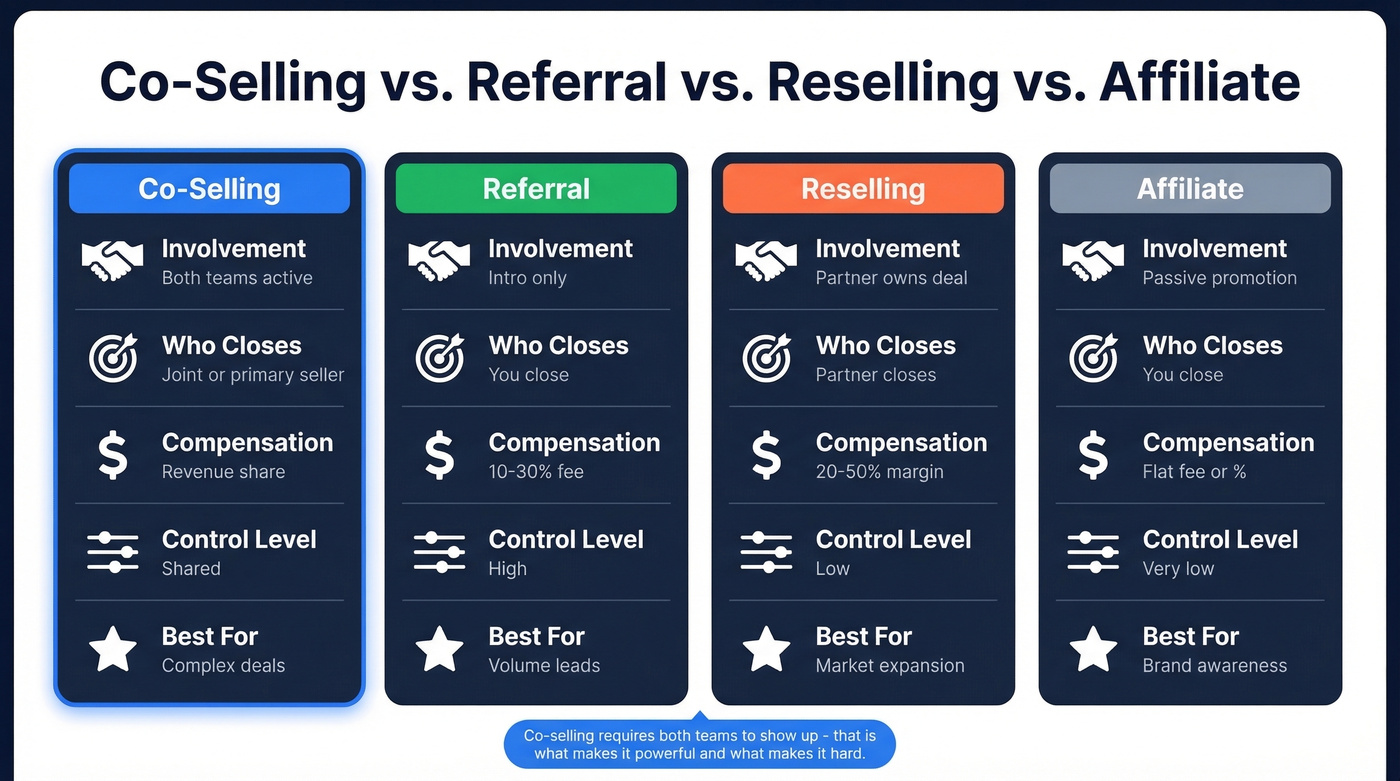
| Dimension | Co-Selling | Referral | Reselling | Affiliate |
|---|---|---|---|---|
| Involvement | Both teams active | Intro only | Partner owns deal | Passive promotion |
| Who closes | Joint or primary | You close | Partner closes | You close |
| Compensation | Revenue share | 10-30% fee | 20-50% margin | Flat fee or % |
| Control | Shared | High | Low | Very low |
| Best for | Complex deals | Volume leads | Market expansion | Brand awareness |
The key distinction: co-selling requires both teams to show up. That's what makes it powerful and what makes it hard.
Why It Matters in 2026
Futurum's 1H 2026 survey of 400 channel partner decision-makers tells the story. Co-sell support jumped to 39.2% as the top vendor priority - a 14.6-point surge from the 2H 2025 baseline. Training programs cratered 14.7 points to 17.5%, dead last. Partners aren't asking for more certifications. They want vendors who'll actually sell alongside them.
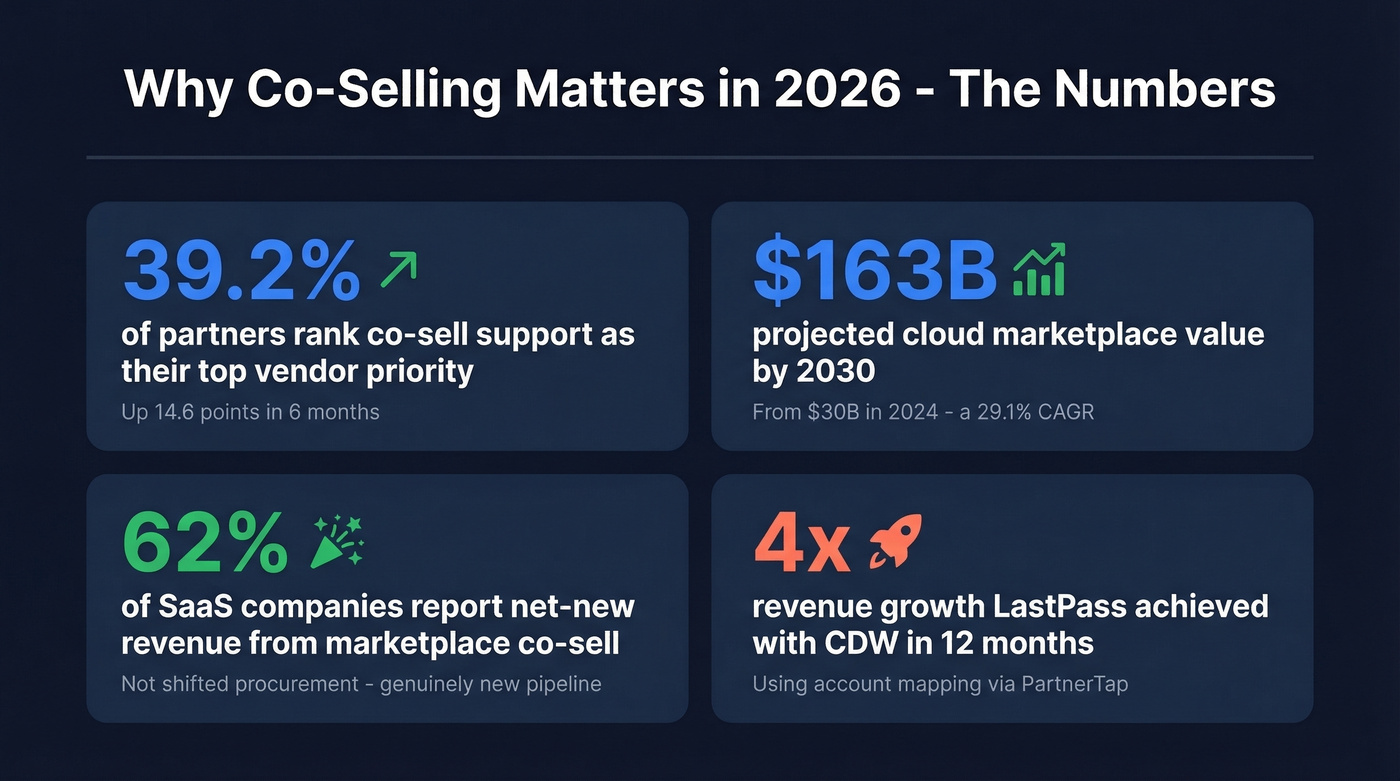
The marketplace numbers reinforce this. Omdia forecasts combined AWS, Azure, and GCP marketplace value growing from $30B in 2024 to $163B by 2030 - a 29.1% CAGR - with partners facilitating roughly 60% of all marketplace transactions by 2030. There's approximately $470B in cloud commitments sitting in customer accounts. Partners who can help burn those commitments down have a structural advantage.
Real results exist. LastPass grew revenue 4x with CDW in their first twelve months using PartnerTap for account mapping. And that 62% net-new revenue figure from marketplace co-sell? That's genuinely new pipeline, not cannibalized deals. The benefits are clearest in complex B2B deals where both partners bring unique access or expertise that neither could replicate alone.
Here's the thing: if your average deal size is under $15k and your product doesn't integrate with a partner's, you probably don't need a co-sell program. A referral agreement with a clear commission structure will outperform a half-built joint selling motion every time. Co-selling only works when both teams gain something they couldn't get alone.
How Cloud Marketplace Co-Selling Works
The three hyperscalers each run co-sell programs, but the mechanics differ in ways that matter.
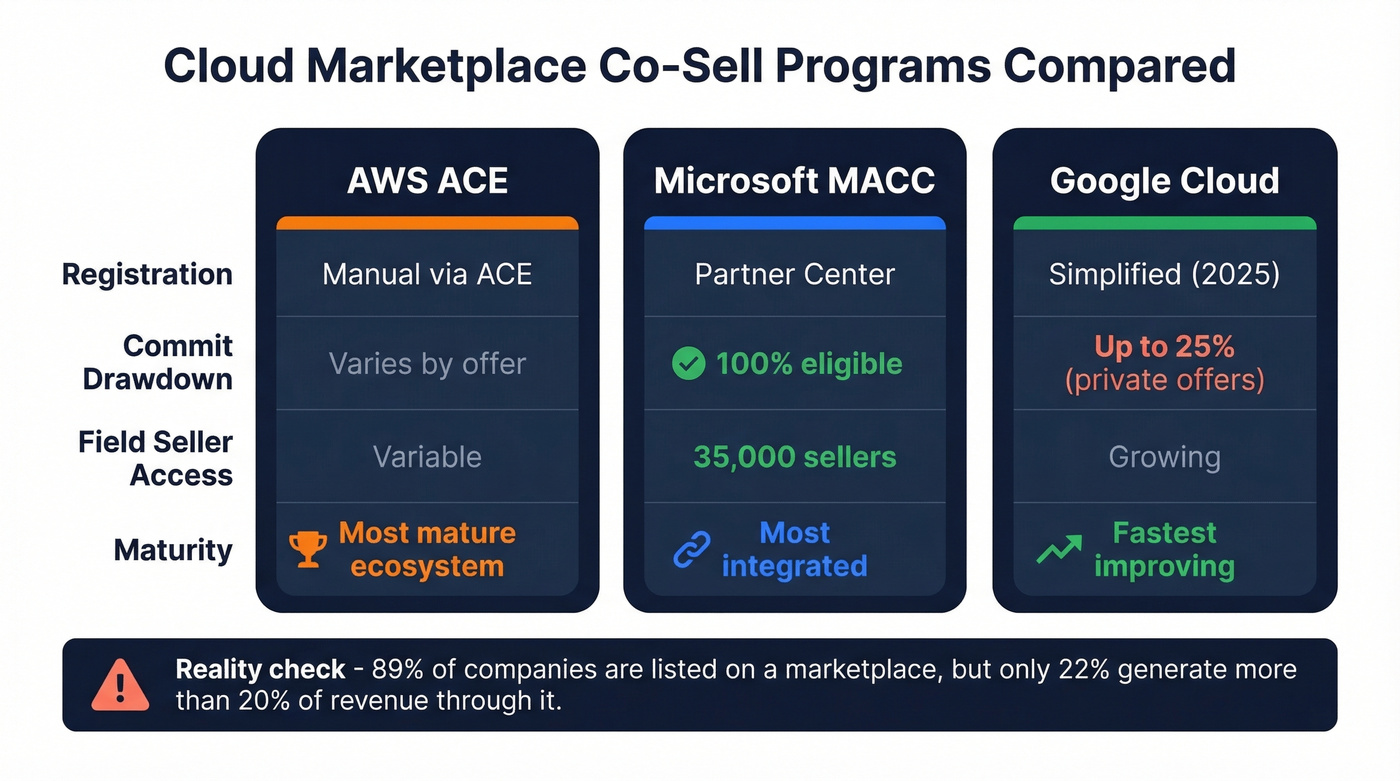
Microsoft fields 35,000 sellers and covers 95% of the Fortune 500 through its cloud. Their MACC (Microsoft Azure Consumption Commitment) model is deeply integrated into how marketplace deals get justified: 100% of eligible software purchases count toward a customer's existing commitment, which slashes procurement friction. Google Cloud introduced a simplified commit drawdown model for qualifying private offers: purchases can count toward committed spend, capped at 25% of the total commitment (effective June 2025). AWS ACE (APN Customer Engagements) is widely considered the most mature ecosystem, but it requires more manual registration and process discipline.
| Dimension | AWS ACE | Microsoft MACC | Google Cloud |
|---|---|---|---|
| Co-sell registration | Manual via ACE | Partner Center | Simplified (2025) |
| Commit drawdown | Varies by offer/program | 100% eligible | Up to 25% (private offers) |
| Field seller access | Variable | 35,000 sellers | Growing |
| Maturity | Most mature ecosystem | Most integrated | Fastest-improving |
Now for the reality check: 89% of companies are listed on a marketplace, but only 22% generate more than 20% of revenue through it. The maturity gap is enormous. Top performers are 2x more likely to automate their workflows and 94% engage hyperscaler field teams consistently. Three categories - infrastructure software, DevOps, and business apps - account for 63% of marketplace spend, so if you're outside those, the path is narrower.

Account mapping finds overlap. Bad data kills the follow-through. When your co-sell partner sends a warm intro and your email bounces, that trust evaporates instantly. Prospeo delivers 98% verified email accuracy with a 7-day refresh cycle - so every joint outreach actually lands.
Don't let stale data sabotage your next co-sell deal.
How to Build a B2B Co-Sell Program
Define Your Ideal Partner Profile
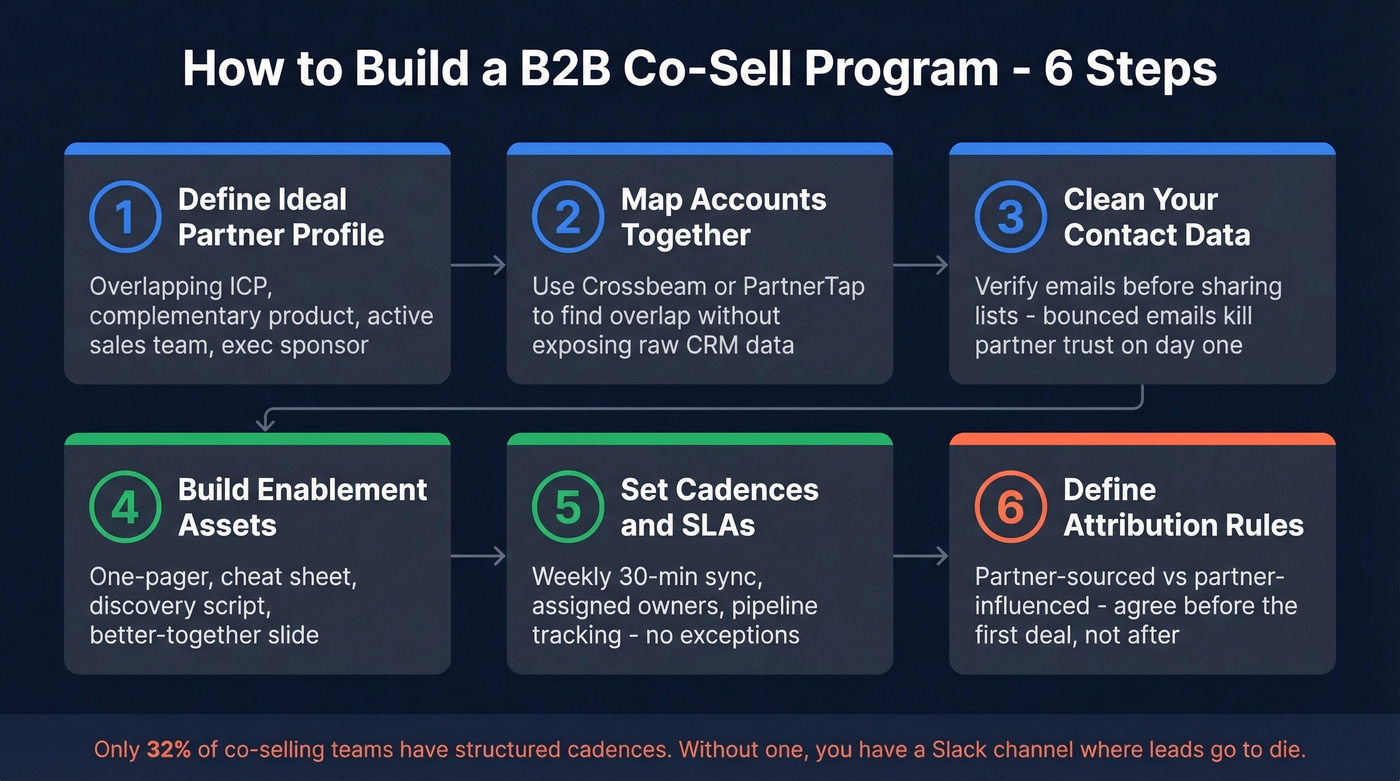
Intelligent Demand flags this as failure mode #1: no Ideal Partner Profile. Before you recruit partners, define what a good one looks like - overlapping ICP with the same buyer persona, a complementary product, an active sales team (not just a marketing partnership), willingness to share account data, and an executive sponsor who'll enforce the cadence.
Skip this step and you'll recruit anyone who says yes. That's how you end up with ten partners and zero joint revenue.
Map Accounts Together
You need to know where your customer bases overlap before a single joint call happens. Tools like Crossbeam and PartnerTap handle this - they let you compare account lists without exposing raw CRM data to each other. We've seen teams discover 500 mutual accounts and still close zero joint deals because nobody acted on the overlap. Account mapping without a follow-up cadence is just an interesting Venn diagram.
Clean Your Contact Data
Before you share a prospect list with a partner, verify it. Nothing kills a partnership faster than your partner's reps hitting invalid addresses from your list. Bounced emails erode trust before the first joint call even happens.
Prospeo runs 98% email accuracy with a 7-day refresh cycle, so the contacts you share today are still valid next week. Bulk verify via CSV upload, then export clean data - the free tier covers 75 emails per month, enough to validate a pilot partner list before scaling.
Build Enablement Assets
Your partner's reps won't learn your product from scratch. Give them a one-pager on your joint value proposition, a cheat sheet mapping your features to their customers' pain points, a discovery script for joint calls, and a "better together" slide they can drop into existing decks. The goal is to make it easier for your partner's rep to sell your product than to skip it.
Set Cadences and SLAs
Only 32% of co-selling teams have structured cadences in place. Let's be blunt: if you don't have a weekly cadence, you don't have a program. You have a Slack channel where leads go to die. Set a 30-minute weekly sync, assign owners to every shared opportunity, and track pipeline movement. No exceptions.
Define Attribution Rules
This is where partnerships get political. Tag every opportunity in your CRM as partner-sourced (the partner brought the lead) or partner-influenced (the partner helped close an existing opportunity). The distinction matters for commission payouts, for proving ROI to leadership, and for keeping your partner motivated. Agree on attribution rules before the first deal, not after.
Co-Selling Agreement Template
Don't handshake your way into a partnership. Put it in writing. Here are the eight components every agreement needs:
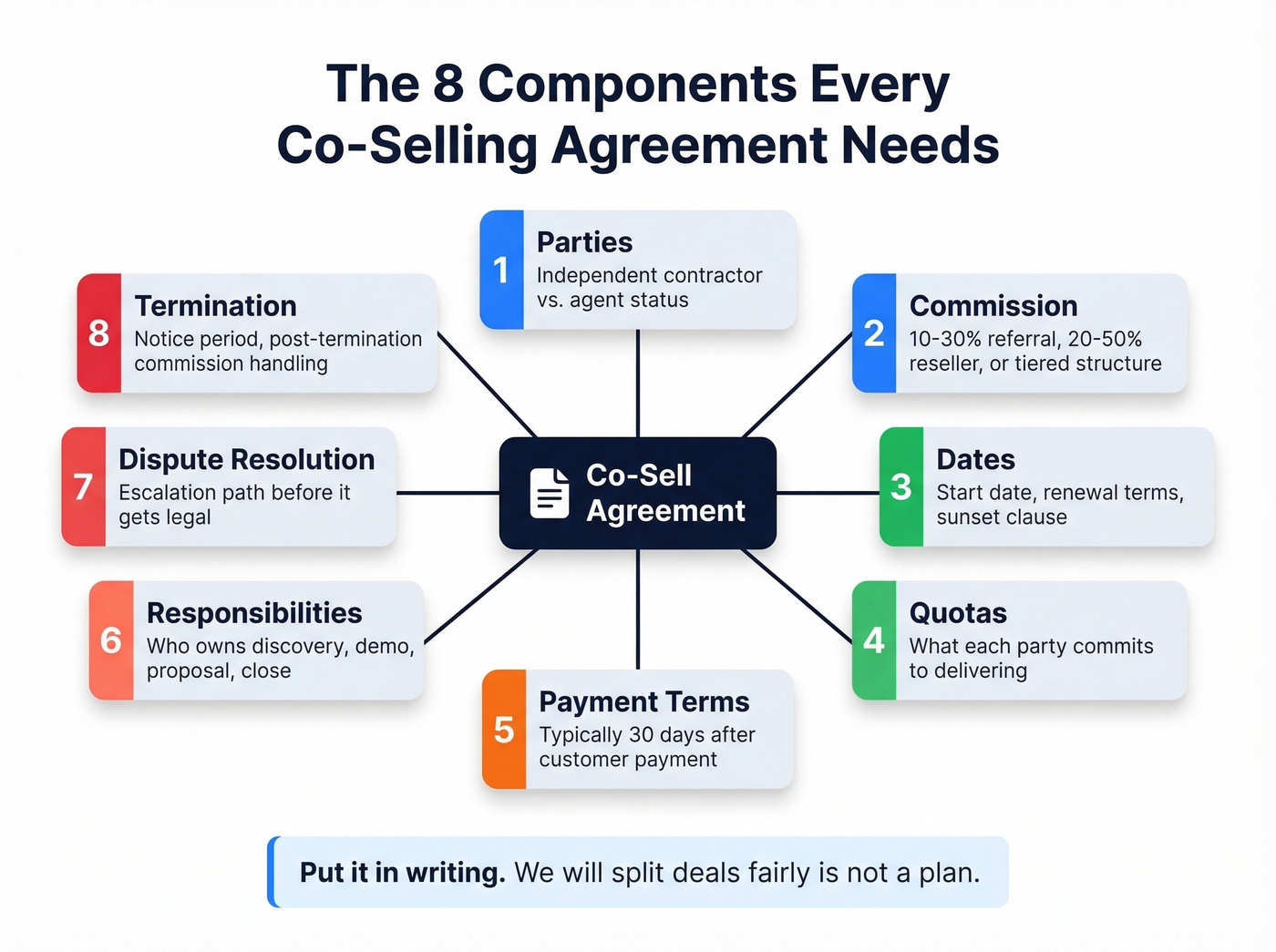
- Parties - who's involved, independent contractor vs. agent status
- Commission - flat, tiered, or milestone-based rate structure
- Dates - start, renewal terms, sunset clause
- Quotas - what each party commits to delivering
- Payment - when commissions are payable (typically 30 days after customer payment)
- Responsibilities - who owns discovery, demo, proposal, close
- Disputes - escalation path before it gets legal
- Termination - notice period, post-termination commission handling
For commission ranges, referral-style payouts typically run 10-30% of deal value. Reseller margins go higher at 20-50% depending on services included. One publicly filed agreement shows a tiered structure: 10% of contract billing in the first 30 days, 15% during the first year, 5% thereafter, with commissions payable 30 days after the company receives customer payment and mandatory weekly sales reports.
Look - most agreements are too vague. "We'll split deals fairly" isn't a clause. Write the numbers down.
How to Measure Performance
| KPI | Formula | Benchmark |
|---|---|---|
| Partner-sourced pipeline | Opps tagged partner-sourced | 15-30% of total pipeline |
| Partner win rate | Co-sell wins / co-sell opps | 15-40% higher than solo |
| Avg deal size | Revenue / joint deals | Typically 1.5-2x solo |
| Cycle acceleration | Solo cycle - joint cycle | 10-30% faster |
| Marketplace revenue % | Marketplace rev / total rev | Target >20% |
If your team ran 40 joint opportunities last quarter and closed 14, your partner win rate is 35% - compare that to your solo close rate to prove the motion's value. The automation gap matters here too: top-performing teams automate at 63% vs. 30% for everyone else. If you're tracking these KPIs in spreadsheets, you're already behind.
Why Co-Sell Programs Fail
70% of business partnerships fail within the first two years. The sourcing on that number is fuzzy, but the pattern is real. Here's what we've observed, backed by Intelligent Demand's analysis:
- No Ideal Partner Profile - recruiting anyone who says yes
- Vague joint ICP - "we both sell to mid-market" isn't specific enough
- No real joint value proposition - just two logos on a slide
- Too many partners - spreading thin instead of going deep
- Over-indexing on lead sourcing - expecting partners to fill your funnel
- Sales team veto power - direct reps blocking partner involvement
- No structured process - introductions with no follow-through
- No co-marketing support - expecting pipeline without awareness
- Weak partner team authority - partnerships team can't enforce anything
- Ignoring partner input - one-directional "enablement"
- No measurement framework - can't prove ROI, can't get budget
- Post-signature neglect - signing the agreement and disappearing
- Lack of learning loops - repeating the same mistakes quarterly
And then there's channel conflict. The r/msp subreddit is full of MSPs describing Microsoft's co-sell program as "not collaboration" and "back stabbing partners" - with reps contacting partner clients directly using tenant data. That's the extreme case, but it illustrates a real tension: 51% of teams cite complexity as a major blocker, and 42% of RevOps teams remain unconvinced about cloud marketplaces entirely.
One more thing worth saying out loud: most guides on this topic are written by PRM vendors selling you software. The failure modes above are all process and people problems, not technology gaps.
Co-Sell Tech Stack
You don't need a PRM to start. You need clean data, a shared spreadsheet, and a weekly cadence. Here's what the full stack looks like when you're ready to scale:
| Tool | Category | Starting Price |
|---|---|---|
| Crossbeam | Account mapping | Free; paid ~$4,800/mo |
| PartnerTap | Account mapping | ~$500-$2,000+/mo |
| PartnerStack | PRM | ~$800-$2,000+/mo |
| Clazar | Marketplace mgmt | ~$1,000-$5,000+/mo |
| Introw | CRM-first PRM | ~$200-$1,000+/mo |
| HubSpot Sales Hub | CRM | $50/mo |
| Salesforce | CRM | $25-$330/user/mo |
| Apollo | Data / outreach | $49/user/mo |
| Clay | Enrichment / workflows | $134/mo |
| Dreamdata | Attribution | $750/mo |
| Prospeo | Data verification | Free; paid ~$0.01/email |
The contrarian take: most teams buy a PRM before they've proven the motion works. Start with your CRM, a clean contact list, and a weekly partner sync. Add tooling when you've closed three joint deals and know what's actually bottlenecking you.
The best co-sell programs start with clean, overlapping contact data. Prospeo's 300M+ profiles with 30+ filters - including technographics, buyer intent, and headcount growth - let you and your partner map shared accounts in minutes, not weeks. At $0.01 per email, scaling joint pipeline costs a fraction of legacy tools.
Build your co-sell target list with data both teams can trust.
FAQ
What is co-selling and how does it differ from a referral?
Co-selling is joint sales execution where both companies' reps actively participate in discovery, demos, and closing. A referral is a one-way introduction - you pass a lead and collect a fee. Co-selling requires shared accountability throughout the pipeline, which produces 1.5-2x larger deal sizes but demands more operational discipline.
How long does it take to see pipeline from a co-sell program?
Expect 90-180 days before closed revenue appears. Month one is account mapping and enablement, months two and three are joint discovery calls, and real wins show up in quarter two. No pipeline by month six means a structural problem - revisit your partner profile and cadence.
Do I need a PRM platform to start?
No. A shared spreadsheet, CRM partner tags, and a weekly sync get you through the first 5-10 joint deals. Add a PRM when you're managing more than three active partners and need automated deal registration.
How do I keep contact data accurate for joint outreach?
Verify every list before sharing it with a partner. Bulk verification tools check emails against live servers - upload a CSV, get results in minutes, export only verified contacts. Bad data in a joint motion damages two brands, not one, so this isn't a step you skip.
Which cloud marketplace is best for co-selling?
Microsoft is the most integrated into its field organization, with 35,000 sellers and MACC mechanics that simplify procurement. AWS ACE is the most mature ecosystem overall. Google Cloud is improving fast after its mid-2025 simplification. Pick based on where your customers already have cloud commitments.