

Coaching vs Mentoring in Sales: What the Data Says (and When to Use Each)
In 2012, 53% of sales reps hit quota. The latest data puts that number at just 16% - and there's no sign it's recovered. Meanwhile, 70% of what reps learn in sales training is forgotten within a week.
The standard playbook of "send the team to a workshop and hope it sticks" is dead. Stop spending budget on training events. Spend it on coaching infrastructure instead.
Quick Version
If you only have 30 seconds:
- Rep has a specific skill gap right now (objection handling, discovery, closing) - they need coaching. Structured, short-term, manager-led.
- Rep is navigating career direction, confidence, or long-term growth - they need a sales mentor. Relationship-driven, senior-led, ongoing.
- You're serious about retention AND performance - you need both.
What Is Sales Coaching?
John Whitmore defined coaching as "unlocking a person's potential to maximize his or her performance." The ATD put it more bluntly: "Coaching is not yelling, telling, or selling." It's observation, motivation, and developmental feedback anchored to specific behaviors.
The timing data is striking. Reps coached within 24 hours of a call are 2.5x more likely to improve than those who get delayed feedback. Teams that receive consistent coaching see 16.7% higher revenue growth. Most managers think they're coaching when they're actually reviewing pipeline. Real coaching is behavioral - it's watching a rep's discovery call and saying, "You asked about budget too early, and here's why that killed the conversation." That's the work. Everything else is a status update.
What Is Sales Mentoring?
Sales mentoring is the longer game. Where coaching targets a specific skill in a specific quarter, mentoring shapes how a rep thinks about their career, builds confidence, and develops judgment over months or years.
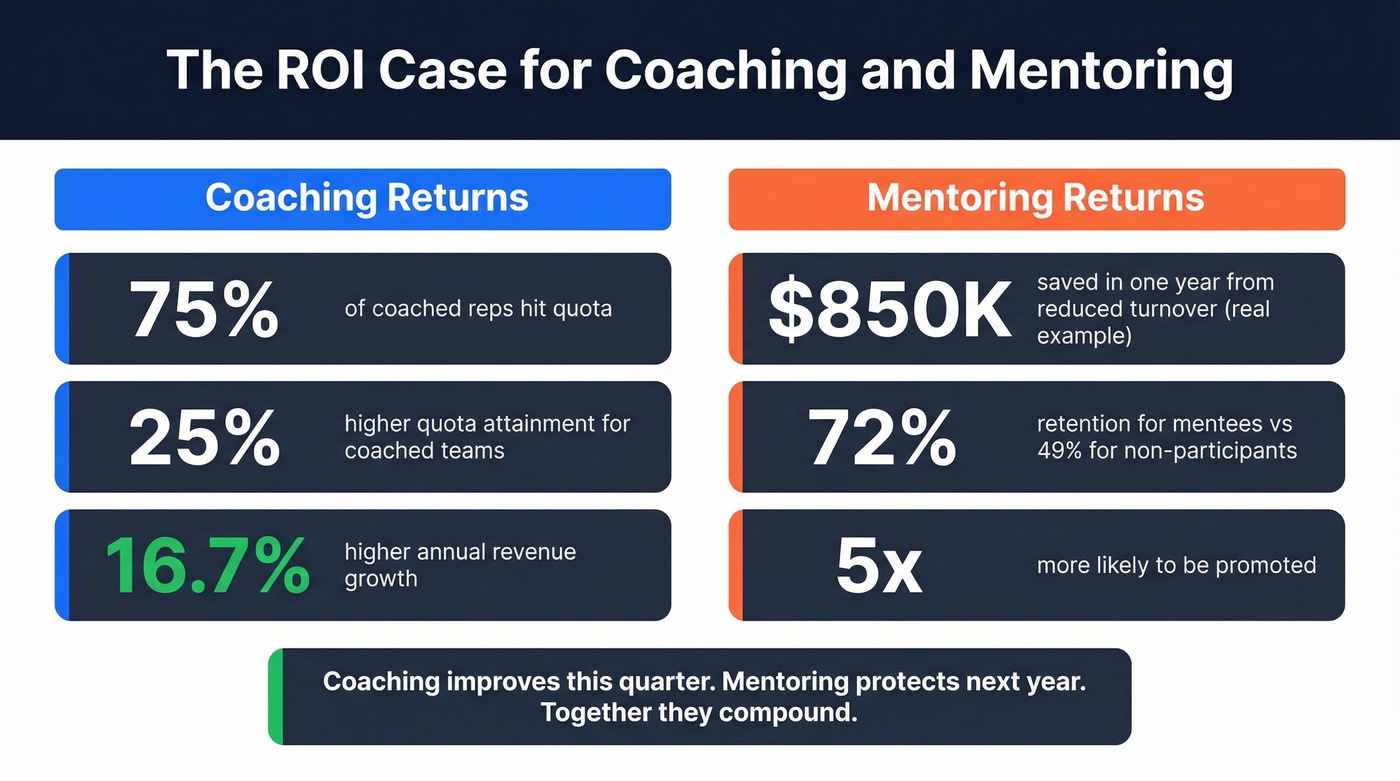
The retention numbers are hard to ignore. A Wharton study found 72% retention for mentees and 69% for mentors, versus 49% for non-participants. Mentees are promoted 5x more often. And 98% of Fortune 500 companies run formal mentoring programs - not because it's trendy, but because losing a senior AE costs 1.5x-2x their salary to replace.
Think about the top rep who just got promoted to team lead. They don't need coaching on discovery calls. They need a mentor who's navigated the transition from individual contributor to leader, someone who can share the unwritten rules that no playbook covers. No amount of weekly pipeline reviews will address that.
The Real Differences
Choosing between coaching and mentoring isn't a style preference. It's a timing decision: what does this person need right now?
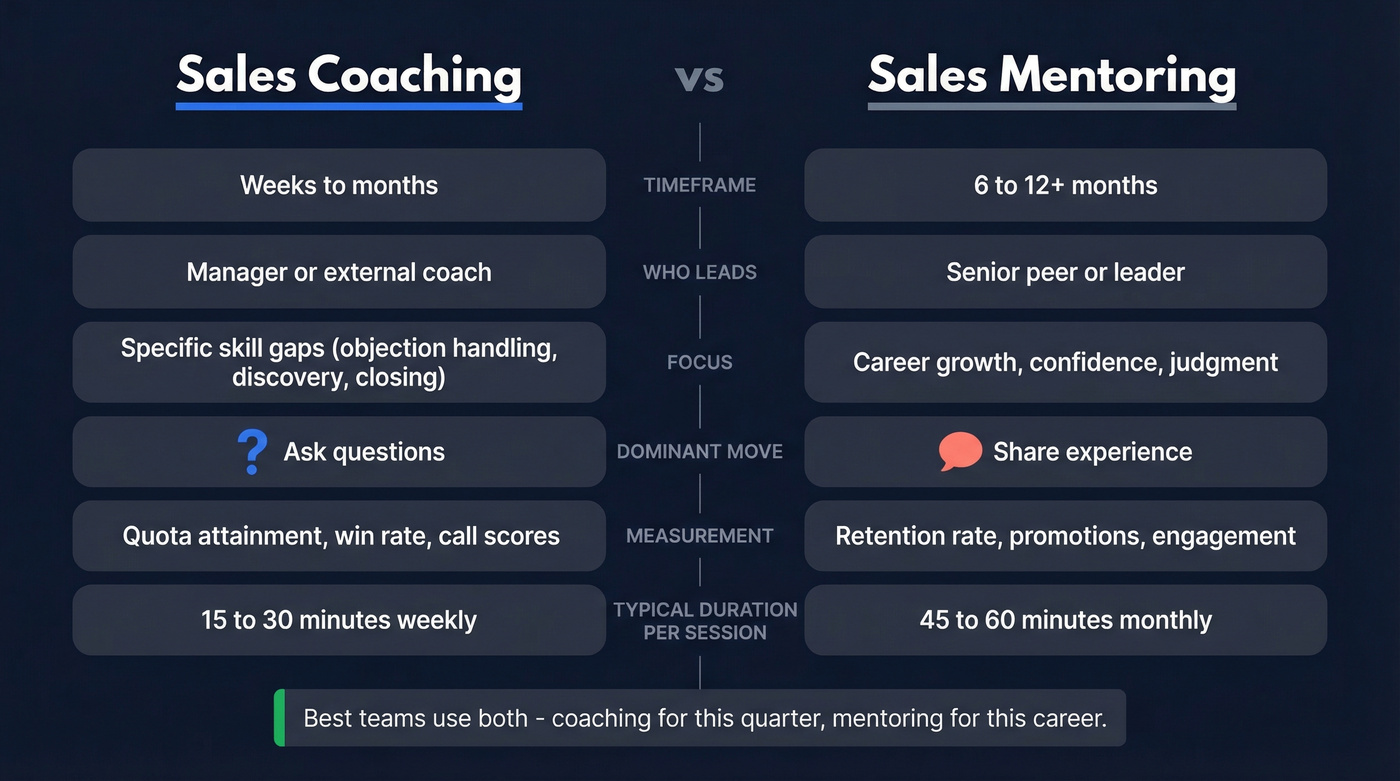
| Dimension | Coaching | Mentoring |
|---|---|---|
| Timeframe | Weeks to months | 6-12+ months |
| Structure | Formal, scheduled | Flexible, organic |
| Who leads | Manager or coach | Senior peer or leader |
| Focus | Specific skill gaps | Career growth, judgment |
| Dominant move | Ask | Tell |
| Accountability | Metrics-driven | Relationship-driven |
| Measurement | Quota, win rate, calls | Retention, promotion |
| Typical cost | $200-$600/hr external | Primarily time; platforms typically priced per user/month |
The "dominant move" row matters more than people realize. A great coach asks questions that force the rep to diagnose their own behavior. An effective mentor shares hard-won experience so the mentee doesn't have to learn everything the painful way. Both are valuable. Neither replaces the other.

Coaching and mentoring build the skills. But your reps still need real buyers to call. Prospeo gives coached reps 300M+ verified contacts with 98% email accuracy - so the improvements from every coaching session translate directly into pipeline, not bounced emails.
Stop coaching reps on leads that bounce. Give them data that connects.
Which Does Your Rep Need?
Run through these before defaulting to one approach.
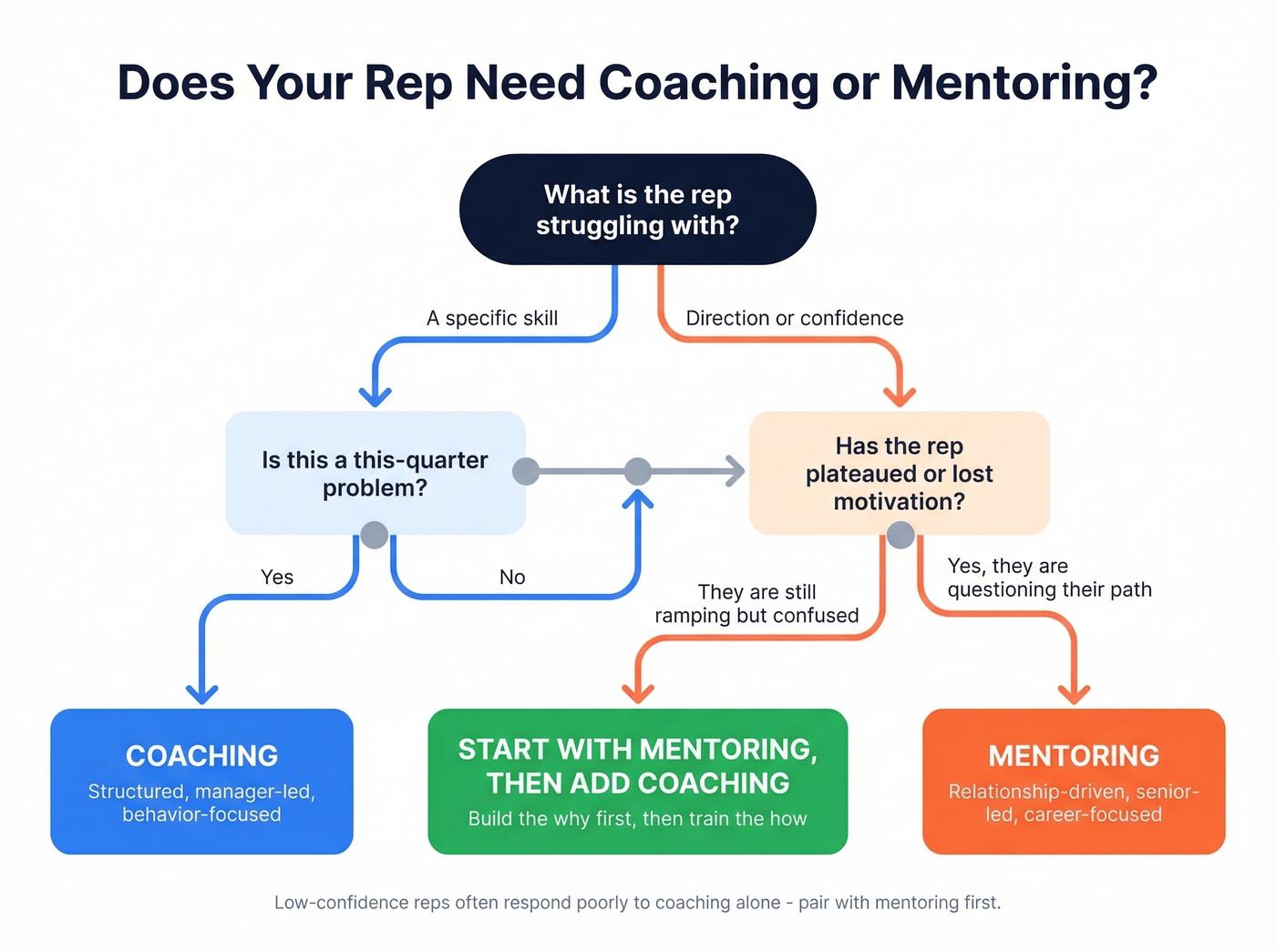
Is the gap a specific skill or a confidence/direction issue? A rep who can't handle pricing objections needs coaching. A rep questioning whether they belong in sales needs a mentor.
Is this a this-quarter problem or a this-year problem? Coaching solves immediate performance gaps. Mentoring builds the foundation that prevents future ones.
Has the rep plateaued or are they still ramping? New SDRs hitting activity numbers but closing nothing often need mentoring first - someone to help them understand the "why" behind the process. Experienced AEs losing deals on negotiation need targeted coaching on a specific behavior.
Is confidence the bottleneck? One-size-fits-all coaching can actually harm low-confidence reps because the critique-and-comparison dynamic amplifies self-doubt. We've watched teams try to coach their way out of confidence problems. It doesn't work. Mentoring provides the judgment-free space to rebuild.
The ROI Case
Coaching Returns
The numbers are consistent: 75% of reps who receive consistent coaching hit their quotas. Teams with coaching see 25% higher quota attainment and 30% more deals won. Coached teams also ramp faster, which means new hires contribute pipeline sooner - and when ramp time costs you a full quarter of a new hire's compensation, shaving even a month off is worth real money. (If you want to quantify the downstream impact, start with your sales conversion rate and work backward.)
Mentoring Returns
Here's a real scenario from MentorcliQ's ROI model. A sales org has junior reps with 25% annual turnover. Reps in the mentoring program turn over at 10%. Average salary is $81k, and replacing someone costs 1.5x that - $121,500 per departure. Over 12 months, mentoring retained 7 additional reps who would've otherwise left. That's $850,000 in avoided replacement costs.
Cox Automotive saw similar results: 79% retention over two years versus 67% company-wide, with participants 23% more likely to be promoted. The benefits of mentorship don't show up on a dashboard the way coaching does. But when your best AE leaves because nobody helped them see a path forward, the cost is immediate and brutal.
Mistakes That Kill Both Programs
Let's be honest - most of these aren't mysterious. They're predictable failures that orgs repeat every year.
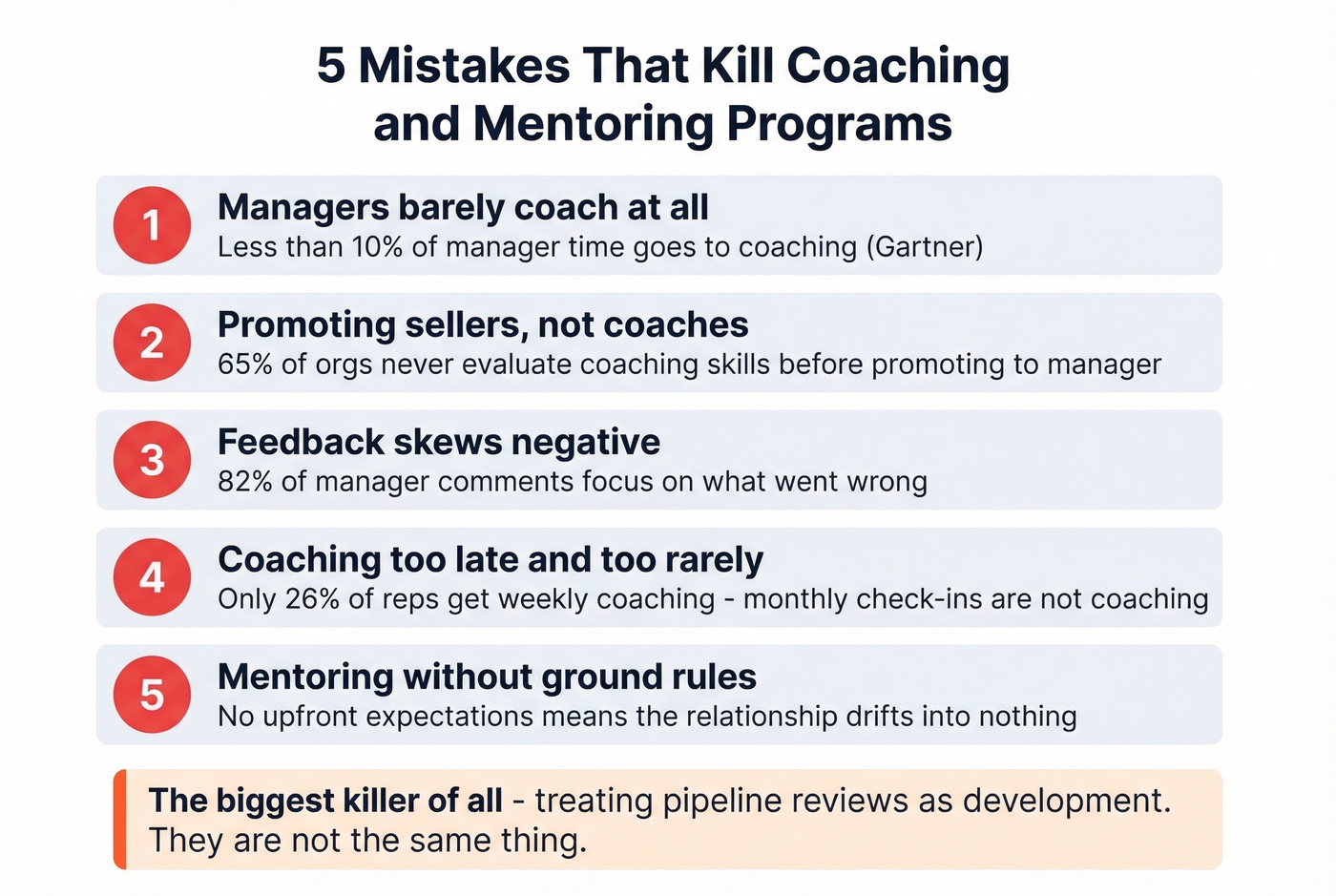
Managers barely coach at all. Gartner found managers spend less than 10% of their time actively coaching. The rest is pipeline reviews, forecasting, and firefighting. If coaching isn't protected time on the calendar, it doesn't happen.
Promoting sellers, not coaches. 65% of organizations don't evaluate coaching skills when promoting someone to manager. Meanwhile, 93% of managers say they need more training on how to coach. They promote the best closer, give them zero development, then wonder why the team is flat.
Feedback skews negative. In one study, when managers were asked to comment on good and bad points, 82% of their comments were negative. That's not coaching - that's criticism with a calendar invite.
Coaching too late and too infrequently. Only 26% of reps receive weekly coaching. Monthly check-ins aren't coaching; they're performance reviews in disguise.
Mentoring without "contracting." Mentoring relationships need upfront expectation-setting - what each party commits to, how often they'll meet, what success looks like. Without this, mentoring drifts into occasional coffee chats that go nowhere.
In our experience, the single biggest killer across both programs is treating pipeline reviews as development. They're not. A pipeline review is a forecast exercise. Coaching and mentoring are about changing behavior and building people. Conflating them is how you end up with a team that hits forecast calls but never actually improves.
How to Implement Both
Building a Coaching Cadence
Start with the Challenger PAUSE framework: Prepare (review calls and data before the session), Affirm (build trust before feedback), Understand (diagnose the behavior together), Specify (agree on one change), Embed (follow up to reinforce).
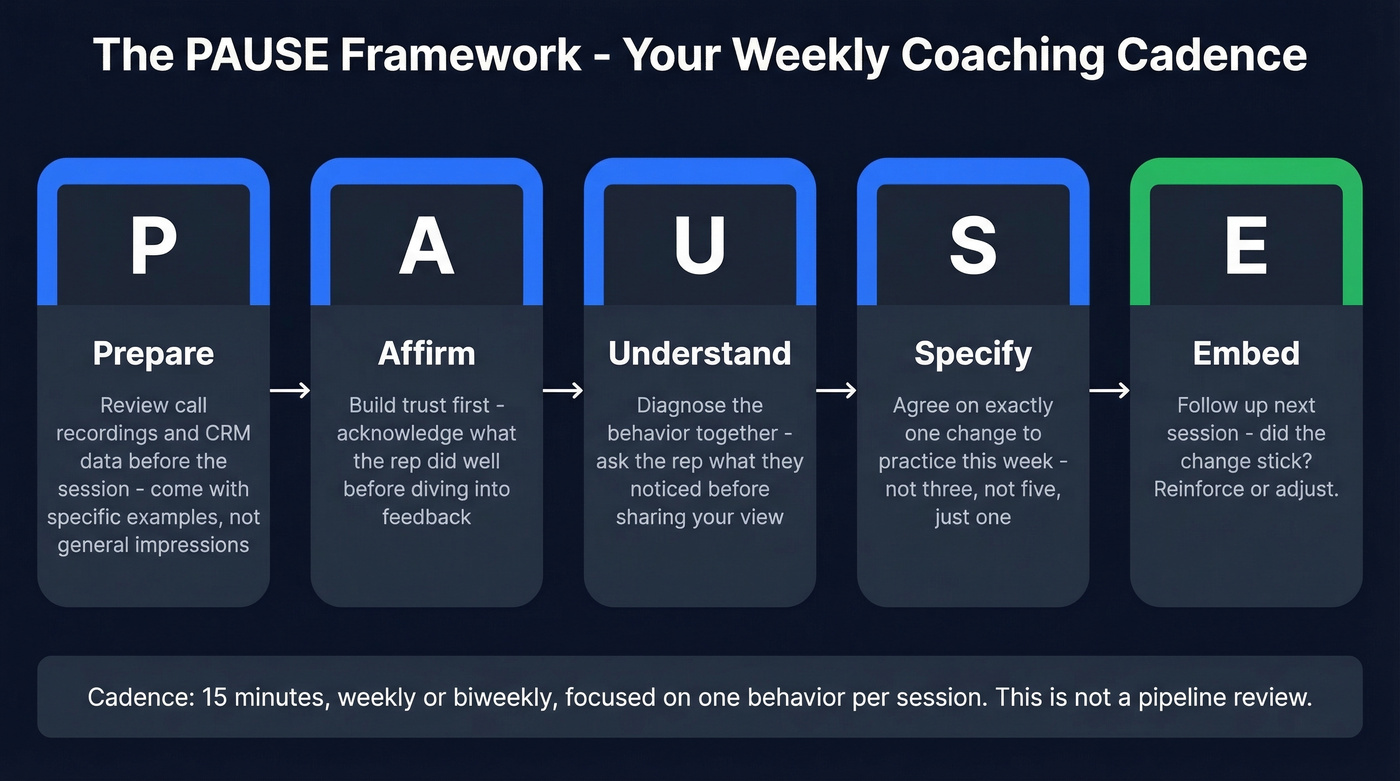
The cadence that works: weekly or biweekly 1:1s, about 15 minutes each, focused on one behavior per session. Not pipeline reviews. Not deal strategy. Pure behavioral coaching.
The infrastructure matters too. Conversation intelligence tools give you call recordings to coach from. CRM data reveals pipeline patterns. And here's a frustration we hear constantly from sales leaders: they sit down to coach a rep on selling skills, only to discover half the rep's dials hit wrong numbers and emails bounced. You can't coach technique when the data is broken. A verified data platform like Prospeo, which maintains 98% email accuracy on a 7-day refresh cycle, eliminates that noise so sessions stay focused on actual selling. GreyScout cut rep ramp time from 8-10 weeks to 4 weeks after switching - that's the kind of foundation that makes coaching sessions productive from day one. (If you're rebuilding the stack, start with your SDR tools and sales prospecting techniques.)
Building a Mentoring Program
Use Qooper's 4 Cs framework: Communication (biweekly or monthly cadence), Connection (match on complementary experience, not just seniority), Clarity (define what the mentee wants), Commitment (6-12 months minimum).
Matching criteria matter more than most orgs realize. A rep struggling with enterprise sales needs a mentor who's closed seven-figure deals, not someone who's great at SMB velocity. The right match accelerates growth in ways no training program can replicate.
Here's our hot take: most sales orgs don't have a coaching problem or a mentoring problem. They have a "nobody owns development" problem. The VP of Sales owns the number. Enablement owns onboarding. Ongoing development falls into a gap where managers are too busy and mentors are never assigned. If nobody's job title includes the word "development," neither program will survive Q2. (This is where a strong sales enablement manager or RevOps Manager can make the system stick.)
One r/sales poster put it bluntly: asking someone 10-15 years senior to be a mentor "seems like a laugh to the face." Formalize the program so nobody has to make that cold ask. Assign pairs, set expectations, and give both parties permission to invest the time.
Faster ramp time is the hidden ROI of both coaching and mentoring. Cut it further by giving new reps instant access to 125M+ verified mobile numbers with a 30% pickup rate - so they're having real conversations from week one, not hunting for contact data.
Ramp reps faster with direct dials that actually pick up.
FAQ
Can a manager be both coach and mentor?
Yes, but separate the conversations. Coaching requires evaluative feedback tied to metrics; mentoring needs a judgment-free space. Run them in different 1:1 slots - mixing both in one session dilutes the value of each.
How much does external sales coaching cost?
Independent coaches typically charge $200-$600/hour or $1,000-$5,000/month on retainer. Group programs run $150-$300 per rep monthly. Vet for structured accountability and measurable outcomes, not just call volume.
How do I find a sales mentor without it being awkward?
Don't cold-ask someone to "be your mentor." Start by asking a specific question about their experience - a deal they navigated, a career transition they made. If the conversation flows, suggest meeting monthly. Formalized mentoring programs remove this friction entirely.
How often should coaching sessions happen?
Weekly, 15 minutes minimum. Reps coached within 24 hours of a call improve 2.5x faster. Monthly sessions aren't coaching - they're retrospectives that miss the behavioral window.
What tools support data-driven coaching?
Conversation intelligence platforms like Gong or Chorus for call review, CRM dashboards for pipeline patterns, and a verified data tool so reps reach real prospects instead of dead ends. When bounce rates drop below 4%, coaching time shifts from data hygiene to actual selling skills.