


Cognism vs Lusha in 2026: The Comparison Neither Vendor Will Write
Cognism just sent your renewal quote and it's 12% higher than last year. Or maybe you're on Lusha's Pro plan and burned through your monthly phone credits by Tuesday. Either way, something isn't working - so let's compare Cognism vs Lusha properly and figure out which tool actually earns your budget.
We've run this exact evaluation with teams that thought they had a "data problem" and later realized they had a "pricing model problem." Same outcome, different pain: one team paid for phone coverage they barely used; another team rationed credits so hard their SDRs stopped calling altogether.
Let's break it down like you'd do on a whiteboard with RevOps in the room: cost structure first, then data fit, then the stuff that quietly bites you (credits, compliance gates, and workflow friction).
30-Second Verdict
Pick Cognism if you're selling into EMEA, your reps live on the phone, and you've got $20K+ a year set aside for data.
Pick Lusha if you're US-focused, email-first, and want self-serve pricing you can start today.
One blunt note: if your team isn't consistently using phone numbers, paying a premium for "better mobiles" is a fast way to waste budget.
Side-by-Side Comparison
| Feature | Cognism | Lusha |
|---|---|---|
| G2 rating | 4.5/5 (1,318 reviews) | 4.3/5 (1,618 reviews) |
| Pricing model | Platform fee + per-seat | Credit-based, self-serve |
| Annual cost (5 users) | ~$22,500-$37,500 | ~$1,794-$3,147 |
| Database strength | EMEA mobiles | US emails |
| Compliance | GDPR + DNC screening | ISO 27701, GDPR, CCPA |
| Chrome extension | Yes | Yes |
| Best for | Phone-first EMEA teams | Budget-conscious email teams |
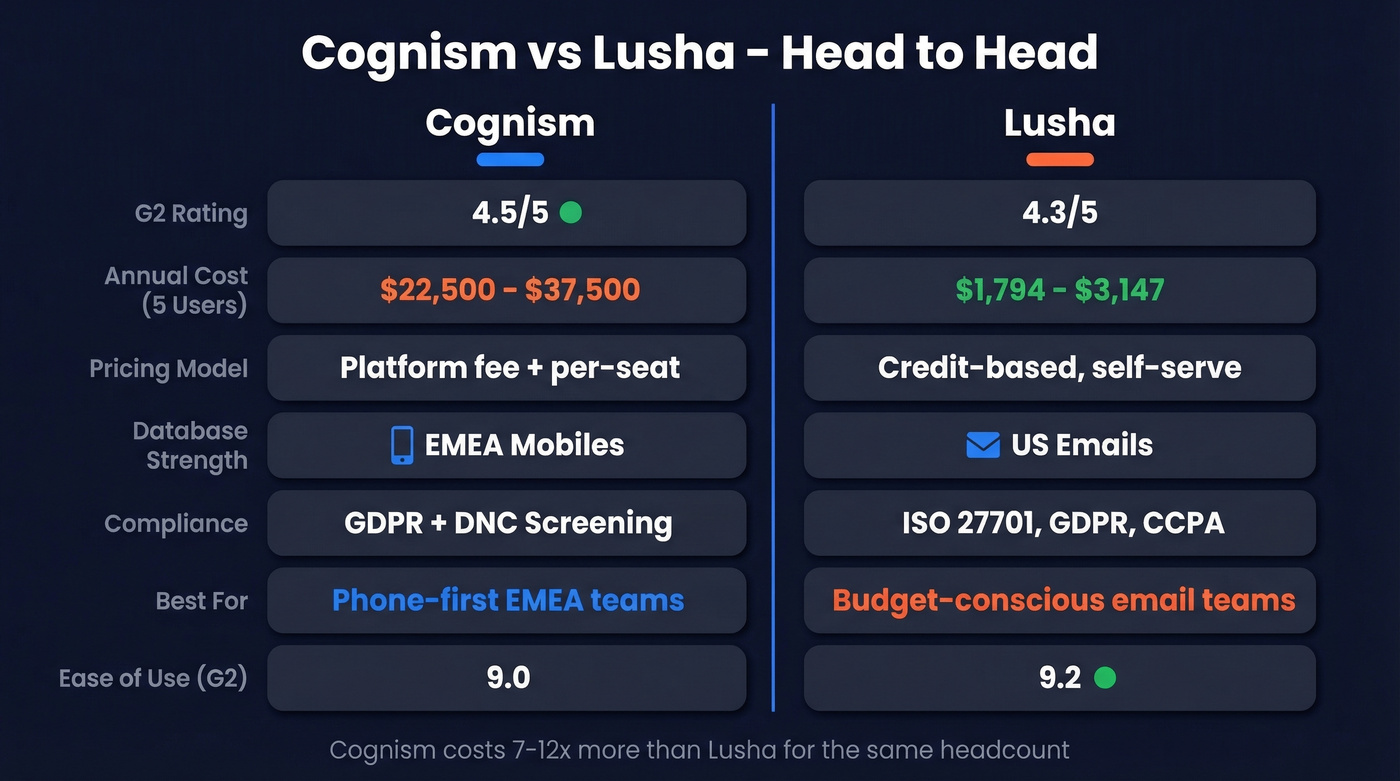
The price gap is the headline. Cognism often lands around 7-12x more than Lusha for the same headcount. Whether that premium is smart or silly depends on how you prospect and where your buyers are.
What Each Tool Actually Costs
Cognism pricing
Cognism doesn't publish pricing. Vendr's benchmarks put a 5-user Grow contract at about $22,513/year, and Elevate at roughly $37,498/year for the same team size: https://www.vendr.com/marketplace/cognism
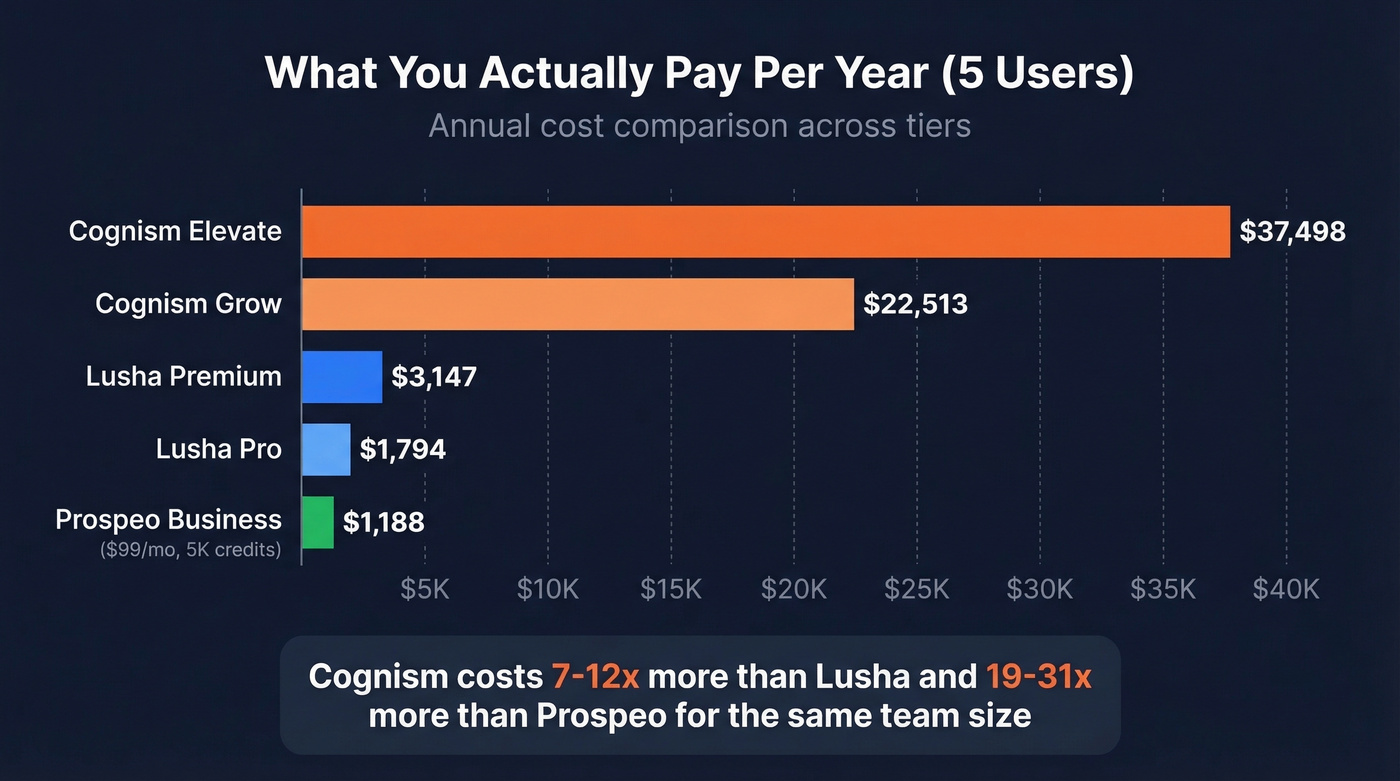
In practice, the structure usually looks like an annual contract with a baseline platform fee plus per-seat licensing. You'll also see add-ons that change the bill more than the seat count does: Salesforce Enrich credits, extra intent topics, and anything that expands usage beyond the default package.
Here's where teams get annoyed (fairly): a mid-market deal can jump past $40K quickly once you add the "small" extras, and renewals commonly come in 10-15% higher. If you're not watching usage, you end up paying for a capability you liked in the demo but never operationalized.
A negotiation lever Cognism's sales team won't volunteer: buying Salesforce Enrich credits in 1,000-credit blocks instead of the full module can save roughly $17K/year on a 5-user Grow deal. That's the difference between about $25,330 and $42,513 for similar outcomes.
Lusha pricing
Lusha's pricing mechanics are public, which we appreciate. Their pricing page lays out the tiers and the credit system clearly: https://www.lusha.com/pricing/
Free includes 70 credits/month. Common third-party breakdowns list Pro at $29.90/user/month on annual billing ($39.90 month-to-month) with 250 credits, and Premium at $52.45/user/month ($69.90 month-to-month) with 800 credits. Scale is custom.
Now the part people miss until it's too late: credits disappear fast when you need phones. One email reveal costs 1 credit. One phone reveal costs 10. On Pro, that's 25 phone lookups a month. That's not "a month of calling" for an SDR; it's a warm-up.
Lusha's rollover rules also matter. Monthly plans can roll over unused credits up to 2x your limit. Annual plans issue credits upfront but reset at cycle end. If your outbound volume swings (product launches, events, hiring bursts), that detail changes the real cost.
Data Quality and Accuracy
Real talk: both tools get dinged for accuracy on G2, which tells you as much about the B2B data category as it does about these two vendors.
On Cognism, frequent negative themes include "inaccurate data" and "incorrect numbers." On Lusha, you'll see the same complaints, just at a different price point. That's why we always push teams to measure outcomes that actually hit revenue: bounce rate, reply rate, connect rate, and how often reps have to "go find it somewhere else" mid-workflow.
Cognism's Diamond Data (phone-verified mobile numbers) is genuinely differentiated, and it's a big reason EMEA-focused teams pay the premium. Lusha leans on broad sourcing and crowdsourcing with frequent refreshes, which helps keep costs down but still leaves you with stale records in certain segments.
A small Sparkle.io test of 250 Lusha-sourced leads reported a 3% bounce rate and 54% open rate, which is solid for a limited sample: https://sparkle.io/blog/lusha-review/
On G2 sub-ratings, Lusha edges Cognism on ease of use (9.2 vs 9.0). Cognism tends to win on support (9.1 vs 8.1) and product direction (9.2 vs 8.3). Those differences matter more once you're past the trial phase and trying to keep reps in one workflow.

The credit math problem isn't unique to Lusha or Cognism. Prospeo charges ~$0.01 per email with 98% accuracy, 125M+ verified mobiles, and a 7-day data refresh cycle - no annual contracts, no hidden tiers.
Stop rationing credits. Start building pipeline.
Coverage, Compliance, and Integrations
Coverage: where each tool tends to shine
Cognism fits best when you're prospecting across the UK, DACH, or the Nordics and you need mobile coverage that supports real call volume. DNC list screening is baked in, which reduces the "are we allowed to call this?" back-and-forth that slows teams down.
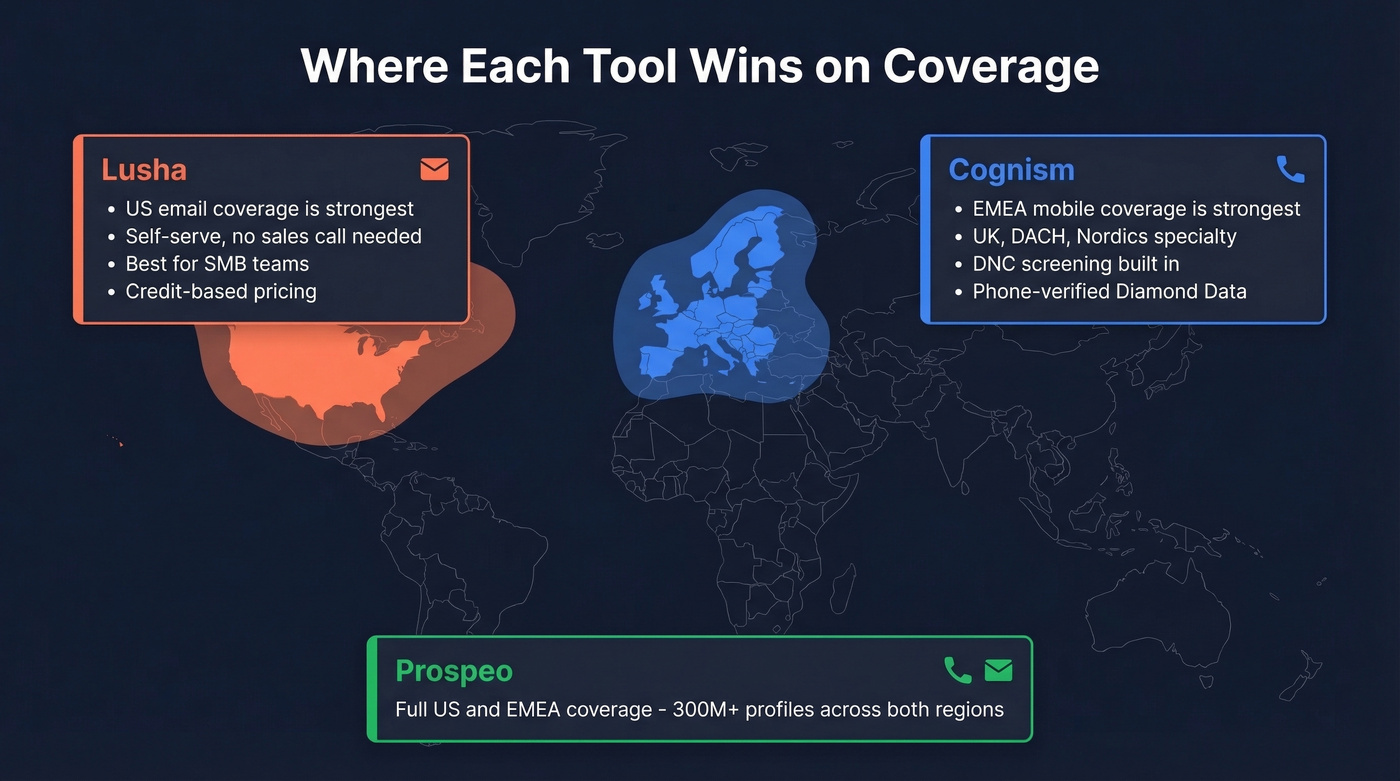
Lusha fits best when you're primarily US-focused and want to get started without a sales call. For a lot of SMB teams, the ability to swipe a card and move on is the whole point.
Compliance: what you'll actually care about
Cognism positions itself strongly around GDPR and DNC screening. Lusha highlights ISO 27701 alongside GDPR and CCPA. Both can work for serious teams, but the practical difference is how much compliance work you have to do yourself versus what the product enforces by default.
Integrations: the "hidden cost" factor
Cognism supports integrations with common CRMs and sales tools like Salesforce, HubSpot, Salesloft, Pipedrive, and Microsoft Dynamics.
With Lusha, some features that matter to ops teams (like DNC filtering and API access) are gated behind the Scale tier, which is custom-priced. That's not automatically bad, but you should know it before you build a workflow that depends on it.
The Credit Math That Trips Teams Up
If you only remember one thing from this comparison, make it this: credit-based tools feel cheap until your team starts doing the activity you hired them to do.
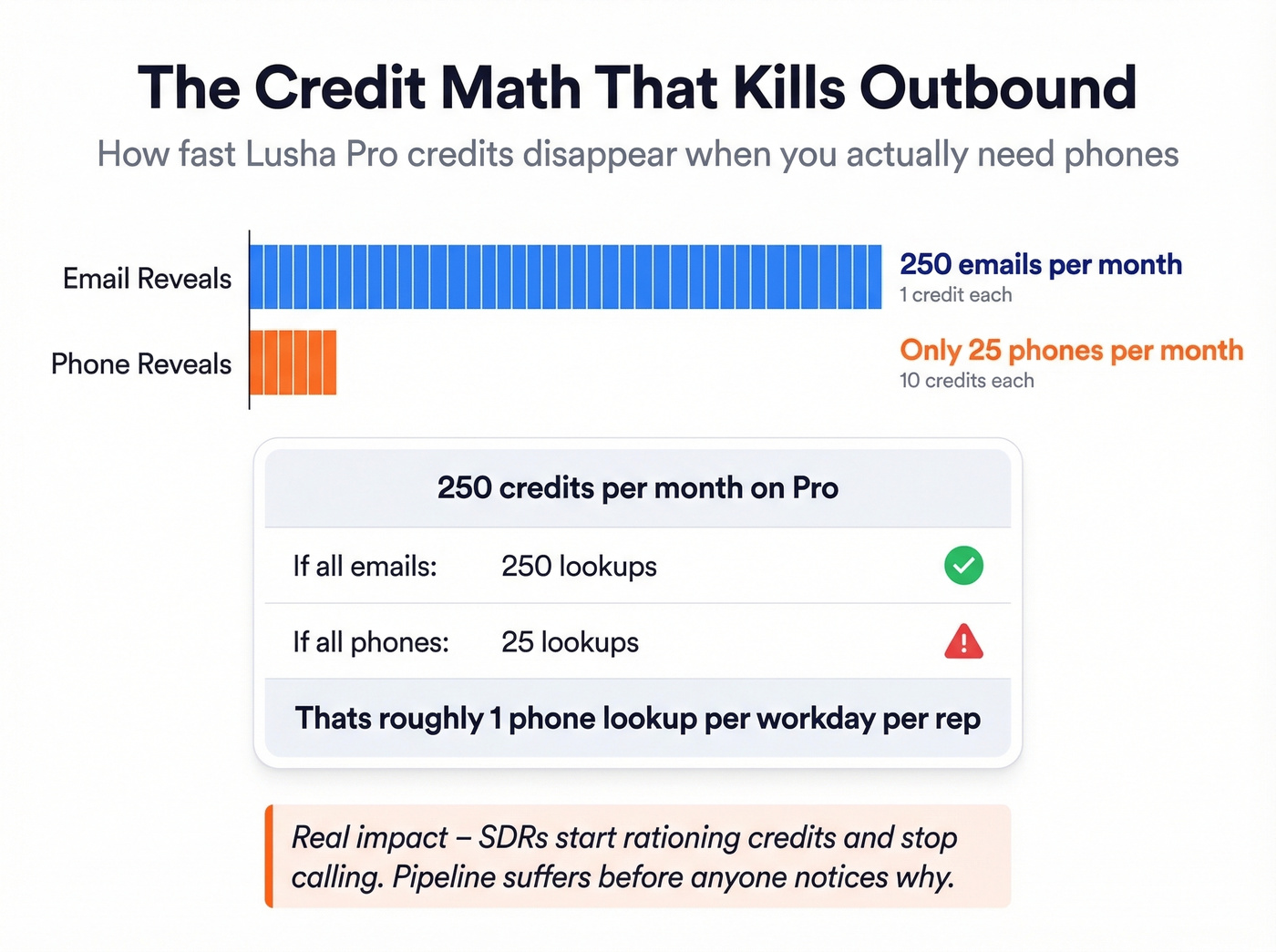
Here's a scenario we've seen more than once. A team buys Lusha Pro for five SDRs because the per-seat price looks safe. Two weeks later, the manager realizes each rep is only pulling a handful of phone numbers a day because they're trying to "save credits for later." Later never comes. Pipeline suffers, and the team blames messaging, ICP, and deliverability before they admit the real issue: the pricing model trained reps to avoid calling.
On the flip side, we've also watched teams renew Cognism because "it's the enterprise option," even though their outbound motion is 90% email and they barely touch mobiles. That's the kind of spend that makes finance start questioning the whole sales stack.
A Third Option Worth Testing (Skip This If You Need a Big Enterprise Contract)
If Cognism's $20K+ commitment feels heavy and Lusha's credit math doesn't add up, Prospeo is worth testing.
Prospeo gives you 300M+ professional profiles, 143M+ verified emails, and 125M+ verified mobile numbers, with 98% email accuracy and a 7-day refresh cycle. It's also self-serve: no platform fee, no annual contract, and you can start on a free tier (75 emails/month plus 100 Chrome extension credits/month). Pricing works out to about $0.01/email, and mobiles are credit-based at 10 credits per number.

Where it tends to win in practice is the boring stuff that keeps domains healthy and reps productive: real-time verification, catch-all handling, spam-trap removal, and workflows that don't force you into a sales call just to run a test.
If you want to sanity-check it quickly, our team usually recommends a simple bake-off: take 200 accounts from your ICP, pull contacts from your current tool and from Prospeo, then compare bounce rate, connect rate, and how many records come back with usable data. You'll know in a week which dataset your outbound engine trusts.
Bottom Line
Here's the thing: most teams weighing Cognism vs Lusha are asking the wrong question. The real question isn't "which platform has better data?" It's "am I paying for capabilities our team doesn't use, or am I limiting activity with a pricing model that punishes volume?"
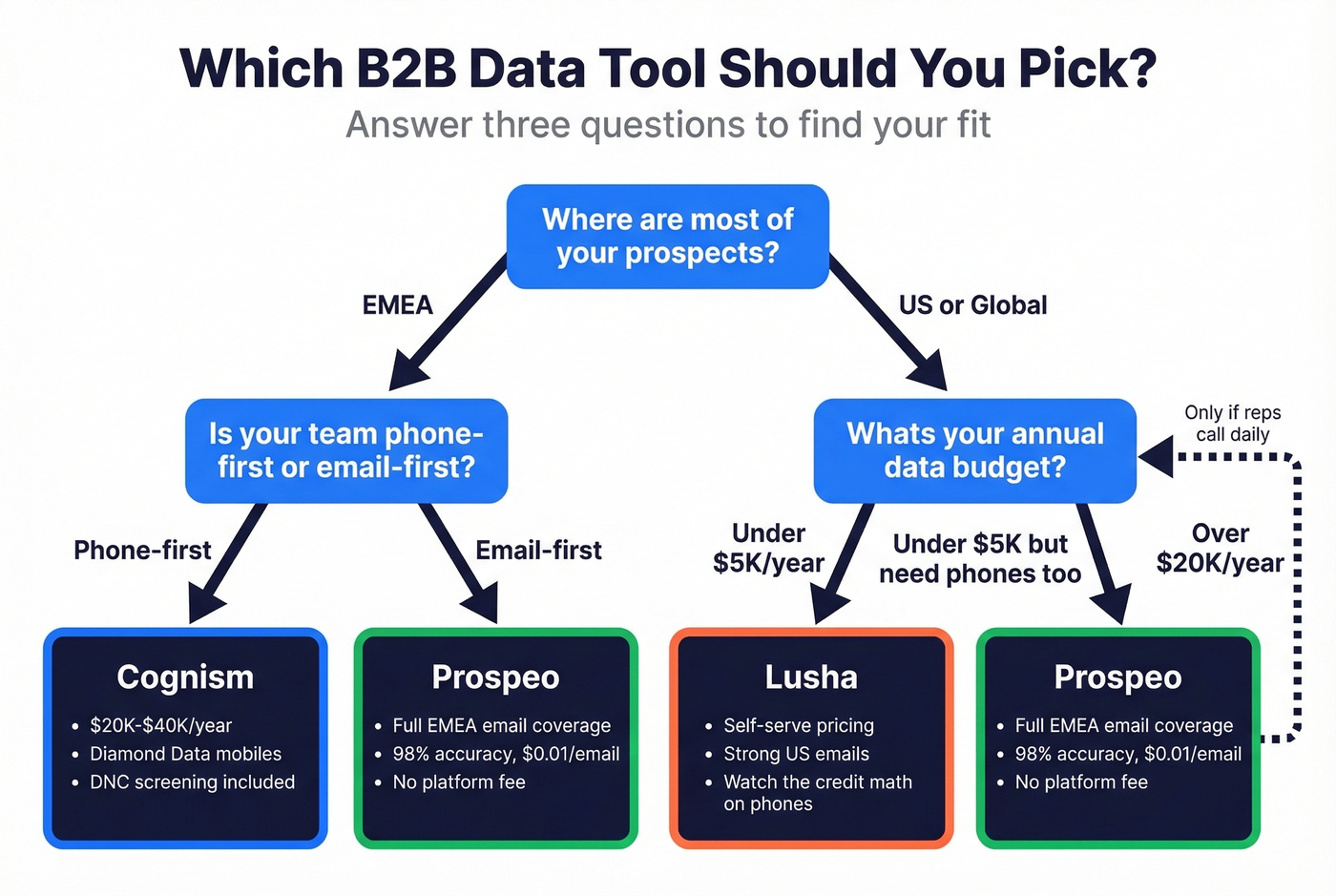
Cognism earns its premium for EMEA phone teams that will actually use Diamond Data daily. Budget $20K-$40K/year and negotiate hard on Enrich credits.
Lusha makes sense for US-focused, email-first teams that value self-serve simplicity. Do the credit math before you commit, and go annual only if you're sure about volume.
For everyone else, test a tool that prioritizes verified emails, fresh data, and self-serve workflows so your team can prospect without watching a credit counter.
Teams using Prospeo book 26% more meetings than ZoomInfo and 35% more than Apollo - with bounce rates under 4%. Full US and EMEA coverage, self-serve pricing, and 30+ filters including intent data.
Get enterprise-grade data without the enterprise invoice.
FAQ
Which is better, Cognism or Lusha?
Cognism is the better fit for EMEA phone prospecting, where phone-verified mobiles matter and teams will actually call. Lusha is the better fit for US-focused, email-first teams that want self-serve pricing and a lighter commitment.
How fast do Lusha credits run out?
Fast, if you need phones. At 10 credits per phone reveal, a Pro plan with 250 credits/month gives you 25 phone lookups. Premium's 800 credits gets you 80 phone lookups, which is still tight for a month of serious outbound calling.
Is Cognism worth the price?
Yes for EMEA phone teams that use mobile data daily and can justify $20K-$40K/year. If you're doing mostly email outreach, you'll often get better ROI from tools that focus on verified email accuracy and frequent refreshes without a platform fee.