

The Data-Backed Cold Call Framework for 2026
It's 10:15 on a Tuesday morning. You've got 50 dials queued up, a script you half-believe in, and a connect rate that's been sliding for three months. Your script probably isn't the problem. Your phone numbers might be.
A solid cold call framework starts with what the data actually says - not what some VP tweeted. Gong analyzed [300M+ cold calls](https://www.gong.io/blog/the-hidden-power-of-cold-calling-insights-from-300m-calls). Cognism studied [204,000+ cold calls](https://www.cognism.com/reports/cold-calling-report-2026) and 27,000+ conversations. Let's build from those numbers.
The Framework at a Glance
- Open with context, not a pitch - anchor to a prior email or pattern interrupt.
- State their problem, not your product.
- Ask one illuminating question and shut up.
- Handle 3-4 objections using Embrace, Inform, Question.
- Close light - ask for 15 minutes, not a demo.
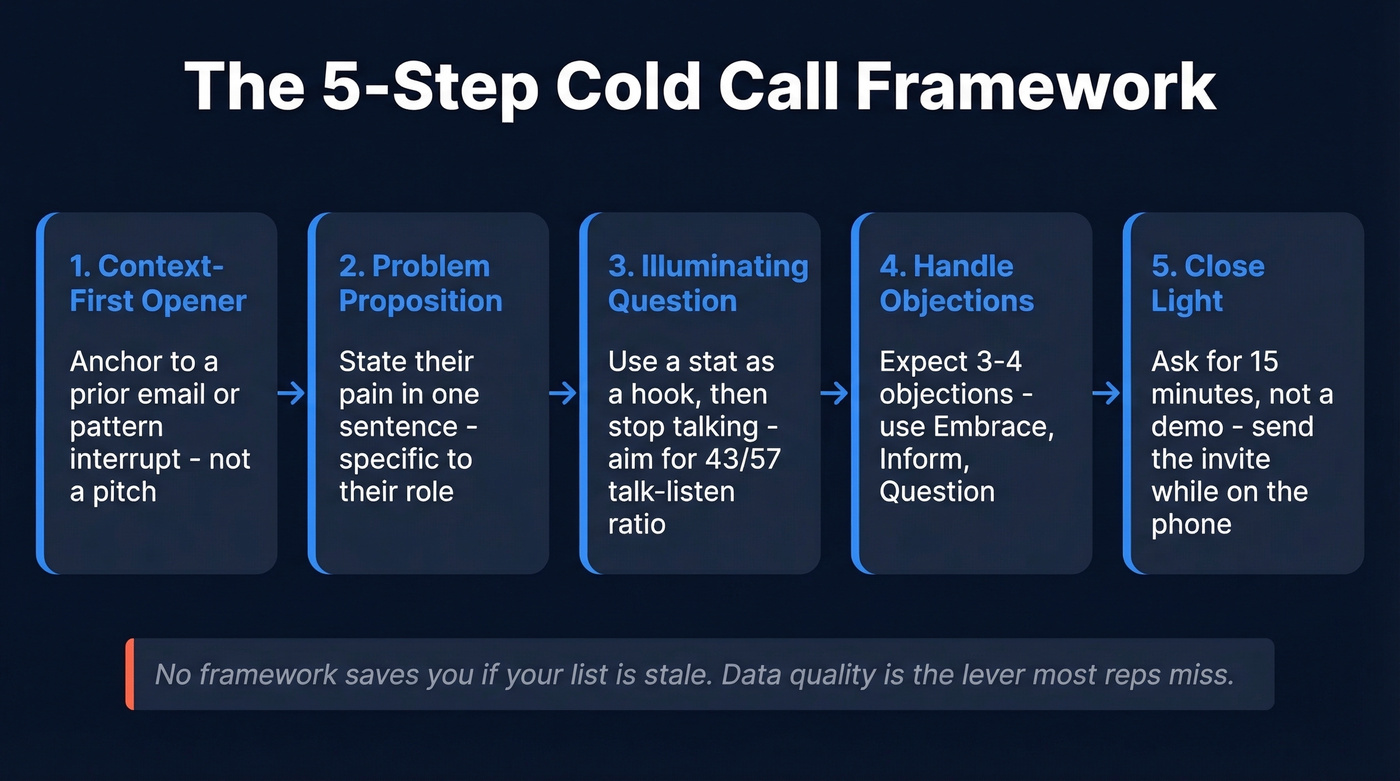
Here's the thing most articles won't give you: no framework saves you if your list is stale. Data quality is the lever, and almost nobody pulls it.
Cold Call Benchmarks Worth Knowing
| Metric | Benchmark |
|---|---|
| Success rate | 2.3% |
| Avg call duration | 93 seconds |
| Best day | Tuesday |
| Best time | 10-11am, then 2-3pm |
| Connect rate | 5-10% (varies by data quality) |
| Dials per meeting | ~72 (practitioner dataset) |
| Attempts to connect | 3 (93% by 3rd call) |
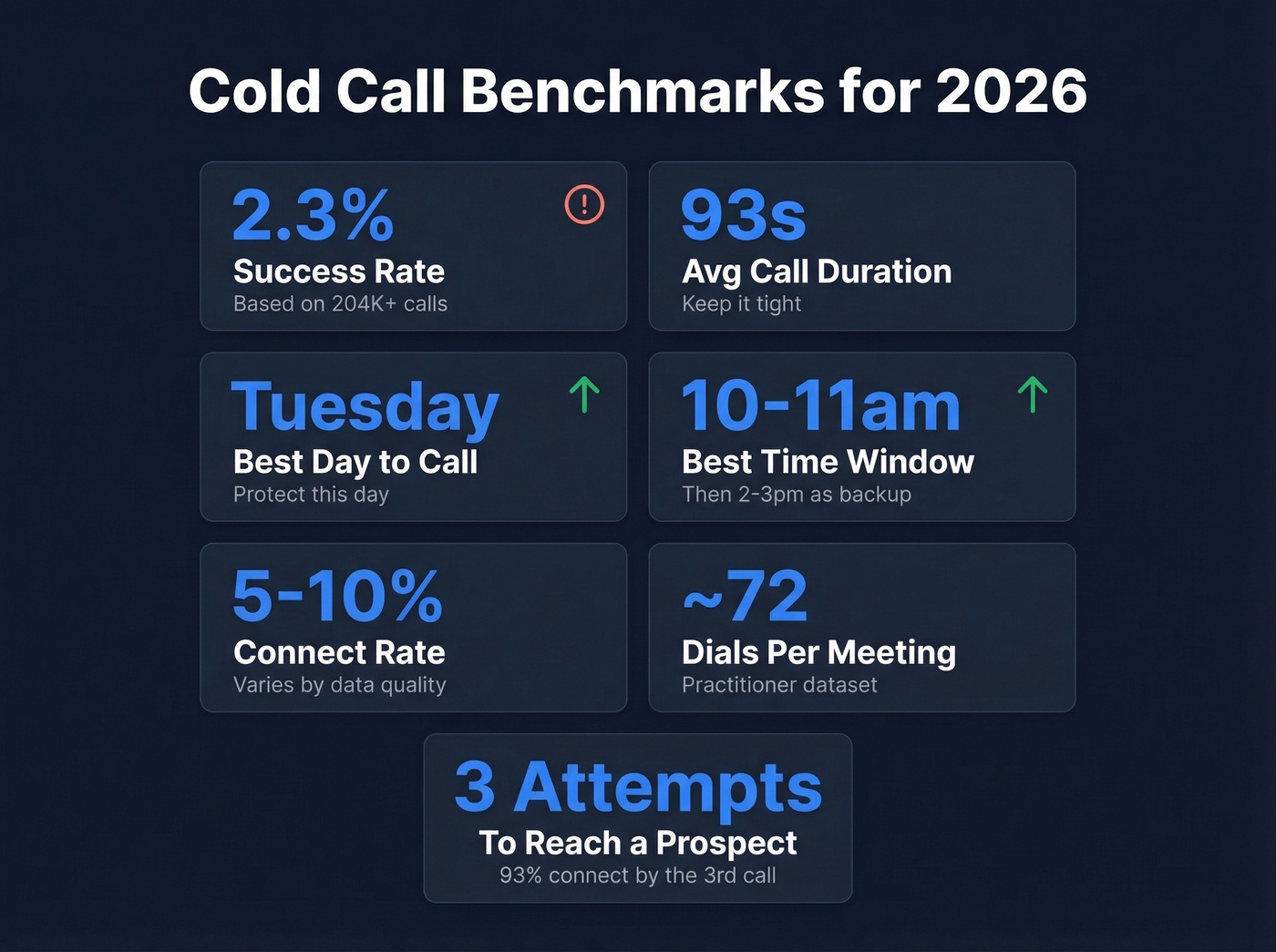
If you're not connecting by the third attempt, the odds drop fast - only about 5% more conversations happen between calls 4 and 5. Protect Tuesday mornings between 10 and 11 like a meeting with your biggest prospect.

The 5-Step Structure Explained
Step 1 - Context-First Opener
A practitioner on r/Entrepreneur A/B tested three opener styles:
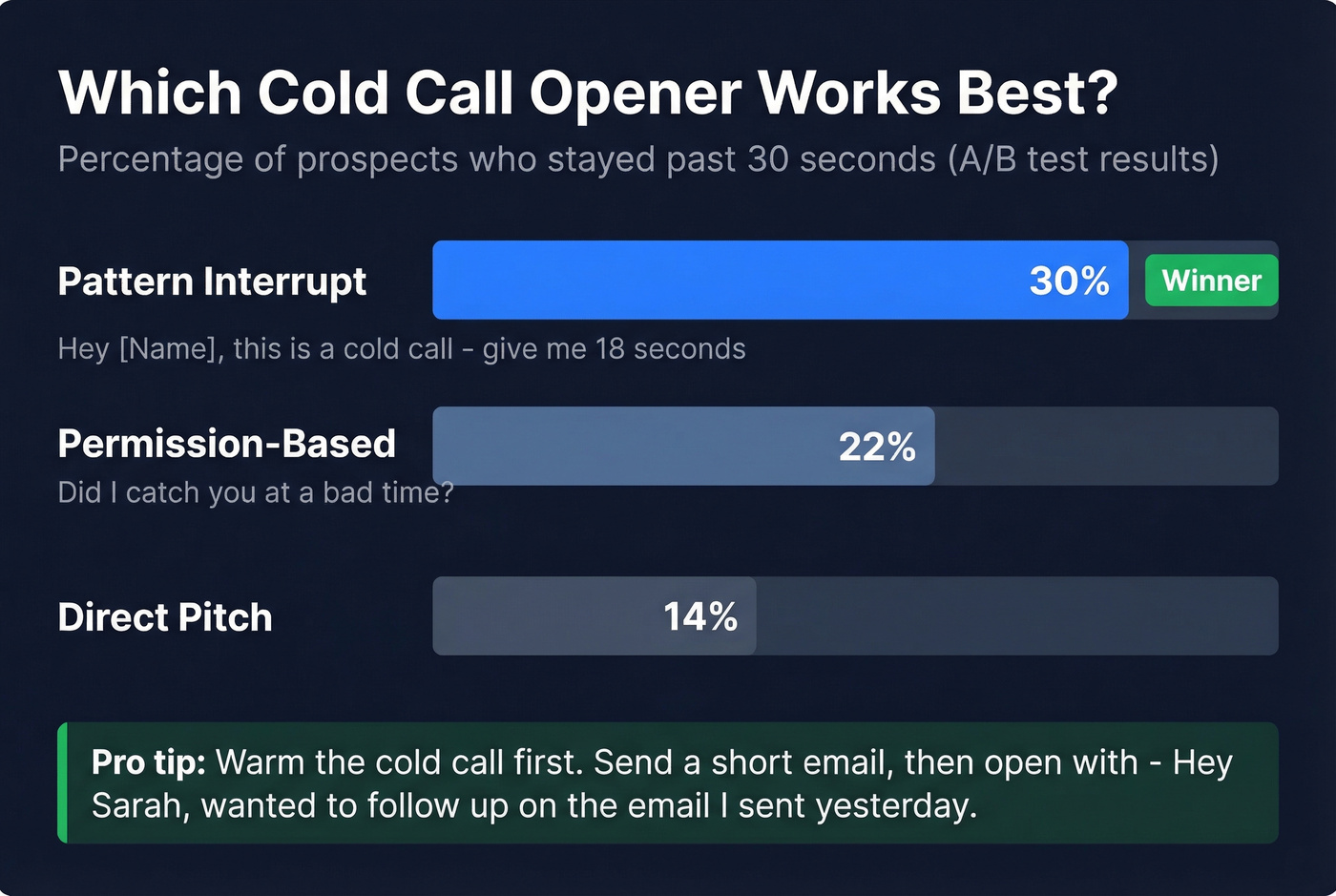
- Pattern interrupt ("Hey [Name], this is a cold call - give me 18 seconds"): 30% stayed past 30 seconds
- Permission-based ("Did I catch you at a bad time?"): 22%
- Direct pitch: 14%
The pattern interrupt wins, but there's an even better play: warm the cold call. Send a short email first - four sentences, a hook, a data point, a specific ask. Then open with: "Hey Sarah, this is Mike with Acme. Wanted to follow up on the email I sent yesterday."
The prospect either asks what it was about or remembers it. Either way, you're in a conversation, not a pitch. Slow down, smile before you dial, and drop the script voice - delivery matters as much as the words. We've watched reps read the exact same script and get wildly different results purely based on tone and pacing.
Step 2 - Problem Proposition
Don't describe your product. Describe their pain. One sentence, specific to their role.
"Most VPs of Ops I talk to are spending 6-8 hours a week reconciling data between three systems that should already be talking to each other."
If they say "yeah, that's us" - you've earned the next 60 seconds. If they don't relate, you've saved yourself a bad meeting.
Step 3 - Illuminating Question
Use a stat as a hook to surface a problem they haven't articulated yet.
"Research shows multi-threaded deals close at 130% higher rates on deals over $50K. How many contacts are your reps typically engaging per account?"
Then stop talking. The talk-to-listen benchmark is 43% talk / 57% listen. High performers hold that ratio steady across won and lost deals, while low performers swing roughly 10 points, talking far more in deals they lose. This is the single easiest metric to track and improve - record five calls, count the minutes, and you'll see where you stand immediately.
Step 4 - Handle the Objection
Successful cold calls involve 3-4 objections before a meeting gets booked. Expect them. Welcome them.
There's a useful distinction between blocking and qualifying objections. Blocking objections are reflexive brush-offs - "I'm busy," "just send me an email". Qualifying objections are real concerns - "we already have a vendor," "no budget this quarter."
For blocking objections, use Embrace, Inform, Question:
"Totally fair - I know I caught you mid-day. The reason I called is [one sentence]. Quick question before I let you go: [illuminating question]."
For qualifying objections, isolate and redirect:
"If we could solve [specific problem] without replacing your current vendor, would that be worth 15 minutes?"
Skip the urge to answer every objection with a feature dump. One sentence of value, one question. That's it.
Step 5 - Close Light
Ask for 15 minutes, not a demo. Specific day and time.
"Would Thursday at 2pm work for a 15-minute call? I'll send the invite now so it doesn't get lost."
Send the calendar invite while you're still on the phone. If they push back, loop back: "No pressure on Thursday - what does next week look like?"

Data decays at 2.1% per month. Prospeo refreshes every 7 days - not every 6 weeks like competitors. 125M+ verified mobile numbers with a 30% pickup rate mean your reps stop dialing ghosts and start having conversations.
Fix your connect rate before you fix your script.
Sample Script You Can Steal
You: "Hey Sarah, this is Alex with Acme. Wanted to follow up on the email I sent yesterday - did you get a chance to see it?"
Prospect: "No, what was it about?"
You: "Most VPs of Ops I talk to are spending 6-8 hours a week reconciling data across systems that should already sync. Is that something your team deals with?"
Prospect: "Yeah, actually. It's a mess."
You: "That's what we're hearing everywhere. We've helped teams like [similar company] cut reconciliation time by half. Would Thursday at 2pm work for 15 minutes? I can walk you through exactly how."
The Voicemail Play
Most reps treat voicemail as a dead end. The data says otherwise.
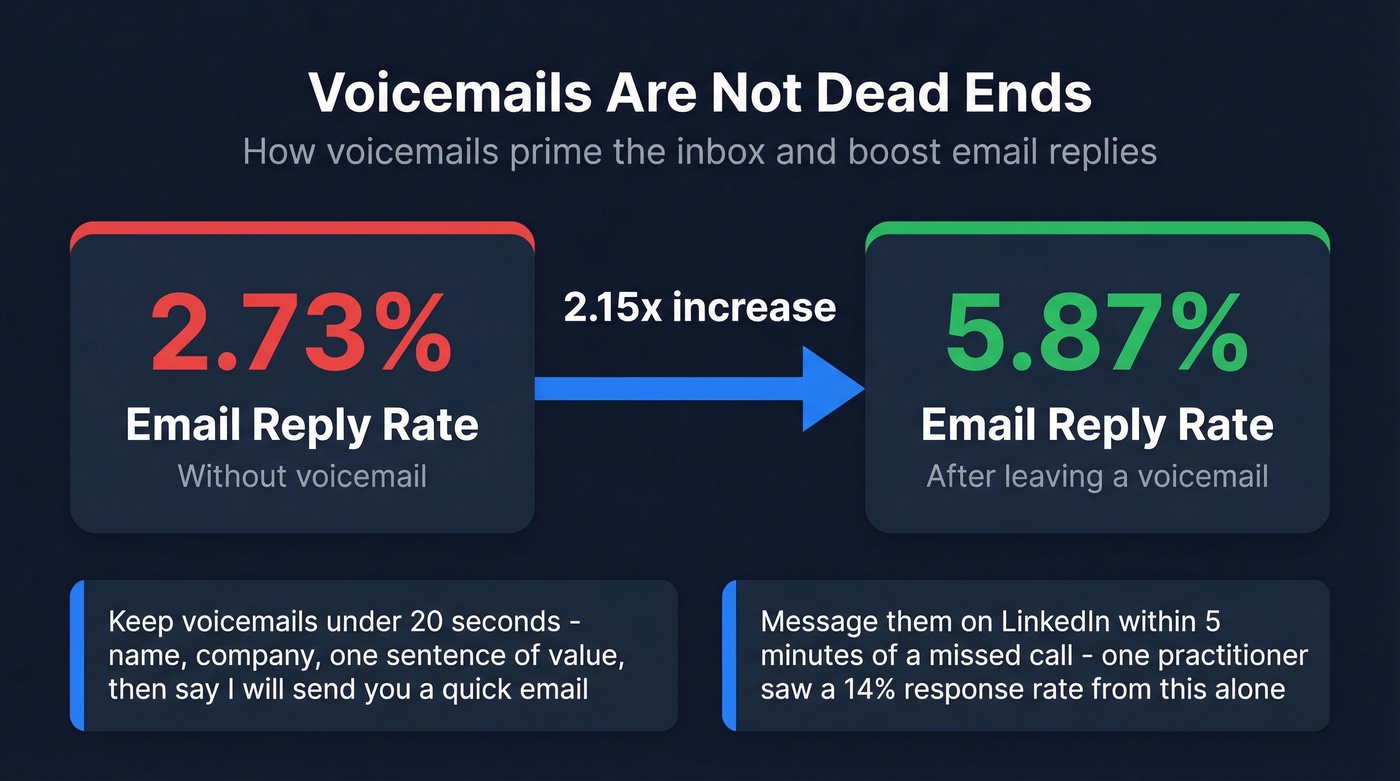
Leaving voicemails lifts email reply rates from 2.73% to 5.87% - more than doubling the response. The voicemail isn't about getting a callback. It's about priming the inbox.
Keep it under 20 seconds: name, company, one sentence of value, "I'll send you a quick email." One practitioner found that pivoting to a message on a professional network within 5 minutes of a missed call generated a 14% response rate. That's a channel most SDRs ignore entirely.
Why Data Quality Breaks Every Framework
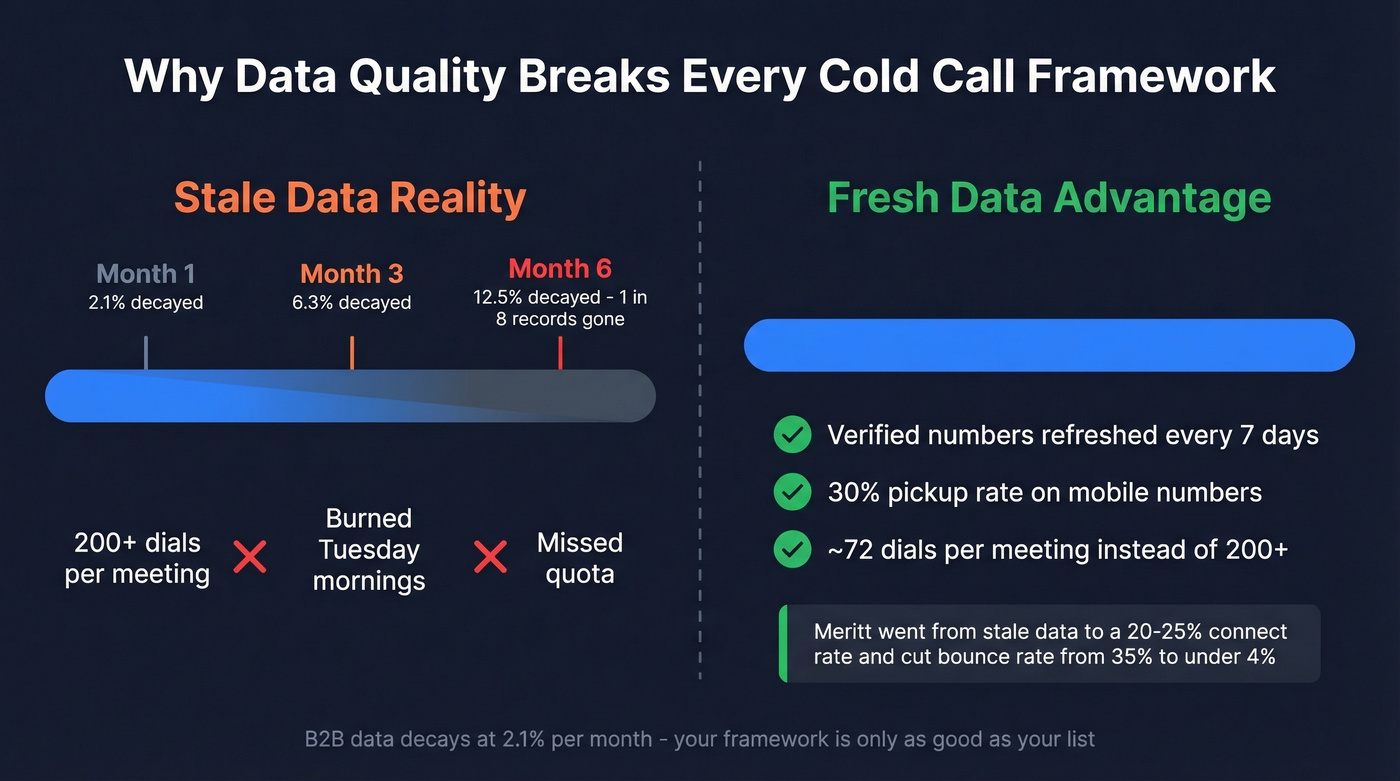
B2B data decays at roughly 2.1% per month. If your list is six months old, roughly 1 in 8 records has gone stale. Your manager asks why you booked 3 meetings when the target is 8, and the answer isn't "my structure needs work" - it's "I'm dialing ghosts."
The data shows cold calling nearly doubles email reply rates (3.44% vs. 1.81%). But that only works if the number connects. We've seen teams overhaul their scripts, run objection-handling workshops , and bring in consultants when the real fix was refreshing their contact data. It's frustrating to watch, honestly.
Prospeo's mobile database covers 125M+ verified numbers with a 30% pickup rate. At that pickup rate, you need far fewer dials to hit the same number of conversations - often the difference between ~72 dials per meeting and 200+. Data refreshes every 7 days versus the 6-week industry average, so you're not burning Tuesday mornings on numbers that churned last month.
That's not theoretical, either. Meritt 3x'd their connect rate to 20-25% after switching, while cutting bounce rate from 35% to under 4%.
Quick Tool Stack
You don't need 15 tools. You need three.
| Category | Pick | Starting Price |
|---|---|---|
| Dialer | CloudTalk / Dialpad / Aircall | $15-30/user/mo |
| Data provider | Prospeo | Free tier; ~$0.01/email |
| Engagement | Salesloft or Outreach | $75-100/user/mo |
For context, a ZoomInfo contract runs $20-50K/year for most teams. Self-serve data providers give you verified emails and mobiles at a fraction of that, no annual lock-in. If you're an SDR team under 10 people, there's no reason to be paying enterprise data prices.
If you're evaluating dialers, start with a ranked list of the best sales dialers and then narrow by workflow (power vs. predictive).
At 72 dials per meeting, every wrong number kills your math. Prospeo's 98% email accuracy and verified direct dials let you warm the cold call with a real email, then connect on a number that actually rings.
Stop running objection workshops when stale data is the real problem.
FAQ
How many dials does it take to book a meeting?
Roughly 72 dials per meeting booked based on practitioner data. Cognism's 204K-call study puts the average success rate at 2.3%. Verified mobile numbers and proper timing - Tuesday between 10-11am - improve that number significantly.
What's the best cold call opener in 2026?
Pattern-interrupt openers ("this is a cold call - give me 18 seconds") kept 30% of prospects on the line past 30 seconds in A/B testing, beating permission-based openers at 22% and direct pitches at 14%. Anchoring to a prior email pushes results even higher.
Does leaving a voicemail actually help?
Yes. Voicemails more than double email reply rates - from 2.73% to 5.87%. The voicemail primes the inbox so your follow-up email gets opened. Keep it under 20 seconds with one clear value statement.
What cold calling framework works best for new SDRs?
The five-step structure above - context-first opener, problem proposition, illuminating question, objection handling, and a light close - gives any SDR a repeatable process they can internalize within a week. New reps should focus on the 43/57 talk-to-listen ratio and run objection drills before worrying about advanced personalization. Pairing this with verified contact data cuts wasted dials so reps spend more time in actual conversations.