

Objection Handling: The Data-Backed Playbook for Every Deal Stage
Your SDR gets hit with "we already use Gong" thirty seconds into the call. There's a pause - the wrong kind - and then a rambling feature dump that ends with a click. You've watched it happen. Everyone has. Most objection handling guides give you seven steps, a motivational quote, and zero data. This one's different.
The Quick Version
The one framework: Validate, Isolate, Reframe (V.I.R.). Three steps, not ten, because reps actually remember three steps under pressure.
The single biggest behavior change: Pause 5x longer after hearing an objection. Top reps do this instinctively. Everyone else rushes to respond.
The mistake to stop immediately: Answering the first objection. It's almost never the real one.
The prerequisite nobody mentions: Before any framework works, you need to be calling the right person with a working number.
What Is Objection Handling?
Most people think it means overcoming resistance. It doesn't. It's the skill of diagnosing and resolving a prospect's concerns so the deal moves forward. Not "crushing objections." Diagnosing and resolving.
Here's the reframe that changes everything: objections are buying signals. A prospect who pushes back on price is mentally evaluating your solution against their budget - that's engagement. A prospect who says nothing and ghosts you? That's the one you should worry about.
Price and timing objections make up the bulk of B2B pushback, which means most of your strategy needs to be built around just two categories.
Why Objections Happen
When a buyer feels pressure, their brain does something unhelpful. The amygdala - the threat-detection center - fires up, and the prefrontal cortex, where actual decision-making happens, goes partially offline. This is cognitive shutdown, and it's why pushing harder after an objection literally makes the buyer less capable of processing your rebuttal.
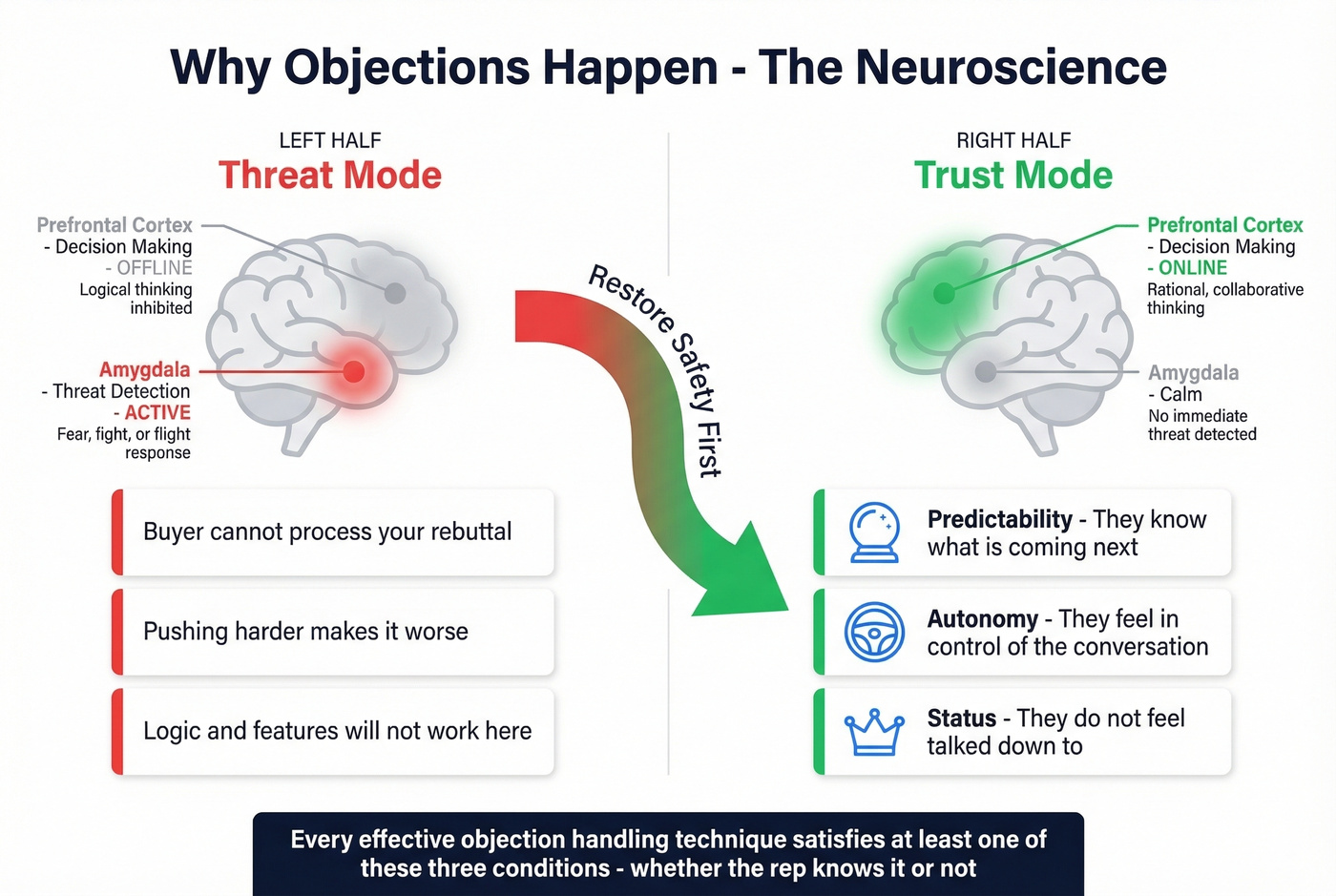
Three neural conditions need to be met before a buyer's brain shifts from threat mode to trust mode: predictability (they know what's coming next), autonomy (they feel in control), and status (they don't feel talked down to). Every effective technique for resolving pushback, whether the rep knows it or not, satisfies at least one of these conditions.
This is why the "always be closing" mentality backfires so spectacularly in complex B2B sales. You're not fighting a logical objection - you're fighting a neurological response. The buyer's brain has decided you're a threat, and no amount of feature-benefit logic will override that until you restore a sense of safety. Acknowledge the emotion before you deliver the information. Mirror their language. Invite collaboration instead of delivering a monologue.
The psychology isn't optional. It's the foundation everything else sits on.
What 67,149 Sales Calls Reveal
Gong analyzed 67,149 sales meetings from a database of 3M recorded calls to identify what top-performing reps actually do differently when they hit an objection. We've reviewed hundreds of these calls ourselves, and the findings challenge a lot of conventional wisdom.
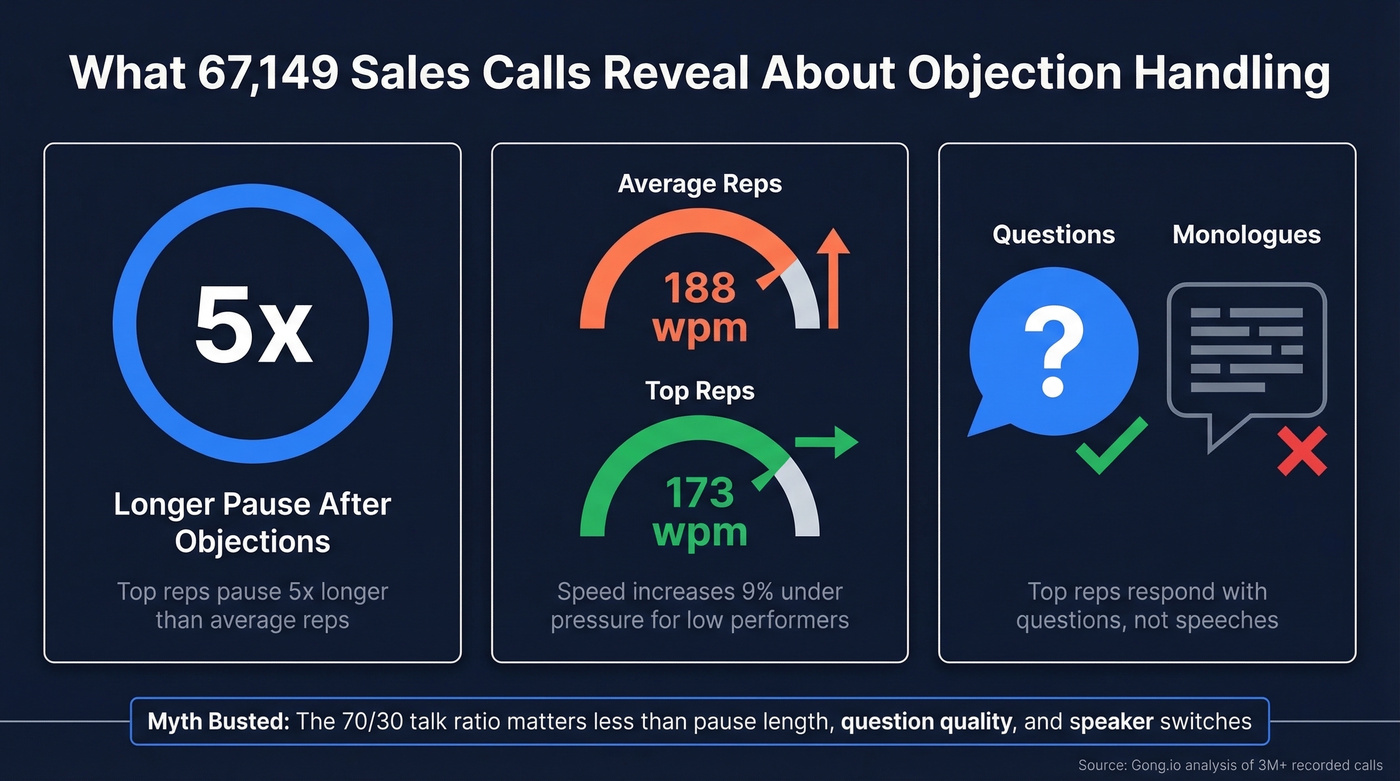
The headline stat: Successful sellers pause 5x longer after an objection than their less-successful peers.
That pause isn't dead air. It's a signal. It tells the buyer "I heard you, I'm thinking about what you said, and I'm not going to steamroll you." It satisfies the autonomy and predictability conditions from the psychology section above. Average reps do the opposite: they hear the objection, panic, and start talking faster.
The speed data backs this up. Normal sales conversation runs at about 173 words per minute. When lower-performing reps hit an objection, they accelerate to 188 wpm - a 9% increase that the buyer absolutely notices, even if they can't articulate why. Top reps either maintain pace or slow down slightly.
The other major finding: successful reps respond to objections with questions, not monologues. They mirror the prospect's last few words with an upward inflection to prompt elaboration. They avoid "why" questions (which feel interrogative) and instead use phrasing like "Can you help me understand what's causing that concern?"
Let's challenge a popular myth while we're here. The "70/30 talk ratio" - prospect talks 70%, rep talks 30% - gets repeated constantly. But the data tells a more nuanced story. Top reps don't necessarily talk less. They pause longer, ask better questions, and create more speaker switches. The ratio matters less than the rhythm.
9 Types of Sales Objections
Most guides cover four or five types - usually some variation of budget, authority, need, and timing. That's incomplete. Outreach's full taxonomy identifies nine distinct categories, and the two most overlooked ones - risk and indifference - are often the hardest to handle because reps don't even recognize them as objections.
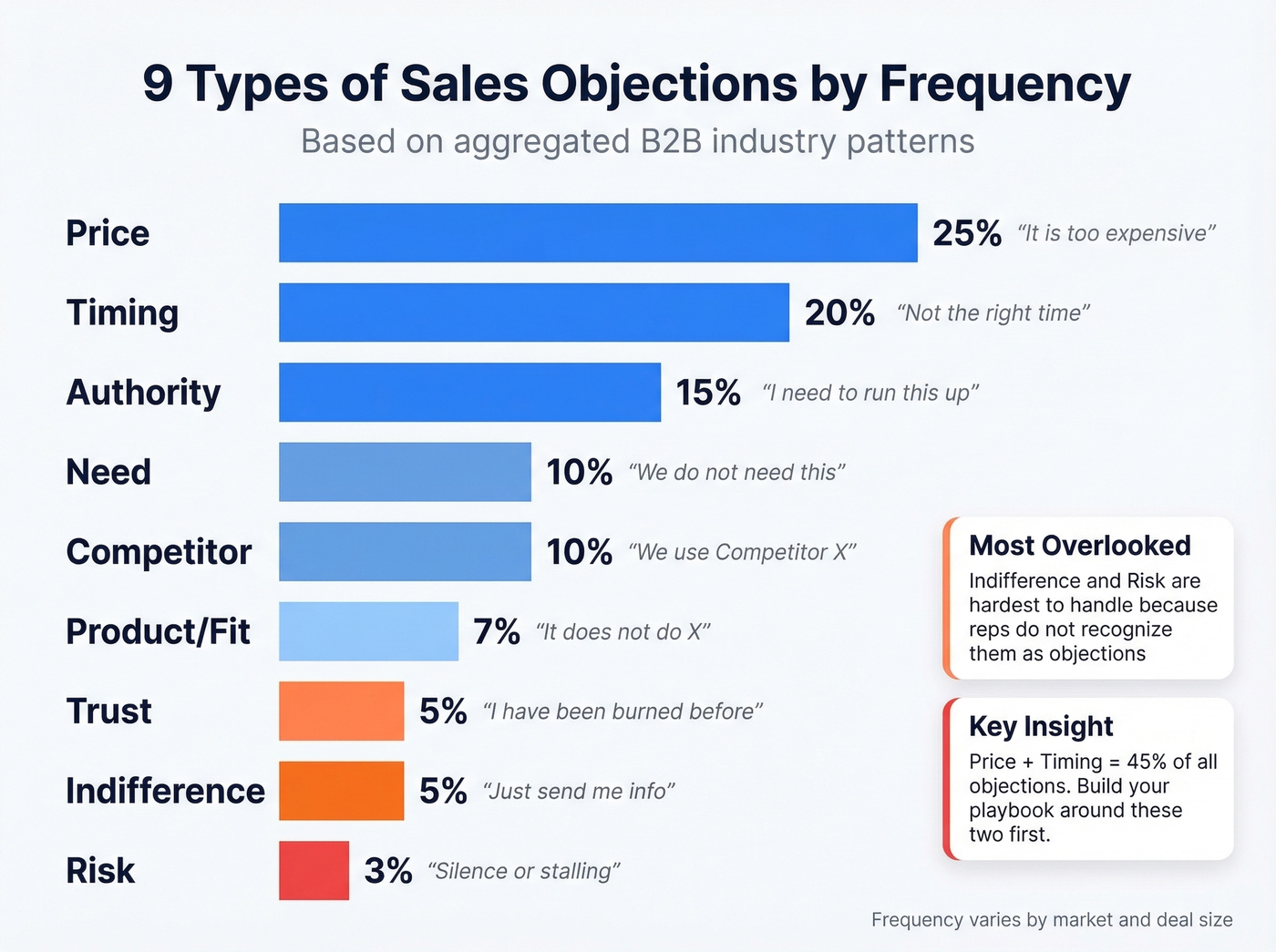
| Type | What It Sounds Like | Diagnostic Question | Frequency |
|---|---|---|---|
| Price | "It's too expensive" | "Compared to what?" | ~25% |
| Timing | "Not the right time" | "What changes next quarter?" | ~20% |
| Authority | "I need to run this up" | "What will they push back on?" | ~15% |
| Need | "We don't need this" | "How are you solving X today?" | ~10% |
| Competitor | "We use [Competitor]" | "How's that handling [Gap]?" | ~10% |
| Product/Fit | "It doesn't do X" | "How critical is X to your workflow?" | ~7% |
| Trust | "I've been burned before" | "What went wrong last time?" | ~5% |
| Indifference | "Just send me info" | "What would make this worth 5 min?" | ~5% |
| Risk | Silence / stalling | "Worst case if this fails?" | ~3% |
These frequency estimates are based on aggregated industry patterns - your team's distribution will vary by market and deal size.
Risk aversion is the hidden driver of late-stage stalls. The prospect won't say "I'm afraid this will fail and I'll look bad." They'll say "let me think about it" or "we need to run this by legal." Indifference is equally dangerous - a prospect who doesn't care enough to object is harder to convert than one who pushes back hard.
The diagnostic questions in that table aren't random. They come from an expert panel of sales leaders who converge on the same principle: diagnose before you respond. Every objection type has a surface version and a real version. The diagnostic question gets you to the real one.

The best objection handling framework is useless if you never reach the decision-maker. 67K calls analyzed - but how many dials never connected? Prospeo gives your reps 125M+ verified mobile numbers with a 30% pickup rate, so they spend time handling real objections instead of hitting voicemail.
Stop practicing scripts on gatekeepers. Start reaching buyers directly.
The V.I.R. Framework
There are dozens of methods for handling objections floating around. Five steps, seven steps, ten steps. We've seen teams try to implement complex multi-stage processes and watch reps abandon them within two weeks because nobody can remember step six when a VP is grilling them about ROI. The one that sticks is V.I.R. - Validate, Isolate, Reframe - because three steps is the maximum a human can reliably execute under conversational pressure.
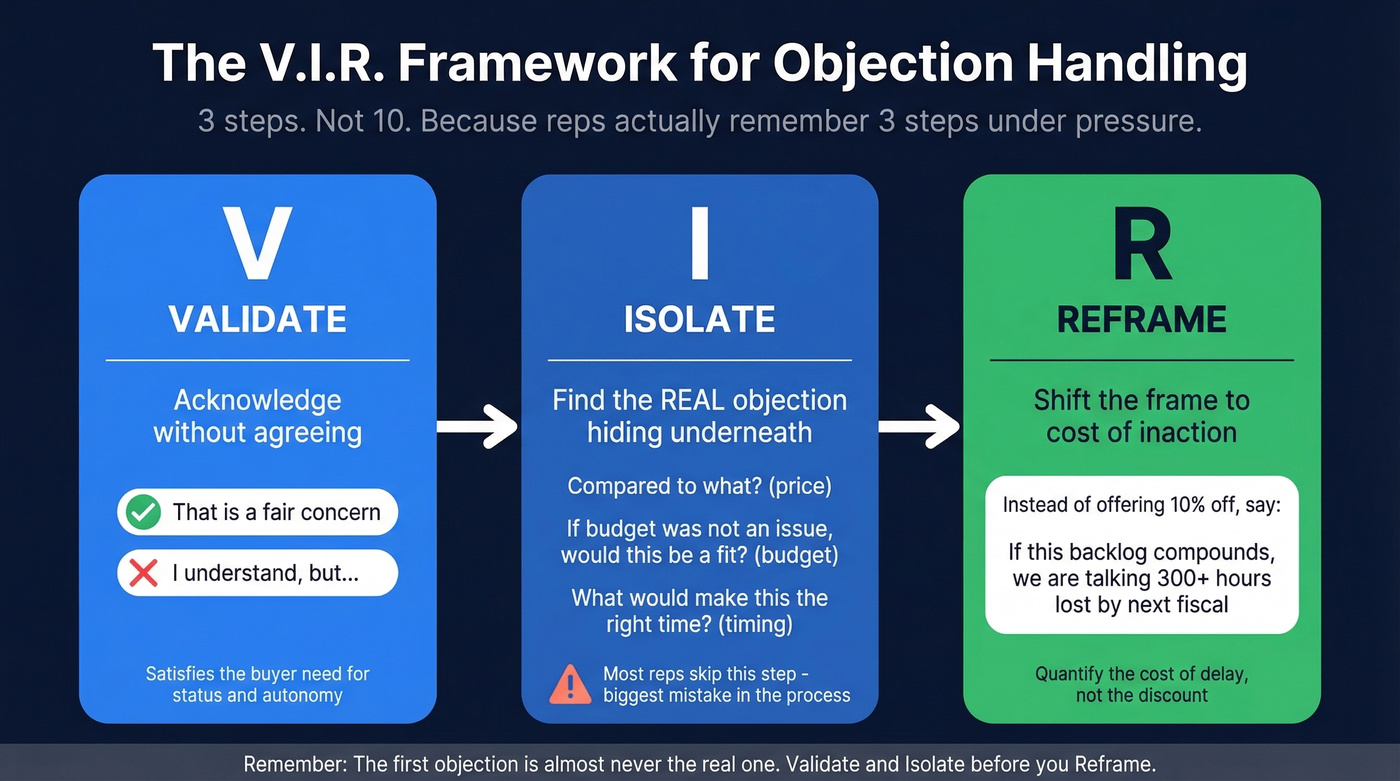
Validate. Acknowledge the objection without agreeing with it. This ties directly to the psychology - you're satisfying the buyer's need for status and autonomy. "That's a fair concern" or "I hear you - budget conversations are never easy" works. What doesn't work: "I understand, but..." The word "but" negates everything before it.
Here's the thing: most reps skip straight to reframing, and it's the single biggest mistake in the process. Isolation means figuring out whether the stated objection is the real blocker. Use the diagnostic prompts: "Compared to what?" for price. "If budget wasn't an issue, would this be a fit?" for budget. "What would make this the right time?" for timing. If the answer to "if budget wasn't an issue" is hesitation, budget isn't the real problem.
Reframe. Once you've isolated the actual concern, shift the frame. The most powerful reframe in B2B sales is cost of inaction - what happens if they do nothing? The consensus on r/sales consistently rewards responses that quantify the cost of delay rather than discount the price. The best-rated response to "budget is locked" reframes it as operational risk: "If this backlog compounds like it has, we're talking about 300+ hours lost by next fiscal." That's infinitely more effective than "I can get you 10% off."
Three words. Validate, Isolate, Reframe. Tattoo it on your team's foreheads if you have to.
Stage-Specific Methods
If you're using the same approach on a cold call and a negotiation call, you're doing it wrong. V.I.R. is the skeleton, but the muscle changes completely depending on where you are in the sales cycle.
Cold Calls
Cold calls give you less than 30 seconds to earn attention. As Sam Nelson puts it, using discovery-call strategies on cold calls will get you hung up on. The goal isn't to overcome the objection - it's to earn a meeting.
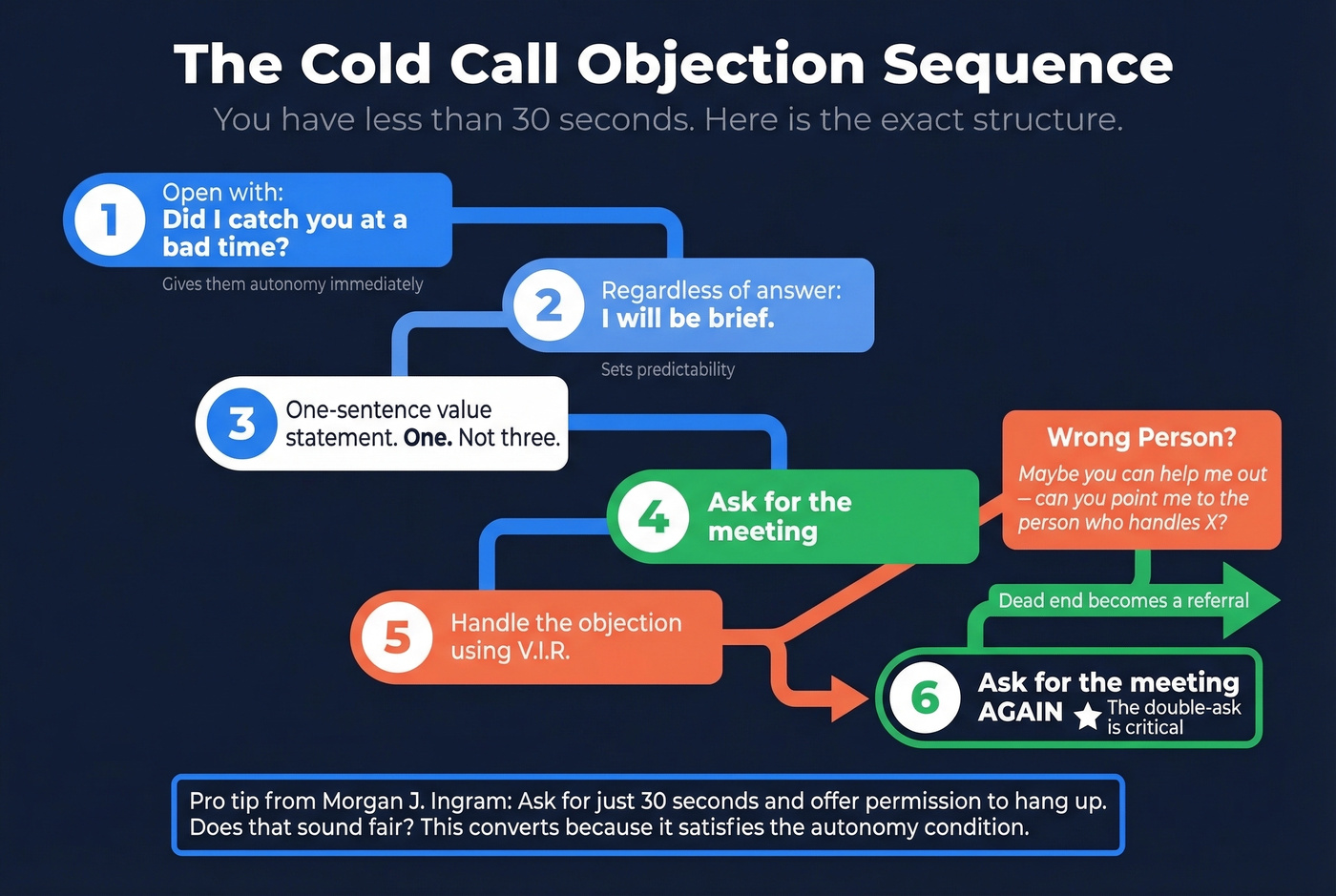
The structure that works: open with "Did I catch you at a bad time?" Regardless of the answer: "I'll be brief." Deliver a one-sentence value statement. Ask for the meeting. Handle the objection. Ask for the meeting again. That double-ask is critical - Morgan J. Ingram's approach of asking for just 30 seconds and offering permission to hang up ("Does that sound fair?") converts surprisingly well because it satisfies the autonomy condition.
When you get "you've got the wrong person," don't apologize and hang up. The redirect works: "Maybe you can help me out - can you point me to the person who handles [X]?" You've turned a dead end into a referral.
Real talk: the best cold call tip nobody discusses isn't a script. It's verifying the number before you dial. If half your dials hit disconnected numbers, your reps never build the conversational muscle memory they need to get sharp. Prospeo's 125M+ verified mobiles with a 30% pickup rate mean reps spend time in live conversations, not listening to dead-line recordings. If you're building a repeatable outbound motion, a cold calling system makes this easier to operationalize.
Discovery Calls
Discovery is where you shift from "earn attention" to "earn trust." The objections here are softer - "I'm not sure we need this" or "we tried something similar" - and they require open-ended questions, not scripts. The mirroring technique shines here. When a prospect says "we tried a similar tool and it didn't work," mirror back: "It didn't work?" with an upward inflection. They'll elaborate. Your goal is to surface the real blocker hiding underneath. If you want a tighter structure for this stage, use a set of discovery questions your whole team can standardize on.
Demos and Proposals
Competitor objections peak during demos. "We already use [Competitor]" is the most common, and the worst response is trashing the competitor. Acknowledge their strength, then ask the gap question: "How are you currently handling [specific gap your product addresses]?"
Social proof and ROI data become your primary weapons here. This is where case studies, customer logos, and concrete numbers earn their keep. Team selling also matters - bringing 2-3 people to the call can boost close rates by up to 258%. A solutions engineer or a live customer reference shifts the dynamic from "sales pitch" to "collaborative evaluation." If your demos are where deals stall, a simple product demo checklist can prevent the most common misses.
Negotiation and Close
Late-stage objections feel like they're about price or terms. They're almost always about risk. The prospect is thinking: "What if this doesn't work and I'm the one who signed the contract?"
Here's the data that should create urgency for both you and the buyer: Outreach's analysis shows deals closed within 50 days carry a 47% win rate. After 50 days, that drops to 20% or lower. The prospect isn't just delaying - they're cutting their own odds in half. Frame it that way: "Every week we push this out, the likelihood of getting this done drops measurably. What would need to be true for us to move forward this month?" If you want a clean way to set terms without triggering threat mode, learn how to use an anchor in negotiation.
Copy-Paste Scripts by Objection
"It's Too Expensive"
Phone: "That's a fair point - nobody wants to overpay. Quick question: compared to what? [Pause.] If price wasn't the issue, is this the solution you'd choose to solve [problem]? ... Okay, so the fit is there. Let's talk about what the cost of not solving [problem] looks like over the next two quarters, and see if the math works."
Email: "Hi [Name], I hear you on pricing - it's the right question to ask. One thing worth considering: [Company similar to theirs] was spending $X/month on [workaround] before switching. They broke even in 6 weeks. Happy to walk through the math on a quick call - would Thursday work?"
"Not the Right Time"
Phone: "Totally get it. What would need to change between now and next quarter to make this a better time? [Pause.] Here's what I'm seeing with teams that wait - deals closed within 50 days have a 47% win rate. After that, it drops to 20%. I don't want that for you. What if we scoped a smaller pilot that doesn't require full commitment right now?"
Email: "Hi [Name], timing is everything - no argument there. One data point to consider: the problem you described in our last call typically compounds at [X rate]. Teams that wait a quarter often find the fix costs 2-3x more. Worth a 15-minute check-in to see if a phased approach makes sense?"
"We Already Use [Competitor]"
Phone: "Good - that means you already see the value in solving this problem. How are you currently handling [specific gap]? [Listen.] That's exactly where we tend to complement what [Competitor] does well. Would it be worth seeing a side-by-side on just that piece?"
Email: "Hi [Name], great - you're already investing in solving this, which tells me it matters. Quick question: how's [Competitor] handling [specific gap]? We've helped teams like [similar company] close that gap without ripping out what's already working. Worth a 15-minute look?"
"I Need to Talk to My Boss"
Phone: "Absolutely - that makes sense. Let me ask: what questions do you think they'll throw at you that we haven't covered yet? [Pause and listen.] Want me to put together a one-page business case you can forward? Or better yet - I'm happy to join that conversation and handle the tough questions directly."
Email: "Hi [Name], totally understand - big decisions need buy-in. I put together a one-page business case with the ROI numbers we discussed. Feel free to forward it directly, or I'm happy to jump on a quick call with your team to answer questions live."
"Send Me an Email" (Brush-Off)
Phone: "Happy to - and I want to make sure it's actually useful. What one thing would you need to see in that email to make it worth your time to read? [Pause.] ... Got it. Let me send that over with some specifics. And if it resonates, I'll follow up Thursday. Fair?"
5 Mistakes That Kill Deals
1. Answering the first objection immediately. The first objection is almost never the real one. It's a reflex - the buyer's brain throwing up a shield while it processes. When you solve the stated objection instantly, you either discount unnecessarily or address the wrong problem entirely. Isolate first. Always.
2. Speeding up instead of pausing. Lower-performing reps accelerate to 188 wpm after hearing an objection. The buyer reads this as panic, which triggers their own threat response. Slow down. The 5x pause isn't a nice-to-have - it's the single highest-correlated behavior with successful objection resolution in the dataset of 67,149 calls.
3. Using discovery tactics on cold calls. "Tell me about your current tech stack" is a great discovery question and a terrible cold call question. Cold calls demand brevity and a meeting ask, not a 20-minute needs analysis. Match your approach to the stage. If your team is still ramping, this cold calling for beginners guide can help standardize fundamentals.
4. Accepting "budget is locked" at face value. Look - budget is rarely truly locked. It's allocated, prioritized, and defended, but it moves when the business case is strong enough. Instead of accepting the objection, reframe to cost of inaction. "If this backlog compounds, what does that cost you by Q3?" forces the prospect to weigh the objection against a real number.
5. Stopping follow-up too early. 94% of reps stop after four attempts. The top 6% follow up five or more times. That fifth or sixth touch is where most deals actually close, because by then the prospect has had time to process, discuss internally, and circle back. Persistence isn't pushy when it's paired with new value in each touchpoint. If you need ready-to-send sequences, keep a set of sales follow-up templates on hand.
Build Your Team's Playbook
Knowing the framework is step one. Operationalizing it across a team is where the real gains happen.
Record and categorize. Pull call recordings and tag every objection by type (use the 9-type taxonomy) and deal stage. After two weeks, you'll see patterns - maybe your team gets crushed by competitor objections during demos but handles pricing well. Now you know where to focus training.
From there, build a shared script library using V.I.R. as the skeleton. For each objection type, document the validate statement, the isolation question, and 2-3 reframe options. Keep it in a living doc that reps can pull up mid-call. Pair this with weekly role-play sessions - fifteen minutes, one objection type, rotating partners. Record them. The discomfort is the point; reps who practice under pressure perform under pressure.
The metric nobody tracks but everyone should: objection-to-close conversion by rep. Which reps convert "too expensive" into closed deals? What are they doing differently? That's your coaching goldmine.
One prerequisite makes all of this possible: clean data. You can't handle objections if you never reach the prospect. If a third of your emails bounce or half your phone numbers are disconnected, your reps never get enough at-bats to improve. We've seen teams double their live conversation volume just by switching to verified contact data with a weekly refresh cycle - and more conversations means faster skill development across the board. If you're tightening your outbound engine, start with data enrichment services to keep records current.
The data is clear: you need to call the right person to even get an objection worth handling. Prospeo's 300M+ profiles with 30+ filters - including buyer intent and job changes - let you target prospects already in-market, so the objections you face are buying signals, not brick walls.
Reach in-market buyers who object because they're evaluating, not ignoring.
Objection Handling FAQ
What's the difference between an objection and a rejection?
An objection is a concern that can be addressed - the prospect is still engaged and evaluating. Rejection is a firm no. Most "rejections" are actually undiagnosed objections where the rep gave up before isolating the real blocker. Staying in the conversation long enough to surface the real concern is what separates top closers from average ones.
How many objections per deal should you expect?
In mid-market B2B, expect 3-7 meaningful objections across the full sales cycle. Price and timing account for roughly 45% of all pushback. The number increases with deal complexity, stakeholder count, and sales cycle length.
What's the best framework?
Validate, Isolate, Reframe. Three steps beat ten because reps actually remember them under pressure. The critical step most people skip is isolation - diagnosing whether the stated objection is the real blocker before attempting to resolve it.
How do cold call objections differ from closing call objections?
Cold calls demand brevity and curiosity - earn a meeting, not a close. You've got under 30 seconds to prove relevance. Closing calls require deeper diagnosis, social proof, risk reduction, and cost-of-inaction framing. Using the wrong playbook for the stage is one of the top five deal-killing mistakes we covered above.
Does contact data quality affect objection handling skill?
Directly. Reps who waste half their dials on disconnected numbers never build the conversational muscle memory needed to improve. Tools like Prospeo verify emails at 98% accuracy and maintain 125M+ mobile numbers on a 7-day refresh cycle, so reps reach real decision-makers and get live practice on every shift.