

The 7 Best Sales Dialers in 2026 (and the One Thing That Matters More)
A RevOps lead we know ran the numbers last quarter: 1,200 dials, 47 conversations, 2 meetings. His team wasn't lazy - they were dialing into garbage data. The best sales dialer in the world won't fix a bad list.
Average cold call connect rates sit between 3% and 10%, while top performers hit 16-22%. The gap isn't the software. It's almost always data quality.
We evaluated each tool below across CRM integration depth, pricing transparency, and compliance features to help you find the right dialer for your team - whatever the size.
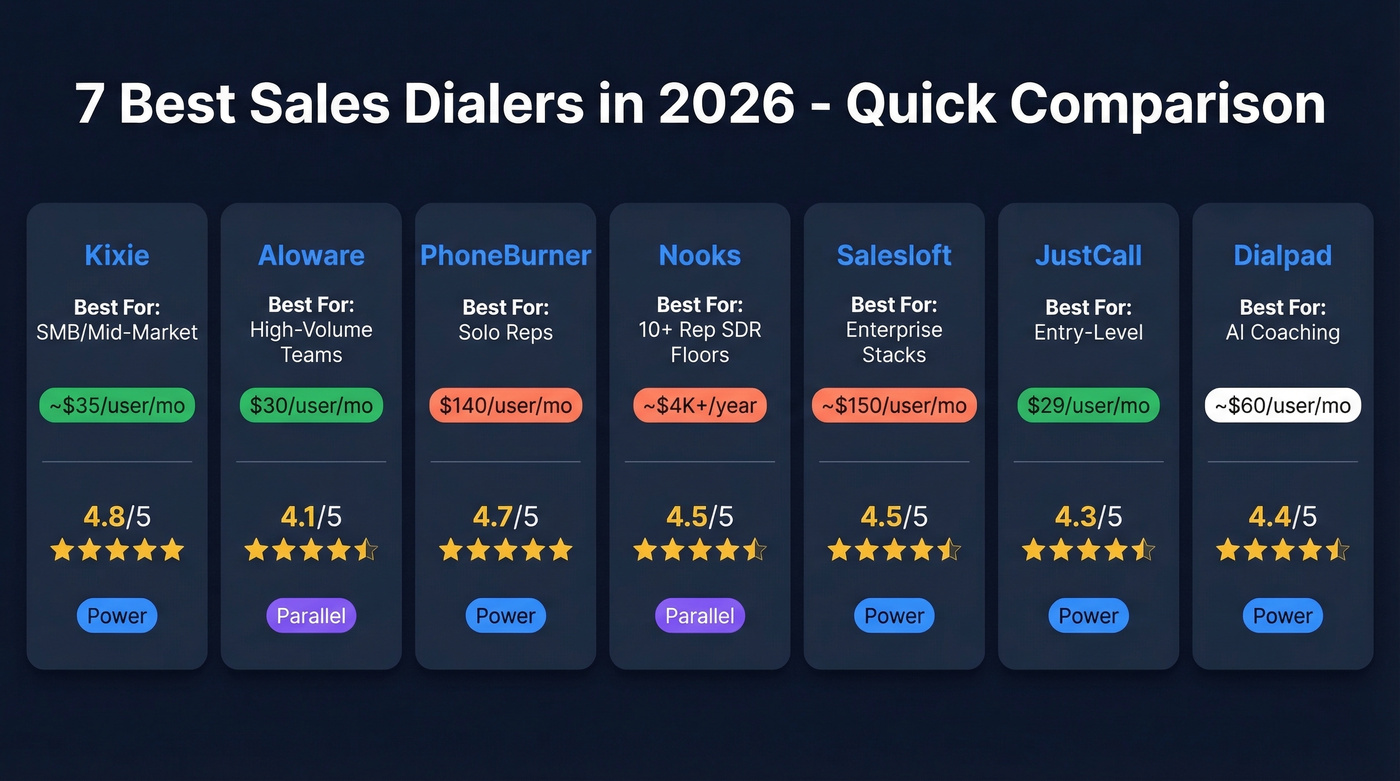
Our Picks at a Glance
| Tool | Best For | Starting Price | G2 Rating |
|---|---|---|---|
| Kixie | SMB/mid-market | ~$35/user/mo | 4.8/5 (863) |
| Aloware | High-volume teams | $30/user/mo | 4.1/5 (822) |
| PhoneBurner | Solo reps | $140/user/mo | 4.7/5 |
| Nooks | 10+ rep SDR floors | ~$4K+/year | 4.5/5 |
| Salesloft | Enterprise stacks | ~$150/user/mo + add-on | 4.5/5 |
| JustCall | Entry-level | $29/user/mo | 4.3/5 (2,376) |
| Dialpad | AI coaching | ~$60/user/mo | 4.4/5 |
Dialer Types, Explained
Before picking sales dialing software, know what you're buying.
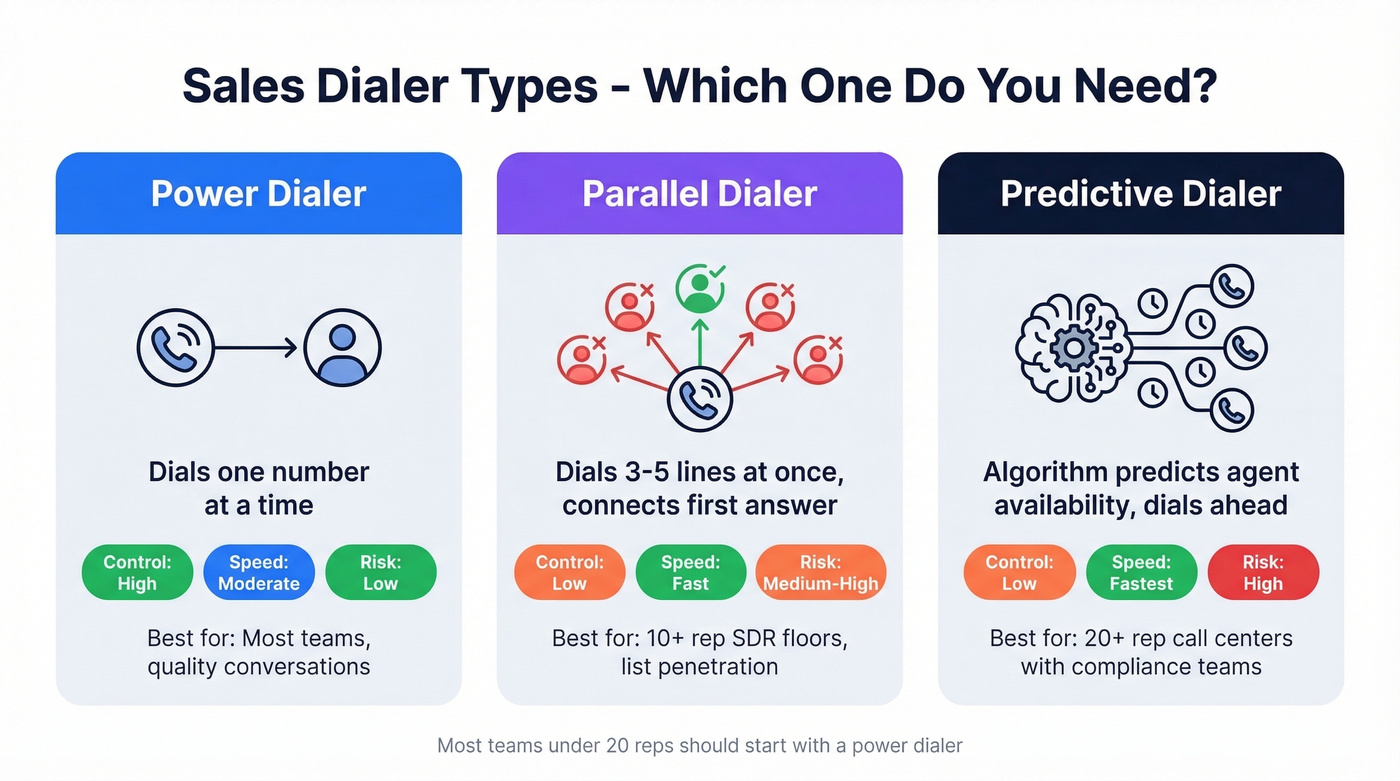
Power dialer: Dials one number at a time per agent. Maximum control, best for quality conversations. The safe default for most teams.
Parallel dialer: Dials 3-5 lines simultaneously, connects the first live answer, drops the rest. Fastest for list penetration, but dropped-call risk is real - and regulators are watching closely.
Predictive dialer: Algorithms forecast agent availability and dial ahead. High throughput, but it needs careful configuration to avoid compliance issues. Most teams under 20 reps don't need this.
Each Dialer, Reviewed
Kixie
Use this if you're an SMB or mid-market team on HubSpot or Salesforce and want a dialer that works tightly with your CRM. Kixie's 4.8/5 on G2 across 863 reviews isn't an accident - Ease of Use scores 9.3 and Quality of Support hits 9.6. In our experience, that support score matters more than feature lists when your reps are mid-campaign and something breaks.
Skip this if you're running a 20+ seat SDR floor where raw volume matters more than per-call quality.
Pricing is tiered; expect roughly $35-$95/user/mo depending on plan and add-ons, with a free 7-day trial. The sweet spot is teams of 3-15 reps who want reliability over feature bloat.
Aloware
Use this if you have 10+ reps and need unlimited calling without per-minute overages. Aloware's pricing starts at $30/user/mo on quarterly billing - but the cheapest plan requires a minimum of 10 users, so your real floor is $300/mo.
Skip this if you're a small team or can't tolerate occasional call quality issues. G2 reviewers flag "Call Issues" and "Slow Performance" as recurring themes, and that's worth taking seriously before you commit.
The local presence add-on runs $300/mo and is marketed as increasing pickup rates by up to 47%. Higher tiers at $60-$85/user drop the seat minimum to 5.
PhoneBurner
PhoneBurner is the rare dialer with genuinely transparent pricing and no seat minimums. Plans run $140/user/mo on Standard, $165 for Professional, and $183 for Premium - all billed annually. You know exactly what you're paying before you talk to anyone. That alone sets it apart.
The catch: texting is locked to Premium, with a 1,000/mo outbound cap and $15 per additional 1,000. For a solo rep or two-person team doing 50-80 dials a day, PhoneBurner is the most straightforward option here. If you need SMS as a core channel, look elsewhere.
Nooks
Nooks is built for SDR floors running 10+ reps who want parallel dialing up to 6 lines with a virtual salesfloor for real-time coaching. The collaboration features - joining a rep's room mid-dial, AI roleplay for practice - are genuinely differentiated. We haven't seen another tool nail the "virtual bullpen" feel this well.
The problem is transparency. Nooks doesn't publish pricing; expect ~$4K+/year with an annual contract. The consensus on r/sales is that Nooks pricing is frustratingly opaque, and that friction point alone pushes some buyers to competitors. Capterra gives it 4.5/5, but on just 2 reviews - too thin to draw conclusions from.
SalesLoft
Already on Salesloft for sequences? The built-in dialer keeps everything in one platform. Buying Salesloft for the dialer? Don't. It's an add-on, not a core feature.
Platform pricing runs ~$150-180/user/mo and calling/dialer add-ons often land around $300/user/year extra (for example, $7,500/yr for 25 users). Negotiate hard - typical discounts run 35-45% off list price, and they expect you to push back.
JustCall
The cheapest option with serious review volume: $29/user/mo on annual billing, 4.3/5 across 2,376 G2 reviews. Good entry point. But minute caps with overages can push real costs to $200-400/mo per seat at scale, which erases the pricing advantage fast. Know your volume before committing.
Dialpad
Best for teams that want AI coaching and real-time transcription without paying for add-ons. Dialpad Sell includes a built-in dialer, real-time coaching powered by their AI engine, and CRM integrations. Pricing varies by plan; expect roughly $60-$95/user/mo.
Here's the thing: it's more of a communications platform that happens to dial well - not a dedicated power or parallel dialer. For teams that live in calls all day, a purpose-built tool will feel snappier.
If you're comparing options in this category, see our breakdown of Dialpad alternatives.

The best sales dialer can't fix bad phone numbers. Prospeo gives your reps 125M+ verified mobile numbers with a 30% pickup rate - 3x the industry average. At $0.10 per mobile, you pay only when a number is found.
Stop burning dials on dead numbers. Fix your data first.
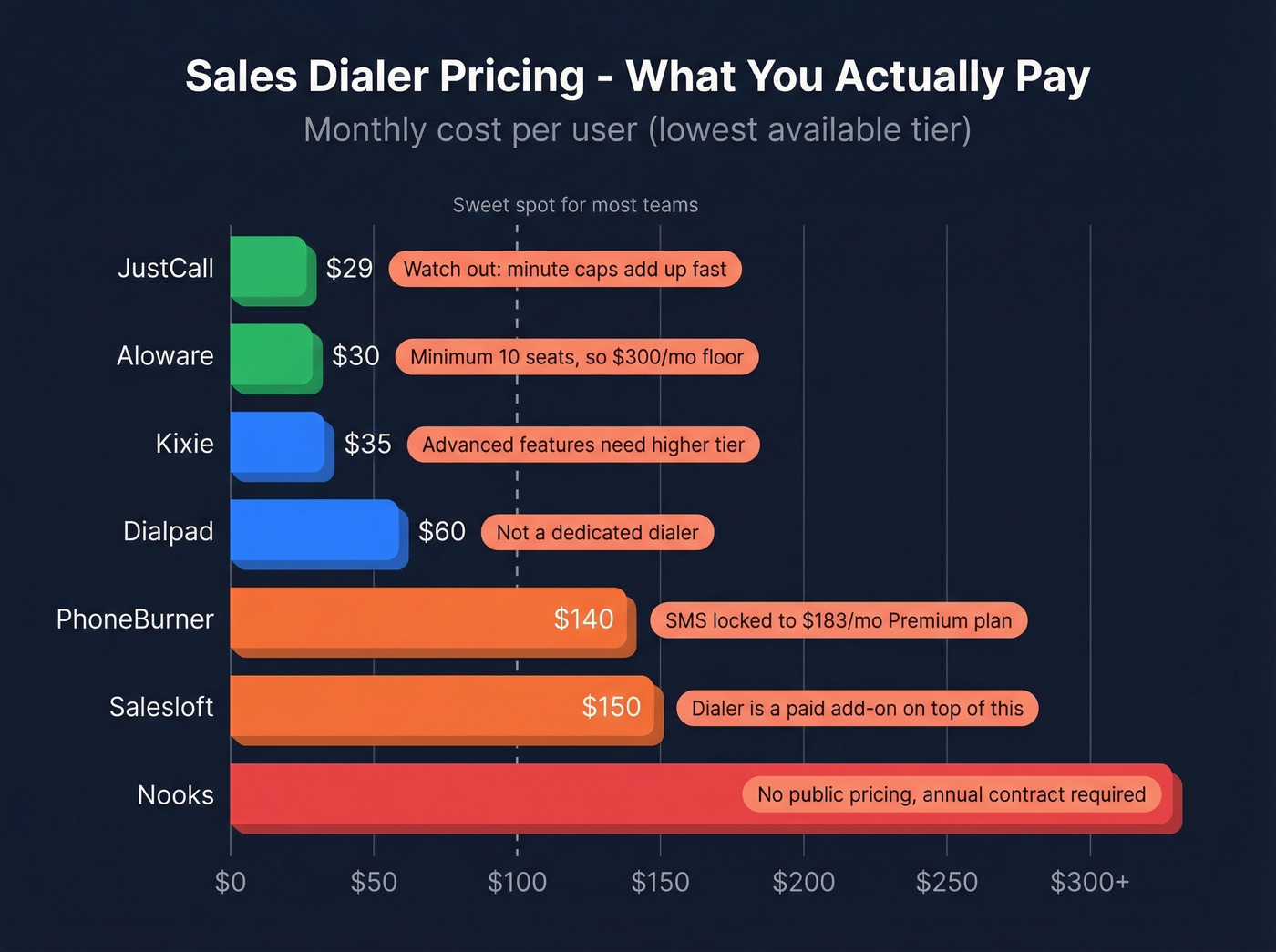
Pricing Comparison
| Tool | Starting Price | Billing | Seat Min | Key Gotcha |
|---|---|---|---|---|
| Kixie | ~$35/user/mo | Monthly | None | Advanced features need higher tier |
| Aloware | $30/user/mo | Quarterly | 10 users | $300/mo floor on cheapest plan |
| PhoneBurner | $140/user/mo | Annual | None | SMS only on Premium |
| Nooks | ~$4K+/year | Annual | Contact sales | No public pricing |
| Salesloft | ~$150/user/mo | Annual | Contact sales | Dialer is an add-on |
| JustCall | $29/user/mo | Annual | None | Minute caps + overages |
| Dialpad | ~$60/user/mo | Annual | None | Not a dedicated dialer |
Why Data Quality Matters More Than Your Dialer
Let's be honest: most teams upgrading from a $50 dialer to a $150 dialer are solving the wrong problem.
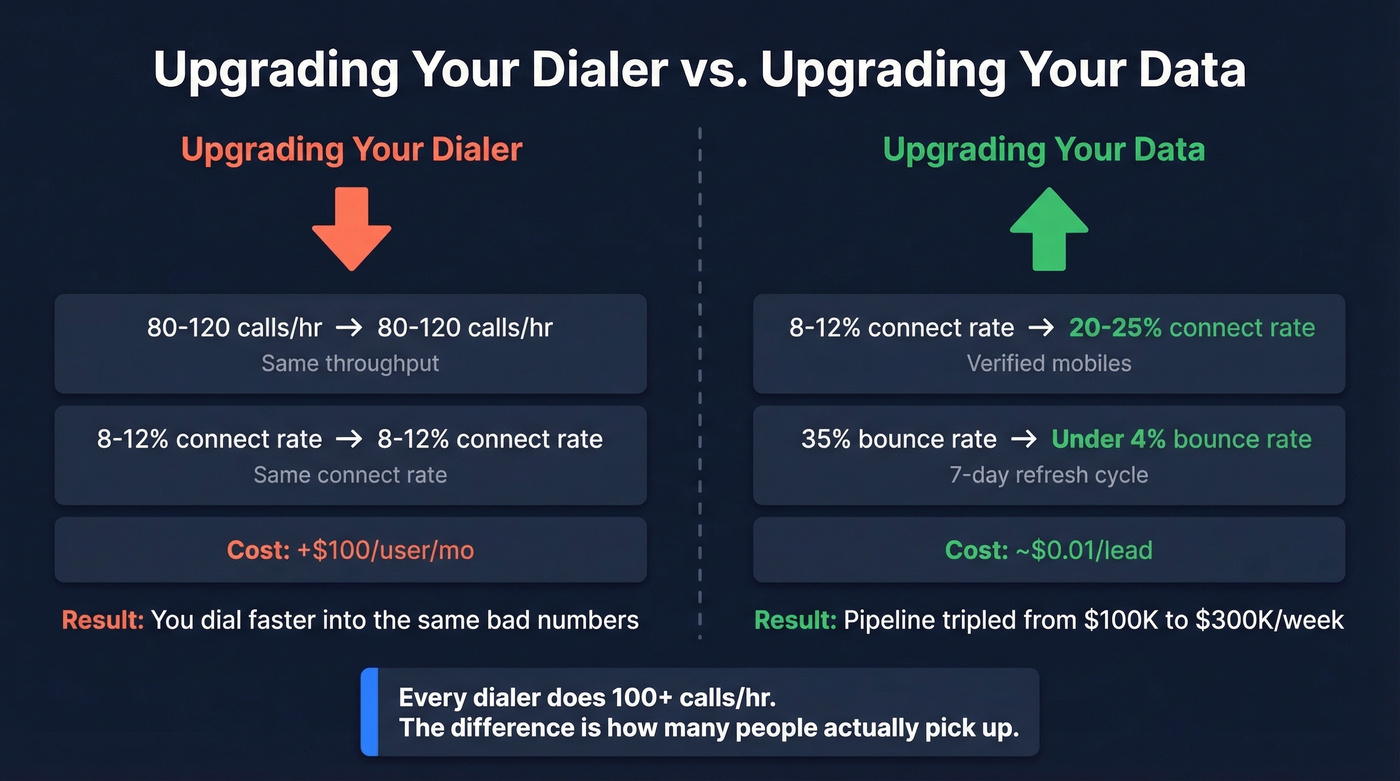
Every tool on this list pushes 80-120 calls per hour. At an 8-12% connect rate on well-targeted lists, the math is roughly the same whether you're paying $29/seat or $183/seat. The variable that actually moves connect rates is the phone numbers you're feeding into the system - not the system itself.
When Meritt switched to Prospeo's verified mobile numbers, their pipeline tripled from $100K to $300K/week and bounce rates dropped from 35% to under 4%. That's not a dialer upgrade. That's a data upgrade. With 125M+ verified mobiles delivering a 30% pickup rate and a 7-day data refresh cycle, the cost at ~$0.01/lead is less than the wasted dial time on stale numbers.
If you're rebuilding your outbound list, start with data enrichment and a clean sales prospecting database before you scale volume.
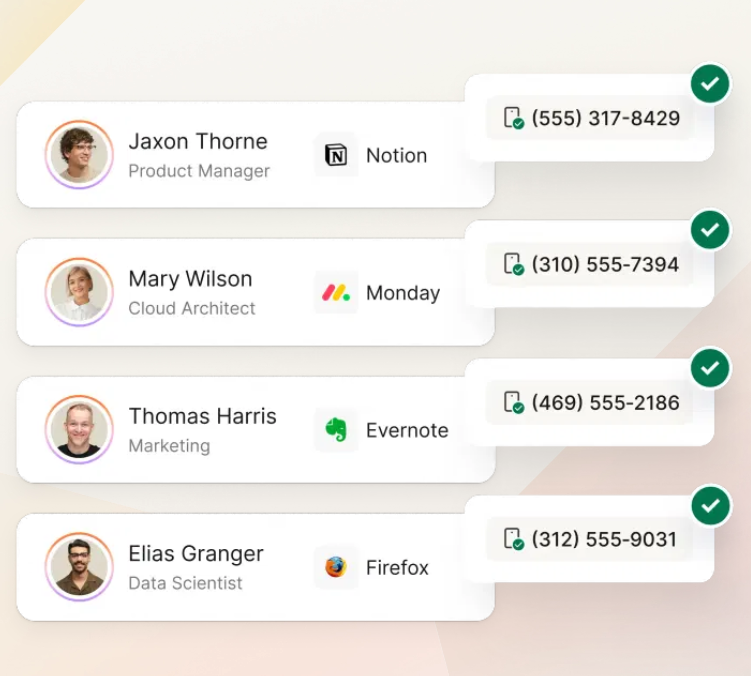
Meritt tripled their pipeline from $100K to $300K/week and hit 20-25% connect rates after switching to Prospeo's verified data. Your dialer does 100+ calls/hour - the difference is how many actually pick up.
Feed your dialer numbers that actually connect.
2026 Compliance Checklist
TCPA litigation surged 95% in 2025, and state mini-TCPA laws keep expanding. Before you dial:
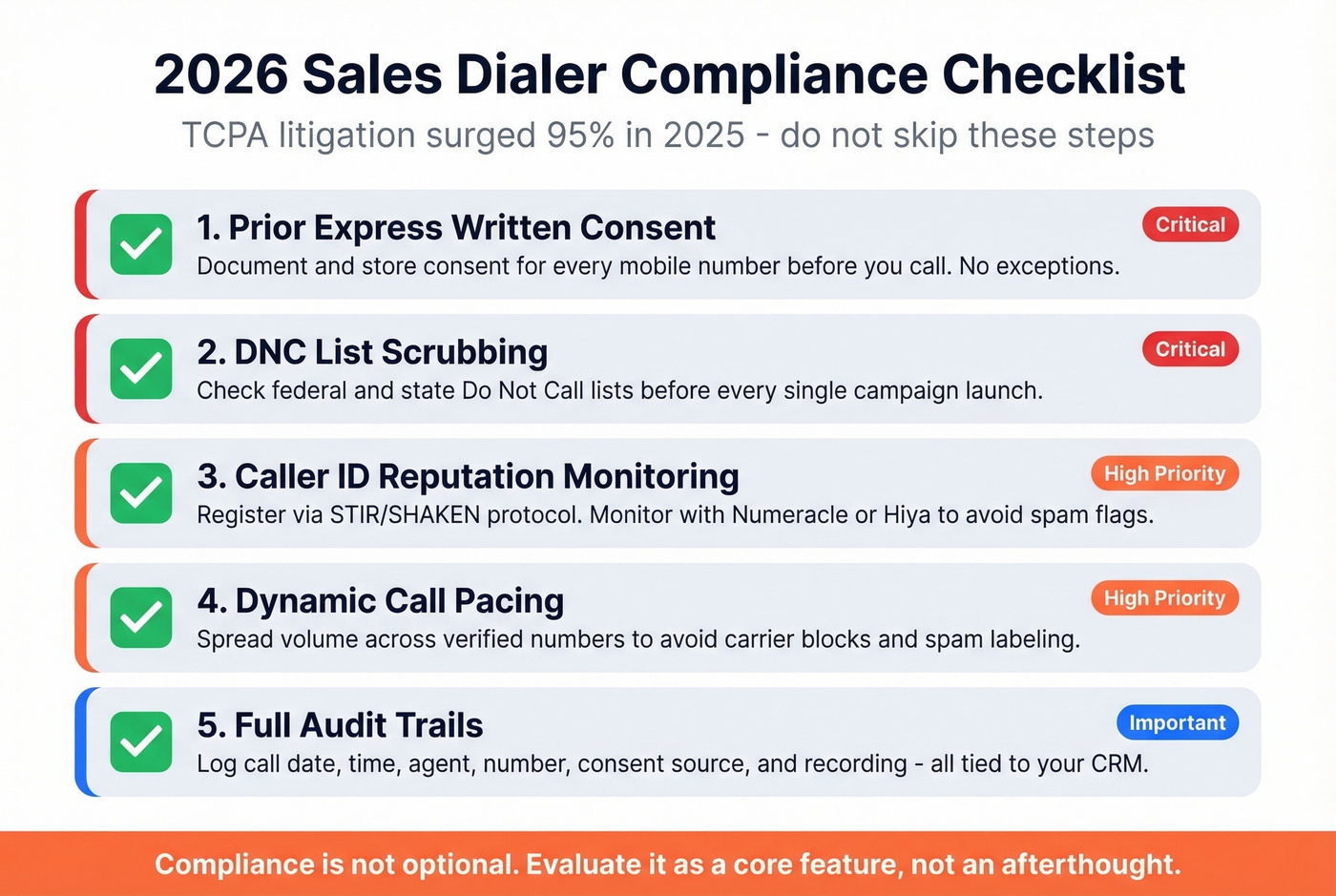
- Prior express written consent - document and store consent for every mobile you call
- DNC list scrubbing - federal and state lists, checked before every campaign
- Caller ID reputation monitoring - register via STIR/SHAKEN; monitor with Numeracle or Hiya
- Dynamic pacing - spread volume across verified numbers to avoid carrier blocks
- Audit trails - call date/time, agent, number, consent source, and recording tied to your CRM
Compliance isn't optional. It should be a core evaluation criterion when comparing any dialing tool, not an afterthought you bolt on after your first lawsuit scare.
If you're building a repeatable outbound motion, pair compliance with a documented cold calling system and consistent sales prospecting techniques.
Sales Dialer FAQ
What's the difference between a power dialer and a parallel dialer?
A power dialer calls one number at a time, giving full control over each conversation. A parallel dialer rings 3-5 lines simultaneously and connects the first live answer - faster for list penetration but carries higher dropped-call risk and potential TCPA exposure.
How many calls per hour can a sales dialer make?
Most power dialers handle 80-120 calls per hour. Parallel dialers push higher, but connect rates depend far more on data quality than raw dial speed - verified mobiles outperform landlines by 2-3x on pickup rates.
How do I choose the right dialer for my team?
Start by mapping your team size, call volume, and CRM stack. A two-person team needs transparent per-seat pricing (PhoneBurner, JustCall), while a 15+ rep floor benefits from parallel dialing and coaching features (Nooks, Kixie). Then validate that your contact data is fresh - no tool compensates for bad numbers.
What's the cheapest way to improve cold call connect rates?
Start with verified mobile numbers instead of upgrading your dialer. Pair that with local presence dialing and calling during the 4-5 PM window for the highest lift. The dialer upgrade can wait; the data fix can't.