

The Cold Calling Objection Framework Guide (Backed by 300M+ Calls)
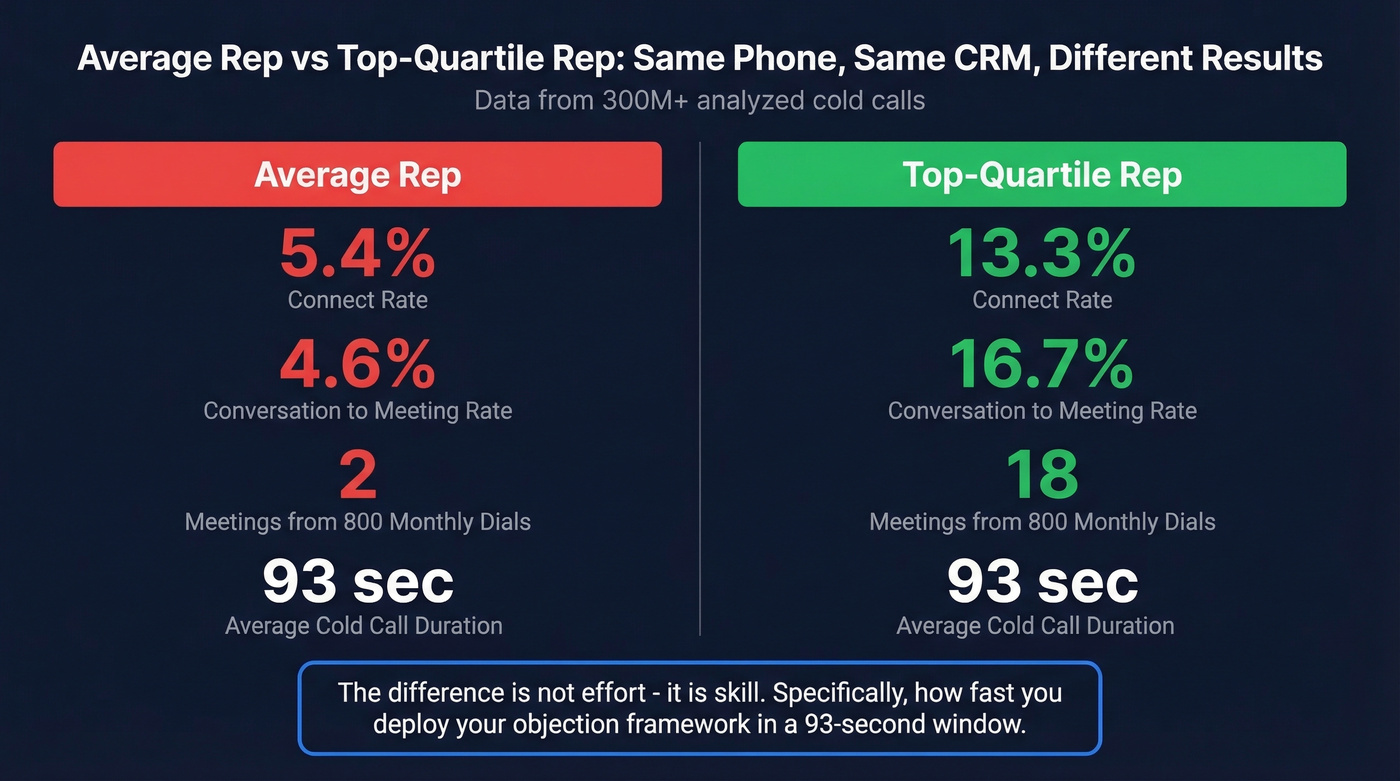
It's Tuesday morning - statistically the highest-booking day for cold calls. You've got 800 dials queued for the month, and the average rep books about two meetings from that activity. The top-quartile rep three desks over? About 18 from the same 800 dials. Same phone, same CRM, same territory. The difference is what happens in the first moments after a prospect picks up and says "not interested."
Analysis of 300M+ cold calls makes the gap clear: average reps connect at 5.4% and convert conversations to meetings at 4.6%. Top-quartile reps hit 13.3% connect rates and 16.7% set rates. The variable is skill - specifically, your cold calling objection framework and how fast you deploy it. The average cold call lasts 93 seconds. That's your window.
Armand Farrokh and Nick Cegelski break this down in Cold Calling Sucks (And That's Why It Works), and it's one of the best practitioner resources on the topic. The big takeaway: you don't need seven frameworks. You need one primary framework and the judgment to switch when the situation demands it.
The Short Version
Primary framework: Validate → Label → Ask. This should be your default for most cold call objections.
When to switch:
- LAER (Listen, Acknowledge, Explore, Respond) - for enterprise deals with layered objections
- ARR (Address, Reframe, Redirect) - for competitive displacement when a prospect already has a vendor
Three Types of Cold Call Objections
Here's the thing: the single biggest reason rebuttals fail is that reps treat every objection the same way. A prospect saying "not interested" three seconds into your call is fundamentally different from a prospect saying "we're locked into a contract through next year." Treating a reflex dismissal like a real concern makes you sound tone-deaf. Treating a real concern like a reflex makes you sound pushy. Diagnose first, respond second.
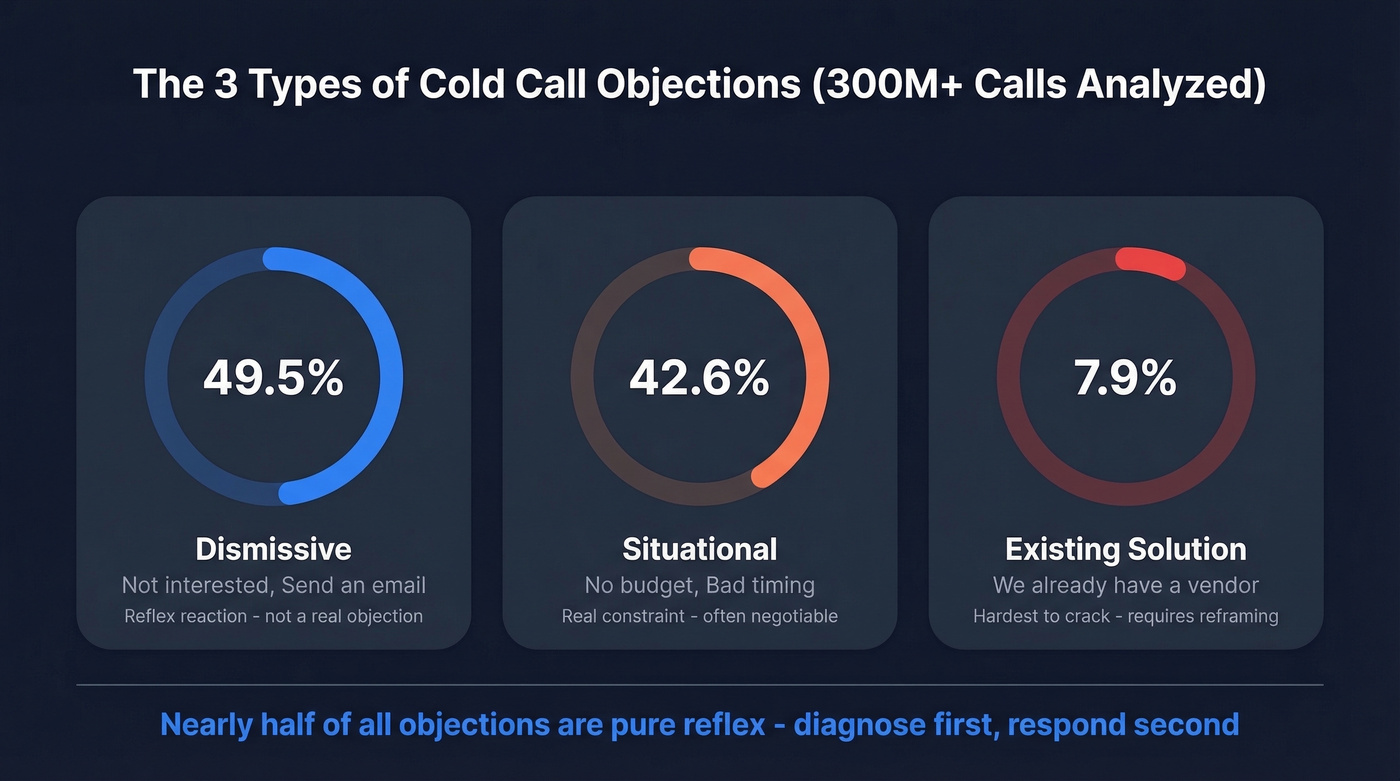
A Gong-backed objection taxonomy breaks it into three types. Some coaches visualize this as an "objection wheel" - a diagnostic tool that helps reps quickly categorize what they're hearing and select the right response path in real time.
| Objection Type | Frequency | What It Sounds Like | What It Actually Means |
|---|---|---|---|
| Dismissive | 49.5% | "Not interested," "Send an email" | Reflex reaction, not a real objection |
| Situational | 42.6% | "No budget," "Bad timing" | Real constraint, but often negotiable |
| Existing Solution | 7.9% | "We already have a vendor" | Hardest to crack - requires reframing |
Nearly half of all objections are dismissive - pure reflex. The prospect hasn't processed what you said. If you respond to "not interested" with a feature dump, you've already lost. The correct move is to acknowledge the reflex, then redirect to a question that earns you 15 more seconds.
Situational objections are where frameworks earn their keep. "No budget right now" might be a real constraint or a polite dismissal wearing a situational costume. Your job is to diagnose which one, and that requires asking, not pitching. Existing solution objections are rare but the hardest to handle - the prospect has already bought something, and you're selling against a decision they've already justified internally.
7 Frameworks Compared
| Framework | Steps | Best For | Difficulty | When to Use |
|---|---|---|---|---|
| Validate-Label-Ask | Validate → Label → Ask | Dismissive & situational | Low | Default for most calls |
| LAER | Listen → Acknowledge → Explore → Respond | Complex situational | Medium | Enterprise deals |
| ARR | Address → Reframe → Redirect | Existing solution | Medium | Competitive displacement |
| ACAC | Acknowledge → Clarify → Address → Confirm | Any | Medium | Diagnosis-first situations |
| FFF | Feel → Felt → Found | Emotional resistance | Low | Rapport-heavy conversations |
| LAARC | Listen → Acknowledge → Assess → Respond → Confirm | Any | High | Formal process mandates |
| Boomerang | Turn objection into reason to continue | Dismissive | Low | "Send me an email" deflections |
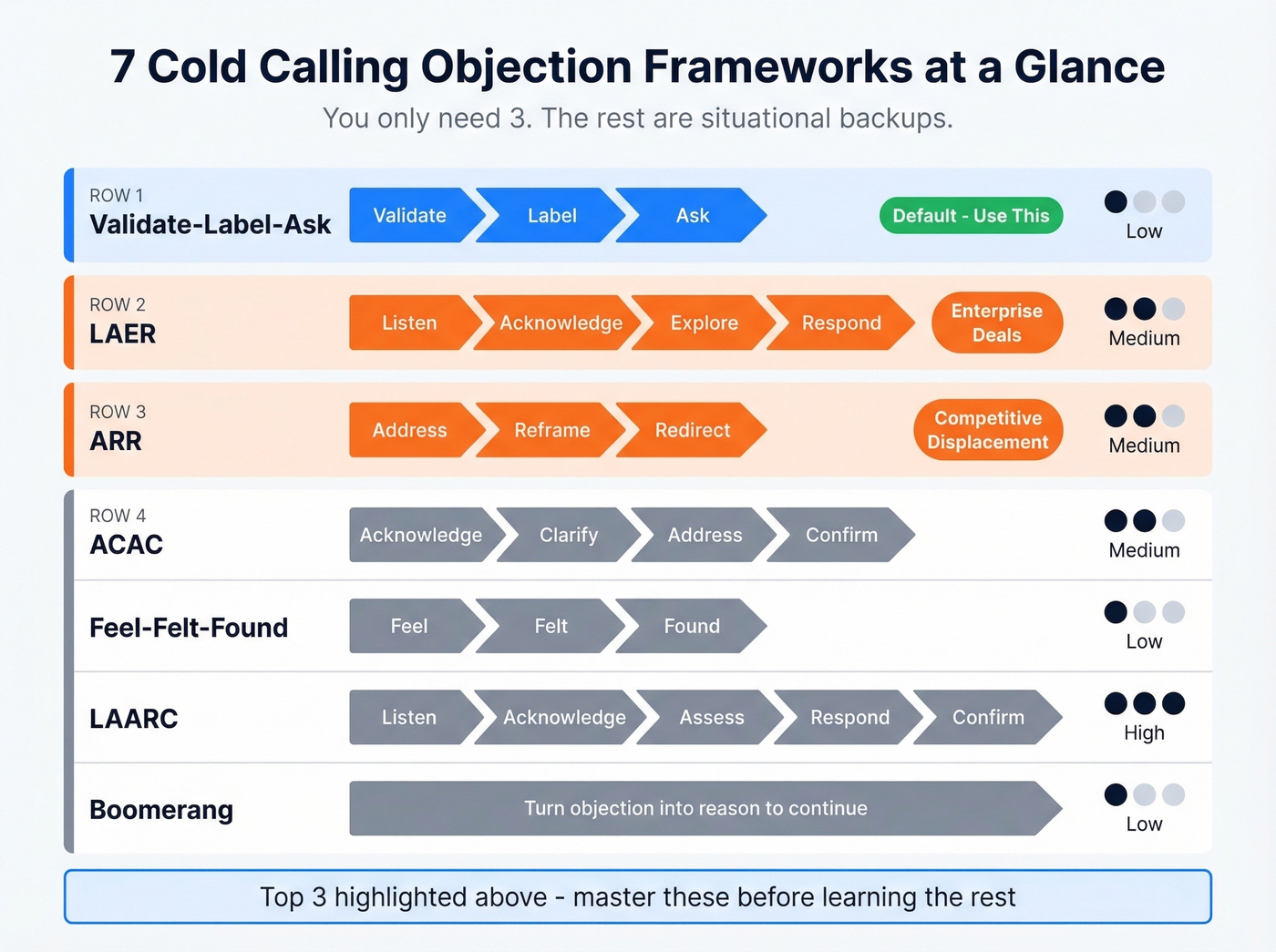
You don't need to memorize all seven. Let's break down the three that actually matter.
Validate → Label → Ask
This is the framework built from large-scale cold call analysis, and it's the one you should default to.
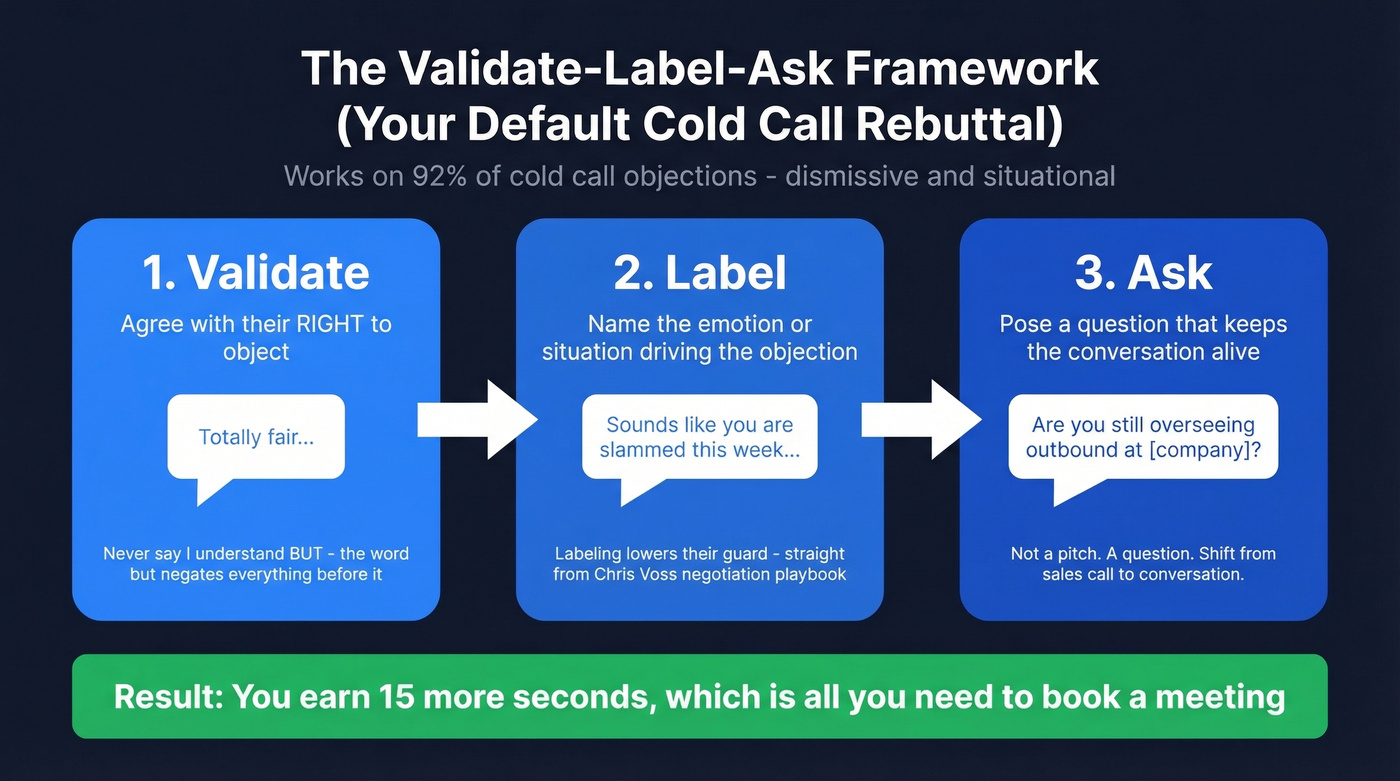
Validate - agree with the prospect's right to object. Not with the objection itself, but with the emotion behind it. "Totally fair" works. "I understand, but..." doesn't - the word "but" negates everything before it.
Label - name the emotion or situation driving the objection. "Sounds like you're slammed this week." Labeling does something counterintuitive: it makes the prospect feel heard, which lowers their guard. This is straight out of Chris Voss's negotiation playbook, and it works just as well on cold calls as it does in hostage situations.
Ask - pose a secondary question that keeps the conversation alive. Not a pitch. A question. This shifts the dynamic from "sales call I need to escape" to "conversation I might learn something from."
When you do move toward a close, use an Interest CTA rather than jumping straight to a calendar link. Research shows "Does it make sense for me to give you more detail on how this works?" outperforms both open-ended and specific meeting CTAs on cold calls.
"Totally fair - sounds like I caught you in the middle of something. Quick question before I go: are you still the one overseeing outbound at [company], or has that shifted?"
LAER - Listen, Acknowledge, Explore, Respond
LAER, developed by Carew International, is built for objections that have layers. When a VP of Finance says "we don't have budget for this," there's usually a story underneath - a failed implementation last year, a competing initiative that ate the budget, a CFO who's frozen all new vendor spend. LAER uncovers that story. The best reps excel at sharing a brief, relevant customer example during the Respond step that mirrors the prospect's situation and makes the solution feel tangible rather than theoretical.
Listen - actually listen. Don't plan your rebuttal while they're talking.
Acknowledge - reflect back what you heard without spinning it.
Explore - ask open-ended questions to dig into the real blocker.
Respond - only after you understand the full picture, address the actual concern, not the surface objection.
"That makes sense - budgets are tight everywhere right now. Is this a timing issue where budget opens up next quarter, or more that this category isn't a priority? I ask because a lot of teams we work with pulled from [adjacent budget line] when they saw the ROI math."
ARR - Address, Reframe, Redirect
ARR comes from the competitive intelligence world and it's purpose-built for the "we already have a vendor" objection. The key principle: never go negative on the competitor. Instead, reframe around a gap the prospect hasn't considered.
Address - acknowledge their current solution without dismissing it.
Reframe - introduce a dimension they haven't evaluated.
Redirect - steer toward a specific next step.
"Good - [Competitor] is solid for [what they're known for]. Where I hear friction is [specific gap]. Is that something you've run into, or has it been smooth?"

Top-quartile reps hit 13.3% connect rates because they reach the right person. Prospeo gives you 125M+ verified mobile numbers with a 30% pickup rate - 3x higher than ZoomInfo. Stop burning your framework on gatekeepers and wrong numbers.
Every great rebuttal starts with actually reaching the decision-maker.
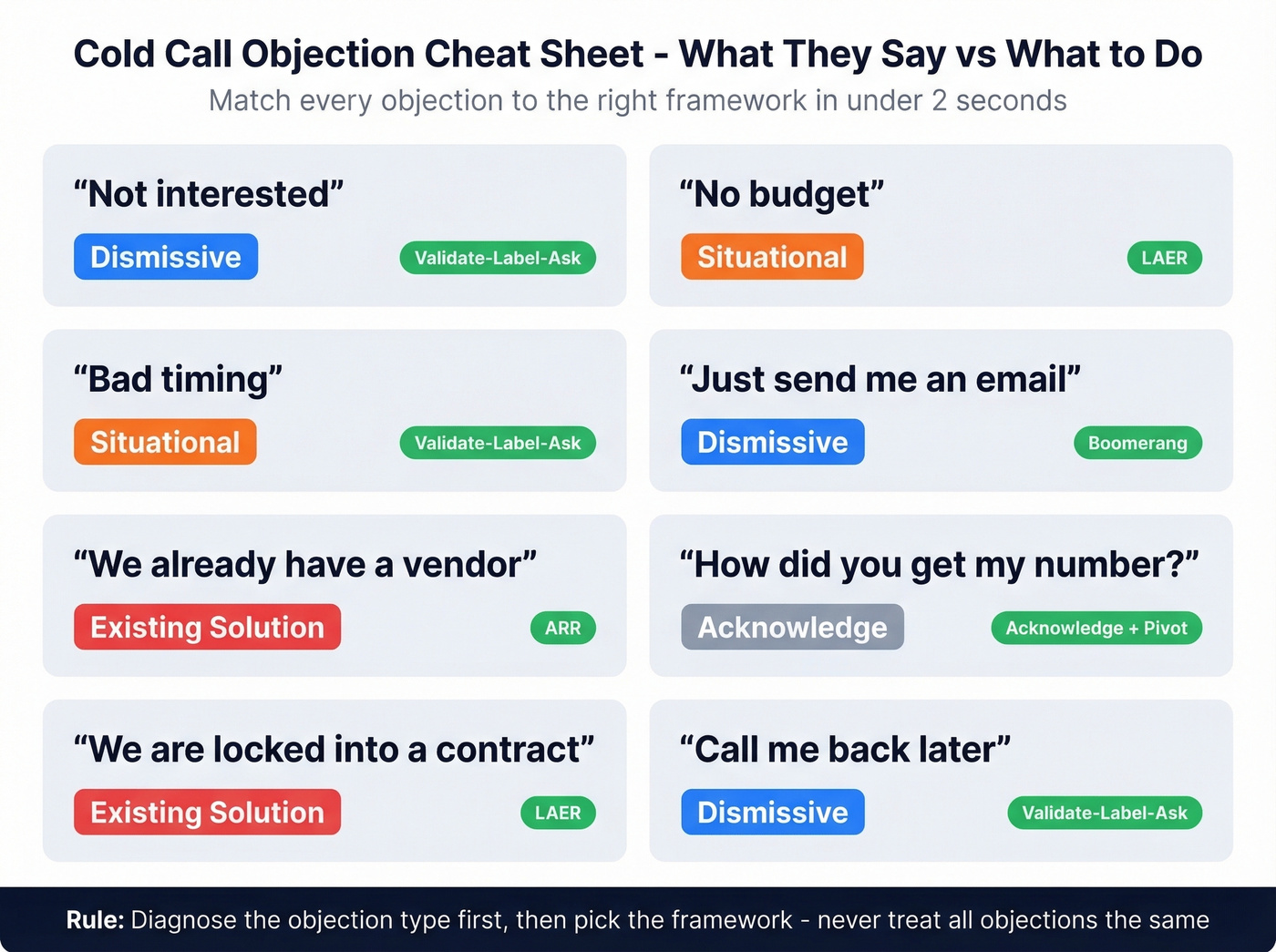
Scripts for the 8 Most Common Objections
"Not Interested"
Dismissive | Validate-Label-Ask
This isn't a real objection. It's a reflex.
"Totally fair - you weren't expecting my call. Quick question before I let you go: is [specific pain point] something your team's dealing with right now, or is that handled?"
"No Budget" / "Bad Timing"
Situational | LAER for budget, Validate-Label-Ask for timing
These two get lumped together because the handling is similar: diagnose whether the constraint is real or a polite exit. Budget objections are sometimes genuine and sometimes a way of saying "I don't see enough value to fight for budget." Your job is to figure out which.
For budget:
"Makes total sense. Is this 'budgets are frozen across the board,' or more that you haven't seen a strong enough case for this category? We've helped teams like [similar company] pull from their [adjacent budget] line when the payback was under 90 days."
For timing:
"Totally get it - sounds like you're in the thick of it. When does the dust settle? I'll put 15 minutes on the calendar for [specific date] so you don't have to think about it."
"Just Send Me an Email"
Dismissive | Boomerang
This is the polite version of "go away." Here's what NOT to say: "Sure, what's your email?" That kills the call. Turn the request into a reason to keep talking for 15 more seconds.
"Happy to - I want to make sure I send you something relevant, though. Are you more focused on [pain A] or [pain B] right now? That way I don't waste your inbox."
"We Already Have a Vendor"
Existing Solution | ARR
"Good - who are you using? [Listen]. They're solid for [strength]. The reason I'm calling is that a lot of teams using [Competitor] tell us [specific gap] is a blind spot. Has that come up for you?"
"How Did You Get My Number?"
Acknowledge + Pivot
Don't dodge this one. Transparency wins.
"Fair question - we use a B2B contact database to find direct lines for [their role] at companies like yours. I'm reaching out because [one-sentence reason]. Does [specific pain] resonate at all?"
This objection is often preventable. If your data source is stale, you're dialing numbers that belong to someone who left the company two years ago. Verify numbers before dialing - stale data creates objections no framework can fix.
"We're Locked Into a Contract"
Existing Solution | LAER
"Understood - when does that come up for renewal? [Listen]. What I'd suggest is a quick 15-minute call about [specific value] a month before renewal so you have a comparison ready. Would [specific month] work?"
"Call Me Back Later"
Dismissive | Validate-Label-Ask
"Call me back later" is "not interested" wearing a friendlier mask. Pin down a specific time or it's a dead lead.
"Absolutely - when's better, Thursday morning or Friday afternoon? I'll keep it to 5 minutes."
Prevent Objections Before They Happen
The best cold calling objection framework is making objections less likely in the first place. This is preemptive strike objection handling: you address the most likely concern before the prospect raises it, removing the friction that triggers a reflexive "not interested."
Openers That Kill Objections
Phrase-level data from 300M+ calls is striking. Saying "the reason for my call is..." makes you 2.1x more likely to book a meeting - it immediately signals you're not wasting their time and preemptively neutralizes the "why are you calling me?" objection. Adding "How've you been?" increases your odds 6.6x because it pattern-interrupts the prospect out of "sales call" mode.
On the flip side, "Did I catch you at a bad time?" makes you 40% less likely to book, with calls using it showing a 0.9% success rate. Kill that phrase from your vocabulary today.
Even when you don't connect, leave a voicemail. Cold calling nearly doubles email reply rates - 3.44% vs 1.81% without a prior call. The voicemail primes the prospect to open your follow-up email.
The Right Number of Attempts
Cognism's cold calling report puts the optimal number at three - that captures 93% of all conversations. Five attempts gets you to 98.6%. The reps who call the same prospect eight times aren't persistent; they're inefficient.
Bad Data Creates Unwinnable Objections

We've seen this across dozens of teams we work with: they invest in frameworks, coaching, and call recording - then feed their reps a list full of wrong numbers. Every wrong number is a wasted dial. Every call to someone who left six months ago generates a "how did you get my number?" objection no framework can save.
Prospeo refreshes every record on a 7-day cycle, where the industry average is six weeks. With 125M+ verified mobile numbers and a 30% pickup rate, you're dialing numbers that actually connect to the right person. Fewer wrong numbers means fewer preventable objections and more conversations where your framework actually matters.
If you're cleaning lists before outreach, start with data enrichment so reps aren’t dialing stale records.
You just learned the framework. Now you need the dials. Prospeo's 300M+ profiles with 30+ filters - including job change signals and buyer intent - let you build lists of prospects who are already primed to say yes. At $0.01 per email, bad data stops being the reason your rebuttals never get used.
Book 26% more meetings with data that connects you to real buyers.
6 Mistakes That Make Objections Worse
- Giving up after the first objection. Expect more than one objection before you earn real attention.
- Pitching before earning the right to. Lead with context and a question, not a feature list.
- Reading scripts verbatim. Use scripts as structure, not dialogue - if you sound like you're reading, the prospect hears "I don't care about your situation."
- Mistaking politeness for interest. When a prospect says "that's interesting," ask "what specifically stood out?" Politeness without specifics is a soft no.
- Treating all objections the same. Use the objection wheel to quickly categorize what you're hearing - a dismissive reflex and a genuine budget constraint require completely different responses.
- Talking more than listening. Ask better questions and give the prospect room to answer.
AI Tools for Real-Time Coaching
Only 22% of reps receive regular coaching, and 60% of teams lack formal programs entirely. AI tools fill that gap - not as replacements for skill, but as accelerants for reps who already know the basics.
Dialpad offers Real-Time Assist cards that surface battlecards mid-call based on keywords. When a prospect says "we're using [Competitor]," the relevant competitive positioning appears on screen. Pricing typically runs ~$80-150/user/month depending on tier. If you’re evaluating options, compare Dialpad alternatives before you commit.
Gong is the conversation intelligence standard. It won't help you in the moment, but post-call analysis shows exactly where you lost deals and which objection responses correlate with booked meetings. Expect ~$1,360-$1,600/user/year plus a platform fee that often runs ~$50,000/year for larger deployments.
Orum is a dialer that practitioners on r/sales consistently recommend. It helps you get to live conversations faster by reducing time spent on voicemails and invalid numbers, so you spend more time actually talking. Pricing typically falls in the $200-400/user/month range.
These tools matter, but they're the last 10%. The first 90% is knowing which objection type you're facing, picking the right framework, and executing it with enough confidence that the prospect stays on the line for 15 more seconds. That's where meetings come from.
Skip Gong if your average deal size is under $10k. You probably don't need that level of conversation intelligence yet. Spend the platform fee on better data and more dials instead - the ROI math doesn't work until you're closing five-figure deals.
FAQ
What's the best cold calling objection framework?
Validate-Label-Ask works for most cold call objections and is backed by analysis of 300M+ calls. It's simple enough to internalize in a single coaching session and flexible enough for both dismissive and situational pushback. Switch to ARR for competitive displacement scenarios.
How do you handle "not interested" on a cold call?
Don't argue. Validate the reflex ("Totally fair"), label the emotion ("Sounds like I caught you in the middle of something"), then ask a secondary question that earns 15 more seconds. "Not interested" is a reflex - the prospect hasn't heard enough to form an actual opinion.
What percentage of cold calls result in a meeting?
Average reps convert 4.82% of conversations into booked meetings. Top-quartile reps hit 16.7% - a 3.6x gap. The difference comes from connect rate, opener quality, and how quickly reps diagnose and respond to objections using a structured framework.
How many times should you call a prospect?
Three attempts captures 93% of all conversations; five gets you to 98.6%. Beyond five, diminishing returns are severe. Spend that time on fresh prospects with verified contact data instead of hammering the same unresponsive number.
Does data quality affect cold call objections?
Absolutely. Stale data causes "wrong person" and "how did you get my number?" objections before you even get to pitch. Weekly data refreshes and verified mobile numbers eliminate an entire category of preventable objections that no rebuttal script can fix.