

Cold Calling Questions That Actually Book Meetings in 2026
You don't need 55 cold calling questions on a laminated cheat sheet. You need 12 great ones, asked in the right order, to the right person. The difference between average reps booking 2 meetings a month and top reps booking 18 comes down to what you say in the first 90 seconds - and whether anyone picks up at all.
The Short Version
Sales teams that ask 11-14 targeted questions per call see a 74% higher success rate than those asking fewer than 7. But cramming in questions doesn't help if the prospect feels interrogated.
Organize your questions across four stages: opener, discovery, qualification, next step. Each stage has a job. The opener earns you 30 more seconds. Discovery uncovers pain. Qualification confirms you're talking to someone who can buy. The close sells the meeting, not the product.
Here's the thing most cold calling advice ignores: the biggest variable isn't your script. It's whether someone actually answers. At a 5.4% average connect rate, over 80% of your dials hit voicemail or dead numbers. Better questions matter. Better data matters more.
The Numbers Behind Cold Call Success
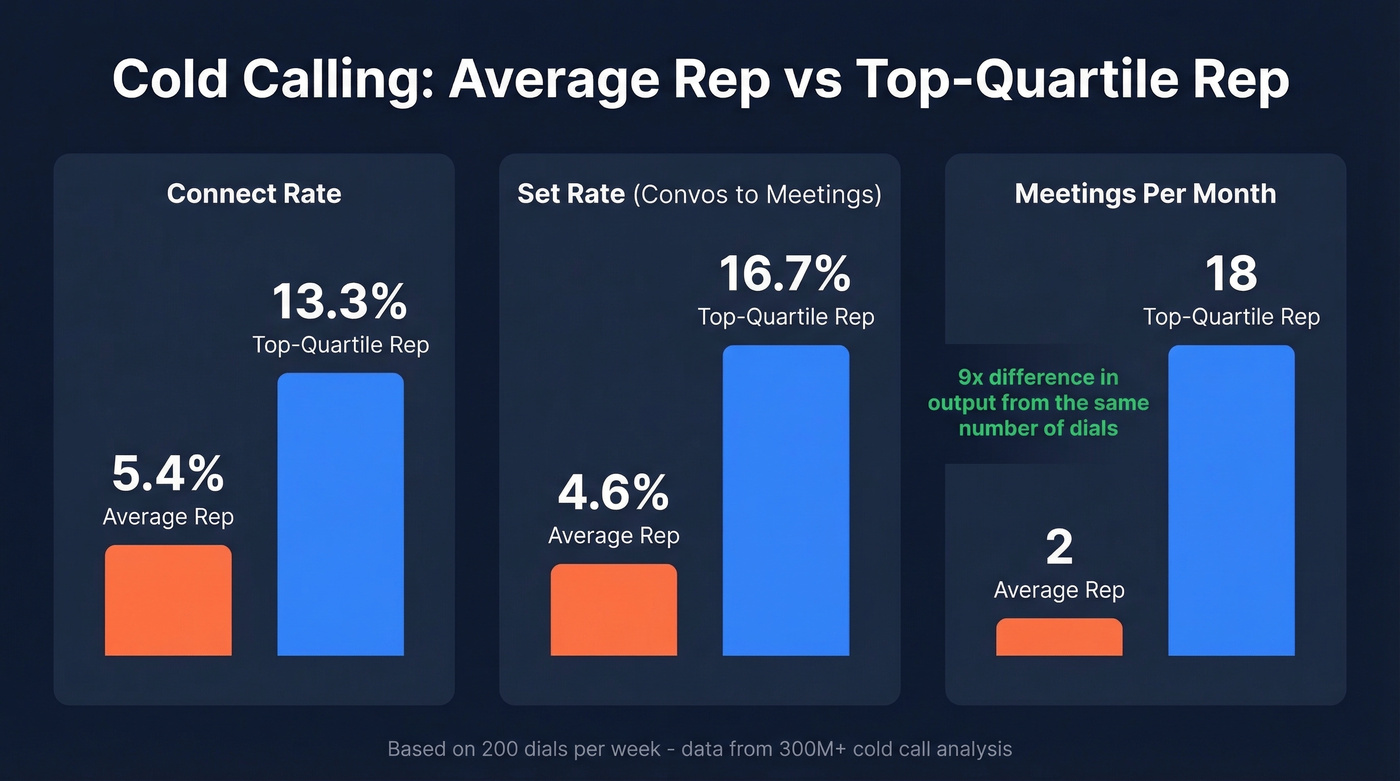
An analysis of 300M+ cold calls gives us the clearest picture of what separates average from elite performance.
| Metric | Average Rep | Top-Quartile Rep |
|---|---|---|
| Connect rate | 5.4% | 13.3% |
| Set rate (convos to meetings) | 4.6% | 16.7% |
| Meetings/month (200 dials/wk) | ~2 | ~18 |
That's a 9x difference in output from the same number of dials. The top quartile isn't working harder - they're connecting more often and converting those conversations at 3x the rate.
Cold calling also nearly doubles email reply rates even when you don't get a live connect (3.44% vs 1.81%). The voicemail still does work. Per RAIN Group research, 82% of buyers will take a meeting from a cold call if the caller demonstrates value and relevance.
The 4-Stage Question Flow
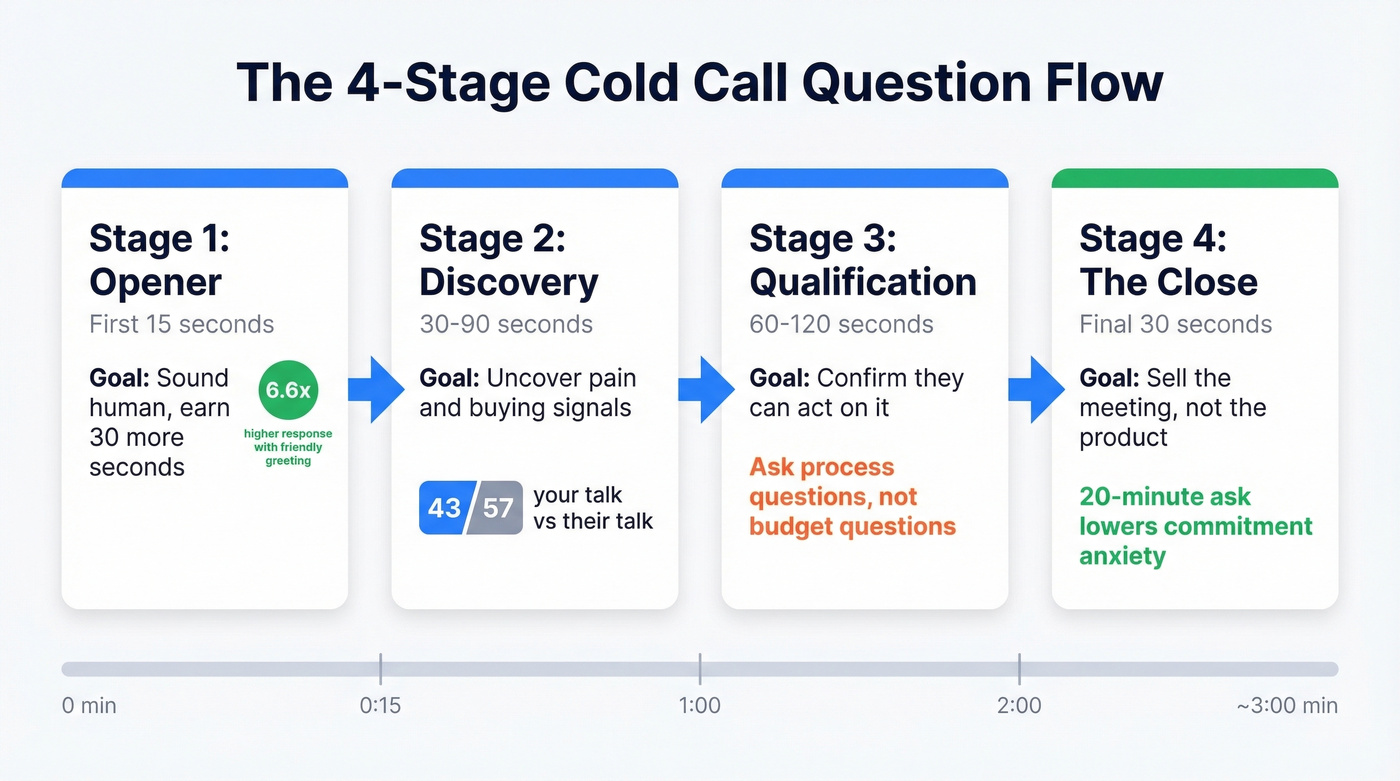
Every productive cold call follows the same arc. You earn attention, uncover a problem, confirm the prospect can act on it, and lock down next steps. Knowing the right questions at each stage is what separates scripted reps from consultative sellers.
Call timing matters too. Tuesday between 10 and 11 AM consistently outperforms other windows.
Stage 1: Openers (First 15 Seconds)
An analysis of 90,000 cold calls found that reps who opened with a friendly greeting had a 6.6x higher response rate than those who led with a pitch. "How have you been?" was the top-performing opener. Separately, Gong data shows that opening with one specific question can drive a 10.01% success rate vs a 1.5% baseline.
The goal here isn't to qualify. It's to sound human and earn 30 more seconds.
"Hey [Name], it's [Your Name] at [Company] - how've you been?" This mirrors how people talk to someone they already know. It disarms the "sales call" reflex before it kicks in.
"I know you weren't expecting my call, so I'll be brief." A pattern interrupt that acknowledges reality. It pre-frames a short conversation, which lowers resistance.
"Quick question before I take up any more of your time - are you still heading up [function] at [company]?" This confirms you've done research and gives them an easy, non-committal first response. People who answer one question are more likely to keep talking.
Stage 2: Discovery (30-90 Seconds)
This is where the call is won or lost. Open-ended questions starting with who, what, and how get prospects talking. Your target: a 43/57 talk-to-listen ratio - you talk 43%, they talk 57%. The biggest tell of a struggling rep isn't the ratio itself but the swing. Low performers' talk time jumps from 54% on won deals to 64% on lost ones. Consistency matters more than perfection.
"How are you currently handling [specific process your product addresses]?" Listen for frustration, workarounds, or manual steps. Those are buying signals. If they describe a smooth process, you're probably not talking to a buyer.
"What happens if you do nothing to fix this?" One of the best discovery questions in B2B sales. It forces the prospect to articulate the cost of inaction - which is your real competitor, not another vendor.
"What have you tried before? What didn't work?" Past failures reveal buying criteria. If they tried a competitor and churned over data quality or implementation headaches, you now know exactly what to position against.
"How is this affecting you personally?" This shifts from organizational pain to individual pain. When a VP of Sales says "my team is frustrated" that's useful, but when they say "I'm spending my weekends fixing pipeline reports" - that's urgency.
"Who else on your team feels the impact of this?" Plants the multi-threading seed early. An analysis of 1.8M opportunities shows closed-won deals have roughly 2x as many buyer contacts as closed-lost. For deals over $50K, multi-threading boosts win rates by 130%.
Stage 3: Qualification (60-120 Seconds)
Most reps blow this stage. They ask "Do you have budget?" and the prospect shuts down. Budget questions need to be reframed as process questions.
"What was the approval process for your last major technology investment?" This tells you how they buy without triggering the "I don't have budget" reflex. You learn about procurement timelines, stakeholders, and deal velocity all at once - it's three questions disguised as one.
"Beyond the official approval process, whose opinion carries weight?" Authority mapping disguised as curiosity. This question reduces late-stage deal collapses by 35% because it surfaces hidden blockers before they kill your deal in week six.
"When you say 'interesting,' what specifically stood out?" A qualifying question disguised as a follow-up. Prospects who are being polite but aren't interested will struggle to answer. Prospects with genuine intent will get specific. It separates tire-kickers from buyers in one sentence.
"Is this something you're actively exploring, or more of a general interest?" Direct but not aggressive. It gives the prospect permission to self-qualify out, which saves everyone time.
Stage 4: The Close (Final 30 Seconds)
Sell the meeting, not the product. Your only job in the last 30 seconds is to get a calendar invite accepted.
"Can we block 20 minutes Thursday to walk through how we've solved this for [similar company]?" Time-boxing the ask to 20 minutes lowers commitment anxiety. Naming a specific day forces a yes/no instead of a vague "let's circle back."
"What would need to be true for this to be worth exploring further?" The most elegant closing question in cold calling. It lets the prospect define their own buying criteria, which you can then mirror back in the follow-up email.
"What's your timeline for making a change here?" If they have one, you've got urgency. If they don't, you know to nurture rather than push.
Questions That Kill Deals
Some questions actively sabotage your call. We've heard all of these on recorded calls, and they make us cringe every time.
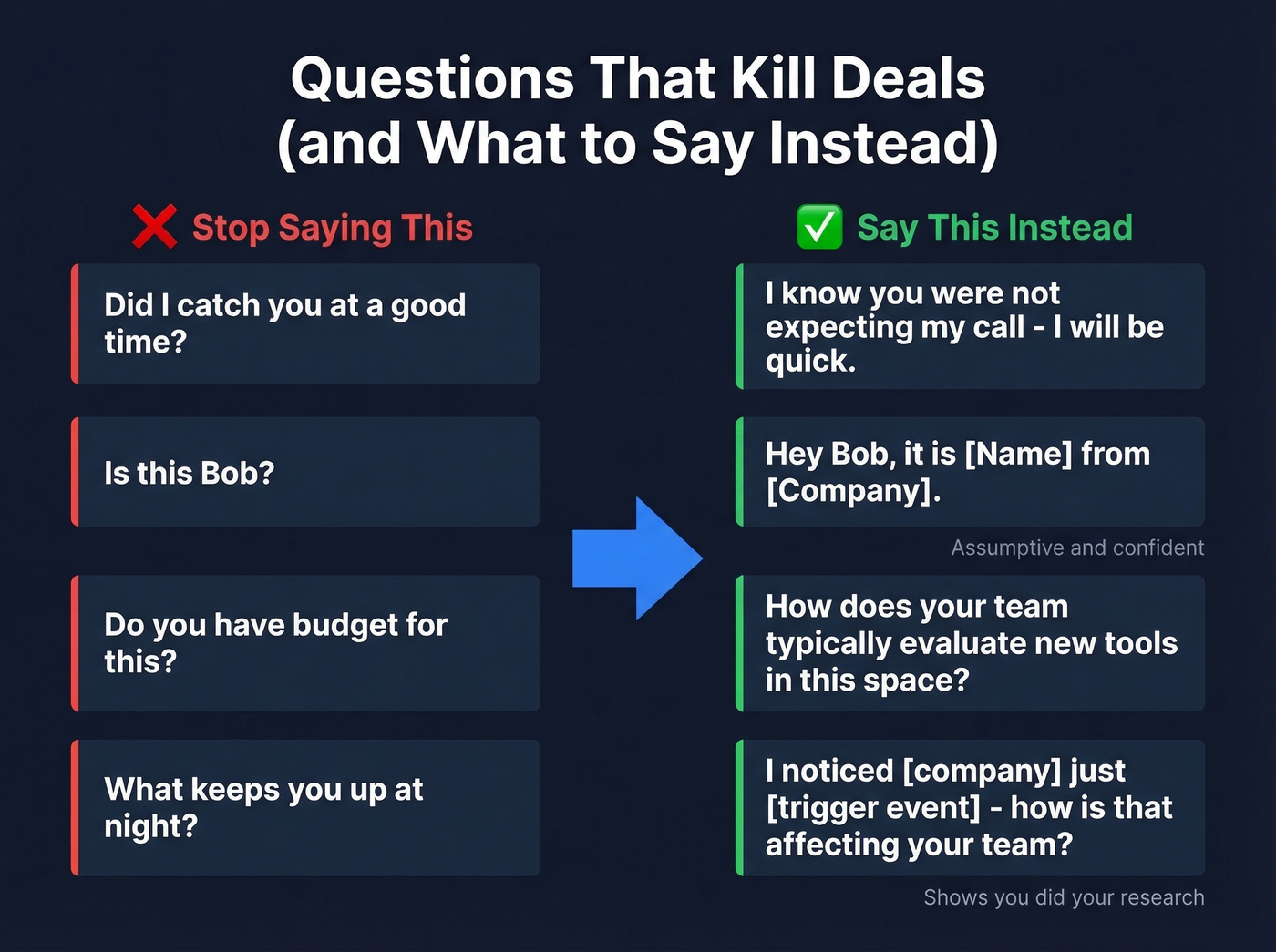
"Did I catch you at a good time?" gives the prospect a free exit. Say instead: "I know you weren't expecting my call - I'll be quick."
"Is this Bob?" triggers immediate defensiveness. Say instead: "Hey Bob, it's [Name] from [Company]." Assumptive and confident.
"Do you have budget for this?" feels like an interrogation. Say instead: "How does your team typically evaluate new tools in this space?"
"What keeps you up at night?" is too vague, too cliche, and signals you did zero research. Say instead: "I noticed [company] just [specific trigger event] - how's that affecting your team?"

At a 5.4% average connect rate, most of your dials never reach a human. Prospeo's 125M+ verified mobile numbers deliver a 30% pickup rate - that's 3x the industry average. Stop perfecting your script for voicemail boxes.
Triple your connect rate before you ask a single question.
Objection-Handling Pivots
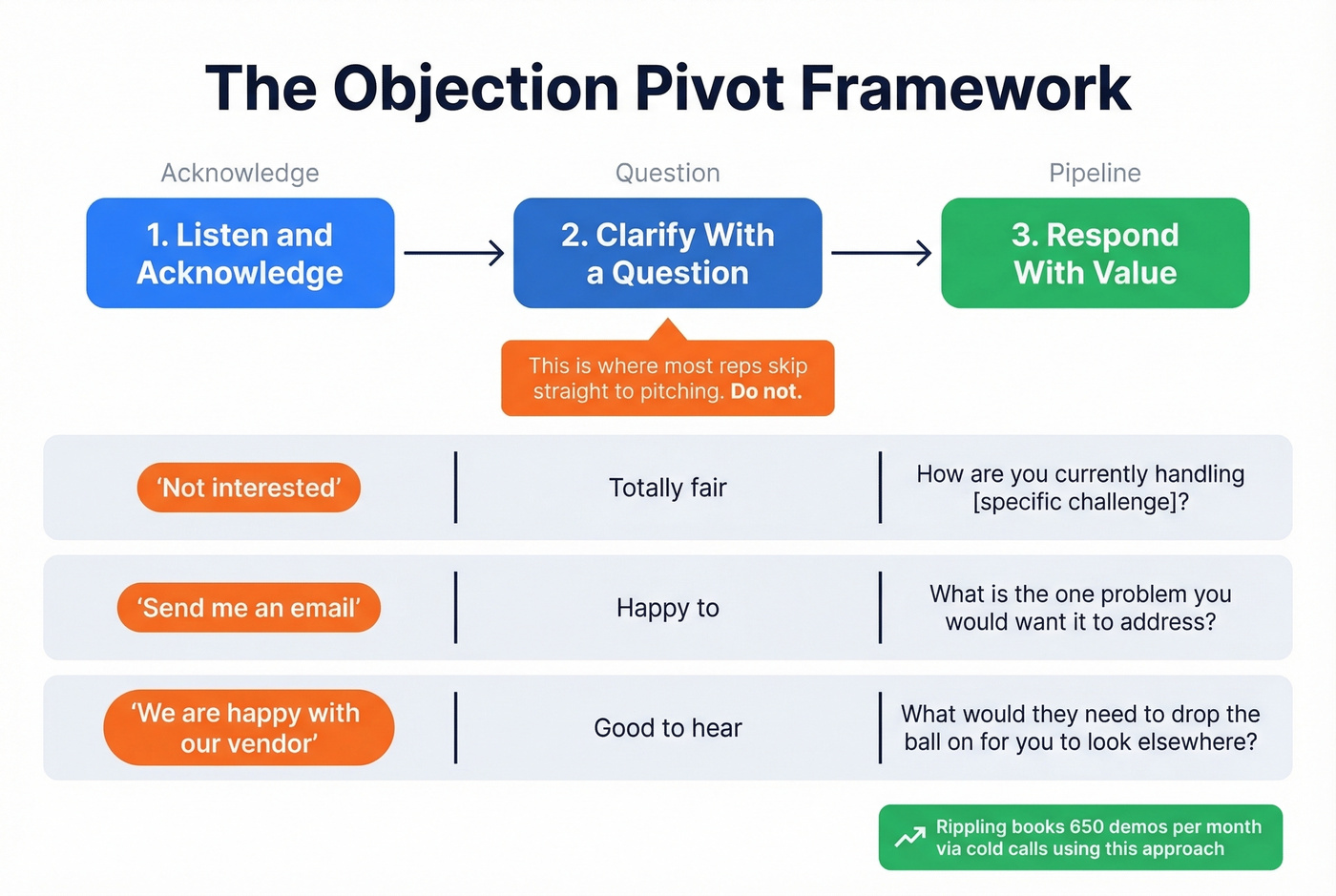
About 60% of cold calls hit the "not interested" objection, so having practiced pivots isn't optional - it's the baseline. The framework that works: listen and acknowledge, clarify with a question, respond with value. The question in step two is where most reps skip straight to pitching. Don't.
| When They Say... | Ask This Instead |
|---|---|
| "Not interested." | "Totally fair. Out of curiosity, how are you currently handling [specific challenge]?" |
| "Send me an email." | "Happy to. So I send the right thing - what's the one problem you'd want it to address?" |
| "I'm busy right now." | "Respect that. Would 2 minutes Tuesday morning work better, or should I try Thursday?" |
| "We're happy with our current vendor." | "Good to hear. What would they need to drop the ball on for you to look elsewhere?" |
| "I'm not the decision maker." | "Makes sense. Who should I be talking to, and would you be open to a warm intro?" |
These aren't tricks. They're genuine follow-up questions that keep the conversation alive instead of letting it die at the first objection. Rippling's SDR team books 650 demos per month via cold calls - roughly 50% of their outbound meetings. They don't hang up at the first objection. They ask better follow-ups.
Picking a Framework
Modern buying committees have expanded from 3-5 stakeholders to 8-12, and buyers complete roughly 80% of their research before talking to sales. Your qualifying questions need to cut through faster than ever.
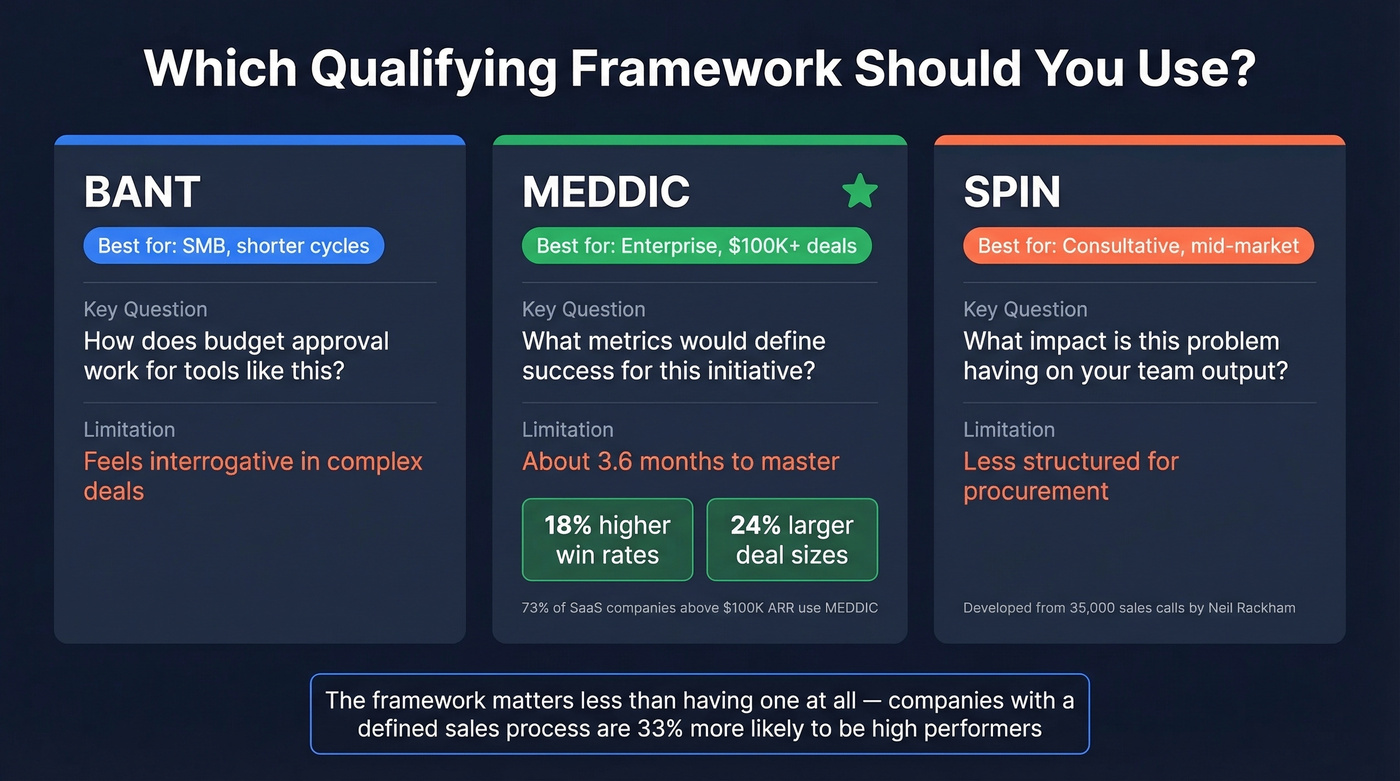
| Framework | Best For | Question Example | Limitation |
|---|---|---|---|
| BANT | SMB, shorter cycles | "How does budget approval work for tools like this?" | Feels interrogative in complex deals |
| MEDDIC | Enterprise, $100K+ deals | "What metrics would define success for this initiative?" | ~3.6 months to master |
| SPIN | Consultative, mid-market | "What impact is this problem having on your team's output?" | Less structured for procurement |
73% of SaaS companies selling above $100K ARR use some version of MEDDIC, and for good reason. Full adoption yields 18% higher win rates and 24% larger deal sizes. SPIN was developed from 35,000 sales calls by Neil Rackham and remains the gold standard for consultative discovery. NEAT Selling (Need, Economic Impact, Access to Authority, Timeline) is gaining traction with teams selling to research-savvy buyers.
Let's be honest: the framework matters less than having one at all. Companies with a defined sales process are 33% more likely to be high performers. I've watched teams agonize over BANT vs. MEDDIC for months while their competitors - using any framework consistently - ate their pipeline. Pick one, train on it, adapt the questions to your call flow.
Before You Dial
Your questions only matter if someone picks up. At a 5.4% connect rate, average reps dial 19 times for every conversation. That means over 80% of your call block is wasted on voicemails, wrong numbers, and switchboard dead ends.
Do these five things before every call block:
Research each prospect for 5 minutes. Recent funding, job changes, company news. One relevant detail in your opener separates you from every other cold caller that day. The consensus on r/sales is that even 2-3 minutes of pre-call research dramatically changes the tone of the conversation.
Verify your contact data. Stale numbers and generic office lines destroy connect rates. You need verified direct dials, not switchboard numbers from a database that refreshed six weeks ago. Prospeo's Mobile Finder covers 125M+ verified numbers with a 30% pickup rate, refreshed every 7 days - worth testing with the free tier before your next call block.
Prep your Stage 2 questions. Know which discovery questions map to this prospect's likely pain points before you dial. Skip this if you're doing high-volume dials to a single persona - in that case, one discovery track is enough.
Time your calls right. Tuesday between 10 and 11 AM consistently outperforms other windows.
Pair calls with email. A pre-call email lifts cold call reply rates from 1.81% to 3.44%. Send it the morning of your call block. If you need copy, keep a few sales follow-up templates ready so you can move fast.
Multi-threading boosts win rates by 130%, but only if you have direct contact data for every stakeholder. Prospeo gives you 98% accurate emails and verified direct dials across entire buying committees - refreshed every 7 days.
Reach every decision-maker on the deal, not just the one who picked up.
Cold Calling Questions FAQ
How many questions should I ask on a cold call?
Aim for 11-14 targeted questions across the four call stages. This range produces a 74% higher success rate than asking fewer than 7. Spread them naturally - front-load discovery, keep the close tight.
What's the best opening question?
A friendly, human greeting outperforms pitch-first openers by 6.6x across 90,000 analyzed calls. "How have you been?" tops the list. Sound like a person, not a script, and you'll earn 30 more seconds every time.
How do I handle "I'm not interested"?
Don't argue. Acknowledge and pivot: "Totally fair - how are you currently handling [specific challenge]?" About 60% of cold calls hit this objection, so a practiced pivot is non-negotiable. The reps who book meetings treat objections as discovery opportunities.
How do I get prospects to actually pick up?
Use verified mobile numbers instead of switchboard lines, call Tuesday around 10-11 AM, and send a pre-call email the same morning. Weekly-refreshed mobile data delivers a 30% pickup rate compared to 12-13% from databases updating every 4-6 weeks. That difference alone can triple your conversations per call block.