

Best Cold Calling Software in 2026 (12 Tools Compared)
400 dials. 12 conversations. Zero meetings booked. Your VP of Sales blames the reps. The reps blame the list. They're both half right - but the list is the bigger problem.
B2B contact data decays roughly 22.5% per year, and 80% of cold calls go to voicemail even when the number is correct. The average SDR makes just 33 cold calls per day and needs 209 dials to book a single appointment, per Bridge Group research. Your cold calling software is only as good as the numbers you're dialing, and most teams get that equation backwards - spending $150+/user/month on a parallel dialer while feeding it stale data.
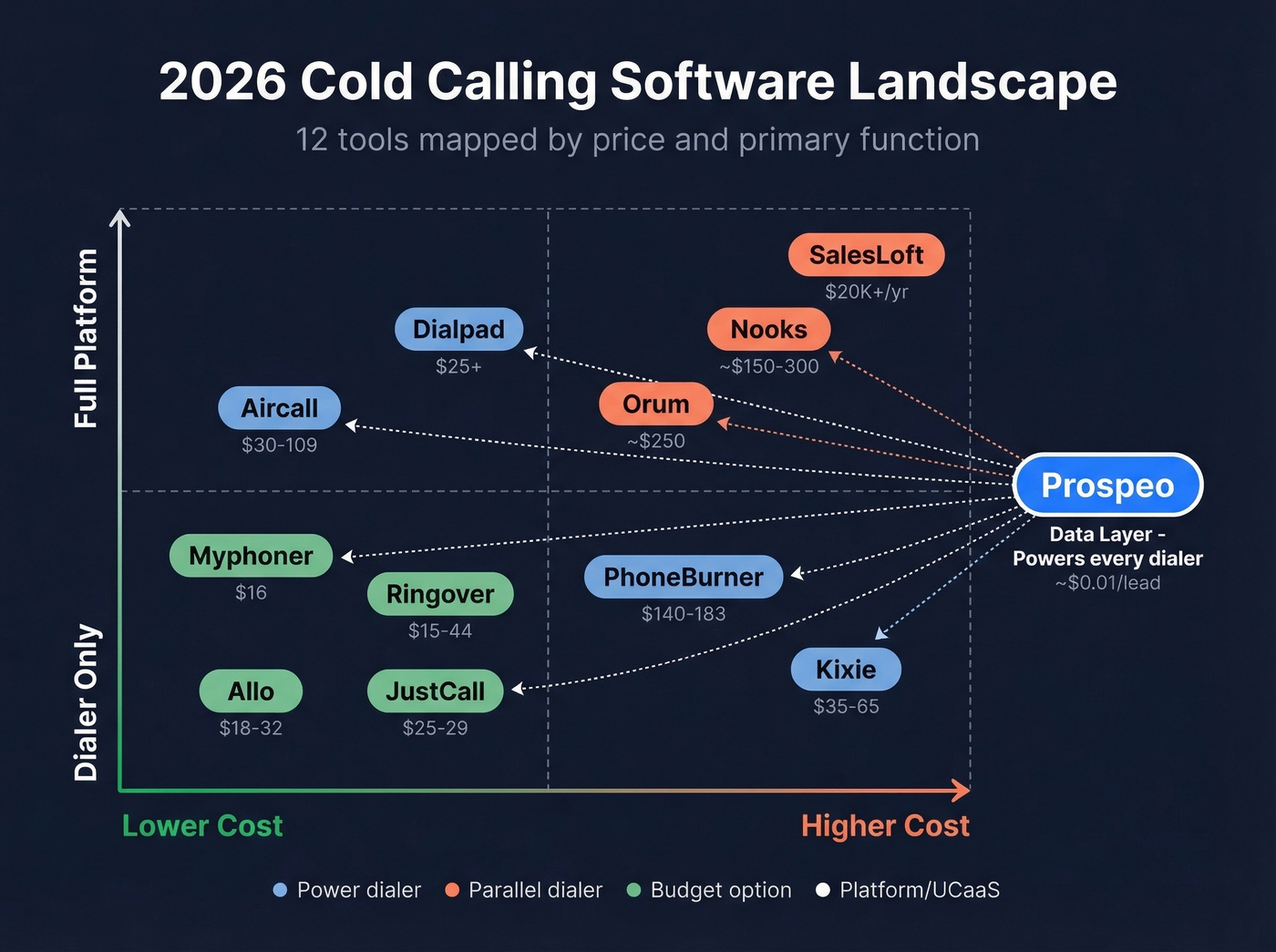
We looked at Gong, RingCentral, and Nextiva but left them out. They're call analytics or UCaaS platforms, not dedicated outbound dialing tools. The 12 tools below are the ones that actually move the needle for outbound teams.
Our Picks
| Category | Tool | Why |
|---|---|---|
| Best for contact data | Prospeo | 125M+ verified mobiles, 30% pickup rate, ~$0.01/lead |
| Best mid-market dialer | Kixie | Unlimited US/Canada, up to 10 lines, ~$35-65/user/mo |
| Best parallel dialer | Orum | 5-10 simultaneous lines, AI summaries, built for volume |
| Best budget option | Myphoner | $16/seat/mo - dead simple, gets the job done |
| Most underrated | Nooks | 4.8/5 on G2 with 1,167 reviews, missing from every competing guide |
What to Look For in Cold Calling Tools
Cold call software isn't one tool - it's a stack: a data source for verified numbers, a dialer for making calls, and optionally a recording/analytics layer for coaching. Get the stack wrong and no single tool saves you. (If you want the full stack blueprint, start with a cold calling system.)
Power vs. Parallel vs. Predictive
A power dialer calls one number at a time, automatically advancing to the next when a call ends. It's the right choice for most teams - predictable, compliant, easy to manage.
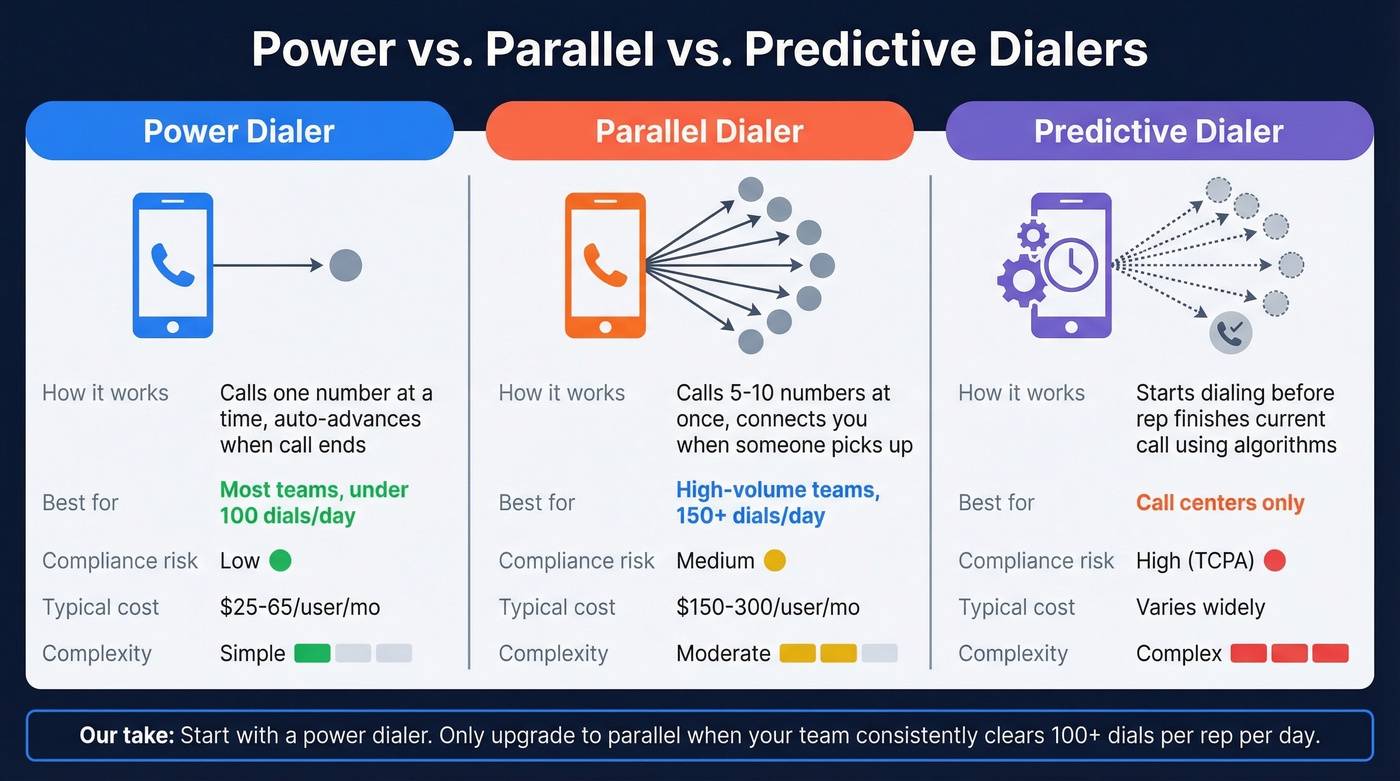
A parallel dialer calls 5-10 numbers simultaneously and connects you only when someone picks up. Much faster, much more expensive, and it only makes sense at high volume. If your team isn't clearing 100+ dials per rep per day, you're overpaying.
Predictive dialers use algorithms to start dialing before a rep finishes their current call, estimating when they'll be free. They're mostly used in call centers and carry higher compliance risk under TCPA rules.
The Efficiency Gap
The difference between manual dialing and a proper outbound tool isn't marginal. Manual reps spend 8-12 seconds dialing each number, 30 seconds leaving voicemails, and 45 seconds logging calls. That adds up to roughly 11 minutes of actual talk-time per hour. With a power dialer handling auto-advance, one-click voicemail drops, and CRM auto-sync, that jumps to 26 minutes. You're more than doubling productive time without adding headcount.
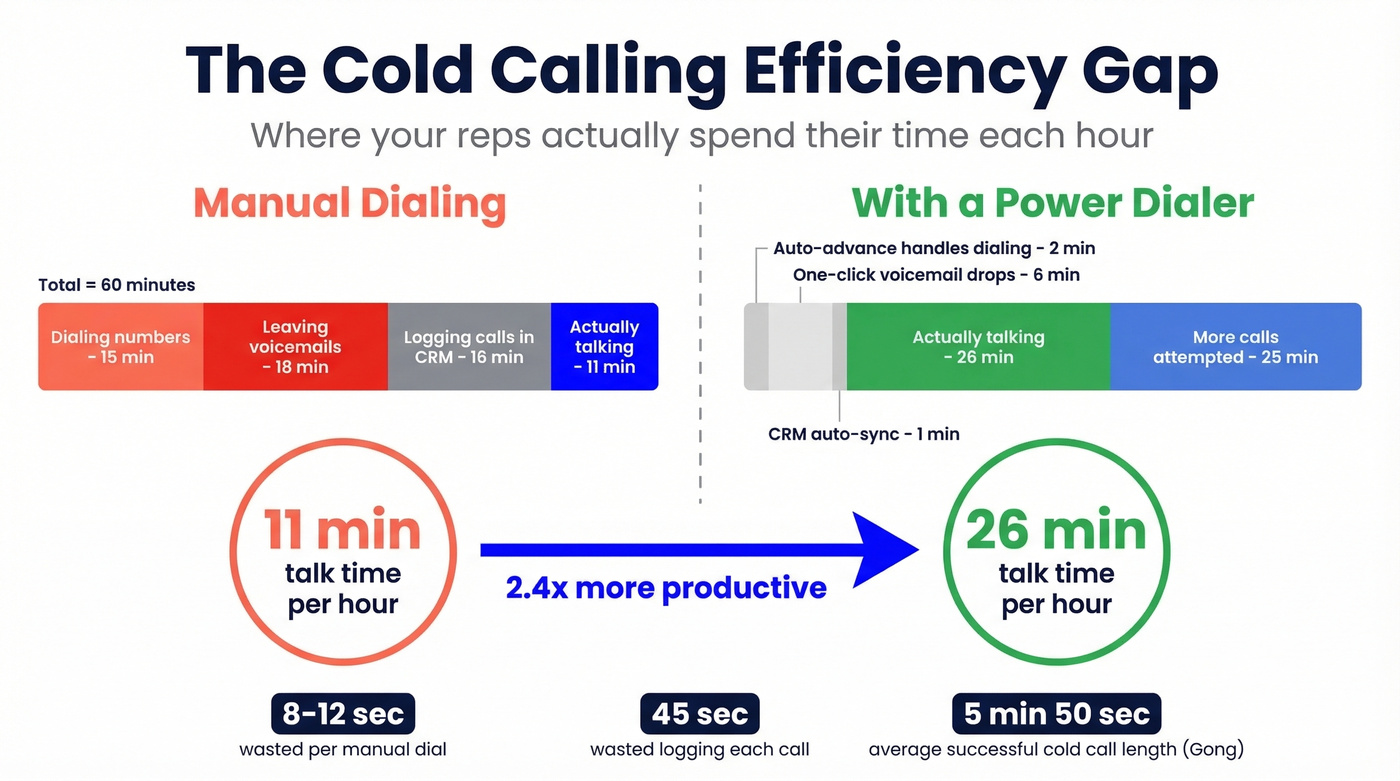
Here's a stat worth pinning to your wall: Gong's research shows successful cold calls average 5 minutes 50 seconds, while failed calls average 3 minutes 14 seconds. In our experience, the teams that win aren't dialing faster - they're spending more time on the calls that matter because their dialing tool handles everything else.
Must-Have Features
CRM integration isn't optional. Manual call logging wastes ~45 seconds per call and guarantees incomplete records. Local presence dialing, where the prospect sees a local area code, boosts pickup rates 15-40% depending on the market. Beyond that, look for call recording, voicemail drop, real-time analytics, and STIR/SHAKEN compliance. DNC list scrubbing is table stakes in 2026's regulatory environment.
The 12 Best Cold Calling Software Tools
Prospeo - Best for Verified Contact Data
Prospeo isn't a dialer. It's the data layer that makes every dialer on this list actually work. The platform covers 300M+ professional profiles with 125M+ verified mobile numbers and 143M+ verified emails at 98% accuracy - and those mobiles hit a 30% pickup rate across all regions. (If you're comparing data vendors, see our breakdown of data enrichment services.)
The 7-day data refresh cycle is the real differentiator. Most providers refresh around 6 weeks, which means you're always dialing some percentage of dead numbers. Prospeo's proprietary verification runs a five-step process with catch-all handling, spam-trap removal, and honeypot filtering to keep your lists clean. Layer in intent data tracking 15,000 topics via Bombora to prioritize prospects actively researching solutions like yours.
The Chrome extension (40,000+ users) pulls verified contacts from company websites, web sources, and CRMs, and native integrations with Salesforce, HubSpot, Smartlead, and Instantly mean data flows directly into your existing stack. Meritt tripled their pipeline from $100K to $300K/week after switching. Snyk cut bounce rates from 35-40% to under 5% across 50 AEs. Pricing starts free (75 emails + 100 Chrome extension credits/month), with paid plans running about $0.01 per lead. No contracts, no sales calls required.
Kixie - Best Mid-Market Power Dialer
Kixie hits the sweet spot for teams of 5-20 reps who need a strong dialer without enterprise pricing or complexity. The Multi-Line PowerDialer handles up to 10 lines simultaneously with unlimited US/Canada minutes included across plans.
ConnectionBoost handles local presence, Conversation Intelligence powers call coaching, and DNC compliance is built in. The AI Human Voice Detection add-on (+$30/month) filters out voicemails before connecting reps, which saves real time at scale. Pricing runs ~$35-65/user/month depending on tier.
The tradeoff? Kixie doesn't try to be a full sales engagement platform. There's no email sequencing or cadence management built in. That's fine - pair it with your existing sequencer and a clean data source, and it does exactly what a dialing tool should do. (For more stack ideas, see SDR tools.)
Orum - Best for High-Volume Teams
Orum dials 5-10 numbers simultaneously and connects reps only when a human picks up. The AI call summaries are genuinely good - Capterra reviews praise their accuracy. G2 rates it 4.6/5 across 781 reviews.
Use this if your reps make 100+ dials per day and you need to maximize conversations per hour. The parallel dialer math is simple: at 50 dials/day, you're overpaying. At 150+, Orum pays for itself in connect rate gains alone.
Skip this if you're a team under 5 reps or your daily dial volume is moderate. At around $250/user/month with an annual contract and a 3-seat minimum, you're looking at $9,000/year minimum commitment. That's serious money for a startup. Capterra reviewers note the UI takes some getting used to, but pickup rates consistently beat other dialers.

Nooks - Most Underrated AI Dialer
The fact that Nooks doesn't appear in a single competing "best cold calling software" guide despite holding a 4.8/5 rating with 1,167 reviews on G2 tells you how lazy most listicles are.
Nooks combines parallel dialing with AI-powered coaching and a virtual sales floor that lets remote SDR teams feel like they're sitting together. G2 reviewers flag occasional call quality issues and a learning curve, but the parallel dialing speed and coaching consistently outweigh those complaints. Pricing is custom - expect $150-300/user/month depending on team size. Worth a demo if you're evaluating Orum.
PhoneBurner - The Workhorse
PhoneBurner is the power dialer that's been around forever, and it shows - in both good and bad ways. Standard plans start at $140/user/month (annual) and Premium hits $183 with AI transcription and SMS. The ARMOR spam remediation add-on and Connect Scores filtering are genuinely useful for maintaining caller ID reputation.
Watch the SMS overage, though. You get 1,000 outbound texts per month, then it's $15 per additional 1,000. Teams doing heavy follow-up texting can see their bill climb fast. At this price point, you're paying a premium for reliability and a proven track record - not innovation.
Aircall - Cloud Phone with Add-Ons That Add Up
Aircall's $30/user/month base price looks reasonable until you start adding what you actually need:
- $30/user/month base
- +$30/license for Salesforce connectivity
- +$9 to $49/license/month for AI add-ons
That puts many real-world setups in the $69-$109/user/month range before taxes.
G2 rates it 4.4/5 with 1,535 reviews, and it's a solid cloud phone system. Just go in with eyes open on the real cost. Three-user minimum on the base plan, too.
SalesLoft - Enterprise Sales Engagement
Salesloft isn't a dialer - it's a full sales engagement platform where the dialer is one module alongside email sequences, cadences, and analytics. Pricing runs $20,000+/year for a team. If you need the complete stack and have the budget, it's excellent. If you only need a dialing tool, you're paying for a lot of features you won't touch. (If you're building sequences, these sales follow-up templates help.)
JustCall - Budget-Friendly Global Dialer
JustCall starts at $25-29/user/month. It's a solid pick for small teams that need a real dialer without the $100+/user price tag. Not the most powerful feature set, but the value-to-cost ratio is hard to beat.
Dialpad
Starts at $25/user/month. Primarily a UCaaS platform with AI coaching baked in. Better as a company phone system than a dedicated outbound tool - if your team needs unified communications first and dialing second, it fits. (If you're shopping around, see Dialpad alternatives.)
Myphoner
$16/seat/month (Plus: $25). Dead simple, built for solopreneurs and tiny teams who want a clean dialing workflow without enterprise complexity. The cheapest real option on this list.
Allo
Starter at $18/user/month, Business at $32. Unlimited US/Canada calls, AI receptionist, and solid CRM integrations at the Business tier. A strong SMB option that punches above its price point.
Ringover
Starts at $15/user/month (TALK tier), scaling to $44 for BUSINESS. Strong for international calling. If your team dials across multiple countries daily, Ringover deserves a look. (If it's not a fit, check Ringover alternatives.)

80% of cold calls go to voicemail - but that stat assumes stale data. Prospeo's 125M+ verified mobile numbers hit a 30% pickup rate across all regions, refreshed every 7 days. At ~$0.01 per lead, you'll spend less on data than a single month of your dialer.
Stop burning dials on dead numbers. Start with data that connects.
What You'll Actually Pay
| Tool | Starting Price | 5-Rep Monthly Cost | Contract? | Watch Out For |
|---|---|---|---|---|
| Myphoner | $16/seat/mo | ~$80 | No | Limited features |
| Ringover | $15/user/mo | ~$75-220 | Annual | Per-minute intl costs |
| Allo | $18/user/mo | ~$90-160 | No | Business tier for CRM |
| JustCall | $25-29/user/mo | ~$125-145 | Annual | Add-ons for advanced AI |
| Dialpad | $25/user/mo | ~$125+ | Annual | Not a dedicated dialer |
| Kixie | ~$35-65/user/mo | ~$175-325 | Annual | AI detection +$30/mo |
| Aircall | $30/user/mo | ~$345-545 (with add-ons) | Annual | Add-ons add up fast |
| PhoneBurner | $140/user/mo | ~$700-915 | Annual | SMS overage $15/1K |
| Nooks | ~$150-300/user/mo | ~$750-1,500 | Custom | Quote-based |
| Orum | ~$250/user/mo | ~$1,250 (3-seat min) | Annual | $9K/yr minimum |
| Salesloft | ~$333/user/mo | ~$1,667+ | Annual | $20K+/yr minimum |
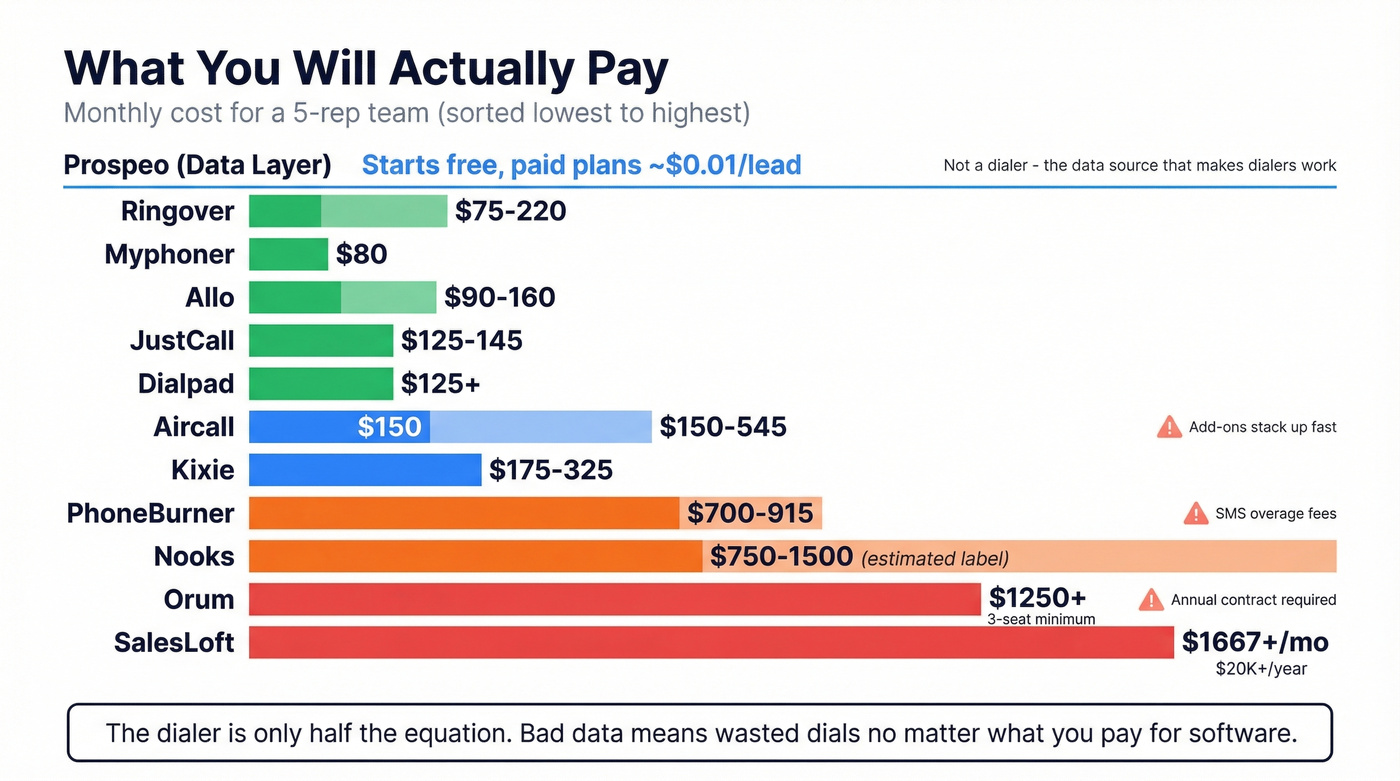
The gap between sticker price and real cost is biggest with Aircall and PhoneBurner. Aircall's base looks cheap until Salesforce connectivity and AI add-ons push the per-seat cost way up. PhoneBurner's SMS overage is the other silent budget killer if your team relies on text follow-ups. Before signing any annual contract, build out the full cost with every add-on your team will realistically need within six months.
Hot take: If your average deal size is under $10K, you probably don't need a $250/user/month parallel dialer. A $35 Kixie seat with clean data will outperform Orum running stale lists - every single time.
Compliance in 2026
TCPA litigation surged 95% in 2025, and the regulatory environment keeps tightening. The June 2025 Supreme Court decision in McLaughlin v. McKesson ruled that district courts aren't bound by FCC interpretations in civil TCPA cases - meaning compliance requirements now vary by jurisdiction. Let's be honest: if you're not tracking this stuff, you're gambling.
Consent revocation rules took effect April 2025. Consumers can revoke consent by any reasonable method - texting STOP, saying it on a call, even emailing. Some cross-channel provisions extend to April 2026.
AI-generated voices are classified as artificial/prerecorded under TCPA (FCC ruling, February 2024). You need prior express written consent to use them.
At least 15 states now have their own mini-TCPA laws, including Texas (SB 140, effective September 2025) and Virginia (SB 1339, effective January 2026) with stricter opt-out requirements.
STIR/SHAKEN authentication is standard. Unauthenticated calls get spam-flagged or blocked by carriers - with roughly 2.5 billion robocalls per month hitting US phones, carriers filter aggressively.
Any dialer you choose needs built-in DNC scrubbing, STIR/SHAKEN compliance, and number reputation monitoring. This isn't a nice-to-have anymore.
How to Choose the Right Tool
| Your Situation | Recommendation |
|---|---|
| Solo or freelancer | Myphoner ($16/mo) |
| Small team, tight budget (2-5 reps) | JustCall or Allo |
| Mid-market team (5-20 reps) | Kixie |
| High-volume SDR floor (20+ reps, 100+ dials/day) | Orum or Nooks |
Here's the thing we keep coming back to after testing dozens of setups: the dialer you choose matters less than the data feeding it. A $16/month Myphoner running verified mobiles will outperform a $250/month parallel dialer running stale numbers. Fix the data first - then optimize the cold calling software around it. (To improve the rest of your outbound motion, use these sales prospecting techniques.)
Snyk's 50 AEs cut bounce rates from 35-40% to under 5% and generated 200+ new opportunities per month. The difference wasn't the dialer - it was feeding verified contacts into it. Prospeo's 5-step verification and 7-day refresh cycle keep your call lists clean while competitors decay.
Your parallel dialer deserves data that actually picks up.
FAQ
Is cold calling still legal in 2026?
Yes, but regulations are significantly tighter than two years ago. TCPA litigation surged 95% in 2025, and 15+ states now enforce their own telemarketing laws with varying requirements. Use software with built-in DNC scrubbing and STIR/SHAKEN compliance, and consult legal counsel if you're dialing at scale.
What's the difference between a power dialer and a parallel dialer?
A power dialer calls one number at a time and auto-advances when the call ends. A parallel dialer calls 5-10 numbers simultaneously and connects you only when someone answers. Parallel dialers cost 3-7x more but significantly increase conversations per hour for high-volume teams making 100+ dials daily.
How much does cold calling software cost?
Budget options start at $15-25/user/month (Ringover, Myphoner, JustCall). Mid-range power dialers run $35-165/user/month (Kixie, PhoneBurner). Parallel dialers cost $150-300/user/month (Orum, Nooks). Always factor in add-on costs - Aircall and PhoneBurner extras can double the sticker price.
Why are my connect rates so low?
Usually bad data, not bad software. B2B contact data decays 22.5% annually, so if you haven't refreshed your lists recently, a quarter of your numbers could be wrong. A 7-day refresh cycle and verified mobile numbers solve this at the source - no dialer fixes stale data.
Do I need a CRM integration?
Yes. Manual call logging wastes roughly 45 seconds per call and guarantees incomplete records. Any modern dialing tool should auto-sync calls, notes, and dispositions to your CRM. HubSpot and Salesforce integrations are table stakes - if a tool doesn't offer them, move on.