

Cold Calling Times Allowed: Every Rule You Need to Know in 2026
$500 per violation. That's the federal penalty for dialing someone at 7:45 AM - and it triples to $1,500 if a court decides you should've known better. With 480+ quiet hours lawsuits or demand letters filed since November 2024, the margin for error on cold calling times allowed has effectively disappeared.
The Quick Version
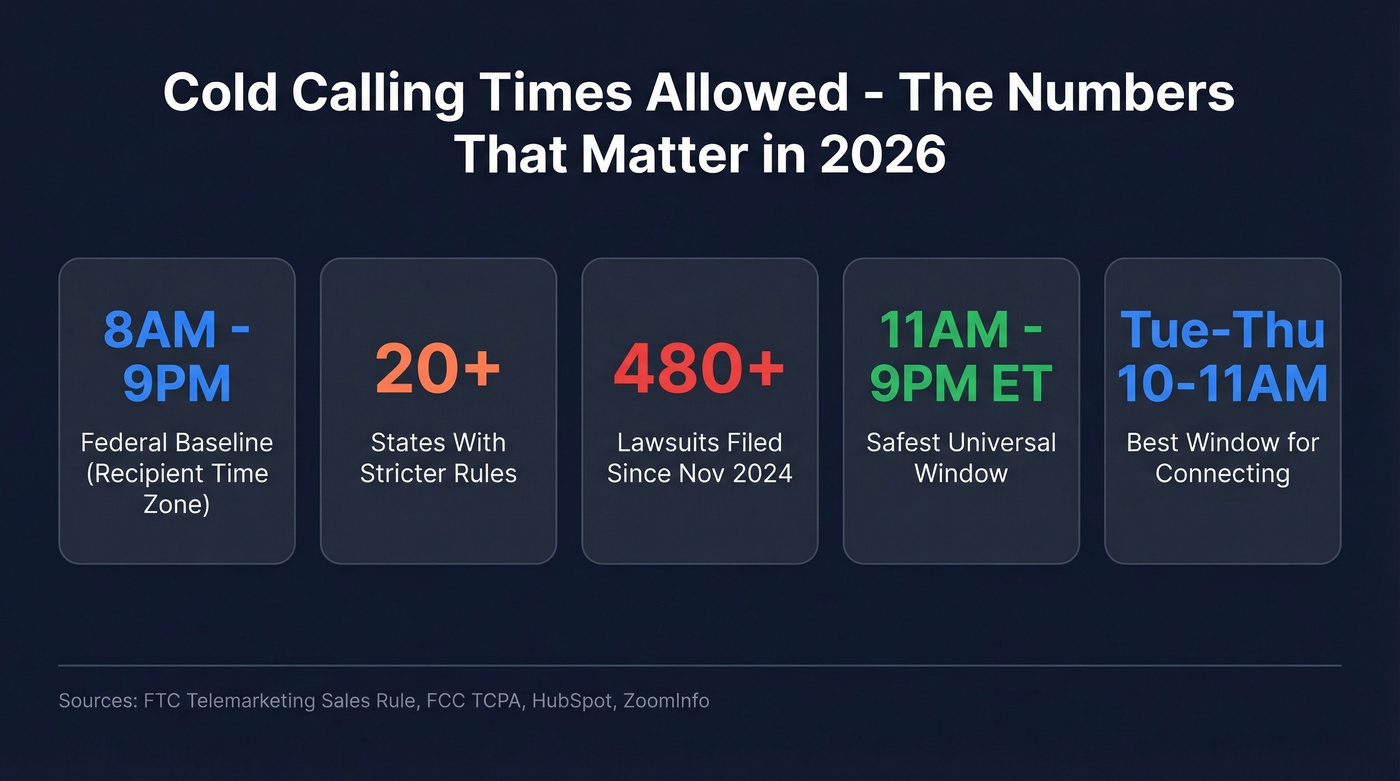
- Federal rule: 8 AM-9 PM in the recipient's local time zone
- 20+ states are stricter - some end calls at 6 PM or ban Sunday dialing entirely
- 480+ quiet hours lawsuits or demand letters filed since November 2024
- Safest universal window: 11 AM-9 PM ET
- Best window for connecting: Tuesday-Thursday, 10-11 AM local
Federal Rule: 8 AM to 9 PM
Both the FTC's Telemarketing Sales Rule and the FCC's TCPA set the same baseline: no telemarketing calls before 8 AM or after 9 PM in the called party's local time zone. That last part matters more than people realize. It's not your time zone - it's theirs.
The FCC enforces this through the TCPA, while the FTC handles it under the TSR. The FCC removed 1,200+ voice service providers from its Robocall Mitigation Database in August 2025 alone, which tells you how seriously they're treating enforcement right now. If you're making outbound calls, these aren't suggestions - they're the floor.
States With Stricter Rules
Twenty states impose tighter windows than the federal 8 AM-9 PM standard. Rhode Island is the most restrictive at 9 AM-6 PM Monday through Friday, with an even narrower 10 AM-5 PM on Saturday. Kentucky doesn't let you start until 10 AM. Several states cap how many times you can call the same number in 24 hours.
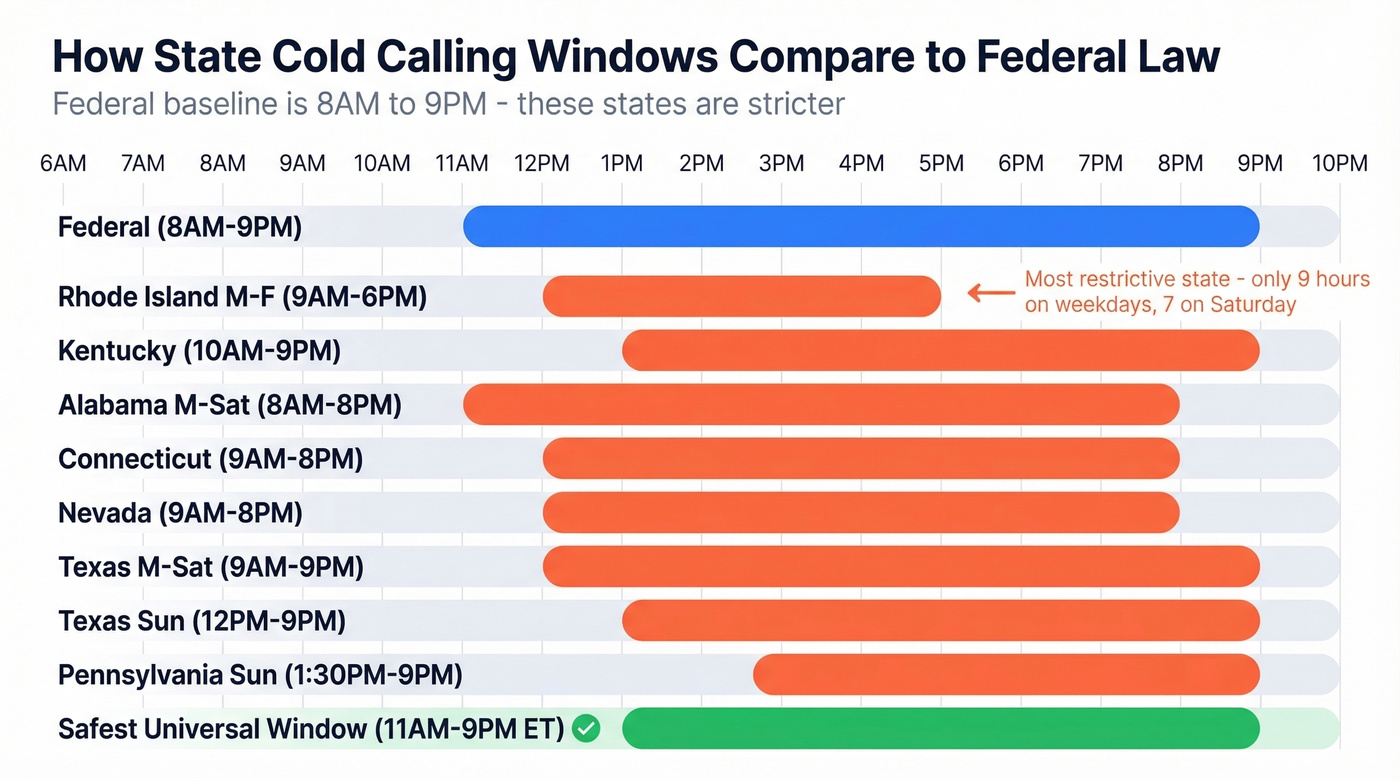
| State | Hours | Days | Freq. Cap | Holiday Ban |
|---|---|---|---|---|
| Alabama | 8a-8p | M-Sat | - | Yes |
| Connecticut | 9a-8p | All | - | - |
| Florida | 8a-8p | All | 3/24hrs | - |
| Illinois | 9a-9p | All | - | - |
| Kentucky | 10a-9p | All | - | - |
| Louisiana | 8a-8p | M-Sat | - | Yes |
| Maryland | 8a-8p | All | 3/24hrs | - |
| Massachusetts | 8a-8p | All | - | - |
| Michigan | 9a-9p | All | - | - |
| Minnesota | 9a-9p | All | - | - |
| Mississippi | 8a-8p | M-Sat | - | Yes |
| Nevada | 9a-8p | All | - | - |
| New Mexico | 9a-9p | All | - | - |
| Oklahoma | 8a-8p | All | 3/24hrs | - |
| Pennsylvania | 9a-9p M-Sat; 1:30p-9p Sun | - | - | Yes |
| Rhode Island | 9a-6p M-F; 10a-5p Sat | - | - | Yes |
| South Dakota | 9a-9p | M-Sat | - | - |
| Texas | 9a-9p M-Sat; 12p-9p Sun | - | - | - |
| Utah | 8a-9p | M-Sat | - | Yes |
| Wyoming | 8a-8p | All | - | - |
A note on holiday bans: "holiday" doesn't just mean Christmas and Thanksgiving. Louisiana's list includes Mardi Gras and Good Friday. Alabama includes Confederate Memorial Day. Utah includes Pioneer Day. Rhode Island includes Victory Day. Always check the specific state's holiday calendar before dialing.
Texas SB 140, effective September 2025, expanded "telephone solicitation" to include text messages and tied violations to the state's Deceptive Trade Practices Act - meaning treble damages plus attorney's fees. Georgia SB 73 removed damage caps entirely and introduced vicarious liability, so your business is on the hook for violations by any vendor dialing on your behalf. New Jersey's "Seinfeld Bill" requires callers to identify themselves within 30 seconds or face penalties. As of fall 2025, at least 15 states enforce mini-TCPA statutes with penalties that stack on top of federal fines.
The Litigation Wave
Here's the thing: these rules used to be loosely enforced. Not anymore.
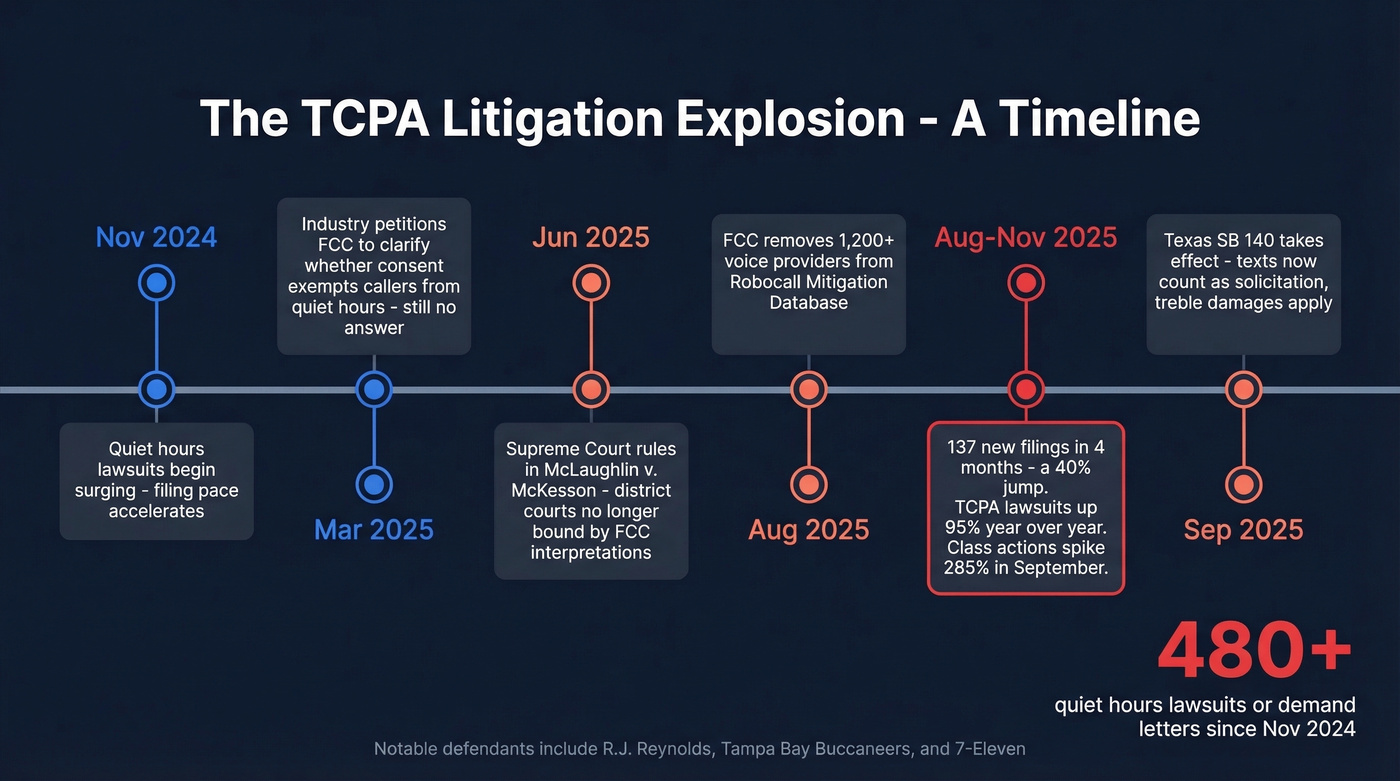
Over 480 quiet hours lawsuits or demand letters have been filed since November 2024, with 137 new filings in the August-November 2025 window alone - a 40% jump in four months. TCPA lawsuits overall surged roughly 95% in 2025, and class actions spiked 285% in September 2025. The defendants aren't obscure startups either. R.J. Reynolds got hit for sending marketing texts at 7:15 AM local time. The Tampa Bay Buccaneers and 7-Eleven have both been sued. One South Florida law firm - Jibrael Hindi's - is responsible for more than 95% of these filings.
We've seen teams assume that having prior express written consent means they can call at any hour. It doesn't - or at least, nobody knows yet. The FCC hasn't ruled on whether consent exempts you from quiet hours restrictions. The industry petitioned the FCC in March 2025 to clarify this. Still no answer. Until they rule, treat consent as irrelevant to quiet hours. This is the single most important compliance ambiguity in outbound sales right now.
Making things worse, the Supreme Court's June 2025 ruling in McLaughlin v. McKesson established that district courts aren't bound by FCC interpretations of the TCPA. The same calling practice could be legal in one jurisdiction and a violation in another. Let's be honest - that's a nightmare for any team running multi-state campaigns.

With penalties up to $1,500 per violation and 480+ lawsuits filed since late 2024, every misdial is a liability. Prospeo gives you 125M+ verified mobile numbers with a 30% pickup rate - so your team spends those precious legal calling windows connecting with real buyers, not burning through bad data.
Make every compliant dial count with numbers that actually pick up.
B2B Calls - TCPA Still Applies
A lot of B2B sales teams assume the TCPA doesn't apply to them. It does.
B2B calls are exempt from some FTC Telemarketing Sales Rule provisions, but the FCC applies TCPA restrictions equally to B2B and B2C. Courts now treat mobile numbers as residential regardless of whether the person uses that phone for business. Florida, Maryland, Oklahoma, and Washington have stricter telemarketing laws with no B2B exemptions at all. If you're dialing cell phones - and in 2026, you almost certainly are - TCPA applies in full.
One gray area that catches teams off guard: ringless voicemail. The FCC treats ringless voicemail drops as prerecorded messages, which means they require prior express consent. Don't assume "it didn't ring, so it doesn't count." Keep ringless drops inside quiet hours just like any other outreach.
Penalties for Violations
| Violation Type | Penalty |
|---|---|
| TCPA standard | $500/violation |
| TCPA willful | $1,500/violation |
| TSR civil penalty | Up to $53,088/violation |
| Connecticut | Up to $20,000/violation |
| New York | Up to $20,000/violation |
| Highest state ceiling | Up to $25,000/violation |
| Class action range | $50K-$10M+ |
The statute of limitations is four years - violations from 2022 can still surface as lawsuits today. In our experience, high-volume callers are the most exposed: even a modest class action filing routinely claims damages in the hundreds of millions. Smaller cases settle for $50,000-$500,000, which is still enough to gut a growing sales org's budget for the year.
Best Times Within Legal Windows
Compliance gives you a window. Strategy tells you where in that window to focus.
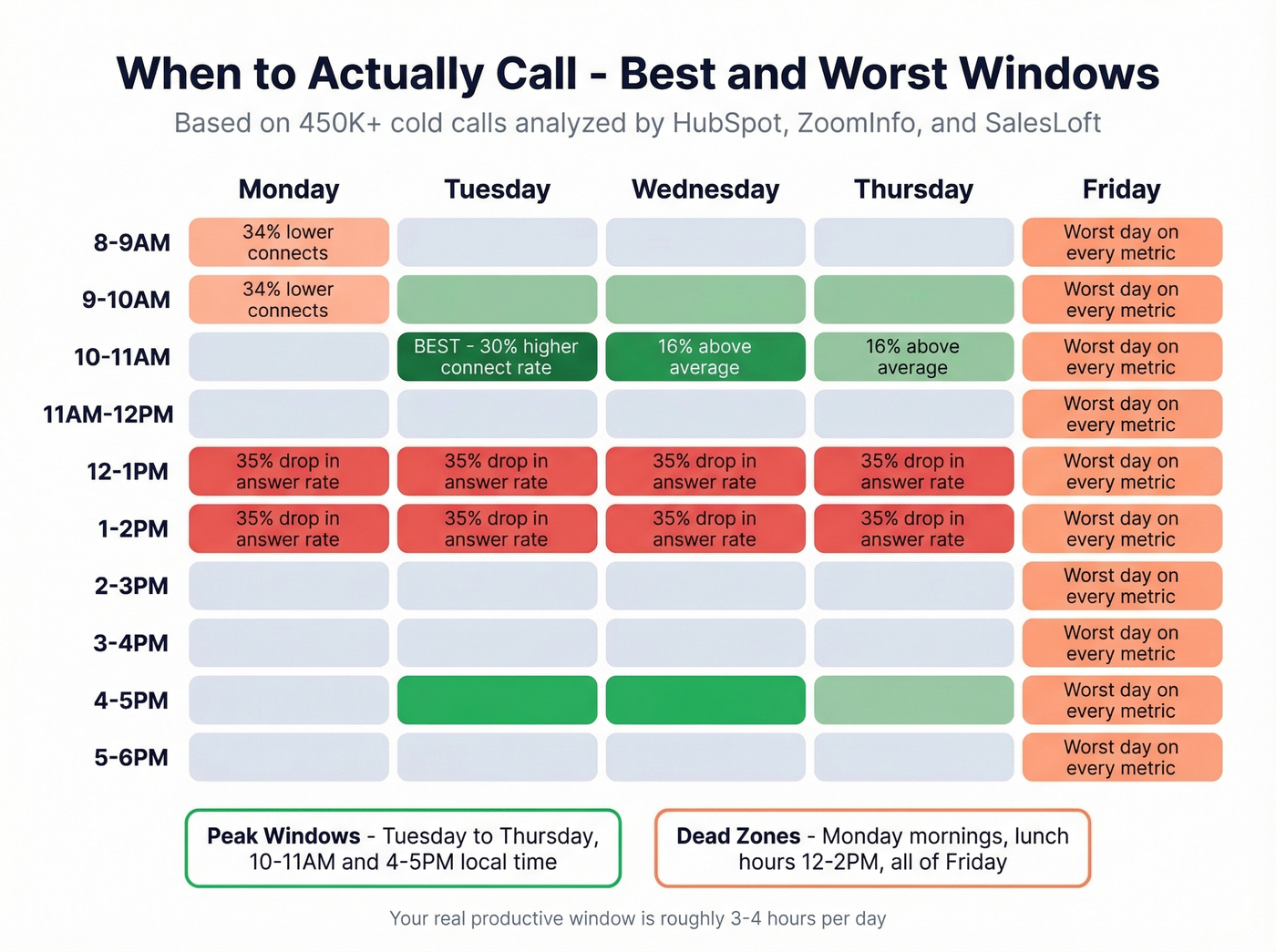
A HubSpot analysis of 450,000+ cold calls found that 10-11 AM on Tuesdays yielded 30% higher connection rates than any other slot. ZoomInfo's study of 1.4 million outbound calls showed Tuesday and Wednesday accounting for 44% of all demos booked, and SalesLoft's data confirmed Wednesday at 10 AM outperformed other windows by 16%. Revenue.io's data points to a second peak at 4-5 PM.
An SDR on r/sales who tracked 37,000 cold calls over two years confirmed the same pattern: 8 AM local before meetings start and 3:30-5 PM local when people wind down were the best windows. The dead zones are consistent across every dataset - Monday mornings see 34% lower connect rates, 12-2 PM drops answer rates by 35%, and Friday is the worst day on every metric.
Look - if your average deal size is under $10K, you probably don't need to optimize calling times down to the minute. Just stay inside the legal window, call Tuesday through Thursday, and focus your energy on list quality instead. The difference between a 10 AM and 11 AM dial is marginal. The difference between a verified number and a dead line is everything.
Your real productive window is roughly 3-4 hours per day. That's it.
Compliance Best Practices
Segment lists by time zone before dialing. This is non-negotiable. Use the more restrictive of the recipient's area code or physical address to determine their zone.
If you're building a repeatable outbound motion, it helps to standardize your cold calling system so time-zone logic and compliance checks aren't left to individual reps.
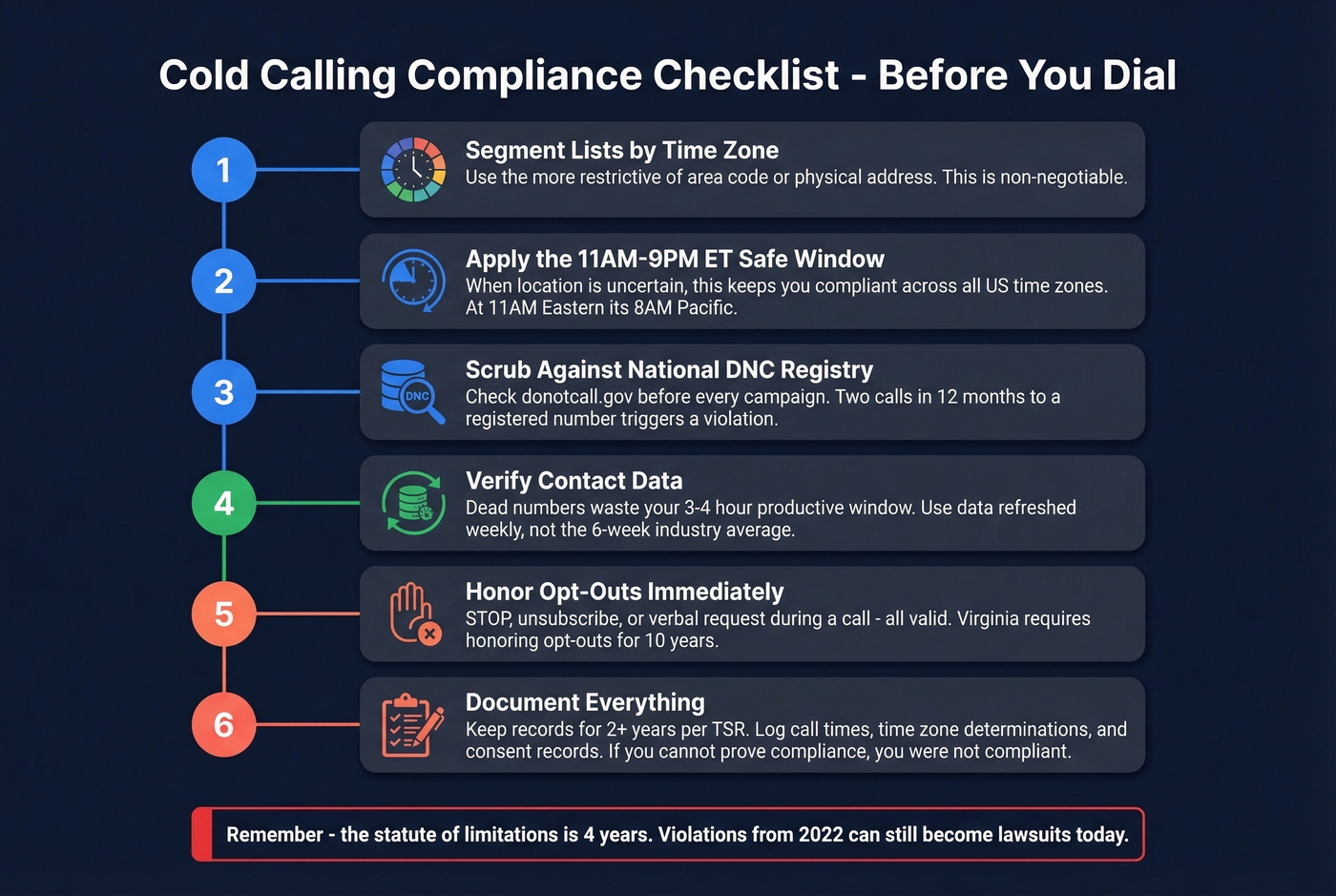
Adopt the 11 AM-9 PM ET safe window when you're uncertain of a recipient's location. At 11 AM Eastern, it's 8 AM Pacific - so you won't accidentally start calling the West Coast before quiet hours end.
Scrub against the National DNC Registry before every campaign. Two telemarketing calls in a 12-month period to a registered number can trigger a DNC violation.
Honor opt-outs immediately. The FCC's April 2025 rules let consumers revoke consent by any reasonable method - "STOP," "unsubscribe," or even a verbal request during a call. The "revoke all" requirement was delayed until April 2026. Virginia's SB 1339 requires opt-outs to be honored for 10 years.
Verify contact data before calling blocks. With only a few peak hours per day, every dead number wastes time you can't get back. Prospeo's 125M+ verified mobile numbers - refreshed every 7 days with a 30% pickup rate - keep your dials productive during that narrow window. If you're evaluating vendors, compare approaches in our guide to data enrichment services.
Document everything. Keep records for at least 2 years per the TSR requirement. Log call times, time zone determinations, and consent records. If you can't prove you were compliant, you weren't. This is also where strong sales operations metrics help: you can audit call-time compliance the same way you audit activity volume.
Your legal calling window is shrinking - some states give you as few as 8 hours to connect. You can't afford to waste a single dial on outdated numbers. Prospeo refreshes data every 7 days (not the 6-week industry average) so your reps reach the right person in that Tuesday 10-11 AM sweet spot.
Fewer hours to call means zero room for stale data.
FAQ
Can I cold call on weekends?
Federally, yes - 8 AM-9 PM applies every day including weekends. But Alabama, Louisiana, Mississippi, South Dakota, Utah, and Rhode Island ban Sunday calls entirely. Texas restricts Sunday to 12 PM-9 PM, and Pennsylvania allows Sunday calling only from 1:30 PM-9 PM. Always check the recipient's state before weekend dialing.
Does TCPA apply to B2B cold calls?
Yes. The FCC applies TCPA restrictions equally to B2B and B2C calls, even though B2B is exempt from some FTC Telemarketing Sales Rule provisions. Courts treat mobile numbers as residential regardless of business use. If you're dialing cell phones - which most B2B teams are in 2026 - TCPA applies in full.
What's the safest calling window across all U.S. time zones?
11 AM-9 PM Eastern. At 11 AM ET, it's 8 AM Pacific - the earliest any state permits calls. This window keeps you compliant even when you don't know the recipient's exact location. Pair it with time-zone-segmented lists for tighter targeting.
How much is the fine for calling outside legal hours?
$500 per violation under TCPA, tripled to $1,500 for willful violations. State penalties reach $25,000 per violation - Connecticut and New York both impose up to $20,000. Class action settlements range from $50K to $10M+, and the 4-year statute of limitations means old violations resurface years later.
How do I verify numbers before dialing?
Use a data provider with frequent refresh cycles so you're not calling disconnected lines. We refresh our 125M+ verified mobile database every 7 days - the industry average is 6 weeks - and deliver a 30% pickup rate, meaning fewer wasted dials during your narrow compliant window.