

Cold Email Call to Action Examples Backed by 28M+ Emails of Data
Your cold email's body copy might be perfect. Subject line, sharp. Personalization, dialed in. And then you end it with "Are you free for a quick call?" - a CTA that triggers loss aversion because you're asking for the one thing nobody wants to give a stranger: their time.
Here's the thing. The average cold email reply rate sits at 3.43%, with the top 10% clearing 10.7%+. We've seen firsthand that a huge chunk of that gap comes down to what you ask for in the last line - not the opener, not the subject line, but the close.
What the Data Says (Quick Version)
A 304K-email study found that asking for interest outperforms asking for a meeting. Interest costs the prospect nothing. A meeting costs them 15-30 minutes they'll never get back.
What 28M+ Emails Reveal About CTAs
A study of 28M+ cold emails found that pitching in your email - buzzwords, ROI claims, AI jargon - drops reply rates by up to 57%. Your CTA lives in that same danger zone. If it reads like a pitch ("Let's schedule a demo to show you how we can 3x your pipeline"), you've already lost.
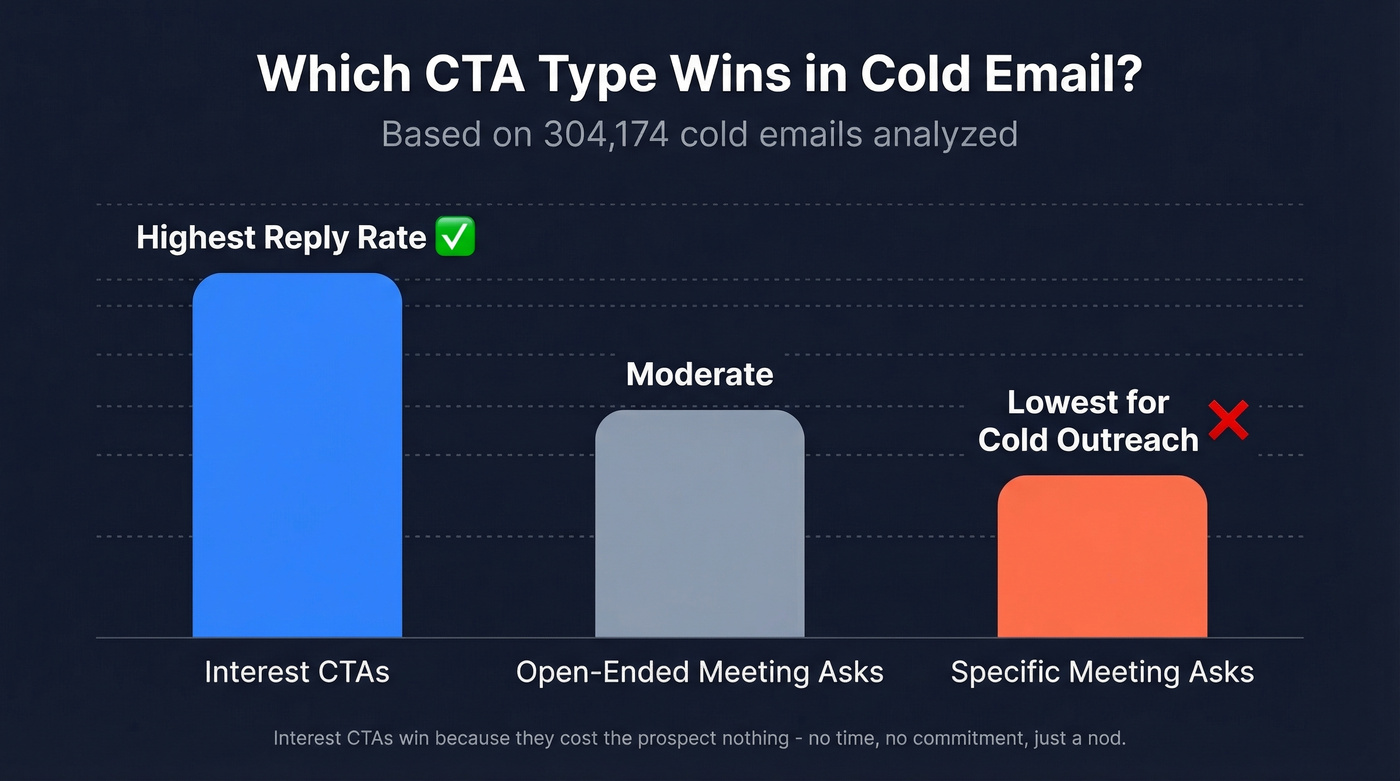
A separate analysis of 304,174 emails broke CTAs into three buckets: specific meeting asks, open-ended meeting asks, and interest-based asks. For cold outreach, interest CTAs won. Asking for someone's time triggers loss aversion - time is finite and non-refundable - while asking for interest costs nothing.
This isn't just platform data. A practitioner on r/coldemail tested three CTA variants across 8,000 agency emails. The "Can I show you a demo video?" CTA drove 50% of positive replies, versus 27% for sample data and 22% for "see the site." The low-friction, tangible offer crushed the vague one.
The average rep sends 344 cold emails to land one meeting. Most teams obsess over subject lines and personalization tokens when the CTA is doing more damage than both combined. Fix the last line first.
15 CTAs That Actually Get Replies
Interest & Permission CTAs
These work best for first cold emails and enterprise prospects where you're selling to a buying committee, not an individual. Once someone says "yes" to a small ask, they're psychologically wired to keep saying yes - so you're not asking for 30 minutes, you're asking for a nod.
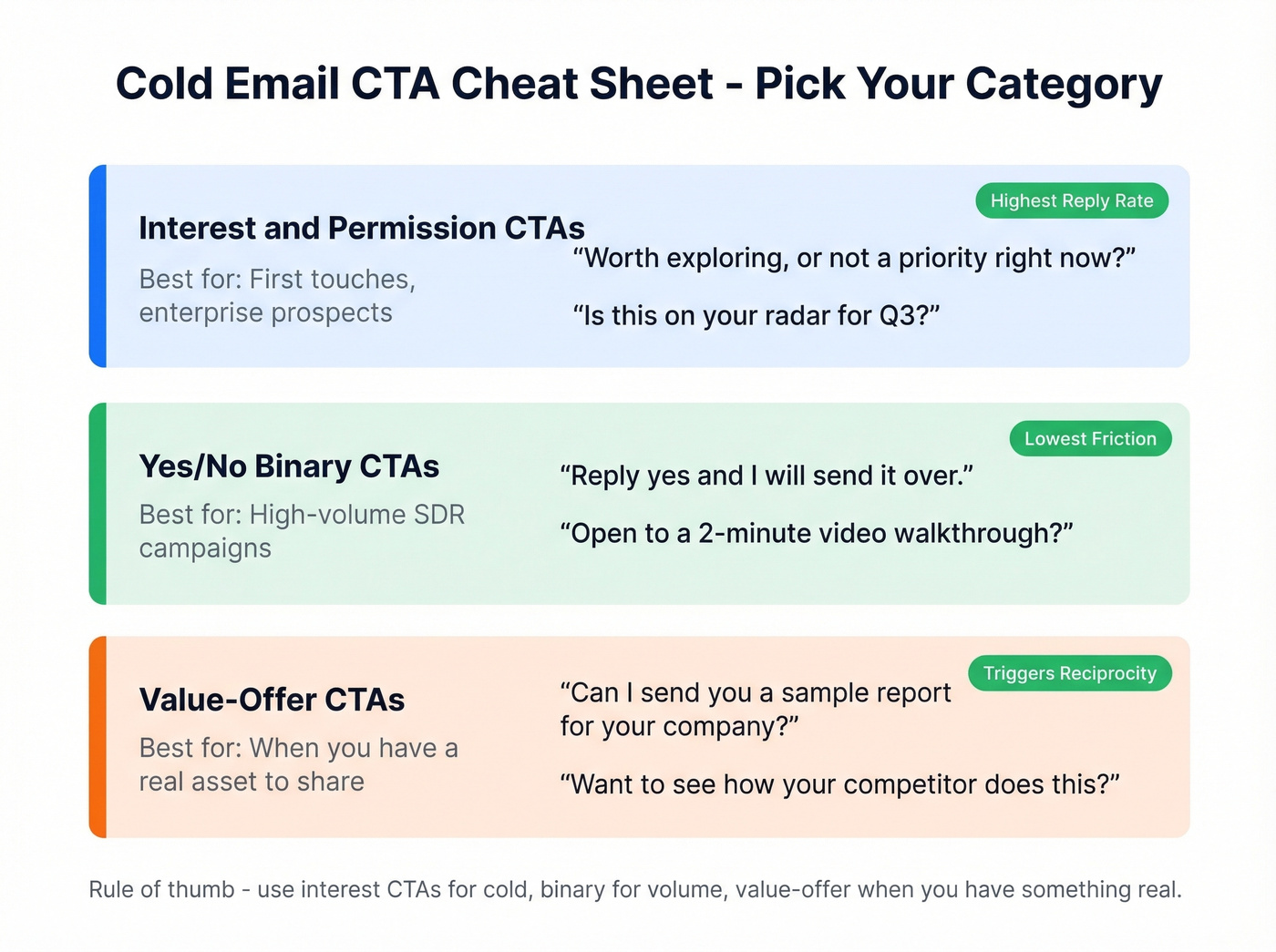
- "Worth exploring, or not a priority right now?"
- "Is this on your radar for Q3?"
- "Would it be alright if I shared a few ideas on [specific problem]?"
- "Curious if this resonates - open to a quick take?"
- "Does this match what you're seeing on your end?"
Yes/No Binary CTAs
Best for high-volume campaigns where you need to reduce cognitive load to near zero. The Reddit 8K-email test reinforced this - the yes/no-style, low-commitment ask performed best.
| CTA | Best For | Why It Works |
|---|---|---|
| "Reply 'yes' and I'll send it over." | SDRs running volume plays | Zero-effort response |
| "Open to a 2-minute video walkthrough?" | Founders selling a visual product | Specific, low-commitment |
| "Want me to send the breakdown? Yes/no is fine." | AEs warming cold lists | Gives explicit permission to say no |
| "Should I share how [similar company] handled this?" | Anyone with a strong case study | Curiosity + social proof |
Value-Offer CTAs
Skip these if you don't have a tangible asset to send. No report, no benchmark, no teardown? Don't fake it. But if you do have something real, lead with it. These CTAs deliver value before asking for time, which flips the reciprocity dynamic in your favor.
"Can I send you a sample report for [their company]?" works because the prospect gets something whether or not they ever take a call. "I built a quick analysis of your [specific metric] - want it?" works even better because it's personalized. And "Want to see how [competitor name] does this?" taps curiosity and competitive instinct at the same time.
Follow-Up & Specific CTAs
These belong in warm follow-ups, not first touches. The 304K-email dataset shows specific CTAs perform best once you're already in a conversation. In cold outreach, they're premature.
- "Does Thursday at 2pm work for a 15-minute call?"
- "Still relevant, or should I close the loop?"
Belkins' 16.5M-email study found the first email has an 8.4% reply rate, dropping 55% by email five. Your first CTA carries the most weight. Don't waste it on a calendar link.

The 28M-email study proved it: pitchy CTAs kill reply rates by 57%. But even the perfect interest CTA is worthless if your emails never land. Prospeo's 5-step verification delivers 98% email accuracy - so your carefully crafted CTA actually reaches the inbox. Teams using Prospeo cut bounce rates from 35%+ to under 4%.
Fix your data before you fix your last line.
CTAs That Kill Your Reply Rate
"Are you free for a quick call?" triggers loss aversion. Time is the most expensive thing you can ask for in a first touch. We've watched teams double their reply rates just by swapping this single line.
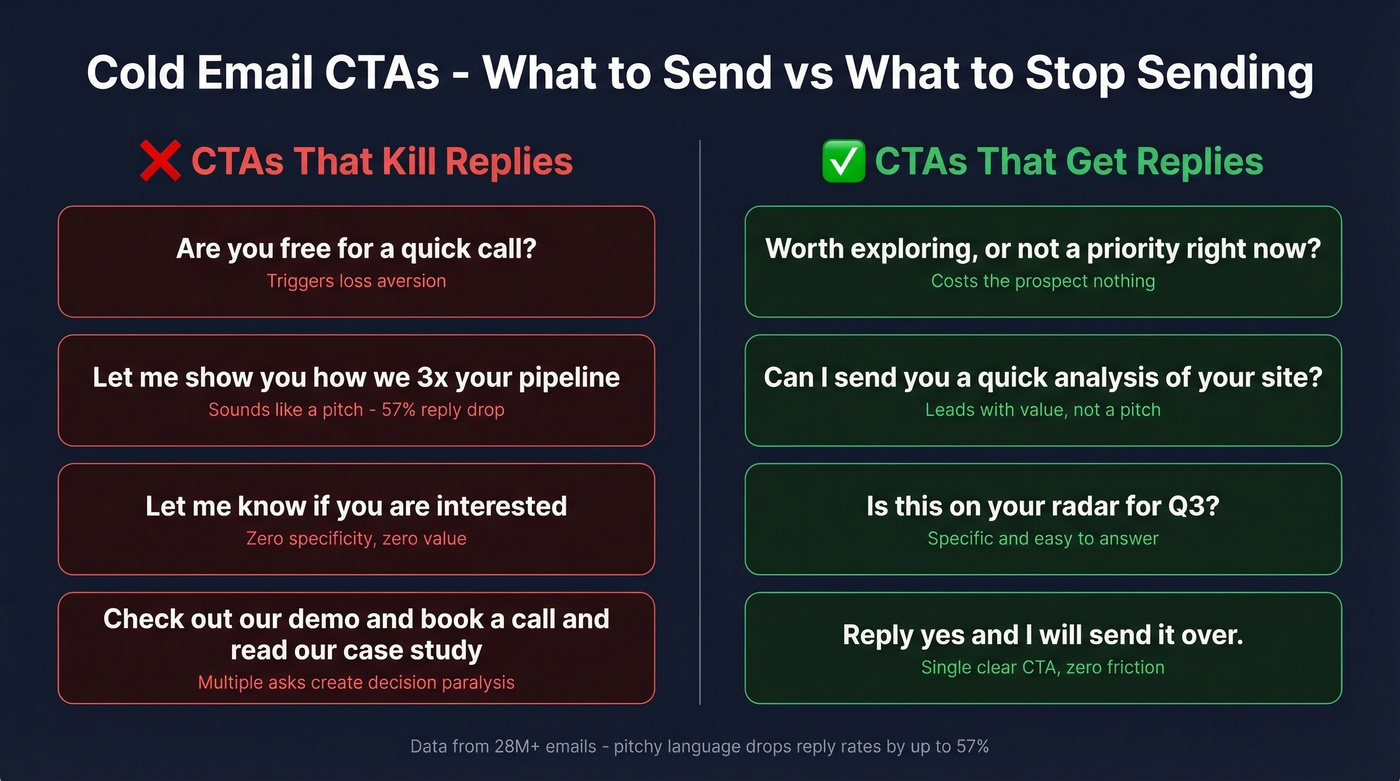
Pitch-heavy CTAs carry the same 57% reply-rate penalty that the 28M-email study found for pitchy language overall. If your CTA sounds like a marketing headline, it's dead on arrival.
Multi-ask emails are another killer. Instantly's 2026 benchmarks show top-performing campaigns use a single clear CTA. Pick one action. Just one.
"Let me know if you're interested" gives the prospect nothing to respond to. Interested in what, exactly? Zero specificity, zero value, zero replies.
One micro-rule worth stealing: aim for a 1:2 ratio of "I/my" to "you/your" in your cold email. The reader should feel the CTA is about them, not about you.
Match Your CTA to Your Audience
Enterprise buying groups involve 6-10 decision-makers and 6-9 month sales cycles. When you ask someone to "book a call," you're asking them to commit organizational time they can't unilaterally give. Interest CTAs ("Worth exploring?") work because they don't require calendar coordination or internal approval.
If you're building a repeatable outbound motion, start with a tight Ideal Customer Profile so your CTA matches the buyer's context.
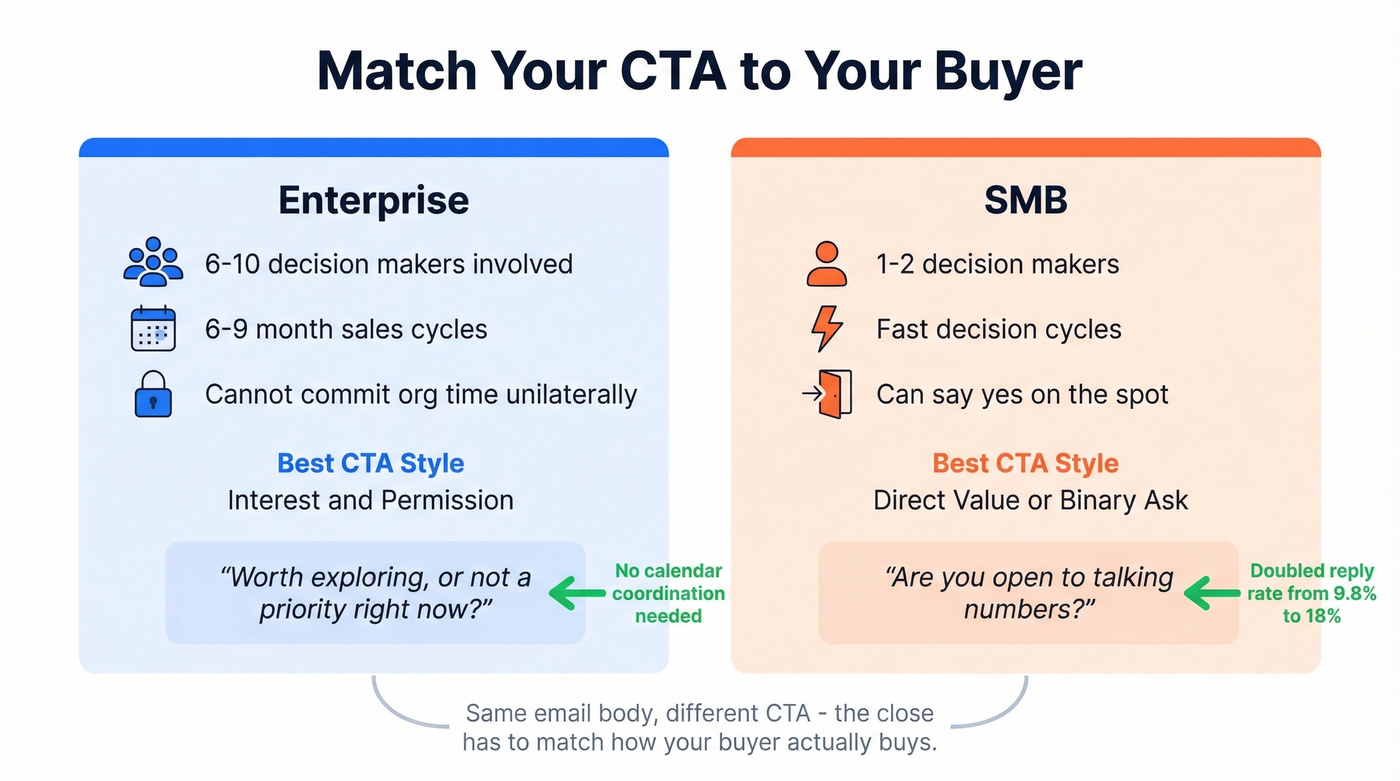
SMB is a different animal entirely. A Mailshake case study demonstrated this perfectly: changing a CTA from "What does your calendar look like for a short call?" to "Are you open to talking numbers?" doubled the reply rate from 9.8% to 18%. Same audience, same email body - just a CTA that matched the buyer's decision speed. That's the kind of gap that makes or breaks a quarter.
How to A/B Test Your CTAs
Don't trust your gut. Get to 100 replies per variation before drawing conclusions - anything less is noise, not signal. Test one variable at a time, and read early replies qualitatively. Objection patterns in the first 20 replies tell you what to adjust next.
If you want a tighter system for sequencing and iteration, build your tests inside a B2B cold email sequence instead of one-off blasts.
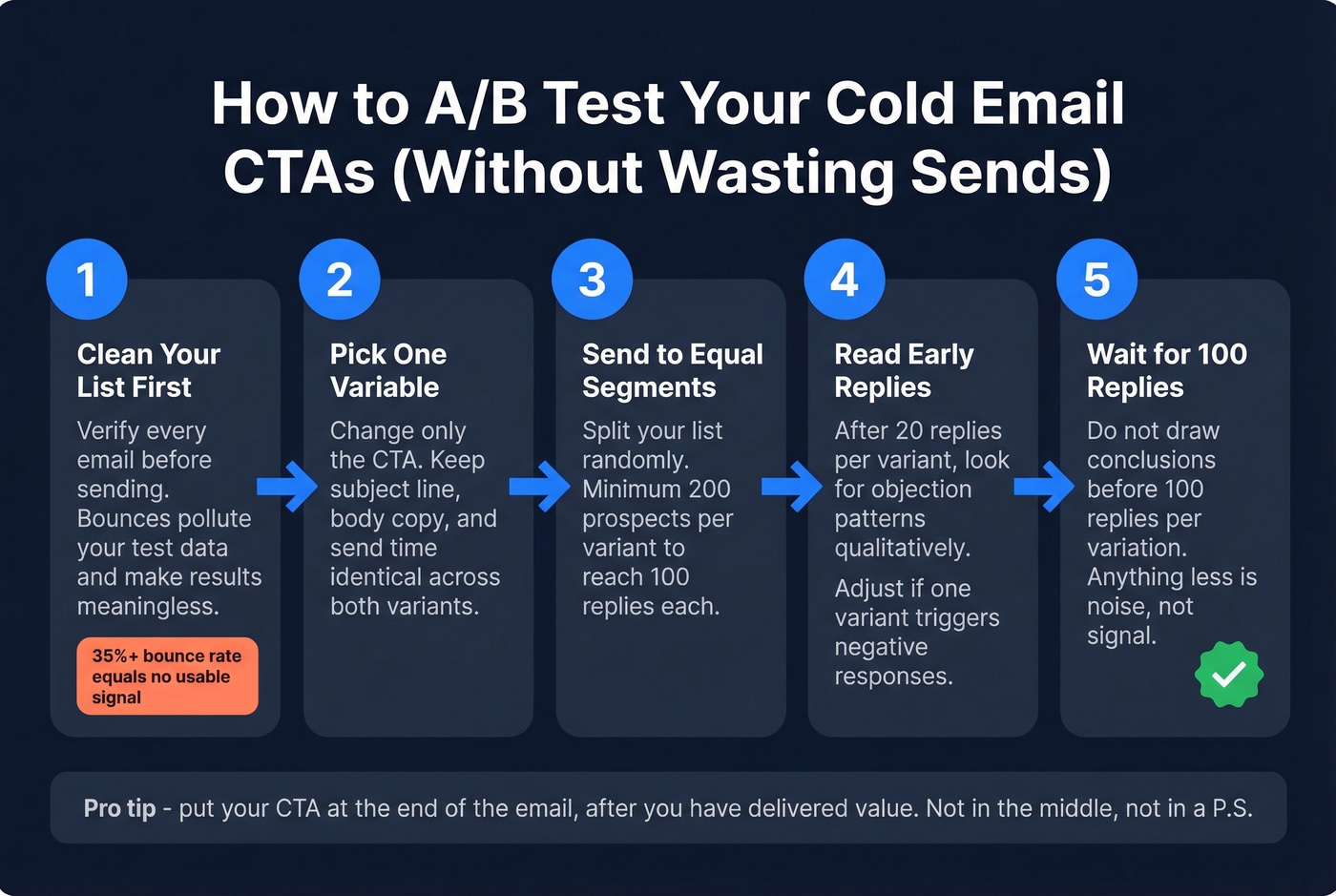
Let's be honest about something most CTA guides skip: your test results are meaningless if half your emails bounce. Clean your list before testing so results reflect CTA performance, not data quality noise. Prospeo's bulk verification handles this in minutes with 98% email accuracy and a 7-day data refresh cycle. (If you're troubleshooting bounces, start with bounce-rate benchmarks and work backward.)
Placement matters too. Put your CTA at the end of the email, after you've delivered value. Not in the middle, not buried in a P.S. - right at the close where the reader's next action is clear. If you're still refining the body copy around the ask, use a simple email copywriting checklist to keep it tight.

You need 100 replies per CTA variation to run a real A/B test. That means sending thousands of emails - and every bounce is wasted signal. Prospeo refreshes 300M+ profiles every 7 days (not 6 weeks like competitors), so your test results reflect CTA performance, not stale data. At $0.01 per email, scaling your CTA tests costs less than your morning coffee.
Stop testing CTAs against bad data. Start with emails that actually connect.
FAQ
What's the best CTA for a first cold email?
An interest-based CTA like "Worth exploring?" or "Is this on your radar?" outperforms meeting asks in cold outreach. The 304K-email study found interest CTAs win because they cost the prospect nothing - no calendar coordination, no time commitment, just a low-friction nod.
How many CTAs should a cold email have?
One. Top-performing campaigns across Instantly's 2026 benchmarks use a single clear CTA. Multiple asks create decision paralysis and dilute response rates.
How do I know if my CTA is working?
A/B test with at least 100 replies per variant before drawing conclusions. If your reply rate is below 3.43%, your CTA likely needs work - but rule out bounce-rate issues first. Verify your contacts before testing so you're measuring CTA performance, not bad data.
Should I include a calendar link in cold emails?
Not in the first touch. Calendar links imply a meeting commitment, which triggers loss aversion with prospects who don't know you yet. Save specific scheduling CTAs for follow-ups after a prospect has expressed interest. The 304K-email data confirms this - interest asks beat specific meeting asks in initial outreach.