

Cold Email Greetings: The Only Ones That Actually Matter
You just got a cold email marketing starting with "Dear Sir or Madam, I hope this email finds you well." You deleted it before the second sentence. So did your prospects.
Cold email greetings are the first thing recipients see, and with 81% of emails opened on mobile, your greeting plus first line is the entire audition. 58% of all replies come from that first email. Get the opening right or nothing else matters.
The Three Greetings You Need
Every other guide gives you 20+ options. That's noise. You need exactly three.
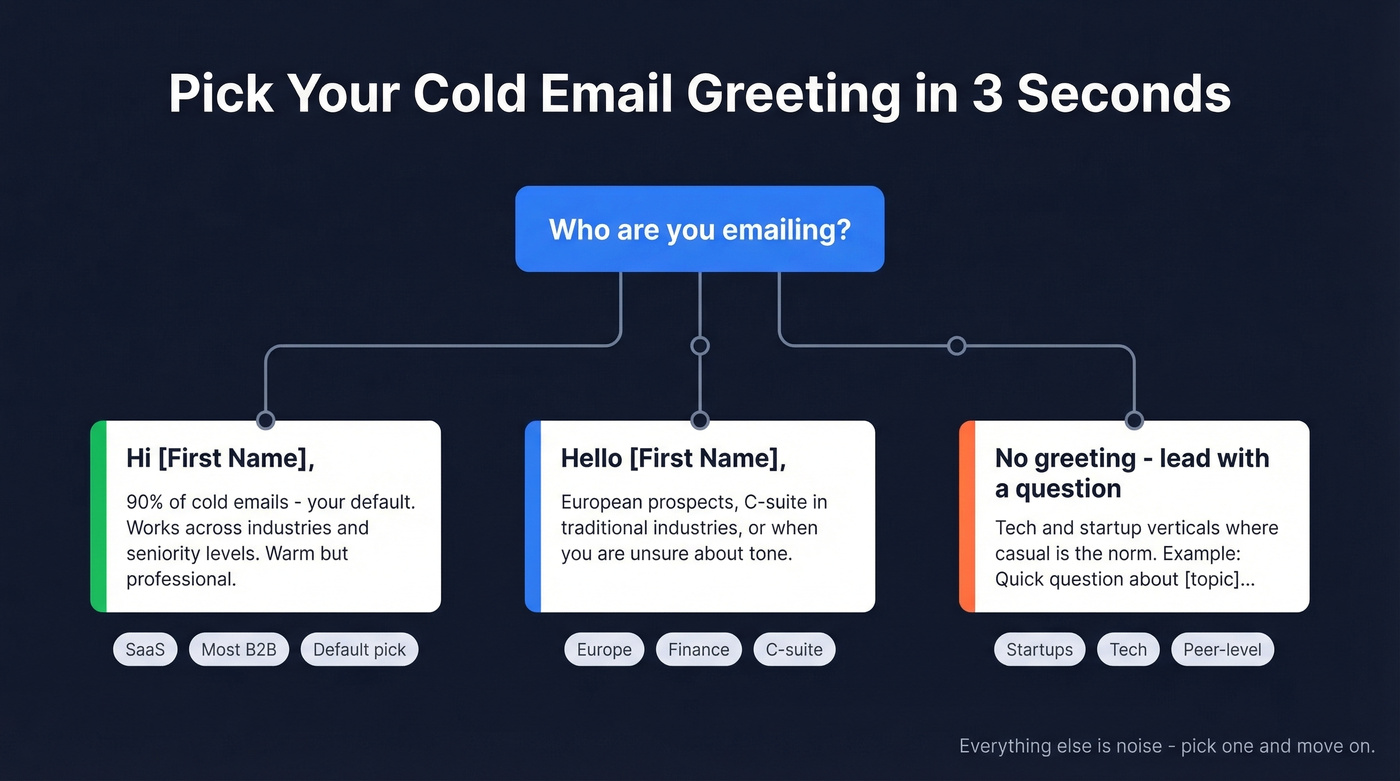
- "Hi [First Name]," - Your default. Works for 90% of cold emails, across industries and seniority levels. Warm without being sloppy.
- "Hello [First Name]," - One notch more formal. Use it for European prospects, C-suite in traditional industries, or when you're unsure about tone.
- No greeting at all - Skip the salutation and open with a question. "Quick question about [topic]..." This works best in tech and startup verticals where casual is the norm.
Pick one and move on. What matters is what comes next.
Best Cold Email Greetings by Context
| Greeting | Tone | Best For |
|---|---|---|
| Hi [First Name], | Casual / standard | Most cold emails |
| Hey [First Name], | Very casual | Startups, peers |
| Hello [First Name], | Mid-formal | Europe, C-suite |
| Dear Mr./Ms. [Last] | Formal | Regulated industries, MENA |
| No greeting | Direct | Question-led openers |
Casual and Standard
"Hi [First Name]," is the workhorse - how you'd start a message to a colleague you've met once. "Hey [First Name]," skews younger and more casual; fine for startup founders, risky for a CFO at a bank. This only works if your data source has accurate first names. We use Prospeo for this, but any good email verification tool will do - the point is that "Hi {{firstName}}" turning into "Hi null" defeats the purpose of personalizing at all.
Slightly Formal
"Hello [First Name]," is your safety net for European markets and senior executives in traditional industries. It signals professionalism without the stuffiness of "Dear." Nobody's ever been offended by "Hello."
Formal
"Dear Mr./Ms. [Last Name]" still has a place. Finance, legal, government, and Middle East markets expect it on first touch. Loosen up after the first reply, but don't skip the formality upfront.
No Greeting (Question Opener)
One of the highest-performing opener formats on Reddit skips the greeting entirely: "hey [name] - random question. are you guys still handling [thing] internally or did you end up outsourcing it?" It works because it feels like a real message, not a template.
One caveat from Lemlist's greeting taxonomy: time-based salutations like "Good morning" break when your sends are staggered across time zones. Stick with non-time-based options.
Greetings That Kill Your Reply Rate
Openers That Signal "Mass Template"
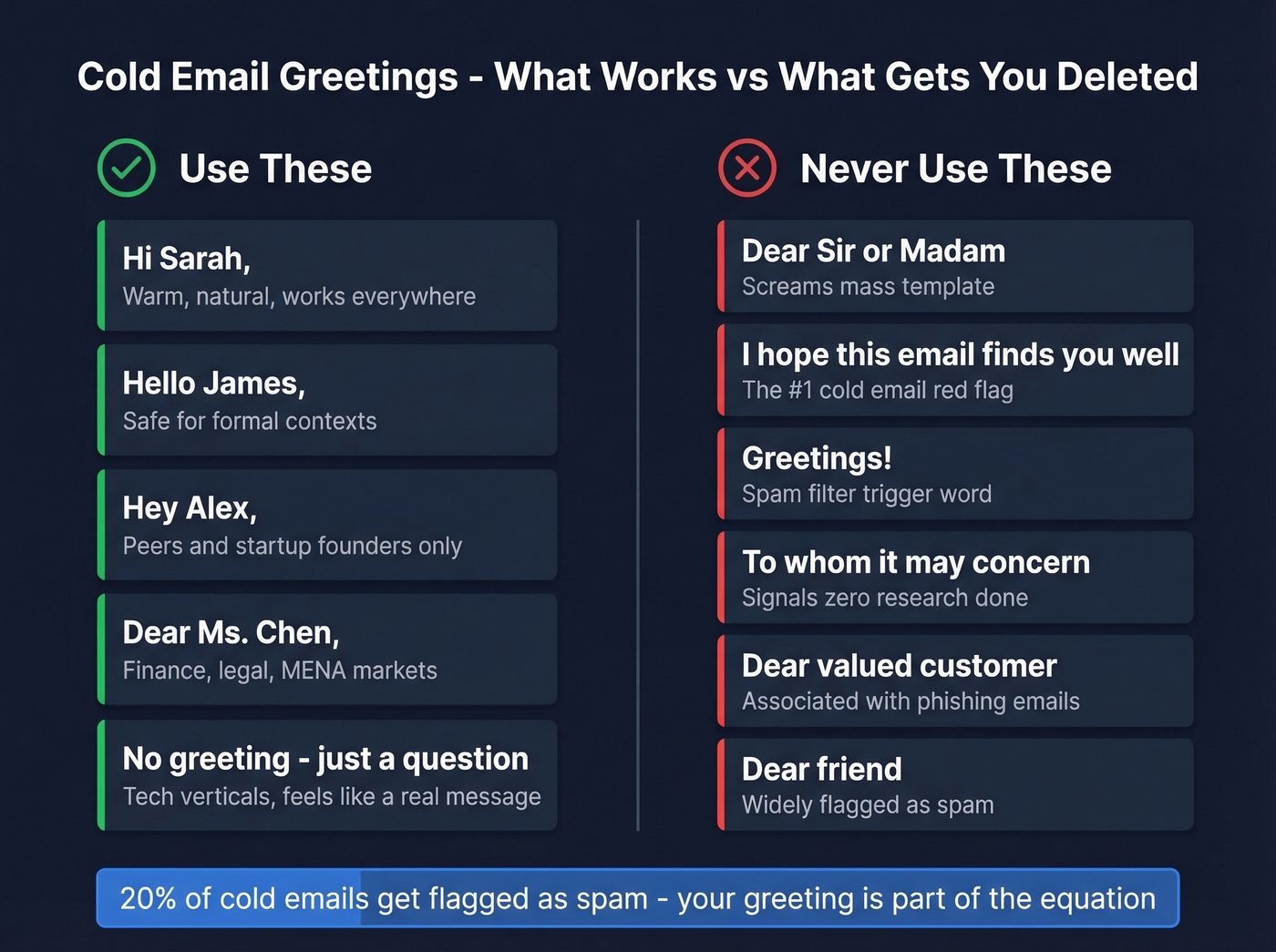
A Reddit user who reviews 200-300 cold emails per week called "I hope this email finds you well" the single most reliable indicator of a cold email. Here's what else gets you deleted:
- "My name is [name] and I represent [company]" - wastes your best real estate on information nobody asked for.
- "We are a leading provider of..." - empty corporate language that screams template.
- "I wanted to reach out because..." - centers you, not them.
Salutations That Hurt Deliverability
Almost 20% of cold emails get flagged as spam. Your greeting can contribute. According to Mailtrap's spam-trigger research, these salutations are widely associated with spammy messages:
- "Dear friend"
- "Greetings" or "Greetings!"
- "Hi there"
- "To whom it may concern"
- "Dear Sir/Madam"
- "Dear valued customer"
These phrases correlate with the emails spam filters are trained to catch. Why risk your sender reputation when "Hi [First Name]," works better anyway?

Spam-trigger greetings aren't your biggest risk - broken merge tags are. "Hi null" and misspelled names destroy credibility instantly. Prospeo's 5-step verification delivers 98% email accuracy with verified first names, refreshed every 7 days.
Stop sending "Hi {{firstName}}" and praying. Verify before you send.
Adjust by Region and Industry
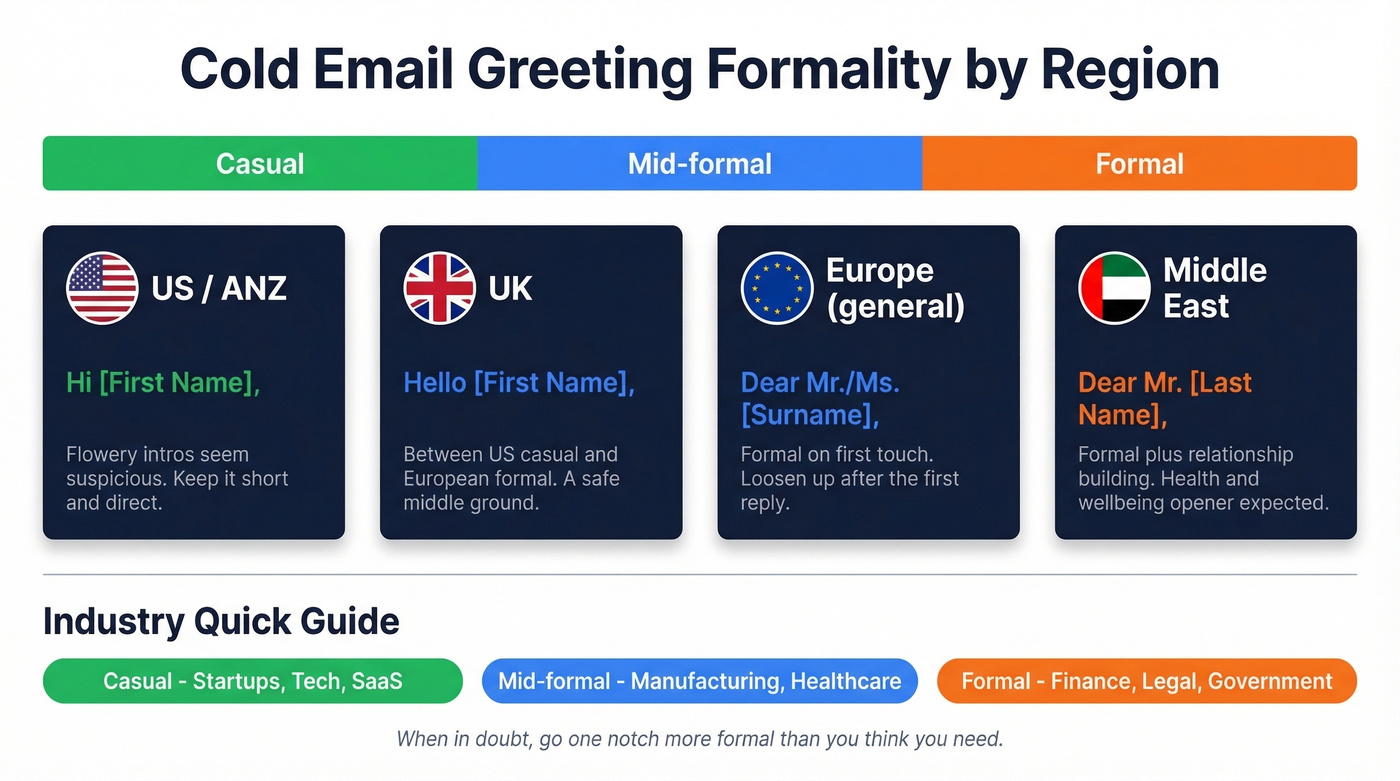
49% of executives cite communication barriers as a primary cause of deal failure. Greeting formality is part of that equation.
| Region | Greeting | Formality | Notes |
|---|---|---|---|
| US / ANZ | Hi [First Name] | Casual | Flowery intros seem suspicious |
| Europe (general) | Dear Mr./Ms. [Surname] | Formal first | Loosen after first reply |
| Middle East | Dear Mr. [Last Name] | Formal + relationship | Health/wellbeing opener expected |
| UK | Hello [First Name] | Mid-formal | Between US and continental Europe |
The industry heuristic is straightforward: startups and tech expect casual, finance and legal expect formal, manufacturing and healthcare land in between. When reaching across cultures, open with calibrated questions - "How are you handling X?" outperforms closed yes/no asks. When in doubt, go one notch more formal than you think you need. You can always loosen up, but you can't un-send a "Hey bro" to a managing director at Deutsche Bank.
What Comes After Matters More
Here's the thing: your greeting is two words. Obsessing over "Hi" vs. "Hello" is rearranging deck chairs. Your opening line is where deals are won or lost.
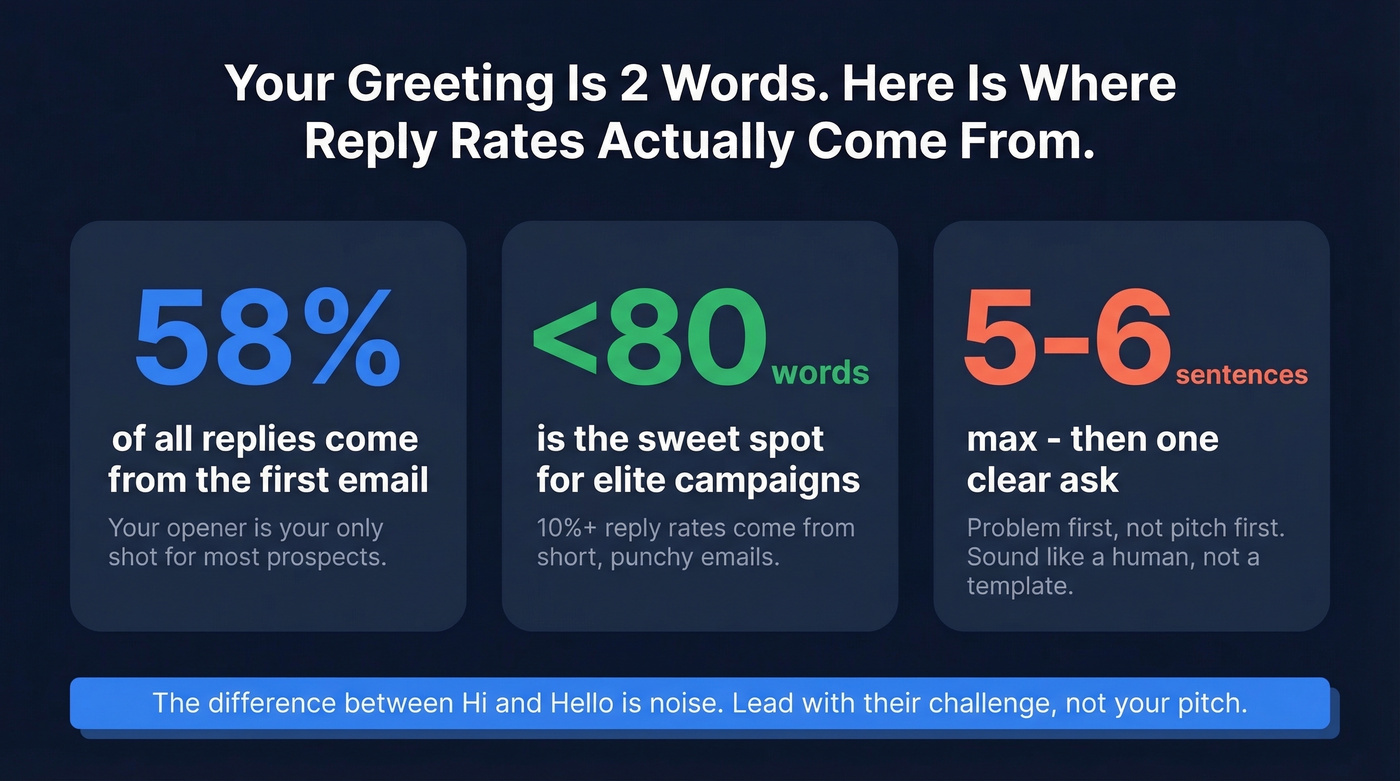
Elite campaigns hit 10%+ reply rates with emails under 80 words. The best cold emails sound like they were thumbed out on a phone - short, casual, one clear idea. We've tested dozens of greeting variants across client campaigns, and the difference between "Hi" and "Hello" is noise. What actually moves reply rates is leading with their challenge, not your pitch. Five to six sentences max. One ask.
The practitioners on r/coldemail are consistent: problem-first messaging with simple language and a clear CTA beats clever copy every time. Your greeting just needs to not get in the way.
Bad Data Kills Your Greeting
"Hi {{firstName}}" becomes "Hi null" - or worse, "Hi Jhon" - when your prospect data is garbage. A misspelled name is a credibility killer that no amount of clever copywriting recovers from. Even the best cold email greetings fall flat when the name is wrong.
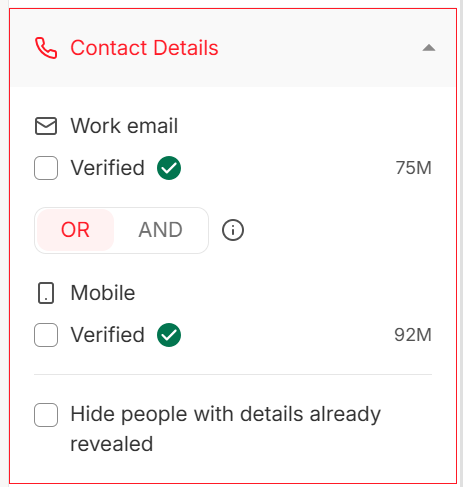
Prospeo catches this before you send. Its 5-step verification delivers 98% email accuracy across 143M+ verified addresses, with data refreshed every 7 days - most major providers refresh on 6-week cycles. It integrates natively with Instantly, Lemlist, and Smartlead, so verified names flow directly into your personalization tokens. The free tier gives you 75 verified emails per month to test it, plus 100 Chrome extension credits.
If you're building lists from scratch, start with a clean lead generation workflow and add data enrichment services before you verify.
The perfect cold email greeting means nothing if it lands in spam. Prospeo's 143M+ verified emails with catch-all handling and spam-trap removal keep your sender reputation clean - at $0.01 per email. Native integrations with Instantly, Lemlist, and Smartlead push verified names straight into your personalization tokens.
Clean data in, replies out. Start with 75 free verified emails.
FAQ
Do greetings like "Hi" or "Hello" actually affect reply rates?
Barely. A/B tests show negligible differences between standard salutations. Default to "Hi [First Name]" and spend your optimization energy on the first sentence - that's where 80%+ of reply-rate variance lives.
Should I skip the greeting entirely?
Question-led openers with no salutation work well in tech and startup verticals, often matching or beating standard greetings in reply rate. Test it against your current opener with a 200-send split.
How do networking email greetings differ from cold outreach?
Networking greetings reference a shared connection, event, or community upfront - "Hi [Name], we're both in [group]" - giving you a warmer entry point. Cold emails don't have that luxury, so they rely on brevity and relevance to earn attention instead.
How do I personalize greetings at scale without errors?
Use a verified data source with accurate first names and a short refresh cycle. Merge tags pull correct names when your underlying data is clean - if it isn't, you're sending "Hi null" at scale, which is worse than no personalization at all.