

Cold Reply Examples: Emails That Get Replies and Scripts for When They Do
You sent 500 cold emails last week. Three people replied. You stared at all three for ten minutes, unsure what to type back.
The irony of cold outreach is that everyone obsesses over getting replies - and nobody prepares for what happens when they actually show up. This guide covers both sides: cold reply examples that earn responses, and the scripts you need when someone finally writes back.
"Cold replies" means two things. It's the outbound emails designed to earn a response, and it's the scripts you use once someone responds. Most guides cover the first half and ignore the second entirely. The average reply rate sits at 3.43%, so when someone does write back - even negatively - you can't afford to fumble it.
What You Actually Need
You don't need 27 templates. You need 3 outbound emails, a 4-step follow-up sequence, and 5 reply scripts. That covers every scenario: the prospect who's interested, the one who says "not now," the one who tells you to get lost, the redirect, and the objection. The structure - context, outcome, soft CTA - adapts to any vertical, whether you're selling SaaS, agency services, or recruiting.
What Good Reply Rates Look Like
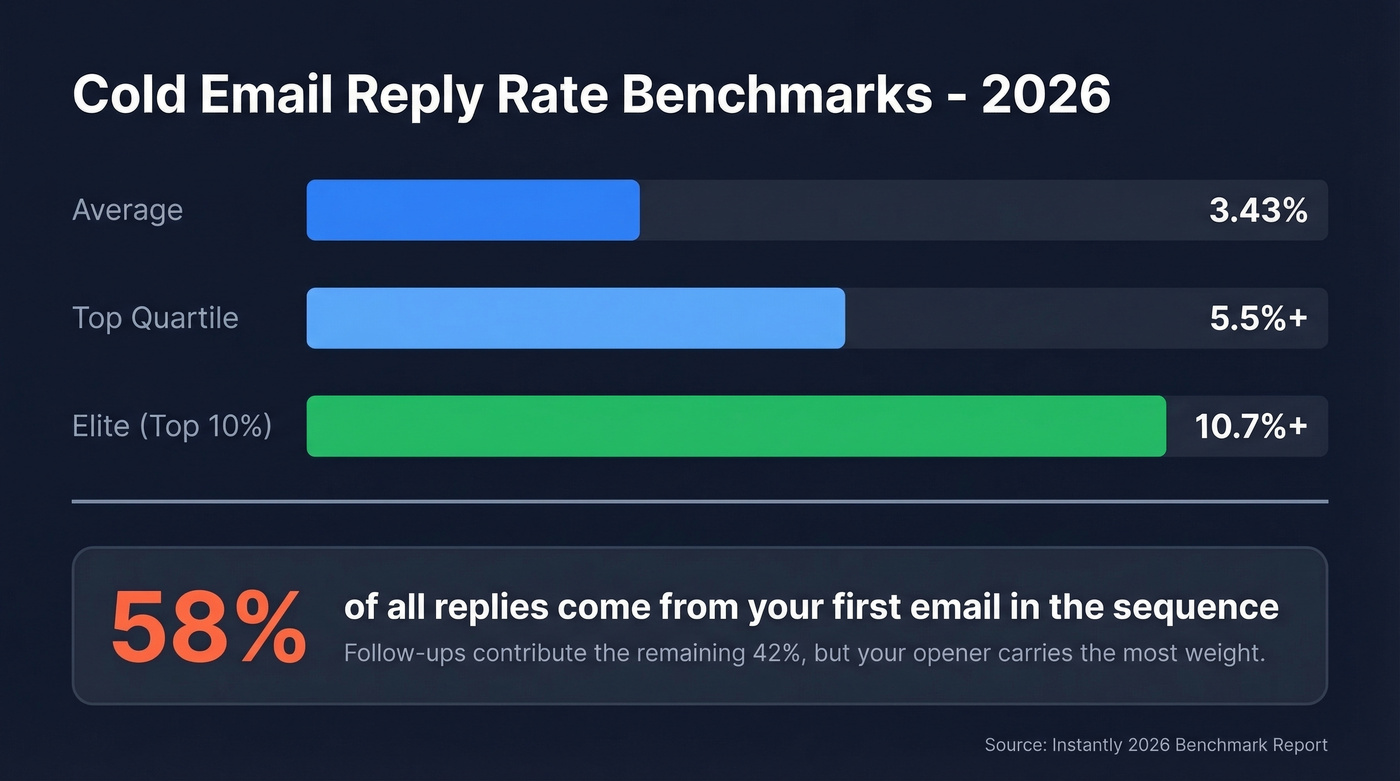
Before you rewrite a single email, know where you stand. The 2026 benchmark report analyzed billions of cold emails and landed on these tiers:
| Performance Tier | Reply Rate |
|---|---|
| Average | 3.43% |
| Top Quartile | 5.5%+ |
| Elite (Top 10%) | 10.7%+ |
One stat that should reshape your priorities: 58% of all replies come from Step 1 of a sequence. Your first email carries most of the weight. Follow-ups contribute the remaining 42%, which still matters - but if your opening email is weak, no amount of follow-up saves it.
Below 3% consistently? Fix your data quality, targeting, and deliverability before you touch your copy.
Cold Emails That Earn Replies
Most high-performing cold emails share three traits: they're under 80 words, they lead with relevance to the prospect, and they end with a soft CTA.
Value-First Template
Lead with something the prospect can use, not something you want to sell. One line of context, one specific outcome, one soft ask.
Hi {{firstName}},
Noticed {{company}} is scaling the outbound team - congrats on the growth. We helped [similar company] cut rep ramp time from 10 weeks to 4 while tripling pipeline.
Worth a quick conversation?
The prospect knows why you're reaching out, what's in it for them, and what you're asking. No fluff, no "I hope this email finds you well."
Trigger-Based Template
Hi {{firstName}},
Saw {{company}} just closed a Series B - congrats. Most teams at this stage burn 3-4 months building outbound infrastructure from scratch.
We've helped 3 post-Series B teams get their first 50 qualified meetings within 60 days. Interested?
Trigger-based emails outperform generic outreach because they answer the prospect's unspoken question: "Why are you emailing me right now?" Funding rounds, job changes, and hiring signals all qualify. The trigger makes the timing feel intentional, not random.
Social Proof Template
Bake a one-line case study directly into the email. Don't attach a PDF. Don't link to a landing page. Just state the result.
Hi {{firstName}},
{{Similar company}} was booking 8 demos/month from cold outbound. After switching to our approach, they hit 31 in 90 days - same team size, same market.
Would it make sense to show you what changed?
The case study does the selling. The CTA stays soft. In our experience, this template consistently outperforms the others when you have a strong proof point - the specificity of "8 demos to 31" does more persuading than any paragraph of benefits ever could.
Right Person Template
You pulled a list of 200 contacts and you're only 60% sure you've got the right titles. Instead of guessing, lean into it.
Hi {{firstName}},
I'm trying to reach whoever handles outbound pipeline at {{company}}. If that's you, I'd love to share how we helped [similar company] add $200K in qualified pipeline in one quarter.
If it's someone else, would you mind pointing me in the right direction?
The "am I reaching the right person?" angle works because it's low-pressure. People forward these. Some reps intentionally email a level below the decision-maker, knowing the redirect reply gives them an internal referral.
Subject Lines That Get Opened
The average cold email open rate is 27.7%. Worse, 70% of mark-as-spam decisions are triggered by the subject line alone - most prospects who aren't interested won't tell you, they'll just flag you.
What works:
- Keep it to 2-3 words. Short subjects look like internal emails, not marketing blasts.
- One practitioner's A/B test on r/coldemail pulled 39% opens with "Quick question" - simple and curiosity-driven.
- Company name subjects like "{{company}} + outbound" hit 33% opens in the same test.
- "Partnership opportunity" lands under 19% opens. It screams mass email. Skip it.
The pattern is clear: subject lines that look like a colleague wrote them outperform anything that sounds like a pitch.
If you want more options, pull from a swipe file of subject lines and test them in batches.

Your cold reply templates are worthless if they bounce. 35% bounce rates kill deliverability and destroy your domain reputation. Prospeo's 98% email accuracy and 7-day data refresh mean every email in your sequence lands in a real inbox - so those carefully crafted scripts actually get read.
Stop writing perfect cold emails to dead inboxes.
The Follow-Up Sequence
48% of salespeople never follow up once. That's staggering.
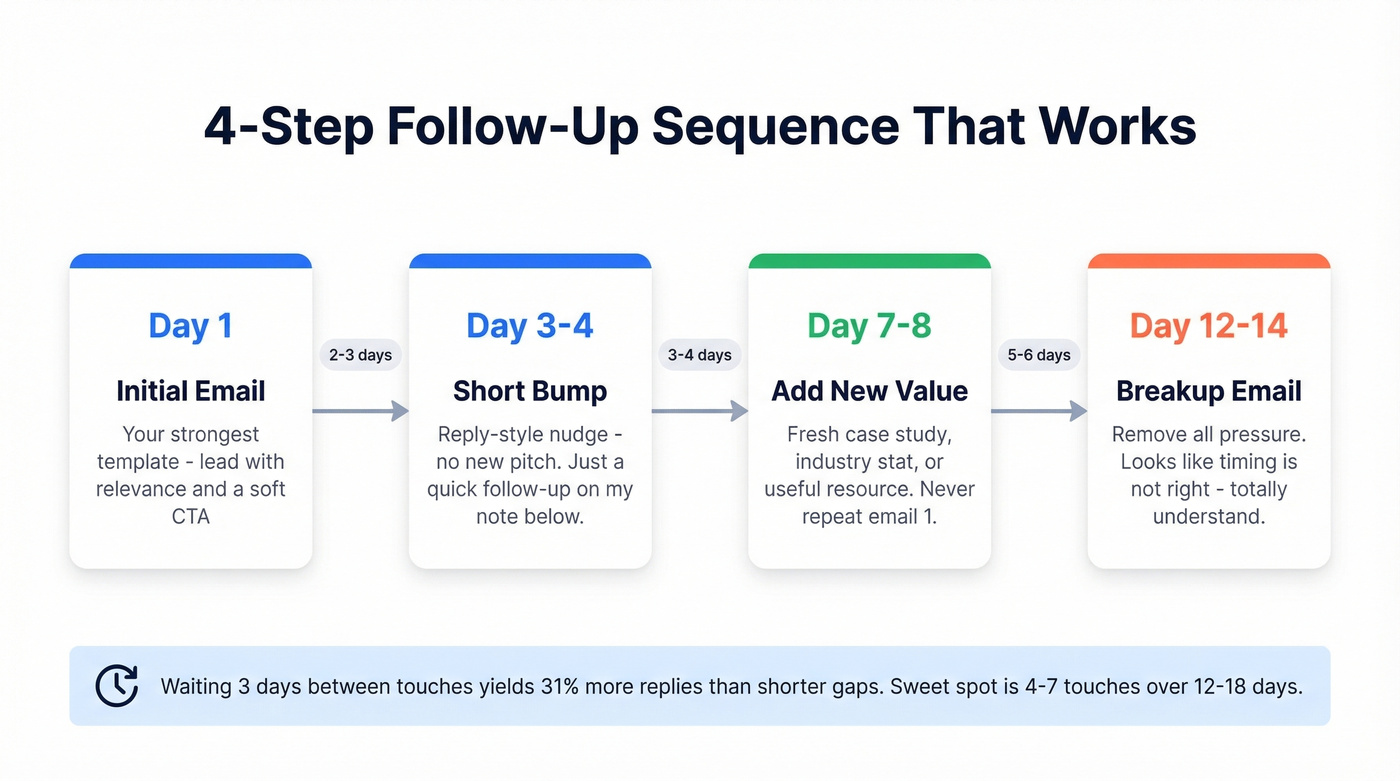
Here's the cadence we've seen work best:
Day 1: Initial email - your strongest template from above.
Day 3-4: Short bump. Make it feel like a reply, not a new pitch. "Quick follow-up on my note below - worth a look?" This technique outperforms formal follow-ups by roughly 30%.
Day 7-8: Add new value. A relevant case study snippet, a stat about their industry, or a resource they'd actually use. Don't repeat your first email.
Day 12-14: Breakup email. "Looks like the timing isn't right - totally understand. If outbound pipeline becomes a priority down the road, I'm easy to find." Breakup emails pull high reply rates because they remove pressure entirely.
Waiting 3 days between touches yields 31% more replies than shorter gaps. The sweet spot is 4-7 touchpoints over 12-18 days. Beyond 7 touches, you hit diminishing returns unless each one adds genuinely new context.
If you need more variations, keep a set of follow-up templates ready so you’re not improvising mid-sequence.
Reply Scripts for Every Response Type
This is the section most cold email guides skip entirely. You got a reply - now what?
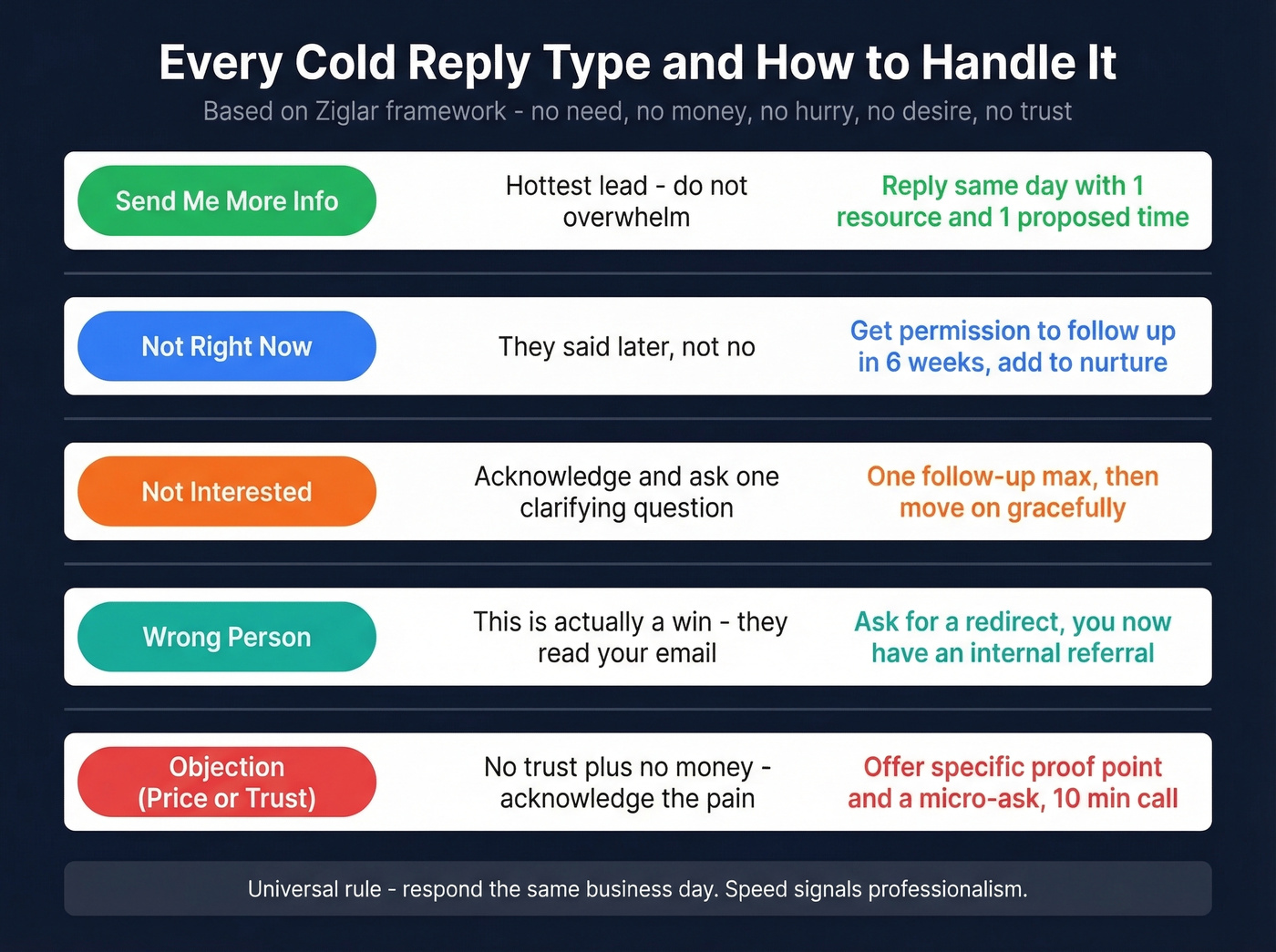
Every response maps to one of five core obstacles from Ziglar's framework: no need, no money, no hurry, no desire, no trust. The process for each follows the same spine: pause, acknowledge, clarify, offer value, or exit gracefully.
"Send Me More Info"
This is your hottest lead. Don't blow it by sending a 40-page deck. Always reply the same business day.
Thanks, {{firstName}} - here's a 2-minute case study showing how [similar company] added $200K in pipeline last quarter: [link]. Happy to walk through what would look different for {{company}}. Does Thursday or Friday work for 15 minutes?
One resource. One proposed time. That's it.
"Not Right Now"
The prospect isn't saying no. They're saying later. Validate and get permission to follow up.
Totally get it - timing is everything. Mind if I circle back in 6 weeks? I'll keep it short and only reach out if we've got something relevant to share.
Add them to a nurture sequence. Don't let them disappear into a spreadsheet graveyard.
"Not Interested"
Here's the thing - some of these sting. One Reddit user shared a reply they received: "Not interested right now. Also, you don't have a website. I'd recommend getting one." Pause, acknowledge, and either ask one clarifying question or exit gracefully.
Appreciate the honesty, {{firstName}}. Out of curiosity - is it the timing, or is this just not a priority for {{company}} right now? Either way, no hard feelings.
If they don't respond, move on. Don't chase brush-offs past one follow-up.
"Wrong Person"
This is actually a win. Someone read your email and is willing to help.
Thanks for letting me know - really appreciate it. Any chance you could point me to the right person on the team? Happy to take it from here so it doesn't land back in your inbox.
Objection: Price, Trust, or "Burned Before"
A real reply from r/coldemail: "I've been burned before and charged a lot for appointments that weren't qualified." This is the "no trust" and "no money" bucket combined. Acknowledge the pain, offer proof, and make a micro-ask.
I hear you - and honestly, that's exactly why we built [specific guarantee or proof point]. Here's a case study from a team that had the same concern: [link]. Would a 10-minute call to see if we're even a fit be worth it? No commitment.
The key across all five types: respond the same business day. Speed signals professionalism and keeps momentum alive.
Reply Killers to Avoid
Seven mistakes that reliably lead to silence:
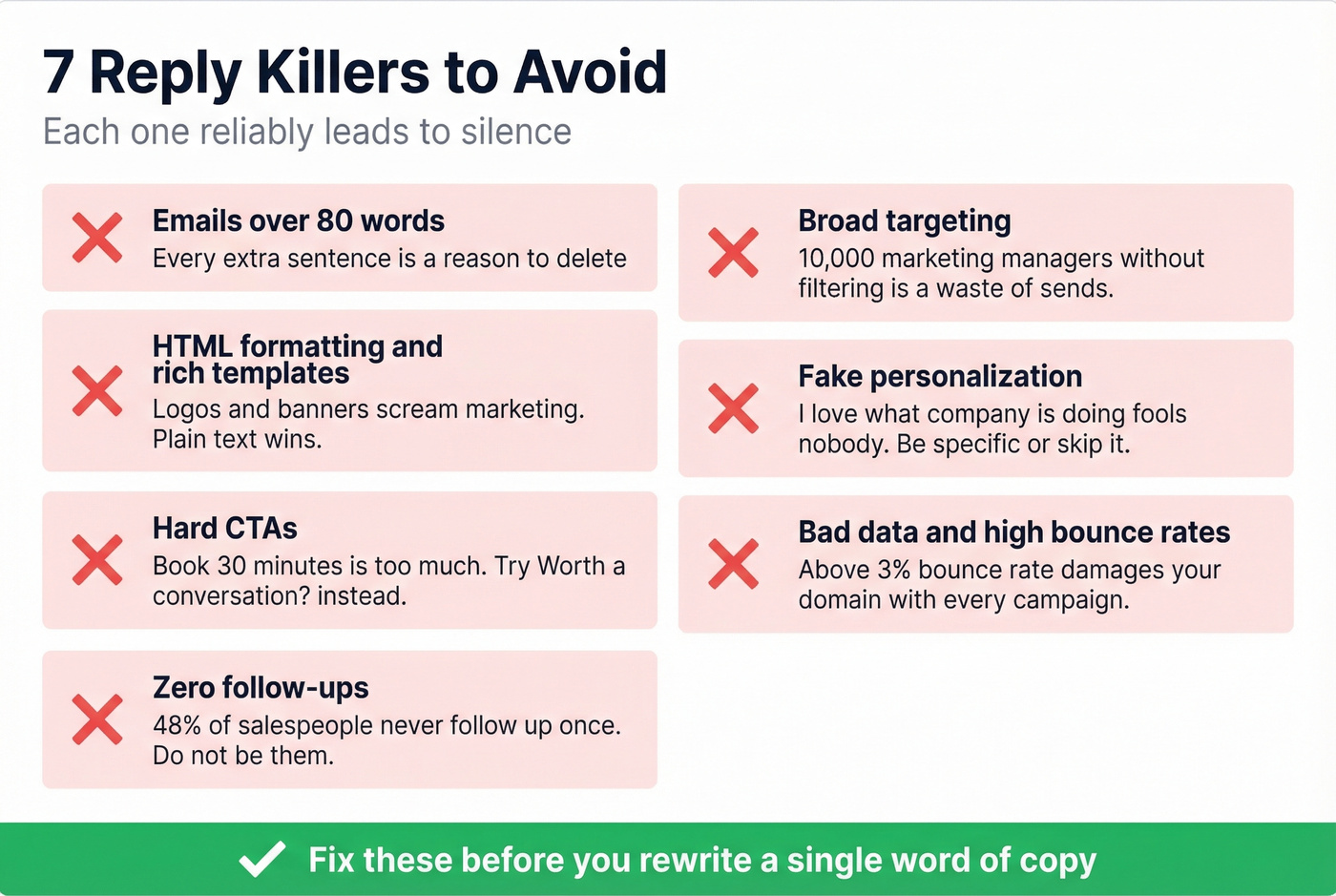
Emails over 80 words. The 2026 benchmarks confirm shorter wins. Every extra sentence is a reason to delete.
HTML formatting. Rich templates with logos and banners scream marketing. Plain text looks like a real email.
Hard CTAs. "Book 30 minutes on my calendar" is too much commitment for a stranger. Use "Worth a conversation?" or "Interested?" instead.
Zero follow-ups. You're leaving nearly half of potential replies on the table.
Broad targeting. Emailing 10,000 "marketing managers" without filtering by company size, industry, or intent is a waste of sends.
Fake personalization. "I love what {{company}} is doing in the {{industry}} space" fools nobody. Reference something specific or skip it.
Bad data. If your bounce rate is above 3%, your domain reputation takes damage with every campaign. Verify every email before it enters your sequence.
If you’re troubleshooting, start with bounce-rate basics and bounce rate codes before changing your copy.
Infrastructure That Drives Replies
Let's be honest: if your deal sizes sit below five figures, copy tweaks won't save you. Infrastructure will.
A practitioner on r/Entrepreneur shared a detailed case study: their reply rate dropped from 8% to 3% over 18 months. After rebuilding their infrastructure, they hit 6%. Here's what changed:
- Expanded from 3 domains to 7, capped each at 26 emails/day
- Manually verified every address - bounce rate dropped from 11% to under 2%
- Shortened emails from 141 words to under 56
- Sent only Tuesday through Thursday, 8-11 AM in the recipient's timezone
Total stack cost: roughly $420/month. Result: 16 qualified leads per month.
Copy matters less than infrastructure. The checklist for B2B prospecting campaigns:
Warm new domains for 2-3 weeks before sending any cold email. Cap daily sends at 25-30 per domain - scale with more domains, not higher volume. Pair with a sequencing tool like Instantly, Smartlead, or Saleshandy. Send Tuesday-Thursday in the recipient's timezone. Wednesday consistently pulls the highest reply rates. Verify every email before it enters a sequence. Prospeo runs a 5-step verification process - catch-all handling, spam-trap removal, honeypot filtering - and delivers 98% accuracy at roughly $0.01 per email with a free tier. There's no reason to send a single cold email to an unverified address.
To keep volume safe, set clear email velocity limits and monitor sender health with email reputation tools.
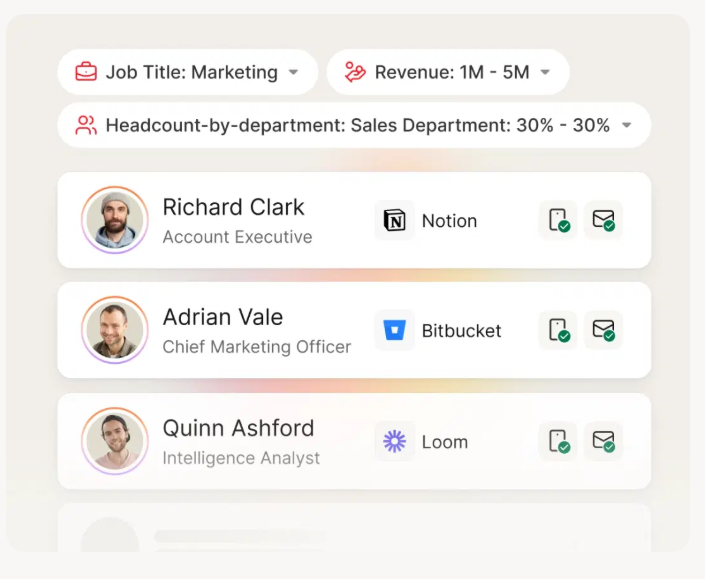
The article says it: below 3% reply rates, fix your data before touching your copy. Prospeo gives you 300M+ verified contacts with 30+ filters - buyer intent, job changes, funding signals - so your trigger-based emails hit the right person at the right moment. At $0.01 per email, scaling from 500 to 5,000 sends costs less than lunch.
Send fewer emails, get more replies - start with better data.
FAQ
What's a good cold email reply rate in 2026?
Average is 3.43%. Top performers hit 5.5%+, and elite campaigns exceed 10.7%. If you're below 3%, prioritize data quality and email length before rewriting copy.
How long should a cold email be?
Forty to sixty words is the sweet spot. The 2026 benchmarks confirm emails under 80 words outperform longer ones across every metric - open rate, reply rate, and positive sentiment.
How many follow-ups should I send?
Four to seven touchpoints over 12-18 days. Space them at least 3 days apart - this cadence yields 31% more replies than shorter gaps.
How should I respond to a negative cold email reply?
Acknowledge the response, ask one clarifying question ("Is it the timing, or not a priority?"), and exit gracefully if they don't engage. Never chase a brush-off past one follow-up - it damages your reputation and wastes selling time.