

How to Collect Email Addresses That Actually Convert
Your list hasn't grown in three months. Brevo's analysis of 44+ billion emails confirms what you already suspect: the teams winning at email marketing aren't the ones with the biggest lists - they're the ones with the freshest, most verified contacts. Your email list is first-party data you actually own. Ad costs keep climbing, third-party cookies are dead, and that list is the most valuable marketing asset you can build.
Here's the thing: most advice on collecting email addresses reads like a 2018 blog post reheated with new screenshots. We've spent months testing capture tools, digging through benchmark studies, and watching what actually moves the needle for our users. This is what works now.
What You Need (Quick Version)
Your path depends on your business model:
- Ecommerce / content creators: Popup tool + lead magnet + exit-intent trigger. Expect a 3.2% mean conversion rate on opt-in forms.
- B2B sales teams: Email finder + verification + outbound sequences. Prospeo searches 300M+ professional profiles with 98% email accuracy, and there's a free tier to test.
- Everyone: Verify before you send. Roughly 22.5% of your list decays every year. Skip verification and you'll tank your sender reputation.
Inbound Methods to Build Your List
Over 70% of first-time visitors never return to your site. Every pageview without an email capture opportunity is a permanent loss. The fix isn't one popup - it's a layered system that gives visitors multiple, non-annoying chances to opt in. Extra form fields reduce conversions, so stick to email-only wherever possible.
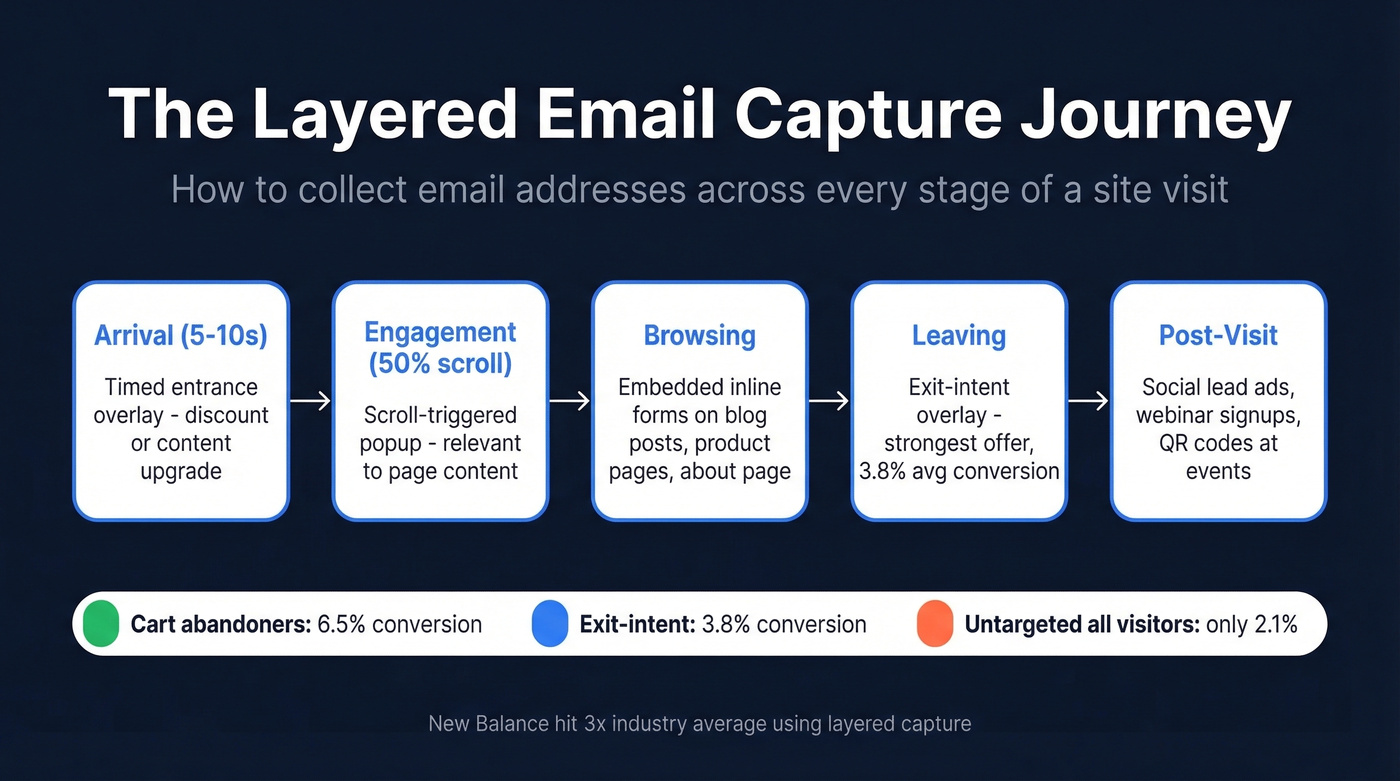
Think of it as a capture journey across the visit:
1. Entrance overlay (timed). Show a simple offer 5-10 seconds after arrival. A discount, content upgrade, or quiz entry works. Don't gate the entire site behind it.
2. Embedded forms on high-traffic pages. Blog posts, product pages, and your about page should all have inline opt-in forms. They convert lower than popups but compound over time - and they don't annoy anyone.
3. Scroll-triggered popups. Trigger at 50% scroll depth. By that point, the visitor has shown real interest. Offer something relevant to the content they're reading.
4. Exit-intent overlays. Your last shot. Exit-intent popups convert at 3.8% on average - higher than scroll or time-delay triggers. Use a stronger offer here: free shipping, a bonus resource, or a limited-time discount.
5. Floating buttons and slide-ins. Less aggressive than popups, always visible. The Sill saw a 126% lift in lead-to-customer conversion using floating buttons.
6. Quizzes, spin-to-wins, and interactive content. Quizzes tap into reciprocity - people give their email to see results. Spin-to-win discount wheels are the ecommerce variant: lower perceived value than quizzes but high novelty factor. Spongelle saw a +131% lift in lead generation after adding interactive capture elements.
7. Webinar and event registrations. Webinars are having a moment again in 2026 because you can't fake a 90-minute live session with AI. The registration form captures the email, and the content builds trust.
8. Social campaigns and lead ads. Run lead-gen ads on platforms where your audience already hangs out. The form is pre-filled, friction is minimal, and you can pipe leads straight into your ESP.
9. Checkout opt-in (ecommerce). Add a checkbox at checkout. Cart abandoners convert at 6.5% on targeted opt-in widgets - the highest of any targeting segment.
10. QR codes at events and in-store. Physical touchpoints still work. Link the QR code to a mobile-optimized landing page with a single-field form.
Don't rely on any single tactic. Layer them. New Balance ran a layered approach and hit 3x the industry average for lead capture. BYLT Basics saw +30% lead-to-customer conversions after stacking multiple capture points across their site.
Outbound: Finding B2B Emails at Scale
Every guide on email collection assumes you're waiting for people to come to you. That's fine for ecommerce. It doesn't work when you're a B2B sales team that needs 500 verified emails for a targeted outbound campaign by Friday.
Outbound email collection means proactively finding professional email addresses for specific prospects, verifying them, and feeding them into sequences. The workflow is straightforward: build your ICP list, find emails, verify, push to your sequencer.
Prospeo is built for this. Search across 300M+ professional profiles using 30+ filters - job title, industry, company size, technographics, and buyer intent. The Chrome extension (40,000+ users) pulls verified emails and mobile numbers from any company website or professional profile in one click. Every email runs through a 5-step verification process including catch-all handling, spam-trap removal, and honeypot filtering, and the database refreshes every 7 days versus the typical competitor refresh cycle of around 6 weeks.

One example: Meritt tripled their pipeline from $100K to $300K per week, and their bounce rate dropped from 35% to under 4%.
What Conversion Rates to Expect
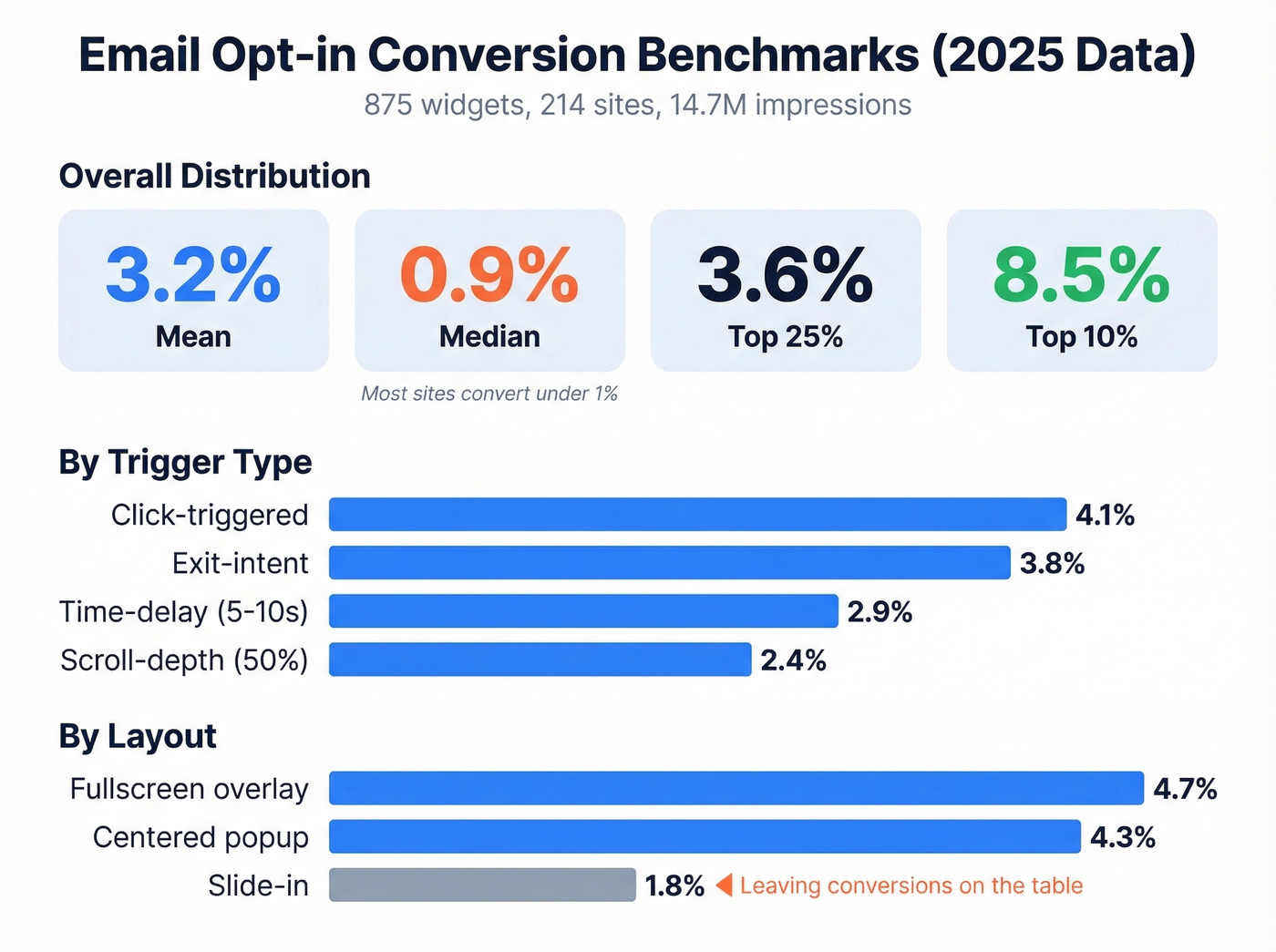
Let's ground this in real numbers. A 2025 analysis of 875 opt-in widgets across 214 sites (posted on r/Emailmarketing) covered 14.7 million impressions and 473,000 subscriptions:
| Metric | Rate |
|---|---|
| Mean | 3.2% |
| Median | 0.9% |
| p75 | 3.6% |
| p90 | 8.5% |
That gap between mean and median tells you something important: a small number of well-optimized forms pull the average way up. Most sites convert under 1%. If you're above 3.2%, you're outperforming the majority.
Trigger Type Benchmarks
| Trigger | Conversion |
|---|---|
| Click-triggered | 4.1% |
| Exit-intent | 3.8% |
| Time-delay (5-10s) | 2.9% |
| Scroll-depth (50%) | 2.4% |
Click-triggered forms - where the visitor actively clicks a button to open the popup - convert highest because they're self-selecting. Exit-intent is your best passive trigger.
Layout Benchmarks
| Layout | Conversion |
|---|---|
| Fullscreen overlay | 4.7% |
| Centered popup | 4.3% |
| Slide-in | 1.8% |
Fullscreen overlays on mobile command attention in a way slide-ins simply can't. If you're still using a polite little slide-in as your primary capture method, you're leaving conversions on the table.
Targeting and Timing
Cart abandoners convert at 6.5%, returning visitors at 3.9%, and untargeted "all visitors" forms manage just 2.1%. Segment your popups.
Mobile slightly outperforms desktop (3.6% vs 2.9%). Seasonality is real too - BFCM drives a 65% uplift, Christmas 42%, Valentine's Day 28%, and Back to School 19%. Plan your capture campaigns around these windows.

Popups and lead magnets collect inbound emails. But B2B teams need outbound lists now - not next quarter. Prospeo searches 300M+ profiles with 30+ filters, verifies every email through a 5-step process, and refreshes data every 7 days. Meritt dropped their bounce rate from 35% to under 4%.
Collect 500 verified emails by Friday - starting at $0.01 each.
Best Lead Magnets for 2026
Over 50% of marketers report higher conversion rates after implementing lead magnets. But not all magnets pull equally.
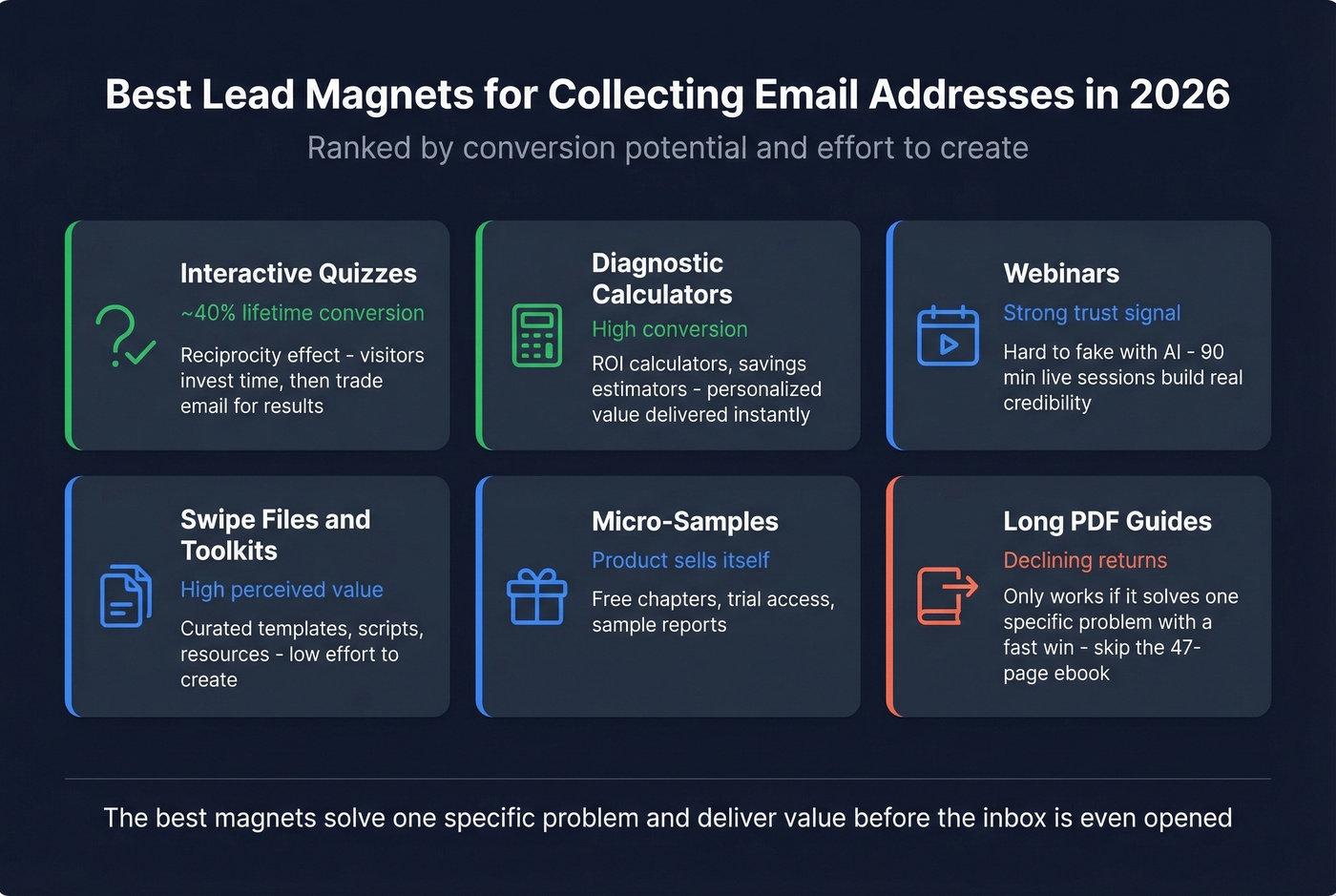
Quizzes are the standout format right now. They tap into reciprocity - visitors answer questions, invest time, and then willingly hand over their email to see results. Interactive quiz platforms report roughly 40% lifetime conversion rates. That's an order of magnitude above a static PDF download.
Beyond quizzes, the formats that consistently perform:
- Diagnostic calculators - ROI calculators, savings estimators, readiness assessments. They deliver personalized value instantly.
- Swipe files and toolkits - curated collections of templates, scripts, or resources. Low effort to create, high perceived value.
- Micro-samples - free chapters, trial access, sample reports. Let the product sell itself.
- Webinars - they signal authenticity in ways AI-generated content can't replicate.
- Guides and playbooks - still work, but they need to solve one specific problem and deliver a fast win. A 47-page ebook nobody reads isn't a lead magnet. It's a guilt trip.
The common thread: the best magnets solve one specific problem and deliver value before the reader even opens their inbox.
Best Tools for Email Collection
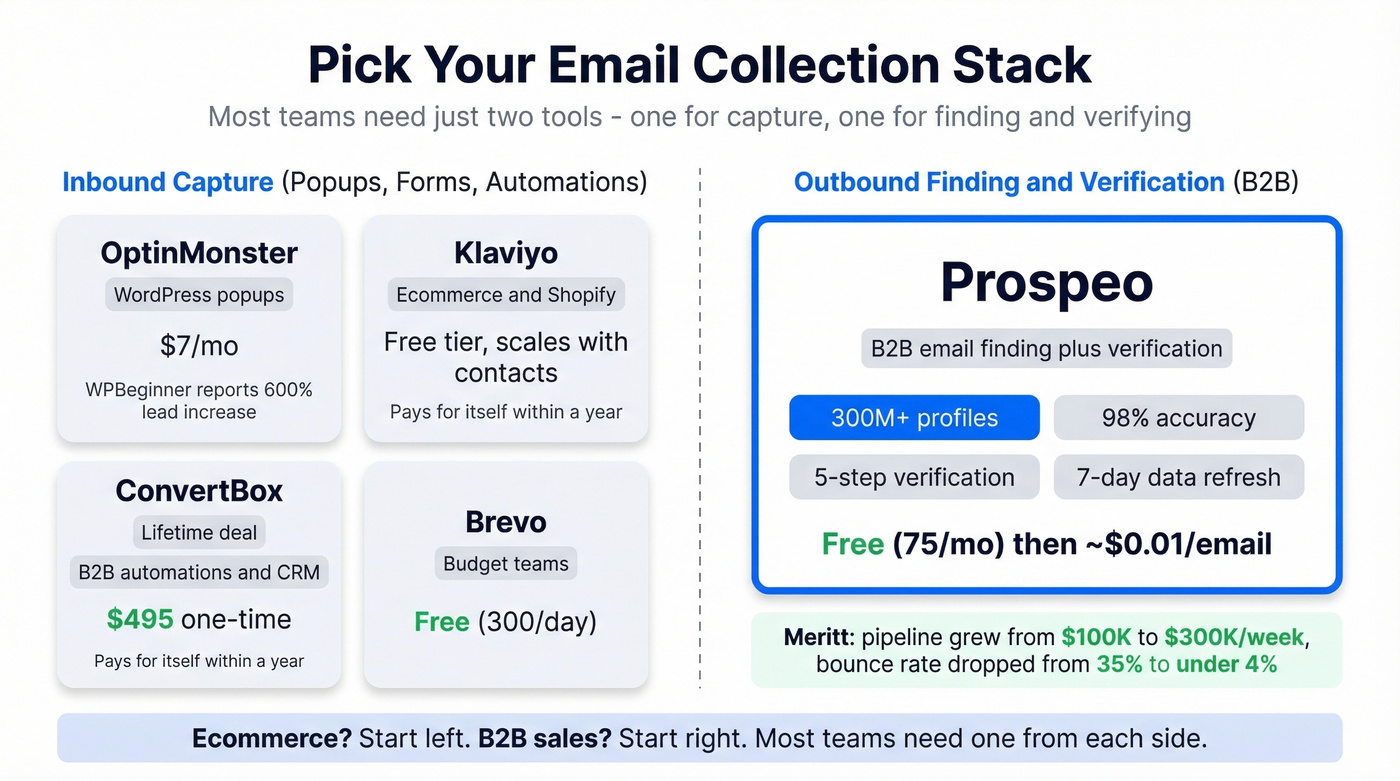
Look, most teams don't need ten tools. They need one capture tool and one verification/finding tool, matched to whether they're running inbound or outbound. Pick from this table and move on.
| Tool | Best For | Starting Price |
|---|---|---|
| Prospeo | B2B email finding + verification | Free (75/mo); ~$0.01/email |
| OptinMonster | WordPress popups | $7/mo |
| ActiveCampaign | B2B + automations | ~$29/mo |
| Klaviyo | Ecommerce | Free tier; scales |
| ConvertBox | Lifetime deal | $495 one-time |
| Brevo | Budget teams | Free (300/day); ~$25/mo |
| Thrive Leads | WordPress (annual) | $99/yr |
| Getsitecontrol | Lightweight capture | $7/mo |
| Optinly | Free-tier starters | Free; $9/mo paid |
| Mailchimp | Under 500 contacts | Free; ~$13/mo paid |
A few quick takes:
For outbound, start with Prospeo. It's not a popup tool - it's for B2B teams who need verified prospect emails proactively. 98% email accuracy, 5-step verification, self-serve pricing starting free. Different category from the rest of this list, but if outbound is your motion, nothing else here replaces it.
On Shopify? Pick Klaviyo. It owns ecommerce capture and cart abandonment flows. Outside ecommerce, it's overpriced - skip it.
Want popups and never want to pay again? ConvertBox at $495 lifetime is rare in SaaS. The math works out within a year for most teams. Skip this if you're not sure you'll need popups 12 months from now.
ActiveCampaign is the pick for B2B teams that need deep automations alongside capture. The learning curve is real, but the CRM + automation combo is hard to beat.
Brevo is the budget play. The free tier gives you 300 emails per day - enough for early-stage teams. On r/MarketingAutomation, Brevo often gets described as punching above its price point. OptinMonster is the WordPress default for a reason - WPBeginner claims a 600% lead increase using it.
Verify Before You Send
Roughly 22.5% of email addresses decay annually. People change jobs, companies shut down domains, and typos slip through forms. Every hard bounce chips away at your deliverability score, and once you're flagged as a spammer, clawing back is painful. We've seen teams with 10,000-contact lists lose inbox placement overnight because they never cleaned a single record.
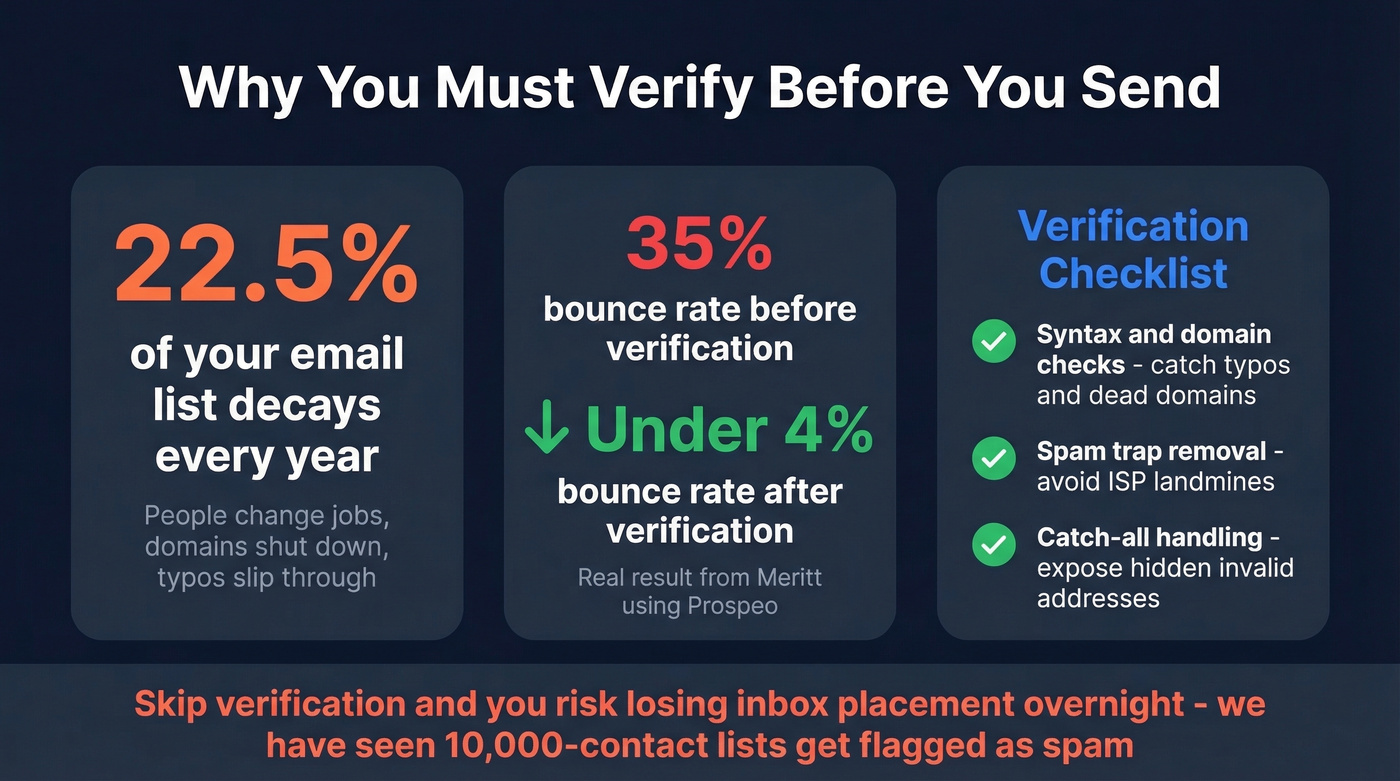
Your verification checklist:
- Syntax and domain checks - catch obvious typos and dead domains
- Spam trap removal - landmines planted by ISPs to catch sloppy senders
- Catch-all domain handling - "accept all" domains hide invalid addresses behind a false positive
- Double opt-in for inbound - confirms the person actually owns the email
- Monthly or quarterly cleaning cadence - don't wait for bounces to tell you there's a problem
- Remove hard bounces immediately after every campaign
Make sure your sending domain has SPF, DKIM, and DMARC records configured - ISPs increasingly expect all three. Snyk's 50-person sales team dropped their bounce rate from 35-40% to under 5% after switching to verified data, generating 200+ new opportunities per month.
GDPR, CAN-SPAM, and Penalties
Compliance isn't optional, and the penalties are steep enough to matter.
GDPR (if you touch EU data): explicit, informed consent is required - pre-checked boxes don't count. Keep records of consent including wording and timestamp. Fines run up to EUR 20M or 4% of global annual turnover, whichever is higher.
CAN-SPAM (US): include a physical mailing address in every email, provide a clear unsubscribe mechanism, honor opt-outs within 10 business days. Penalties reach $46,517 per email in violation.
And let's be direct about one thing: buying email lists is a deliverability death sentence. It's potentially illegal under GDPR, it tanks your sender reputation, and the engagement rates are near zero. Every major ESP - ActiveCampaign, Brevo, Mailchimp - explicitly prohibits purchased lists. Don't do it.
Mistakes That Kill Your List
Automation without personalization. Slapping a first name into a template isn't personalization. If your "personalized" recommendations are irrelevant, you're training people to ignore your emails.
Broken mobile layouts. Tiny text, broken images, CTAs you can't tap. The #1 complaint on r/EmailWhisperers is that brands still ship emails that are unusable on phones. In 2026. It's frustrating.
Over-sending. Audience fatigue leads to unsubscribes and spam complaints. Both directly hurt deliverability. More emails doesn't equal more revenue past a certain point.
No segmentation. Blasting your entire list with the same message is a 2010-era mistake that somehow persists. Segment by behavior, purchase history, or engagement level at minimum. (If you're doing outbound, this is basically intent based segmentation in practice.)
Never verifying or cleaning. If you haven't cleaned your list in six months, you're sending to dead addresses, spam traps, and people who forgot they signed up. This is the most preventable mistake on the list, and in our experience, it's the one we see most often.
Your list decays 22.5% per year. Prospeo's 7-day refresh cycle and 98% email accuracy mean every address you collect actually reaches a real inbox. No spam traps, no honeypots, no bounced sends torching your sender reputation.
Fresh, verified emails that protect your domain - not destroy it.
FAQ
How do I collect email leads without a website?
Social media lead ads, webinar registrations, and QR codes at events all capture emails without a website. For B2B teams, email finder tools let you search professional profiles and export verified contacts directly - no website needed.
What's a good popup conversion rate?
The median popup conversion rate is 0.9% and the mean is 3.2%, based on a study of 14.7 million impressions across 214 sites. If you're above 3.2%, you're outperforming most sites. Top performers (p90) hit 8.5% or higher.
Should I use single or double opt-in?
Double opt-in reduces bounces, filters bots, and strengthens GDPR compliance by confirming genuine consent. The slight friction is worth the list quality - you'll see lower unsubscribe rates and better deliverability long-term.
Is it legal to buy email lists?
It's technically legal under CAN-SPAM with conditions, but potentially illegal under GDPR without explicit consent. Purchased lists deliver near-zero engagement and damage your sender reputation. Every major ESP prohibits them - use organic capture or verified finder tools instead.
How often should I clean my email list?
Clean your list monthly or quarterly at minimum. Remove hard bounces immediately after every campaign, and run full verification at least once per quarter. With ~22.5% annual decay, waiting longer means you're sending to increasingly dead addresses.