

Compelling Events in Sales: How to Find, Build, and Use Them to Close Faster
You're scrubbing the forecast on a Thursday afternoon, and it hits you: not a single deal on the board has a real reason to close this quarter. Reps have "verbal commits" and "strong interest," but nobody can name a date that matters to the buyer. That's the gap between a forecast and a fantasy. A compelling event in sales is the single most dangerous blind spot most pipeline reviews never surface - 85% of deals lack an identified one, per SalesHood's analysis of 100,000 opportunities.
What Is a Compelling Event?
A compelling event is a time-bound business trigger that forces a decision - driven by the customer's world, not yours. The simplest diagnostic comes from a 3-part test that's held up for years:
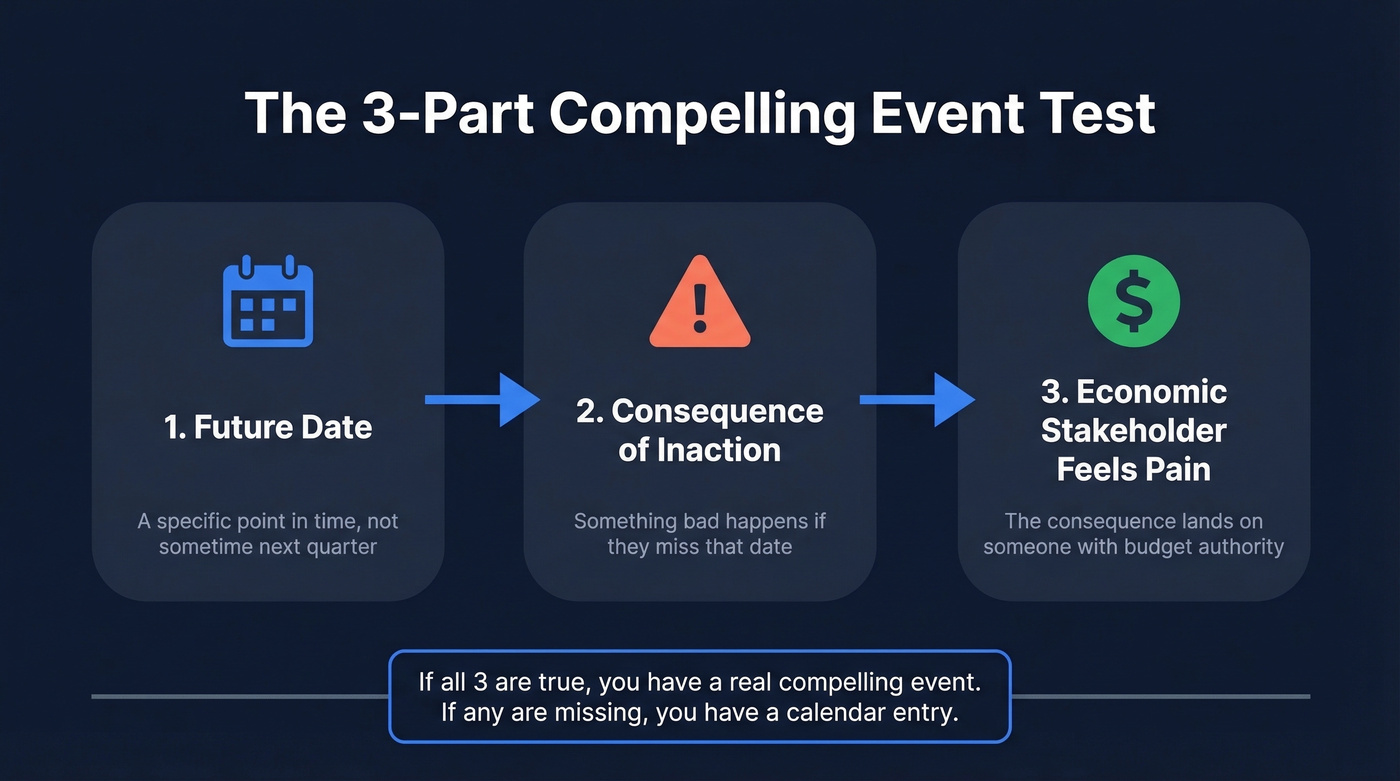
- There's a future date - a specific point in time, not "sometime next quarter."
- There's a consequence of inaction - something bad happens if they miss that date.
- An economic stakeholder feels the pain - the consequence lands on someone with budget authority.
If your "compelling event" takes more than 10 words to explain, it probably isn't one.
Quick examples that pass the test: a regulatory deadline, an expiring vendor contract with a hard renewal date, a board mandate to hit a growth number by Q3, or a product launch that requires new infrastructure by a fixed go-live. In public sector sales, these triggers often come from legislation, agency directives, or fiscal year budget deadlines - and those deadlines rarely move.
Here's the thing: there's no "T" in MEDDPICC. Timing only matters when it's tied to Pain, Metrics, and the Decision Process - not as a standalone checkbox. A date without consequences is just a calendar entry.
Real vs. Fake Buyer Urgency
Seller urgency isn't buyer urgency. Your quarter-end isn't their deadline. Let's separate the real from the fake.
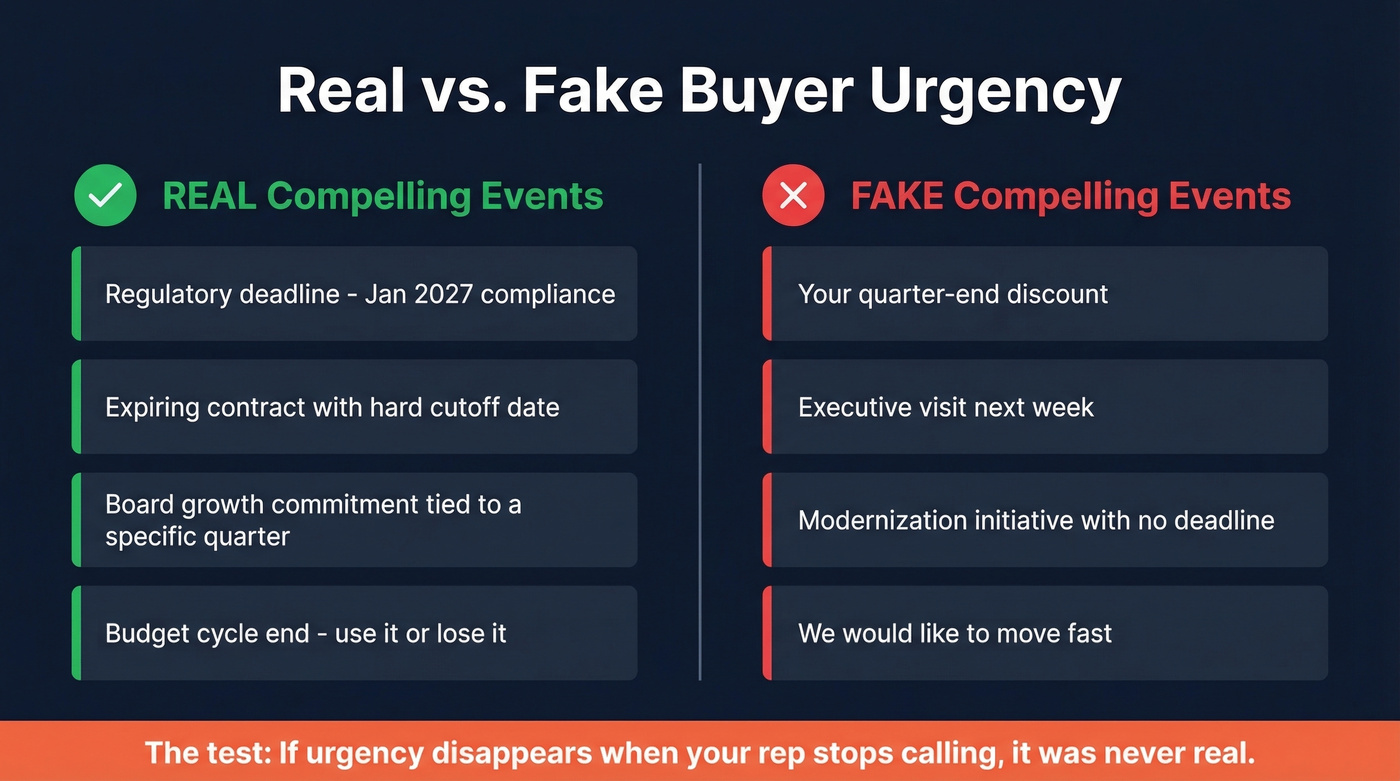
| Real Compelling Event | Fake Compelling Event |
|---|---|
| Regulatory deadline (Jan 2027 compliance) | Your quarter-end discount |
| Expiring contract with hard cutoff | "Executive visit next week" |
| Board growth commitment with a date | "Modernization initiative" |
| Budget cycle end (use-it-or-lose-it) | "We'd like to move fast" |
If the urgency disappears when your rep stops calling, it was never a real trigger.
Why These Events Drive Sales Velocity
SalesHood's 100,000-opportunity dataset found a 0.8 correlation between a customer-defined compelling event and both faster sales cycles and higher win rates. That's an unusually strong signal for something most teams don't even track in their CRM.
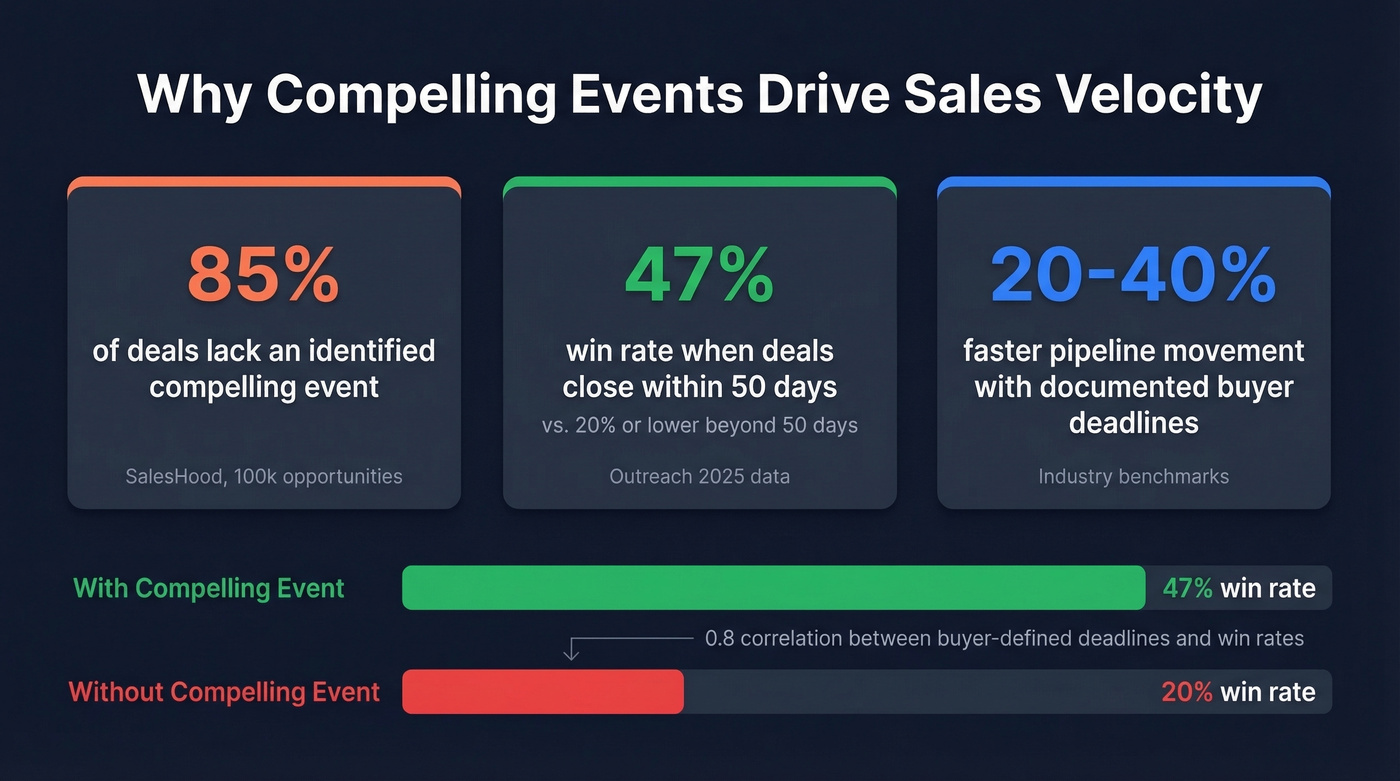
Outreach's 2025 data analysis adds another dimension: opportunities closed within 50 days hit a 47% win rate. Beyond 50 days, win rates crater to 20% or lower. Deals with documented buyer-side deadlines typically move 20-40% faster through the pipeline, which keeps them on the right side of that cliff.
In our experience, the deals that close fastest always have a date the buyer cares about - not just one the rep optimistically entered into Salesforce. Meanwhile, 34% of revenue teams report average cycles of 1-2 quarters, which is plenty of time for a deal without buyer urgency to die quietly in a spreadsheet.

Deals with compelling events move 20-40% faster - but only if you reach the right stakeholder before the deadline passes. Prospeo gives you 98% accurate emails and 125M+ verified mobile numbers so you connect with the economic buyer who actually feels the pain.
Stop losing time-bound deals to bad contact data.
15 Discovery Questions to Uncover Buyer Urgency
These questions map directly to the 3-part test. Pick 2-3 per conversation and dig into the answers.
Date Questions
- "What's driving the timeline on this initiative?"
- "Is there a specific date by which this needs to be live and operational?"
- "When does the current contract or system expire?"
- "What happens to the budget if this doesn't get approved by end of fiscal year?"
- "If you could pick the ideal go-live date, what would it be - and why that date?"
Consequence Questions
- "What happens if you don't solve this by [date they mentioned]?"
- "What's the cost of doing nothing for another 90 days?"
- "Are there compliance or regulatory implications if this slips?"
- "How does this delay affect downstream teams or commitments you've already made?"
- "What did it cost the business the last time a project like this stalled?"
Stakeholder Pain Questions
- "Who's most affected if this doesn't happen on time?"
- "Has your CFO or CRO flagged this as a priority for this year?"
- "Whose budget is this coming from, and what are they accountable for this quarter?"
- "If this initiative fails, who has to explain it to the board?"
- "Is there an executive sponsor who's personally committed to a delivery date?"
These draw from MEDDPICC and SPICED, but the goal isn't to interrogate. It's to help the prospect articulate urgency they already feel but haven't put into words. We see this question constantly in r/sales threads: reps asking how to surface a compelling event when the prospect says "we're just exploring." The answer is always the same - stop asking about timelines and start asking about consequences.
No Compelling Event? Build One.
95 out of 100 times, nobody needs to buy your product right now. Especially when it requires process change. Waiting for a trigger to appear is a losing strategy.
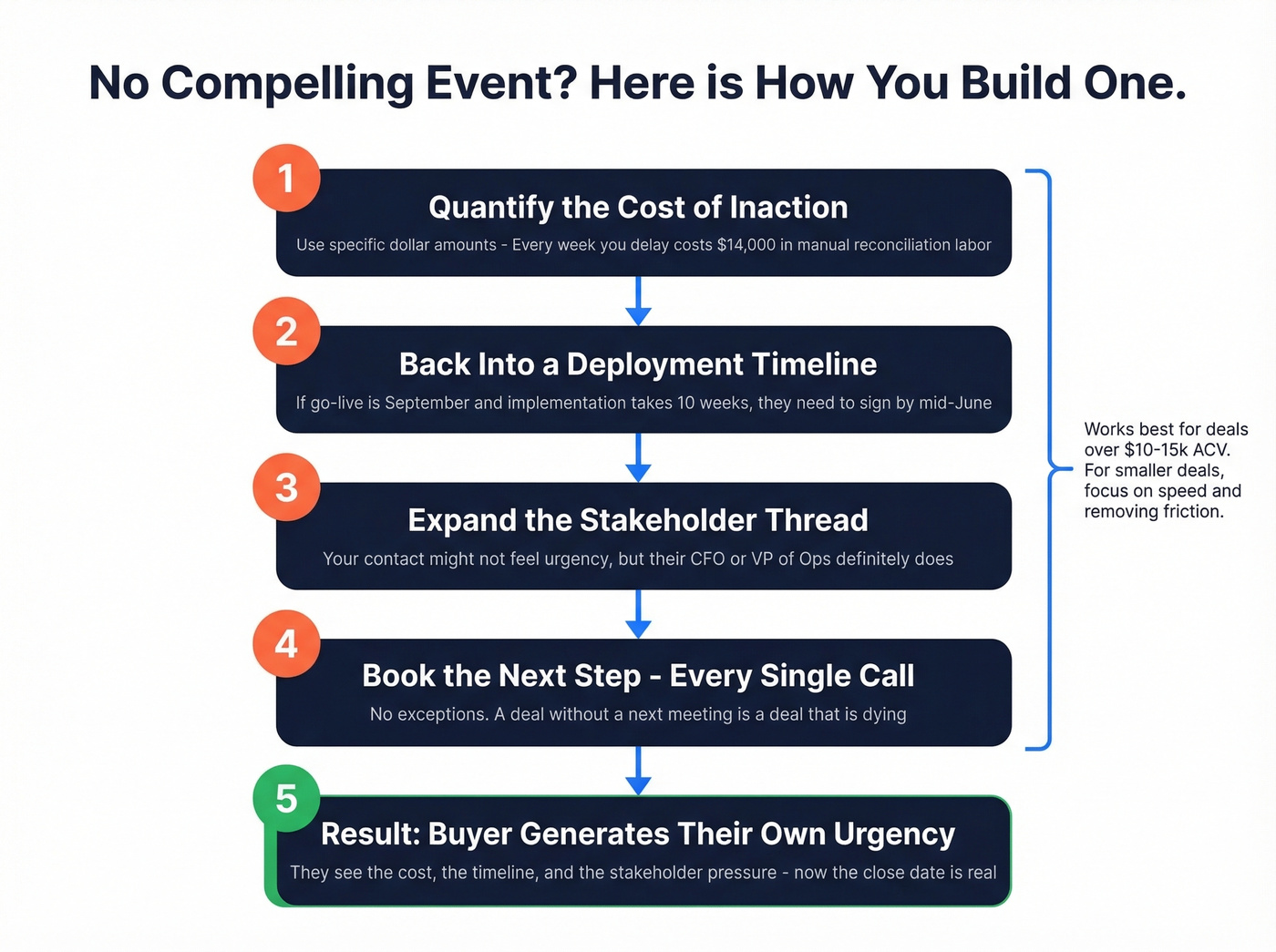
The MEDDIC Academy's approach rejects the idea that "no compelling event = no deal." Instead, you create urgency ethically by making the cost of doing nothing impossible to ignore.
Quantify the cost of inaction with specific dollar amounts. "Every week you delay, your team burns $14,000 in manual reconciliation labor" hits differently than "this will save you time." Back into a deployment timeline from there - if they need to be live by September and implementation takes 10 weeks, they need to sign by mid-June. Suddenly the close date is real and the procurement timeline starts working backward.
Book a next step after every single call. No exceptions. A deal without a next meeting is a deal that's dying. And talk to more stakeholders - the person you're speaking with might not feel urgency, but their CFO does. Their VP of Ops definitely does. Expand the thread.
For deals big enough to justify it, get on a plane. In-person meetings compress timelines in ways video calls can't. The consensus on r/sales is consistent: reps who fly out close faster because it signals commitment and creates social pressure to reciprocate.
Our honest take: Most sales qualification frameworks obsess over whether a compelling event exists. The better question is whether you can construct one. The best AEs we've watched don't find urgency - they build it by connecting dots the prospect hasn't connected yet. For deals under $10-15k in annual contract value, you probably don't need a perfect time-bound trigger. You need a fast, frictionless buying experience that removes the reason to delay.
The SPICED framework takes this further by reframing "compelling event" as "critical event" - extending urgency beyond the initial close into implementation, adoption, and renewals. That's a useful mental model for SaaS teams where the real revenue comes from expansion.
How to Operationalize This
Knowing what a compelling event is doesn't help if it lives in a rep's head and never makes it into your forecast.
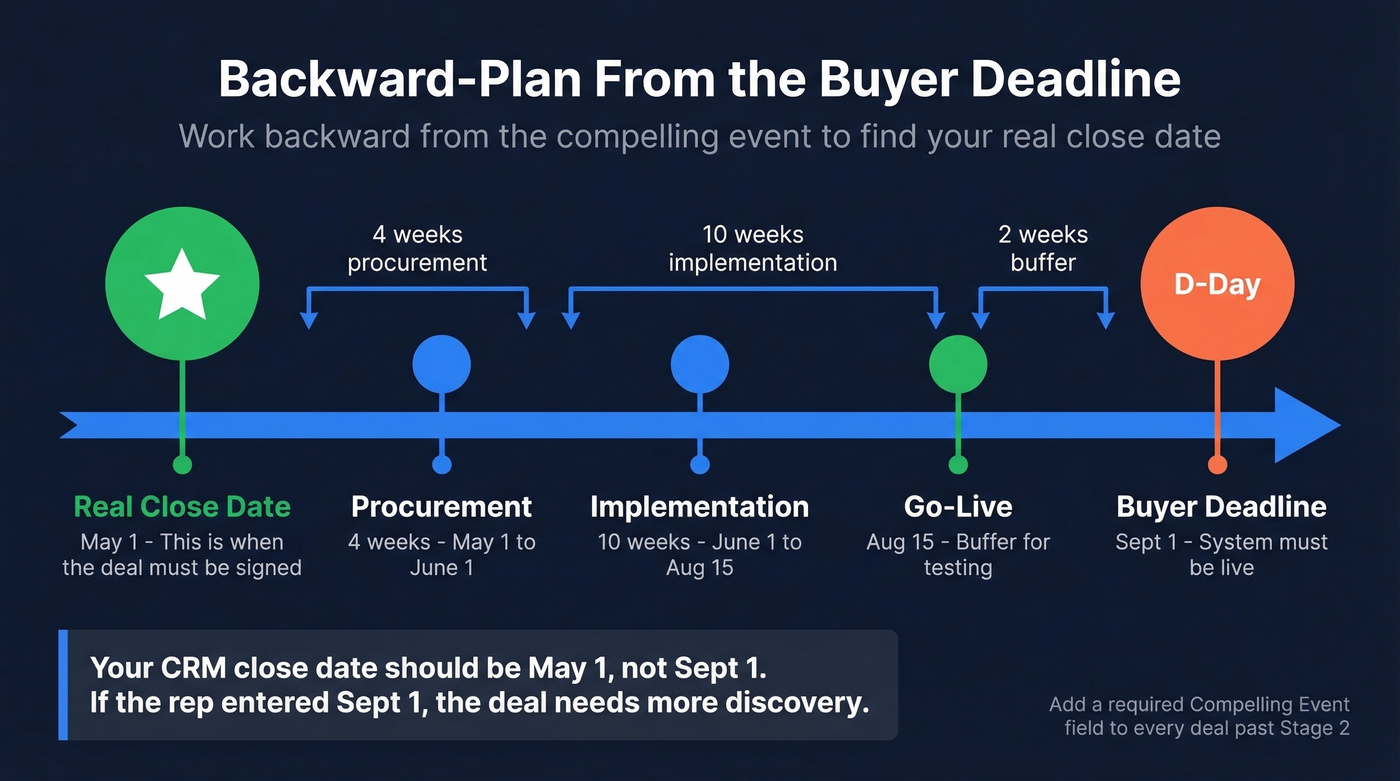
Add a compelling event field to your CRM. Salesforce custom field, HubSpot property - pick one. Make it required for any deal past Stage 2. If the field is blank, the deal doesn't belong in the forecast. Period. (If you're rebuilding your stack, compare sales forecasting solutions and best sales forecasting tools before you commit.)
Use it in pipeline reviews. Every deal review should start with: "What's the buyer's deadline, and when is it?" If the rep can't answer in one sentence, the deal needs more discovery, not more demos. (A simple pipeline health scorecard makes this visible fast.)
Backward-plan from the event. Take the deadline date, subtract procurement time, implementation time, and a buffer for internal approvals. That's your real close date - not the one the rep optimistically entered. Once you've identified buyer urgency, execution speed becomes everything. A bounced email or a stale phone number burns days you can't afford when a hard deadline is ticking. We use Prospeo for this - 98% email accuracy and a 7-day data refresh cycle means your first outreach to the economic buyer actually lands, and 125M+ verified mobiles with a 30% pickup rate beats guessing at switchboard numbers. (If you're building a repeatable motion, pair this with sales prospecting techniques and sales follow-up templates.)
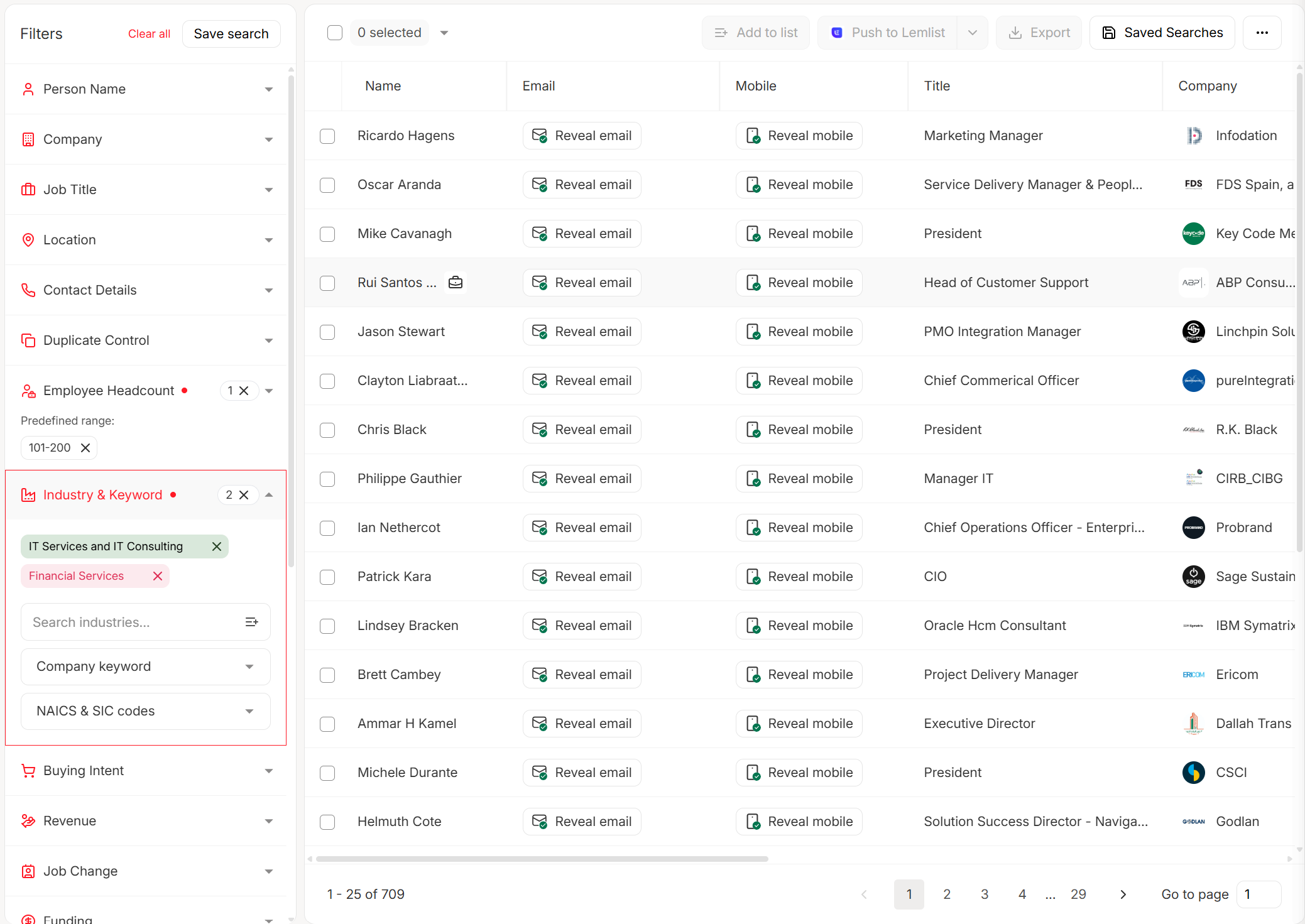
Building urgency means reaching more stakeholders - the CFO, the VP of Ops, the executive sponsor. Prospeo's 30+ search filters including buyer intent, job changes, and funding signals help you identify who's feeling the pain right now, with contact data refreshed every 7 days.
Expand the thread before the compelling event expires.
FAQ
What's the difference between a pain point and a compelling event?
A pain point is an ongoing problem the prospect tolerates indefinitely. A compelling event adds a hard deadline and consequences to that pain. Pain without a date is a wish list. Pain with a date and a stakeholder accountable for the outcome is a deal that moves - typically 20-40% faster through the pipeline.
Can you create a compelling event if one doesn't exist?
Yes. Quantify the cost of inaction with specific dollar amounts and back into a deployment timeline that creates a natural deadline. When the prospect sees that delay costs them $14,000 per week in manual labor or puts a board commitment at risk, they generate their own urgency. Skip this approach for very small deals - under $5k ACV, speed and simplicity matter more than building a business case.
How do you act on a compelling event once you find one?
Map backward from the deadline to your required close date, accounting for procurement and implementation. Then reach the economic buyer and champion immediately - don't let a week pass. Bounced emails and wrong numbers are the silent killers of time-sensitive deals, so verify your contact data before you hit send.