

The SPICED Framework: A Practitioner's Guide to Better Discovery
79% of sales teams grew revenue last year, yet only 28% of individual reps hit quota. That gap isn't market conditions. It's execution - specifically, discovery.
Buying committees have ballooned to 6-10 stakeholders, sometimes 15+ on enterprise deals. Reps aren't skipping discovery. They're running it like a checklist - firing template questions, ticking CRM boxes, and moving on without understanding the buyer's world. The SPICED framework fixes this for recurring-revenue teams. Built by Winning by Design, it's organized around one idea: if you can't tell the customer's story back to them, your forecast is fiction.
Quick Version
- SPICED stands for Situation, Pain, Impact, Critical Event, Decision - five components mapping the buyer's story from context to close.
- It's optimized for consultative SaaS sales in the $50K-$250K ACV range, where understanding the customer's world matters more than qualifying their budget.
- Unlike MEDDIC (deal-mechanics-focused) or BANT (triage-focused), SPICED is consultative - it starts with the customer's story, not your deal mechanics.
- The single biggest implementation mistake: treating SPICED fields as checkboxes instead of a diagnostic framework to think with.
What Is the SPICED Sales Framework?
Jacco van der Kooij and Winning by Design created SPICED as a discovery and qualification framework for recurring-revenue businesses. Over 25,000 professionals have been trained on it, with a 4.8/5 rating from 750+ reviews.
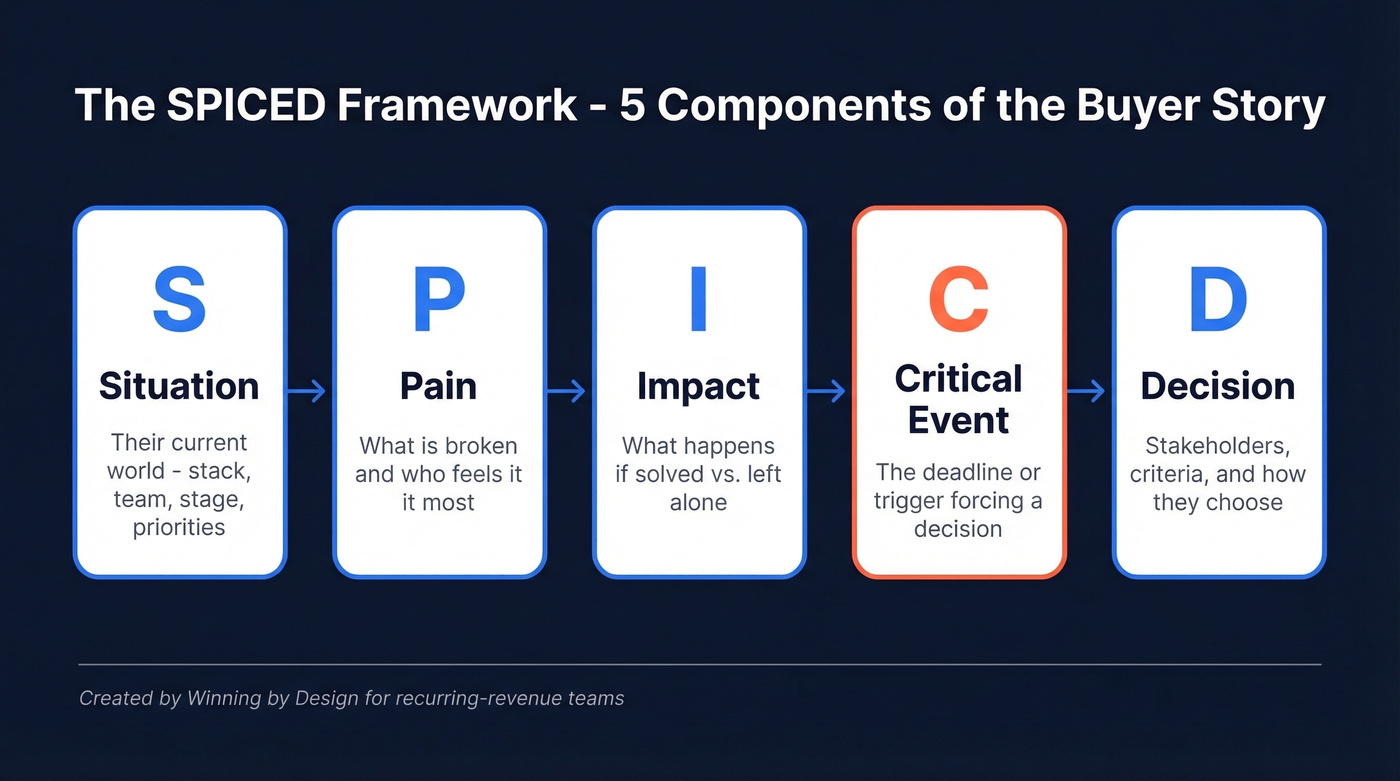
Think of it like a doctor's diagnostic process. A good doctor doesn't ask "where does it hurt?" and prescribe something. They understand your medical history (Situation), identify symptoms (Pain), assess what happens untreated (Impact), determine if there's a time-sensitive trigger (Critical Event), and understand who's involved in the treatment decision (Decision). That full picture is what separates a diagnosis from a guess.
One important warning: some vendors publish the wrong acronym. Sweep.io defines SPICED as "Situation, Problem, Implication, Challenge, Example, Decision" - which isn't SPICED at all. The canonical definition from WbD's blueprint is Situation, Pain, Impact, Critical Event, Decision. If your team copied a blog template without checking the source, you might be running the wrong framework entirely.
Each Letter Explained (with Discovery Questions)
Situation
Situation is the buyer's current world - tech stack, team structure, growth stage, competitive pressures, and strategic priorities. The context that makes everything else make sense.
Discovery questions:
- "I noticed you recently expanded into [market/region] - how's that reshaping your priorities?"
- "Walk me through your current stack for [relevant function]. What's working, what's not?"
- "How's your team structured around [process]? Who owns what?"
Tie Situation questions to specific company announcements, job postings, or funding events. "I saw you're hiring three SDRs" tells the prospect you did your homework - and it opens the door to a real conversation instead of an interrogation.
Pain
Here's the thing about Pain: reps default to asking about pain they expect to find instead of listening for the pain the buyer actually feels. We've seen this over and over in deal reviews. The whole point of this component is uncovering what's real, not confirming your assumptions.
Rational pain sounds like "our forecast accuracy is 60% and the board wants 85%." Emotional pain sounds like "I'm personally on the hook when we miss the number, and I don't trust the data my team gives me." Both are real. The emotional version drives urgency.
Discovery questions:
- "What's the most frustrating part of [process] right now?"
- "When this breaks down, who feels it first?"
- "How long has this been a problem? What's kept it from getting fixed?"
Impact
Impact is what happens if the pain gets solved - and what happens if it doesn't. This is where you build the business case.
Discovery questions:
- "If you solved this, what would that mean for the team in the next 6 months?"
- "What's the revenue impact of getting this right vs. leaving it as-is?"
- "How does this affect your personal goals for the year?"
Impact and Critical Event often surface out of order. A buyer might mention a board deadline before they've articulated the pain. Don't force the sequence - capture what they give you and fill in the gaps. The emotional dimension of impact ("I'd finally walk into the board meeting confident in my numbers") is what gets deals unstuck when procurement slows things down.
Critical Event
No Critical Event, no deal. You have a conversation.
This is the single most important qualifying signal in the framework, and it's the one reps most often skip. A Critical Event is the deadline, milestone, or external force creating urgency - a contract renewal date, a board meeting, a regulatory deadline, a new fiscal year, or a competitive threat. Something external forcing a decision by a specific date.
Discovery questions:
- "Is there a specific date or event driving the timeline on this?"
- "What happens if this isn't resolved by [quarter/date]?"
- "Any external deadlines - compliance, board reviews, contract renewals - that factor in?"
If the buyer can't name a Critical Event, probe deeper before investing more cycles. Either you haven't uncovered it yet, or the deal isn't real.
Decision
Decision maps how the buyer will actually choose - stakeholders, evaluation criteria, internal process, and tradeoffs. With buying committees running 6-10+ people, this component isn't optional. A conversation-intelligence analysis of 1.8M opportunities found that closed-won deals have roughly 2x the buyer contacts compared to lost deals. For deals over $50K, multi-threading boosts win rates by 130%.
Discovery questions:
- "Walk me through how you've evaluated similar investments in the past."
- "Who else needs to weigh in on this decision?"
- "What criteria will matter most when you're comparing options?"
Map every stakeholder by name and role early. Decision isn't just "who signs the contract" - it's the full decision journey, including champions, blockers, and influencers.
Complete SPICED Example - A $75K Deal
Here's what a filled-out SPICED record looks like for a realistic deal. You're selling a RevOps platform to a 200-person B2B SaaS company.
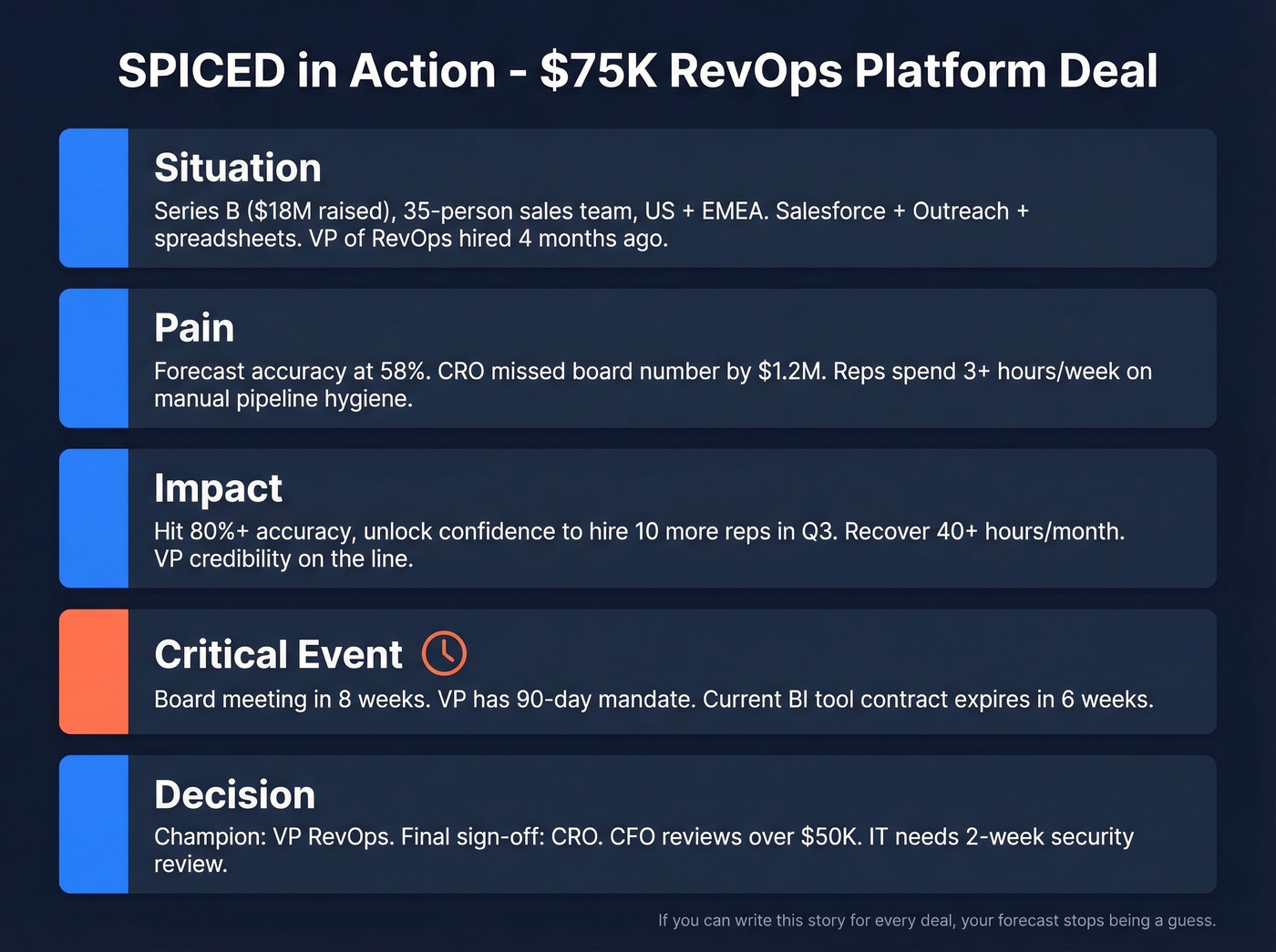
Situation: Series B ($18M raised), 35-person sales team across US and EMEA. Running Salesforce + Outreach + spreadsheets for forecasting. VP of RevOps hired 4 months ago. Evaluating three vendors.
Pain: Forecast accuracy is 58%. The CRO presented a number to the board last quarter that missed by $1.2M. Reps spend 3+ hours per week on manual pipeline hygiene. The VP of RevOps described the current process as "duct tape and hope."
Impact: Improving forecast accuracy to 80%+ saves the CRO from another board miss and unlocks confidence to hire 10 more reps in Q3. That's 40+ hours/month recovered across the team. The VP was hired to fix this - their credibility is on the line.
Critical Event: Board meeting in 8 weeks. VP of RevOps has a 90-day mandate. Current BI tool contract expires in 6 weeks.
Decision: VP of RevOps is champion and day-to-day evaluator. CRO has final sign-off. CFO reviews anything over $50K. IT needs a 2-week security review. Criteria: Salesforce integration depth, time-to-value under 30 days, forecast accuracy benchmarks from similar companies.
When you can write this story for every deal in your pipeline, your forecast stops being a guess. Missing a Critical Event means the timeline is soft. Missing Decision stakeholders means you're single-threaded. Missing Impact means you can't justify the price.

Your Situation questions land harder when you already know the buyer's world. Prospeo gives you 50+ data points per contact - job changes, tech stack, funding, headcount growth - so you walk into discovery with real context, not guesses.
Stop guessing Situation. Start every SPICED call already informed.
SPICED vs MEDDIC vs BANT
These three frameworks solve different problems. Choosing between them is about which fits your sales motion.
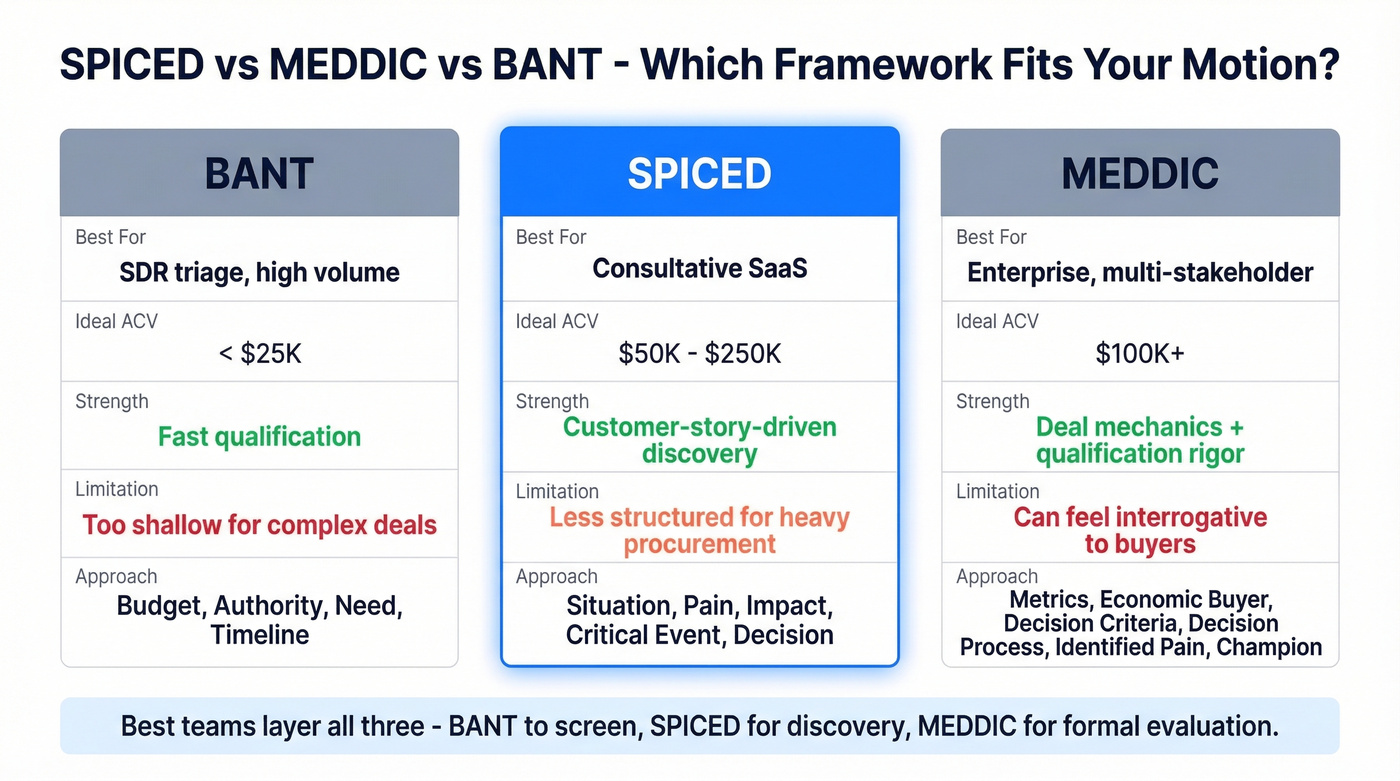
| Framework | Best For | Key Strength | Key Limitation | Ideal ACV |
|---|---|---|---|---|
| BANT | SDR triage, high-volume | Fast qualification | Too shallow for complex deals | < $25K |
| SPICED | Consultative SaaS | Customer-story-driven | Less structured for heavy procurement | $50K-$250K |
| MEDDIC | Enterprise, multi-stakeholder | Deal mechanics + qualification rigor | Can feel interrogative | $100K+ |
Let's break down the concrete difference on a $60K deal. BANT captures: "Budget approved at $60K, VP of Sales is the decision-maker, need is pipeline visibility, timeline is Q2." Useful, but thin. MEDDIC captures metrics, economic buyer, decision criteria, decision process, identified pain, and champion - thorough, but mechanical. SPICED captures the same deal as a story: the VP of RevOps was hired to fix a broken forecast, the CRO missed the board number by $1.2M, and there's a board meeting in 8 weeks driving urgency.
Some teams use MEDDPICC, adding Paper Process and Competition to the original six elements - useful when procurement and competitive displacement are central to the deal.
The best teams don't pick one framework. They use BANT to screen inbound leads, SPICED for discovery and deal narrative, and MEDDIC when deals enter formal evaluation. Dogmatic commitment to a single framework is how you end up with a tool that works for 60% of your deals and fails the rest.
Beyond Discovery - The Bow Tie Lifecycle
Most teams treat SPICED as a pre-sale tool. That misses the point.
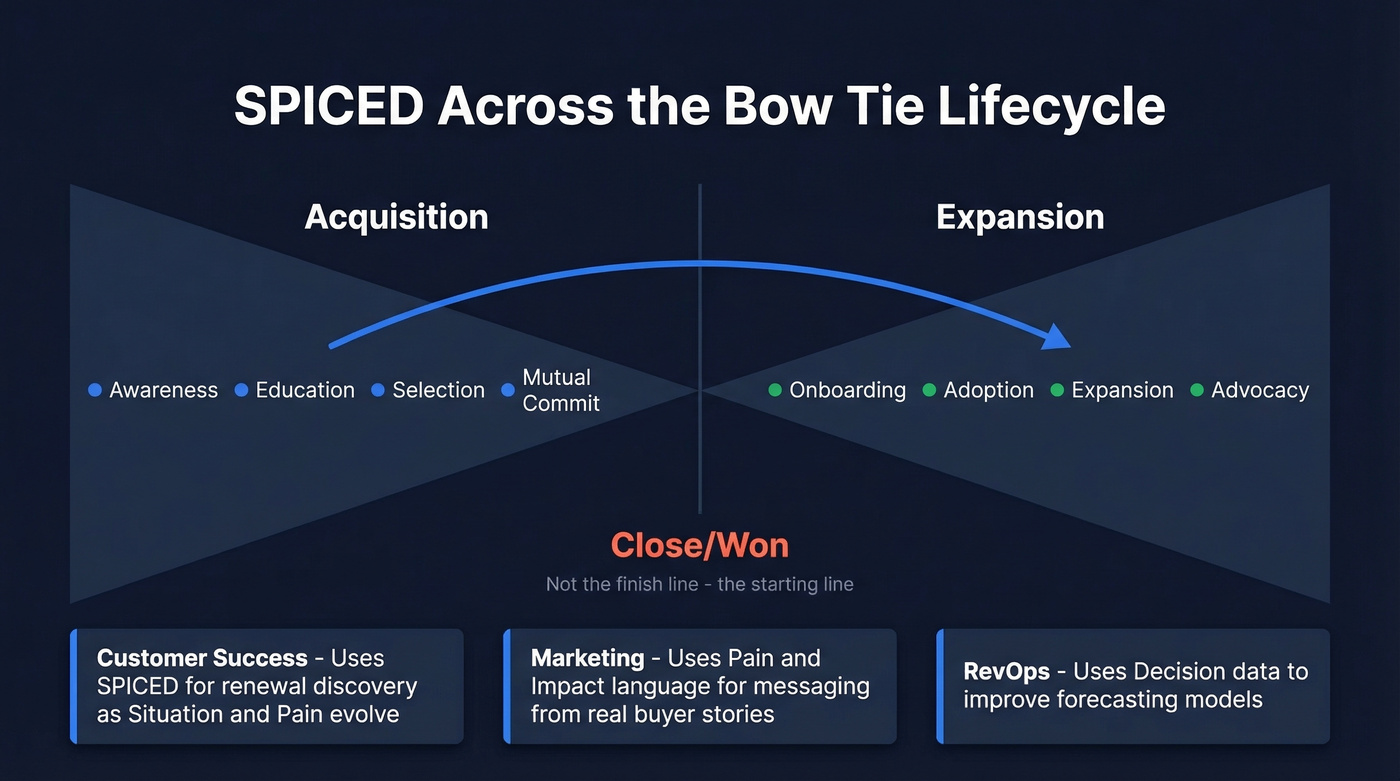
WbD built it as part of their Bow Tie model, which reframes the revenue journey as a full lifecycle. The left side covers acquisition (Awareness, Education, Selection, Mutual Commit) while the right side covers expansion (Onboarding, Adoption, Expansion, Advocacy). Close/Won isn't the finish line - it's the starting line.
Customer Success uses SPICED for renewal discovery, because the customer's Situation and Pain evolve. Marketing uses Pain and Impact language to build messaging from real buyer stories. RevOps uses Decision data to improve forecasting models. When the methodology becomes a shared language across revenue teams, the entire org operates from the same buyer intelligence instead of siloed notes buried in individual rep accounts.
CRM Implementation Guide
A framework that lives in a slide deck is useless. SPICED needs to live in your CRM, your deal reviews, and your team's vocabulary.
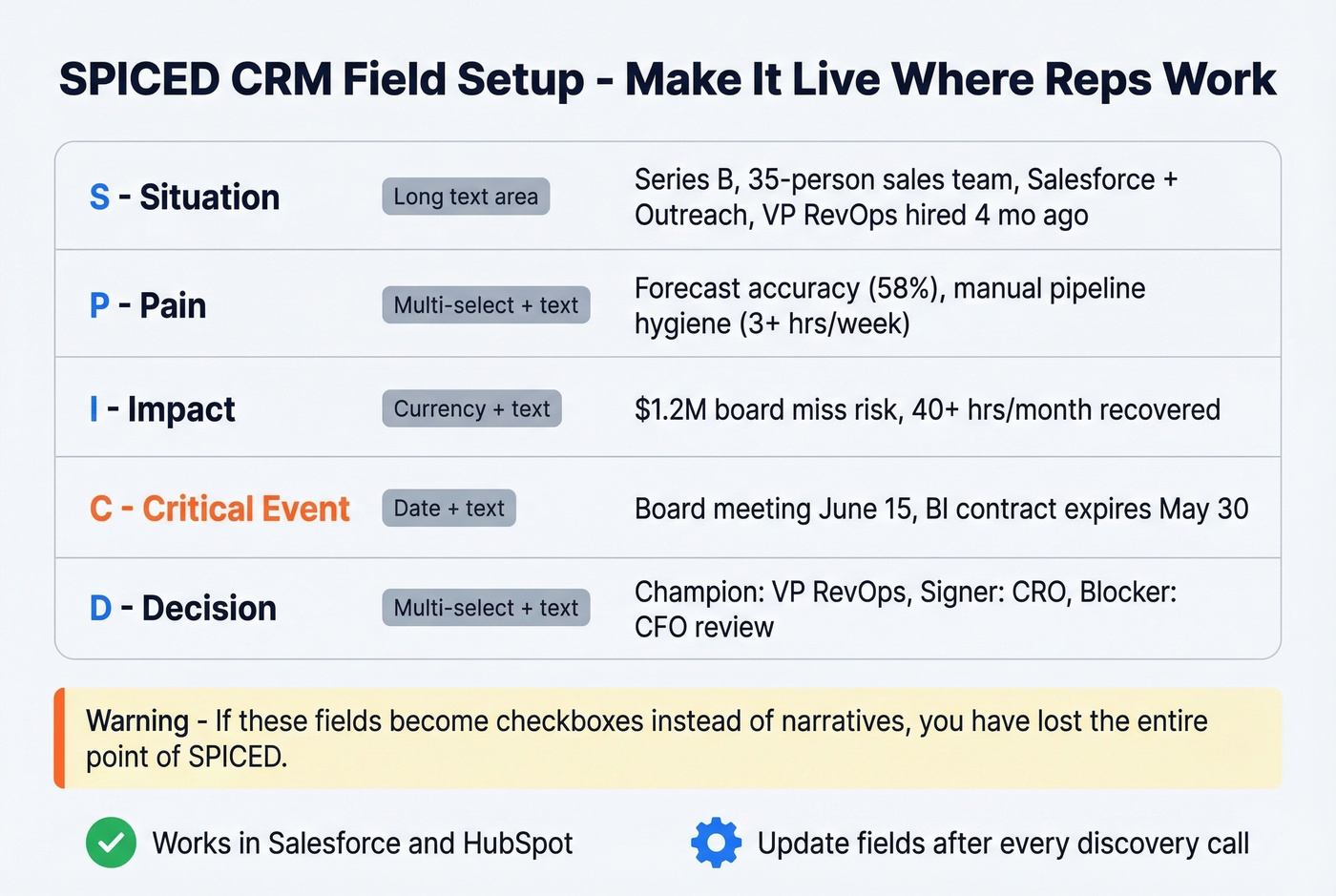
Here's a recommended field schema for Salesforce or HubSpot:
| SPICED Component | Field Type | Example Value |
|---|---|---|
| Situation | Long text area | "Series B, 35-person sales team, Salesforce + Outreach, VP RevOps hired 4 mo ago" |
| Pain | Multi-select picklist + text | "Forecast accuracy (58%), manual pipeline hygiene (3+ hrs/wk)" |
| Impact | Currency + text area | "$480K/yr recovered time; CRO board credibility" |
| Critical Event | Date + text area | "2026-06-15 - Board meeting, 90-day mandate" |
| Decision | Multi-select (stakeholders) + text | "Champion: VP RevOps; EB: CRO; Blocker: CFO review > $50K" |
The picklist on Pain lets you run reports on which pain points correlate with closed-won deals. The date field on Critical Event lets you build pipeline views sorted by urgency. The stakeholder multi-select on Decision forces reps to name names, not hide behind "the team is evaluating."
Conversation intelligence tools like Gong or Avoma can auto-populate SPICED fields from call transcripts - mapping AI-generated summaries to each component and flagging gaps. If you're evaluating platforms, start with a shortlist of conversation intelligence tools. If your CRM supports it, this eliminates the biggest adoption barrier: manual data entry after every call.
Manager reinforcement is the other half. Run weekly deal reviews using SPICED language. Don't ask "what's the next step?" Ask "what's the Critical Event?" and "who's in the Decision and have we talked to all of them?" When managers inspect deals through the SPICED lens, reps internalize the framework instead of treating it as CRM busywork.
Multi-threading boosts win rates by 130% on $50K+ deals. But you need verified contact data for every stakeholder. Prospeo delivers 98% email accuracy and 125M+ verified mobiles across 300M+ profiles - so your Decision mapping isn't just names on a slide.
Map the full buying committee with contacts that actually connect.
Why Most Teams Fail at SPICED
In our experience, about 73% of SPICED implementations fail within 90 days. It comes down to four failure modes.
Wrong definitions. Teams copy a blog template without verifying the source and end up running "Situation, Problem, Implication, Challenge, Example, Decision" instead of the actual framework. Always go back to the canonical definition.
Checkboxing instead of diagnosing. This is the most common failure. Reps treat SPICED like a form - "Situation: checked. Pain: checked. Moving on." If your Situation field says "mid-market SaaS company" and nothing else, you haven't done discovery. You've done data entry.
CRM hygiene collapse. Teams launch with enthusiasm, build the fields, run two weeks of deal reviews - and stop enforcing. Within a month, half the opportunities have empty SPICED fields. Within three months, nobody's using them. If you need a tighter operating cadence, standardize your CRM deal stages with exit criteria tied to SPICED.
No manager reinforcement. The consensus on r/sales isn't that SPICED is a bad framework - it's that managers introduce it without changing how they run deal reviews, so it becomes another CRM tax with no payoff. If your managers still ask "what's the next step?" instead of "what's the Critical Event?", the framework dies on the vine.
Skip SPICED entirely if your team doesn't have the discipline for weekly deal reviews. Without that reinforcement loop, you're just adding fields nobody fills out.
Does SPICED Actually Work?
WbD reports results from trained teams: 50% shorter sales cycles, 298% increase in wins, 3x ARR year-over-year, and 8x outbound pipeline share. They don't publish methodology for those numbers. But the underlying logic is sound - teams that understand their buyers' stories close more deals faster, and we've seen that pattern hold across dozens of deal reviews with our own customers.
The training runs $500 for a 2-hour live session (max 25 participants), including the Impact Toolkit and certification. For teams that can't justify the cost, self-implementation is viable - the framework is well-documented enough to operationalize from public resources and the CRM schema above. If you're trying to improve forecast quality as you roll this out, pair SPICED with a simple accurate sales forecasting process and track forecast accuracy metrics weekly.
If your average deal size is under $25K and you're running high-velocity sales, SPICED is probably overkill. BANT will serve you fine. But for any deal where you need to understand the buyer's world to win - $50K+ ACV, multiple stakeholders, behavior change required - the SPICED framework is the best discovery methodology available. The framework isn't the point, though. The diagnostic mindset is.
FAQ
What does SPICED stand for?
Situation, Pain, Impact, Critical Event, and Decision. Created by Winning by Design for recurring-revenue sales teams, the five components map the buyer's full story from current context through purchase decision. The canonical source is WbD's blueprint - not third-party blog posts that sometimes get the acronym wrong.
What's the difference between SPICED and MEDDIC?
SPICED is consultative and customer-story-driven, starting with the buyer's world. MEDDIC is deal-mechanics-focused, mapping metrics, economic buyers, and decision processes. Most high-performing teams use SPICED for early discovery and MEDDIC when deals enter formal evaluation above $100K ACV.
Is the SPICED sales methodology only for SaaS?
It's optimized for recurring-revenue businesses at $50K-$250K ACV, but works for any consultative B2B sale involving multiple stakeholders and behavior change. Teams in professional services, managed IT, and manufacturing have adapted the methodology successfully.
How do I prepare for a SPICED discovery call?
Research the prospect's tech stack, headcount, funding stage, and org structure before the call. Prospeo's 30+ search filters - including technographics, job changes, and headcount growth - let you build a Situation profile in minutes. Map questions to each SPICED component beforehand, then focus the live conversation on validating and deepening what you already know.
Can conversation intelligence tools automate SPICED?
Yes. Platforms like Gong, Chorus, and Avoma can map call transcript sections to each SPICED component and flag gaps - for example, highlighting when a rep never uncovered a Critical Event. This cuts manual CRM entry and gives managers a structured view for deal reviews.