

CRM Deal Stages: A Framework With Exit Criteria (2026)
Your forecast was 40% off last quarter. Not because reps sandbagged or a whale slipped - because deals sat in "Proposal Sent" for six weeks with no exit criteria, no required fields, and no one asking whether the buyer actually wanted the proposal.
Opportunities that close within 50 days carry a 47% win rate; past that threshold, win rates crater to 20% or lower. The fix isn't better reps. It's better CRM deal stages.
If you take nothing else from this article: design 5-7 stages around buyer decisions (not rep activities), define verifiable exit criteria for each, and enforce them with required CRM fields. Below is the complete framework.
What Are Deal Stages?
A pipeline is the container - a defined set of stages for tracking a sales process. Stages are the steps inside it. A deal (or "opportunity" in Salesforce) is the individual record representing a potential sale, and tasks are the to-dos tied to a deal: calls, emails, follow-ups.
Salesforce calls them "opportunity stages." HubSpot calls them "deal stages." Same concept, different branding. Don't let terminology differences confuse the architecture. What matters is that every record carries a clear deal status - a snapshot of where the buyer stands right now, not where the rep hopes they'll be next week.
Why Most Pipeline Stages Fail
The default stages in most CRMs are built around rep activities, not buyer decisions. HubSpot's out-of-the-box stages include "Appointment Scheduled" at 20% probability - that's a calendar event, not evidence of buyer commitment. "Presentation Scheduled" at 60%? You haven't even presented yet.
This creates what Campaign Creators calls "pipeline theater": dashboards that look precise but reflect nothing about where the buyer actually stands. Reports say $2M in pipeline. Reality says $800K, maybe.
One Reddit user shared their agency pipeline with stages like "Meh Call," "Great Call," and "Never Replied to Book Meeting" - and openly admitted it was overkill. That's the trap. When you track internal activity outcomes as stages instead of using properties or tags, you end up with 12+ stages that tell you what the rep did, not what the buyer decided. Skip the "Qualified to Buy" stage entirely - it's meaningless without documented exit criteria, and it gives reps a comfortable place to park deals they haven't actually qualified.
A Deal Stage Framework That Works
Every stage transition should require decision proof - verifiable evidence that the buyer reached a meaningful commitment step. Not "we had a good call." Not "they seemed interested." Something you can point to in the CRM record.
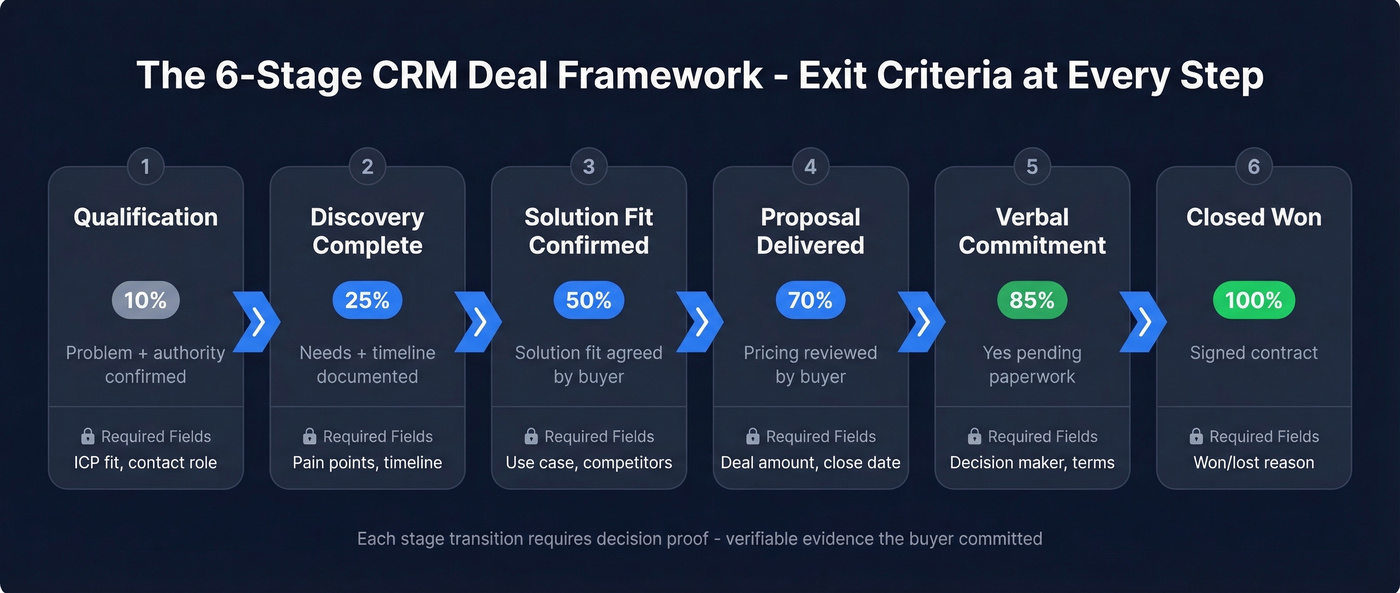
We've tested this six-stage model across B2B teams, and it holds up whether you're selling $5K deals or six-figure contracts - though deal size will influence how many stakeholders you encounter and how long each stage takes.
| Stage | Exit Criteria (Decision Proof) | Probability | Required CRM Fields |
|---|---|---|---|
| Qualification | Problem + authority confirmed | 10% | ICP fit, contact role |
| Discovery Complete | Needs + timeline documented | 25% | Pain points, timeline |
| Solution Fit Confirmed | Solution fit agreed | 50% | Use case, competitors |
| Proposal Delivered | Pricing reviewed by buyer | 70% | Deal amount, close date |
| Verbal Commitment | Yes, pending paperwork | 85% | Decision maker, terms |
| Closed Won / Closed Lost | Signed or lost | 100% / 0% | Won/lost reason |
How many stages should you have? Five to seven covers most scenarios. If your sales cycle is under 4 weeks, five stages is plenty - six is vanity. Enterprise teams with 90+ day cycles need six or seven to capture stakeholder alignment and procurement steps. More than eight almost always means you're tracking activities, not buyer decisions.
Start with these probabilities, then calibrate quarterly using your actual stage-to-close conversion rates. The biggest waste of time in pipeline management is probability percentages that nobody recalibrates. The defaults above are directional - your data will tell you the truth within a quarter or two.

Exit criteria only work when the contacts in your pipeline are real. Prospeo's 98% email accuracy and 5-step verification mean every deal in your CRM is tied to a verified decision-maker - not a bounced address parked in "Qualification" forever.
Stop filling pipeline stages with bad data at $0.01 per verified email.
Stage-to-Stage Benchmarks
Knowing your framework is one thing. Knowing what "good" looks like is another.
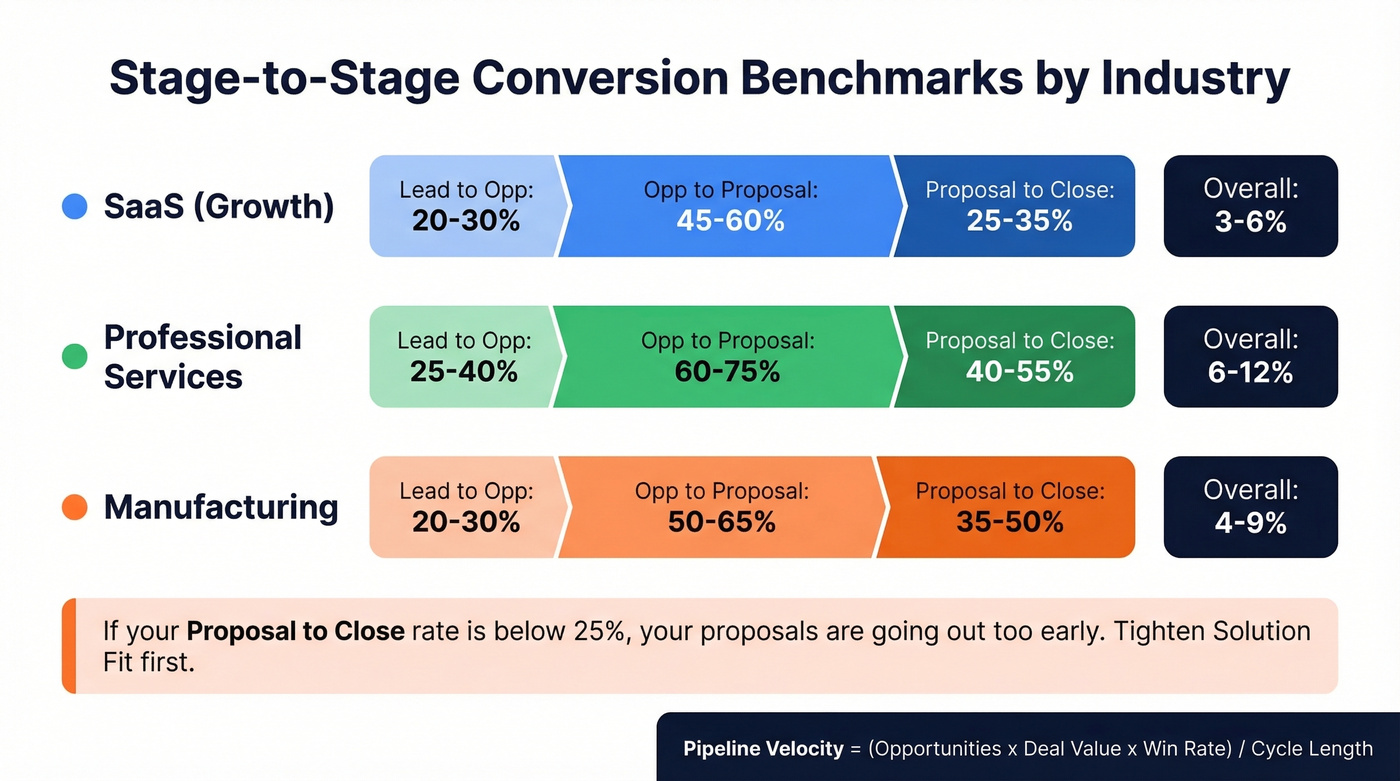
| Industry | Lead to Opp | Opp to Proposal | Proposal to Close | Overall (Lead to Close) |
|---|---|---|---|---|
| SaaS (Growth) | 20-30% | 45-60% | 25-35% | 3-6% |
| Professional Services | 25-40% | 60-75% | 40-55% | 6-12% |
| Manufacturing | 20-30% | 50-65% | 35-50% | 4-9% |
A separate MarketJoy analysis measuring Opp to Closed-Won (not full-funnel) puts the B2B average at roughly 7%. Don't conflate that with the full Lead to Close rates above - they measure different spans of the funnel.
Here's our position: if your Proposal to Close rate is below 25%, your proposals are going out too early. Tighten the Solution Fit stage before you blame your close technique.
The biggest bottleneck across all industries is MQL to SQL at roughly 15-21%. If your number is significantly below that, the problem isn't your stages - it's your lead qualification criteria or your marketing-to-sales handoff.
Pipeline velocity ties it all together: (Number of Opportunities x Average Deal Value x Win Rate) / Sales Cycle Length. In our experience, teams that track this monthly catch forecast drift two to three weeks earlier than teams that only review it at quarter-end. It's the single number that tells you whether your pipeline is healthy or just full.
Stages for Non-SaaS Teams
Here's the thing: if you sell physical products through wholesale distribution, most deal stage guides are useless. A Reddit user in B2B manufacturing put it bluntly - all the HubSpot advice assumes you're running demos and trials, not quoting lead times on custom parts.
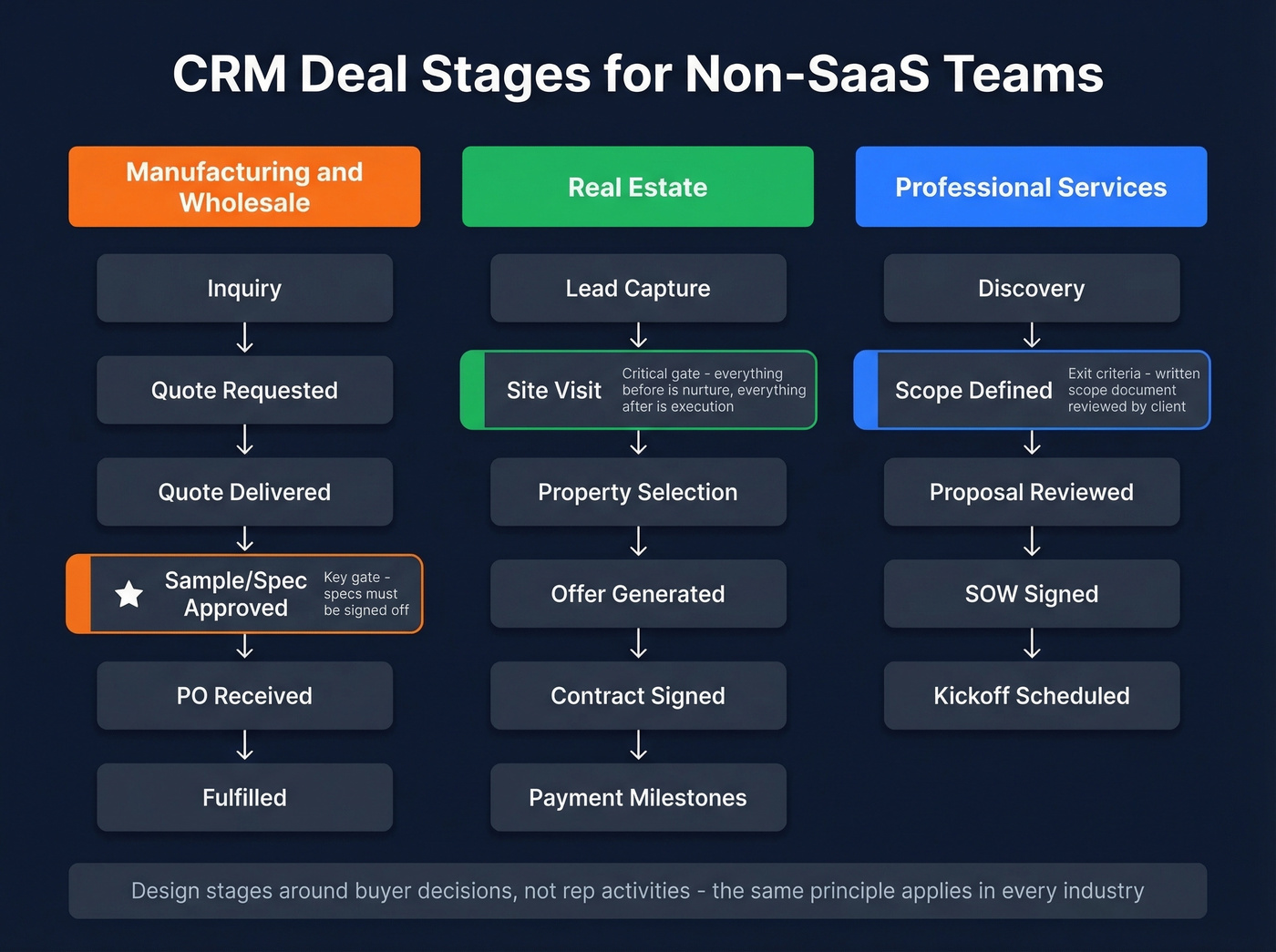
Manufacturing and wholesale pipelines should look more like: Inquiry, Quote Requested, Quote Delivered, Sample/Spec Approved, PO Received, Fulfilled. The buyer decisions revolve around specs, pricing, and purchase orders - not demos. A $500 reorder and a $200K custom fabrication job shouldn't share the same pipeline either, because the exit criteria at each stage are fundamentally different.
Real estate follows its own logic entirely: Lead Capture, Site Visit, Property Selection, Offer Generated, Contract Signed, Payment Milestones. The site visit is the critical stage gate. Everything before it is nurture, everything after is execution.
For professional services teams, we've found this works well: Discovery, Scope Defined, Proposal Reviewed, SOW Signed, Kickoff Scheduled. The exit criterion for "Scope Defined" is a written scope document the client has reviewed - not just a verbal conversation about what they need.
Enforcing Stage Hygiene
A beautiful stage framework means nothing if reps can drag deals forward without evidence.
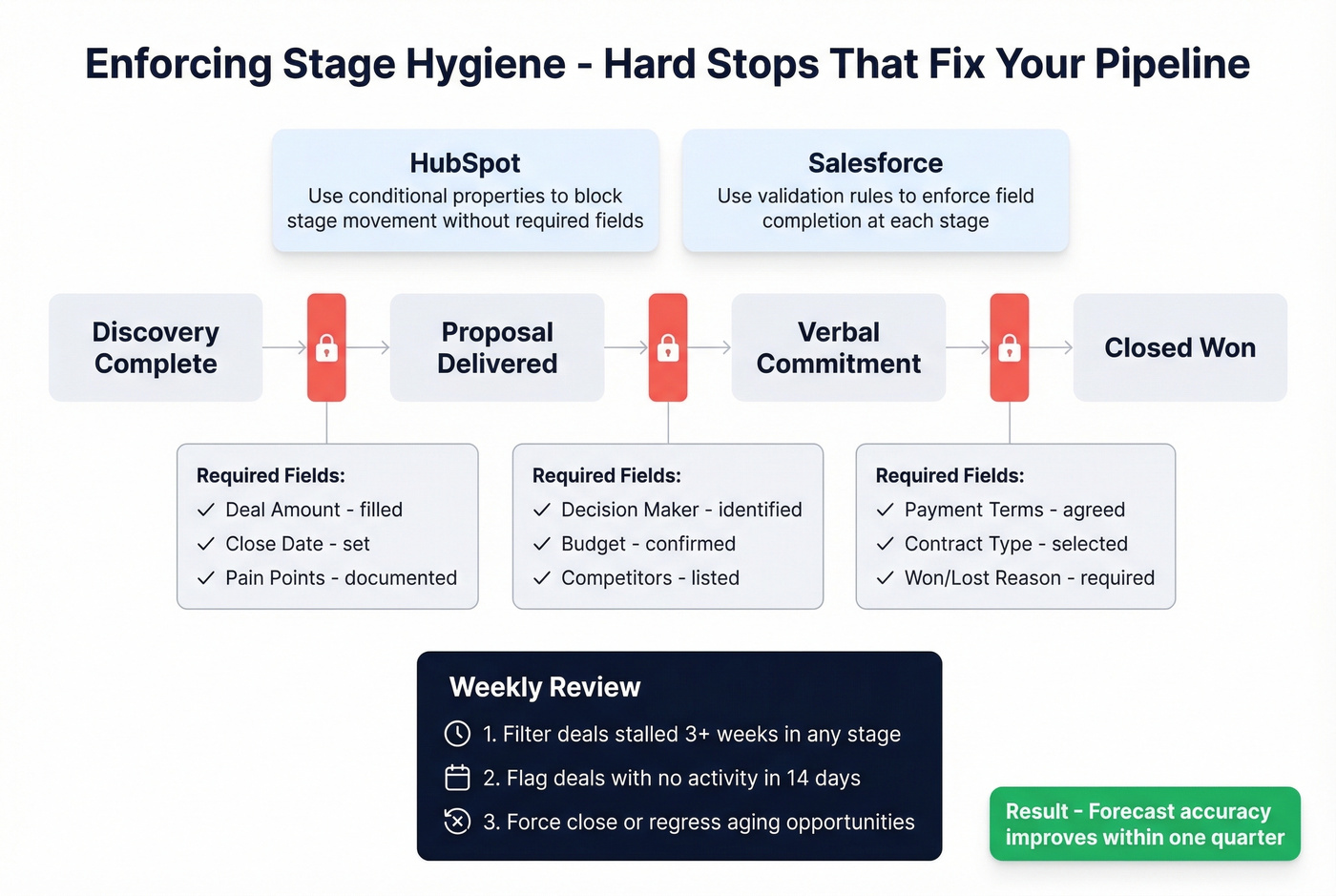
HubSpot's conditional properties let you set hard stops: a deal can't move to "Proposal Sent" unless Deal Amount and Close Date are filled. Can't move to "Closed Won" without Payment Terms. One HubSpot admin on r/hubspot discovered conditional properties by accident and said it transformed their pipeline discipline - reps couldn't skip fields anymore, and forecast accuracy jumped within a single quarter. Salesforce has similar validation rules.
The CRM-agnostic principle: every stage transition should require at least one field update that proves the buyer did something. No exceptions.
Beyond hard stops, managers should filter opportunities by stage weekly to spot stalled records. If a deal has sat in "Discovery Complete" for three weeks with no activity, it isn't progressing - it's decaying. Most CRMs let you build saved views that surface these aging deals automatically, so your pipeline reviews focus on action, not archaeology.
We've seen founder-led SaaS teams make the same mistakes repeatedly - skipping qualification because the founder "knows" the deal is good, never documenting a compelling event, overcomplicating proposals for deals that needed a one-pager. Hard stops fix the first two problems by making them structurally impossible to ignore.
Clean Stages Need Clean Data
Your stages can be perfect, but if the contact data behind each deal is wrong, deals die before they start. Bounced emails and wrong phone numbers cause deals to stall at early stages - reps can't reach the decision maker, so the deal sits in "Qualification" until it rots. We've watched this pattern kill pipeline at multiple companies we've worked with, and it's always the same story: the CRM says there's a contact, but the email bounces and the phone number goes to a generic switchboard.
Prospeo's CRM enrichment returns 50+ data points per record at a 92% match rate, with a 7-day refresh cycle compared to the 6-week industry average. Pair clean stages with clean data and your forecast actually means something. If you're evaluating vendors, start with this list of data enrichment services.
Your Proposal-to-Close rate tanks when proposals land in the wrong inbox. Prospeo gives you 143M+ verified emails and 125M+ direct dials so every deal stage has the right contact attached - with 83% enrichment match rates across your entire CRM.
Enrich your CRM deals with 50+ verified data points per contact.
FAQ
What's the difference between deal stages and pipeline stages?
Same concept, different CRM terminology. "Deal stages" is HubSpot's label; "opportunity stages" is Salesforce's. Both describe sequential steps a sale moves through inside a pipeline. The status at any given moment tells you which stage a record currently occupies.
How many stages should a CRM pipeline have?
Five to seven for most teams. SMB orgs with sub-30-day cycles do fine with five. Enterprise teams running 90+ day sales motions need six or seven to capture procurement and multi-stakeholder alignment steps. More than eight signals you're tracking rep activities, not buyer decisions.
How do I set deal stage probabilities?
Start with the framework in this article (10%, 25%, 50%, 70%, 85%, 100%), then recalibrate quarterly using your actual stage-to-close conversion rates. Default CRM probabilities are almost always wrong - one quarter of real data will expose the gaps.
How do I keep deal data accurate across stages?
Use a data enrichment tool that refreshes contacts automatically. Stale records are the silent killer of pipeline velocity - a deal can't advance if the rep's emails are bouncing. Look for tools with weekly refresh cycles and catch-all domain verification so your CRM doesn't fill up with dead contacts.