

Buying Committees: Who's Really Deciding (and How to Reach Them All)
Your champion just Slacked you: Finance wants the ROI model, security needs the SOC 2 report, and procurement - who apparently now has veto power - wants a vendor risk assessment by Friday. You thought you were selling to one person. You're selling to thirteen.
Welcome to the buying committee. Forrester's Buyers' Journey Survey puts the average B2B group at 13 stakeholders, and that number doesn't even count the external analysts, consultants, and peer references circling the decision. The single biggest deal-killer isn't price or product fit. It's single-threading - relying on one contact to navigate an entire committee. Seventy-eight percent of reps do exactly that, and their deals die in the dark.
What Is a Buying Committee?
The concept goes back to Thomas V. Bonoma's 1982 Harvard Business Review article, which introduced the "buying center" - the informal group of people who influence a B2B purchase. Bonoma identified six roles: initiators, influencers, deciders, purchasers, users, and gatekeepers. The framework has held up for decades, even as the number of people filling those roles has ballooned.
A buying committee isn't the same as a procurement team. Procurement is one function within the group - increasingly powerful, but still one seat at the table. The committee includes everyone from the end user who'll live in the product daily, to the CFO who signs the check, to the security analyst who can kill the deal with a single compliance objection.
You'll also see "buying group" (Forrester's preferred term) and "buying center" (the academic term). They're synonyms in practice. What matters isn't the label - it's recognizing that no single person makes a B2B purchase decision anymore.
How Big Are These Groups?
The honest answer: it depends on deal complexity. The average-of-13 stat from Forrester is real, but averages mislead when committee sizes range from 2-3 people to 25 in some Gartner Peer Community anecdotes.
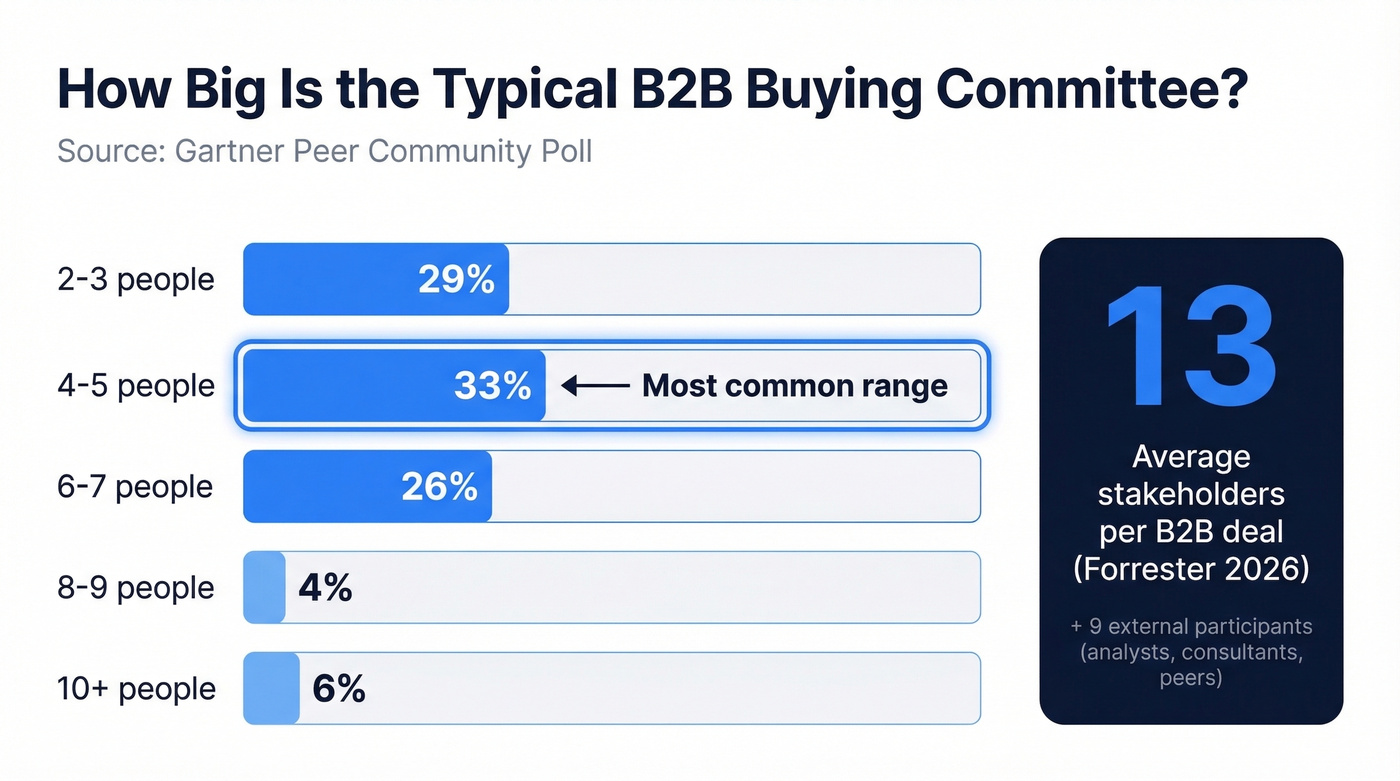
A Gartner Peer Community poll gives a more useful breakdown:
| Group Size | % of Respondents |
|---|---|
| 2-3 people | 29% |
| 4-5 people | 33% |
| 6-7 people | 26% |
| 8-9 people | 4% |
| 10+ people | 6% |
Most deals land in the 4-7 range. Enterprise deals with six-figure-plus price tags often hit double digits.
The SiriusDecisions buying scenario framework helps explain why:
| Scenario | Typical Size | Deal Value | Timeline |
|---|---|---|---|
| Independent | 1-2 people | Low/self-serve | Days to weeks |
| Consensus | 3-6 people | Mid-market | Weeks to months |
| Committee | 6-10+ people | Enterprise | Quarters |
Bigger deal, longer timeline, more people who need to weigh in. Forrester's 2026 data adds another layer: the average B2B purchase involves 13 internal stakeholders plus 9 external participants - analysts, consultants, implementation partners, and peer references who all shape the decision.
Here's the thing: if your average contract value is under $25K, you probably don't need a 10-role mapping exercise. A quick 3-person power map will do. But the moment you're selling six figures, skipping the full committee map is how you lose to "no decision."
Roles on a Modern Buying Committee
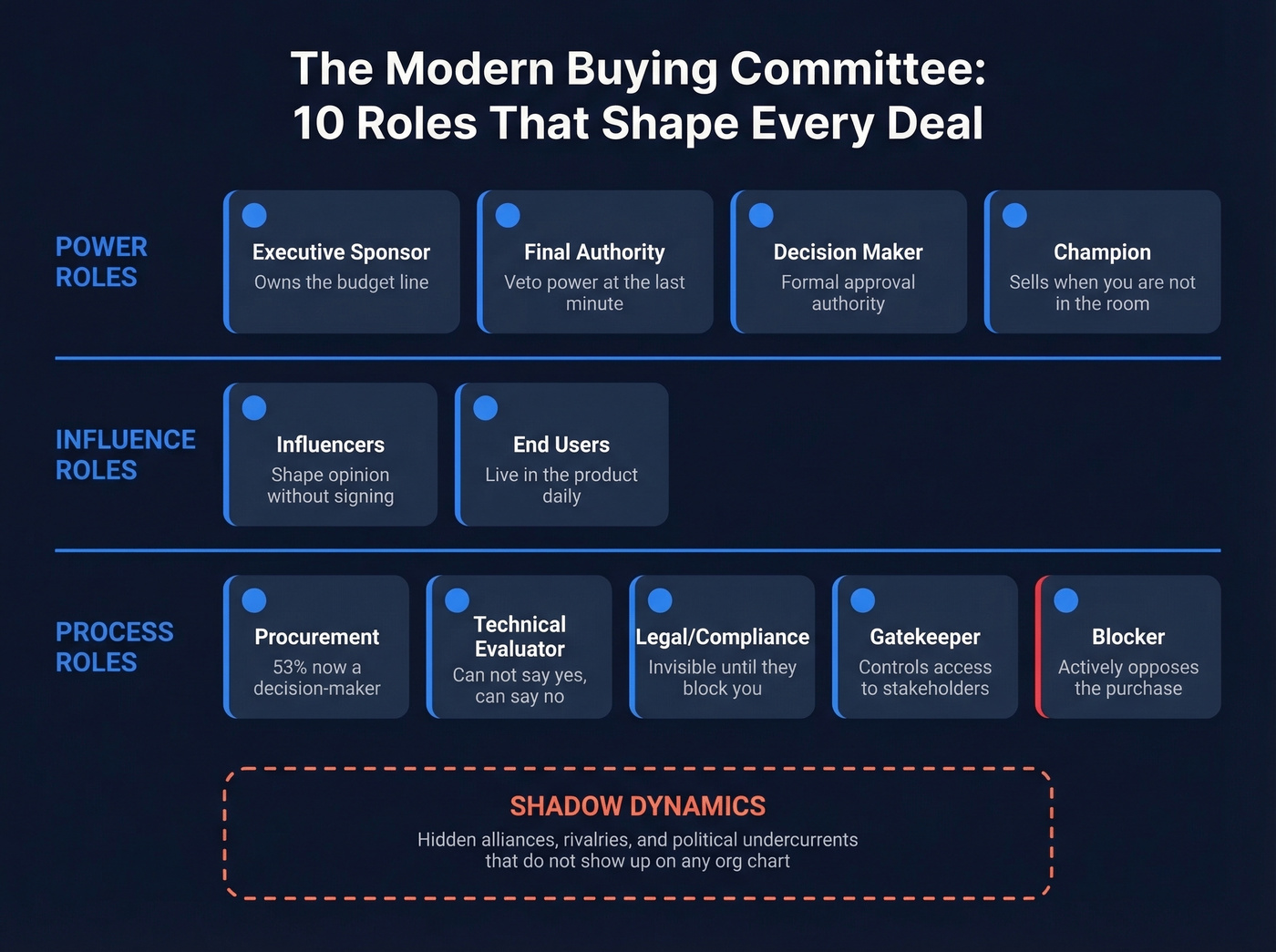
Most guides give you Bonoma's six roles and call it a day. That's a map without a travel guide. Below is a modernized 10-role taxonomy that reflects how enterprise deals actually move in 2026, grouped by how they affect your deal.
Power Roles
The Executive Sponsor owns the budget line. They care about strategic alignment and board-level metrics, and they're often the last signature. In enterprise deals, watch for a separate Final Authority - a C-suite leader or board member who hasn't been involved in evaluation but holds veto power at the eleventh hour. We've lost deals to this phantom signer, and you will too if you don't ask early: "Is there anyone above you who needs to approve this before it's final?"
The Decision Maker has formal authority to approve - sometimes the same person as the sponsor, sometimes not. The Champion is your internal advocate, the person selling the deal when you're not in the room. Their political capital is your currency, and burning it by making them chase down stakeholders you could reach yourself is a strategic mistake.
Influence Roles
Influencers shape opinion without signing anything. This could be a respected individual contributor, a team lead, or a department head adjacent to the buyer. Don't underestimate the senior IC who's been at the company for a decade - their word carries more weight than most VPs.
End Users live in the product daily. Their enthusiasm or resistance determines adoption and renewal. If you skip the user demo and sell top-down only, you'll close the deal and churn in six months.
Process Roles
Procurement negotiates terms, pricing, and SLAs. In 2026, 53% of buyers identify procurement as a decision-maker, not just a rubber stamp. They're involved earlier and with more authority than ever.
Technical Evaluator tests integrations, reviews architecture, flags security gaps. Can't say yes, but can absolutely say no.
Legal/Compliance reviews DPAs, data residency, regulatory risk. Invisible until they block you.
Gatekeeper controls access to other stakeholders - often an EA, a chief of staff, or a project manager running the evaluation.
Blocker actively opposes the purchase. Maybe they back a competitor, maybe they fear the change. Ignoring them doesn't make them disappear.
Shadow Dynamics
Beyond these official roles, there's what ColonySpark calls the "Shadow Committee" - informal influencers and organizational dynamics that don't show up on any org chart but absolutely shape outcomes. The VP who lost a budget fight last quarter and is looking for a win. The director who got burned by a similar vendor two years ago. You won't find these people in a discovery call unless you ask the right questions, and these hidden alliances, rivalries, and political undercurrents often matter more than the formal hierarchy.

You just mapped 10 roles on the buying committee. Now you need to actually reach them. Prospeo gives you verified emails (98% accuracy) and direct dials (125M+ mobile numbers) for every stakeholder - from the executive sponsor to the technical evaluator. Use 30+ filters to find each role by job title, department, and seniority. Stop single-threading.
Multi-thread every deal with contact data that actually connects.
What Changed in 2026
Several forces are reshaping how these groups operate, and they're pulling in contradictory directions.
AI Is Everywhere, Trust Is Fragile
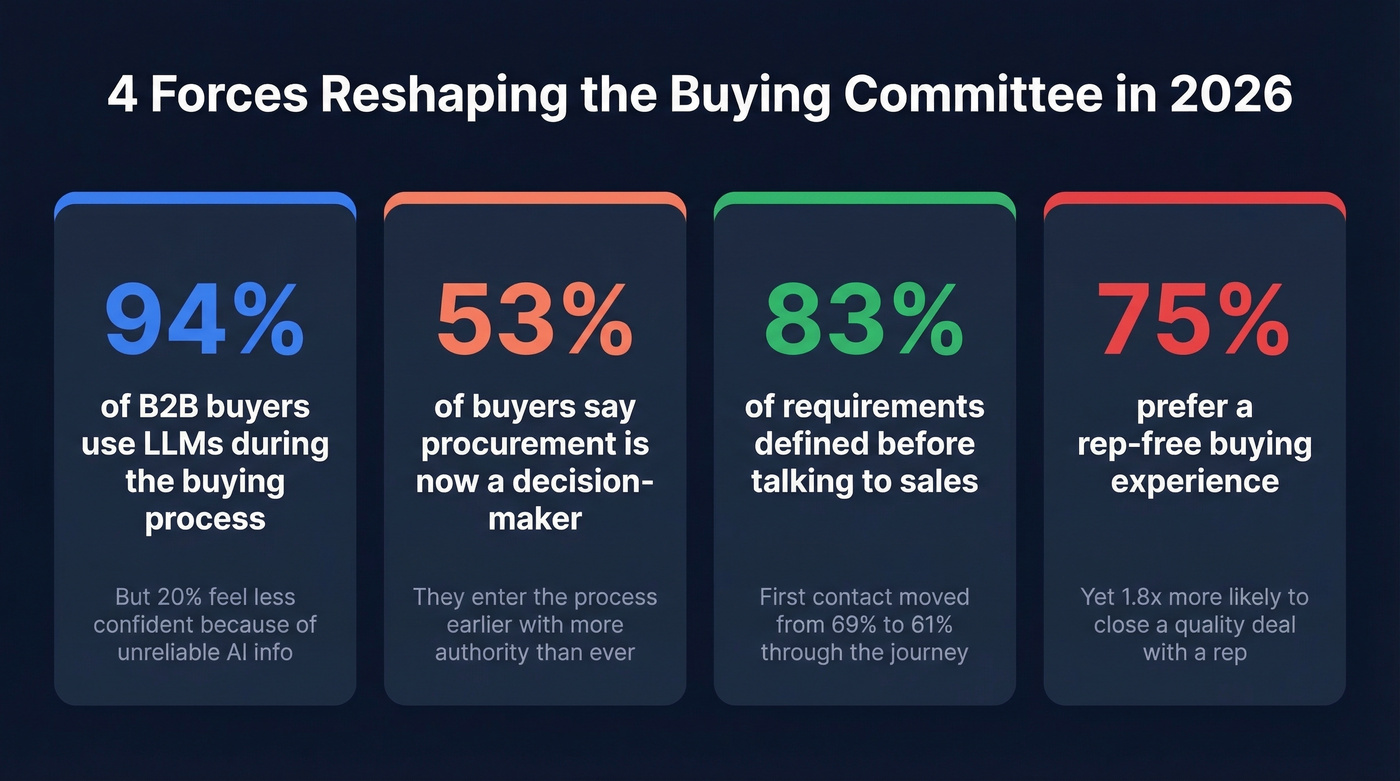
By 2026, 94% of B2B buyers use LLMs during the buying process. But the confidence picture is split: 36% feel more confident in their decisions thanks to AI, while 20% feel less confident because of unreliable or inaccurate information. That trust gap means committees are leaning harder on peer validation and human expertise - even as they use AI to do initial research.
Procurement Has Real Power Now
This isn't your 2020 procurement team that showed up at the end to negotiate a discount. Fifty-three percent of buyers now identify procurement as a decision-maker, and they're entering the process earlier. If you're not building procurement-ready materials from day one, you're creating a bottleneck you'll hit at the worst possible moment.
Buyers Finish the Work Before You Show Up
Buyers define their requirements 83% of the time before ever talking to sales. First contact has moved from 69% to 61% of the way through the journey. Sales cycles have compressed from 11.3 months to 10.1 months. And even trials don't guarantee conversion: 35% of buyers who complete a trial plan to convert with a different provider.
The window to influence is narrower than it's ever been.
The Rep-Free Paradox
This tension defines 2026 selling: 75% of B2B buyers say they prefer a rep-free experience. But Gartner's own research shows buyers are 1.8x more likely to complete a high-quality deal when they use supplier digital tools with a sales rep versus independently. Buyers want self-serve research. They need guided buying. The committee is where those two forces collide.
What Each Stakeholder Needs to Say Yes
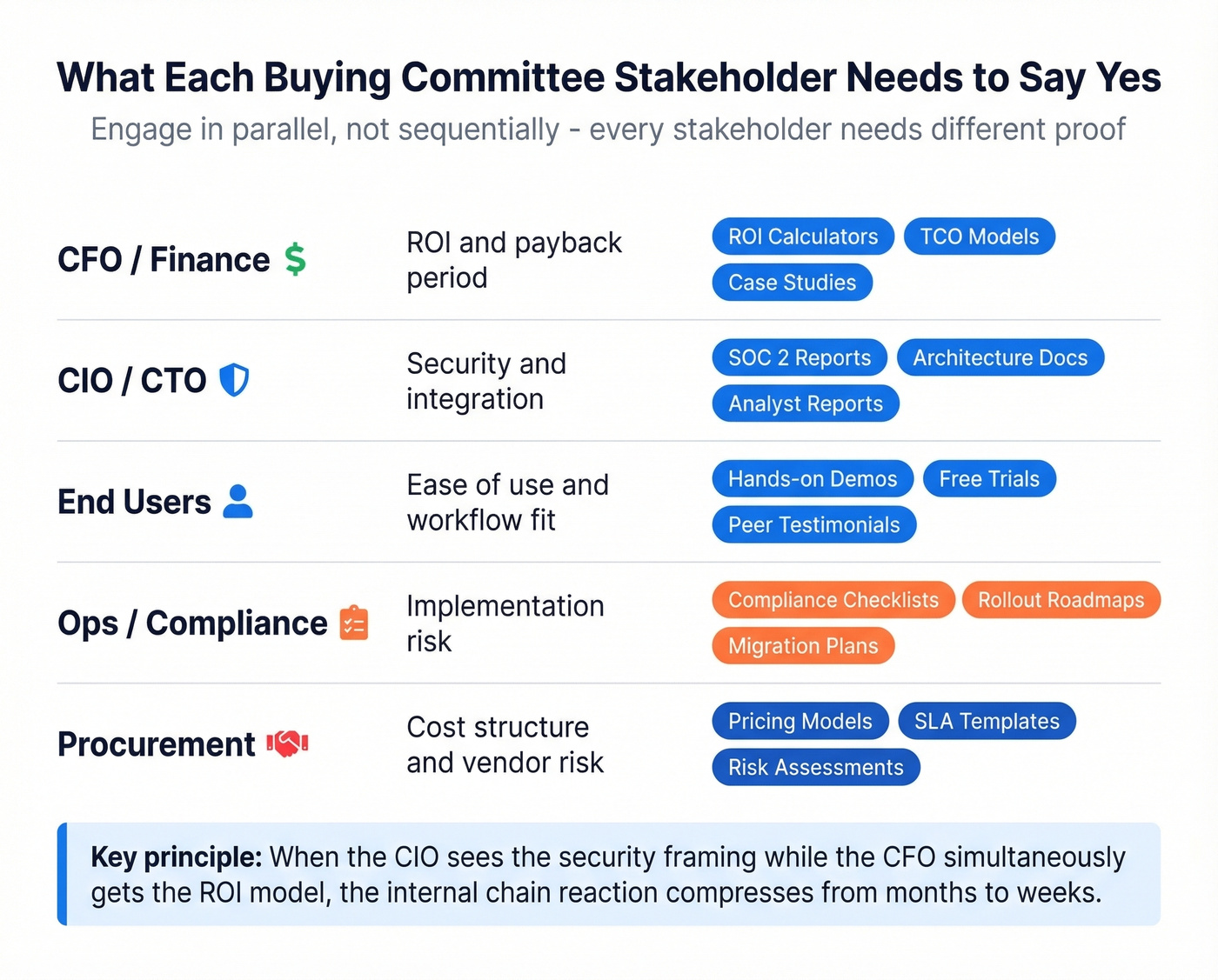
Buying committee stakeholders consult 4-5 pieces of content before group discussions. The mistake most teams make is creating one pitch deck and hoping it resonates with everyone. It won't. A CFO and a technical evaluator have fundamentally different anxieties.
| Stakeholder | Top Priority | Content That Moves Them |
|---|---|---|
| CFO/Finance | ROI, payback period | ROI calculators, TCO models, case studies |
| CIO/CTO | Security, integration | SOC 2 reports, architecture docs, analyst reports |
| End Users | Ease of use, workflow | Hands-on demos, free trials, peer testimonials |
| Ops/Compliance | Implementation risk | Compliance checklists, rollout roadmaps |
| Procurement | Cost structure, risk | Pricing models, SLA templates, risk assessments |
The key principle: engage these stakeholders in parallel, not sequentially. The consensus on r/b2bmarketing is clear - deals stall when buyers have to piece everything together themselves. When the CIO sees the threat/urgency framing while the CFO simultaneously gets the ROI model and security gets the compliance docs, the internal chain reaction compresses from months to weeks.
We've found that parallel engagement doesn't just save time - it changes the committee's internal dynamic. Instead of a serial game of telephone where your message degrades at each handoff, every stakeholder forms their own direct impression. That's how you build consensus instead of hoping for it.
If you're sending the same case study to every stakeholder and wondering why deals take forever, this is why.
Why Deals Stall in Committee
Eighty-six percent of B2B purchases stall at some point. Not 86% of bad deals - 86% of all purchases. And 40% stall specifically because of internal stakeholder misalignment. The committee members can't agree, so they default to the safest option: doing nothing.
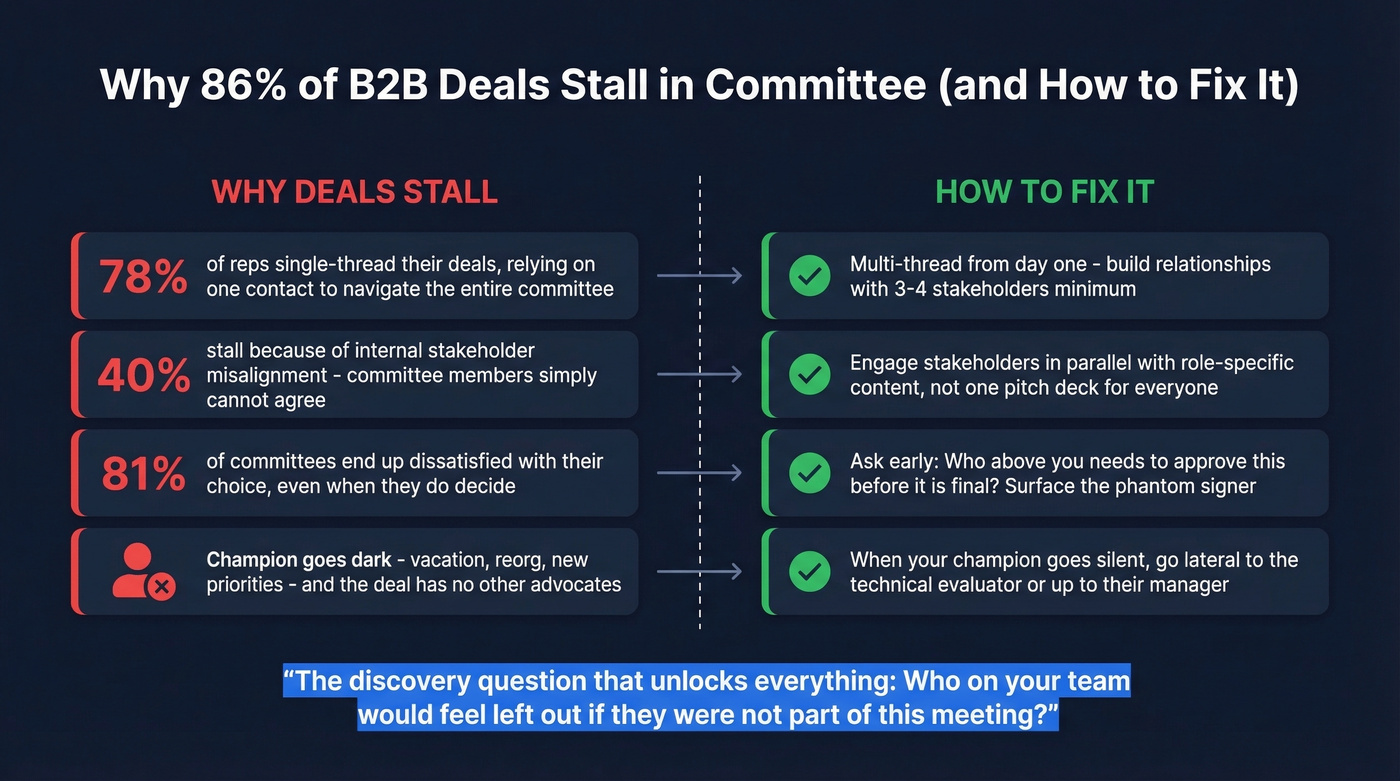
Even when committees do decide, 81% end up dissatisfied with their choice - a sign that the process itself is broken, not just slow.
No decision isn't a pipeline problem. It's a safety problem. The status quo feels safe. Change feels risky. Every stakeholder who isn't actively bought in becomes passive resistance, and passive resistance is enough to kill a deal.
When your champion goes dark - vacation, reorg, new priorities - don't panic. Go lateral. Reach out to the technical evaluator you demoed for, or go up to the champion's manager with a value-focused message. In our experience, the deals that survive a champion going silent are always the ones where we'd already built relationships with three or four other stakeholders. The discovery question that unlocks this: "Who on your team would feel left out if they weren't part of this meeting?"
Stop thinking of the buying committee as an obstacle. Each person you equip with the right content becomes a node in your internal sales network. The question isn't "how do I get past the committee?" It's "how do I arm every member to sell on my behalf?"
Four Tactics That Actually Unstick Deals
Build a buyer hub. A single page or deal room with pricing, FAQs, implementation plan, security documentation, ROI model, and decision timeline. When your champion has to forward seven separate email attachments to seven different stakeholders, you've already lost momentum. Give them one link. Track which stakeholders open which documents - those engagement signals tell you who's bought in and who needs attention.
Create a mutual action plan. Shared steps, owners, dates. This sounds basic, but it forces the committee to acknowledge the decision timeline out loud. Most stalls happen because nobody agreed on when a decision would be made.
Multi-thread intentionally. We've seen this pattern repeatedly: a rep builds a great relationship with one champion, the champion goes dark, and the deal dies. When you're connected to 4-5 stakeholders, one person going quiet doesn't kill the opportunity. Only 7% of reps connect with 6+ people at an account. Be in that 7%. (If you want a system for this, start with account-based selling.)
Analyze your CRM patterns. Which roles correlate with wins versus stalls? Where does momentum typically die? If you notice that deals without a procurement contact by Stage 2 close at half the rate, that's a process fix, not a pipeline problem. This is also where pipeline health metrics keep you honest.
How to Map and Identify Members
Knowing the roles is step one. Actually mapping real humans to those roles - and reaching them - is where most teams fall apart.
Start in discovery. Ask your champion directly: "Beyond you, who needs to be comfortable with this decision?" Push further: "Who could slow this down or stop it?" Most champions will name 3-4 people. The real committee is usually twice that. Use a tighter set of discovery questions to surface blockers early.
Understand roles and motivations. Don't just collect names - understand what each person cares about. The VP of Engineering and the VP of Finance both need to approve, but they're evaluating completely different things. Map each person to the role taxonomy above. (This is the same logic behind MEDDPICC economic buyer mapping.)
Map influence and relationships. Who reports to whom? Who has informal influence? Who's the blocker, and who can neutralize them? This is where org chart research and your champion's candor both matter.
Build targeted engagement plans. Each stakeholder gets a tailored touchpoint. The CFO gets the ROI model. The technical evaluator gets the integration documentation. Procurement gets the pricing breakdown and SLA template. Parallel, not sequential. If you're running this through sequences, solid sequence management prevents stakeholders from getting mismatched messaging.
Maintain the map as a living document. Committees shift. People leave, get promoted, or lose interest. Update your stakeholder map at every deal review. A map that's accurate at Stage 1 and stale by Stage 3 is worse than no map at all. Pay attention to engagement signals - who's opening your deal room documents, who's clicking links, who's gone completely silent. Those signals are your early warning system. (A digital sales room can make this easier to track.)
The 78% of sales professionals who single-thread aren't doing it by choice. They're doing it because they don't have a reliable way to reach the rest of the group. You've identified the roles, but you don't have contact data for half the stakeholders. Your champion introduced you to three people, but there are eight more you need to reach.
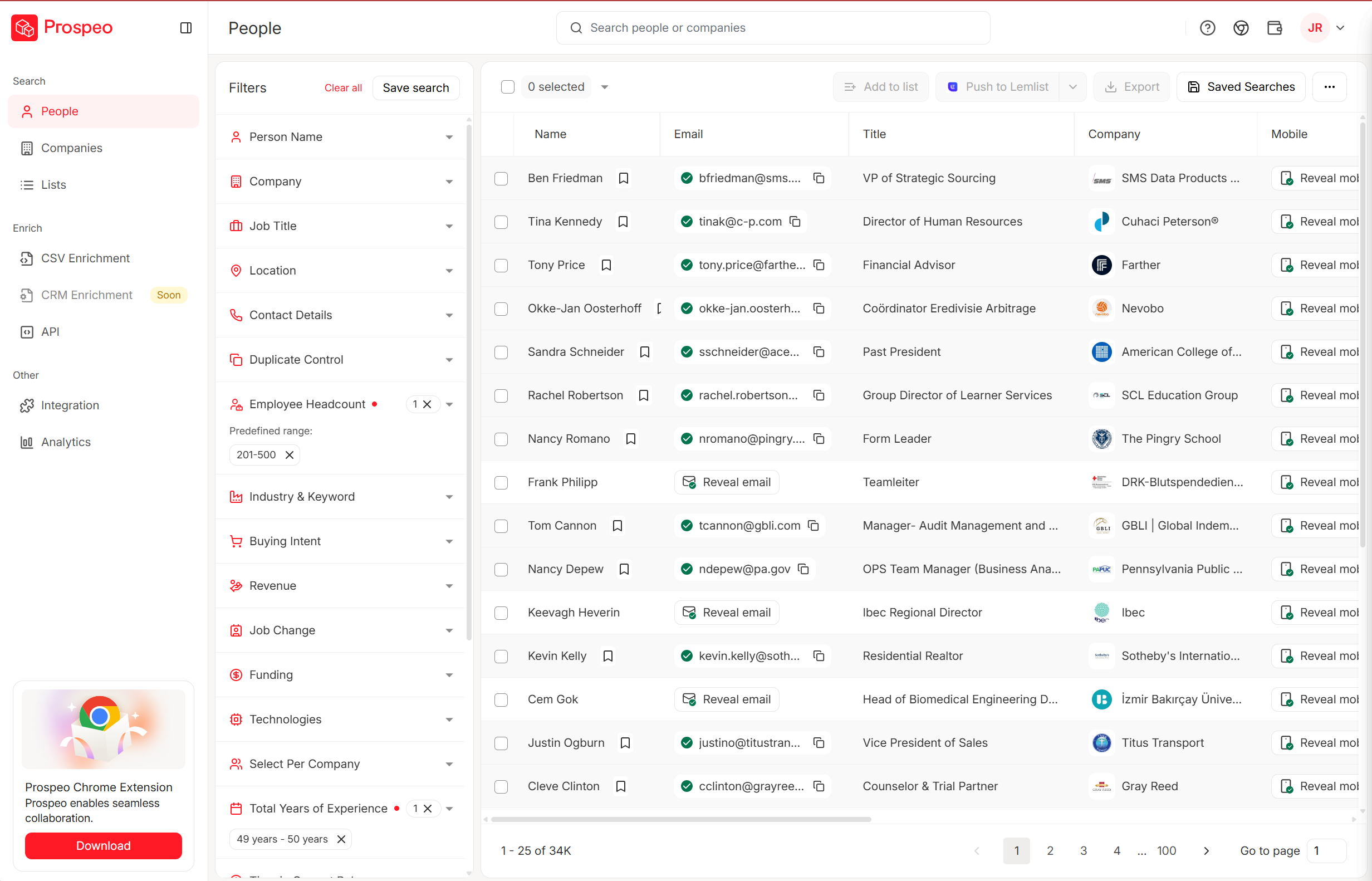
Prospeo lets you search by company, title, and department across 300M+ profiles with 98% email accuracy and a 7-day refresh cycle. You find the VP of Security, the procurement lead, and the end-user team lead - with verified emails and direct dials - without waiting for introductions that may never come. Fix the data problem and multi-threading becomes the default, not the exception. If you're evaluating vendors, compare approaches in data enrichment services and sales prospecting databases.
Procurement has veto power. Legal is invisible until they block you. The phantom signer appears at the eleventh hour. Every one of these people has a verified email and direct dial in Prospeo's 300M+ profile database - refreshed every 7 days, not 6 weeks. At $0.01 per email, mapping an entire 13-person committee costs less than a cup of coffee.
Reach every stakeholder before your deal stalls in the dark.
FAQ
What is a buying committee?
A buying committee is the informal group of stakeholders - spanning multiple departments and seniority levels - who collectively influence a B2B purchase decision. The concept originates from Thomas V. Bonoma's 1982 Harvard Business Review framework, which identified six core roles: initiators, influencers, deciders, purchasers, users, and gatekeepers.
How many people are typically involved?
Forrester puts the average at 13 internal stakeholders, plus 9 external participants like analysts and consultants. A Gartner poll shows 33% of groups have just 4-5 people, while enterprise deals with $100K+ contract values regularly involve 10 or more. Size scales directly with deal complexity.
Why do deals stall in committee?
Three primary reasons: internal misalignment (40% of stalls), single-threading that leaves the deal dependent on one champion, and status quo bias where no decision feels safer than change. Eighty-six percent of B2B purchases stall at some point - parallel stakeholder engagement and multi-threaded relationships are the fix.
How do you identify every stakeholder?
Start with discovery questions - ask your champion who else needs to be involved and who could block the process. Supplement with org chart research and enrichment tools to surface verified contact data for stakeholders your champion hasn't introduced you to. Map each person to a specific role and update throughout the sales cycle.
What's the difference between a buying committee and a buying group?
They're synonyms. "Buying group" is Forrester's preferred term, "buying center" is the academic term from Bonoma's original research, and "buying committee" is the most common phrase in sales conversations. All three describe the same thing: the collection of people who shape a B2B purchase decision.